Showing posts with label rise of the machines. Show all posts

Mining 24 Hours a Day with Robots  

Posted by Big Gav in

The local mining industry often justifies the tax breaks and incentives it receives on the basis it employs people in the mines (they usually claim to be a major employer but there seems to be little truth to that, employing around 1% of the workforce). MIT Technology Review notes that increasing automation of mine sites, which is going to drive the "cashed up bogan" of the mining boom into extinction - Mining 24 Hours a Day with Robots.

Each of these trucks is the size of a small two-story house. None has a driver or anyone else on board.

Mining company Rio Tinto has 73 of these titans hauling iron ore 24 hours a day at four mines in Australia’s Mars-red northwest corner. At this one, known as West Angelas, the vehicles work alongside robotic rock drilling rigs. The company is also upgrading the locomotives that haul ore hundreds of miles to port—the upgrades will allow the trains to drive themselves, and be loaded and unloaded automatically.

Rio Tinto intends its automated operations in Australia to preview a more efficient future for all of its mines—one that will also reduce the need for human miners. The rising capabilities and falling costs of robotics technology are allowing mining and oil companies to reimagine the dirty, dangerous business of getting resources out of the ground.

BHP Billiton, the world’s largest mining company, is also deploying driverless trucks and drills on iron ore mines in Australia. Suncor, Canada’s largest oil company, has begun testing driverless trucks on oil sands fields in Alberta.

Watch Tesla’s new fully self-driving car navigate around Palo Alto, driving through intersections & finding its own parking spot  

Posted by Big Gav in , ,

Elektrek has an article on Tesla's latest self-driving vehicle technology - Watch Tesla’s new fully self-driving car navigate around Palo Alto, driving through intersections & finding its own parking spot.

The summoning mode reminds me of the car "Kit" in the old TV series Knight Rider. Apparently Tesla are looking to train the machine intelligence that operates the vehicle using real-world driver behaviour data captured over the coming months before rolling out the software to customer vehicles.

BNEF has a study on the "future of urban mobility" (AN INTEGRATED PERSPECTIVE ON THE FUTURE OF MOBILITY) which follows on the footsteps of their report earlier in the year looking at the growth of electric vehicle sales (ELECTRIC VEHICLES TO BE 35% OF GLOBAL NEW CAR SALES BY 2040).

Tesla released a video demonstration of a Model X equipped with its latest self-driving sensor suite, which is going into Tesla’s vehicles right now, and using the most advanced version of the software, which will be pushed to owners gradually throughout the coming year. The demo shows the Model X self-driving around Palo Alto, near Tesla’s headquarters. ...

Tesla CEO Elon Musk says that “when searching for parking, the car reads the signs to see if it is allowed to park there, which is why it skipped the disabled spot.”

When you have to get back to your car, of course, Tesla will not make you try to find it. You can tap ‘Summon’, like the current feature in ‘Tesla Autopilot 1’, but with the new hardware suite Musk says that “it will eventually find you even if you are on the other side of the country” instead of the 39 feet the first generation Autopilot can travel.

Will Superintelligent Machines Destroy Humanity ?  

Posted by Big Gav in

reason has a review of Nick Bostrum's book "Superintelligence" - Will Superintelligent Machines Destroy Humanity?.

In Frank Herbert's Dune books, humanity has long banned the creation of "thinking machines." Ten thousand years earlier, their ancestors destroyed all such computers in a movement called the Butlerian Jihad, because they felt the machines controlled them. Human computers called Mentats serve as a substitute for the outlawed technology. The penalty for violating the Orange Catholic Bible's commandment "Thou shalt not make a machine in the likeness of a human mind" was immediate death.

Should humanity sanction the creation of intelligent machines? That's the pressing issue at the heart of the Oxford philosopher Nick Bostrom's fascinating new book, Superintelligence. Bostrom cogently argues that the prospect of superintelligent machines is "the most important and most daunting challenge humanity has ever faced." If we fail to meet this challenge, he concludes, malevolent or indifferent artificial intelligence (AI) will likely destroy us all. ...

In the Dune series, humanity was able to overthrow the oppressive thinking machines. But Bostrom is most likely right that once a superintelligent AI is conjured into existence, it will be impossible for us to turn it off or change its goals. He makes a strong case that working to ensure the survival of humanity after the coming intelligence explosion is, as he writes, "the essential task of our age."

Mobile Security Robot To Be Mass Produced  

Posted by Big Gav in

Factor has a look at a new "night watchman" robot - BOTS ON PATROL: MOBILE SECURITY ROBOT TO BE MASS PRODUCED.

In a move that will rock the job security of night watchmen everywhere, the world’s first commercially available security robot is set for mass production in the US.

Designed by Denver-based Gamma 2 Robotics, the robot will now be manufactured entirely in the States, with a process that can be scaled up to full mass production as demand grows.

The robot, which is known as the Vigilant MCP (mobile camera platform), features a digital camera and an array of sensors to detect the presence of unauthorised intruders, and will activate the alarm and send out an alert should it find someone where they shouldn’t be.

It is being pushed as a solution to night security in particular, with proposed industries including retail, warehouses, data centres and convention centres.

Personally i think a better design would look like this :

Earning a living  

Posted by Big Gav in ,

Humans Need Not Apply  

Posted by Big Gav in

The impact of massive automation of jobs seems to be one of the emerging concerns of the past few years - this video from CGP Grey is quite a good summary - Humans Need Not Apply.

Where will the new jobs come from ?  

Posted by Big Gav in

The Economist has an article on the effect of technology on employment, declaring "The effect of today’s technology on tomorrow’s jobs will be immense — and no country is ready for it" -

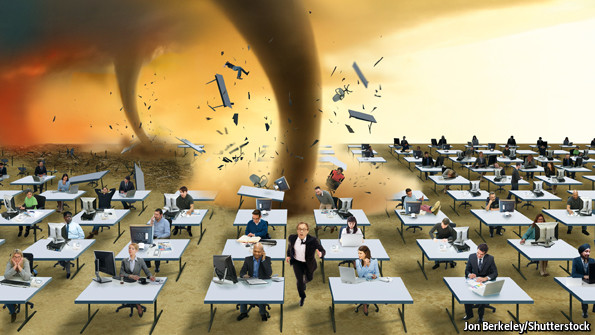
Optimism remains the right starting-point, but for workers the dislocating effects of technology may make themselves evident faster than its benefits (see article). Even if new jobs and wonderful products emerge, in the short term income gaps will widen, causing huge social dislocation and perhaps even changing politics. Technology’s impact will feel like a tornado, hitting the rich world first, but eventually sweeping through poorer countries too. No government is prepared for it.

Why be worried? It is partly just a matter of history repeating itself. In the early part of the Industrial Revolution the rewards of increasing productivity went disproportionately to capital; later on, labour reaped most of the benefits. The pattern today is similar. The prosperity unleashed by the digital revolution has gone overwhelmingly to the owners of capital and the highest-skilled workers. Over the past three decades, labour’s share of output has shrunk globally from 64% to 59%. Meanwhile, the share of income going to the top 1% in America has risen from around 9% in the 1970s to 22% today. Unemployment is at alarming levels in much of the rich world, and not just for cyclical reasons. In 2000, 65% of working-age Americans were in work; since then the proportion has fallen, during good years as well as bad, to the current level of 59%.

Worse, it seems likely that this wave of technological disruption to the job market has only just started. From driverless cars to clever household gadgets (see article), innovations that already exist could destroy swathes of jobs that have hitherto been untouched. The public sector is one obvious target: it has proved singularly resistant to tech-driven reinvention. But the step change in what computers can do will have a powerful effect on middle-class jobs in the private sector too.

Until now the jobs most vulnerable to machines were those that involved routine, repetitive tasks. But thanks to the exponential rise in processing power and the ubiquity of digitised information (“big data”), computers are increasingly able to perform complicated tasks more cheaply and effectively than people. Clever industrial robots can quickly “learn” a set of human actions. Services may be even more vulnerable. Computers can already detect intruders in a closed-circuit camera picture more reliably than a human can. By comparing reams of financial or biometric data, they can often diagnose fraud or illness more accurately than any number of accountants or doctors. One recent study by academics at Oxford University suggests that 47% of today’s jobs could be automated in the next two decades.

At the same time, the digital revolution is transforming the process of innovation itself, as our special report explains. Thanks to off-the-shelf code from the internet and platforms that host services (such as Amazon’s cloud computing), provide distribution (Apple’s app store) and offer marketing (Facebook), the number of digital startups has exploded. Just as computer-games designers invented a product that humanity never knew it needed but now cannot do without, so these firms will no doubt dream up new goods and services to employ millions. But for now they are singularly light on workers. When Instagram, a popular photo-sharing site, was sold to Facebook for about $1 billion in 2012, it had 30m customers and employed 13 people. Kodak, which filed for bankruptcy a few months earlier, employed 145,000 people in its heyday.

The problem is one of timing as much as anything. Google now employs 46,000 people. But it takes years for new industries to grow, whereas the disruption a startup causes to incumbents is felt sooner. Airbnb may turn homeowners with spare rooms into entrepreneurs, but it poses a direct threat to the lower end of the hotel business—a massive employer. ...

Innovation has brought great benefits to humanity. Nobody in their right mind would want to return to the world of handloom weavers. But the benefits of technological progress are unevenly distributed, especially in the early stages of each new wave, and it is up to governments to spread them. In the 19th century it took the threat of revolution to bring about progressive reforms. Today’s governments would do well to start making the changes needed before their people get angry.
One area where cheap machines have made a radical difference is outdoor adventure photography - the video below was shot with a $300 GoPro camera mounted on a $700 drone helicopter - total cost probably 2 orders of magnitude less than the gear to shoot equivalent footage would have cost 10 years ago.

A Staff of Robots Can Clean and Install Solar Panels  

Posted by Big Gav in , ,

The NYT has an article on the use of robots for improving the energy efficiency and construction cost for solar power plants - A Staff of Robots Can Clean and Install Solar Panels.

In a dusty yard under a blistering August sun, Rover was hard at work, lifting 45-pound solar panels off a stack and installing them, one by one, into a concrete track. A few yards away, Rover’s companion, Spot, moved along a row of panels, washing away months of grit, then squeegeeing them dry. But despite the heat and monotony — an alternative-energy version of lather-rinse-repeat — neither Rover nor Spot broke a sweat or uttered a complaint. They could have kept at it all day.

That is because they are robots, surprisingly low-tech machines that a start-up company called Alion Energy is betting can automate the installation and maintenance of large-scale solar farms.

Working in near secrecy until recently, the company, based in Richmond, Calif., is ready to use its machines in three projects in the next few months in California, Saudi Arabia and China. If all goes well, executives expect that they can help bring the price of solar electricity into line with that of natural gas by cutting the cost of building and maintaining large solar installations.

In recent years, the solar industry has wrung enormous costs from developing farms, largely through reducing the price of solar panels more than 70 percent since 2008. But with prices about as low as manufacturers say they can go, the industry is turning its attention to finding savings in other areas. ...

Modules dropped to 35 percent of system costs in 2013, down from 53 percent in 2010, while labor, engineering and permitting rose to 15 percent from 9 percent in the same time period, according to Greentech Media, which tracks the industry. ...

Several companies are developing or selling robots to aid in installation or cleaning, including the Swiss outfit Serbot, which makes robots that can wash the windows of glass skyscrapers as well as clean solar arrays.

Another start-up based in California, QBotix, has developed a robot that controls tracking operations, moving along an array and tilting the panels to follow the sun and maximize their output. Getting as much as 40 percent more electricity out of each panel than in a fixed-tilt system, said Wasiq Bokhari, the company’s chief executive, allows developers to build smaller, cheaper systems to meet their energy production targets.

Making Gas Turbines Smarter  

Posted by Big Gav in , , , ,

GigaOm has an article on GE's efforts to make turbines for power generation using natural gas more efficient - Putting data centers on turbines to save billions of dollars.

“We’re almost putting a data center on a gas turbine,” Ruh said during a session at GigaOM’s Mobilize conference on Wednesday morning, referencing the hundreds of sensors the company is placing on those machines to capture data. If those sensors, combined with GE’s (or anyone’s) software for managing and analyzing the data, is able to improve efficiency by just 1 percent, that could save nearly $6 billion a year.

Or think about air travel. Forty-one percent of unplanned downtime for airlines is caused by mechanical errors, Ruh explained, so GE wants to be able to predict when its engines or other airline systems will fail. With this knowledge, carriers can fix problems during scheduled downtime and save everyone precious time.

Speaking of jet engines, Ruh noted just how much potentially predictive data they’re generating. If someone captured everything coming off of a jet engine, he said, “We’re talking several hundred terabytes a day.”

However, he acknowledged, the macro effects of the industrial internet — cost savings, carbon-footprint reductions and efficiency gains — will come with shifts in the employment sector that might not be good for everyone involved. “There will be new kinds of jobs that get created that don’t exist today,” Ruh said. But, he added, “Some things people used to do will be done more efficiently through these machines.”

The Internet of Things Can Make Us Human Again  

Posted by Big Gav in , ,

ReadWriteWeb has a look forward at how the "internet of things" could change our daily lives - Internet of Things Can Make Us Human Again.

We've entered an era where the cost of sensors, processors and transmitters are so low that it's fast becoming cost effective to put them inside everything, even the clothes we wear. Even our own toothbrush may soon sense and communicate socially about where it is and how it's being used in space and time. Sci-fi writer Bruce Sterling has coined the term "spime", to describe objects that can be "tracked through space and time throughout the lifetime of the object."

David Orban, one of the founders of WideTag, the creator of the iPhone app WideNoise, also offers WideSpime, which helps developers build mass data collection services for real-time data management in a way that maintains the autonomy of both the data and the object generating the data.

In our most recent Internet of Things post Objects Aren't Social, Orban comments that objects " ...are going to form their own independent social networks, which are going to be fundamentally incompatible with human communication." These new machine networks will be so redundant and reliable that we will be freed from most of our machine-operating duties. We will get to be human again.

WideTag3.jpgWe will soon see cars that don't rear end each other because onboard sensors won't allow it. Or how about a vacuum cleaner that knows about a mess your cat made and cleans it up before you even notice your machine-network's admin message about it. Also, consider an Internet of Things home that tracks your habits so well it knows which rooms to heat and light because it knows what you'll be doing on that particular day.

Orban's dream is that thousands of years of human subservience to machines will end because we will teach our machines how to not only take care of themselves, but how to take care of us as well.

But what if someone wanted to manipulate these systems for an unethical advantage? Or even worse, what if these manipulations were built into these new machine networks at the earliest stages? On Sunday night, ReadWriteWeb reported on a presentation by Tim O'Rielly regarding the future Internet of Things. In his presentation he said, "You see increasingly the giants of the Internet are trading for their own account - they are building a platform in which all roads lead back to themselves. Now there is a contervailing force for openess, but we have to wary, we have to be aware of that; we have to work for openess in that web."

Statistics

Locations of visitors to this page

blogspot visitor
Stat Counter

Total Pageviews

Ads

Books

Followers

Blog Archive

Labels

australia (619) global warming (423) solar power (397) peak oil (355) renewable energy (302) electric vehicles (250) wind power (194) ocean energy (165) csp (159) solar thermal power (145) geothermal energy (144) energy storage (142) smart grids (140) oil (139) solar pv (138) tidal power (137) coal seam gas (131) nuclear power (129) china (120) lng (117) iraq (113) geothermal power (112) green buildings (110) natural gas (110) agriculture (91) oil price (80) biofuel (78) wave power (73) smart meters (72) coal (70) uk (69) electricity grid (67) energy efficiency (64) google (58) internet (50) surveillance (50) bicycle (49) big brother (49) shale gas (49) food prices (48) tesla (46) thin film solar (42) biomimicry (40) canada (40) scotland (38) ocean power (37) politics (37) shale oil (37) new zealand (35) air transport (34) algae (34) water (34) arctic ice (33) concentrating solar power (33) saudi arabia (33) queensland (32) california (31) credit crunch (31) bioplastic (30) offshore wind power (30) population (30) cogeneration (28) geoengineering (28) batteries (26) drought (26) resource wars (26) woodside (26) censorship (25) cleantech (25) bruce sterling (24) ctl (23) limits to growth (23) carbon tax (22) economics (22) exxon (22) lithium (22) buckminster fuller (21) distributed manufacturing (21) iraq oil law (21) coal to liquids (20) indonesia (20) origin energy (20) brightsource (19) rail transport (19) ultracapacitor (19) santos (18) ausra (17) collapse (17) electric bikes (17) michael klare (17) atlantis (16) cellulosic ethanol (16) iceland (16) lithium ion batteries (16) mapping (16) ucg (16) bees (15) concentrating solar thermal power (15) ethanol (15) geodynamics (15) psychology (15) al gore (14) brazil (14) bucky fuller (14) carbon emissions (14) fertiliser (14) matthew simmons (14) ambient energy (13) biodiesel (13) investment (13) kenya (13) public transport (13) big oil (12) biochar (12) chile (12) cities (12) desertec (12) internet of things (12) otec (12) texas (12) victoria (12) antarctica (11) cradle to cradle (11) energy policy (11) hybrid car (11) terra preta (11) tinfoil (11) toyota (11) amory lovins (10) fabber (10) gazprom (10) goldman sachs (10) gtl (10) severn estuary (10) volt (10) afghanistan (9) alaska (9) biomass (9) carbon trading (9) distributed generation (9) esolar (9) four day week (9) fuel cells (9) jeremy leggett (9) methane hydrates (9) pge (9) sweden (9) arrow energy (8) bolivia (8) eroei (8) fish (8) floating offshore wind power (8) guerilla gardening (8) linc energy (8) methane (8) nanosolar (8) natural gas pipelines (8) pentland firth (8) saul griffith (8) stirling engine (8) us elections (8) western australia (8) airborne wind turbines (7) bloom energy (7) boeing (7) chp (7) climategate (7) copenhagen (7) scenario planning (7) vinod khosla (7) apocaphilia (6) ceramic fuel cells (6) cigs (6) futurism (6) jatropha (6) nigeria (6) ocean acidification (6) relocalisation (6) somalia (6) t boone pickens (6) local currencies (5) space based solar power (5) varanus island (5) garbage (4) global energy grid (4) kevin kelly (4) low temperature geothermal power (4) oled (4) tim flannery (4) v2g (4) club of rome (3) norman borlaug (2) peak oil portfolio (1)