Showing posts with label spime. Show all posts

The Internet of Things Can Make Us Human Again  

Posted by Big Gav in , ,

ReadWriteWeb has a look forward at how the "internet of things" could change our daily lives - Internet of Things Can Make Us Human Again.

We've entered an era where the cost of sensors, processors and transmitters are so low that it's fast becoming cost effective to put them inside everything, even the clothes we wear. Even our own toothbrush may soon sense and communicate socially about where it is and how it's being used in space and time. Sci-fi writer Bruce Sterling has coined the term "spime", to describe objects that can be "tracked through space and time throughout the lifetime of the object."

David Orban, one of the founders of WideTag, the creator of the iPhone app WideNoise, also offers WideSpime, which helps developers build mass data collection services for real-time data management in a way that maintains the autonomy of both the data and the object generating the data.

In our most recent Internet of Things post Objects Aren't Social, Orban comments that objects " ...are going to form their own independent social networks, which are going to be fundamentally incompatible with human communication." These new machine networks will be so redundant and reliable that we will be freed from most of our machine-operating duties. We will get to be human again.

WideTag3.jpgWe will soon see cars that don't rear end each other because onboard sensors won't allow it. Or how about a vacuum cleaner that knows about a mess your cat made and cleans it up before you even notice your machine-network's admin message about it. Also, consider an Internet of Things home that tracks your habits so well it knows which rooms to heat and light because it knows what you'll be doing on that particular day.

Orban's dream is that thousands of years of human subservience to machines will end because we will teach our machines how to not only take care of themselves, but how to take care of us as well.

But what if someone wanted to manipulate these systems for an unethical advantage? Or even worse, what if these manipulations were built into these new machine networks at the earliest stages? On Sunday night, ReadWriteWeb reported on a presentation by Tim O'Rielly regarding the future Internet of Things. In his presentation he said, "You see increasingly the giants of the Internet are trading for their own account - they are building a platform in which all roads lead back to themselves. Now there is a contervailing force for openess, but we have to wary, we have to be aware of that; we have to work for openess in that web."

They Don't Talk Trash, They Track It  

Posted by Big Gav in , ,

The New York Times has an article on a baby step towards the "internet of things" (itself one component of a closed loop manufacturing system that we need to develop to kick our resource extraction habit) - They Don't Talk Trash, They Track It.

"Smart" phones offer the intelligence of a computer, with the convenience of a phone. "Smart" meters let homeowners choose between using cheap and expensive electricity.

A 5-year-old group at the Massachusetts Institute of Technology has spent the last year attaching thousands of tracking devices to pieces of garbage in Seattle and New York City. The devices send out pulses to signal where they are.

The signals go to MIT's SENSEable City Lab for analysis. Last year, they also went to art exhibits in both cities, where live maps revealed the many paths garbage takes.

For example, a plastic soap bottle tossed in a Manhattan recycling bin took several twists and turns around the city before crossing the river to Kearny, N.J.

Carlo Ratti, who directs the City Lab, said each city he's lived in -- Turin, Italy; Paris; Cambridge, England; Boston -- has suffered from congestion, pollution and inefficiency problems.

He believes new technologies, like iPhones, social networking and wireless communication, can inform city dwellers and make cities "smarter." "The only way we can actually solve some of the big problems, like climate change, is if we really coordinate and act together," Ratti said. "What, for the first time, is really bringing us together is the power of networks in general and the Internet." ...

The aim of project "Trash Track": to study where recyclables go. Dietmar Offenhuber, a doctoral student in the lab, said there's plenty of research on how things are made, but little is known about how they degrade and finally disappear. Among the questions here -- especially for cities paying millions for recycling programs -- are how much greenhouse gas is created and how much energy is wasted in the process. Another might be whether recycling really happens.

"Even the people working in waste removal don't really have a clear knowledge or picture of where the stuff goes," he said.

That's partly because trash goes through so many handoffs en route to its final destination, Offenhuber said. Trash companies follow their own haul, for example. But once they separate the aluminum and sell it to a collector, their records end. No single database tracks a soda can through its cycle. ...

But according to Offenhuber, telecom companies are watching Trash Track to see if it can be scaled up. By the end of this year, he said, the SENSEable City Lab wants to deploy thousands more trackers, and it wants to focus on e-waste.

That will help the companies develop a tracker that's cheaper and easier to use. Ultimately, the device may even come in a tracking "kit" that lets someone attach it to an item, then log on to a Web site that tells its whereabouts.

McKinsey: Get Ready For Sensor-Driven Business Models  

Posted by Big Gav in ,

Read Write Web has a post on a new report from McKinsey on the "Internet Of Things" concept that Bruce Sterling used to spend a lot of time popularising, focusing on the "new sensor-driven business models" this enables - McKinsey: Get Ready For Sensor-Driven Business Models.

McKinsey sees two categories for emerging applications: "information and analysis" and "automation and control." Many of the applications listed are for large companies or specialized industries (for example automobile manufacturers). But consumers should take note too, because there will be a lot more data about us flowing onto the Internet.

McKinsey defines Internet of Things as "sensors and actuators embedded in physical objects [...] linked through wired and wireless networks, often using the same Internet Protocol (IP) that connects the Internet."

In the "information and analysis" category, McKinsey firstly lists tracking behavior. An example is insurance companies installing location sensors in customers' cars, allowing them to base the price of policies on "how a car is driven as well as where it travels." Another example is Tesco's use of sensors to capture shoppers' profile data via membership cards. According to McKinsey, this "can help close purchases by providing additional information or offering discounts at the point of sale."

On the B2B side, McKinsey points to companies using sensors to track RFID tags placed on products moving through supply chains. We've written before about IBM's activities in this market.

The next information and analysis application is enhanced situational awareness. This is when large numbers of sensors are deployed in infrastructure such as roads and buildings, in order to report on real-time environmental conditions such as weather or temperature.

Sensor-driven decision analytics shows how revolutionary sensor technologies could be, without most consumers even realizing it! The report explains that some retailers are presently studying ways to gather and process data from shoppers as they flow through stores. Sensor readings and videos will be able to "note how long they linger at individual displays and record what they ultimately buy," data which McKinsey says "will help to increase revenues by optimizing retail layouts."

The second major category for Internet of Things apps in this report is "automation and control." By this McKinsey means "converting the data and analysis collected through the Internet of Things into instructions that feed back through the network to actuators that in turn modify processes."

IBM and Internet of Things  

Posted by Big Gav in , , ,

Bruce has a post on IBM's efforts to get into the "internet of things" market - Spime Watch: IBM and Internet of Things. As usual, Bruce's interjections are marked with ((( ))) pairings.

((( The thing that’s endearing about IBM is their deployment of real money. Like, megatons of money. Plus swarms of real-world machinery and thousands of actual engineers. )))

http://www.readwriteweb.com/archives/ibm_internet_of_things.php

(…)

“I recently spoke to Andy Stanford-Clark, a Master Inventor and Distinguished Engineer at IBM. Yesterday we wrote about how Stanford-Clark has hooked his house up to Twitter. Today we delve more into what his employer, IBM, is doing with the Internet of Things.

“IBM is involved in some very interesting projects at the intersection of two big trends we’ve been tracking in 2009: The Real-time Web and Internet of Things. They have a website devoted to this topic, called A Smarter Planet. As the name implies, it focuses on environmental matters such as energy and food systems. Sensors, RFID tags and real-time messaging software are major parts of IBM’s smarter planet strategy.

(((I like the idea of a multinational corporation with a “smarter planet strategy.” Decent of them to realize they don’t get an extra planet after dominating one of them.)))

“The catchcry for the site - Instrumented, Interconnected, and Intelligent - is about outfitting the world with sensors and hooking them to the Internet to apply the ’smarts.’

“IBM has a whole set of RFID and sensor technology solutions. But more importantly it has been busy working with various manufacturers and goods suppliers in recent months, to introduce those solutions to the world.

“This month IBM made an agreement with Matiq, an IT subsidiary of Norway’s largest food supplier Nortura. The project involves using RFID (radio frequency identification) technology to track and trace poultry and meat products “from the farm, through the supply chain, to supermarket shelves.” This food tracking solution will help ensure that meat and chicken are “kept in optimal condition throughout the supply chain.” The system uses IBM’s WebSphere RFID Information Center, together with IBM’s sensor and actuator solutions.

“A similar project is one that IBM announced at the end of June with Danish transportation company Container Centralen. By February 2010, Container Centralen undertakes to use IBM sensor technology “to allow participants in the horticultural supply chain to track the progress of shipments as they move from growers to wholesalers and retailers across 40 countries in Europe.”

“Specifically this refers to transportation of things like flowers and pot plants, (((no, no, not actual “pot plants,” that’s more of a Californian cottage-industry thing))) which are very sensitive to the environment they travel in. Having sensors as part of the entire travel chain will allow participants to monitor conditions and climate during travel. Essentially it makes the travel process very transparent… (((etc etc etc)))

Bruce also has a look at the emerging market for tinfoil hats for passports - Arphid Watch: Passport Sleeves.
((( Haven’t had any arphid news on BEYOND THE BEYOND in a while. Not because we lost interest in RFID, but because the technology itself looks snafu’d. As the technology ages, its original headlong tech impetus is unable to overcome its many poorly-designed deployments. )))

((( Here’s the Obama State Department shrugging about their RFID train wreck, and hoping nobody notices that the previous Administration installed zillions of terror-friendly radio beacons in the purses and pockets of the American civil population. )))

http://www.washingtonpost.com/wp-dyn/content/article/2009/07/11/AR2009071101929_pf.html

“…when the sleeves come off, “you’re essentially saying to the world, ‘Come and read what’s in my wallet,’” says Marc Rotenberg, executive director of the Electronic Privacy Information Center in Washington, D.C.

“By obliging Americans to use these sleeves, he says, the government has, in effect, shifted the burden of privacy protection to the citizen. (…)”

((( Well, yeah; the State Department installed the arphids in there, and if you’re worried about that, they don’t mind if you now go buy and install your own tinfoil hat. Up to you. Pal, voter.)))

((( Given their mournful fait accompli on the ground, they probably lack any rational alternative, except to INSIST that everybody go buy some tinfoil hat for their passport, in which case the Global War on Terror situation looks even more aggressively crazy than it was before. Not to mention the tremendous publicity boon for RFID hackers seeking employment with terrorist hotel-bomber types, who’d no doubt love to bug any doorway anywhere on earth, and automatically count the vulnerable foreigners walking through it. )))

((( Also, according to the original genius plan, you were supposed to be using these safe-and-secure arphid beacons to merrily zip through airports, en-masse, subway-style, like with Oyster cards. Seen any of that jolly high-tech activity anywhere lately? Me neither. Instead we’ve created a huge, botched superpower effort that is paranoid, semi-secret, global in scale, leaky in security and at best semi-functional. “Gothic High-Tech.” )))

(((Later: George Mokray write in:)))

“I’ve been making my own duct tape wallets (and notebook covers) for years. My most recent credit card came with an RFID chip so I decided to make my next wallet with an aluminized mylar substrate from a potato chip bag rather than the paper I used to use. My assumption is that the aluminized mylar will dampen the RFID signal. My passport was renewed just before RFID chips became standard issue, thanks to your head’s up. The wallet is wearing well, better than the old paper and duct tape ones.

“Doing a Tuvan throat singing workshop at NE Conservatory the next couple of days with actual Tuvan artists, Allash. South African choral music all day Saturday. Ain’t globalization grand.

“Solar IS Civil Defense,
George Mokray”

(((Great job with the duct tape potato chip bag Tuvan throat-singing solar arphid wallet, George. Always great hearing from you; you are our kind of people.)))

And one last item from Bruce - The Gothic “Ghost Properties” of the London Rich.
At an abandoned home with yellowing newspapers on its front stoop, Paul Palmer peeks through a mail slot to find letters and leaves carpeting the entryway. The house next door has a dead plant chained to its porch, which is covered in faded utility bills.

Mr. Palmer investigates abandoned homes for a living. But his turf isn’t a poverty-stricken corner of this financial capital. It’s the Mayfair district, home to wealthy financiers, celebrities, the U.S. Embassy — and a few squatters. (((<— Is it necessary for me to point this little arrow at the “squatters,” or are you catching on yet?)))

In the city of Westminster, where Mayfair is located, homes can cost up to £50 million ($81 million). Yet Westminster is fifth among London’s 33 boroughs in the number of unoccupied properties. In 2008, 1,737 homes had been vacant six months or more, the third highest number among all London boroughs, according to the Empty Homes Agency, a nonprofit group that seeks to put empty homes back into use. (((I wonder where the Empty Homes Agency gets their NGO funding, because they’re gonna be busy guys.)))

Unlike people facing foreclosures in other neighborhoods around the world, Mayfair’s homeowners aren’t down on their luck. Rather, the properties serve as investments for owners who pay the bills to keep them empty — something the neighbors and city object to when the homes fall into disrepair. (((It’s hard to conceive of a practice more Gothic than this — it’s a financial practice for human shelter that evicts human beings and then destroys the homes through entropy. Wait, I can think of one financial practice even more spooky and extreme: profitably burning dead fossil fuels so that the *entire planet* becomes humanly uninhabitable.)))

Many owners decline to rent the homes due to local council tax rules, which tax properties at a lower rate if they are empty and unfurnished. That loophole frustrates Mr. Palmer. “We shouldn’t be rewarding these people,” he says. (((Can’t blame capitalism all the time, especially in the Wall Street Journal. Posh neighborhoods inhumanly determined to keep up property values can also regulate themselves right out of human existence.)))

As the Westminster City Council’s empty-property officer, Mr. Palmer strolls the area’s streets six hours each day to identify vacant homes and track down their owners. Under British law, local authorities have the power to seek an order to claim ownership of the ghost properties and put them up for sale….

The Next Internet: The Internet Of Things, Smart Grids And Environmental Monitoring  

Posted by Big Gav in , , , ,

Internet pioneer and Google evangelist Vint Cerf has a blog post on the expansion of today's internet to include the "internet of things" Bruce Sterling spends a lot of time talking about and the provision of the environment monitoring and "smart grid" features we need to optimise our (clean) energy acquisition and usage - The Next Internet.

In the next decade, around 70% of the human population will have fixed or mobile access to the Internet at increasingly high speeds, up to gigabits per second. We can reliably expect that mobile devices will become a major component of the Internet, as will appliances and sensors of all kinds. Many of the things on the Internet, whether mobile or fixed, will know where they are, both geographically and logically. As you enter a hotel room, your mobile will be told its precise location including room number. When you turn your laptop on, it will learn this information as well--either from the mobile or from the room itself. It will be normal for devices, when activated, to discover what other devices are in the neighborhood, so your mobile will discover that it has a high resolution display available in what was once called a television set. If you wish, your mobile will remember where you have been and will keep track of RFID-labeled objects such as your briefcase, car keys and glasses. "Where are my glasses?" you will ask. "You were last within RFID reach of them while in the living room," your mobile or laptop will say.

The Internet will transform the video medium as well. From its largely programmed, scheduled and streamed delivery today, video will become an interactive medium in which the choice of content and advertising will be under consumer control. Product placement will become an opportunity for viewers to click on items of interest in the field of view to learn more about them including but not limited to commercial information. Hyperlinks will associate the racing scene in Star Wars I with the chariot race in Ben Hur. Conventional videoconferencing will be augmented by remotely controlled robots with an ability to move around, focus cameras and microphones, and perhaps even directly interact with the local environment under user control.

The Internet will also become more closely integrated with other parts of our daily lives, and it will change them accordingly. Power distribution grids, for example, will become a part of the Internet's information universe. We will be able to track and manage electrical power demand and our automobiles will participate in the generation as well as the consumption of electricity. By sharing information through the Internet about energy-consuming and energy-producing devices and systems, we will be able to make them more efficient.

A box of washing machine soap will become part of a service as Internet-enabled washing machines are managed by Web-based services that can configure and activate your washing machine. Scientific measurements and experimental results will be blogged and automatically entered into common data archives to facilitate the distribution, sharing and reproduction of experimental results. One might even imagine that scientific instruments could generate their own data blogs.

These are but a few examples of the way in which the Internet will continue to surround and serve us in the future. The flexibility we have seen in the Internet is a consequence of one simple observation: the Internet is essentially a software artifact. As we have learned in the past several decades, software is an endless frontier. There is no limit to what can be programmed. If we can imagine it, there's a good chance it can be programmed. The Internet of the future will be suffused with software, information, data archives, and populated with devices, appliances, and people who are interacting with and through this rich fabric.

Bruce himself has a post on work being done at HP on environmental monitoring - The Central Nervous System for the Earth.
(((Man, this one's right out of the Bright Green playbook. Cram too-cheap-to-meter nano-scale environmental sensors into every handheld on Earth. Then network them.)))

(((The head of this lab was here at Picnic doing his elevator pitch, and I don't think he's kidding. Even if one guy in a hundred is carrying a ful-scale environmental lab in his pocket... and actively measuring, uhm, chem/bio, temperature, vibration, sound, magnetic fields, radiation, humidity and weather conditions... "all so cheap as to be basically free"... well, that would make the 20th century look as crude as the world before germ theory.)))

"Avoid catastrophic failures through early monitoring... instrument the facility with a nervous system."

"Safety, health, optimization, intelligence."

Pachube  

Posted by Big Gav in , ,

Bruce Sterling's latest edition of "Spime Watch" (which observes the genesis of the "internet of things") has turned up this experimental web service called Pachube. That reminds me - I wonder what happened to that spime with antlers ?

Pachube (pronounced "patch bay") is a web service available at http://www.pachube.com that enables people to tag and share real time sensor data from objects, devices and spaces around the world.

The key aim is to facilitate interaction between remote environments, both physical and virtual. Apart from enabling direct connections between any two environments, it can also be used to facilitate many-to-many connections: just like a physical "patch bay" (or telephone switchboard) Pachube enables any participating project to "plug-in" to any other participating project in real time so that, for example, buildings, interactive installations or blogs can "talk" and "respond" to each other.

Pachube is a little like YouTube, except that, rather than sharing videos, Pachube enables people to monitor and share real time environmental data from sensors that are connected to the internet. Pachube acts between environments, able both to capture input data (from remote sensors) and serve output data (to remote actuators). Connections can be made between any two environments, facilitating even spontaneous or previously unplanned connections. Apart from being used in physical environments, it also enables people to embed this data in web-pages, in effect to "blog" sensor data....

The Interoperation  

Posted by Big Gav in , ,

While I'm a regular reader of both Technology Review and almost everything Viridian Pope Emperor Bruce Sterling writes, I must admit I'd missed this story - "The Interoperation" - in Tech Review recently. Until, that is, I came across it at Laurance Aurbach's "Pedshed". Here's his review (from which I also learnt that Laurance did the original design for the Viridian web site):

“The Interoperation” is a short story by Bruce Sterling, award-winning science fiction author and futurist. Sterling has always been one of the most canny and entertaining prognosticators of architectural futures, and this latest work does not disappoint. “The Interoperation” deftly and fondly sends up starchitecture, obsolescence, digitization, networking and the vagaries of fame. It explores the design process more deeply than his previous fiction. Like most works by Sterling, the story is shambling, episodic and lacking in coherent structure.

While Sterling has in the past been skeptical of Peak Oil and Kunstler’s Long Emergency thesis in particular, note that “The Interoperation” is set firmly in an imagined post-Peak Oil era. Travel is mostly by bike and train; cross country trips are rare; recycling is a pillar of the economy; and sustainability saturates business practices thoroughly.
The Costa Vista Motel was the first, last, and only building that Yuri Lozano had created as a certified, practicing architect. It had been “designed for disassembly,” way back in 2020. So today, some 26 years later, Yuri had hired the giant deconstruction-bot to fully reclaim the motel’s materials: the bricks, the solar shingles, the electrical fixtures, the metal plumbing. The structure was being defabricated, with a mindless precision, right down to its last, least, humble hinges.

…

Nowadays, Preston spent his lonely hours grooming architecture websites. There he gamely removed the moronic popular commentary and tried to drum up some intelligent interest in the doctrines of Arts & Crafts, Futurism, the modern movement, the postmodern movement, and New Urbanism.

These were architectural schemes that long-forgotten people had created with pencils on paper. No proper 21st-century person could tell these primitive notions apart. Still, some critic was bound to take a keen interest in such efflorescences of human genius, and it was bound to be some weedy obsessive like Preston Mengies.

…

The Church of Computer-Human Symbiosis was an aging group of California hacker cranks who had inherited the vast fortune of a vanished social-software company. They had long been Roebel’s ideal patrons, for they were crazily rich, all-forgiving, and incapable of judgment.

Over the decades, Roebel had built the cult an awesome set of monumental churches. His temples were top-end architecture glamour hits; glossy photo books about them weighed down coffee tables on six continents.

Nobody ever worshiped in the amazing churches Roebel had built, because the cult was too crazy and scary. Furthermore, the roofs leaked and all the utilities malfunctioned. Still, that didn’t much matter to the cultists. They were serenely indifferent to such earthly concerns, since they spent most of their waking lives playing immersive simulation games.

…

Yuri recalled that ClearWorks had been programmed by just one guy. It was the brainwork of a single geek, some embittered dissident from the early CAD business. The name of this lonesome genius was Greg Something, or Bob Something, or Jim Something, and he was the type of arrogant, self-aggrandizing, utterly unworldly, Unix-bearded software-genius figure who wanted to create a programmatic universe all by himself.

Greg-Jim-Bob had never managed that feat, but he’d managed to create ClearWorks. That program had become a legend among its users. All the cognoscenti and digerati and designerati vied to praise ClearWorks. Of course, nobody actually used it. If you gave people the tools that were perfect for their jobs, they’d have nothing to do but their jobs.

The whole secret of the network revolution was that it connected everybody, and it therefore caused everybody to do everybody else’s jobs.

…

Yuri had begun to sense the way the programmer thought. No geek from 30 years ago could ever think like a modern builder. Though he had a cunning intuitive arsenal of cool ways to assemble his sand, he lacked any cool ways to disassemble his sand.

It was as if he thought that real buildings went up in some Platonic cyberspace where gravity, friction, and entropy had never existed. Where the passage of the years was just an abstraction. The author of ClearWorks was pure geek, so he didn’t realize that when you meshed bits and atoms, you had to respect the atoms. Bits were the servants of atoms. “Bits” were just bits of atoms.

Bits came and went at the flick of a switch, but atoms had deep and dark and permanent physical laws. Atoms didn’t go away when you shut down the screen. When you lacked a responsible way to deal with the atoms, you were a menace to yourself and all around you.

The story draws from the Cradle to Cradle mindset and Bruce's vision of what we need to do to implement it - "the internet of things" (and the spimes and blobjects that inhabit it), described in his book "Shaping Things".

Bruce himself has a post at Beyond the Beyond - "The Last Time We Flunked Out At Sustainability" - on a Canadian art exhibiton called "1973: Sorry, Out of Gas".
Curated by Mirko Zardini, CCA Director and Chief Curator, with Giovanna Borasi, CCA Curator of Contemporary Architecture, the exhibition presents an unprecedented exploration of the architectural response to the 1973 oil crisis.

The exhibition 1973: Sorry, Out of Gas and its accompanying catalogue are the first to study the architectural innovation spurred by the 1973 oil crisis, when the value of oil increased exponentially and triggered economic, political, and social upheaval across the world. Featuring over 350 objects including architectural drawings, photographs, books and pamphlets, archival television footage, and historical artefacts, the exhibition maps the global response to the shortage and its relevance to architecture today.

The research and innovations of thirty years ago are of particular relevance in the context of contemporary concerns about diminishing energy resources. While influential at the time, much of the innovative work of architects, engineers, and activist groups of the period was forgotten once financial markets and energy distribution systems adjusted, and political focus diminished.

Today, however, a new sense of urgency is emerging, provoked by the reality of a deteriorating environment and a finite supply of fossil fuels. “It is of vital importance to consider the radical yet, in many cases, little-known work from the 1970s as architects today struggle to address similar issues,” said CCA Director and exhibition curator Mirko Zardini. “By providing insight on the forerunners of many contemporary approaches to sustainable living, the exhibition aims to increase public awareness and encourage contemporary research in the field.” ...

Kiashu has an interesting post at The Oil Drum looking at the potential for a peak oil inspired shift from what he terms "wasteful industrial society" to the "ecotechnic society" - "The Freezing Point of Industrial Society".
When will fossil fuel industrial society end?

When oil costs $240-$1,500 a barrel for several years.
One says to me, "I wonder that you do not lay up money; you love to travel; you might take the [railway] cars and go to Fitchburg today and see the country." But I am wiser than that. I have learned that the swiftest traveller is he that goes afoot. I say to my friend, Suppose we try who will get there first. The distance is thirty miles; the fare ninety cents. That is almost a day's wages... Well, I start now on foot, and get there before night... You will in the meanwhile have earned your fare, and arrive there some time tomorrow, or possibly this evening... And so, if the railroad reached round the world, I think that I should keep ahead of you...

- Walden, Henry David Thoreau

What was true in 1845 when Thoreau wrote that is not true today in the developed West, but is still true in the Third World. Fuel was still expensive enough that a journey of a day's walk taken by mechanical means was more expensive than a day's labour. Resources were more expensive than labour; now in the West labour is more expensive than resources, while in the Third World labour is still very cheap. But will it always be so?

This piece considers that industrialisation could only happen with cheap fuels, and by looking at the countries of the world, tries to figure out just how cheap fuel has to be before lots of people start using it – before a country can industrialise with fossil fuels. The flipside to this is seeing how expensive fuel must be before it deindustrialises. This then gives us a clue to if and when will industrial society will end. ...

Kiashu's post included a link to this article from Dave Dubyne at Language Matters - "Saving the Go-Go Juice" - which talks about how China already practices quite a bit on on-site recycling on construction sites.
Speeding down the brand new four-lane highway at 100 kilometres per hour, I saw plenty of farm workers harvesting heads of cabbage. In the western world a truck would follow the workers as they proceeded through the fields to collect the harvest, but here the truck stays parked and the produce is walked to the truck. Everything is brought to a central area. The truck stays in the same spot until full — engine off instead of idling and moving - and then heads to the wholesale market.

Harvesting, planting and fertilizing are all done by hand, with dozens of workers in each field at a time. Pesticides and fertilizers are applied by hand walking with a pack sprayer on the back, a completely manual pumping system. Irrigation is similar: workers load water into buckets of various sizes and carry it to the plants or pour it into the irrigation troughs. Again, most of the fuel usage is taken out of the farming process. I only ever saw tractors called tuo-la-ji - a two-wheeled machine doing work in place of humans - and that was plowing the fields.

As I was passing one of the millions of construction sites in China, I stopped to check out the Chinese style of demolition and re-cycling. One front-end loader is used to break the walls, foundations or unmovable pieces into smaller workable segments. The rest of the work is done by hand. Men and women with bamboo-handled sledgehammers break the cement, brick and tiles from the metal re-bar hidden side. The metals are removed on the premises, separated on premises and loaded onto various trucks waiting at the entrance of the construction site. Work is continually in progress, with pieces of various metals tossed into ever-growing piles of multi-colored scrap. Most striking was the pile of re-bar: It looked like a giant bird’s nest that could have comfortably accommodated two very large elephants.

Each truck collected different metals and scrap. One small pick-up truck was full of wires; another was full of pressure gauges and valves; yet another was full of aluminum window frames. The steel collection truck was loaded with pipes, re-bar and beams. All the while a continuous line of workers carried baskets of cement debris and metal-less chunks of bricks, heaving their contents into a waiting flatbed for non-metal debris only.

My immediate thoughts were to compare western-style demolition at a construction site and the amount of fuel each society uses to accomplish the same end result: to clear a lot for a new building. In the West, many more machines would be loading trucks with debris containing both metal and cement. That waste would be taken to a second location where it would be broken and separated. From there, after separation, the loads of cement debris and metal would be loaded onto separate trucks and delivered to their ultimate destination. Notice the difference? A Chinese construction site is the re-cycling factory.

Garbage collection is also something to behold. In the West we use trucks to roll through the city and collect rubbish from our individual homes, businesses and dumpsters. Here, it is done manually, as men and women move handcarts around the city using a flat-headed shovel to scoop up the trash. These filled carts can hold 25 to 50 kilos per load. When the carts are full, they are pushed or pulled to a central location where the rubbish is dumped into a waiting truck. In my neighborhood, a line of full trash carts snaked its way down the street to the collection site, mingling with buses and cars in the bicycle lane while waiting to unload.

These comparisons reminded me of a time in Hawaii when I went to pick up a Peruvian friend to go surfing. As we pulled out of the parking garage, a landscaper was using a gasoline-powered blower to clean up the grass clippings. He laughed and said to me, “That’s American style: take a broom and put a motor on it.”


Links:

* Beyond The Beyond - Spime Watch: Automated Custom Manufacturing
* Beyond The Beyond - The Fuzzy Tail » SlideShare
* Beyond The Beyond - Indian intellectuals storm police headquarters, free colleagues. "Note: do not arm Communist party apparatchiks to repress grumpy peasantry. Use legal system, that is what it is there for."
* Open The Future - Village Greens. Jamais' take on Shellenberger and Nordhaus. Go and read it.
* Beyond The Beyond - Backlash Comparison: Who's Nuttier, Apple Fanatics or Ron Paul Enthusiasts?. Hmmm - I like Wired, but what they did to Al Gore in 2000 was unforgivable and they seem to be up to the same tricks with Ron Paul now. What gives ? That said, the contributions of some RP supporters in this and in a lot of other discussions do have a tendency to sound like the rantings of deranged maniacs (without the charm of genuinely gonzo writing), which isn't helping his cause much...
* Beyond The Beyond - Greenwater EcoMercs. "Greenwater. When you like your green activism in khaki green. It's a kind of Naomi Klein shock doctrine thing, only they kill the guys who don't hug trees.". Image below by Jamais Cascio - from his collection on Flickr.

Neo Peak Oil  

Posted by Big Gav in , , , , , , , ,

Edward Tapamor at Peak Oil Passnotes has some comments on his perception of the need for some of the old school peak oil movement to change tack to remain relevant as the subject becomes more widely understood.

If we think of peak oil as a subject in itself, rather than a subset of general discourse about oil and energy, then we can see it has been around for something approaching 100 years. After World War One there was sustained and popular debate about the prospect of the U.S.’s valuable resource running out. After all there was no more to be found and it was going to be too expensive anyway.

This debate has been repeated a few times since then, most notably in the 1970s, but it has never been stronger than it is now. Nor has it attracted such a wide range of people willing to discuss it.

The basics of peak oil are in fact quite simple. Under the present, failing, economic system scarcity breeds profits. Thus peak oil presents opportunities for those who control resources and powerful people, powerful nations and institutions rarely give away their golden goose. That the consequences may be painful for weaker people like you and me matters not.

Secondly there is the scale of the problem. That is if the world is consuming around 85 million barrels per day of oil - and demand is set at the very least to remain constant - one has to bring on stream around 3.4 million barrels per day of oil, each year and every year, just to stand still. That is a big task in the present day environment and is exacerbated by the first problem, the fact that scarcity breeds profits.

Unfortunately for the world, it appears to be – at least – stepping onto a plateau of global production that will only be altered by economics. In other words it is only recessions that can dampen demand, reduce costs and allow the oil industry to ‘catch up’ by bringing capacity on stream when demand is low. The oil industry is banking on a recession to do just that.

But sadly for the oil industry a few items have changed. Populations in producer countries, such as the poor people who live under the heel of the U.S. client state in Saudi Arabia, are growing in numbers. They will inevitably consume more energy. Then of course there is the wildcards of China and India. Even with a recession demand in those countries will continue to grow.

So following on from the meeting of the Association for the Study of Peak Oil & Gas (ASPO) in Eire recently it is time for the peakers to get their act together. ASPO must cement itself as a credible, reasoned organisation. Not one that publishes fascist-eugenicist rants and calls anyone who diverts from the line a “cornucopian”.

It must have a global focus and structure, not one splintered and focussed upon individuals such as Colin Campbell. Nice man though he is – apart from that publication which was very worrying - he cannot hope to cement a global debate on peak oil. His treatment of Fatih Birol at the ASPO Berlin meeting was a disaster and dampened any reasoned debate. Kjell Aleklett, Jean Laherrere, Baquis and many others must also stand down, move aside.

ASPO must also take its place as part of a debate about the energy future. Not the bringer of all truth to the ignorant masses. It must be the OPEC of peak oil, with rotating nations’ organisations heading up debate. It must learn to debate with its enemies, with the industry. It must learn the art of persuasion, not ridicule, not conspiracy and be part of a world that accepts peak oil as part of energy supply issues. Not as a reason to write self promoting, self aggrandising books.

It is time for the new wave of peakers to take the stage. And they are there. Waiting.

After Gutenberg has a report on the Rocky Mountain Institute's efforts to design Plug In Hybrid Electric Vehicles from the ground up, in the wake of (somewhat inconsistent) foot dragging from the big manufacturers.
Felix Kramer1 relays word of RMI (Rocky Mountain Institute) PHEV Exploratory Project: a multi-year process of designing and producing a new PHEV from the ground up.
Rocky Mountain Institute and its founder / chief scientist, Amory Lovins, have had an incalculable impact on the way we think about technology and society. From "negawatts" to "natural capitalism" and "tunneling through the cost barrier," RMI specializes in changing the way we look at energy, efficiency and our infrastructure.

RMI has put together what Kramer describes as “an exceptional automotive consulting group” led by John Waters. An engineer with experience in business development, Waters long background in the battery world includes stints at EnerDel, Delphi, and Electronic Data Systems (he led the battery design programs for GM’s EV1 and Electric S-10).
Originally part of RMI’s transportation consulting team, the PHEV now is working with Alcoa, Johnson Controls, Google, and the Turner Foundation to explore the possibilities of bringing a lightweight, fully functional PHEV to the US market. As this effort unfolds, various technologies and market strategies will be explored and developed.

The PHEV team will focus research on:
* Battery, motor, engine, and control technologies
* Optimized vehicle platform characteristics (i.e., aerodynamics, lightweighting, rolling resistance)
* Various market penetration scenarios
* Enterprise structures

RMI views the work of the PHEV as complementary and essential to its overall effort in shifting the current energy supply and energy use infrastructures to fully integrated systems. These new energy systems will leverage sustainable energy (e.g., wind, solar, hydro, etc.) and integrate vehicle-to-grid and building-to-grid scenarios. This is part of RMI’s "Smart Garage" methodology whereby whole system energy solutions can be realized through the integration of users to the overall energy system, thereby providing radical breakthroughs in energy savings and emission reduction.

Recently, RMI was one of the six organizations receiving grants from Google.org’s RechargeIT project. Kramer notes that RMI is renown for its technical depth and its initial partnerships. “In addition to the publicly-announced startups (Fisker, Visionary Vehicles, Venture Vehicles),” notes Kramer, “we can expect to hear from a few other such efforts in the near future.”

It is the impression of this blog that such initiative is occurring because of foot-dragging from the car makers. While there has been considerable hyperbole and puffery about reducing vehicle weight, there also has been a general reluctance to shift away from the heavy equates to quality paradigm. The RMI PHEV Exploratory Project is an example of leadership; someone will demonstrate to the car companies how to shift the paradigm. As previously noted, the argument for the use of lightweight advanced-composite structures to lessen oil consumption is basically one of physics; a lighter vehicle means less energy is required, which in turn could allow for the application of smaller power plants that consume less fuel and produce fewer emissions.

While much lighter, the Hypercar is designed for safety. Not only is the composite shell stronger than steel, the concept car includes an inner crashbox modeled after those used by formula race cars. Further safety features are the inclusion of crushable / shock-absorbing material plus front and side airbags.

A light weight, safe vehicle is a major accomplishment, and, yet the initial concept was bothersome since it stuck with propulsion that over time still contributed a significant amount of green house gases. A similar situation is the incongruous efforts by General Motors to use clean, renewable solar energy for an infrastructure that continues to produce gas guzzling, polluting transportation, or efforts by Ford to incorporate cradle to cradle design in its infrastructure and products while funding efforts to resist the reduction of particulate matter in diesel fumes that correlates to asthma and other respiratory illness, particularly in youth and the elderly.

Now that the banana farmers have gone back to the CADM, such development mean more than a theoretical hope that the entire body of an electric powered hypercar could be made of low-cost, environmentally-benign materials and serve as a repository for energy storage from 1) the Grid, 2) local energy production and 3) regenerative processes afforded by the power electronics of the vehicle.

After Gutenberg also has some further comments on solar thermal power, particularly in the MENA area.
From Renewable Energy Access1 we learn that “harnessing the sun’s energy falling on just 6,000 square kilometers of desert in North Africa would supply energy equivalent to the entire oil production of the Middle East of 9 billion barrels a year.” The German Aerospace Center made this estimate based upon the power generated by solar thermal electric power plants “of between 50 and 200 MW in size in different locations across North Africa.”
The study calculated that solar thermal power plants could supply 68 percent of North Africa’s as well as Europe’s electricity by 2050. Cables to transmit electricity from North Africa to Europe have already been built under the sea.

Who knows, staff at the center might even appreciate the United Arab Emirates using the billions acquired for their oil to develop new, renewable energy sources.

In any case, such a report comes at a time when significant development of CSP (Concentrating Solar Power) is underway in Spain. As previously noted, SyV (Sacyr-Vallehermoso), one of the largest Spanish infrastructure corporations, is undertaking three solar power plants in Spain with a total capacity of 150 MW and a total overall investment of $890 million. An estimated $500 million will go to the supplier of the technology. Solel parabolic trough thermal technology has been responsible for continuous production of utility scale power in California’s Mojave Desert over the last twenty years.

The RE article used the German proposal as a way to mention Flabeg, “a German-based manufacturer of parabolic trough mirrors for solar thermal power plants. The company recently developed a mirror that can reflect 93 percent of the sun’s rays.” Flaberg wants to sell high precision mirrors, which can concentrate the solar power onto an absorber tube with a diameter of 70 mm or less, in the solar thermal power plant market arising in Spain and North Africa.
The company is set to deliver 210,000 of the high precision mirrors to the 50 megawatt (MW) solar thermal power plant Andasol II, in Spain—the biggest in Europe—by the end of June 2008… Flabeg has already equipped the 50 MW Andasol I solar thermal plant with 210,000 RP 3 mirrors.

Flaberg is using the precision of their reflectors as a selling point. The author of the article, Jane Burgermeister, states that one of these 50 MW solar power plants can generate an estimated, “5 million kilowatt-hours more of electricity for every extra 1 percent of sunlight that is collected by solar mirrors.” (One would assume that estimate is based upon the expected lifespan of the installation.)

Optical characteristics are critical to design, manufacturing, operation and maintenance of the solar field, particularly with the required to build a utility-scale solar thermal electric power plant. There is a trade-off because of cost. (See 2007 National Renewable Energy Laboratory report on estimations of material costs2. The report compared polished aluminum, thin mirrored glass and silvered polymer film coated aluminum, all of which can make use of recycled materials.) Not only must developers consider reflective ability, but also congruency with design of the support structure and durability over the expected life of the facility. Some prefer metal reflectors because of their lower cost.

Vinod Khosla, an advocate for and investor in solar thermal electric power, has noted that “worldwide, the electric power industry creates 40 percent of total carbon emissions, and electricity use is rapidly growing.” Large-scale, affordable sources of clean power are needed “to meet the dual challenges of economic growth and carbon constraints.” Khosla also has advocated for development of the interconnected electricity system between regions, power brokers, etc. Sophistication in power generation needs to be equaled by elegance in distribution for CSP to be effective.

RE commentator Hussain Alrobaei reminds its readers that MENA (the Middle East and North Africa) is one of the principle regions around the globe that benefits from a higher solar radiance.
There will be a significant market for producing solar electricity under the ideal meteorological conditions in the sunbelt countries of the MENA and transferring part of this electricity to Europe. As proposed recently by the Trans-Mediterranean Renewable Energy Cooperation, concentrating solar thermal power stations in MENA could be used for export electricity to Europe as well as for providing regional freshwater from combined thermal desalination of sea water [1,2]. The electricity produced in CSP plants can be used for domestic needs and export, as well as for additional desalination of sea water through reverse osmosis (RO), if required. The design of such combined solar power and desalination plants can be flexibly adapted to any required size and need. CSP plants can be designed from 5 MW to several 100 MW capacity [3]. Therefore, in the future European mix of energy sources for power generation, CSP can serve to cover base load, intermediate load or peaking load and even to compensate the fluctuations of PV and wind power.
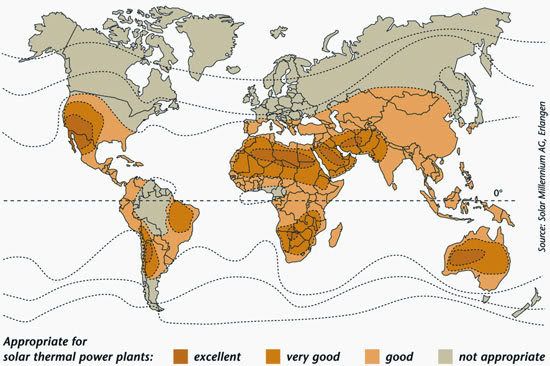


One of the organisations pushing for the development of North African solar energy resources is TREC (the Trans-Mediterranean Renewable Energy Cooperation initiative), which was initiated by the Club Of Rome, with the motto "Clean Power From Deserts".
The Trans-Mediterranean Renewable Energy Cooperation (TREC) is an initiative that campaigns for the transmission of clean power from deserts to Europe. Since it was founded in 2003 by The Club of Rome, the Hamburg Climate Protection Foundation and the National Energy Research Center of Jordan (NERC), it has developed the DESERTEC Concept and researched it in cooperation with the German Aerospace Center (DLR). Now TREC is making this concept a reality in cooperation with people in politics, industry and the world of finance.


The DESERTEC Concept of TREC is to boost the generation of electricity and desalinated water by solar thermal power plants and wind turbines in the Middle East and North Africa (MENA) and to transmit the clean electrical power via High Voltage Direct Current (HVDC) transmission lines throughout those areas and as from 2020 (with overall just 10-15% transmission losses) to Europe.

The technologies that are needed to realise the DESERTEC concept are already developed and some of them have been in use for decades. Several studies by the German Aerospace Center (DLR) confirm the viability of this concept and the usefulness of realising it very soon.

The SMH reports that the latest US Climate change conference has been branded a failure.
The White House-sponsored climate change conference, which ended today, has been labelled a failure by one of Australia's most powerful commentators on the environment. Don Henry, executive director of the Australian Conservation Foundation, said Australia needed to stop copying the US position on climate change immediately.

"It is disappointing the conference has not delivered,'' Mr Henry said. ''(US) President Bush is still resisting setting binding targets or commitments on greenhouse gas emissions. "He wants the flexibility of voluntary targets. "The US is the world's biggest climate laggard and are holding up global action on climate change.''

Mr Henry said Mr Bush's climate change policies were "disastrous'' and Australia had to "disconnect'' itself from them. "More than any other country on Earth we should tackle this issue seriously with our water supplies at risk and the Great Barrier Reef,'' he said. "At the conference every developed country has taken on board binding targets and every developing country has committed to cleaning up their economy and set long-term aspirational goals. "The only two that have not are Australia and the US who have not ratified the Kyoto Protocol and stand out like sore thumbs.''

Tom Paine has a post predicting that as Bush's reign of terror comes to a close, the atmosphere is in further danger from cloud of toxic lame duck executive decisions.
If this week's revelations by Rep. Henry Waxman, D-Calif., are any indication, it's going to be an ugly time for breathers during the last 16 months of the Bush administration. And it could be a boom time for special interests seeking to cash in before the President heads off to the ranch.

Possible deals are in store for coal, cars, and a variety of smokestack industries - a veritable "onslaught" as my friend, John Walke of the National Resources Defense Council puts it.

Usually we can only guess how these deals are cut behind the scenes. But Waxman provided a rare glimpse of Bush administration skullduggery as he released the results of an investigation of furtive administration attempts to sandbag a request by California to enforce its landmark greenhouse gas emission standards for motor vehicles.

The California standards are extraordinarily important because more than a dozen other states have adopted or plan to adopt them.

The car companies have launched an all-out war to kill the standards. In one key battleground, a federal judge in Vermont recently upheld that state's version of the standards despite a ferocious attack by the auto industry, which basically claimed the California/Vermont standards would put them out of business. ...

Waxman's investigation makes it appear as if the fix is in to kill California's request simply to satisfy one special-interest polluter. And that doesn't bode well for other key administration decisions to be made in the coming months regarding pollution requirements for coal-burning power plants, mining, fuels and other matters. To cite one shocking example, an EPA official noted last week that the administration is likely to promote the notion of making liquid fuel from coal as part of its answer to the Supreme Court decision on global warming - even though doing this likely would make global warming even worse!

One thing is certain: the polluters have really bulked up to deal with the Bush final days. The two key architects of air pollution policy for the Bush Administration — Jeffrey Holmstead and William Wehrum — have both gone through the proverbial revolving door to law firms that represent electric power companies and other big polluters. (Holmstead to Bracewell Giuliani, Wehrum to Hunton & Williams.)

They are very smart fellows and will probably do a great job representing their clients. But that may not be the best news possible for the rest of us who can't afford to hold our breath for 16 months.

Distibuted manufacturing of uniquely identifiable and locatable objects is one of those emerging fields I think will help us to omplement full cradle to cradle manufacturing techniques and to put problems like peak oil behind us - this is one of Bruce Sterling's favourite topics (usually tagged with words like spime or blobject) these days, and TreeHugger reports he has made a movie on "Downloadable Designs".
Bruce Sterling has not only written the book on downloadable designs (called Shaping Things), He made the movie too!

According to Putting People First", The future will see a new kind of object — we have the primitive forms of them now in our pockets and briefcases: user-alterable, baroquely multi-featured, and programmable — that will be sustainable, enhanceable, and uniquely identifiable. Sterling coins the term “spime” for them, these future manufactured objects with informational support so extensive and rich that they are regarded as material instantiations of an immaterial system. Spimes are designed on screens, fabricated by digital means, and precisely tracked through space and time. They are made of substances that can be folded back into the production stream of future spimes, challenging all of us to become involved in their production.

Last night Sterling showed an amazing video in Italy; you can see it :: Here


Bruce himself reports that the "Climate Crisis Is Stirring Brain-Eating Amoeba". Another horror from down under...
(((I don't make the news, I just blog it, folks....)))

Link: Arizona Boy Dies Of Rare Infection - Local News Story - KPHO Phoenix.

"This is definitely something we need to track," said Michael Beach, a specialist in recreational water-born illnesses for the CDC. "This is a heat-loving amoeba. As water temperatures go up, it does better," Beach said. "In future decades, as temperatures rise, we'd expect to see more cases."

Though infections tend to be found in southern states, Naegleria has been found almost everywhere in lakes, hot springs, even some swimming pools. Still, the CDC knows of only several hundred cases worldwide since its discovery in Australia in the 1960s. The amoeba typically live in lake bottoms, grazing off algae and bacteria in the sediment. Beach said people become infected when they wade through shallow water and stir up the bottom. If someone allows water to shoot up the nose -- say, by doing a cannonball off a cliff -- the amoeba can latch onto the person's olfactory nerve.

The amoeba destroys tissue as it makes its way up to the brain. People who are infected tend to complain of a stiff neck, headaches and fevers, Beach said. In the later stages, they'll show signs of brain damage such as hallucinations and behavioral changes. Once infected, most people have little chance of survival.....

I included a couple of links about the evolution of social entrepreneurship in a post a week or so ago, including one to grassroots loan broker Kiva, which is the subject of an article in today's SMH - apparently they have been so successful raising money lately that there is a shortage of firms to lend to.
Last month I became a financier, or, to be more specific, a microfinancier. I lent $50 to Saitia Teropika in Samoa. I've never been to Samoa or met Teropika, but I know she's 37 years old and has nine children. I know the money is to help her buy seeds and pesticides to expand her market garden.

I know all this because of an innovative organisation called Kiva, which supports charity in the form of zero-interest business loans. It does this by using a website to link people in the First World to people in the Third. Founded in 2005 by an American couple, Matt and Jessica Flannery, it is a fascinating use of the internet.

Kiva (the word is Swahili for "unity"), in San Francisco, deals with potential borrowers through 68 microfinance companies in the Third World. These "field partners" charge the borrowers interest and take responsibility for identifying responsible entrepreneurs, disbursing the loan, collecting repayments and giving lenders periodic updates on how the business is going.

The concept has been a modest hit in America. So far $US11 million ($12.5 million) has been lent by 119,000 people. When I visited the website this week to look for a second business to fund, I found a message possibly unique in the history of charity: "Due to a recent surge in support ignited by viewers of the Oprah Winfrey Show, the Today Show, and readers of President [Bill] Clinton's newly released book Giving, there is currently a shortage of businesses in need of loans. The www.kiva.org staff and our field partners are working overtime to get more businesses on the website."

But it's not just Americans who are involved. Contributors to Saitia Teropika's $750 loan also come from Germany, Singapore, Finland, Canada, Italy and Taiwan, and there are several Australians. Lenders can create a profile on the site and put up their photo and some personal details: this is charity for the MySpace generation.

Common Dreams has an article from Ray McGovern on Bush, Oil and Moral Bankruptcy.
It is an exceedingly dangerous time. Vice President Dick Cheney and his hard-core “neo-conservative” protégés in the administration and Congress are pushing harder and harder for President George W. Bush, isolated from reality, to honor the promise he made to Israel to prevent Iran from developing a nuclear weapon.On Sept. 23, former national security adviser Zbigniew Brzezinski warned pointedly:
“If we escalate tensions, if we succumb to hysteria, if we start making threats, we are likely to stampede ourselves into a war [with Iran], which most reasonable people agree would be a disaster for us…I think the administration, the president and the vice president particularly, are trying to hype the atmosphere, and that is reminiscent of what preceded the war in Iraq.”

So why the pressure for a wider war in which any victory will be Pyrrhic-for Israel and for the U.S.? The short answer is arrogant stupidity; the longer answer-what the Chinese used to call “great power chauvinism”-and oil.

The truth can slip out when erstwhile functionaries write their memoirs (the dense pages of George Tenet’s tome being the exception). Kudos to the still functioning reportorial side of the Washington Post, which on Sept. 15, was the first to ferret out the gem in former Fed chairman, Alan Greenspan’s book that the Iraq war was “largely about oil.”

But that’s okay, said the Post’s editorial side (which has done yeoman service as the White House’s Pravda) the very next day. Dominating the op-ed page was a turgid piece by Henry Kissinger, serving chiefly as a reminder that there is an excellent case to be made for retiring when one reaches the age of statutory senility.

Dr. Kissinger described as a “truism” the notion that “the industrial nations cannot accept radical forces dominating a region on which their economies depend.” (Curious. That same truism was considered a bad thing, when an integral part of the “Brezhnev Doctrine” applied to Eastern Europe.) What is important here is that Kissinger was speaking of Iran, which-in a classic example of pot calling kettle black-he accuses of “seeking regional hegemony.” What’s going on here seems to be a concerted effort to get us accustomed to the prospect of a long, and possibly expanded war.

Don’t you remember? Those terrorists, or Iraqis, or Iranians, or jihadists…whoever…are trying to destroy our way of life.

The White House spin machine is determined to justify the war in ways they think will draw popular support from folks like the well-heeled man who asked me querulously before a large audience, “Don’t you agree that several GIs killed each week is a small price to pay for the oil we need?”

The Bush policy toward the Middle East is at the same time consistent with, and a marked departure from, the U.S. approach since the end of World War II. Given ever-growing U.S. dependence on imported oil, priority has always been given to ensuring the uninterrupted supply of oil, as well as securing the state of Israel. The U.S. was, by and large, successful in achieving these goals through traditional diplomacy and commerce. Granted, it would overthrow duly elected governments, when it felt it necessary-as in Iran in 1953, after its president nationalized the oil. But the George W. Bush administration is the first to start a major war to implement U.S. policy in the region.

Just before the March 2003 attack, Chas Freeman, U.S. ambassador to Saudi Arabia for President George H.W. Bush, explained that the new policy was to maintain a lock on the world’s energy lifeline and be able to deny access to global competitors. Freeman said the new Bush administration “believes you have to control resources in order to have access to them” and that, with the end of the Cold War, the U.S. is uniquely able to shape global events-and would be remiss if it did not do so. This could not be attempted in a world of two superpowers, but has been a longstanding goal of the people closest to George W. Bush.

In 1975 in Harpers, then-Secretary of State Henry Kissinger authored under a pseudonym an article, “Seizing Arab Oil.”

Blissfully unaware that the author was his boss, the highly respected career ambassador to Saudi Arabia, James Akins, committed the mother of all faux pas when he told a TV audience that whoever wrote that article had to be a “madman.” Akins was right; he was also fired.

The Huffington Post has an article on John Dean and his alienation from the Republican tribe - "From Nixon to Bush to Giuliani--"Much, Much Worse"".
John Dean knows something about White House abuse of power. He wrote a bestseller in 2004 on the Bush White House called Worse Than Watergate. In a recent interview I asked him what he thinks of that title now. Now, he replied, a book comparing Bush and Nixon would have to be called Much, Much Worse.

"Look at the so-called Watergate abuses of power," he said. "Nobody died. Nobody was tortured. Millions of Americans were not subject to electronic surveillance of their communications. We're playing now in a whole different league."

And how does Bush compare with the Republicans seeking to succeed him? "If a Rudy Giuliani were to be elected," Dean said, "he would go even farther than Cheney and Bush in their worst moments."

What about the rest of the pack? "I'm very concerned about the current attitude in the Republican party," he said. "However there are candidates on the Republican side who are not quite as frightening as Giuliani." When I asked who he had in mind, he laughed and said "Ron Paul." He conceded that "there's no chance he's going to be president."

Dean's new book is Broken Government: How Republican Rule Destroyed the Legislative, Executive, and Judicial Branches. It's a massively documented and thorough indictment, arguing that, over the last 30 years, Republicans have broken or ignored laws, rules, and the Constitution. He's especially critical of the growth of presidential power under Bush II, and what he calls the "corruption" of the courts by "radical conservatives."

I asked Dean to imagine the moment when Bush leaves office on Jan. 20, 2009, presumably to be replaced by a Democrat, presumably Hillary -- will it then be possible to say "our long national nightmare is over"? Dean replied with one word: "Yes." He quickly added, "I do feel strongly that the Republicans have so abused the law and embedded so many people within the system, within the executive branch, that's it's going to take a couple of terms of Democratic presidents before you have people there who are representing the American people." Does that mean he is supporting Hillary? "She's obviously the one the other Democrats have to beat," he said, "but I don't take any position."

How then would he describe his political position? He says in his new book that he's left his "former tribe" - does that make him a Democrat today? "It doesn't," he replied. "I carry water for nobody. My only interest is being an honest information broker about what's happening. I have no agenda other than explaining - and being shocked at my former tribe."

"I've had invitations to become involved with Democrats," he added, "and have turned them all down. I'm an independent. That happens to be the largest group of voters in the country today - we're about 40 per cent strong."


Links:

* Scientific American - Sunny Outlook: Can Sunshine Provide All U.S. Electricity?
* CSP Today - First Forum On Concentrating Solar Thermal Power To Take Place In Seville
* Europa Rapid - Energising Europe: A real market with secure supply
* WorldChanging - Taking Public Transit: The Most Effective Route to Cutting Carbon. Or even better, walk or ride a bike...
* Alt Energy Stocks - Visual Comparison of Alternative Transportation Fuels
* Alt Energy Stocks - Visual Comparison of Electricity Generation Technologies
* Brisbane Courier Mail - Global food shock real, says former Nats leader
* TreeHugger - The 100 Mile Café: More for the Locavore
* TreeHugger - The Exxon FIles: The Denial Continues
* Andrew Leonard - Don't cry for Saudi Arabia
* Huffington Post - New Rule: Stop Saying Iraq is Another Vietnam, it's Another Enron. I wonder how Ken Lay is doing these days.
* New York Times - Pressure to deal with Blackwater mounting
* The Nation - Congress Quietly Approves Billions More for Iraq War. Ron Paul, Dennis Kucinich and Russ Feingold (+ 12 other Democrats in the House) vote against.
* NY Post - Bloomberg: Insurgents In Iraq Like Americans Who Fought British. How indiscreet - I thought we were liberating them from tyranny.
* Lancaster Intelligencer Journal - Ellsberg Calls for Actions to Prevent War with Iran
* Democracy Now - Bolivian President Evo Morales on Indigenous Rights, Climate Change, Iraq, Establishing Diplomatic Relations with Iran, Che Guevara's Legacy and More
* Beyond The Beyond - Germans Take to the Streets. "Liberty instead of fear !".
* Common Dreams - The Internet: Our Last Hope for a Free Press
* LRC Blog - What Really Happened on the Ferry From Mackinac Island?

Statistics

Locations of visitors to this page

blogspot visitor
Stat Counter

Total Pageviews

Ads

Books

Followers

Blog Archive

Labels

australia (619) global warming (423) solar power (397) peak oil (355) renewable energy (302) electric vehicles (250) wind power (194) ocean energy (165) csp (159) solar thermal power (145) geothermal energy (144) energy storage (142) smart grids (140) oil (139) solar pv (138) tidal power (137) coal seam gas (131) nuclear power (129) china (120) lng (117) iraq (113) geothermal power (112) green buildings (110) natural gas (110) agriculture (91) oil price (80) biofuel (78) wave power (73) smart meters (72) coal (70) uk (69) electricity grid (67) energy efficiency (64) google (58) internet (50) surveillance (50) bicycle (49) big brother (49) shale gas (49) food prices (48) tesla (46) thin film solar (42) biomimicry (40) canada (40) scotland (38) ocean power (37) politics (37) shale oil (37) new zealand (35) air transport (34) algae (34) water (34) arctic ice (33) concentrating solar power (33) saudi arabia (33) queensland (32) california (31) credit crunch (31) bioplastic (30) offshore wind power (30) population (30) cogeneration (28) geoengineering (28) batteries (26) drought (26) resource wars (26) woodside (26) censorship (25) cleantech (25) bruce sterling (24) ctl (23) limits to growth (23) carbon tax (22) economics (22) exxon (22) lithium (22) buckminster fuller (21) distributed manufacturing (21) iraq oil law (21) coal to liquids (20) indonesia (20) origin energy (20) brightsource (19) rail transport (19) ultracapacitor (19) santos (18) ausra (17) collapse (17) electric bikes (17) michael klare (17) atlantis (16) cellulosic ethanol (16) iceland (16) lithium ion batteries (16) mapping (16) ucg (16) bees (15) concentrating solar thermal power (15) ethanol (15) geodynamics (15) psychology (15) al gore (14) brazil (14) bucky fuller (14) carbon emissions (14) fertiliser (14) matthew simmons (14) ambient energy (13) biodiesel (13) investment (13) kenya (13) public transport (13) big oil (12) biochar (12) chile (12) cities (12) desertec (12) internet of things (12) otec (12) texas (12) victoria (12) antarctica (11) cradle to cradle (11) energy policy (11) hybrid car (11) terra preta (11) tinfoil (11) toyota (11) amory lovins (10) fabber (10) gazprom (10) goldman sachs (10) gtl (10) severn estuary (10) volt (10) afghanistan (9) alaska (9) biomass (9) carbon trading (9) distributed generation (9) esolar (9) four day week (9) fuel cells (9) jeremy leggett (9) methane hydrates (9) pge (9) sweden (9) arrow energy (8) bolivia (8) eroei (8) fish (8) floating offshore wind power (8) guerilla gardening (8) linc energy (8) methane (8) nanosolar (8) natural gas pipelines (8) pentland firth (8) saul griffith (8) stirling engine (8) us elections (8) western australia (8) airborne wind turbines (7) bloom energy (7) boeing (7) chp (7) climategate (7) copenhagen (7) scenario planning (7) vinod khosla (7) apocaphilia (6) ceramic fuel cells (6) cigs (6) futurism (6) jatropha (6) nigeria (6) ocean acidification (6) relocalisation (6) somalia (6) t boone pickens (6) local currencies (5) space based solar power (5) varanus island (5) garbage (4) global energy grid (4) kevin kelly (4) low temperature geothermal power (4) oled (4) tim flannery (4) v2g (4) club of rome (3) norman borlaug (2) peak oil portfolio (1)