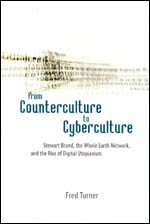
I'd noted the parallels in the first episode to Fred Turner's book "From Counterculture To Cyberculture", so I wasn't particularly surprised to see Turner make an appearance in this episode, along with Stewart Brand, and the tracing of these ideas back to Bucky Fuller.
What was new about this episode was the repeating of common misconceptions about "The Limits To Growth" and the strange line of reasoning that seemed to argue that the search for "equilibrium" (ie. a scenario where our overall impact on the environment is trimmed to the point where we don't end up having the population crash as we overwhelm the planet's carrying capacity) that "Limits" undertakes is really arguing for a form of political stasis where no radical change is to be contemplated.
While this may have been a goal of the Technocrats that preceded them, it doesn't ring true for the systems theorists.
Curtis even notes that Jay Forrester and the "Limits" crew explicitly said they weren't considering politics, but discounts this as a form of dishonesty rather than accepting that the book is just outlining scenarios around resource consumption, population and pollution rather than being a political manifesto (which would have been entirely counterproductive).
Where is does veer towards politics (in the section entitled "Transitions to a sustainable system", where it prescribes the changes required to make our global economy sustainable), the practices recommended are both positive and a change from the general status quo today - it doesn't read like a manual for perpetuating elite control and forbidding political change, with the non-technical recommendations including :
* poverty reduction * nonviolent conflict resolution * accurate/unbiased media * “decentralisation of economic power, political influence and scientific expertise” * “stable populations” and “low birth rates” by “individual choice”
Curtis' main point (like Turner's before him) - that the counterculture / hippie / cyberculture ideal of a world without politics is a fantasy - is valid, but he really goes off the rails trying to blame the systems theorists and ecologists for the problems of the world today.
The section about the colour revolutions in eastern europe, in particular, seemed wildly off base - he assumes that this genuinely was a case of leaderless uprising spontaneously organised via network culture - when instead they were orchestrated from the US to expand western influence at the expense of the Russians - and naturally enough faltered once the population realised that their interests weren't really being advanced at all by the changes (just as we'll most likely see with the current "Arab Spring" equivalent).
Last week I gave Stewart Brand a simple challenge. In his book Whole Earth Discipline he claimed that the pesticide DDT "was banned worldwide" as a result of campaigning by environmentalists, killing millions. Complaints meant the explicit claim was cut at the last minute from the film he fronted for Channel 4, What the Green Movement Got Wrong, but the impression remained. I challenged Brand either to provide evidence to support his claim or to admit that he got it wrong.
In replying to me he did neither. He also failed to provide the sources he had promised to show me during the televised debate following his film. I wrote this up on this website. In response he sent me a long series of emails, which you can read in full on my site.
None of them meet my challenge, but they have opened my eyes to what I fear is his real agenda – one that seems very different to what he claims to be doing. Here is the open letter I have just sent to him, in which I answer his new claims and voice my concerns.
Dear Stewart,
Thank you for your emails and sorry for taking a while to reply: I had to check your claims before responding to them. Before I go on, let me remind you of some of things you say in your book:
"Every interview with a public figure should include the question 'What have you been wrong about, and how did that change your views?' The answer will tell us if the person is intellectually honest or a tale-spinner with delusions of infallibility."
"Fessing up aids learning."
"Failure to acknowledge a mistake is paralysing."
Are we to assume that this advice applies only to other people? I have now given you several opportunities – before, during and after our televised debate - to admit that you made a mistake when you claimed, in relation to the control of malaria, that "DDT was banned worldwide". Instead of doing so, you have dug a deeper hole for yourself.
It's not a complicated matter. A worldwide ban cannot take place without an international instrument. The only instrument I'm aware of that regulates DDT at the global level is the 2001 Stockholm convention. This does not ban its use for disease control. Rather, DDT is banned for agricultural purposes, not least because spraying it indiscriminately encourages resistance in malarial mosquitoes. If there is another instrument, please name it and quote the relevant text. If there isn't, all you need to do is to admit that you got it wrong. As the passages I've quoted from your book suggest, there's no shame in doing so. The shame lies in sticking to a claim when it has been shown to be false.
Instead of answering my challenge, you begin your emails by selectively quoting two articles that make broad and generalised allegations (several of which turn out to be false), but which provide no evidence for a global ban. I took the trouble of reading these articles in full, and found that both of them, in sections you don't quote, make it clear that there was no global ban. That hardly helps your case.
Then you take the extraordinary step of turning for help to Patrick Moore. Moore, as I am sure you are aware, represents a number of polluting and destructive industries, and helps them with their battles against environmentalists. For example, he fronted the logging industry's campaign against people trying to stop the clear-cutting of old-growth forests in western Canada. He has been a prominent spokesman in the movement denying that man-made climate change is taking place, and has been criticised for failing to declare his commercial interests. He is the source of a number of lurid myths about the environment movement.
For example, in the Great Global Warming Swindle, broadcast on Channel 4 in 2007, he made the following claim: "When I left Greenpeace it was in the midst of them adopting a campaign to ban chlorine worldwide. Like I said, 'you guys, this is one of the elements in the periodic table, you know; I mean, I'm not sure if it's in our jurisdiction to be banning a whole element'."
But Greenpeace has never campaigned to ban chlorine worldwide. Instead it has campaigned against certain organo-chlorines, like dioxin, and sought – successfully – to stop chlorine being used to bleach wood pulp in Ontario and British Columbia because of the pollution it was causing in rivers and lakes.
This alone should make you wary of calling on Moore as an expert on what has and has not been banned worldwide. True to form, this master of spin tried to help you out by inventing a whole new concept in international law: a "de facto worldwide ban". What a marvellous weasel phrase that is - and how little it helps your case. Either there has been a worldwide ban or there hasn't. If there has, show me where and when.
It may be true, in some places and at some times, that DDT has been hard to obtain for the purposes of disease control when it was believed to be the most effective option, though you have yet to show me hard evidence that even this is the case. If it is true, however, I regret it. Like you, I believe that eliminating malaria by the most effective means has to be a global priority. In 1989 I got into trouble with a friend in Manaus in the Amazon whose house I was staying in by letting officials come in and spray his walls with DDT. I thought it was the right thing to do; he did not.
Moore also sent you an extract from his book in the hope that it might deliver you from the fix you're in. I checked out some of the claims he makes in this extract, and immediately found that they are exaggerated and inaccurate.
For example, he maintains that:
"DDT was even discontinued for use in malaria control by the World Health Organisation and USAID"
and that
"the WHO and USAID refused aid to countries that used DDT for malaria control"
These claims are untrue. Not only did these agencies not refuse aid on these grounds, they never stopped using DDT for malarial control, where they believed this was the best option. In many cases it was not the best option. As the malaria expert and former World Health Organisation (WHO) global malaria programme coordinator, Allan Schapira, points out in the Lancet (hat tip: Tim Lambert):
"Indoor residual spraying is an effective intervention, provided a programme infrastructure can be set up and maintained to include trained sprayers, supervisors, managers, stocks, equipment, and vehicles, that roads allow access to every village at the right time at least once a year, and that insecticides are not diverted to agriculture … In view of the difficulties encountered in maintaining indoor residual spraying, WHO has invested substantially in exploring other methods, especially insecticide-treated bed nets. … In the choice between indoor residual spraying and insecticide-treated nets, a WHO study group convened in 2004 noted that the decision should, in most cases, be based on operational factors. Because long-lasting insecticidal nets can be managed easily with minimum risk of diversion of insecticide, for most high-burden countries that have not developed an infrastructure for indoor residual spraying, the priority will be to ensure coverage of at-risk populations with such long-lasting nets."
Here's what USAID says:
"USAID has never had a 'policy' as such either 'for' or 'against' DDT for IRS [indoor residual spraying]. The real change in the past two years has been a new interest and emphasis on the use of IRS in general – with DDT or any other insecticide – as an effective malaria prevention strategy in tropical Africa."
That wasn't hard to find – it took me 20 seconds on Google – so why does Moore continue to spread this myth?
USAID also says that the use of DDT spraying "to prevent malaria is an allowable exception under the Stockholm convention" and that the decision about whether or not to use DDT "is based on cost-effectiveness; on entomological factors; on local building materials; and on host-country policy."
In other words, you have yet to show me any hard evidence of anything, let alone the claim that there was a worldwide ban. You can go on wasting my time and yours if you like, by seeking to defend something that is evidently false, or you could show a little of the intellectual honesty you call for in your book by accepting that you got it wrong. At the moment you are making yourself look like "a tale-spinner with delusions of infallibility", to use a phrase from your book.
In the meantime, all this has got me thinking: you call yourself an environmentalist and claim to be trying to reform the environmental movement for its own good. Yet you repeat and then try to defend a myth circulated by corporate lobbyists about the environment movement – that it obtained a global ban on DDT, killing millions – even when you are unable to produce evidence to support it. Then you turn for help to one of the environment movement's most entrenched enemies. Why should we continue to believe you when you claim that you're on our side?
Like Moore, you trade on your credentials as a founder of the early environment movement. Like Moore, you now work as a corporate consultant. By the way, who does your company, the Global Business Network, now represent? The list of corporations Sourcewatch gives as its clients – including ExxonMobil, Saudi Aramco, Cargill, Dow Chemical, Shell and BP – makes my hair stand on end. But is it correct? And why have you ceased to carry this list on your website? Like Moore, you attack the environment movement in ways that suit corporate interests: calling us, in effect, to drop our campaigns for regulation and democratic control in favour of techno-fixes.
When I first came across your work, I took it at face value. As I read more, I began to wonder if you are not, as you claim, pioneering a new form of environmentalism, but a new form of corporate consultancy. You seem to be seeking to shape the environmental debate to suit the businesses you work for. Our correspondence does nothing to dispel this impression. Can you disabuse me of my suspicions?
You are more dangerous than the other corporate-sponsored adversaries of the green movement. You don't deny that climate change is happening. You don't get abusive, you remain polite and charming, you sound reasonable at all times. You are, as a result, a more effective operator than them: you have persuaded a lot of influential people that you are working for the good of the planet. I fear you are running the most insidious and subtle exercise in corporate propaganda I have yet encountered. As a result, no one, until now, has called you out on it. With this response, that changes.
This post is the latest installment of my series on Bucky Fuller and was prompted by my reading Fred Turner's book "From Counterculture To Cyberculture: Stewart Brand, the Whole Earth Network and the Rise of Digital Utopianism", which looks at the influence Bucky Fuller had on a range of people, in particular Stewart Brand, who helped create first the hippie counterculture and the back to the land movement of the sixties and seventies, then later the cyberculture that grew up around the San Francisco bay area.
I won't try to review the book here as I wouldn't do it justice - but I highly recommend it if you have any interest in this particular piece of history.
Brand has had a significant influence on the environmental movement which has continued through to the current day and the evolution of his views over that time is worth spending some time considering.
As they came of age, Stewart Brand and others of his generation faced two questions: How could they keep the world from being destroyed by nuclear weapons or by the large-scale, hierarchical governmental and industrial bureaucracies that had built and used them? And how could they assert and preserve their own holistic individuality in the face of such a world?
As he sought to answer those questions, Brand turned first to the study of ecology and a systems-oriented view of the natural world. Later, after graduating from Stanford and serving several years as a draftee in the army, he found his way into a series of art worlds centered in Manhattan and San Francisco. For the artists of those communities, as for Brand's professors at Stanford, cybernetics offered a new way to model the world. Even at the height of the cold war, many of the most important artists of this period, figures such as John Cage and Robert Rauschenberg, embraced the systems orientation and even the engineers of the military-industrial research establishment. Together they read Norbert Wiener and, later, Marshall McLuhan and Buckminster Fuller; across the late 1950s and well into the 1960s, they made those writings models for their work. At the same time, both the artists he met and the authors they read presented the young Stewart Brand with a series of role models. If the army and the cold war corporate world of Brand's imagination moved according to clear lines of authority and rigid organizational structures, the art worlds of the early 1960s, like the research worlds of the 1940s, lived by networking, entrepreneurship, and collaboration. As he moved among them, Brand came to appreciate cybernetics as an intellectual framework and as a social practice; he associated both with alternative forms of communal organization.
Ecology as Alternative Politics
Brand first encountered systems-oriented ways of thinking at Stanford in a biology class taught by Paul Ehrlich. By the end of the decade, Ehrlich was famous for predicting in his book The Population Bomb (1968) that population growth would soon lead to ecological disaster. In the late 1950s, however, he was concentrating on the fundamentals of butterfly ecology and systems-oriented approaches to evolutionary biology. These preoccupations reflected the extraordinary influence of cybernetics and information theory on American biology following World War II. At the level of microbiology, information theory provided a new language with which to understand heredity. Under its influence, genes and sequences of DNA became information systems, bits of text to be read and decoded. In the 1950s, as Lily Kay has pointed out, microbiology became "a communication science, allied to cybernetics, information theory, and computers." Information theory also exerted a tremendous pull on biological studies of organisms and their interaction. Before World War II, biologists often focused on the study of individual organisms, hierarchical taxonomies of species, and the sexual division of labor. Afterward, many shifted toward the study of populations and the principles of natural selection in terms modeled on cybernetic theories of command and control. ...
For Brand, even as a student at Stanford, the ability to think outside the dominant paradigm of cold war conflict both marked and made possible an advancement in human evolution. The liberation of the individual was simultaneously an American ideal, an evolutionary imperative, and, for Brand and millions of other adolescents, a pressing personal goal.
The question was, How could that liberation be achieved in daily life? Brand's search for individual freedom led to a decade-long migration among a wide variety of bohemian, scientific, and academic communities. In the course of these travels, Brand encountered both communal ways of living and a series of technocentric, systems-oriented theories that served as ideological supports for communalism. Often enough, the theories themselves were not explicitly theories of social organization so much as theories of local social practices, such as how to make art or how to take LSD or how to run a business meeting. As he moved among these communities, however, and later, when his Whole Earth Catalog became a forum in which such communities met, Brand began to see how the systems orientation of Paul Ehrlich's population biology, combined with new, countercultural modes of living, might offer an appealingly individualistic lifestyle—not only for him, but also for anyone else who could abandon the halls of bureaucratic America. ...
The same tension between global humanist ideals and local elite practice would haunt much of the New Communalist movement over the next decade, and the Whole Earth network for years after that. But in the early 1960s, the linking of the global and the local helped account for much of Marshall McLuhan's appeal within the emerging counterculture. McLuhan's simultaneous celebration of new media and tribal social forms allowed people like Stewart Brand to imagine technology itself as a tool with which to resolve the twin cold war dilemmas of humanity's fate and their own trajectory into adulthood. That is, McLuhan offered a vision in which young people who had been raised on rock and roll, television, and the associated pleasures of consumption need not give those pleasures up even if they rejected the adult society that had created them. Even if the social order of technocracy threatened the species with nuclear annihilation and the individual young person with psychic fragmentation, the media technologies produced by that order offered the possibility of individual and collective transformation. McLuhan's dual emphases also allowed young people to imagine the local communities they built around these media not simply as communities built around consumption of industrial products, but as model communities for a new society. In McLuhan's writing, and in the artistic practice of groups like USCO and, later, the psychedelic practices of groups like San Francisco's Merry Pranksters, technologies produced by mass, industrial society offered the keys to transforming and thus to saving the adult world.
No one promoted this doctrine more fervently than the technocratic polymath Buckminster Fuller. Architect, designer, and traveling speechmaker, Fuller became an inspiration to Stewart Brand, the Whole Earth network, and the New Communalist movement as a whole across the 1960s. The geodesic domes Fuller patented soon after World War II came to be favored housing on communes throughout the Southwest. Fragments of his idiosyncratic conceptual vocabulary, such as "tensegrity," "synergy" and "Spaceship Earth," bubbled up steadily in discussions of how and why alternative communities should be built. And Fuller himself—seventy years old in 1965, short, plump, bespectacled, and, when he spoke in public, often clad in a three-piece suit with an honorary Phi Beta Kappa key dangling at the waist— seemed to model a kind of childlike innocence that many New Communalists sought to bring into their own adulthoods. If the politicians and CEOs of mainstream America were distant and emotionally reserved, Fuller was playful and engaged. And like his young audiences, he displayed a highly individualistic turn of mind and a deep concern with the fate of the species. Fuller made his name designing futuristic technologies such as the three wheeled Dymaxion car and, most famously, the geodesic dome, but the roots of his interests reached deep into America's pre-industrial past. ...
Fuller, like Emerson, saw the material world as the reflection of an otherwise intangible system of rules. But unlike Emerson and the Transcendentalists, Fuller linked that system of rules not only to the natural world, but also to the world of industry. During World War I, Fuller had watched his four-year-old daughter Alexandra die of infantile paralysis, contracted in part, he believed, because the family's home was badly built. At the time, he was working as a contractor with the navy. Earlier, as a junior officer, he had seen how, with proper coordination, extraordinary industrial resources could be mustered to solve military problems. In his view, his daughter had died directly from a disease but indirectly from a failure to distribute the world's resources appropriately. This conviction grew during World War II and the early years of the cold war, when once again Fuller saw the full scope of industrial production at work, as well as the inequality with which the world's resources were distributed. What humankind required, he came to believe, was an individual who could recognize the universal patterns inherent in nature, design new technologies in accord with both these patterns and the industrial resources already created by corporations and the military, and see that those new technologies were deployed in everyday life.
In a 1963 volume called Ideas and Integrities, a book that would have a strong impact on USCO and Stewart Brand, Fuller named this individual the "Comprehensive Designer." According to Fuller, the Comprehensive Designer would not be another specialist, but would instead stand outside the halls of industry and science, processing the information they produced, observing the technologies they developed, and translating both into tools for human happiness. Unlike specialists, the Comprehensive Designer would be aware of the system's need for balance and the current deployment of its resources. He would then act as a "harvester of the potentials of the realm," gathering up the products and techniques of industry and redistributing them in accord with the systemic patterns that only he and other comprehensivists could perceive. To do this work, the Designer would need to have access to all of the information generated within America's burgeoning technocracy while at the same time remaining outside it. He would need to become "an emerging synthesis of artist, inventor, mechanic, objective economist and evolutionary strategist." Constantly poring over the population surveys, resource analyses, and technical reports produced by states and industries, but never letting himself become a full-time employee of any of these, the Comprehensive Designer would finally see what the bureaucrat could not: the whole picture.
Being able to see the whole picture would allow the Comprehensive Designer to realign both his individual psyche and the deployment of political power with the laws of nature. In contrast to the bureaucrat, who, so many critics of technocracy had suggested, had been psychologically broken down by the demands of his work, the Comprehensive Designer would be intellectually and emotionally whole. Neither engineer nor artist, but always both simultaneously, he would achieve psychological integration even while working with the products of technocracy. Likewise, whereas bureaucrats exerted their power by means of political parties and armies and, in Fuller's view, thus failed to properly distribute the world's resources, the Comprehensive Designer would wield his power systematically. That is, he would analyze the data he had gathered, attempt to visualize the world's needs now and in the future, and then design technologies that would meet those needs. Agonistic politics, Fuller implied, would become irrelevant. What would change the world was "comprehensive anticipatory design science.' ...
At another level, though, the swirling scene at the Trips Festival, and Brand's role in it, represented a coming together of the New Communalist social ideals then emerging and the ideological and technological products of cold war technocracy. The festival itself was a techno-social hybrid. The Longshoreman's Hall surrounded dancers with the lights, images, and music of electronic media. The bodies of many dancers were infused with LSD. To the extent that they felt a sense of communion with one another, the sensation was brought about by their integration into a single techno-biological system within which, as Buckminster Fuller put it, echoing Norbert Wiener, the individual human being was simply another "pattern-complex." Brand himself had organized the event in keeping with the systems principles he had encountered at Stanford and afterward. Far from asserting direct control over events, he had built an environment, a happening, a laboratory. He had set forth the conditions under which a system might evolve and flower, and he had stocked the biological and social worlds of those who entered that system with technologies that allowed them to feel as though the boundaries between the social and the biological, between their minds and their bodies, and between themselves and their friends, were highly permeable. He had helped found a new tribe of technology-loving Indians, artistic engineers of the self. Very soon these new Comprehensive Designers would set out from San Francisco to found their own communities in the wilderness.
When they got there, thought Brand, what they would need most would be tools and information.
Stewart's particular genius has been in the creation of forums (ranging from magazines to conferences to online discussion groups to consulting organisations) that have enabled people with expertise in different disciplines to come together and exchange ideas about innovative uses of technology.
The Whole Earth Catalog and the back to the land movement
One of the better reviews of Turner's book looks at the emergence of sixties youth culture and influence thinkers like Marshall McLuhan, Paul Ehrlich and Bucky Fuller had on Brand the counterculture in general.
Turner gives the label “ New Communalism” to the utopian impulses that led both to the portion of the sixties counterculture which found its central text in the Whole Earth Catalog, and to the embrace of technology which found itself eventually at home in the 1990’s with some aspects of insurgent Republicanism. He suggests further that the values of the communal 1960’s utopian movement exemplified by Brand and his Whole Earth Catalog were not co-opted and distorted in later years by the forces of capitalism or the state as some believe, but rather became a part of the cyberculture of both creators and users of computers and new forms of computing.
The book opens with the defining computational metaphor as expressed by contemporary writers such as Esther Dyson, John Perry Barlow and Kevin Kelly: digital technologies transcend the world of governments and restrictions, and are instead tools by which stultifying bureaucracies can be overthrown and new, flexible ways of living, working, and producing for a strong economy can be achieved. Yet, to the students of the Berkeley Free Speech movement in which these writers began and which provided the origin of the counterculture, cybernetics represented a militarized and menacing force antithetical to the longed-for new society. The students of the Berkely Free Speech movement of the 1960’s and their colleagues across the country sometimes demonstrated and protested using computerized punch cards as the emblem of a repressive society.
In spite of the 1960’s students’ perceptions, Turner suggests that the seemingly closed world of the military-industrial complex was not monolithic. Within that complex, beginning with the great collaborative research enterprises of World War II, could be found a computation subculture bound by, in anthropological terms, a “trading language” and a “legitimacy exchange” which facilitated border-crossing and group work by professionals from various backgrounds. At the same time, Norbert Wiener and his associates, pioneers of cybernetics and associated with the wartime computing effort, expressed an idea of human being as automated mechanical information processors but with an added, more benign idea of a system in which men and machines collaborated. Thus it seems, even in the founding metaphors of computing, there were possibilities for divergence in how computing was regarded, along with spaces in which computing work was boundary-spanning and non-hierarchical.
It was the youth culture of the 1960’s, emerging as it did as a reaction against the systems which included the computing of the time, which added the notion of a liberated egalitarian society and communal ideals. It was during this time that two youth movements emerged. One was political, as represented by the SDS and the civil rights struggle, which became the so-called New Left. The other, more inward-turning, embracing new ways of consciousness and relationships and accompanied by drugs and rock and roll music, became the “counterculture”. It is in this non-political, utopian stream that Turner places the countercultural origins of cyberculture in the New Communalism. It is here that Turner arrives at the central questions he hopes to answer: how did the systems visions of the cold war and the seemingly antithetical communitarian visions of the New Communalists become so entwined that, years later as the Internet evolved out of the Cold War systems, it could appear to many to be the New Communalist ideal reborn? Here, Turner suggests, is the pivotal role of Steward Brand as the node connecting these networks.
Brand’s own intellectual journey into the counterculture began as a Stanford student learning about the then-new system-oriented ecological theories of population biologist Paul Ehrlich. After college and military service, he found his way into the avant-garde arts scene in New York city. These artists were developing a countercultural artistic system which were labeled “happenings”—seemingly spontaneous, egalitarian, and participatory, combining lighting, drama, music, art and systems thinking along with Eastern mysticism and involving multidisciplinary collaboration in a workshop setting. These artists were steeped in the communication theories of Marshall McLuhan which celebrated new media and tribal social forms, and the ideals of futuristic technology of architect Buckminster Fuller. Indeed, Brand credited Fuller as the inspiration for the Whole Earth Catalog.
Brand maintained that given access to the information we need, humanity can make the world a better place. The Whole Earth Catalog magazine he founded was promoted as a "compendium of tools, texts and information" which sought to "catalyze the emergence of a realm of personal power" by making technology available to people eager to create sustainable communities. Brand eventually achieved his goal of persuading NASA to release the first photo of the Earth from space (wandering around for some time wearing a badge saying "Why Haven't We Seen A Picture of the Whole Earth?") and the photo became the cover for the Catalog.
There is an interview by Massive Change with Stewart that describes his first meeting with Bucky Fuller and the story of his "whole earth" badge:
Massive change: What was Bucky Fuller's reaction to your button campaign that asked, "Why haven't we seen an image of the whole earth yet?"
Stewart Brand: It was all because of LSD, see. I took some lysergic acid diethylamide on an otherwise boring afternoon and came to the notion that seeing an image of the Earth from space would change a lot of things. So, on next to no budget, I printed up buttons and posters and sold them on street corners at the University of California, Berkeley. I went to Stanford and back east to Columbia, Harvard, and MIT. I also mailed the materials to various people: Marshall McLuhan, Buckminster Fuller, senators, members of the U.S. and Soviet space programs.
Out of everyone, I only heard back from Bucky Fuller, who wrote, "Dear boy, it's a charming notion but you must realize you can never see more than half the earth from any particular point in space." I was amused, and then met him a few months later at a seminar at Esalen Institute in Big Sur, California. I sat across from his lunch table and pushed the button over to him, asking him what he thought about it. He said, "Oh yes, I wrote to that guy." I said, "I'm the guy. So what do you think? What kind of difference do you think it will make when we actually get photographs of the earth from space?"
There was this slow, lovely silence. Then he said, "Dear boy, how can I help you?"
Whole Earth (and later Wired) editor Kevin Kelly has noted that style of the Whole Earth Catalog preceded the modern internet / blogosphere, and was eventually made redundant by it.
For this new countercultural movement, information was a precious commodity. In the 1960s, there was no Internet; no 500 cable channels. Bookstores were usually small and bad; libraries, worse. The WEC not only gave you permission to invent your life, it gave you the reasoning and the tools to do just that. And you believed you could do it, because on every page of the catalog were other people doing it. This was a great example of user-generated content, without advertising, before the Internet. Basically, Brand invented the blogosphere long before there was any such thing as a blog. ...
This I am sure about: it is no coincidence that the Whole Earth Catalogs disappeared as soon as the web and blogs arrived. Everything the Whole Earth Catalogs did, the web does better.
The Whole Earth Catalog was succeeded by a journal called CoEvolution Quarterly (CQ). CQ often included content related to futurism and the science of ecology, including authors like Lewis Mumford, Howard T. Odum, Karl Hess, Ivan Illich, Wendell Berry, Ursula K. Le Guin, Gregory Bateson, Amory Lovins, Hazel Henderson, Gary Snyder, Lynn Margulis, Eric Drexler, Paul Hawken, John Todd, Kevin Kelly and Donella Meadows (and not to forget Bucky Fuller of course), many of whom would be familiar to students of peak oil and the limits to growth.
The Whole Earth Catalog was something of a bible for the "back to the land" movement of the hippie counterculture, however its influence waned as the seventies progressed and the hippies became disillusioned with communal life out of the cities and as they faded from media attention.
The hippies weren't the first (or the last counterculture) to emerge - there are some interesting parallels with the German Wandervogel of the early 20th century (who, like the followers of the "local currencies" movement of that period, eventually went rogue) and with the modern day "rippies" trying to go off the grid in the US.
The WELL
Between 1968 and 1972, two communities began to mingle within blocks of the Whole Earth Catalog offices in Menlo Park. One, centered around the Stanford Research Institute and composed primarily of engineers, was devoted to the ongoing pursuit of increased human-computer integration. The other, clustered around the Catalog and the countercultural communities it served, focused on the pursuit of individual and collective transformation in a New Communalist vein. Stewart Brand positioned himself between these worlds and, in a variety of ways, brokered their encounter. - From Counterculture to Cyberculture
In the mid-1980's, Brand cofounded the "Whole Earth 'Lectronic Link" (WELL) with Larry Brilliant (now of Google.org), the prototype online community which still continues today and spawned both the EFF and Craigslist.
As it turned out, psychedelic drugs, communes, and Buckminster Fuller domes were a dead end, but computers were an avenue to realms beyond our dreams. - Stewart Brand
In a review of Turner's book, The New York Times noted that it was unsurprising that many members of the counterculture would end up being part of the "computer revolution".
It might be argued that so prevalent was the counterculture, and so experimental and energetic were its most vocal proponents, that it would have been surprising had many of them not found their way to the computer revolution. But Mr. Turner demonstrates something more essential in the continuity.
First, he suggests, we are mistaken in thinking that the postwar technological world was dominated by hierarchies and rigid categories. Under the influence of the mathematician Norbert Wiener, it became increasingly common to think of humans and machines as interacting elements of “cybernetic systems” — organisms through which information flowed. This also led to a different way of thinking about living organisms and their networks of interaction.
Marshall McLuhan wrote in 1964: “Today we have extended our central nervous system itself in a global embrace, abolishing both space and time as far as our planet is concerned.” Buckminster Fuller proposed the idea of a Comprehensive Designer, a creator who would embody “an emerging synthesis of artist, inventor, mechanic, objective economist and evolutionary strategist.”
These writers were the patron saints of the “Whole Earth Catalog,” their books appearing alongside macramé and carpentry manuals, their ideas presumably brought to life in the commune, where the natural and human world would be bound together, creating a single organism from which new possibilities would unfold.
During this period Brand coined the famous expression "information wants to be free", though that was only half of his commentary at the time.
On the one hand information wants to be expensive, because it’s so valuable. The right information in the right place just changes your life. On the other hand, information wants to be free, because the cost of getting it out is getting lower and lower all the time. So you have these two fighting against each other.” That was eventually compressed into “Information wants to be free. Information also wants to be expensive. - Stewart Brand
GBN was co-founded by Brand and is a classic example of his ability to assemble a diverse group of thinkers - in this case including people like Francis Fukuyama, Pierre Omidyar, Freeman Dyson, Peter Gabriel, Bill Joy, Amory Lovins, Paul Hawken, William Gibson and Bruce Sterling.
The Viridian Design Movement
At the beginning of the 21st century, author and futurist (and GBN member) Bruce Sterling published what he dubbed "The Viridian Manifesto", looking to spark a design movement to solve the problem of global warming and other collisions with the limits to growth. Since Bruce published his manifesto, a range of web sites that I'd categorise as Viridian have sprung up, with some openly acknowledging this heritage and other perhaps entirely oblivious to it - and with many of them also noting Bucky Fuller as an inspiration.
One of Stewart Brand's recent projects is a collaboration with computer scientist Danny Hillis to build the "Clock of the Long Now", a 10,000-year timepiece; his Long Now Foundation also runs a number of related projects, such as the Rosetta Project, cataloguing the world's languages, and the Long Bets ("the arena for accountable predictions") website.
Wired And Newt Gingrich - Did Something Go Terribly Wrong ?
Turner's book ends on something of a down note, as it describes how Brand and the Wired crew become involved with Esther Dyson, Newt Gingrich and the mid-90s "Republican Revolution".
One chronicler of both the counterculture and the cyberculture that followed it is RU Sirius (whose "Mondo 2000" magazine was prominent in the pre-Wired era). RU has a review of Turner's book in which he notes his disquiet with the period when "Brand's digital countercultural elite" engaged with Gingrich and co.
While I welcome Turner's critical vision, I must say honestly that, although I was repulsed by the Gingrich alliance and by much of the corporate rhetoric that emerged, at least in part, out of Brand's digital elitist clan — I think Brand's tactics were essentially correct. Turner implies that valuable social change is more likely to happen through political activism than through the invention and distribution of tools and through the whole systems approach that is implicit in that activity. But I think that the internet has — palpably — been much more successful in changing lives than 40 years of left oppositional activism has been. For one example out of thousands, the only reason the means of communication that shapes our cultural and political zeitgeist isn't COMPLETELY locked down by powerful media corporations is the work that these politically ambiguous freaks have accomplished over the past 40 years. In other words, oppositional activism would be even more occult — more hidden from view — today if not for networks built by hippie types who were not averse to working with DARPA and with big corporations. The world is a complex place.
RU has some more choice words about the failure of cyberculture (like the counterculture before it) to make the world a better place, lamenting the atomisation of modern society and the power this has gifted to faceless corporations in this interview with Jon Lebkowsky (another fixture of the Viridian movement) entitled "It's Better to be Inspired than Wired".
Cyberculture (a meme that I'm at least partly responsible for generating, incidentally) has emerged as a gleeful apologist for this kill-the-poor trajectory of the Republican revolution. You find it all over Wired - this mix of chaos theory and biological modeling that is somehow interpreted as scientific proof of the need to devolve and decentralize the social welfare state while also deregulating and empowering the powerful, autocratic, multinational corporations. You've basically got the breakdown of nation states into global economies simultaneous with the atomization of individuals or their balkanization into disconnected sub-groups, because digital technology conflates space while decentralizing communication and attention. The result is a clear playing field for a mutating corporate oligarchy, which is what we have.
I mean, people think it's really liberating because the old industrial ruling class has been liquefied and it's possible for young players to amass extraordinary instant dynasties. But it's savage and inhuman.
Maybe the Wired elite think that's hip. But then don't go around crying about crime in the streets or pretending to be concerned with ethics.
It's particularly sad and poignant for me to witness how comfortably the subcultural contempt for the normal, the hunger for novelty and change, and the basic anarchistic temperament that was at the core of Mondo 2000 fits the hip, smug, boundary-breaking, fast-moving, no-time-for-social-niceties world of your wired mega-corporate info/comm/media players. You can find our dirty fingerprints, our rhetoric, all over their advertising style. The joke's on me.
RU interviewed Turner about his book (the audio can be found here [mp3]), noting the Fuller connection and the failure of the counterculture to achieve long term change because of their refusal to engage with politics.
RU Sirius: Brand works his way through Wiener to Buckminster Fuller, another systems thinker.
Fred Turner: Brand has had a series of very powerful intellectual inspirations. Fuller would be one, Kesey would be another. For Brand, Fuller was a model in two senses. He was a model of systems thinking, and he was also a model of an intellectual entrepreneur. Fuller moved from university to university, from setting to setting, knitting communities together. That's what Brand learned to do. He learned to do it partly by watching Fuller.
RU: Fuller was, in a sense, one of the first cyber-Ronin, the wandering techno-entrepreneur type that is much touted later in the 1990s by people like John Brockman and "Wired" magazine.
FT: Absolutely. I think of Fuller and Kesey and Brand as P.T. Barnums. They are people who can't ride a trick horse, can't ride an elephant, can't ride a trapeze. And yet they build the rings of the circus; they bring the performers in; and they learn the languages and the styles of the circus. And they speak the circus' meanings to the audience. Brand has very much been the voice of a series of very important circuses.
RU: So, into the hippie era, Brand is part of the Merry Pranksters for a while; he does the "Whole Earth Catalog," but he's never really a hippie. And most hippies are not, generally, systems thinkers. "Hey man, spare change, I'm going to Woodstock" isn't systems thinking. Brand is very much off on his own distinctive trip. And yet there is this through-line that takes Brand from the avant-garde through the trips festivals to Whole Earth and on to the Global Business Network and then on through the creation of "Wired." Can you describe what those memes or through-lines are?
FT: There's a misapprehension that has plagued a lot of Americans, including a lot of historians, about the 60s counterculture. We tend to think of the counterculture as a set of anti-war protests; as drug use and partying. But we don't tend to differentiate between two groups that were very importantly differentiated in that time: the New Left, and the group that I've called the New Communalists. Brand speaks to the New Communalists. Though it's mostly forgotten now, between 1966 and 1973 there was the largest wave of communal activity in all of American history.
Between 1966 and 1973, conservative estimates suggest that 10 million Americans were involved in communes. Brand speaks to that group by promoting the notion that small-scale technologies like LSD, stereos, books, Volkswagens; are tools for building new alternative communities.
The New Left wanted to change the world by doing politics in order to change politics. They formed SDS (Students for a Democratic Society). They protested. Brand and his group turned his backs on all that. Brand said, what we need to do is go out and build these communities, and my job is to build a catalog of tools through which people can gain access to the technologies that they can build communities around. So the core idea that migrates from the 60s to the 90s is the idea that we can build small-scale technologies and communities of consciousness around those technologies. So we no longer need to do politics per se. That idea kicks in again in the 80s around the rise of the personal computer, the ultimate in small-scale technology. It gives us the idea of virtual community, a distributed community gathered around small-scale technologies. And it ultimately plays very directly into the beliefs of Newt Gingrich in the 1990s. ...
RU: The new communalist movement failed pretty much entirely. The idea of leaving behind the urban and suburban settings and going off and starting your own world failed. Even in terms of ecological or environmental ideas, the hip idea now is urban density. The attitude about tools survived, but the idea of back-to-the-country was pretty much useless.
FT: The idea of back-to-the-country didn't work. But I think something deeper didn't work, and it haunts us today, even as it underlies a lot of what we do. The notion that you can build a community around shared style is a deeply bohemian notion. It runs through all sorts of bohemian worlds. The notion that if you just get the right technology you can then build a unified community is a notion that drove a lot of the rural communal efforts. They thought by changing technological regimes; by going to 19th century technologies; by making their own butter; sewing their own clothes — they would be able to build a new kind of community. What they discovered was that if you don't do politics — explicitly, directly, through parties, through organizations — if you don't pay attention to and articulate what's going on with real material power, communities fail.
So I argue that there's a fantasy that haunts the internet, and it's haunted it for at least a decade. And it's the idea that if we just get the tools right and communicate effectively, we will be able to be intimate with one another and build the kinds of communities that don't exist outside, in the rest of our lives. And I think that's a deep failure and a fantasy.
The fantasy hasn't died entirely however, with one unlikely champion being the leader of Britain's rebranded "progressive" conservatives, David Cameron, saying we're entering a new era - where governments have less power (and less money) and people empowered by technology have more.
Jamais Cascio has echoed Turner's claim that in order to be effective, politics cannot be avoided, in an essay entitled "The End Of Politics Delusion".
You have my express permission to kick the next person -- especially someone advocating the embrace of radical forms of technological advancement -- who tells you that they wish nothing more than to get rid of, move beyond, or otherwise avoid "politics." Kick them hard, and repeatedly. They have adopted a profoundly ignorant and self-serving position, one that betrays at best a lack of understanding of human nature and society, and at worst a malicious desire to preemptively shut down any opposition to their goal. ...
In the early days of the dot-com era, this attitude resulted in the absence of digital tech industry voices in Washington, DC, allowing the incumbent telecom and entertainment industries free rein to write laws and buy politicians without opposition. Companies and industries that had considered themselves beyond politics found out just how wrong they were. Stung by that experience, today's advocates of the "escape politics" position usually articulate it as more of a wishful whine, as with [Peter] Thiel's line ["In our time, the great task for libertarians is to find an escape from politics in all its forms..."] ...
there's a profound ignorance across the tech advocacy community of the importance of politics to human society. Politics means conflict, debate, and frustration. It also means choice. A world without politics is a world where disagreement is illegitimate. It's a world where your ability to choose your future -- to make your future -- has been taken away, whether you like it or not.
Brand's Environmental Heresies And The Eco-Pragmatist Manifesto
Since "Counterculture to Cyberculture" was published Brand has continued to be active, creating a large amount of controversy in the environmental movement with an article on his "EnvironmentalHeresies" - taking aim at 4 areas where he thinks the environmental movement has gone the wrong way - population growth, urbanisation, genetically engineered organisms, and nuclear power.
Wired had an interview with Brand where he puts the case for the formation of huge slums in the developing world as a positive thing (the opposite to the argument made in Mike Davis' "Planet Of Slums").
Wired: What makes squatter cities so important?
Stewart Brand: That's where vast numbers of humans—slum dwellers—are doing urban stuff in new and amazing ways. And hell's bells, there are a billion of them! People are trying desperately to get out of poverty, so there's a lot of creativity; they collaborate in ways that we've completely forgotten how to do in regular cities. And there's a transition: People come in from the countryside, enter the rickshaw economy, and work for almost nothing. But after a while, they move uptown, into the formal economy. The United Nations did extensive field research and flipped from seeing squatter cities as the world's great problem to realizing these slums are actually the world's great solution to poverty.
Wired: Why are they good for the environment?
Brand: Cities draw people away from subsistence farming, which is ecologically devastating, and they defuse the population bomb. In the villages, women spend their time doing agricultural stuff, for no pay, or having lots and lots of kids. When women move to town, it's better to have fewer kids, bear down, and get them some education, some economic opportunity. Women become important, powerful creatures in the slums. They're often the ones running the community-based organizations, and they're considered the most reliable recipients of microfinance loans.
Wired: How can governments help nurture these positives?
Brand: The suffering is great, and crime is rampant. We made the mistake of romanticizing villages, and we don't need to make that mistake again. But the main thing is not to bulldoze the slums. Treat the people as pioneers. Get them some grid electricity, water, sanitation, crime prevention. All that makes a huge difference.
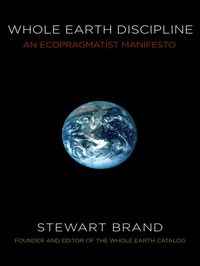
The 4 "heresies" form the foundation of Brand's latest book "WHOLE EARTH DISCIPLINE: An Ecopragmatist Manifesto" (along with another one - geoengineering will be required to mitigate global warming), which Brand discusses in this Long Now seminar called "Rethinking Green".
Personally I'd say Brand has 2 of his original 4 "heresies" right - population (which isn't the problem many believed back in the 1970's - and some grim hangers on still think today) and urbanisation (with "cities are the future" being a key Viridian catchphrase).
I remain somewhat dubious about genetically modified crops and think Brand is simply wrong about nuclear power, which is (at best) an expensive diversion of resources from our key task of replacing and extending our existing power generation capacity with truly clean and renewable power sources (in fact, its a remarkable about-face to go from promoting tools for individual use to recommending the ultimate centralised power source, one which can't be used by individuals and always requires massive government subsidies and regulation, and completely at odds with his "Long Now" school of long-term thinking for that matter).
The topic of Geoengineering is worthy of a post of its own, so I'll leave that for later.
Brand discusses "Whole Earth Discipline" in this talk at EDGE.
About 40 years ago I wore a button that said, "Why haven't we seen a photograph of the whole Earth yet?" Then we finally saw the pictures. What did it do for us?
The shift that has happened in 40 years which mainly has to do with climate change. Forty years ago, I could say in the Whole Earth Catalog, "we are as gods, we might as well get good at it". Photographs of earth from space had that god-like perspective.
What I'm saying now is we are as gods and have to get good at it. Necessity comes from climate change, potentially disastrous for civilization. The planet will be okay, life will be okay. We will lose vast quantities of species, probably lose the rain forests if the climate keeps heating up. So it's a global issue, a global phenomenon. It doesn't happen in just one area. The planetary perspective now is not just aesthetic. It's not just perspective. It's actually a world-sized problem that will take world sized solutions that involves forms of governance we don't have yet. It involves technologies we are just glimpsing. It involves what ecologists call ecosystem engineering. Beavers do it, earthworms do it. They don't usually do it at a planetary scale. We have to do it at a planetary scale. A lot of sentiments and aesthetics of the environmental movement stand in the way of that.
The next post in the series will look at one of the key enablers of a fully renewable energy powered future - smart grids - and how they are a stepping stone towards one of Bucky's visions - the Global Energy Grid.
Supporting technical details and citations for this post can be found here: “Four Nuclear Myths” (PDF).
I have known Stewart Brand as a friend for many years. I have admired his original and iconoclastic work, which has had significant impact. In his new book, Whole Earth Discipline: an Ecopragmatist Manifesto (Viking), he argues that environmentalists should change their thinking about four issues: population, nuclear power, genetically modified organisms (GMOs), and urbanization. Many people have asked me to assess his 41-page chapter on nuclear power, so I’ll do that here, because I believe its conclusions are greatly mistaken.
Stewart recently predicted that I wouldn’t accept his nuclear reassessment. He is quite right. His nuclear chapter’s facts and logic do not hold up to scrutiny. Over the past few years, I’ve sent him five technical papers focused mainly on nuclear power’s comparative economics and performance. He says he’s read them, and on p. 98 he even summarizes part of their economic thesis. Yet on p. 104 he says, “We Greens are not economists” and disclaims knowledge of economics, saying environmentalists use it only as a weapon to stop projects. Today, most dispassionate analysts think new nuclear power plants’ deepest flaw is their economics. They cost too much to build and incur too much financial risk. My writings show why nuclear expansion therefore can’t deliver on its claims: it would reduce and retard climate protection, because it saves between two and 20 times less carbon per dollar, 20 to 40 times slower, than investing in efficiency and micropower.
That conclusion rests on empirical data about how much new nuclear electricity actually costs relative to decentralized and efficiency competitors, how these alternatives compare in capacity and output added per year, and which can most effectively save carbon. Stewart’s chapter says nothing about any of these questions, but I believe they’re at the heart of the matter. If nuclear power is unneeded, uncompetitive, or ineffective in climate protection, let alone all three, then we need hardly debate whether its safety and waste issues are resolved, as he claims.
The much ballyhooed "nuclear renaissance" meme has been given short shrift in the SMH today as well - Nuclear delusions keep mushrooming.
Little wonder Australians are reconsidering the nuclear option for electricity production. The recent wave of euphoric predictions of a global nuclear renaissance from industry promoters has created high community expectations.
But on closer scrutiny, nuclear power's real potential is disappointing. Despite over half a century of intensive subsidisation and promotion, it produces less than 15 per cent of the world's electricity. This may seem hard to believe, given the fervour with which its promoters have been singing its praises of late, but the numbers speak for themselves.
In addition to 430 reactors operating worldwide, 52 reactors are listed by the International Atomic Energy Agency as ''under construction''. Thirteen have been on that list for over 20 years, and 24 still don't have an official planned start-up date.
One oft-quoted goal of the nuclear industry is to grow to 730 reactors worldwide by 2030. This would require one to be completed every 24 days, every year for the next 20 years. And it would assume none currently operating will be shut down. This seems improbable as the average age of operating power plants is 25 years.
Meanwhile the industry gestures excitedly at China (16 under construction), India (seven under construction) and Russia (nine under construction), which are unlikely even to compensate for lost global capacity as older reactors will have to close.
Predictions of huge expansion in Eastern Europe or North America - even in Australia - over the next two decades border on hysteria. Don't be deceived by talk of ''planned reactors'' or ''new generation solutions'': ask to see the poured concrete and the installed reactor core.
A realistic appraisal suggests we will see reactors built, and continue to hear excited talk about nuclear expansion. But it is almost as certain the so-called "renaissance" will be more of a protracted, agonising expiration.









 Posts




