Apocaphilia  

Posted by Big Gav

James Kunstler certainly has the knack for getting publicity, with his recent comments in Salon (vigourously debated at WorldChanging last week) leading to an outbreak of hostilities with the Rocky Mountain Institute's Amory Lovins at Salon, who obviously didn't appreciate being dissed in Kunstler's original interview.

Opinions on James Howard Kunstler's latest tract, The Long Emergency, vary pretty widely here at WorldChanging. Alex disagrees pretty strongly with Kunstler's dystopic vision; JonL found it (at least its manifestation in an interview in Salon) to be a "breath of fresh air." Personally, I'm in Alex's camp -- I'm tired of Apocaphilia in its various manifestations, and Kunstler in particular seems to claim that we can do nothing to head off disaster. Moreover, any attempts to invent better, more efficient, less damaging tools are pointless, in Kunstler's view, and he calls out Amory Lovins' "hypercar" idea for particular ridicule.

Lovins didn't like that, and responded to Kunstler. Salon managed to get Lovins' response, as well as a second exchange between the two. I'd have to say that Lovins comes across as the clear winner of the debate, although that's undoubtedly my own biases talking, at least in part. Not just my bias for Lovins' perspective, though, my bias for research over accusation and thought over fear. Or, as Lovins puts it, "Facts are more mundane than fantasies, but a better basis for conclusions."
In his rebuttal, Lovins' description of RMI's campus makes it sound like a dream place to live and work (well, its a long way to the beach, but apart from that):
James Howard Kunstler criticizes me for supposedly suggesting superefficient cars at the expense of walkable neighborhoods. If he'll kindly look at my 1999 book "Natural Capitalism," he'll find that Chapter 2, "Hypercars and Neighborhoods," emphasizes the importance of both, and strongly supports New Urbanism. It suggests practical and profitable ways to build very efficient cars and not need to drive them much, so we can have communities worth living in and traveling to. I can't imagine why this approach should be deemed objectionable -- unless, of course, he simply didn't ascertain my actual views.

His claim that there is no practical alternative to current oil dependence, other than dramatic changes in settlement patterns and lifestyles, is also extensively rebutted in our peer-reviewed, independent study "Winning the Oil Endgame." If Mr. Kunstler thinks our study is wrong, he would do a public service by explaining how. Meanwhile, serious students of this subject may be forgiven for preferring our well-documented analysis to his qualitative contentions.

[...]

Calling RMI's main campus (at 7,100 feet in Old Snowmass, Colo.) "a hyper-suburban corporate campus masquerading as ... environmentally sensitive" seemed too bizarre to merit reply when David Owen, in the New Yorker (Oct. 2, 2004), said we'd promoted sprawl by not building in a city. But before this notion gains more currency by Mr. Kunstler's further embroidery, some facts should be noted.

RMI's main building is among the world's most energy-efficient, saving 99 percent of space- and water-heating energy, 90 percent of household electricity (the rest is solar-generated), and 50 percent of water, all with a 10-month payback in 1984. It has received more than 70,000 visitors and produced 28 indoor banana crops with no conventional heating system, down to -47 outdoors. Other RMI buildings also use solar micropower, exceptionally energy- and water-efficient appliances and fixtures, daylighting, superwindows and other sustainability-enhancing features.

RMI's organization-wide practices also include: On-site housing nearby (with high-speed wireless Internet) and bike parking for roughly half the staff and their families, with carpooling and free or discounted bus passes for the rest and a hybrid company car available to all employees; virtual and distributed offices (with similar car-displacing policies) linked by a high-speed virtual private network and Internet videoconferencing, which we also use worldwide to displace much travel; flextime, work-at-home, inclusive staff coordination, and community-building; buying 94 percent of electricity as certified-green, plus 100 percent solar-powered hosting of several Web sites; associate membership of the Chicago Climate Exchange, where we offset our small net carbon dioxide emissions, and of Climate Neutral Network; and comprehensive recycling.
I think its pretty clear that Kunstler shouldn't have picked on Amory and the Hypercar - as well as being inaccurate (as Amory isn't just saying lets build more efficient cars and all problems will be solved, and has spent a lot of time describing his vision of "green" urban planning design), it was both unnecessary and beside the point.

I quite like Jamais' critique of (and usage of the word) apocaphilia - though I'm not sure it really applies to most of us in the peak oil blogistan - we may be obsessed with various forms of possible apocalypse (be it oil depletion, financial meltdown, outbreak of war, global warming, or more recently, plague), but I don't think any of us (outside of the eco-anarchist world perhaps) regard this as a good (or deserved) thing - just something to be worried about, and hopefully, to avoid.
I think one of the reasons I react so strongly to the statements of apocaphiles is their neo-Puritanism. The gleeful notion that the people in the suburban houses and big cars will be punished for their sins seems to bubble just under the surface. If my posts (and here I'll speak just for me, not for the rest of the WorldChanging crew) tend towards the technofix, it's because I don't think that wanting to live a comfortable life is sinful; approaches to change that let people live comfortable lives without feeling punished for their sins are going to be a helluva lot more appealing to society -- and therefore a helluva lot more readily used -- than approaches that intentionally demand less comfort and convenience.

Technorati tags:

Pipe Dreams  

Posted by Big Gav

Pipes seem to be much in the news this week. Pepe Escobar has a good article in the Asia Times ("Pipelineistan's biggest game begins") about the recently opened pipeline from the Caspian sea to Turkey. Amy Goodman at Democracy Now also has an interview with Michael Klare on this topic (via Energy Bulletin).

History may judge it as one of the capital moves of the 21st century's New Great Game: May 25, the day high-quality Caspian light crude started flowing through the Caucasus toward the Mediterranean in Turkey. The Baku-Tbilisi-Ceyhan pipeline (BTC) - conceived by the US as the ultimate Western escape route from dependence on oil from the Persian Gulf - is finally in business.

This is what Pipelineistan is all about: a supreme law unto itself - untouchable by national sovereignty, serious environmental concerns (expressed both in the Caucasus and in Europe), labor legislation, protests against the World Bank, not to mention mountains 2,700 meters high and 1,500 small rivers. The founding stone is at British Petroleum's (BP's) gleaming terminal at Sangachal, half an hour along the Caspian south of Baku. The state is 44 meters wide, snaking 1,767 kilometers across three countries, two of those (Azerbaijan and Georgia) extremely volatile, and the other (Turkey) faces potential trouble from dispossessed Kurds.

In Georgia the obstacles are more complex than in Azerbaijan. Thus the "Rose Revolution" of late 2003, getting rid of Edward Shevardnadze to the benefit of young, photogenic, American-educated and American-aligned Mikhail Saakashvili. The small matter of defending BTC from attacks of alleged al-Qaeda-related Chechens holed up in the Georgian mountains remains. But at least protection at the end of BTC in Ceyhan in Turkey is guaranteed: it's not a coincidence that the pipeline ends right next door to the massive American airbase at Incirlik.

In terms of no-holds-barred power politics and oil geopolitics, BTC is the real deal - a key component in the US's overall strategy of wrestling the Caucasus and Central Asia away from Russia - and bypassing Iranian oil and gas routes. Kazakh President Nursultan Nazarbaev, for instance, has just announced that Kazakh crude will also flow through the BTC before 2010. He even proposed to add Aktau - the Kazakh Caspian oil Mecca - to a new acronym (ABTC?). It's interesting to remember that BP always denied that it needs Kazakh oil to fill its pipeline.

BTC makes little sense in economic terms. Oil experts know that the most cost-effective routes from the Caspian would be south through Iran or north through Russia. But BTC is a designer masterpiece of power politics - from the point of view of Washington and its corporate allies.

The Globe and Mail's series on energy this week also included an article on pipelines - in this case, the growing demand for deep sea pipelines, as companies are forced to develop more remote and difficult to reach areas.
Norway's Langeled pipeline is a massive engineering challenge with the potential for an even more massive payoff when it is successfully operating in two years time: It could supply more than 20 per cent of the United Kingdom's natural gas.

Almost three million tonnes of rock are being laid on the bottom of the North Sea between Norway and the U.K. to support and stabilize the route for construction, planned for a seabed at depths of more than 1,000 metres, where the terrain features ragged underwater peaks that can jut up 60 metres. At sea level, the weather can be brutal -- gales and giant waves are typical. Below, the water in some parts is so cold that antifreeze will be needed to keep the gas flowing.

It is in this environment that the 1,200-kilometre link is being built. It will be the world's longest undersea pipeline and perhaps the industry's greatest construction challenge to date. Contending with such extremes is quickly becoming the norm in the pipeline business, where there is a new urgency to connect remote supplies of oil and natural gas with hungry consumer markets. The fear of energy shortages has heightened the sense of urgency, but these megaprojects require years to plan and build -- and those timelines are just getting longer as the challenges grow.

Over at Rigzone, they have an article on the damage done to oil platforms and pipelines by last year's Hurricanes. If global warming results in larger, more intense tropical storms, you have to wonder how much more of a problem this will be in future, especially with increasing offshore oil production.
Hurricane Ivan has shown that oil drillers need to do a better job of securing their platforms to prevent damage to pipelines on the sea floor and pipeline operators need to be better prepared to make repairs,

The hurricane shut down significant volumes of U.S. oil and natural gas production in the Gulf of Mexico last fall, sending prices sharply higher. Platforms were damaged by the wind and waves, but the most lasting damage was done to pipelines, preventing even healthy platforms from getting product to shore. Some of the damage was caused by five mobile drilling rigs pushed by the storm's winds miles away from where they were stationed, with their anchors wreaking havoc in the pipeline-laden sea-bottom.

Finally, another use for pipes is as a means of harnessing the power of ocean thermal energy conversion (via Peak Energy North).
Craven's system exploits the dramatic temperature difference between ocean water below 3,000 feet - perpetually just above freezing - and the much warmer water and air above it. That temperature gap can be harnessed to create a nearly unlimited supply of energy. Although the scientific concepts behind cold-water energy have been around for decades, Craven made them real when he founded the state-funded Natural Energy Laboratory of Hawaii in 1974 on Keahole Point, near Kona. Under Craven, the lab developed the process of using cold deep-ocean water and hot surface water to produce electricity. By the 1980s the Natural Energy Lab's demonstration plant was generating net power, the world's first through so-called ocean thermal energy conversion.

"The potential of OTEC is great," says Joseph Huang, a senior scientist for the National Oceanic Atmospheric Administration and an expert on the process. "The oceans are the biggest solar collector on Earth, and there's enough energy in them to supply a thousand times the world's needs. If you want to depend on nature, the oceans are the only energy source big enough to tap."

Technorati tags:

Saudi Oil Minister Says Don't Panic  

Posted by Big Gav

Looking over the week's news, the Saudi oil minister says they have plenty of oil and can pump whatever is necessary to meet demand. However, it appears they currently may be pumping less than they say they are, and the Algerian oil minister is predicting price rises in the northern summer, blaming a lack of refining capacity to meet demand. So - it looks like OPEC has got everyone reading their excuses from the same page.

Elsewhere, it appears Crikey was right and Lord Downer of Baghdad was wrong about the East Timor Oil and Gas Negotiations being finished - the East Timorese are saying they haven't agreed to anything.

Technorati tags:

Apeakolypse Now  

Posted by Big Gav

It appears the UK activist community has discovered peak oil, with this week's main story in Schnews devoted to the topic.

Peak Oil is the greatest story never told. Even though Peak Oil is the central fact driving the wars and economic crises of our time, it is seldom mentioned in the mainstream corporate news.

Peak Oil (also known as the Big Rollover or the Long Emergency) is when demand for oil outstrips supply because the halfway point of the planet’s oil deposits has been passed. ‘Halfway’ is a misleading word in this context. Most of the oil that’s still left in the ground will be staying there, because it takes more oil energy to get it out of the ground than it yields. The oil and natural gas is no longer worth the drilling or pumping. Petroleum geologists reckon that the world oil peak will be sometime between 2005 -2010. The majority of non-OPEC producers such as the United States, Britain, Norway, and Mexico, who satisfy 60 percent of world oil demand, are already in a production plateau or decline. A leading guru, Colin Campbell (ex of Shell and Total Fina Elf) reckons 2007. Are we preparing for it? Are we readying ourselves to radically change our lifestyles and energy consumption? Of course not.

The bottom line is this: humankind is entering a whole new era. One in which every year from, say, 2007, there will be less and less net energy available to us no matter what we do (Alternative energy sources are nowhere near developed enough, or invested in, to compensate). The last time anything like this happened was the collapse of the ancient civilizations. The Maya, the Romans, the Greeks; these civilisations ended when their strategies for energy capture - be it slaves, coal or topsoil - became subject to the law of diminishing returns.

Technorati tags:

BP - Beyond Propaganda  

Posted by Big Gav

Just in case you thought you should still believe anything you read in the commercial press.

Days after financial services giant Morgan Stanley informed print publications that its ads must be automatically pulled from any edition containing "objectionable editorial coverage," global energy giant BP has adopted a similar press strategy.

According to a copy of a memo on the letterhead of BP's media-buying agency, WPP Group's MindShare, the global marketer has adopted a zero-tolerance policy toward negative editorial coverage. The memo cites a new BP policy document entitled "2005 BP Corporate-RFP" that demands that ad-accepting publications inform BP in advance of any news text or visuals they plan to publish that directly mention the company, a competitor or the oil-and-energy industry.

Technorati tags:

Slow News Day  

Posted by Big Gav

Having had a busier than usual day at work and then going straight on to a workshop to discuss ideas for a Sustainability Centre that is going to be built around the corner (I had to resist the urge to suggest sustainable crops for the permaculture section), I'm short of ideas for a post tonight.

James Kunstler is still getting a lot of attention for "The Long Emergency", with another interview out today, this one at Grist.
Q: Are you predicting that there will be an elite class that is still privy to all of the conveniences of the cheap-oil era?

A: There will be activities like flying that only the elite can participate in. You are going to see the aviation industry dramatically contract because it relies so heavily on fuel prices. You are going to start to see real political grievance over motoring becoming an increasingly elite activity. Let's say a third of the public can't participate in the motoring system at all. They may resent paying taxes to maintain this tremendous amount of highway infrastructure. The interstate highway system is actually very vulnerable -- once cracks and potholes start, the whole thing starts to fall apart very rapidly. So that could inhibit the mobility of the elite as well.

There is always a lot of speculation about the activities of elites in some of the more obscure sections of the peak oil world, where this report, which purports to summarise the topics of discussion at the recent Bilderbergs meeting in Germany, has been a topic of conversation lately. This is unlikely to be true, but who knows, maybe Bilderbergers do leak sometimes.
An American Bilderberger expressed concern over the skyrocketing price of oil. One oil industry insider at the meeting remarked that growth is not possible without energy and that, according to all indicators, the world's energy supply is coming to an end much faster than the world leaders have anticipated. According to sources, Bilderbergers estimate the extractable world's oil supply to be at a maximum of 35 years under current economic development and population. However, one of the representatives of an oil cartel remarked that we must factor into the equation, both the population explosion and economic growth and demand for oil in China and India. Under the revised conditions, there is apparently only enough oil to last for 20 years. No oil spells the end of the world's financial system. So much has already been acknowledged by The Wall Street Journal and the Financial Times, two periodicals who are regularly present at the annual Bilderberg conference.

Conclusion: Expect a severe downturn in the world's economy over the next two years as Bilderbergers try to safeguard the remaining oil supply by taking money out of people's hands. In a recession or, at worst, a depression, the population will be forced to dramatically cut down their spending habits, thus ensuring a longer supply of oil to the world's rich as they try to figure out what to do.

On the topic of peak oil theorists with out-of-the mainstream views (err - even more out the mainstream than the rest of us, anyway), I've been gently chided by Mark Robinowitz of OilEmpire.us for categorising his site as a "Tin Foil Hat" site (he prefers the term "Solar Powered Tin Foil Hat", as he's gone off grid somewhere in the Cascades with a PV powered computer). As he seems a nice enough guy I've moved that section of the blogroll into the less contentious "Head For The Hills" section - which seems to be literally true in his case.

Technorati tags:

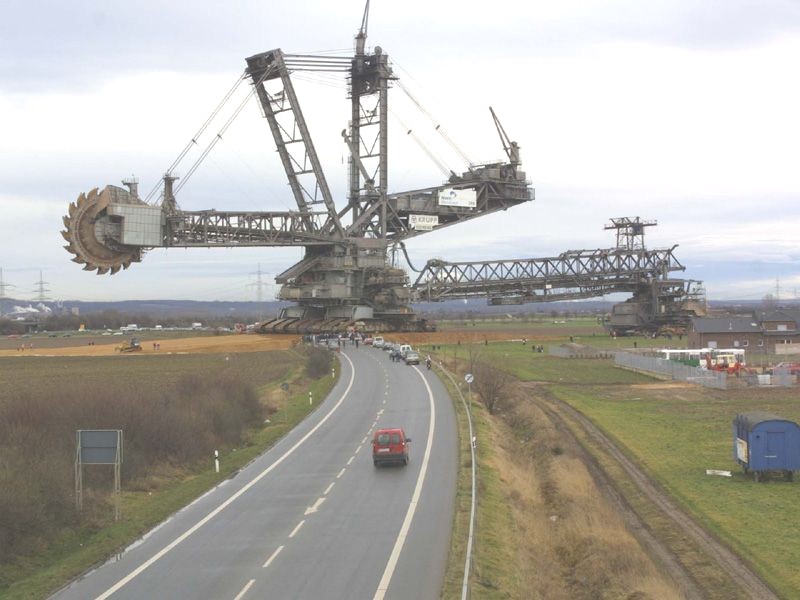
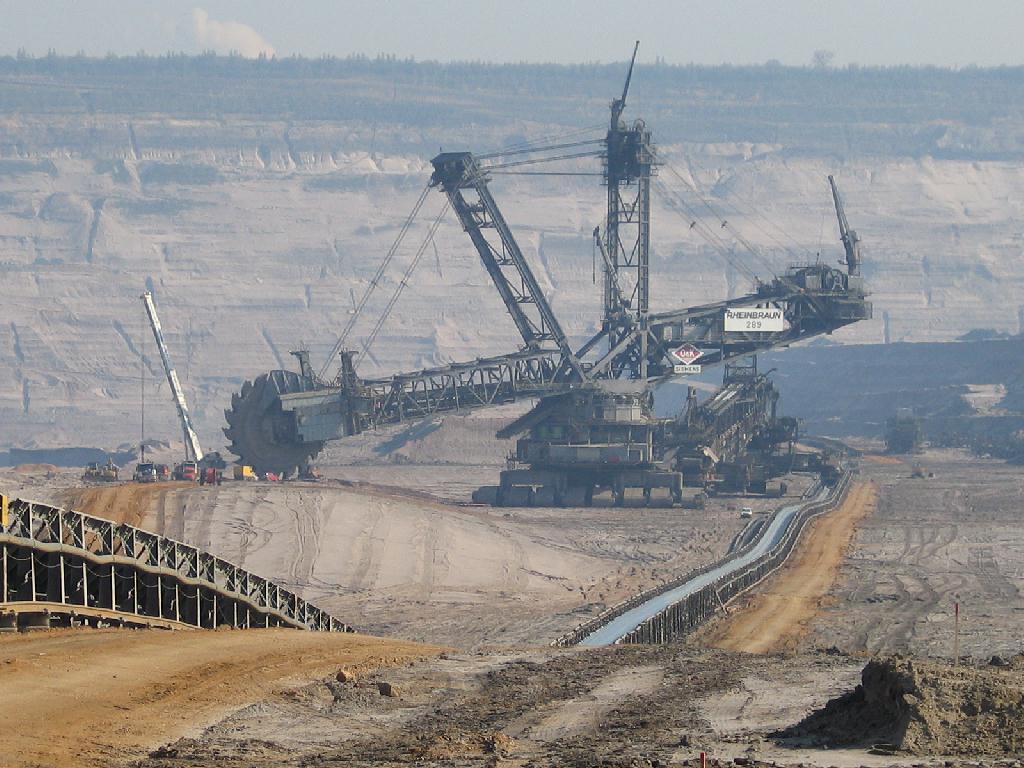
Spot The Bulldozer  

Posted by Big Gav


Found it ?

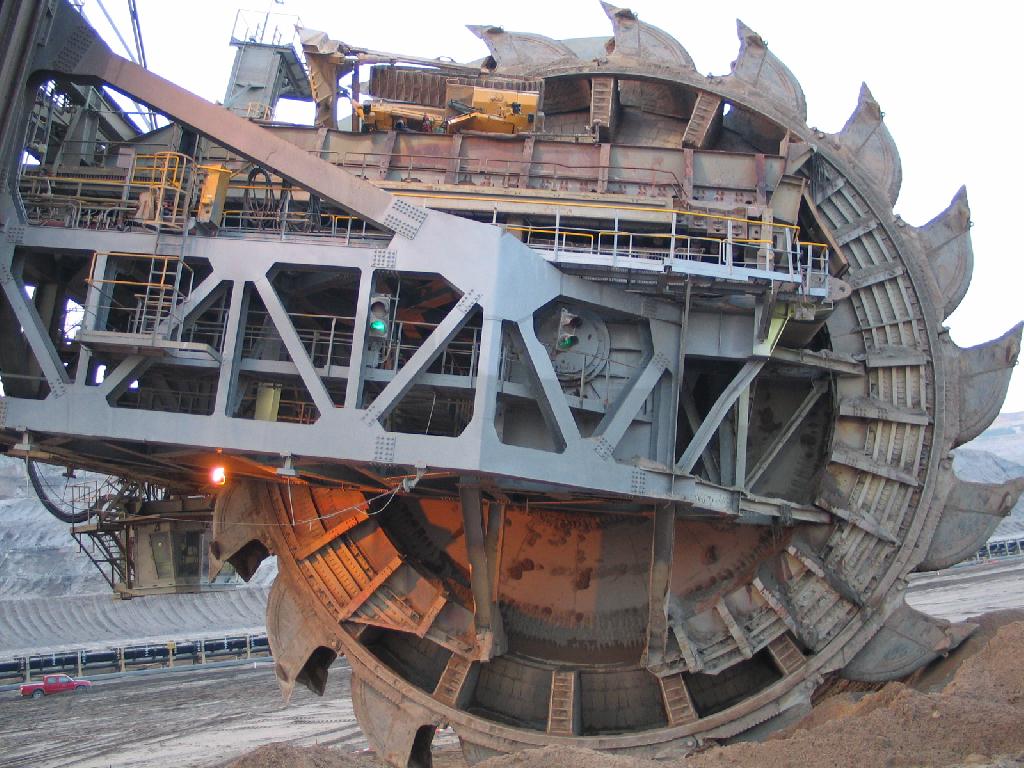
The beast that is eating the bulldozer is a little device used for coal mining.

Most of the coal mines here aren't the "lop the top off the mountain" type discussed elsewhere recently. Instead we tend to have large open cut mines where vast amounts of coal are stripped out of the ground.


Coal quality around the country tends to vary - the mine this monster is working is a "brown" coal field in Victoria - brown coal is lowest quality and particularly polluting. As you go north up the east coast the quality of coal tends to get better and better, with most of the top quality black coal destined for export, particularly to China, which has a voracious appetite for the stuff - they are estimated to be consuming 2.2 billion tonnes a year of coal by 2010.

Coal is actually our largest export, which may give you a clue as to why Australia refuses to sign the Kyoto agreement - its easy to assume we're just being America's lapdog as usual, but in this case there is also a lot of money riding on the decision.


The monster in the pictures has some quite impressive statistics - you certainly wouldn't want to have a collision with it one the freeway:

The Large Bucket Wheel Excavator

* Stands over 95 metres tall
* Is over 215 metres long (2.5 football fields)
* Weighs over 45,500 tons (yes that's 45 thousand tons!)
* Cost US$100 million, took 5 years to design & manufacture and 5 years to assemble on site
* Requires 5 people to operate
* The Bucket Wheel is over 70 feet in diameter with 20 buckets each of which can hold over 15 cubic metres of material.
* It moves on 12 crawlers (each is 3.6 metres wide, 2.4 metres high and 14 metres long) - 8 in front and 4 in back
* It can remove over 76,455 cubic metres of overburden each day

Putting the Kyoto treaty aside, even locally, the variable coal quality here demonstrates just how difficult it is to take any sort of effective action on global warming without firm government intervention.

Australia operates a national electricity grid (well, it doesn't include WA, but they'd prefer to be a separate country anyway) which consists of a number of regional (state) grids connected by interconnectors. All electricity generated is sold into the national market, with generation rights directed to those generators who are willing to sell at the cheapest price via a complicated reverse auction process.

Because brown coal is, to be blunt, noxious crap, it tends to be much cheaper than the better quality black coal. As a result, those electricity generators who burn the brown coal have a financial advantage over those who burn the less bad stuff. So reducing greenhouse gas emissions using any sort of market based solution is a pipe dream.

Caveat Empty  

Posted by Big Gav

From the Bulletin of Atomic Scientists (via Energy Bulletin) comes an analysis of ExxonMobil's view of the oil production curve. Exxon is the biggest and generally most aware of the 5 angry dwarfs (as I recently heard the remnants of the seven sisters disparaging referred too - though the 5 greedy giants may be a more accurate description).

As they have an extremely poor track record when it comes to transparency and market manipulation, which goes right back to the beginning of the oil age, it's best to take anything they say publically with a large shaker of salt - but in this case it would seem to be a quiet admission of the inevitable.

Without any press conferences, grand announcements, or hyperbolic advertising campaigns, the Exxon Mobil Corporation, one of the world's largest publicly owned petroleum companies, has quietly joined the ranks of those who are predicting an impending plateau in non-OPEC oil production. Their report, The Outlook for Energy: A 2030 View, forecasts a peak in just five years.

In the past, many who expressed such concerns were dismissed as eager catastrophists, peddling the latest Malthusian prophecy of the impending collapse of fossil-fueled civilization. Their reliance on private oil-reserve data that is unverifiable by other analysts, and their use of models that ignore political and economic factors, have led to frequent erroneous pronouncements. They were countered by the extreme optimists, who believed that we would never need to think about such problems and that the markets would take care of everything. Up to now, those who worried about limited petroleum supplies have been at best ignored, and at worst openly ridiculed.

Meanwhile, average consumers have taken their cue from the market, where rising prices have always been followed by falling prices, leading to the assumption that this pattern will continue forever. In truth, the market price of crude oil is completely decoupled from and independent of production costs, which average about $6 per barrel for non-OPEC producers and $1.50 per barrel for OPEC producers. This situation has nothing to do with a free market, and everything to do with what OPEC believes will be accepted or tolerated by the United States. The completely affordable market price--what consumers pay at the gasoline pump--provides magisterial profits to the owners of the resource and gives no warning of impending shortages.

All the more reason that the public should heed the silent alarm sounded by the ExxonMobil report, which is more credible than other predictions for several reasons. First and foremost is that the source is ExxonMobil. No oil company, much less one with so much managerial, scientific, and engineering talent, has ever discussed peak oil production before. Given the profound implications of this forecast, it must have been published only after a thorough review.

Technorati tags:

Neocons and Theocons At Armageddon  

Posted by Big Gav

Some history on neocon strategy in the middle east.

In his indispensable study Blood and Oil, Professor Michael Klare shows how the desire to control petroleum reserves in Saudi Arabia and the Persian Gulf has shaped American policy ever since the presidency of Franklin Delano Roosevelt. Klare also shows how the thirst for oil and natural gas now motivates our global misadventures from Central Asia and the Caspian Sea to Sudan and Venezuela.

Decades before Mr. Bush showed the slightest interest in the wider world, neo-conservatives like Richard Perle and Paul Wolfowitz were honing this imperial energy policy, which goes far beyond securing enough oil for Americans to burn. Control of global reserves - and the ability to reward or punish rivals who need the oil and natural gas - is for the neo-cons a primary lever to enhance American power over other nations.

To be fair, they did not invent the idea, parts of which reach back at least as far as earlier empire-builders like Teddy Roosevelt, Admiral Alfred Mahan, and their British counterpart, Lord Curzon. The idea of using oil as a lever later shaped America's conflict with Japan in the run-up to World War II. Even more, it shaped the way Washington kept the Japanese in check after the war.

Perle learned the geo-political uses of oil as a top staff aide to Democratic Senator Henry "Scoop" Jackson, one of the country's leading energy strategists. The eager young aide worked with Jackson all during the 1970s, when American policy-makers were considering a wide range of responses to OPEC's new power and the oil crisis it created.

Wolfowitz got his education as as Deputy Assistant Secretary of Defense during the creation of the Carter Doctrine, which President Jimmy Carter announced in his 1980 State of the Union message. Opening the door to much that has followed, this unilateral edict declared Persian Gulf oil reserves off-limits to domination by any of America's current or potential rivals.

In their many years of pushing Washington to invade Iraq, the neo-cons consistently emphasized the strategic importance of controlling as much of the world's energy supplies as possible. Nowhere did they make this clearer than in the 18 February 1992 draft of the Defense Planning Guidance. Its principal authors were Wolfowitz and Lewis "Scooter" Libby, now Vice President Cheney's chief of staff.

Technorati tags:

Son Of Cold Fusion  

Posted by Big Gav

WorldChanging has a new report on sonofusion [pdf] (acoustic inertial confinement fusion), which is showing some promise as a possible (and practical) source of fusion based energy. It may just be a repeat of the disappointing experience with cold fusion - but you never know - worth keeping an eye on.

In Sonofusion (2004), we talked about Purdue physicists demonstrating thermonuclear fusion takes place in tiny bubbles in liquids hit by a pulse of neutrons and ongoing acoustic oscillation (i.e., sound); In Son of Sonofusion (2005), we talked about researchers at the University of Illinois Urbana-Champaign confirming aspects of the research, including the extremely high temperatures found in the collapsing bubbles (we're talking much hotter than the surface of the Sun). Now sonofusion returns, hotter and more powerful than ever...

If sonofusion works -- and we're probably still another couple of years from having solid confirmation -- it will take a decade or two at least before we could see any real world applications from it. It's not going to save us from having to do the hard work of moving away from fossil fuels. But another decade or two would mean it would be starting to come online in the early part of the 2020s, just when the conversion from gasoline and coal will start to really hit high gear -- an ideal moment, then, for another clean source of power to step onto the stage.

By 2050, we could be living in a world powered by wind, the Sun, and stars in a jar.

Elsewhere at WorldChanging, they have a good post up on quantum solar dots, that looks at possible improvements of solar photovoltaic generation of electricity.
Solar photovoltaic generation of electricity has a big problem: with currently-available technology, it's not terribly efficient. I mean that literally; the "solar constant" is ~1.35 kilowatts of power per square meter, but most off-the-shelf solar panels can only convert about 20-30% of that to electricity. Improvement is clearly possible, and some researchers have figured out ways to boost that efficiency to 50% or more (although some promising developments in flexible, polymer-based photovoltaics are far worse, with only 5-15% efficiency). One of the more interesting approaches involves using selenium "nanocrystals" to boost efficiency to up to 60%. Now researchers at the US Department of Energy's National Renewable Energy Laboratory have pushed that concept to a new potential efficiency peak.

By using lead sulfide as the nanocrystal -- or "quantum dot" -- material, the NREL team claims a potential efficiency of more than 65%. We've noted various worldchanging applications of quantum dots before (for infrared-sensitive polymer photovoltaics with ~30% efficiency, and for high-efficiency reversible thermoelectric materials), and it's clear that nanomaterial and nanofabrication research will be critical for making solar photovoltaic sufficiently efficient for widespread adoption.

Technorati tags:

Surfing Elliot Waves  

Posted by Big Gav

I don't know much about Elliot Waves (although I have done some reading about Krondatieff waves that I find disturbing) - but here's an article about an Elliot Wave guru who thinks oil prices have peaked.

My portfolio today was showing signs of a very strong oil and gas market, so someone is wrong about where oil prices are headed.

The usually bullish New York Institutional Gold Conference took a splash of cold water on its opening day when Elliot Wave guru Robert Prechter said he is monitoring a repeating technical pattern that could prove a downer for commodities. Furthermore he warned that the US economy appears to be rolling over into a deflation he has long warned of.

Speaking on the opening day of the annual New York event, Prechter drew a full house for his keynote presentation which focused on gold, silver, oil and the U.S. dollar.

Prechter was adamant that the rise in commodity prices has not been because of fundamentally higher demand, but rather because all assets have been “captive to the expansion of liquidity since 2001. “There has been a tremendous expansion of liquidity. . . everything inflated. . . now the infusion is slowing and prices are dipping,” he said.

He is especially bearish on oil because of the strong popular consensus that has developed for peak oil accompanied by price targets exceeding $100 a barrel. He likened it to the momentum that spawned a slew of books in the late 1990s with titles alluding to stratospheric general equity prices, such as Dow 100,000.

“If everyone believes [oil is about to run out] then that must already be priced in. So it has a long way to go. . . down,” said Prechter.

Prechter says the turn in prices now being seen presages an economy “rolling over to deflation.” “It will surprise everyone. You’re not safe anywhere . . . not even in gold or silver,” was his gloomy conclusion.

Technorati tags:

CO2 Injection  

Posted by Big Gav

The Oil Drum has a post up on increasing efficiency of oil extraction using CO2 injection. There are a few caveats - as I noted a while ago, you need to be on land - you also need to be near a CO2 source, such as a power station.

One of the more promising techniques for EOR is injecting carbon dioxide into a layer of rock that still has oil, but where it cannot easily be obtained normally. There are two benefits to using CO2. One of these is to strip some of the gas out of the atmosphere. The University of Texas recently showed that they could inject liquid CO2 into a depleted oil reservoir, and because the reservoir was a fluid trap, it would hold the gas and keep it from getting back into the reservoir.

But the benefits extend beyond that. An experiment that the Globe and Mail referred to has been going on in the Weyburn oil field in Saskatchewan for the last five years. CO2 from a synthetic fuel plant in North Dakota is piped to the oilfield and injected. While the reservoir holds the gas, the mix with the oil, means that the oil flows out of the well more easily.

Technorati tags:

Time Ripe For Urban Agriculture  

Posted by Big Gav

Energy Bulletin has a good article up on promoting urban agriculture.

Is America ready for a metropolitan agriculture policy? Is the time ripe to take some of the billions in subsidies now flowing to big commodity-crop operators and focus instead on sustainable farm production in and around the citistate regions where 80 percent of us live?

Rep. Earl Blumenauer, D-Ore., and the man who founded Congress' Livability Caucus, argues that with half of federal farm subsidies currently "flowing to six states to produce 13 commodities that in the main we don't need, like corn, wheat, cotton, and rice," there's a dramatically superior alternative.

We should, says Blumenauer, "use that money to build sustainable agriculture, create a farmer's market in every community, help farmers protect our land and water, preserve our watersheds, foster land banks and control erosion."

Historically, he argues, our metropolitan regions weren't just centers of commerce but areas of fertile fields, often in lush river valleys. Even today, they have some of America's best land for sustainable agriculture. "With small diversions from the agriculture bill," argues Blumenauer, "we could provide grants for communities to develop year-round farmers' markets" and help local producers provide fresh vegetables and fruits, high-quality cheeses, honeys, nuts and more.

It's not hard to dismiss Blumenauer's idea. Small-scale agriculture has been losing out to big (and increasingly subsidized) farm operations for decades. This winter, the Bush administration quickly retreated from its proposal to significantly trim payouts to the mega-producers.

Technorati tags:

Sodom and Gomorrah  

Posted by Big Gav

For those of you who haven't visited the Cascadian branch of Peak Energy lately, MonkeyGrinder has an impressively passionate rant (or perhaps even a tour-de-force) up.

Greenspan Says Everything Is Fine  

Posted by Big Gav

Noted energy expert Alan Greenspan says that high prices will spur development of alternatives before oil reserves are depleted. Thats comforting (it must be very relaxing being an economist) - but it would be nice if he would specify exactly which alternatives will fill our energy needs. I also note that after a few rocky weeks most oil and gas stocks here are heading back to record levels, even with the price of oil almost 20% lower than it was a few weeks ago.

Federal Reserve Chairman Alan Greenspan said Friday that oil markets may stay turbulent "for some time to come," but he predicted that high prices will spur the use of cheaper alternatives well before the world's oil reserves are depleted. In a speech in New York, Greenspan again offered an optimistic assessment of how oil prices will affect the global economy. Already, he said, U.S. crude-oil inventories have risen to their highest level in three years, helping to abate the recent "price frenzy" in oil markets.

"If history is any guide, oil will eventually be overtaken by less-costly alternatives well before conventional oil reserves run out," Greenspan said in prepared remarks to the Economic Club of New York. But that, he said, will take time. For now, "we, and the rest of the world will have to live with the geopolitical and other uncertainties of the oil markets for some time to come," Greenspan said.

Since Greenspan last spoke on energy, crude-oil prices have dropped more than $10 from a record high of about $58 a barrel and the U.S. economy has shown renewed signs of strength. Oil traders, however, expect prices to surge again in the second half of the year ahead of the winter, when demand peaks.

Technorati tags:

Paranoia Runs Deep  

Posted by Big Gav

James Kunstler has a new blog post up - I'm not sure why he thinks belief in a June attack on Iran is paranoid (you only have to read what Dick Cheney and Seymour Hersh have said, both of whom I think you can take at their word - at least when it comes to threats from Cheney - to come to that conclusion) - but there you go - I guess paranoia is in the eye of the beholder.

"Paranoia runs deep; into your life it will creep. . . ."
So went the lyrics to the old Buffalo Springfield song from the tumultuous Vietnam War years and now, as Yogi Berra also said around the same time, "it's like deja vu all over again."

I like to claim that I am allergic to conspiracy theories and the paranoia that attends them. But these days I'm not so sure anymore. The noise in the system is getting pretty thick, and the Internet is the perfect system for paranoia because any website can appear to be dignified and therefore to speak with some kind of authority. You have to sort out the reality from the noise the best that you can on your own. (So maybe it's not such a bad thing that this blog is so amateurish-looking, as many readers complain.)

The latest paranoid thread out there is that the US Military is waiting to commit a June assault on Iran's nuclear facilities, and that the Bush administration has been manipulating the stock markets up and the oil markets down in an attempt to to lull the public deeper into its coma of cluelessness by making the surface of American life seem placid.

I really don't know what the government is capable of doing to tweak the markets. It certainly has access to a lot of nominal "money," and I suppose that it is not to difficult to put that money into "play," by funneling it this way and that way through large institutions and agencies. The current crisis of capital derives from the fact that the American economy produces fewer and fewer things of enduring value -- and more and more fluff in the form of Star Wars movies

I'd also say that the Iran thread is an old "paranoid" thread now (i've been muttering about it forever), and that "Star Wars" movies are actually an example of one of the few industries that make money sustainably - intellectual output is something that doesn't require particularly cheap energy, unlike a lot of manufacturing industries that build tangible, yet useless, objects. Manipulation of the markets is less clear cut, but the rumours are quite intense lately - such as the notes on weirdness in the treasuries market I posted recently.

Still - there is plenty of paranoia and conspiracy theorising going on out there, if you know where to look...

Technorati tags:

Crude Awakening  

Posted by Big Gav

TreeHugger has a brief note on the series in the Canadian "Globe and Mail" on peak oil.

The Globe and Mail, Canada's major serious newspaper, has started a seven day series "Crude Awakening" about the effects of Peak Oil on Canada and the World. Articles today include Supply- Are Saudi reserves drying up? and Demand- the Unquenchable thirst of China.-a scary combo. It is available online but unfortunately the remarkable two page graphic on supply and demand is not.

Canada's oil sands are also the topic of an article examining the environmental devastation caused by extracting oil from the tar sands in the San Francisco Gate. It sounds like converting all of Canada's tar sands into oil should emit enough greenhouse gasses to fry every last one of us - but they may run out of the natural gas used in the process first - so start praying for natural gas depletion to kick in early.
Nowhere else is the conflict between energy use and ecological cost so stark. "The oil sands are a big challenge," Canada's environment minister, Stephane Dion, who has fought publicly with other Cabinet officials for a tougher line on global warming, said in an interview. "They are sending out a lot of greenhouse gas emissions. "But there is no minister of the environment on Earth who can stop this from going forward, because there is too much money in it," Dion said.

The sands make up three broad oil fields, the combined size of Florida, in northern Alberta 500 miles from the U.S. border. Up close, a visitor quickly enters a world of vast industrial scale, in which the tar-like scent of the sands permeates everything. The largest of the pits is a 50-square-mile moonscape of slag heaps and tailings ponds owned by Syncrude, a consortium of Canadian and American companies. Next to the pit is a refinery -- or upgrader, in oil sands terminology -- whose towers, tanks, pressure chambers and spaghetti-like piping cover 1,000 acres.

As these pits are depleted, companies will be forced to go after deeper deposits. Those are extracted by a process known as "in situ," or in position, in which steam is pumped into underground deposits to dissolve the thick oil and allow it to be piped to the surface. In-situ work is much more expensive than open-pit mining, requiring about four times as much natural gas to create the steam.

In both methods, the extremely heavy oil that is produced, called bitumen, has to be further refined into lighter synthetic crude oil before it can be piped to customers, mostly in the U.S. West and Midwest, for further refining and distribution. Even though costs have dropped, the oil sands process remains inefficient. Two tons of sand yield a single barrel -- 42 gallons -- of oil. On average, each barrel creates more greenhouse gas emissions than four cars do in a day.

Elsewhere at TreeHugger there are some notes on alternative energy and energy efficiency - generating electricity from elephant dung (OK - so thats a pretty small niche), mapping the world's wind reserves (the west coast of Tassie is the best bit of Oz apparently), news of the world's first commerical wave powered energy generation in Portugal (also noted by WorldChanging), eco-efficient air conditioning and finally a list of online resources on hybrid cars.

Technorati tags:

Deputy PM Fears For Oil Reserves  

Posted by Big Gav

John Anderson has mentioned peak oil a few times now, most recently on the ABC - I wonder if the rodent is ever going to start talking about it ?

Deputy Prime Minister John Anderson believes high fuel prices reflect the inevitable decline in the world's oil and gas reserves. He expressed deep concern about the long-term future of oil and says fuel prices will have to be high enough to encourage more exploration.

Mr Anderson says the world could reach peak production of oil and gas far sooner than predicted because of the rapid increase in energy demands in China. "We are using stored energy left over from ages gone by at an alarming rate and it isn't re-making," he said.

Elsewhere in local peak oil news, "Possum News Network" (no, I've never heard of them either, and neither have the possums in the trees outside my flat) has a report on peak oil and its impact on Australia.
We are now in overshoot mode as far as the provision of additional oil dependent infrastructure is concerned. In the last 50 years this infrastructure grew along the path of increasing oil production. Now, shortly before the peak, it would be uneconomic to provide new capacities which would be utilized for only a couple of years and would then no longer be needed.

Alternatives to oil are limited. If we turned all Australian sugarcane into ethanol, it would yield just 5 litres per car per week. If all our oil seeds were used to make biodiesel, production would just cover 6 per cent of our diesel consumption. It’s been estimated that if the UK’s whole car fleet were hydrogen powered cars, that country would require a hundred nuclear power plants.

Once Peak Oil is understood, there can be no more business as usual. But what do we have to do? Here is a first list:

• Australian car manufacturers must produce thrifty hybrid cars. Low fuel consumption, not generous accessory packages and other electrically powered equipment, is needed.

• Stop building tollways, road tunnels and car parks. RailCorp is so busy trying to finish the Chatswood-Epping line and their clearway program, as well as training new drivers, that we can’t expect much more from heavy rail before the oil peak.

• Rescue our tollway companies. They’d have to convert car lanes to rail tracks and run light rail on them, with connecting feeder buses to the suburbs and heavy rail interchanges The RTA will have to do the same with all major urban roads.

• Replace domestic flights up to 1,000 km with electric night trains running on improved track. Long distance truck traffic will have to be moved to rail either as containers or by using rolling highways where trucks and trailers are loaded onto special flatbed cars.

• Forget desalination plants powered by electricity from coal. Peak Oil will trigger a general energy crisis and make electricity very expensive. Rainwater harvesting, both by private home owners and by local government, should be mandatory.

• No more subdivisions in the west of Sydney, as these will just increase long distance commuting. A vigorous program of decentralisation to smaller cities along the coast and outside commuting distance from Sydney should accommodate the 30 per cent of population growth now earmarked for Greenfield sites. Town planning guidelines should favor cycling and walking to work by reducing commuting distances.

• We need to preserve good agricultural land in the Sydney basin for vegetable production because long distance transport by truck will become prohibitively expensive in the future.

In short, we need a 180 degree turnaround from what we’re doing today.

Technorati tags:

Goodbye American Dreamland  

Posted by Big Gav

For those who haven't seen it around the traps yet, here's an article from Culture Change's Jan Lundberg outlining a fast crash scenario.

The scenario I foresee is that market-based panic will, within a few days, drive prices up skyward. And as supplies can no longer slake daily world demand of over 80 million barrels a day, the market will become paralyzed at prices too high for the wheels of commerce and even daily living in "advanced" societies. There may be an event that appears to trigger this final energy crash, but the overall cause will be the huge consumption on a finite planet

The trucks will no longer pull into Wal-Mart. Or Safeway or other food stores. The freighters bringing packaged techno-toys and whatnot from China will have no fuel. There will be fuel in many places, but hoarding and uncertainty will trigger outages, violence and chaos. For only a short time will the police and military be able to maintain order, if at all. The damage that several days' oil shortage and outage will do will soon wreak permanent damage that starts with companies and consumers not paying their bills and not going to work.

After an almost instant depression seizes the modern industrialized world, and nation-states break down, the frantic attempts of people to feed themselves, stay warm and obtain fresh water (pumped presently via petroleum to a great extent), there will be no rescue. Die-off begins. The least petroleum-dependent communities will survive best. These "backward" nations will be emulated by the scrounging survivors of the U.S. and the rest of the "developed" world, as far as local food production will be tried -- in a paved-over, toxic landscape by people who have lost touch with the land.

What about renewable energy and other alternatives? They are not ready and will never be as long as oil is king. This is something not acknowledged by the boosters of the technofix. When oil abdicates, no one can fill the shoes.

Technorati tags:

US House Rejects Lifting Offshore Drilling Ban  

Posted by Big Gav

Interesting to see that energy security concerns (not that they'd really be alleviated in any meaningful way by more drilling) haven't overwhelmed environmental conerns just yet - expanded offshore drilling in the US is still being blocked. (via Grist).

Peterson said lifting the drilling ban was necessary to ease skyrocketing natural gas prices that hurt senior citizens living on fixed incomes and force US companies to relocate overseas where gas is cheaper. "As long as the door is shut on domestic natural gas production, we will continue to export American jobs, pay higher energy bills, and prop up rogue nations that control the oil and gas spigots of the world," Peterson said.

However, opponents said the plan would violate the rights of states to protect sensitive coastal and marine areas. "This amendment is bad policy and reflects the misguided attempt to try and drill our way out of energy problems," said Democratic Rep. Lois Capps of California. "It takes only one accident or spill to devastate the local marine environment and economy."

US natural gas production is expected to fall further behind growing demand, especially from new power plants fueled by gas, making the country more dependent on imports.

Also noted by Grist, the debate on what is less environmentally unfriendly - cloth or disposable nappies - has ended in a draw - apparently they both suck equally. Nevertheless - I still think biodegradable nappies should be used if possible (especially if they are produced somewhere that doesn't require them to be hauled half way around the world (as most of them seem to be produced in Europe).

And on a more disturbing note, lunatic US fundamentalist Senator Inhofe (who lists despoiling the atmosphere amongst his favourite hobbies while waiting for the Rapture) is linking people who support environmental organisations with terrorism. So next time you hug a tree (or make a donation to Greenpeace), watch out - you might find yourself sharing a cell with some random Muslim who's just been hauled off the streets as well.
Now, I don't really have a conspiratorial temperament. I tend to think that stupidity is responsible for far more of what ails the world than evil -- which is why I'm more optimistic than many of my eco-brethren. However, this seems worth worrying about. After all, as the old saying goes, it's not paranoia if they're really watching you.

Trying to drum up this sort of frenzy serves dual, overlapping purposes. One, it reignites some of the flagging terrorist hysteria that does so much to prop up the right wing, greasing the skids for a further expansion of domestic police powers. Two, it works to discredit the green movement as a whole, greasing the skids for further deregulation of corporate power. At the Senate Environment and Public Works Committee show trial yesterday, they trotted an FBI flunky in to proclaim earnestly that the ELF and the ALF constitute the single greatest domestic terrorist threat the nation faces today.

Technorati tags:

Statistics

Locations of visitors to this page

blogspot visitor
Stat Counter

Total Pageviews

Ads

Books

Followers

Blog Archive

Labels

australia (619) global warming (423) solar power (397) peak oil (355) renewable energy (302) electric vehicles (250) wind power (194) ocean energy (165) csp (159) solar thermal power (145) geothermal energy (144) energy storage (142) smart grids (140) oil (139) solar pv (138) tidal power (137) coal seam gas (131) nuclear power (129) china (120) lng (117) iraq (113) geothermal power (112) green buildings (110) natural gas (110) agriculture (91) oil price (80) biofuel (78) wave power (73) smart meters (72) coal (70) uk (69) electricity grid (67) energy efficiency (64) google (58) internet (50) surveillance (50) bicycle (49) big brother (49) shale gas (49) food prices (48) tesla (46) thin film solar (42) biomimicry (40) canada (40) scotland (38) ocean power (37) politics (37) shale oil (37) new zealand (35) air transport (34) algae (34) water (34) arctic ice (33) concentrating solar power (33) saudi arabia (33) queensland (32) california (31) credit crunch (31) bioplastic (30) offshore wind power (30) population (30) cogeneration (28) geoengineering (28) batteries (26) drought (26) resource wars (26) woodside (26) censorship (25) cleantech (25) bruce sterling (24) ctl (23) limits to growth (23) carbon tax (22) economics (22) exxon (22) lithium (22) buckminster fuller (21) distributed manufacturing (21) iraq oil law (21) coal to liquids (20) indonesia (20) origin energy (20) brightsource (19) rail transport (19) ultracapacitor (19) santos (18) ausra (17) collapse (17) electric bikes (17) michael klare (17) atlantis (16) cellulosic ethanol (16) iceland (16) lithium ion batteries (16) mapping (16) ucg (16) bees (15) concentrating solar thermal power (15) ethanol (15) geodynamics (15) psychology (15) al gore (14) brazil (14) bucky fuller (14) carbon emissions (14) fertiliser (14) matthew simmons (14) ambient energy (13) biodiesel (13) investment (13) kenya (13) public transport (13) big oil (12) biochar (12) chile (12) cities (12) desertec (12) internet of things (12) otec (12) texas (12) victoria (12) antarctica (11) cradle to cradle (11) energy policy (11) hybrid car (11) terra preta (11) tinfoil (11) toyota (11) amory lovins (10) fabber (10) gazprom (10) goldman sachs (10) gtl (10) severn estuary (10) volt (10) afghanistan (9) alaska (9) biomass (9) carbon trading (9) distributed generation (9) esolar (9) four day week (9) fuel cells (9) jeremy leggett (9) methane hydrates (9) pge (9) sweden (9) arrow energy (8) bolivia (8) eroei (8) fish (8) floating offshore wind power (8) guerilla gardening (8) linc energy (8) methane (8) nanosolar (8) natural gas pipelines (8) pentland firth (8) saul griffith (8) stirling engine (8) us elections (8) western australia (8) airborne wind turbines (7) bloom energy (7) boeing (7) chp (7) climategate (7) copenhagen (7) scenario planning (7) vinod khosla (7) apocaphilia (6) ceramic fuel cells (6) cigs (6) futurism (6) jatropha (6) nigeria (6) ocean acidification (6) relocalisation (6) somalia (6) t boone pickens (6) local currencies (5) space based solar power (5) varanus island (5) garbage (4) global energy grid (4) kevin kelly (4) low temperature geothermal power (4) oled (4) tim flannery (4) v2g (4) club of rome (3) norman borlaug (2) peak oil portfolio (1)