Will Silicon Light Illuminate the Future?  

Posted by Big Gav

Technology Review has a look at developments in silicon-based lighting and its potential to compete with conventional (energy wasting) incandescent bulbs and existing LED-based lighting.

Researchers at a Canadian startup say they've found a way to make low-cost, white-light LEDs that could one day end our addiction to inefficient incandescent bulbs. They claim to have cracked the cost barrier for solid-state lighting by replacing the expensive semiconductors compounds traditionally used in LEDs with low-cost silicon.

"Because it's a silicon-based system, we think [the lighting] will be affordable," says Stephen Naor, chief executive officer of Ottawa-based Group IV Semiconductor (named after silicon's position in the periodic table). "That's critical, because if you don't have affordability, then nobody is going to buy it."

Roughly 60 percent of all lightbulbs in the world are still incandescent--and for good reason: most cost pennies to produce. However, 95 percent of the energy used by these bulbs is wasted as heat. Solid-state lighting is already widely used for specialty applications; LEDs on Christmas tree lights, for example, are based on gallium nitride semiconductors. And experts predict that this technology will be increasingly used for general lighting purposes.

...

CEO Naor says Group IV's silicon-based light chips could use up to 90 percent less energy than incandescent bulbs and last up to 50 times longer. He adds that the ultimate goal is to have brighter, higher quality light at far less cost than conventional LEDs, which today can run around $40 for bulbs containing a cluster of 36 LEDs. "You can build an LED lightbulb out of many LEDs," he explains. "But we anticipate one [silicon-based] chip will be bright enough to replace a 100-watt lightbulb, so in that sense we're brighter. And that one chip has huge cost benefits."

But Naor concedes that Group IV's technology is not yet ready to take on conventional LEDs. "We have a lot of work ahead to get brighter, to get it to the efficiency we're targeting, and of course to get the lifetimes that the industry is expecting."

Meanwhile, the traditional LED market isn't standing still. San Jose, CA-based Philips Lumileds Lighting, the world's largest manufacturer of high-powered LEDs, continues to roll out products. The Optoelectronics Industry Development Association estimates that the mass substitution of incandescent lighting with LEDs could happen by 2012, while significant displacement of fluorescent technology would follow several years later.

Technology Review also has a skeptical look at GM's Fuel Cell Strategy, pointing out the advantages of plug in hybrid vehicles.
Last month, GM announced plans to distribute 100 fuel-cell-powered vehicles to customers next fall, along with plans to develop home-based hydrogen refueling stations. It's the automaker's latest move in its stated goal to build the world's largest fuel-cell vehicle fleet. The first 100 vehicles will be available for evaluation in California, New York, and Washington, DC.

But, from an environmental and technical standpoint, does it make sense?

Fuel-cell vehicles, which are being developed by other automakers as well, are powered by electricity generated from hydrogen. They emit only water vapor from their tailpipes, and the fuel cells are significantly more efficient than an internal-combustion engine in extracting energy from the fuel.

But GM's focus on creating a fleet of hydrogen fuel-cell vehicles could be a costly mistake as a strategy for combating global climate change and for decreasing U.S. dependence on oil, many energy experts say. The problem, these critics argue, is that powering electric vehicles with hydrogen fuel cells is both inefficient and expensive.

Wired's "Autopia" blog has a post on the Case for Plug-in Hybrids and talks a little about the V2G concept.
Last month I questioned the wisdom of connecting a plug-in hybrid to the grid, but after hearing James Woolsey speak I'm a bit more open to the idea.

Woolsey, who at one time was the head of the CIA, is passionate about freeing us from oil dependency for national security reasons, and he wowed a crowd of financiers last week at a clean energy conference in Seattle with his justification for plug-in hybrids. He argues that in addition to substantially reducing the amount of oil we import, plug-in hybrids can also serve as battery backups for the power grid.

If we had a few million plug-in hybrids, their batteries could collectively be tapped by the electric utilities during peak demand. The vehicles would recharge at night, and then if we get an electricity crunch, electricity from the cars could be sent upstream, which is cheap and cleaner than what utilities do now -- burn more expensive natural gas or fire up their dirtiest coal power plants. The vehicle owners would be compensated by receiving the substantial difference between what they paid for off-peak to peak power.

The other benefit is to supplement the grid in time of crisis. If terrorists destroy a power station, then individuals could use their cars to keep their houses functioning until power is restored. This also would come in handy for natural disasters too. In addition to the getting power from the grid, Woolsey argues that homes with small solar arrays could also keep vehicles charged.

The Onion appears to think the word hybrid is getting a little over-hyped, reporting Green-Conscious GE Develops Hybrid Lightbulb.
One year after pledging to develop more energy-efficient products, General Electric Co. unveiled a product it is calling its most eco-friendly lighting source to date: the first-ever gasoline-electric hybrid lightbulb. "With the price of petrol escalating as its supply dwindles, now is the perfect time to introduce innovative lighting technology that only relies on this fast-depleting, nonrenewable resource for a portion of its power," GE chairman Jeff Immelt said in a statement released Monday.


If the Wisebulb, which will be available in stores by November for the retail price of $89.99, is used only for recommended short-term, dim, and frequent on-and-off lighting, it could eliminate nearly 80 percent of global-warming pollution that would be caused by using solely gas-powered lightbulbs, GE spokesman Brian Tormey said.

"A full tank of gas can illuminate a hybrid bulb for an average of two weeks," Tormey said. "Once the 1.5-gallon tank is empty, all customers have to do is drive their lightbulb to the gas station and fill it up for only about $6."

The hybrid bulb's structure—slightly more complex than the older filament-and-wire models—features a small, efficient four-cylinder internal-combustion engine at the base of the bulb that powers an electric generator attached to the glass mount. The generator produces electricity that is then fed to the electric motor, which ignites a small flame inside the glass casing. Any excess electricity is used to charge the bulb's 300-volt lead-acid battery, which at full capacity is capable of independently lighting a 60-watt bulb for up to 30 minutes.

The "Peak Oil and Permaculture" roadshow has made its way onto ABC Radio National.
Today on the program, a public forum on the future of oil and what falling global reserves may mean for our economies and societies.

A recent Senate committee interim report said Australia should be planning now for 'peak oil' - the point at which international demand for oil begins to outstrip supply.

Research bodies liked the International Energy Agency and some oil company executives dispute the peak oil theory but there are also plenty of well credentialled peak oilers, including some experts with considerable experience in the industry, who say peak oil is a real problem.

Today, in a public forum I hosted in Melbourne in early September, we hear from five people who believe, like the Senate Committee, that Australia needs to start preparing now for future oil security.

Guests:
Richard Heinberg
Journalist and Peak Oil writer

David Holmgren
Permaculture originator

Ken Davidson
Journalist, The Age

Elizabeth Heij
Facilitator of the CSIRO Sustainability Network

Philip Sutton
President, Sustainable Living Foundation

It seems high fuel prices have managed to reduce air travel, which should make George Monbiot happy.
HIGH oil prices have forced Australians to change their transport plans in the air as well as on the ground. They are taking fewer plane trips because of fuel surcharges imposed by airlines.

Analysis by CommSec shows the cost of air travel rose 3.9 per cent last financial year despite price discounting led by the Qantas offshoot, Jetstar. Consumers responded by making 1.5 per cent fewer plane trips.

Reduced air travel coincides with a 2.9 per cent drop in international visitors to Australia in the year to August.

The Australian's "Criterion" column has a long look at local coal seam methane producers in "Not Just Hot Air".
A decade ago, the idea of tapping methane from coal seams was about as fanciful as harvesting gas from flatulating cows. After all, Australia has plentiful reserves of conventional natural gas.

The trouble is, the gas reserves aren't conveniently located to serve the fast-growing southern Queensland and northern NSW markets. Energy shortages are looming and the gap will widen if the delayed PNG gas pipeline does not eventuate.

Already, 25-30 per cent of Queensland's gas is derived from coal seam gas (otherwise known as coal-bed methane gas), up from 2 per cent in 1998. Until recently, coal-seam methane was a dangerous and unwanted by-product of coal mining.

In a further sign of a maturing sector, Santos last week bid $606 million for the biggest producer, Queensland Gas Company (QGC, $1.45). Last year Santos paid a similar amount for Tipperary's stake in the Fairview seam, while Arrow Energy (AOE, 86.5c) paid $140 million for CH4 Gas.

The prevailing view is, Santos has raised the price bar: the bid values QGC's 2P (proven and probable) reserves of 422 petajoules at a "pretty rich" (Macquarie Equities' words) $1.36 per gigajoule. There's a good chance QGC can increase these reserves to 1000PJ, which would make Santos look smarter.

With about 20 companies now involved in the CSG sector, it's reasonable to expect a further shakeout.

But investors shouldn't rely on Santos sparking an acquisition race at silly multiples. Their choice is between the established producers - the likes of Queensland Gas, Arrow Energy, Origin and Santos - or a good spread of emerging plays.

Of the juniors, Eastern Star Gas (ESG, $1.85) boasts the land's biggest onshore natural gas accumulation, so given such a "look at me" assertion we have to take notice. Eastern Star's Gunnedah Basin project contains rated P3 reserves of 17,000PJ, more than three times Australia's current average consumption of all types of energy (P3 reserves are proven, probable and possible - otherwise known as an educated guess).

...

Sydney Gas has a half stake in the Camden Gas Project, having sold down full ownership of the deposit to operating partner AGL.

Criterion rates Metgasco, Molopo and Eastern Star as SPECULATIVE BUYS.

As for Sydney Gas, no one doubts the quality of its asset, so perceptions about former management have much to do with the share price malaise. So we also rate it a SPECULATIVE BUY, in the hope it can benefit from higher NSW gas prices relative to Queensland's.

There's reasonable scope for another offer for Queensland Gas despite Santos's full price, so QGC investors should HOLD. We also rate Arrow a HOLD.

Vaunted counter-bidders for QGC include Origin Energy, AGL and Babcock & Brown, although the former two may be preoccupied in the retail energy market.

It's a given that the eastern seaboard's demand for gas will soar, but not every CSG hopeful will make the grade. The winners will be those who take advantage of the PNG pipeline uncertainties to snare long-term customer contracts.

The Australian also reports that the US is hatching a plot to carve up Iraq. I thought that was the plan all along - did The Australian only just work this out ?
AN independent commission set up by the US Congress is believed to be drawing up a plan to carve up Iraq into three highly autonomous regions.

The Iraq Study Group, co-chaired by James Baker, the former US secretary of state, is preparing to report to President George W. Bush next month amid signs that sectarian violence and attacks on coalition forces in Iraq are spiralling out of control.

The conflict is claiming the lives of 100 civilians a day and bombings are at record levels.

Rumours about a pre-election invasion of Iran continue to circulate (with the Republicans looking headed for a thrashing at this point) - here's one from Past Peak.
Chris Hedges, who used to be the Middle East bureau chief for the New York Times, thinks a Bush administration attack on Iran is inevitable. And the disaster that follows, he says, will be, quite literally, apocalyptic. Excerpts:
The aircraft carrier Eisenhower, accompanied by the guided-missile cruiser USS Anzio, guided-missile destroyer USS Ramage, guided-missile destroyer USS Mason and the fast-attack submarine USS Newport News, is, as I write, making its way to the Straits of Hormuz off Iran. The ships will be in place to strike Iran by the end of the month. It may be a bluff. It may be a feint. It may be a simple show of American power. But I doubt it.

War with Iran — a war that would unleash an apocalyptic scenario in the Middle East — is probable by the end of the Bush administration. It could begin in as little as three weeks. This administration, claiming to be anointed by a Christian God to reshape the world, and especially the Middle East, defined three states at the start of its reign as "the Axis of Evil." They were Iraq, now occupied; North Korea, which, because it has nuclear weapons, is untouchable; and Iran. Those who do not take this apocalyptic rhetoric seriously have ignored the twisted pathology of men like Elliott Abrams, who helped orchestrate the disastrous and illegal contra war in Nicaragua, and who now handles the Middle East for the National Security Council. He knew nothing about Central America. He knows nothing about the Middle East. He sees the world through the childish, binary lens of good and evil, us and them, the forces of darkness and the forces of light. And it is this strange, twilight mentality that now grips most of the civilian planners who are barreling us towards a crisis of epic proportions. [...]

These men advocate a doctrine of permanent war...[b]ut this war will be different. It will be catastrophic. It will usher in the apocalyptic nightmares spun out in the dark, fantastic visions of the Christian right. And there are those around the president who see this vision as preordained by God; indeed, the president himself may hold such a vision.

The hypocrisy of this vaunted moral crusade is not lost on those in the Middle East. Iran actually signed the Nuclear Non-Proliferation Treaty. It has violated a codicil of that treaty written by European foreign ministers, but this codicil was never ratified by the Iranian parliament. I do not dispute Iran's intentions to acquire nuclear weapons nor do I minimize the danger should it acquire them in the estimated five to 10 years. But contrast Iran with Pakistan, India and Israel. These three countries refused to sign the treaty and developed nuclear weapons programs in secret. Israel now has an estimated 400 to 600 nuclear weapons. The word "Dimona," the name of the city where the nuclear facilities are located in Israel, is shorthand in the Muslim world for the deadly Israeli threat to Muslims' existence. What lessons did the Iranians learn from our Israeli, Pakistani and Indian allies? [...]

And another from the way-out-left Michel Chossudovsky.
The overall significance of these military drills must be assessed in relation to the sequence of Russian, Chinese and Iran war exercises conducted since late August.

There is a consistent pattern. These war games are not isolated events. They are part of a carefully coordinated endeavor, in response to the US-NATO military build-up. They should also be considered as acts of deterrence, intended to display military capabilities to deter military action by US led coaltion.

The issue of war preparation has been carefully avoided by the Western media. The sequence and interrelationship between these war games is not mentioned.

While the war exercises are casually acknowledged in separate wire service reports, the Western media fails to address the broader implications of these military exercises.

Military Alliances

The SCO and CSTO war games must also be examined in relation to the structure of military alliances. Both China and Russia are allies of Iran, involved in extensive military cooperation agreements.

China and Russia are major actors in Central Asian oil. They have significant strategic and economic interests in the Central Asian region and the Caspian sea basin. They also have economic cooperation agreements with Iran's State oil company.

US Sponsored Military Build-Up

The Cold War although officially over has not quite reached its climax.

The US military agenda is not limited to gaining control over Iran's oil and gas reserves, (using the "campaign against international terrorism" as a pretext). Reminiscent of the Cold war era, the objective of US military intervention also consists in weakening and ultimately displacing China and Russia from playing a significant role in Central Asia.

Most Western press reports have failed to acknowledge the seriousness of the US-NATO- Israeli military build-up. Underlying what is normally understood as a Middle East war, the conflict could evolve towards a clash between former competing super powers of the Cold War era.

Directed against Iran and Syria, the US sponsored military operation, if it were to be launched, could result in a broader conflict marked by the indirect involvement of Russia and China and their central Asian allies. In fact that indirect involvement is already established through Iran's observer status to the SCO, various bilateral military cooperation agreements as well as the sale of Chinese and Russian weapons systems to Iran.

...

The threat of an Al Qaeda "Attack on America" is being used profusely by the Bush administration and its indefectible British ally to galvanize public opinion in support of a global military agenda.

Known and documented, the "Islamic terror network" is a creation of the US intelligence apparatus. Several of the terror alerts were based on fake intelligence as revealed in the recent foiled "liquid bomb attack". There is evidence that the several of the terrorist "mass casualty events" which have resulted in civilian casualties were triggered by the military and/or intelligence services. (e.g Bali 2002).

The "war on terrorism" is bogus.

I tend to think that Iran is safe for now and the Bushies are melting down (but maybe that's wishful thinking on my part) - however the fear campaign associated with the bogus war on terror has a momentum of its own. Now the football season is over and we're in the dead zone before cricket season commences, we've been subjected to breathless reports that Al Qaeda wanted to attack an Ashes test match between Australia and England last year. Couldn't pick a better way to get the day's headlines...
FRANKLY, the news that plans had been made to attack the Australian and English players during the Ashes series last northern summer did not come as a surprise. The walls came down long ago, the battlelines were blurred, the general population became fair game, the rules went out of the window.

Nor is the enemy easily pinned down. Nowadays battles are waged by nationalists, religious extremists and other unsavoury types. No one is sitting in trenches. Hit-and-run tactics, and the fear they create, are the chosen weapon of the ecstatic killers.

Given my recent post that looked at Maurice Strong, I thought this little snippet from a Canadian paper 30 years ago was interesting - apparently he thought there was lots of oil and gas offshore Nova Scotia.
AN "energy surplus area" was the East Coast’s future,said Maurice Strong, who added that the search for oil off the coast had "just begun." The president of Petro-Canada told members of the Engineering Institute of Canada meeting in Halifax that he would "stake his reputation on the prospect" that the area "would soon become an important supplier of oil and gas."

Although Petro-Canada had not found commercial amounts of either oil or gas in the four exploratory wells the company had drilled, Strong said the signs were "very encouraging" and that the history of the exploration process off the east coast "was no different than that of most great oil-producing areas."

This isn't really tinfoil, but Cryptogon came up with a tinfoil title for it - "Monsanto and India's Agricultural Apocalypse" - a look at the impact of GE seeds in India.
Indian farmers now must compete or go under. To compete, many have turned to high-cost seeds, fertilizers and pesticides, which now line the shelves of even the tiniest village shops.

Monsanto, for instance, invented the genetically modified seeds that Mr. Shende planted, known as Bt cotton, which are resistant to bollworm infestation, the cotton farmer's prime enemy. It says the seeds can reduce the use of pesticides by 25 percent.

The company has more than doubled its sales of Bt cotton here in the last year, but the expansion has been contentious. This year, a legal challenge from the government of the state of Andhra Pradesh forced Monsanto to slash the royalty it collected from the sale of its patented seeds in India. The company has appealed to the Indian Supreme Court.

The modified seeds can cost nearly twice as much as ordinary ones, and they have nudged many farmers toward taking on ever larger loans, often from moneylenders charging exorbitant interest rates.

Virtually every cotton farmer in these parts, for instance, needs the assistance of someone like Chandrakant Agarwal, a veteran moneylender who charges 5 percent interest a month.

He collects his dues at harvest time, but exacts an extra premium, compelling farmers to sell their cotton to him at a price lower than it fetches on the market, pocketing the profit.

His collateral policy is nothing if not inventive. The borrower signs a blank official document that gives Mr. Agarwal the right to collect the farmer's property at any time.

Business has boomed with the arrival of high-cost seeds and pesticides. "Many moneylenders have made a whole lot of money," Mr. Agarwal said. "Farmers, many of them, are ruined."

Adaptation  

Posted by Big Gav

David at Carbon Sink notes that the Rodent has a new policy for dealing with climate change: Adaptation - especially if those who are affected by it might be thinking of moving to Australia.

Minster for Hypocrisy Ian Campbell today signalled what could be the Howard government's new policy on climate change: Adaptation.

Denial is no longer credible, prevention and mitigation are too hard, so we'll adapt. Easy! Ok, so we'll have to say ta ta to coral in the Great Barrier Reef, snow in the Snowies, water in the Murray-Darling, agriculture in the Riverina, wheat in the wheat belt, food, water that kind of thing ... but hey, we're a resourceful lot us Aussies, I'm sure we'll think of something!

Ian Campbell was interviewed on AM this morning about helping our neighbours deal with climate change:
TONY EASTLEY: The Federal Minister for Environment, Senator Ian Campbell, says the Government is taking measures to help its neighbours.

Do you agree that some of Australia's neighbours face a very bleak outlook as a result of global warming?

IAN CAMPBELL: I don't think there's any doubt that the impacts of global warming will have major impacts right around the world. And I think the crux of the report, which says that these are very small economies, many of them lying low in the sea, will be impacted, possibly ahead of some of the larger countries with, you know, that are higher out of the water, quite frankly.

TONY EASTLEY: So you agree with Reverend Tim Costello when he talks about environmental refugees?

IAN CAMPBELL: We've had refugees coming, or we've had people coming out of the Pacific for a long time. The major impacts, the long-term impacts of climate change will take many decades to unfold.

I think the short-term impacts of, for example, storm surges and potential increases in cyclonic activity, are issues that we need to address as a world. And I think Australia and the developed countries do have a substantial role to play in helping smaller, less developed countries adapt to the already built-in climate change that's already built into the atmosphere, because we have pumped a trillion tonnes of carbon into the atmosphere already in the last 150 years.

TONY EASTLEY: Am I right in saying, though, that in the next 50 years or so we can expect to receive some of these environmental refugees from some of the Pacific Islands?

IAN CAMPBELL: Having spent a lot of time in the Pacific generally on whaling-related issues, I've got no doubt that the Pacific Island nations would like to see us work with them on adaptation measures. They would much prefer to stay on their own islands, and I think that is where the focus should be.

Torres Strait Islanders might be a little luckier - as citizens they should be able to make it onto the mainland.
Australia’s poorest neighbours will fail unless urgent action is taken to tackle climate change, a CSIRO report to be released today says.

The report, which includes recommendations for the Federal Government, concludes that millions of people in the Asia-Pacific region will be displaced by soaring temperatures and sea level rises of up to 50cm by 2070.

Bangladesh, India, Vietnam, China and small Pacific islands would be the worst affected and Australia would be looked to for leadership. They would suffer threats to water security, prolonged drought, storm surges, rising sea levels and more extreme weather events.

An independent report for the Climate Change and Development Roundtable will also be launched today, calling for Australia not to ignore the climate change threat.

World Vision chief executive Tim Costello said the poorest people in the poorest countries would be the hardest hit by climate change. “Climate change will fundamentally change the way we aid the world’s poor,” Mr Costello said. “It will undermine the value and impact of current aid spending and will lead to far greater calls for assistance from those hurt most.”

Recommendations for the Government include giving priority to renewable energy programs for developing countries, helping communities prepare for disasters and reviewing immigration programs to consider support for the region’s displaced people.

A draft of the fourth United Nations Intergovernmental Panel on Climate Change report, written by the world’s top climate scientists and due for official release next year, came to similar conclusions.

It said king tides had exposed a need for better coastal protection and long-term planning to potentially move half the 4000 people living on the Torres Strait islands.

Just how much the sea level might change is an interesting topic - David from Carbon Sink points to an exaggerated view of how Australia might look - it would be interesting to see what a more realistic sea level rise looked like though.
A 100m sea level rise is way beyond the most catastrophic forecasts for climate change. According the the IPCC the West Antarctic ice sheet (WAIS) has enough ice to raise the sea level by 6 metres, Greenland by 7.2 metres, and even if the entire Antarctic ice sheet melted into the ocean, the sea level would rise by 'just' 61.1 metres.

So even if both polar icecaps melted completely the sea level rise would be well short of the 100m rise that would supposedly result from 'extreme global warming' and a fraction of the 300m rise depicted the picture above. Quite frankly I don't know where the extra ~230m would come from. That's an awful lot of thermal expansion.

Putting this alarmist nonsense aside, what does the IPCC really say about sea level rise?


Crikey points out that the Rodent has set one of our intelligence agencies the task of investigating the impact of global warming (maybe he's worried the coal industry hasn't been telling him inconvenient truths - though as Crikey points out, he'd still prefer not to prefer to remain blissfully ignornat of other energy related issues).
John Howard is nothing if not cautious. Indeed, Gerard Henderson often reminds us of the problems he has had in the past with indecision.

Caution can be bad. It can also be safe. On the roads, for example, caution pays. And on global warming, it appears, the PM is behaving like a model driver. Geoffrey Barker writes in the Fin today:
Welcome signs are emerging that the federal government has realised that global warming is infinitely more threatening to Australia than Islamist terrorism.

To his credit John Howard has reportedly asked Australia's intelligence analysis agency, the Office of National Assessments (ONA), to prepare a detailed report for cabinet on global warming and its security implications.

By contrast he has not sought a national intelligence estimate on terrorism, perhaps because he does not want to be told, as US intelligence agencies have told President George Bush, that the Iraq War has increased the overall terrorist threat…

It’s cute, getting ONA involved. A very nice angle. And what a wonderful driving lesson we’re getting from the PM on how to do a u-turn – pull over to the side of the road, draw to a complete stop and then head in the opposite direction.

Crikey also speculates that Rupert Murdoch's about turn on global warming might be a contributing factor - and he may have read GBN's report for the Pentagon as well.
Geoffrey Baker speculates today in the Fin Review (not online) that the PM's request for an ONA report on the security implications of global warming coincides pretty neatly with Rupert Murdoch’s green light on global warming. But Crikey understands that the idea for a paper on the security implications of climate change came up at a high-level meeting around a year ago.

Maybe the government was taking its cue from Washington -- a secret Pentagon report on the global security implications of climate change that was leaked back in February 2004 made for some pretty scary reading. The London Observer obtained a copy of the Pentagon report that painted Biblical scenes of global catastrophe costing millions of lives, with “nuclear conflict, mega-droughts, famine and widespread rioting" that could erupt across the world and “bring the planet to the edge of anarchy."

The Pentagon report warned that global warming was a far greater risk than terrorism, advised that climate change should be considered "immediately" as a top political and military issue and concluded: "Disruption and conflict will be endemic features of life ... Once again, warfare would define human life.” Among the catalogue of unbelievable predictions was that “catastrophic" shortages of portable water and energy will lead to widespread war by 2020.

So what would an ONA report on the security implications of global warming for Australia look like? Clive Hamilton of The Australia Institute told Crikey that “the most startling claim of the Pentagon report for Australia was that we, along with the United States, could find ourselves building 'defensive fortresses' around our country to protect our resources from desperate outsiders and aggressive states created by rapid and unpredictable climate change.”

I forgot to include Treehugger's review of George Monbiot's new book in yesterday's post - George Monbiot Turns Up the Heat.

“I am not writing this book to confirm what you believe is true… As always, I seem destined to offend everyone.”

These are the words of British journalist and environmental campaigner George Monbiot, recently described by the Observer newspaper as “the most astute political and environmental cartographer of his time.” The opening quote was taken from the introduction to his new book Heat – How to Stop the Planet Burning, which is now available in the shops. It looks set to become an important work in the growing literature on climate change. The author challenges the facts and figures promoted by both the oil industry and the environmental lobbies, waging war on both deliberate deceit and well-meaning woolly thinking alike. Monbiot claims that even the most ambitious targets for emissions cuts, such as the UK government’s promise of a 60% cut by 2050, are way below what is needed. He argues that cuts in the magnitude of 90% are vital by 2030 in order to avoid climate change slipping out of our control.

Controversially, for many environmentalists at least, Monbiot believes that campaigning for self-enforced abstinence is a waste of time: “Why bother installing an energy-efficient lightbulb when a man in Lanarkshire boasts of attaching 1.2 million Christmas lights to his house?” Regulation, he argues, is the only way to achieve the cuts in emissions that are needed. He claims that many environmentalists, including himself, are hypocrites. He cites examples of friends who campaign against climate change, yet holiday in the Pacific, or work to protect biodiversity, yet serve tuna to their guests. The kinds of change that are needed, according to Monbiot, can only be achieved with constraints that “apply to everyone, rather than to everyone else… Manmade global warming cannot be restrained unless we persuade government to force us to change the way we live.”

Whilst such massive cuts may, at first, seem unrealistic, Monbiot then sets out to show the means by which he believes they can be achieved. He claims to have succeeded, albeit “by the skin of his teeth”. In fact, he argues, cuts can be achieved in almost every sector of society without significant loss of material comfort or alteration to our way of life. The one exception to this, he believes, is aviation. No amount of innovation or change in the aviation industry is likely to offset it’s projected growth and, he claims, the only option is to significantly curtail our “right to fly”. He accepts that this may well be hard to swallow, but points out that it is only a real hardship for a small, relatively wealthy minority of the world’s population.

Many of the solutions that Monbiot advocates will be familiar to environmentalists – renewable energy, greater efficiency, electric cars etc. However, he is also ruthless in picking apart ideas that he believes won’t work. Building-integrated micro wind turbines are dismissed as “a waste of time and money”, biofuel imports may “accelerate rather than ameliorate climate change”, and carbon offsets are like “pushing your food around your plate to give the impression you’ve eaten it.” Whilst many of Monbiot’s assertions will surprise environmentalists, including myself, there is no doubt that he backs up his arguments with extensive facts and figures. I have not had time, nor am I really qualified, to work out whether these figures add up, but Monbiot’s relentless questioning of, as he puts it, “both friend and foe” is admirable. We need rigorous debate and constant self-reflection if we are to come up with a viable vision for the future. There is no point in promoting solutions that do not work.

Monbiot's latest column is largely about his dismissal of micro wind turbines and the like - personally I think he's being a bit too focused on the economics - micro wind turbines aren't the best or most cost effective way of generating renewable energy - but I for one won't complain if I see people putting them up on their homes...
In seeking to work out how a 90% cut in carbon emissions could be achieved in the rich nations by 2030, I have made many surprising findings. But none has shocked me as much as the discovery that renewable micro generation has been grossly overhyped. Those who maintain that our own homes can produce all the renewable electricity and heat they need have harmed the campaign to stop climate chaos, by sowing complacency and misdirecting our efforts.

Some campaigners accept that micro generators can make only a small contribution, but argue that they are still useful, as they wake people up to green issues. It seems more likely that these overhyped devices will have the opposite effect, as their owners discover how badly they have been ripped off and their neighbours are driven insane by the constant yawing and stalling of a windmill on a turbulent roof.

Far from shutting down the national grid, as the Green MEP Caroline Lucas has suggested, we should be greatly expanding it, in order to produce electricity where renewable energy is most abundant. This means, above all, a massive investment in offshore windfarms. A recent government report suggests there is a potential offshore wind resource off the coast of England and Wales of 3,200TWh. High voltage direct current cables, which lose much less electricity in transmission than an AC network, would allow us to make use of a larger area of the continental shelf than before. This means we can generate more electricity more reliably, avoid any visual impact from the land and keep out of the routes taken by migratory birds. Much bigger turbines would realise economies of scale hitherto unavailable.

The electricity system cannot be run on wind alone. But surely it’s clear that building giant offshore windmills is a far better use of our time and money than putting mini-turbines in places where they will generate more anger than power.

Business 2 has a look at 20 Smart Companies to Start Now - listing 20 ideas that venture capitalists want to fund and the price they have put on the head of each concept. 4 of the 20 are green / energy related - but these don't seem to rate as highly (financially speaking) as some of the entertainment related prospects. Elon Musk of tesla Motors caught my eye, as he's looking to fund (unsurprisngly to smart grid geeks) - ultracapacitors. Maybe he should look around for some relevant 1960's patents and see if he can liberate them from oil companies...
The New Power Play

The Investor: Elon Musk, co-founder, PayPal

What he's backed: SpaceX, Tesla Motors

What he wants now: As Musk's two most recent investments - in a space rocket and an all-electric sports car - suggest, the 35-year-old entrepreneur likes to think big. So he's intrigued by the promise of a next-generation battery called an ultracapacitor, capable of powering everything from cars to tractors. Unlike chemical batteries, ultracapacitors store energy as an electrical field between a pair of conducting plates. Theoretically, they can be charged in less than a second rather than hours, be recharged repeatedly without sacrificing performance, and far outlast anything now on the market.

"I am convinced that the long-term solution to our energy needs lies with capacitors," Musk says. "You can't beat them for power, and they kick ass on any chemical battery."

Musk would know: He was doing Ph.D. work at Stanford on high-energy capacitors before he helped get PayPal off the ground. At least one startup, EEStor in Texas, and a larger company, Maxwell Technologies in California, are working on ultracapacitors. Yet Musk believes a university-based research group has an equal shot at a commercial breakthrough, since universities are where the most promising research is bubbling up. "The challenge is one of materials science, not money," Musk says.

The team to pull this off, he says, would need expertise in materials science, applied physics, and manufacturing. Musk wants to see a prototype that can power something small, like a boom box. "Make one and show me that it works," Musk says. "Then tell me what's wrong with it and how it can be fixed."

What he'll invest: $4 million over two years for a working prototype

Send your pitch to: mbb@spacex.com. -- M.V.C.

A Better Energizer

The Investors: Samir Kaul and Vinod Khosla, partners, Khosla Ventures

What they've backed: BCI, Codon Devices, iSkoot

What they want now: Khosla, a legendary Silicon Valley VC whose winners have included Juniper Networks and Redback Networks, and Kaul are looking for an engineering team to build a lithium-ion battery with five times the life of anything found in cell phones, PDAs, or cameras. Matsushita and Sanyo are pushing the limits on lithium-ion cells, as are a couple of promising startups. But as with ultracapacitors, Khosla and Kaul think the right inventor will come from an academic lab. "We see research that proves it's attainable," Kaul says. "This is not a flying car. If it was, I'd ask for 20 times."

What they'll invest: $2 million for a 10- to 15-person team to show proof of concept

Send your pitch to: cj@khoslaventures.com. -- S.H.

The Australian has a report that the WA government and Woodside have come to an arrangement over the Pluto project and guaranteed allocations of gas for local consumption (just one aspect of creeping resource nationalism that we'll see more of as we go past the peak).
WOODSIDE and the West Australian Government have come to an accommodation over the future development of the Pluto gas reserves on the North West Shelf. Pluto, which was found only in April last year, is being fast-tracked by Woodside to supply LNG to Japan by 2010.

But Woodside chief executive Don Voelte earlier this year lashed out at the state Government when it was proposed that up to 20 per cent of gas resources would have to be reserved for future domestic use. He said the Pluto project, estimated to cost around $US5 billion ($6.73 billion), would not go ahead if the gas reservation policy was applied.

Woodside owns 100 per cent of Pluto and has already signed up two Japanese customers to take 3.7 million tonnes of LNG a year for 15 years. The economics of Pluto, which is estimated to contain around 4.1 trillion cubic feet of gas, are so fine that an LNG development would not be viable if 15 per cent of field reserves were unavailable for LNG production.

Last week, West Australian Premier Alan Carpenter said the Government was flexible on how companies chose to implement the policy, so long as 15 per cent of the overall gas stock was retained locally."We've told the companies that the flexibility will allow them to supply the gas from other fields, if that is easier for them, or to enter into trade arrangements between different companies or partners they may have in various projects," the Premier said.

It is understood one way for Woodside to sustain the integrity of Pluto for an LNG project is for the company to swap gas from other reservoirs to cover the shortfall on its domestic gas obligation.

WorldChanging has a post on The Canary Project.
The Canary Project is bringing us striking visuals of global warming from across the planet. We’ve already mentioned the project a couple of times, so it's worth taking a closer look at what makes it so powerful.

Humans are visual, short-term thinkers. We deal well with acute, visible threats but have trouble mustering the attention to address invisibly creeping, long-term ones. And global warming is the archetypical long-term villain. Concealed and slow, it courts procrastination. Even when we agree on its importance, the clamors of the here-and-now too easily push it from our radars. The Canary Project bridges our cognitive disconnect by exposing what global warming looks like on a scale people can relate to.

The mission of The Canary Project is to photograph landscapes around the world that are exhibiting dramatic transformation due to global warming and to use these photographs to persuade as many people as possible that global warming is already underway and of immediate concern.


The New Hanpshire "Union Leader" has an article on a new documentary called "Crude Impact".
After he sold his Manchester-based software company called Silknet for the jaw-dropping sum of $4.2 billion, Jay Wood showed that he could make money.

Now he's making movies.

His first film -- a 97-minute documentary called "Crude Impact" -- will make its debut on Friday at the Music Hall in Portsmouth as a part of the 6th Annual New Hampshire Film Expo.

"If he puts his mind to it, there's nothing that Jay can't do," said Jim Davis, who was vice president of business development for Silknet. "People use the term, �Renaissance man' a lot, but Jay is just that, a Renaissance man.

"He had fooled around with a guitar in the past, and after we sold the company, he told me he'd always wanted to play in a rock �n' roll band, so he took guitar lessons, went to this place in San Francisco where they put bands together, and he actually did play in one.

"He always wanted to be fluent in another language," Jim added, "so he took Italian lessons, then moved to Italy for a while and now he's fluent in Italian."

Now he's fluent in oil.

That petro-chemical substance is at the heart of "Crude Impact," and Jay has invested a substantial amount of time and money to explore the volatile interconnection between oil and mankind.

"For more than a year, we traveled all over the world, interviewing people we felt best understood the history of oil's impact on our world and the issue of �peak oil,'" he said. "�Peak oil' is the point in time where the quantity of oil extracted from the earth begins to irreversibly decline, and the ramifications of �peak oil' are terrifying."

Nowhere, he claims, are the ramifications more terrifying than in regions like the Amazon rainforest, which is where he had the epiphany that lead him to make "Crude Impact."

"I had gone on a trip to Ecuador in August of 2004 with a group called the Pachamama Alliance," he said. "It's a group that works with the indigenous people to help protect the rainforest from oil development. The Achuar people there had never had contact with the rest of civilization until the 1970s. Texaco and oil development is what forced it upon them, and after seeing what's happened there since -- deforestation, water pollution, skyrocketing cancer rates -- I knew that, when I came back, I had to do something.

"I never knew about this -- the impact of oil extraction and oil usage -- and when I tried to determine the best vehicle for getting this message out, I decided it was film."

MonkeyGrinder is getting with the "peak oil and global warming have the same solutions" program (well - some peak oil solutions are global warming anti-solutions - which is why its best to keep both issues in mind at all times) - in "64 squares and a grain of sand".
One theme I plan on developing – with full comprehension of rapidly enveloping energy constraints, or “peak oil”, is the need to hitch our wagon to a concept that everybody gets. Peak oil is too wonky, too nerdy, and frankly too depressing for the majority of people to entertain honestly and openly, at least in the short term. I can debunk Daniel Yergin any day of the week, but gosh, he has a Pulitzer. It is an uphill battle – to get people to pay attention.

The concept to connect with is Global Warming, of course. It has brand name recognition, and it is well-nigh undeniable, except by sophists and a few crusty scientists who get carted out by Exxon-Mobil once year to shout “I’m not dead yet!”

The real changes we must make to “solve” climate change dovetail nicely with reasonable responses for Peak Oil. Increased use of renewables. Living arrangements which don’t intrinsically waste energy. I expect it won’t be long before the Chinese government orders the bicycles back in Beijing, by dictate.


FN Arena has an introductory article on peak oil by a local from Flinders University called "Crude Assumptions - The State of the Peak Oil Debate" that also notes the need to consider global warming when thinking about adapting to peak oil.
...if you delve into the depths of the debate, you discover a lesser-known method for predicting peak oil that does not rely on abstract mathematics or assumptions about remaining reserves. Chris Skrebowski, editor of the UK Energy Institute's Petroleum Review and former sceptic of peak oil, has painstakingly assembled a database of regional oil production data from around the world. The database includes regions with growing production, regions that are in decline, and new projects coming online in the next few years. Furthermore, according to Skrebowski there is on average a 6-year lag between discovering new oil and that production flow coming online, meaning "any new projects that are to come into production by 2010/2011 would be known by now." That means you can reliably predict production six years into the future based on what you know about today's oil projects, but it also means you cannot extend the forecast beyond the six year outlook. In some ways, Skrebowski's analysis is analogous to the headlights on a car: it doesn't stretch very far ahead, but if there's something there it will enable you to see it just before you hit it!

And the good news (if we put aside the whole issue of climate change) is that there are numerous new projects coming online in the next few years and global oil production can be expected to grow. The bad news is that according to all of the published production data and considering all these new projects, Skrebowski says decline will outweigh growth by the end of 2010. This is basically right in the middle of the range of dates predicted by the mathematical methods, and it is only a few years away.

There may be potential for increasing production from non-conventional sources of hydrocarbons such as coal-to-liquids, gas-to-liquids, heavy oil, tar sands, oil shale and methane hydrates. But as climate change is increasingly being recognised as one of the defining issues of our time, there is good reason for us to think twice before investing enormous sums of money in new, less clean ways to burn fossil fuels. And more importantly (in the peak oil debate, that is), the lag time for exploiting these non-conventional fuels is so great that none will come online (in sufficient volume) in time to offset the net decline due in 2010.

Skrebowski's analysis is not the final word on peak oil – he has had to assume certain values for future growth and decline rates of the various regions. Skrebowski admits to the uncertainty and suggests the peak date could be as early as 2008, but is very unlikely to be later than 2010. In terms of uncertainty, his method is more robust than any method that depends on (a) guessing the recoverable reserve size, or (b) guessing the mathematical shape of the global production curve. And after all, at this stage, arguing about whether the peak will be 2008 or 2010 is a bit like shifting deck chairs on the Titanic to get the best view of the iceberg. The "take-home message" is that according to the most reliable data, and with the most robust analysis of that data, there appears to be no way the world as a whole will avoid a significant decline in energy production starting within the next 4 years and continuing for an unknown length of time – perhaps indefinitely.

I notice I got a mention in Energy Bulletin, with a slightly backhanded compliment (no offence taken of course guys) that Peak Energy is an "Indefatigable and idiosyncratic collector of news items on energy, environment, politics, tinfoil conspiracies.".

While I'm trying not to become a tinfoil site (and obviously failing), I also try not to simply post a set of links each day that simply mirrors what can be found at EB, PeakOil.com, The Oil Drum's DrumBeat and LATOC Breaking News. On the other hand I don't have time to write a detailed essay each day either, so instead I try to find unearth a few untouched gems, put in some local news, a little bit of politics and a tinfoil decoration for colour. If I'm lucky the news flow will line up a few articles that I can weave a little story around, though that has been rare in recent months.

Hopefully that partially explains the idiosyncratic nature of my posts - I suspect the other reason is that its simply in my nature to try and be different (and its hard to overcome your inbuilt tendencies).

A few weeks ago my team at work got sent off on a corporate offsite for a few days. One of the exercises we did was a Myers-Brigg test, then mapped out what traits were most appropriate for the various tasks our team does and then looked at how well our profiles matched these (its psychological mumbo-jumbo but nevertheless it was interesting enough - better than plotting strategy for the next year anyway). My personality type was adjudged to be INTP which could be cycnically described as "Lord, help me be less independent, but let me do it my way." - which isn't all that far from the mark, to be honest.

I'm not sure ranting away at our corporate psychologist about the propaganda industry after a few drinks was a great career move, but I did learn a bit about spiral dynamics which was interesting (an alternative / complementary theory to "Maslow's hierarchy of needs" which pops up in post collapse doomer writings occasionally).

Heat: How to Stop the Planet Burning  

Posted by Big Gav

Alex at WorldChanging has a fairly detailed review of George Monbiot's Heat: How to Stop the Planet Burning up at WorldChanging.

These are hard days, but thrilling. They're difficult, and scary, because for the first time we're coming to understand that things are worse than we thought, and the time we have to act on climate change should perhaps be measured in years, not decades. They're exciting because we're beginning to see paths forward that could lead us out of this catastrophe and into a better future: they're still faint, and we're far from home and night is not far off, but they do exist.

George Monbiot's new book, Heat: How to Stop the Planet Burning,is, at its core, a personal quest to find such a path. Indeed, Monbiot fairly declares that he was prompted to write the book in part because of a member of the audience at one of his talks in which he had declared the need for an 80% reduction in carbon asked him "When you get your 80% cut, what will this country look like?"

In actuality, he discovers, many scientists are now arguing that the developed world probably needs to cut its climate-changing emissions by 90% by 2030, if we are to avoid runaway catastrophic climate change. "This is the task whose feasibility Heat attempts to demonstrate."

It's a good book, and worth reading. Monbiot has some extremely annoying tics -- a tendency to call ideas which are already well-debated his, a certain parochial view of the nature of modern life which probably describes well life in the UK but completely misses the mark for various reasons in other places, a certain scolding leftier-than-thou vibe, a disdain for technology -- but he also does a fine job of pulling together some good thinking about how we might go about radical carbon-cutting.

...

All in all, Monbiot's made a real contribution here. Heat isn't the book to get your skeptical uncle, but it does have some good ideas and clear thinking in it.

Perhaps more importantly, it is part of a new generation of climate change books, ones which are more interested with debating what we should do about global warming than whether or not it exists, and that shift is a cool breeze on a hot day

This weekend's Australian Financial Review also had a review of the book - originally rpinted in the New Statesman. For someone who dislike's "woolly thinking" I found the reviewer's conclusion spectacularly woolly - "just deal with it" (ie. don't both reducing carbon dioxide emissions) is ignoring that if we keep making the problem worse, trying to live with it becomes ever more difficult - until eventually the planet finds itself (minus us and other large animals) back at the end of the Permian.
In Heat, the environmental activist and thinker George Monbiot tries to bring the debate about climate change closer to known facts and reasonable conjecture, avoiding the woolly thinking that is so prevalent on the subject. The result is a book that anyone who thinks they know what should be done about global warming must read. One virtue of Monbiot's consistently heretical inquiry is that he recognises the magnitude of the danger: if present trends continue, the result could be a climate shift analogous to that which wiped out much of the world's biodiversity when the Permian era came to an abrupt end roughly 250 million years ago. Even if the change turns out to be much less dramatic, we can forget about carrying on with business as usual.

Monbiot clears the mind of a great deal of cant. As he shows, many fashionable environmental nostrums are either pointless or harmful in their effects. Micro wind-turbines are not worth the time and money spent on them: Britain needs a larger national grid, not a smaller one. Biofuels are a particularly dangerous panacea. To reduce our dependence on fossil fuels significantly, we would need to plant them on a vast scale, further reducing the world's shrinking inheritance of land and water. A large part of the present crisis is a result of the agricultural destruction of wilderness, which plays a vital role in maintaining global climate. Between 1985 and 200o, production of palm oil - currently the cheapest source of biofuel - accounted for nearly 90 per cent of deforestation in Malaysia. A large-scale shift to biofuels - as advocated by George W Bush, for example - could have a comparable effect worldwide, increasing the harm done by farming while diminishing food production. The result would damage human welfare and the biosphere as a whole. As Monbiot notes: "Biofuel production is a formula not only for humanitarian disaster but also for environmental catastrophe."

...

Here and throughout the book, Monbiot is torn between the angry passion of the activist and the stoic lucidity of the analyst. Like nearly all environmentalists, he believes we would lose nothing by moving towards a more sustainable way of life. But is this actually the case? If there is a 30 per cent chance that the ground on which we are standing is going to give way whatever we do, what is the point in focusing all our energies on trying to make our position more sustainable? Growing numbers of scientists believe the probability of highly disruptive climate change occurring during the present century may be a good deal higher than 30 per cent. If this is so, will we not be better employed preparing to cope with the disruption than by pretending that it can still be stopped?

There are some useful things that can be done. In Britain, we can increase flood defences against rising sea levels, secure our electricity supplies by commissioning replacements for existing nuclear power stations, develop new technologies for cleaner coal and create wildlife corridors to help other species adapt. But first we have to accept that we cannot control the process of climate change we have set in motion. Unfortunately this requires an insight into the limits of human power that is beyond most environmentalists. Like the rest of humankind, they cannot bear very much reality.

Jonathan at Past Peak also has some thoughts on a recent column by Monbiot - along with some reposts on exponential growth.
Someone I always make a point of reading is Britain's George Monbiot. Here are excerpts from a recent piece of his on getting real about global warming:
Almost everywhere, climate change denial now looks as stupid and as unacceptable as Holocaust denial. But I'm not celebrating yet. The danger is not that we will stop talking about climate change, or recognising that it presents an existential threat to humankind. The danger is that we will talk ourselves to Kingdom Come.

If the biosphere is wrecked, it will not be done by those who couldn't give a damn about it, as they now belong to a diminishing minority. It will be destroyed by nice, well-meaning, cosmopolitan people who accept the case for cutting emissions, but who won't change by one iota the way they live. [...]

While environmentalism has always been characterised as a middle-class concern, and while this has often been unfair, there is now an undeniable nexus of class politics and morally-superior consumerism...[C]arbon emissions are closely correlated to income: the richer you are, the more likely you are to be wrecking the planet, however much stripped wood and hand-thrown crockery there is in your kitchen.

It doesn't help that politicians, businesses and even climate change campaigners seek to shield us from the brutal truth of just how much has to change. Last week Friends of the Earth published the report it had commissioned from the Tyndall Centre for Climate Change Research, which laid out the case for a 90% reduction in carbon emissions by 2050. This caused astonishment in the media. But other calculations, using the same sources, show that even this ambitious target is two decades too late. It becomes rather complicated, but please bear with me, for our future rests on these numbers. ...

Greed kills — and greed comes in many forms. Most insidious, perhaps, is our greed for comfort and convenience. Humans, like other organisms, generally take the path of least resistance. We're supposed to be more intelligent than other organisms and therefore better equipped to understand what's going to be the real path of least resistance over the long term, but it never seems to work that way in practice. Everybody wants to be comfortable now. And besides, if the people around you aren't changing how they live, you feel like your own little contribution is meaningless. But that is a sure path to disaster for us all.

Tom Paine has an article on the "World Bank's Dirty Power Plan".
A closed-door meeting wrapped up Wednesday in Monterrey, Mexico that may determine the fate of the earth’s atmosphere. There, energy and environment ministers from the world’s eight wealthiest countries (the U.S., the United Kingdom, Canada, Japan, France, Germany, Italy and Russia) were sitting down with their peers from the world’s most populous and prosperous developing countries (China, India, Brazil, South Africa and Mexico) to discuss how to tackle climate change.

The plan they were discussing was not developed through any United Nations agency or other open process. Instead, the plan was developed by officials at the World Bank, acting on the 2005 request from leaders of the Group of Eight countries (G-8). While some initially saw this new “investment framework” on climate change as an opportunity to break the logjam in climate negotiations, according to a recent report issued by the Institute for Policy Studies and others, the plan assumes business as usual: a sea-level rise of at least 3 feet over the next century, and the massive extinction of a large share of the world’s plant and animal species. Of course, among those most threatened are the world’s poorest populations.

Equally troubling, among the technologies the World Bank advocates as “solutions” to climate change is nuclear power, despite massive subsidies that are its only key to viability and global concern over nuclear accidents, waste and terrorism.

The World Bank also promotes integrated gasification combine cycle and carbon capture and storage, two untested technologies for use on coal-fired power plants. Yet there are serious environmental concerns associated with coal mining and burning, and cost concerns associated with these technologies. The World Bank deceptively claims these technologies can “eliminate most of the emissions of CO2.” But the anticipated efficiency gains are only 7 to 13 percent for gasification. And this technology will add between 30 and 60 percent to the price tag of an ordinary coal burner, which means more debt for the poorest.

The World Bank promotes these and other technologies to the detriment of renewable energy, such as wind, a fast-growing, competitive and clean source of energy—and despite the fact that even the G8 recognized the potential of renewables: Its Renewable Energy Task Force developed a plan in 2001 that would have provided renewable energy to 1 billion people by 2010. (The U.S. killed that initiative.)

The World Bank is heavily invested in the outcome of the prescriptions it is promoting. For example, it has invested over $25 billion in oil, gas and coal projects since 1992, when the Climate Convention was signed, and remains heavily invested in these and other greenhouse gas-emitting sectors, despite recommendations from its own panel of experts, which urged the Bank to divest itself of all oil and coal investments by 2008.

Simultaneously, the World Bank is rapidly gaining monopoly control over the carbon trading market, which it actively promotes, claiming the vast majority of finance for clean energy will come from this sector. Yet early results show the market is actually encouraging polluting industries to delay reducing their emissions of pollutants in order to profit from the new carbon market.

Tom Paine also has a post on"The Stench From Texas" (and its not Dubya's sulphurous reek that El Hugo was complaining about at the UN).
It’s like an old-time Texas shootout. Think of the Texas Rangers in a firefight with cattle rustlers. Only this time the shootout involves smokestacks rather than smoking guns. And the result may tell a lot about whether we as a nation are really going to take global warming seriously.

The modern-day rustlers here are Texas Governor Rick Perry—former lieutenant governor to then-Governor George W. Bush—and TXU Corp., one of the nation’s biggest polluters.

The Rangers are made up of a unique alliance of Texas mayors, environmentalists and cattle ranchers.

The fight involves TXU’s plan, backed by Perry, to build 11 new coal-burning electric power plants during the next several years. Other power companies seek to build a half dozen additional coal plants.

Granted, if you live in Texas, this is bad. But it’s going to be bad for individuals who live outside the Lone Star state as well. Aside from the fact that the new power plants could threaten air quality in some communities—Dallas Mayor Laura Miller predicts a “tsunami of emissions” in parts of the state—collectively these plants in Texas would emit the equivalent of 19 million automobiles' worth of carbon dioxide every year. If all were up and spewing, Texas would emit nearly as much carbon dioxide as California, New York and Florida combined.

WorldChanging has a post entitled "Without Renewable Power, U.S. Army Could Fail in Iraq " - of course, by the same token, if we embarked on a massive program to adopt renewable energy, the US army (and others) wouldn't need (if thats the correct word for it) to be in Iraq...
In a July 25 memo to the Pentagon, U.S. Marine Corps Major General Richard Zilmer made a “Priority 1” request for solar—and wind-powered generators to help with the fight in Iraq. “Without this solution, personnel loss rates are likely to continue at their current rate,” Zilmer writes. “Continued casualty accumulation exhibits [the] potential to jeopardize mission success.”

The “thermal signature” of diesel-powered generators currently in use can enable enemies to detect U.S. outposts, experts say. And missions to supply the generators with JP-8, the standard battlefield fuel, are vulnerable to ambush. Without “a self-sustainable energy solution,” Zilmer notes, the U.S. Army will “continue to accrue preventable… serious and grave casualties.”

Although Zilmer’s memo shows a growing focus on incorporating renewable energy sources into combat operations, it is not the first time the U.S. military has embraced the benefits of renewables. A 2004 study conducted for the Army reported that using solar panels to recharge equipment batteries was a better option than having soldiers carry disposable batteries into combat. Pentagon research from June 2005 illustrates the costs and benefits of using solar power to reduce fuel use. And four wind turbines currently supply roughly 25 percent of electricity needs at the U.S. Naval Station at Guantanamo Bay in Cuba.

According to a 2004 study by the Rocky Mountain Institute, more than 50 percent of all fuel consumed in the battlefield is used by support units, not frontline troops. Before the recent rise in oil prices, the U.S. Army spent some $200 million annually on fuel and paid personnel an estimated $3.2 billion to transport it. The Defense Energy Support Center reports that in 2005, the U.S. military spent around $8 billion on some 128 million barrels of fuel; in 2004, it spent $7 billion on 145 million barrels. Zilmer’s memo estimates that a hybrid solar and wind power system, though expensive initially, would cut costs by 75 percent and pay for itself in 3­–5 years.

In addition, if we were no longer oil dependent, and thus weren't in Iraq, we wouldn't have crazed vigilantes harrassing their fellow air passengers.
Another airplane passenger false alarm:
Seth Stein is used to jetting around the world to create stylish holiday homes for wealthy clients. This means the hip architect is familiar with the irritations of heightened airline security post-9/11. But not even he could have imagined being mistaken for an Islamist terrorist and physically pinned to his seat while aboard an American Airlines flight -- especially as he has Jewish origins.

Turns out that one of the other passengers decided to take matters into his own hands.
In Mr Stein's case, he was pounced on as the crew and other travellers looked on. The drama unfolded less than an hour into the flight. As he settled down with a book and a ginger ale, the father-of-three was grabbed from behind and held in a head-lock.

"This guy just told me his name was Michael Wilk, that he was with the New York Police Department, that I'd been acting suspiciously and should stay calm. I could barely find my voice and couldn't believe it was happening," said Mr Stein.

"He went into my pocket and took out my passport and my iPod. All the other passengers were looking concerned." Eventually, cabin crew explained that the captain had run a security check on Mr Stein after being alerted by the policeman and that this had cleared him. The passenger had been asked to go back to his seat before he had restrained Mr Stein. When the plane arrived in New York, Mr Stein was met by apologetic police officers who offered to fast-track him out of the airport.

Even stranger:
In a twist to the story, Mr Stein has since discovered that there is only one Michael Wilk on the NYPD's official register of officers, but the man retired 25 years ago. Officials have told the architect that his assailant may work.

Following on from my recent post on theories about financial collapse, here's some tinfoil economic analysis from Cryptogon.
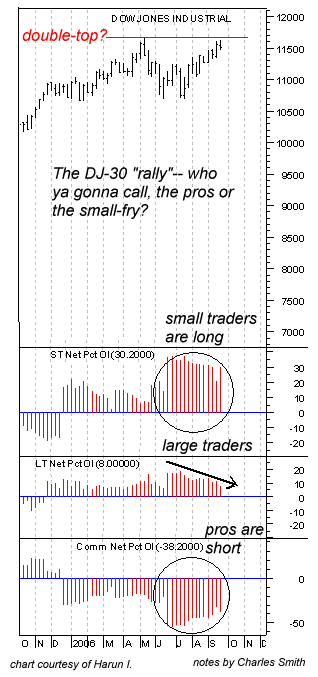
Here is the Dow Industrials with all three groups of traders as classified by the CFTC. What is important to note here is the level of net percent holdings by group. Commercials: 38.2% net short, Non-Commercial (Large Traders): 8% net long, Non-reportable (Small Traders) 30.2 % net long.

What does this mean? It means the least knowledgeable, least capitalized group of traders is holding the greatest OI (open interest, in this case long positions) against (betting against that is) the most knowledgeable, most heavily capitalized traders. Normally Large traders (hedge funds and the like) offset Commercials but their net long position is anemic. It might be time to pop the popcorn, pull up a chair and watch how this turns out or position oneself to take advantage of the rout should it occur.

There are a number of influential folks who would dearly like to see the "rally" extend to November 3 (for instance, those incumbents running for Congressional offices). But it remains to be seen if their pals will keep buying the "rally" to goose it along until the incumbents are duly re-elected on a platform of "lower gasoline prices and continued prosperity, as proven by the new Dow record high." Or, maybe even the "Plunge Protection Team" won't be able to maintain air pressure in this phony Dow "record."

Billmon is somewhat aghast at the latest round of big lies coming out of the buzz machine - as always I can't resist a pertinent Orwell quote.
Everything I said above applies to the googolplex power to other GOP talking point de jour -- the claim that House leaders demanded Foley's resignation as soon as they learned about the "really dirty" stuff, i.e. his sex chats with former pages.

As the Think Progress blog makes definitively clear, this is categorically a lie, because Foley resigned before ABC News even reported the existence of the tell-tale IMs.

According to Hastert, the ABC report was the first time he learned -- ever -- that there was a problem with Foley. (The Walrus's story, and he's stickin' to it, is that he was out of the loop when Foley was confronted earlier this year with the less naughty e-mails.) He even prepared a formal statement to that effect:
No one in the Republican Leadership, nor Congressman Shimkus, saw those messages until last Friday when ABC News released them to the public. When they were released, Congressman Foley resigned. And I'm glad he did, if he had not, I would have demanded his expulsion from the House of Representatives.

But now the Rovians have turned the timeline completely on its head, and are claiming Hastert demanded Foley's resignation because of something the Speaker himself says he knew nothing about.

This may seem a trivial matter, given all the other lies, big and small, that have come rattling down the propaganda assembly line over the past six years. Foley himself is just a sideshow geek compared to the three-ring circus that gave us the war in Iraq. But if there's been a more brazen attempt to rewrite history -- last week's history! -- I can't remember it.

True, the Rovians are desperate, but this clearly reflects their belief that they can say anything, any fucking thing at all, and not be called on it by the corporate media, at least not in any kind of time frame that matters. And as far as I can tell, they're right -- they haven't been called on it, except by Think Progress and the wild-eyed bloggers and the other tattered remnants of the left opposition.

I know, I know: So what else is new? But I've enough journalist left in me to still be astonished at how deeply and sincerely so many in my old profession has learned to love Big Brother. And they didn't even have to have cages filled with carnivorous rats strapped to their heads.

I'll close with one of Past Peak's recent collections of Bush jokes.
We're covering a story about a certain congressman. Let's call him. Representative Mark Foley, Republican of Florida. He spent most of his career protecting children from Internet stalkers. Turns out he was doing it so he could have them all to himself. — Jon Stewart

But in fairness to the Republicans, let me just throw this out — who invented the Internet? That's right — Al Gore, a Democrat. If it wasn't for him, none of this would have happened. Run with it Fox News. — Jimmy Kimmel

(Foley's) in rehab, which means it only happened because he was drinking. We've all done it folks — drunk dialing. It's just that in Foley's case, it was drunk texting erotic messages to underage pages about masturbation. It's simple. You drink, you forget things — especially things that could endanger minors. And I know people are wondering why Condoleezza Rice can't remember a July 2001 meeting with George Tenet where he warned her an al Qaeda attack was likely, even though White House records prove the meeting happened. She probably just blacked out. She was playing a drinking game. Every time you hear George Tenet say "imminent," you take a shot. — Stephen Colbert

This is like the worst thing to happen to congressional Republicans since last Thursday...Most people think GOP stands for Gay Old Pedophile. — Jay Leno

Get Ready For Freak Weather  

Posted by Big Gav

While I generally like Michael Pascoe at Crikey, he seems to have been reading too much peak oil doomerism and has developed an allergic reaction to it in the form of a bout of free market mysticism, with the recent (possibly manipulated) pull back in the oil price causing him to exclaim "Cheaper oil and free gas – doomsday postponed again" (I'm not sure if today's bounce in prices immediately invalidates all his claims - trying to prove or disprove peak oil based on short term price movements is a fool's errand).

It’s getting harder for members of the peak oil doomsday cult to keep the faith – oil futures fell under US$59 a barrel overnight while natural gas prices in the UK turned negative, ie gas traders will pay you to take the stuff away.

Marketwatch.com summarises the oil price:
Crude-oil futures fell almost 4% (to close at $US58.68 a barrel), pulling the benchmark contract to its lowest level in more than a year, with pressure coming from swelling US inventories, a lack of risks to output and doubts that key oil producers will take formal action to reduce supplies and stem the drop in prices.

The market has "high inventories, high levels of exploration activity, no supply shortage, low consumption at this time of the year and no Gulf [of Mexico] hurricanes -- with lower chances of having one," said James Williams, an economist at WTRG Economics. "The combination of these factors is consistent with prices below $50 per barrel."

More shocking to the end-of-civilisation-as-we-know-it mob must be the glut of natural gas in the UK. A new pipeline from Norway is delivering into a market whose storage facilities are 96% full. Reports the BBC:

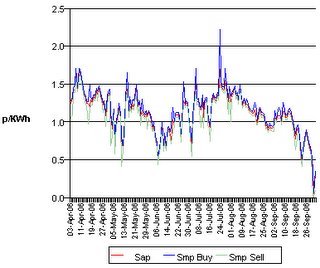
After trading at an average of 26p a therm through September, the spot price for gas delivered immediately fell to -5p during the course of the day, meaning traders are paying to get rid of it.

Major UK energy companies may be unable to take advantage of the free gas because of the lack of available storage and the fact that they have "hedged" supplies -- protecting themselves against the risk of high gas prices over the winter by buying it in advance at a lower price.

Prices will rise in the northern winter as the new pipeline won’t always be running at capacity and demand increases as the temperature falls. It nonetheless remains a reality check after the many scary headlines the world has been subjected to during the oil bubble.

A broader cheap oil perspective is on offer in Newsweek with a claim that Chinese demand has been overstated, but the peak oil cult members won’t be easily converted.

Oil prices will continue to bounce around with whatever supply shocks come along and petrol won’t be as cheap as we were used to, but the doomsday scenario has never made sense – the market mechanism and our incredible adaptive abilities are forever underestimated. Just watch us.

I mocked the Newsweek article earlier this week (Chinese imports are up 15% in the past 8 months) and both Roland Watson at New Era Investor and (glancingly) The Oil Drum (twice) have warned about the natural gas situation in the UK (and the oil situation throughout Europe) this week.

Markets will help us adapt our energy mix but they aren't some sort of magical fix-all - they don't handle issues like global warming (period) and they only handle peak oil (and gas) if people recognise what is happening in advance (or if the post peak production decline is slow and substitutes are developed in time). Given the poor quality information available about oil reserves, its entirely possible markets will fail to send the right price signals until its too late to adapt without much pain.

On the subject of markets, TOD also has a long post on the falling oil price being a harbinger of recession.
British energy customers must be wondering when the continued bad news of price increases will end. In a mini-version of "Peak Oil" in the UK, the sceptred isle will become and stay a net oil and gas importer next year. Retail suppliers of energy had been fearfully locking in prices for gas and electricity earlier this year but are now caught out by the drop in natural gas prices over the Summer. In fact, the new gas pipeline from Norway has been sending so much gas in their testing phase that the price dropped to -5p a therm as they gave the stuff away!

Here is the graph for wholesale gas below:


Customers want to know when they will benefit from these lower prices. The answer is most likely early next year as the higher priced hedges expire. Talk of price gouging once again pervades the media but the fact is that a combination of a rapid downside to UK Peak Gas and too much hedging by companies caused all of this.

Britain is a microcosm of Peak Oil in two senses. One is the fact that their reserves peaked in 1999. The second and more ominous is that few saw it coming. UK Peak Oil arrived silently and took the energy gurus by surprise. These so called experts also predicted Britain would be a net energy importer by 2010. The surprise decline in North Sea production has now brought that forward to 2007. So much for the experts and expect a repeat performance for worldwide Peak Oil.

Mobjectivist has another update on EEStor and their ultracapacitor technology. The post he links to makes the (fairly obvious I would hope) point that a smart grids and energy storage are but one piece of the puzzle - swapping out coal and oil power generation for renewables is the other.
But these are all forms of energy storage, not sources of energy on their own. The primary form of energy for the United States would still, even if every car had one of these EEStor capacitors in it, still be coal and oil. (We could use a lot less, but still.) The objective still has to be reducing the amount of oil we use to avoid Peak Oil (whenever it happens, better to prepare early.) Quite aside from Peak Oil, climate change requires that we stop using fossil carbon altogether. Storage technologies, exciting as they are, are not by themselves the answer.

While our media doesn't pay that much attention to the global warming issue (preferring to worry about the "terrorism" bogeyman instead), it seems global warming is right at the top of the list of national concerns for the voters.
THIS year's Lowy Institute poll reveals Australian concern over global warming to be the big "sleeper" issue of national affairs, a problem that worries Australians more than Islamic fundamentalism.

Australian public convictions on climate change have crept up on our political leaders and have now overtaken them. The political party that can best respond will harness a powerful force.

As the institute's executive director, Allan Gyngell, observes, "this has become mainstream; it's no longer just an issue for Greens and people dressed up in koala suits".

The annual Lowy Institute poll exposes three clear Australian conclusions about climate change. There is no ambiguity or hesitation on this issue any longer, with the "don't know" responses down to an unusually low 1 per cent.

First, this is a very big issue: 68 per cent of respondents rate it as a "critical threat" to Australia's vital interests over the next 10 years.

Just up the coast from me, desalination plants are becoming the focus for communities that are rapidly running out of water (I'm not sure what inland cities like Goulburn and Toowoomba who have already run their dams dry are doing, given their lack of an ocean to electrolyse). Sydney is cheating (for now) by siphoning water away from rivers further south into our main dam, which makes the dam volume figures rather rubbery). The Independent also has a good article on drought - worldwide.
GOSFORD and Wyong councils have begun a search for beach sites for a second lot of temporary desalination units that would produce enough water for 25,000 homes.

With dam levels down to 16 per cent and creeks running dry, the two councils, which share responsibility for water in the region, have already chosen sites for desalination units that will supply residents with an extra 8 million litres of water a day, or enough to supply about 20,000 homes.

The two councils on Sunday banned the use of all town water outside the home because of the dire state of their water supply. They are already tapping into bore water, taking water from the Hunter region and investigating major water-recycling schemes.

State Government and council support for desalination comes as Sydney transfers massive amounts of water from the Shoalhaven River to Warragamba Dam, while inland cities suffer from the drought.

The local press is still mildly excited about ethanol as a petrol substitute (baby steps) and Kim Beazley got a little press talking about hybrids and "flex fuel" ethanol capable vehicles. There is a long way to go to get this debate to where it needs to be...
A FEDERAL Labor government would abolish tariffs on imported hybrid and ethanol-compatible cars, reducing their price by up to $2000, the party says.

City drivers of these cars would receive traffic and parking advantages, the party leader, Kim Beazley, told a summit on alternative fuels hosted by the NRMA in Sydney yesterday.

He also promised to convert the Commonwealth's car fleet to green engines if the Australian car industry could develop the technology. "You build it, we'll drive it," Mr Beazley said.

But Australia's first 100 per cent ethanol-compatible car, which can also run on petrol, or some combination of both, will come from Europe.

Saab unveiled its "flex-fuel" engines at the conference. It will install the ethanol-compatible technology for an extra $1500. The technology, which is available in Sweden and Britain, has been used for decades in Brazil.

Professor Rubens Maciel Filho, of the State University of Campinas, Sao Paulo, told the summit it was hard for Brazilians to understand why Australians were not already using ethanol technologies.

Scientists at the environment and energy ministers meeting in Mexico are saying "Get ready for freak weather".
The world's top polluting nations were told on Wednesday to prepare for decades of weather turmoil, even if they act now to curb emissions and pursue green energy sources.

Environment and energy ministers meeting in the Mexican city of Monterrey vowed to work faster to control global warming as scientists told them each year wasted in curbing greenhouse gas emissions would cost them dearly.

Yet even if countries froze emission levels now, the world still faces 30 years of floods, heat waves, hurricanes and coastal erosion, the British government's chief scientific advisor David King, said.

King - who considers global warming a bigger threat than terrorism - said rich nations must help the developing world prepare for a weather shift that could put millions of lives at risk.

"We've got 30 years of climate change ahead of us even if we stop right now. We're persuading countries they have to adapt to the changes that are ahead of them," King told Reuters at the meeting of top greenhouse gas emitting countries.

"Because we've raised the carbon dioxide level in the atmosphere so quickly, the earth's climate system is falling behind. This is way in excess of anything the planet has known, probably for 45 million years," he said.

Among countries who sent ministers to Monterrey were China and India, whose ballooning demand for energy has made them some of the worst polluters after the United States, which pumps out a quarter of the world's greenhouse gases.

The United States, which could face fiercer hurricanes as sea temperatures rise, sent a senior official, but US officials did not brief the press.

Already, a roughly 1 degree Celsius temperature rise over the past century has allowed icy Greenland to start growing barley, and farmers in Spain are battling arid conditions.

"The people in denial now are the equivalent of the Flat Earth Society," British Energy Minister Malcolm Wicks told Reuters in an interview. "Humankind is in a race for life against global warming."

Crikey reports troglodyte Murdoch press columnist Andrew Bolt is still playing the global warming denial game - and being repudiated by the scientists whose research he has been misusing to perform his lobbying on behalf of the coal industry.
Anti-global warming columnist Andrew Bolt’s recent column "Bulled by a Gore" forensically picked apart Al Gore’s film An Inconvenient Truth by scattering a number of references to studies by eminent scientists through his argument. But one of those scientists is now accusing Bolt of citing his research in a “gross distortion of scientific findings”.

In his column (published in the Herald Sun and the Brisbane Sunday Mail in September), Bolt quoted the findings of Jeff Severinghaus, Professor of Geosciences at the University of California, San Diego:
Gore says ice cores from Antarctica, that go back 650,000 years, show the world got warmer each time there was more carbon dioxide in the air. In fact, as the University of California's Professor Jeff Severinghaus and others note, at least three studies of ice cores show the earth first warmed and only then came more carbon dioxide, many hundreds of years later. So does extra carbon dioxide cause a warming world, or vice versa?

Severinghaus told Crikey that he doesn’t make a habit of Googling his own research, but Bolt appeared on his radar when a librarian in Brisbane wrote to him asking if “I’d really meant what Bolt said I meant”.

He didn’t. “Many, many other studies have found that carbon dioxide causes the earth to warm. This is not controversial, and to continue to deny it is akin to denying that cigarette smoking causes cancer,” Severinghaus told Crikey. “The evidence for a human-caused warming of the globe is overwhelming. The scientific debate is over, and what we are seeing now is an attempt to mislead the public.”

Closing with Billmon on Iraq - apparently police brigades that act in concert with death squads get special remedial training when caught - I'm sure the citizens of Baghdad are glad to know that we're doing such a great job investing in their democratic institutions...

Statistics

Locations of visitors to this page

blogspot visitor
Stat Counter

Total Pageviews

Ads

Books

Followers

Blog Archive

Labels

australia (619) global warming (423) solar power (397) peak oil (355) renewable energy (302) electric vehicles (250) wind power (194) ocean energy (165) csp (159) solar thermal power (145) geothermal energy (144) energy storage (142) smart grids (140) oil (139) solar pv (138) tidal power (137) coal seam gas (131) nuclear power (129) china (120) lng (117) iraq (113) geothermal power (112) green buildings (110) natural gas (110) agriculture (91) oil price (80) biofuel (78) wave power (73) smart meters (72) coal (70) uk (69) electricity grid (67) energy efficiency (64) google (58) internet (50) surveillance (50) bicycle (49) big brother (49) shale gas (49) food prices (48) tesla (46) thin film solar (42) biomimicry (40) canada (40) scotland (38) ocean power (37) politics (37) shale oil (37) new zealand (35) air transport (34) algae (34) water (34) arctic ice (33) concentrating solar power (33) saudi arabia (33) queensland (32) california (31) credit crunch (31) bioplastic (30) offshore wind power (30) population (30) cogeneration (28) geoengineering (28) batteries (26) drought (26) resource wars (26) woodside (26) censorship (25) cleantech (25) bruce sterling (24) ctl (23) limits to growth (23) carbon tax (22) economics (22) exxon (22) lithium (22) buckminster fuller (21) distributed manufacturing (21) iraq oil law (21) coal to liquids (20) indonesia (20) origin energy (20) brightsource (19) rail transport (19) ultracapacitor (19) santos (18) ausra (17) collapse (17) electric bikes (17) michael klare (17) atlantis (16) cellulosic ethanol (16) iceland (16) lithium ion batteries (16) mapping (16) ucg (16) bees (15) concentrating solar thermal power (15) ethanol (15) geodynamics (15) psychology (15) al gore (14) brazil (14) bucky fuller (14) carbon emissions (14) fertiliser (14) matthew simmons (14) ambient energy (13) biodiesel (13) investment (13) kenya (13) public transport (13) big oil (12) biochar (12) chile (12) cities (12) desertec (12) internet of things (12) otec (12) texas (12) victoria (12) antarctica (11) cradle to cradle (11) energy policy (11) hybrid car (11) terra preta (11) tinfoil (11) toyota (11) amory lovins (10) fabber (10) gazprom (10) goldman sachs (10) gtl (10) severn estuary (10) volt (10) afghanistan (9) alaska (9) biomass (9) carbon trading (9) distributed generation (9) esolar (9) four day week (9) fuel cells (9) jeremy leggett (9) methane hydrates (9) pge (9) sweden (9) arrow energy (8) bolivia (8) eroei (8) fish (8) floating offshore wind power (8) guerilla gardening (8) linc energy (8) methane (8) nanosolar (8) natural gas pipelines (8) pentland firth (8) saul griffith (8) stirling engine (8) us elections (8) western australia (8) airborne wind turbines (7) bloom energy (7) boeing (7) chp (7) climategate (7) copenhagen (7) scenario planning (7) vinod khosla (7) apocaphilia (6) ceramic fuel cells (6) cigs (6) futurism (6) jatropha (6) nigeria (6) ocean acidification (6) relocalisation (6) somalia (6) t boone pickens (6) local currencies (5) space based solar power (5) varanus island (5) garbage (4) global energy grid (4) kevin kelly (4) low temperature geothermal power (4) oled (4) tim flannery (4) v2g (4) club of rome (3) norman borlaug (2) peak oil portfolio (1)