US Army colonel: world is sleepwalking to a global energy crisis  

Posted by Big Gav in

The Guardian has an article on a recent conference discussing peak oil - US Army colonel: world is sleepwalking to a global energy crisis.

A conference sponsored by a US military official convened experts in Washington DC and London warning that continued dependence on fossil fuels puts the world at risk of an unprecedented energy crunch that could inflame financial crisis and exacerbate dangerous climate change.

The 'Transatlantic Energy Security Dialogue', which took place on 10th December last year, was co-organised by a US Army official, Lieutenant Colonel Daniel L. Davis, operating in a private capacity, in association with former petroleum geologist Jeremy Leggett, chairman of the UK Industry Taskforce on Peak Oil and Gas. ...

The dialogue opened with a presentation by Mark C. Lewis, former head of energy research at Deutsche Bank's commodities unit, who highlighted three interlinked problems facing the global energy system: "very high decline rates" in global production; "soaring" investment requirements "to find new oil"; and since 2005, "falling exports of crude oil globally."

Lewis told participants that the International Energy Agency's (IEA) own "comprehensive" analysis in its World Energy Outlook of the 1,600 fields providing 70% of today's global oil supply, show "an observed decline rate of 6.2%" - double the IEA's stated estimate of future decline rate out to 2035 of about 3%.

The IEA report also shows that despite oil industry investment trebling in real terms since 2000 (an increase of around 200-300%), this has translated into an oil supply increase of just 12%. ...

Lewis also referred to US Energy Information Administration (EIA) data showing that although global crude oil exports increased "year on year from 2001 to 2005", they "peaked in 2005 and have been trending down since 2009." Lewis attributed this trend to rapidly rising populations in the Middle East which has led to escalating domestic oil consumption, effectively eating into the quantity of oil available to export onto world markets.

Dutch to cut output from huge Groningen gas field  

Posted by Big Gav in ,

Reuters reports that the Dutch government is cutting back on gas production, citing earthquakes as the reason (some peak oilers are speculating they want to lengthen the life of the field to hedge against future supply disruptions) - Dutch to cut output from huge Groningen gas field. Platts says Europe expects to fill the shortfall with additional gas import from Russia.

The Netherlands will cut gas production at Groningen, the largest gas field in western Europe, by about a quarter over the next three years, the Economics Ministry said on Friday, bowing to public concerns over earth tremors in the area.

The decision to cut production will mean lower revenues for the government at a time when it is already struggling to meet the European Union's budget deficit targets, even after years of austerity measures. "The studies showed that there are risks and consequences, including earthquakes," of the gas extraction in Groningen, Prime Minister Mark Rutte told reporters at his weekly press conference before the details were announced. ...

Gas from Groningen is sold mostly to utilities and large industries in the home market, although some gas is piped to Germany, Italy, France and Britain. The gas market has been expecting a decision to cut output, which has already driven up gas prices, analysts said.

Thailand instability continues  

Posted by Big Gav in

Off topic (Thailand has no significant fossil fuel resources) but I thought this report in the Sydney Morning Herald was interesting - Thai police release image of alleged grenade-thrower. For those who haven't been following Thai politics, the current government is a populist movement with it's support base amongst the rural poor (confusingly led by Thailand's richest man who is currently in exile in Dubai).

The opposition is a strange coalition of monarchists, supporters of military rule and the urban middle class which has been doing it's best to destabilise the government, likely with the aim of provoking a military coup (one Bangkok based friend of mine says the middle class are basically cutting their own throats by supporting this, as they are hoping for an economically liberal government but will end up with an authoritarian military one).

Two explosions about two minutes apart shook a protest site near Victory Monument in central Bangkok on Sunday afternoon, the second daylight attack using grenades in 48 hours. Police said footage shows the man tried to throw one grenade into a tent behind a rally stage but missed and the grenade hit the roof of a coffee shop and exploded. He threw another grenade and fired shots at protesters who started to chase him before flagging down a motor cycle taxi, police say.

The attack comes as tensions soar in the city of 12 million people after a week of almost daily shooting attacks on protest sites and small explosives hurled at the homes of protest supporters. The footage has been released amid angry accusations over who was responsible for a blast on Friday in the middle of a protest parade that left one protester dead and 35 wounded. Police said for that blast they are seeking two men, one believed to be aide of a former opposition Democrat party MP who were seen in a video clip of the explosion.

The Democrats support the protest movement trying to topple government of prime minister Yingluck Shinawatra, raising suspicion is was a staged attack designed to blame her supporters.

Beijing sunrise  

Posted by Big Gav

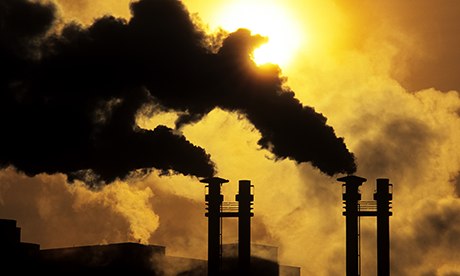
Time has an interesting photo of a modern Beijing sunrise, brought to you by that wonderful substance, coal - Smog in Beijing Is So Awful You Have to Catch the Sunrise on a Big Screen.

Peak Oil Is Irrelevant ?  

Posted by Big Gav in

TreeHugger has a somewhat provocatively titled post proclaiming the end of peak oil - Peak Oil Is Irrelevant.

Unlike the less informed articles of this type which predict a never ending gushing of unconventional oil at an indeterminate price this one correctly notes that while there may be a lot of unconventional oil out there (which traditional peak oil analysis ignored, to it's cost), the price point it is produced at and the alternatives available are what will shape the demand / supply curve into the future.

The prediction that US oil production would peak in the 1970s was, in fact, accurate, but new discoveries – including North American sources involving fracking and tar sands – keep pushing the timeline outward. Some say we will always find new oil sources, though economic theory states they will also get inexorably more expensive.

Recent discussions have revived the peak oil debate. A Business Insider article last spring claimed “it is probably safe to say we have slayed "peak oil" once and for all, thanks to the combination new shale oil and gas production techniques and declining fuel use.” It was counterpointed here. But I basically don’t care.

All the talk of peak oil, that we are running out of fossil fuels and therefore need alternatives — or that we’re not and therefore there’s nothing to worry about — is a distraction. In fact, it’s worse than a distraction; it’s misleading because it makes people think that the goal is to find more oil. And that then gives people the impression that since we, in fact, do have existing and yet-to-be-found sources, we don’t have any energy problems. That’s a dangerous path.

The problem, as Sami Grover wrote in a Treehugger post in 2012, is not a lack of carbon-based fuels. The problem is that, if we use those fuels, the resulting greenhouse gas emissions will push the atmosphere far off the critical balance needed to maintain the climate. In other words, those sources – coal, oil, gas – must be left in the ground. Burning them is nothing less than suicide.

The only reason we should really care about peak oil is that it means oil will be getting increasingly expensive and, as that happens, renewable sources will become more competitive. (And that’s before factoring in technical and manufacturing advances for renewables. And certainly before factoring in the unaccounted for “external” costs of non-renewables. When you do that, renewables simply become an even more overwhelmingly obvious choice.)

N.S.A. Devises Radio Pathway Into Computers  

Posted by Big Gav in , ,

The NYT has a report based on some of Edward Snowden's trove of documents - N.S.A. Devises Radio Pathway Into Computers.

The National Security Agency has implanted software in nearly 100,000 computers around the world that allows the United States to conduct surveillance on those machines and can also create a digital highway for launching cyberattacks.

While most of the software is inserted by gaining access to computer networks, the N.S.A. has increasingly made use of a secret technology that enables it to enter and alter data in computers even if they are not connected to the Internet, according to N.S.A. documents, computer experts and American officials.

The technology, which the agency has used since at least 2008, relies on a covert channel of radio waves that can be transmitted from tiny circuit boards and USB cards inserted surreptitiously into the computers. In some cases, they are sent to a briefcase-size relay station that intelligence agencies can set up miles away from the target.

Salon has an interview with Glenn Greenwald about surveillance and the Snowden story - “Surveillance breeds conformity”: Salon’s Glenn Greenwald interview. As with everything involving Greenwald it is rather long...

As your recent interchange with Jeffrey Toobin on CNN highlighted, there are some chilling media tendencies to condemn whistle-blowers like Snowden in fealty to the established order. How do you account for the U.S. media’s defense of an administration that has consistently lied about the level of surveillance going on?

I think the path of least resistance and the greatest careerist benefits come from embracing orthodoxies and supporting those in power. That has been true forever. If you’re kind of an outsider, and you are looking for ways to up your status, you become a loyalist to the king, you go serve the royal court, this is, I think, common in all societies. There is a temptation among certain kinds of people to further themselves by turning themselves into servants of power, and a lot of people in journalism are very much like that.

I also think that because most of our well-known journalists work for large corporations there is an institutional ethos embedded into these institutions saying that those in authority are to be respected and admired and obeyed. That is the nature of what large institutions inculcate. People who thrive in those corporations tend to embrace that way of thinking. So unlike, say, 50 years ago when journalists were kind of these consummate paid outsiders, now the television stars, the Jefferey Toobins, tend to be authoritarian; they tend to be supportive of the status quo because it has rewarded them so much. And then, finally, there is the tendency in American journalism to be very closely identified with those in political power, and anyone who opposes political power in D.C. — Julian Assange or Chelsea Manning or Edward Snowden or any of those whistle-blowers — are going to to be hated by journalism because they are going to be viewed through the prism of those who wield political power. I think all those factors combine to bring hostility toward people who can bring about transparency. The ultimate irony is that journalists, if you can believe anything that they say about themselves, should be cheering for those who bring transparency.

Woodside looking to join Canadian LNG boom  

Posted by Big Gav in , ,

The SMH has a report on the Canadian LNG boom - Woodside secures a slice of Canadian LNG boom. It will be interesting to see how many of the 10 proposed projects go ahead.

Woodside's proposal is one of more than 10 LNG export ventures proposed on Canada's Pacific coast, where cargoes are expected to target high-priced markets in Asia.

The government is assuming about five of the projects will get built, creating more than 39,000 annual jobs during a nine-year construction period, and 75,000 jobs once the plans are fully operational. Among the most advanced are the Kitimat LNG project between Apache and Chevron, and Shell's LNG Canada venture which involves LNG import giant Korea Gas Corporation, Mitsubishi and PetroChina.

Al Gore says use of geo-engineering to head off climate disaster is insane  

Posted by Big Gav in , ,

The Guardian has an article on recent comments by Al Gore where he called geoengineering "utterly mad" - Al Gore says use of geo-engineering to head off climate disaster is insane.

The draft climate report of the Intergovernmental Panel on Climate Change, due for release in Germany in April, said governments might have to turn increasingly to technologies for "carbon dioxide removal" to keep warming below the dangerous threshold of 2 degrees. The draft said those technologies might involve capturing and burying emissions from coal-fired power plants, or planting more forests. But there has been debate in the environmental community over other more radical solutions.

On geo-engineering Gore drew a distinction between small-scale interventions, such as white roofs, and large-scale projects meant to extract or neutralise emissions from the air or block the sunlight. Those ideas, he said, carried enormous risks. "The most discussed so-called geo-engineering proposals – like putting sulphur dioxide in the atmosphere to reflect incoming sunlight – that's just insane. Let's just describe that clearly – it is utterly mad," Gore told the conference call.

He warned that such large and untested experiments carried enormous risks while "doing nothing to address other consequences of climate change such as ocean acidification". He said: "We are already engaged in a planet-wide experiment with consequences we can already tell are unpleasant for the future of humanity. So the hubris involved in thinking we can come up with a second planet-wide experiment that would exactly counteract the first experiment is delusional in the extreme."

Gore was also cool on the other quick-fix of nuclear power, advocated by some. ... Gore's re-thinking has apparently gone in the other direction. He told the call he had been an enthusiastic supporter of nuclear energy when he was in Congress. He was not opposed to nuclear energy now, he said. But he said the current state of technology in the nuclear energy industry did not yet warrant a big expansion.

Cryptogon points to a Chinese geoengineering proposal, aimed at neutralizing acid in the air ("Ph conditioning") with giant jellyfish shaped blimp membranes - Atmosphere Processors for Beijing [???].

In the past 30 years, China has suffered from air pollution and heavy haze created by fast industrial growth and economic expansion. An Environmental Chemistry Letter research journal article reviews the techniques for remediation of air pollution. A geoengineering method is proposed for mitigating air pollution and haze in China’s cities by using water to scavenge air pollution. Here, water should be sprayed into the atmosphere like watering garden. The scientific rationale and mechanism for the geoengineering scheme are explained.

Directing Heat At The Right Target  

Posted by Big Gav in ,

The continuing heatwave in Australia and latest round of bushfires and brownouts resulting from it have highlighted the fact that coal fired power has intermittency problems - Victorian Senator's heat directed at wrong target.

"Most of our power system performed very well under exceptional circumstances, but the large Loy Yang A coal-fired power station in the Latrobe Valley suffered unexpected outages for a long period of time as a result of the heat. No type of power plant can ever be 100 per cent reliable in extreme weather, but when a coal-fired plant suffers a fault the system loses a large amount of power. Wind farms and solar households are made up of thousands of independent generators, so a fault in one makes almost no difference.

“Without rooftop solar power and solar hot water acting to reduce the demand from large-scale power stations, it is very likely that Victoria would have set a new record for power use. And without the contribution from wind and solar energy, more homes may have had their power switched off over the last few days,” he said.

Mr Sonnreich said the Renewable Energy Target had been very successful at delivering large amounts of clean energy from solar power, solar hot water and bioenergy at low cost to consumers, while delivering billions of dollars of investment and tens of thousands of jobs in regional areas.

Utilities hail electric cars to cut bills, reduce emissions  

Posted by Big Gav in , , ,

I was talking to a manager from one of the utility companies here at a conference last year and the conversation drifted onto a few topics that I find interesting.

The first item of note was that they have cut back on the amount of data that they are collecting from smart meters, noting that there are a few different customer segments with varying levels of interest in the data that is captured - but even the keenest lose interest in the data once they have optimised their usage patterns. Obviously this would change if pricing was more dynamic but that day seems to be a way off.

I also asked how they were dealing with the problem (from their point of view) of falling demand and his response was that they were looking to increasing uptake of electric vehicles to compensate for this.

This approach is now being promoted by the utilities industry association - Utilities hail electric cars to cut bills, reduce emissions.

A new report has uncovered that the cost of recharging electric cars could be as little as a quarter of the $1.50 a litre it currently costs to fill petrol-run cars.

Analysis by the Energy Supply Association of Australia (ESAA) found that an equivalent litre of electricity, or e-litre, could cost from 37 cents in off peak up to 62 cents in peak prices. It found that electric cars have the equivalent fuel costs of approximately 3 cents per kilometre, compared to 10 cents per kilometre for conventional cars.

The ESAA represents most of the country’s generators and network suppliers. Many of these businesses are being impacted by reduced demand for electricity. Some analysts, and some of its members, suggest that increased electric vehicle ownership could be a solution to those problems.

CEO Matthew Warren says electric cars are not only a “faster, cleaner, quieter and safer driving experience, they are also cheaper to run,” with electric engines being “simpler and far more efficient than the most advanced combustion engines.”

ReNew Economy has a related article on the factors causing the decline in demand - Why is electricity consumption decreasing in Australia?.

All of the decline in consumption has in fact been at the expense of coal fired generators. Many are now barely profitable. Greenhouse gas emissions fell by 9.2 Mt CO2-e, roughly 2% of Australia’s total emissions, in 2012 alone.

To be precise, what the above figures are measuring is not electricity used by final consumers, but electricity supplied to the national grid system by large generators which participate in the (wholesale) National Electricity Market.

It is very difficult to find consolidated data on the quantities of electricity supplied by small distributed generators, such as rooftop photovoltaics and landfill gas plants. But the Australian Energy Market Operator (AEMO) has estimated that in 2012-13. photovoltaics supplied 2.7 TWh and other small generators supplied 3.1 TWh. So, although important and growing, these sources alone do not account for the whole of the 8 TWh reduction from the peak year, let alone the 37 TWh reduction from the long term trend.

Research we have recently completed concludes that the three largest factors contributing to the recent dramatic changes in demand for electricity are:

  • the impact of (mainly regulatory) energy efficiency programs
  • structural change in the economy away from electricity intensive industries
  • since 2010, the response of electricity consumers, especially residential consumers, to higher electricity prices.

Australia’s first mandatory regulatory energy efficiency measures were introduced in the late 1990s. These were Mandatory Energy Performance Standards (MEPS) for refrigerators and freezers.

Since then, these standards have been extended to a very wide range of residential and commercial appliances and equipment. Analogous energy efficiency requirements have been applied to new buildings. We have used data in reviews of the appliance and equipment measures and the building measures to estimate that the increased impact of these measures between 2006 and 2013 has in total reduced annual demand for electricity by 10.5 TWh, or 28% of the total 37 TWh reduction.

Smaller demand reductions have come from increased uptake of solar and heat pump water heaters (supported by various government programs), the Home Insulation Program (the so-called “pink batts scheme”), and the Victorian and NSW retailer energy efficiency obligation schemes. All of these schemes together contribute another 8% of the reduction.

Chasing the Dream of Half-Price Gasoline from Natural Gas  

Posted by Big Gav in ,

The dawn of the gas age has made GTL an interesting prospect for those seeking to profit from the age of expensive oil. Technology Review has a look at a new technique for turning natural gas into liquid fuel - Chasing the Dream of Half-Price Gasoline from Natural Gas.

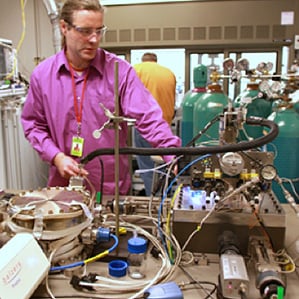
At a pilot plant in Menlo Park, California, a technician pours white pellets into a steel tube and then taps it with a wrench to make sure they settle together. He closes the tube, and oxygen and methane—the main ingredient of natural gas—flow in. Seconds later, water and ethylene, the world’s largest commodity chemical, flow out. Another simple step converts the ethylene into gasoline.

The white pellets are a catalyst developed by the Silicon Valley startup Siluria, which has raised $63.5 million in venture capital. If the catalysts work as well in a large, commercial scale plant as they do in tests, Siluria says, the company could produce gasoline from natural gas at about half the cost of making it from crude oil—at least at today’s cheap natural-gas prices.

If Siluria really can make cheap gasoline from natural gas it will have achieved something that has eluded the world’s top chemists and oil and gas companies for decades. Indeed, finding an inexpensive and direct way to upgrade natural gas into more valuable and useful chemicals and fuels could finally mean a cheap replacement for petroleum.

Natural gas burns much more cleanly than oil—power plants that burn oil emit 50 percent more carbon dioxide than natural gas ones. It also is between two and six times more abundant than oil, and its price has fallen dramatically now that technologies like fracking and horizontal drilling have led to a surge of production from unconventional sources like the Marcellus Shale. While oil costs around $100 a barrel, natural gas sells in the U.S. for the equivalent of $20 a barrel.

But until now oil has maintained a crucial advantage: natural gas is much more difficult to convert into chemicals such as those used to make plastics. And it is relatively expensive to convert natural gas into liquid fuels such as gasoline. It cost Shell $19 billion to build a massive gas-to-liquids plant in Qatar, where natural gas is almost free. The South African energy and chemicals company Sasol is considering a gas-to-liquids plant in Louisiana that it says will cost between $11 billion and $14 billion. Altogether, such plants produce only about 400,000 barrels of liquid fuels and chemicals a day, which is less than half of 1 percent of the 90 million barrels of oil produced daily around the world.

Pine Island Glacier melting past 'the point of no return'  

Posted by Big Gav in

The Independent has a report on the shrinking of Antarctica's Pine Island glacier - Pine Island Glacier melting past 'the point of no return'.

Antarctica’s Pine Island Glacier could now be in a state of irreversible retreat, making it likely to become an even more significant contributor to the global sea level rise during the next two decades, scientists have warned. The research, published in Nature Climate Change, found that in recent years, the grounding line, which separates the grounded ice sheet from the floating ice shelf, has retreated by tens of kilometres.

An international team of scientists from the CSC-IT Center for Science in Finland, the Chinese Academy of Sciences and the Universities of Exeter and Bristol combined field observations and computer models to predict how the ice will change over the next few years. Their research concluded the recent Pine Island Glacier thinning has probably “reached a point of no return”, according to the British Antarctic Survey (BAS). This glacier is currently responsible for contributing 25 per cent of the total ice loss from West Antarctica, which the BAS say is likely to increase over the next 20 years.

Dr Hilmar Gudmundsson from the BAS said: "At the Pine Island Glacier we have seen that not only is more ice flowing from the glacier into the ocean, but it's also flowing faster across the grounding line - the boundary between the grounded ice and the floating ice. We also can see this boundary is migrating further inland. “The Pine Island Glacier shows the biggest changes in this area at the moment, but if it is unstable it may have implications for the entire West Antarctic Ice Sheet.

Tony Abbott’s half-baked war on renewable energy  

Posted by Big Gav in ,

Crikey has an article on the desperate conservative backlash against renewable energy - Tony Abbott’s half-baked war on renewable energy.

Last week it was quietly announced that the Australian Cleantech Competition would henceforth be known as the Australian Technologies Competition. It was another subtle reminder of how the new Australian conservative government is going about the rephrasing of Australia’s energy future. Anything that involves the words climate, clean energy, or cleantech are considered projects or institutions non grata.

In the public arena, it’s not just a renaming that’s taking place, but a concerted attack on renewables. For the second time in as many weeks, Prime Minister Tony Abbott has criticised renewable energy, its intermittency and its supposed costs — repeating the force-fed lines from his main business adviser, Maurice Newman, extremist blogs and some mainstream media, and encouraged by the fossil fuel incumbents, whose greatest fear is that their coal- and gas-fired generation is being sidelined and rendered unprofitable by the growing capacity of wind and solar.

Abbott’s complaints fail on numerous counts. For a start, the Renewable Energy Target is having little impact on retail prices. The Queensland Competition Authority notes in its latest finding that the large-scale renewable target (the apparent subject of the new government’s attacks) will cost Queensland households $26 a year, or about 1.3% of their bills — about half the rise in retail bills caused by soaring gas prices.

Wind and solar do not need new back-up power. South Australia has got to 31% wind and solar without the need for any new equipment. That’s because most of the peaking plants that respond to changes in demand — and supply — already exist to cope when a whole bunch of people switch on air-conditioners at the same time, or when coal- or gas-fired generation has unexpected shutdowns, such as when the Millmerran coal-fired generator shut down last March, or the two major gas generators lost large amounts of capacity in South Australia. The difference with wind and solar is that at least their output is predictable.

Abbott’s outburst are cheered, and sometimes inspired from the sidelines, by elements of the mainstream media. The Australian took another bash at Germany last weekend, which it likes to cite as what happens to a country when it moves away from baseload — coal and nuclear — and towards renewables. The newspaper’s principal complaints were there were more coal plants, more emissions, and more costs.

Germany is the nightmare scenario for the fossil fuel industry because if the biggest manufacturing economy in Europe can wean itself off nuclear, coal and gas, then so can everyone else — which is why its policies are attacked with such gusto.

What The Australian omits to tell its readers is that coal-fired generators coming on line now were planned and construction was begun well before Fukushima, and before the extent of the rapid growth in renewables was acknowledged. The net impact is a lot more coal projects are being abandoned. The country’s big three utilities — RWE, E.ON and Vattenfall — have made it clear they intend to build no new fossil fuel plants, because some of them are having to close new plants almost as quickly as they are opened.

Investment bank UBS, for instance, predicts that one-third of Germany’s fossil fuel capacity will need to be closed by 2017 because it is no longer economic, and they are no longer needed. Germany industry has not been affected by the renewable energy roll-out because it is only charged the wholesale price of electricity, plus a margin. Its costs have fallen substantially in recent years, not risen.

To try and illustrate its lament, The Australian sought to create drama by pointing to a period in early December when renewables contributed just 5% of generation needs on some days. I presume these charts reflect the issue.

Actually, it’s not the dips that are worrying the incumbent utilities or the grid operators — it’s the big lumps of clean energy that are forcing their generators offline when they produce. Currently, Germany gets just under 25% of its electricity from renewables over a year, and this will rise to around 60% by 2035 (the new government’s new target). As that happens, those gaps will disappear, the lumps will get bigger, and new storage solutions will mean there will be even less need for fossil fuel or “baseload” generation. A similar scenario would take place in Australia, which is why the incumbents are so keen to neuter the Renewable Energy Target so they can extend their revenues as far as possible.

Cheap, Efficient Organic Flow Battery Materials From Harvard  

Posted by Big Gav in ,

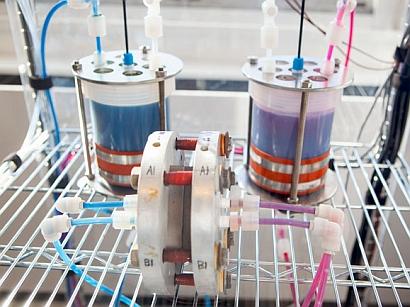
Ecogeek reports that a group from Harvard have developed an organic ("rhubarb based) flow battery that could help hasten to transition to renewable energy - Cheap, Efficient Organic Flow Battery Materials.

The science of power storage has a new variety of options and new materials to investigate thanks to some recent developments in the chemistry of materials used in flow batteries. Until now, flow batteries have largely relied on metallic compounds for the active chemicals they use. But new materials have been found that are cheaper and more effective than the chemicals which have been most used in flow batteries until now.

The research undertaken by scientists at Harvard University has identified a range of organic compounds known as quinones, which are have the potential to be especially useful for flow batteries. Initial research indicates they are inexpensive and efficient materials well suited for use in power storage. A recently published paper in the journal Nature discusses the use of 9,10-anthraquinone-2,7-disulphonic acid (AQDS), a compound found in rhubarb, in a flow battery.

Large-scale energy storage is an area where flow batteries can excel, because the equipment needed to build a large energy storage system is basic, industrial gear, rather than highly specialized equipment. To increase storage capacity, a flow battery just needs a couple of larger storage tanks.

The AQDS materials are naturally abundant and very stable. They are potentially safer than metal-based flow batteries because the materials are "less likely to react violently if they accidentally come in contact with each other." When used in a flow battery, they show very good cycle efficiency and "[represent] a new and promising direction for realizing massive electrical energy storage at greatly reduced cost." The chemicals needed to store a kilowatt-hour of energy would cost $27, which is roughly one-third the cost of other systems.

The nuclear renaissance is stone cold dead  

Posted by Big Gav in

The Climate Spectator has a look at the collapse of the "nuclear renaissance" - The nuclear renaissance is stone cold dead.

The figures are in: 2013 was an annus horribilis for the nuclear power industry − its third in a row − and the nuclear renaissance can now be pronounced stone cold dead.

The most that could be said for the 2013 figures − four reactors connected to grids, four permanently shut down − is that they weren't as bad as the previous year. Nuclear power suffered its biggest ever one-year fall in 2012 − nuclear generation fell 7 per cent from the 2011 figure.

Nuclear generation fell in no less than 17 countries, including all of the top five nuclear-generating countries. Nuclear power accounted for 17 per cent of global electricity generation in 1993 and it has steadily declined to 10 per cent now.

The International Atomic Energy Agency has downwardly revised its projections, and now anticipates nuclear capacity growth of 23 per cent to 100 per cent by 2030. Historically, the IAEA's upper projections have been fanciful, while its low projections also tend to be too high (by 13 per cent on average) but provide a reasonable guide nonetheless. So growth of 23 per cent by 2030 − annual growth of a little over 1 per cent − is about as much as the industry can realistically hope for.

The IAEA will further reduce its projections when it factors in last year's annus horribilis. Perhaps the most striking developments were in the United States, where the industry is finding it increasingly difficult to profitably operate existing reactors − especially ageing reactors requiring refurbishments − let alone build new ones. Almost half of the world's reactors have operated for 30 years or more, so the problem of ageing reactors is starting to come into sharp focus.

Peter Bradford, a former member of the US Nuclear Regulatory Commission, notes that by 2009, applications for 31 new reactors in the US were pending. "The 31 proposed reactors are down to four actually being built and a few others lingering on in search of a licence, which is good for 20 years," Bradford writes. "Those four are hopelessly uneconomic but proceed because their state legislatures have committed to finish them as long as a dollar remains to be taken from any electric customer's pocket. Operating reactors are being closed as uneconomic for the first time in 15 years."

UBS: Utilities face “perfect storm” from renewables, storage  

Posted by Big Gav in ,

ReNew Economy has an article on a recent report from UBS on the outlook for power utilities - UBS: Utilities face “perfect storm” from renewables, storage.

A new report from leading utilities analysts at investment bank UBS suggests that energy utilities in Europe, north America and Australia are facing a “perfect storm” from the falling costs of renewables, energy efficiency and falling demand, and may not be able to sustain their business models.

The report – entitled “Can utilities survive in their current form?” – is the latest in a series of assessments, reviews and analysis that point to the severe disruption to the centralized generation model, and the demand and supply dynamics that have governed the industry for the past few decades. To briefly summarise the UBS response to its own question, the answer is No.

UBS says the biggest impact on the current utility model will occur in developed markets, where renewables in general and distributed solar in particular will take more of an already depleted “demand pie.”

This, says UBS, will cause profits to fall and could force utilities, particularly generators, to look at greater exposure to renewables and distributed generation, and to other downstream services. It comes to a similar conclusion on this as the CSIRO Future Grid forum, and echoes some of the strategic decisions currently being mooted German energy giants RWE and E.ON.

“We expect the renewables onslaught to continue and that the going will only get tougher for conventional generators,” the UBS analysts write. “We believe the will need to examine and change their traditional business models to survive the renewables era.”

These new business models could include a greater focus on rooftop solar, energy efficiency, and consumer offerings that combined solar, storage, and electric vehicle infrastructure, as well as energy-efficient appliances.

Bucky Fuller's grain silo houses found in New Jersey  

Posted by Big Gav in

TreeHugger has a post on some Bucky Fuller designed structures that have been rediscovered in New Jersey (prompted by this article in Gizmodo and the NYT) - Bucky Fuller's grain silo houses found in New Jersey.

In 1940, before the Wichita House or the geodesic dome, Bucky Fuller was fascinated by the technology used to build grain silos. ... Unfortunately steel was in demand for weapons, not houses, so they were never produced in volume. A dozen of them survive at Camp Evans in New Jersey, a remarkable story of architectural preservation.

Solar Power Craze on Wall St. Propels Start-Up  

Posted by Big Gav in , , ,

The NYT has an article on booming solar power companies like SolarCity - Solar Power Craze on Wall St. Propels Start-Up.

The first inklings of the idea came to Elon Musk and a cousin in an R.V. heading to the Burning Man festival in 2004.

Solar energy, they agreed, could be big.

But not even Mr. Musk, the billionaire behind the Tesla electric car, could have foreseen the solar power craze that is sweeping Wall Street. He and his cousins Peter and Lyndon Rive are riding a wave of exuberance over the industry and their young business, SolarCity.

The company — the nation’s largest provider of rooftop solar systems, with more than 80,000 customers — has not made a dime. And, frankly, no one quite seems to know when, or if, it will.

But SolarCity has captured investors’ imaginations and become a potent symbol of a stock market ascent that makes the vertigo-inducing heights of Twitter seem tame. SolarCity’s share price, which closed at $59.27 on Friday, has soared more than sevenfold since it went public, and the company, which did not exist eight years ago, is valued at roughly $4.9 billion.

Depending on whom you talk to, the rise of SolarCity and similar companies is either a sure sign that solar power is finally having its day or that yet another mania has gripped the markets. Two other companies, SunPower and SunEdison, have also exploded in value. In all, an estimated $13 billion was invested in solar projects in 2013, a tenfold increase since 2007, according to GTM Research, which tracks the industry.

Is time up for Australia's uranium industry ?  

Posted by Big Gav in

Following the latest spill of radioactive material at ERA's Ranger uranium mine he ABC has an opinion piece wondering if it is time to decommission the industry - Is time up for Australia's uranium industry ?.

IN THE EARLY HOURS of December 7, a crack appeared in a large leach tank in the processing area of the Ranger uranium mine in Kakadu National Park. The area was evacuated, the tank completely failed, the containment system was inadequate and one million litres of highly acidic uranium slurry went sliding downhill — taking Energy Resources of Australia's credibility with it.

The spill has left traditional owners who live and rely on creeks only kilometres downstream angry and "sick with worry" and raised profound concerns about the management culture and integrity of infrastructure at the mine.

Operations at Ranger are now halted. The mine operates inside Kakadu National Park — Australia's largest park and a dual World Heritage listed region. It, and its people, deserve the highest standards of protection, but sadly Ranger is a long way short of this.

The Australian uranium industry has long been a source of trouble. Now it is increasingly in trouble. The commodity price has collapsed, projects across the country have been stalled, deferred or scrapped and the recent Kakadu spill has again raised community attention and concern.

At least the absence of a nuclear power industry in Australia means we don't have stories emerging like this one from the US - U.S. Dumped Tens of Thousands of Steel Drums Containing Atomic Waste Off Coastlines .

More than four decades after the U.S. halted a controversial ocean dumping program, the country is facing a mostly forgotten Cold War legacy in its waters: tens of thousands of steel drums of atomic waste.

From 1946 to 1970, federal records show, 55-gallon drums and other containers of nuclear waste were pitched into the Atlantic and Pacific at dozens of sites off California, Massachusetts and a handful of other states. Much of the trash came from government-related work, ranging from mildly contaminated lab coats to waste from the country’s effort to build nuclear weapons.

Federal officials have long maintained that, despite some leakage from containers, there isn’t evidence of damage to the wider ocean environment or threats to public health through contamination of seafood. But a Wall Street Journal review of decades of federal and other records found unanswered questions about a dumping program once labeled “seriously substandard” by a senior Environmental Protection Agency official…

Heatwave hits inland Australia  

Posted by Big Gav in ,

After last year's record breaking temperatures we are having a hot start to 2014 in Australia as well (apparently it reached 54 degrees in inland South Australia) - Heatwave hits inland Australia.

Extreme conditions continued yesterday, with soaring temperatures in areas extending from Queensland's interior to Central Australia and north-western New South Wales.

On Thursday temperature records again tumbled in central, western and north-west Queensland, with the mercury topping 40 degrees Celsius in a number of areas. "Century Mine in the far north-west of the state got up to 44.6 today, Camooweal 45.5, a new January record, the Monument Airport 45.9, another January record," said the weather bureau's Peter Otto. "Bedourie police station [recorded] 47.3 [degrees], which is an annual extreme for them, and Birdsville got up to 48.6."

Statistics

Locations of visitors to this page

blogspot visitor
Stat Counter

Total Pageviews

Ads

Books

Followers

Blog Archive

Labels

australia (619) global warming (423) solar power (397) peak oil (355) renewable energy (302) electric vehicles (250) wind power (194) ocean energy (165) csp (159) solar thermal power (145) geothermal energy (144) energy storage (142) smart grids (140) oil (139) solar pv (138) tidal power (137) coal seam gas (131) nuclear power (129) china (120) lng (117) iraq (113) geothermal power (112) green buildings (110) natural gas (110) agriculture (91) oil price (80) biofuel (78) wave power (73) smart meters (72) coal (70) uk (69) electricity grid (67) energy efficiency (64) google (58) internet (50) surveillance (50) bicycle (49) big brother (49) shale gas (49) food prices (48) tesla (46) thin film solar (42) biomimicry (40) canada (40) scotland (38) ocean power (37) politics (37) shale oil (37) new zealand (35) air transport (34) algae (34) water (34) arctic ice (33) concentrating solar power (33) saudi arabia (33) queensland (32) california (31) credit crunch (31) bioplastic (30) offshore wind power (30) population (30) cogeneration (28) geoengineering (28) batteries (26) drought (26) resource wars (26) woodside (26) censorship (25) cleantech (25) bruce sterling (24) ctl (23) limits to growth (23) carbon tax (22) economics (22) exxon (22) lithium (22) buckminster fuller (21) distributed manufacturing (21) iraq oil law (21) coal to liquids (20) indonesia (20) origin energy (20) brightsource (19) rail transport (19) ultracapacitor (19) santos (18) ausra (17) collapse (17) electric bikes (17) michael klare (17) atlantis (16) cellulosic ethanol (16) iceland (16) lithium ion batteries (16) mapping (16) ucg (16) bees (15) concentrating solar thermal power (15) ethanol (15) geodynamics (15) psychology (15) al gore (14) brazil (14) bucky fuller (14) carbon emissions (14) fertiliser (14) matthew simmons (14) ambient energy (13) biodiesel (13) investment (13) kenya (13) public transport (13) big oil (12) biochar (12) chile (12) cities (12) desertec (12) internet of things (12) otec (12) texas (12) victoria (12) antarctica (11) cradle to cradle (11) energy policy (11) hybrid car (11) terra preta (11) tinfoil (11) toyota (11) amory lovins (10) fabber (10) gazprom (10) goldman sachs (10) gtl (10) severn estuary (10) volt (10) afghanistan (9) alaska (9) biomass (9) carbon trading (9) distributed generation (9) esolar (9) four day week (9) fuel cells (9) jeremy leggett (9) methane hydrates (9) pge (9) sweden (9) arrow energy (8) bolivia (8) eroei (8) fish (8) floating offshore wind power (8) guerilla gardening (8) linc energy (8) methane (8) nanosolar (8) natural gas pipelines (8) pentland firth (8) saul griffith (8) stirling engine (8) us elections (8) western australia (8) airborne wind turbines (7) bloom energy (7) boeing (7) chp (7) climategate (7) copenhagen (7) scenario planning (7) vinod khosla (7) apocaphilia (6) ceramic fuel cells (6) cigs (6) futurism (6) jatropha (6) nigeria (6) ocean acidification (6) relocalisation (6) somalia (6) t boone pickens (6) local currencies (5) space based solar power (5) varanus island (5) garbage (4) global energy grid (4) kevin kelly (4) low temperature geothermal power (4) oled (4) tim flannery (4) v2g (4) club of rome (3) norman borlaug (2) peak oil portfolio (1)