LED Hugger  

Posted by Big Gav

I've referred to LED based lighting and its advantages over incandescent lights and fluorescent lights quite a few times in the past. It seems that things are moving along quite swiftly on this front, with TreeHugger posting a slew of reports on the subject lately.

First up, they note there has been a breakthrough in White LED Breakthrough, with reports of a doubling of efficiency.

It seems like the light emitting diode (LED) world is going from one breakthrough to the next. The last one was the accidental invention of warm white LEDs using quantum dots, and now a Japanese researcher at the Meijo University, professor Satoshi Kamiyama, has found a way to make white LEDs more efficient using a purple LED and a silicon carbide substrate. This new white LED has a brightness of 130 lumens per watt! "Normal incandescent light bulbs produce 15-20 lumens per watt; modern fluorescent bulbs produce between 60-110 lumens per watt; and current LED methods allow for a maximum of 60-70 lumens per watt. In short, if this is real, it's a big breakthrough." Professor Satoshi Kamiyama will establish a startup in January to manufacture and sell the LED units.

While LED lighting is functional it can also be used for decoration - TreeHugger also has posts on their use n home decorating and as Christmas lights.
Treehuggers know that the best new source of electricity is conservation- that money invested there beats nuclear, coal, solar and wind. Our local City-owned utility appears to get that- we just exchanged two strings of old incandescent Christmas lights for new LED lights that use 90% less power. Free.

And a final note on LED's - it appears butterflys had this stuff worked out long before we did (another case of - inadvertent - biomimicry ?).
It turns out that the technology that enables high efficiency LED's is not particularly original but was figured out a while back - by butterflies. "When scientists developed an efficient device for emitting light, they hadn't realised butterflies have been using the same method for 30 million years. Fluorescent patches on the wings of African swallowtail butterflies work in a very similar way to high emission light emitting diodes (LEDs).

Moving on from LED's, TreeHugger takes a look at Google's quest to reduce power consumption in its data centres, and the hope that the fruits of this effort will trickle down to the consumer electornics world.
In a similar vein to our previous posts about more efficient CPUs and more efficient software, this TG Daily article tells us a bit about how mega-huge search giant Google battles its ever-increasing thirst for energy. "'Over four years, the power costs of running a PC can add up to half of the hardware cost,' says Google vice president of operations Urs Hoelzle. '[O]ne of the major inefficiency [is] DC power supplies that are typically about 70% efficient but reach 90% at Google.' Hoelzle says that Google is working with component makers to accelerate the time-to-market of more efficient devices, such as motherboards with a smaller number of DC voltage inputs. Other strategies of limiting power losses include more efficient software as well as an effort to improve the physical design layout of a data center". The sooner this reaches "consumer grade" electronics, the better. So much energy is completely wasted right now, we could certainly shut down many coal power plants if only we started to seriously work on that problem.

ASPO Australia Launch  

Posted by Big Gav

ASPO Australia has formalled been launched in Perth - the ABC and Steve Gloor report.

World oil prices surged overnight prompted by forecasts that the northern hemisphere may be in for a harsh winter that would stretch oil supplies. But this may just be a sign of things to come, with some oil analysts predicting that the global supply of oil may be about to peak as early as next year.

The Association for the Study of Peak Oil and Gas is an international organisation of scientists, which is working to determine the timing and effect of the oil peak and subsequent decline in production. The Association has just been launched in Australia by its international President, Swedish physicist Kjell Aleklett. Professor Aleklett has been speaking to our reporter Andrew Geoghegan.

ANDREW GEOGHEGAN: Professor Aleklett, you're talking about a permanent shortfall in global oil supply. Just explain to us the concept of peak oil.

KJELL ALEKLETT: That's the time when the production cannot keep up with what demand is. That means that you will get a lower production some year compared to the year before, even if you like to buy more. And that of course means that it will be harder and harder to get the oil, and the price probably will go up.

ANDREW GEOGHEGAN: So when do you think this is likely to happen?

KJELL ALEKLETT: It will happen some time between now and 2020. And it will probably hit around 2010.

The Australian also reported on the launch with an article entitled "No technological fix for falling oil stocks".
Declining production from the world's major oil fields could not be made up by technological advances or the development of new discoveries, a Swedish energy expert warned yesterday.

In Perth to launch the Australian chapter of the Association for the Study of Peak Oil and Gas, Professor Kjell Aleklett of Uppsala University said four fields the size of the North Sea would have to be found for oil production to meet expected world demand in 2025. "This is just not possible," he told a meeting of transport bureaucrats. "There is no possibility that the 65 current oil-exporting countries can lift output sufficiently to meet demand when production is declining in 54 of them."

He said 75 per cent of known world oil reserves were in Muslim countries, and the rest of the world would have to be conscious of this as supplies of traded oil tightened.

In other news, the SMH reports that two NZ oil projects are about to go ahead (I'm not sure how much gas exploration is being done but presumably it is a high priority given the imminent demise of the Maui field forecast in the stuff I linked to yesterday).

Russia is apparently going to extend the new oil pipeline to China all the way to the Pacific to supply Japan as well. I imagine Putin will have China and Japan each paying the entire cost of this thing by the time he has finished with them. While Russia has been on the ropes for a long time now I think things will be picking up for them over the next decade - enormous natural resources, a sparsely populated country (with a shrinking population), lots of nearby customers who need their resources and a huge nuclear weapons stockpile to guarantee their own security make for quite an interesting combination in an energy hungry world. Its a shame it can't be safely invested in really.

Reports asking if General Motors will go broke are commonplace now. High oil prices (and their own addiciton to profits via SUVs) may well kill of the US car industry entirely - though Toyota looks like doing pretty well in the coming years thanks to their foresight with regards to hybrid cars and fuel efficiency.

The SMH is also reporting that Zimbabwe is planning to set up a nuclear power plant. Somehow I don't see this happening, but the reports of uranium finds in the country are interesting.

Bloomberg notes that "Oil's 2-Month Drop Leaves Traders With Worthless Bets" - although yesterday's bounce may have eased the pain a little.
Crude oil may extend a two-month decline as concern about shortages eases, leaving traders who bet on $100 oil with near-worthless investments.

``People who have put out extreme price scenarios have become very quiet,'' said Craig Pennington, the head energy analyst at Schroders Plc in London, which manages $206 billion in assets.

Exxon Mobil Corp. Chairman Lee Raymond told a U.S. Senate hearing on Nov. 9 that prices have probably peaked. Boone Pickens, a Dallas hedge fund manager who more than a year ago predicted oil would reach $60, says he expects prices to drop toward $50 a barrel as record prices lead to lower demand.

Crude oil for January delivery traded at $57.80 a barrel in New York at 8:21 a.m. London time. That's down 18 percent from a record $70.85 a barrel in August, when Hurricane Katrina struck the U.S. Gulf coast and shut down about a fourth of U.S. oil and gas production. Hurricane Rita in September further damaged rigs and refineries.

Hedge funds, often blamed for soaring prices, have their biggest bet against oil in 2 1/2 years, selling $3.2 billion of futures contracts in New York, according to data from the Commodity Futures Trading Commission. Lower prices are easing pressure on bankrupt airlines such as Delta Air Lines Inc., while signaling an end to surging profits at the oil companies.

Rigzoen, on the other hand, is pontificating on the propects of $100 oil again (I find this article rather unconvincing but I'll throw it in the mix anyway).
Oil prices certainly won't see any significant relief from falling demand or alternative-energy sources.

True, the high price of oil is slowing demand right now, but investors tend to concentrate on U.S. demand -- which accounts for 25% of the world's oil, said Hassey. Global demand is falling, but not as fast as U.S. demand, he said. At the same time, there are questions about whether alternative-energy sources will erode demand.

But "I don't think we're going to have enough alternative energies at a good price that's globally distributed within the next two to five years before [the] next global expansion occurs," said Hassey.

There is "no really new alternative is on the horizon," said veteran commodities trader Kevin Kerr. Given all that, "$100 oil is not that far off" -- in 2 to 30 months without a major terrorist act, and 6 to 12 months with a major terrorist attack, said Kerr, who also edits Global Resources Trader, a service of MarketWatch.

"The bottom line is, the light, sweet, easy-to-get/easy-to-refine oil is much harder to lay your hands on nowadays," he said, and that lack of light, sweet crude to refine "will most certainly drive prices higher overall."

So "for those asking 'are we there yet?' -- be patient. It probably won't happen in 2005, but 2006 or 2007 could be another story," First Enercast's Ameko said.

Crooked Timber has some notes on support for the Iraq war, and asks why do most Americans now "hate America" ? The interesting thing about this is not so much that support is rapidly dwindling for the ill-advised adventure in the middle east, but the almost total hostility from scientists and engineers towards the Republican party now.

I know there are a few engineers reading this and I suspect that if your engineering schools were anything like mine then you were among the most reactionary people to be found on any University campus ( I doubt there is such a thing as a young left wing engineer). So what has turned the techies away from the right as it currently exists ? Primarily their contempt for objective reality and their attacks on science it would seem (I'll presume your average engineer isn't particularly focussed on morality though that may not be entirely true).
In the leadup to the Iraq war, we were repeatedly told that anyone who disagreed with the rush to war, or criticised the Bush Administration, was “anti-American”. It now appears that the majority of Americans are anti-American. A string of polls has shown that most Americans now realise that Bush and his Administration lied to get them into the war and that it was a mistake to go to war. The latest, reported in the NYT is this one from the Pew Research Centre.

It has a lot of interesting statistics on the views of Americans in general, and various elite groups. The truly striking figure is Bush’s approval ranking among leading scientists and engineers, drawn from the National Academy of Sciences and the National Academy of Engineering. In Aug 2001, it was 30 per cent – not strong but not negligible either. In Oct 2005, it’s fallen to 6 per cent, with 87 per cent disapproving. I’d guess that the scientists in the sample are even more hostile than the engineers (though, obviously, the engineers must be pretty hostile).

It would be interesting to know how much of this hostility relates to specific anti-science policies (stem cells, Intelligent Design and so on) and how much to the Administration’s thoroughgoing embrace of the view that reality is socially constructed, and that the most powerful get to do most of the construction.

The other reason people are becoming disenchanted is the outright lying and blatant propaganda we're subjected to - democracy works when there is openness, transparency and something approaching the truth coming out of the mouths of politicians and their henchmen in the media. Neoconservatives unfortunately seem to hate all of these things, and view democracy as just a handy word to use to excuse their actions. Crooked Timber takes The Economist's American correspondent Lexington to task for being part of the spin machine.
The Economist’s Lexington starts an article (behind paywall) on whether Bush lied with a piece of self-justificatory hackishness.
The Democrats risk painting themselves as either opportunists (who turn against a war when it goes badly) or buffoons (too dim to question faulty intelligence when it mattered). They also risk exacerbating their biggest weakness—their reputation for being soft on terrorism and feeble on national security. So who is getting the best of the argument? Mr Bush starts with one big advantage: the charge that he knew all along that Iraq possessed no weapons of mass destruction seems to be a farrago of nonsense. Nobody has yet produced any solid evidence for this. Sure, Mr Bush made mistakes, but they seem to have been honest ones made for defensible reasons. He genuinely believed that Saddam Hussein possessed WMD—as did most of the world’s security services. And he was not alone in thinking that, after September 11th, America should never again err on the side of complacency. More than 100 Democrats in Congress voted to authorise the war. But being right and being seen to be right are different things. Mr Bush may not have consciously lied, but, egged on by Mr Cheney and Donald Rumsfeld, he made dreadful miscalculations.

The issue, as the Economist’s journalists know bloody well, isn’t whether the Bush administration believed at one point that there were weapons of mass destruction in Iraq. It’s whether or not the Bush administration mendaciously manipulated intelligence to make the public case for their beliefs. The critics mentioned in the piece aren’t making “the charge that [Bush] knew all along that Iraq possessed no weapons of mass destruction.” I’m not aware of anyone apart from a few crackpots who are. They’re making the case that the Republican administration deliberately suppressed information that didn’t support its case, and presented highly dubious information as providing a slam-dunk case for imminent war. In other words, the administration stitched up a regime that turned out not actually to have weapons of mass destruction, let alone an active nuclear programme, through spin, lies and use of ‘evidence’ that they knew at the time to be dubious. I’d like to see Lexington explain exactly how the claims of al-Qaeda links, the aluminium tubes presentation, the yellowcake claims and so on were “honest [mistakes] made for defensible reasons.” But of course he does no such thing – instead he attacks his very own, custom designed straw man in an attempt to disassociate the heap of political trouble that Bush is now in from the fact that the Bush administration undoubtedly lied in the run-up to the war. Shoddy, shoddy stuff.


Peak Gas  

Posted by Big Gav

TreeHugger has one of their periodic peak energy posts up - this one looking at the peak of natural gas production - it notes the need for massive investment in clean, renewable energy technologies.

Regular readers of Treehugger are probably starting to become familiar with the concept of peak oil. We've written about it quite a bit, but we must not get tunnel vision and think that it is the only fossil fuel that can reach peak production and then decline. Natural gas is actually more probablematic in some ways since, as The Oil Drum mentions today, it depletes even faster than oil. The reason is simple: It is much easier to get a gas out of the ground than a liquid. The EIA point out that in 1970 gas well depletion rates were 20%, and by 1996 had reached 49%.
When one taps an oil reservoir the oil requires a certain amount of differential pressure to push it towards the well, and with the passages it must pass being generally narrow, flow is relatively constricted. Good well management means that, in order to control water and gas problems, the pressure difference between the well and the rock is carefully controlled, and this allows the oil to be effectively recovered at rates which, while worryingly increasing, are still generally considered to be less than 10%..

Natural gas, on the other hand, flows a lot more easily, and normally does not have a lot of the constraints that producing oil has. Thus, if your pipeline can handle the flow, and there is a demand, the gas field can be drained much more rapidly, with a consequent dramatically more rapid conclusion to the flow. As Dr Campbell pointed out fields may last just months, and then "boom" they are gone.

Adding this to the fact that North-America will soon have to import natural gas from other continents in the form of liquefied natural gas (LNG, natural gas liquefies at approximately minus 160 Celcius), that the price of natural gas are high and will certainly keep rising this winter, and the problems keep pilling up.

A sad eventual outcome would be for coal to displace natural gas when it starts to run out; things would only get worse. One more reason - as if we needed more - to invest massively in clean energy technologies such as wind, solar and hydro/wave.

Gas has been much in the news lately, with the Qatar deal to supply gas to the US noted pretty much everywhere, which probably does't augur well for Woodside's recent talk about exporting LNG to the US east coast (Qatar has the world's third largest reserves, trailing Russia and Iran).
Qatar and Washington have launched a joint project to build the world's largest liquefied natural gas (LNG) refinery mostly for export to the United States, in a $14-billion strategic alliance between the two countries.

Qatar Petroleum has a 70% stake in the project and ExxonMobil Ras Laffan III Limited, a subsidiary of the US oil giant ExxonMobil, the remaining 30%. In a first phase, the RasGas-3 plant is to produce 15.6 million tons a year of LNG through two trains, the first of which will be operational from the second half of 2008, according to an official statement.

Under the 25-year accord starting in 2008 - signed on Tuesday during a visit by US Energy Secretary Samuel Bodman - Washington will import 25-30% of its LNG needs from Qatar, Qatari Energy Minister Abdullah bin Hamad al-Attiya told AFP. Qatar's giant North Field, which has proven reserves of more than 25 trillion cubic metres of natural gas, is the third largest in the world.

The tiny Gulf emirate has launched an industrialisation drive to become the world's top exporter of LNG.

Jerome a Paris at Daily Kos has a post up on natural gas depletion which must make scary reading for NZ and UK readers - and the news isn't much better for the US, even with the newer Qatari LNG "pipeline" coming onstream.
The UK will only have enough gas this winter if it's not too cold:
A wholly predictable energy crisis looms

Crisis, what crisis? The Government can hardly be blamed for the weather but it is responsible for the country's energy policy. Having denied for months that we are in danger of running out of gas this winter, there is a sudden sense of panic in the Downing Street air now that the temperature has begun to drop.

New Zealand may lose 25% of its power overnight:
Maui gas production is in free fall. In peak oil terminology we are over the cliff. Within a year, maybe two tops, Maui gas will be gone. We are not the only nation facing natural gas depletion. The great Canadian natural gas fields, which power much of the United States, are on the production plateau. Major blackouts have already plagued the US over the last couple of years caused by peak surges in electricity consumption. As Canadian gas production hits the cliff it is almost certain that the US will experience severe and lasting electricity outages.

The Maui gas field has been responsible for 25% of New Zealand's electricity generation. When it runs out in a year or two, not only will a multibillion dollar infrastructure become essentially obsolete overnight but New Zealand will have lost 25% of it's electricity generation capacity.

The situation in North America is not much better.

...


Today, there are 5 terminals in service in North America, and 4 under construction (essentially those that will receive Qatari LNG). Beyond that, a number of projects are under way, but it's not clear whethere they will be permitted and where they will get they LNG from (most of the projects from the countries listed above Qatar in the above graph are still tentative as of today).

So, if all goes well, some volumes of LNG will get to the US market from 2009 or so - not enough to cover the expected shortages then - nor earlier. Higher Henry Hub (HH) prices will attract "spot" LNG to some extent (i.e. uncommitted volumes that some producers have available) but that it never going to be a significant portion of that business which requires very heavy investments (Qatar will have spent 55 billion dollars to bring its LNG export capacity to 9bcf/d in 2010) - and thus long term contracts for most avialable volumes to underpin these investments. But that spot LNG market will drive prices up.

So far, winter has been pretty mild, and thus Henry Hub prices have not gone up further - they are now back at their post-Katrina levels. But this is unlikely to last if the winter becomes harsher than usual, and some areas may find themselves, like in the UK, with the choice between cutting off residential users or cutting off industrial users. Price mechanisms would likely cut off industrial users, but would create a political backlash as retails prices go through the roof. The other option is rationing. either way, the economic consequences will not be benign.

In recent years, gas-fired power plants have been built in many countries, starting with the USa and the UK, on the basis of plentiful - and cheap (expectations were for 2-4$/mbtu gas prices) natural gas. Suddenly, gas is neither cheap, nor plentiful, and it's going to be a painful experience - call it a grand rehearsal for peak oil...

On a semi-related note, Scrutiny Hooligans note some interesting figures on US electricity prices.
BNN reports "U.S. electricity rates are 46 percent higher than a year ago, an industry group said Friday.

U.S. wholesale day-ahead power prices in early November averaged $81.21 per megawatt hour compared to $55.72 per megawatt hour in early November 2004, said Platts National Daily Power Index.

The year-to-year increase, driven largely by much higher natural gas prices, was even greater before day-ahead wholesale electricity prices fell 21 percent, or $21.06, from early October, when the Platts National Daily Power Index stood at $102.27."

Time to powerdown, learn to live on less, think before acting, shift the balance with out upsetting the cart, umm...or something like that. Most of my reading says this initial downturn in gasoline prices will only be temporary; basically until cold weather kicks in, and then all bets are off, as to affordability. We'll see, I suppose..

And on a short local note, peak oil references are now becoming mainstream, with the SMH including this snippet in the business section:
Peak oil speak

When it comes to the topic of peak oil, there are differing views.

US oil group Chevron readily acknowledges that oil will peak at some point and is running an advertising campaign in the US encouraging talk about conservation, noting that "the era of easy oil is over".

But mention the idea of peak oil to the world's biggest publicly traded company, ExxonMobil, and the response is much more frosty.

At an American Chamber of Commerce lunch in Sydney yesterday, ExxonMobil Australia chairman Mark Nolan held the company line, saying he was comfortable with US Geological Survey projections of world oil supply that an increasing number of industry observers characterise as overly optimistic.

But judging by the share prices, Chevron could be winning the argument.

In the past six months its shares have risen 13 per cent, while ExxonMobil shares have gained only 8 per cent. The biggest local oil and gas play, Woodside Petroleum, has left both in the dust with a 43 per cent rise in the same period.

Weekend Roundup  

Posted by Big Gav

Tom Whipple has yet another installment of his peak oil series in the Falls Church News Press - this one looks at the ASPO USA conference in Denver and the importance of decline rates for production from existing fields. The other US newspaper that has repeatedly been covering peak oil is the Cleveland Plains Dealer, which Columbia Journalism Review has, errr, reviewed.

The Association for the Study of Peak Oil (ASPO) was formed in Europe circa 2001. After four years, the Association decided it could more effectively educate the world about the advent of peak oil by breaking up into national organizations. At last report, 15 national ASPOs are in some stage of formation – mostly in Europe.

Last week ASPO-USA, a not yet fully formed organization, had its first meeting in Denver . Some 450 people showed up to hear an array of knowledgeable speakers on nearly every aspect of when world oil production will peak and what we can or should do about it.

The top issue —is peak oil imminent and if so when— was discussed in depth by five respected and highly qualified speakers. The heart of their presentations was simple:

* The world is currently producing about 85 million barrels per day (mb/d).
* As long as the world’s economy continues to grow, it will need another 1-2 mb/d each year.
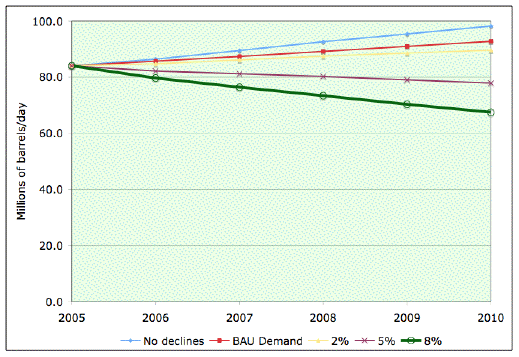
* Production from the fields that are currently producing our 85 mb/d is continuously dropping. The optimists say this depletion is as little as 2.5 percent each year, while credible pessimists are saying 8 percent a year may be more realistic.
* The answer to the rate of depletion question (and we won’t know for several years) is the key to the "when" of peak oil. If the depletion rate is only 2.5 percent then existing fields will still be producing about 74 mb/d in 2010. This amount can possibly be offset by production from new fields with a little left over for some economic growth. If the depletion rate is much higher then supply will not cover demand and we will see much higher priced oil.

This is the peak oil debate in a nutshell. It is the interplay between the worldwide demand as determined by price, the rate at which existing fields are depleting, and the oil industry's ability to bring new fields into production in the next five years. All this will determine the year when production peaks.

Differences among the speakers as to when peaking will occur hinge on their opinions about these variables. All, however, seemed to agree that we should see the peak within the next five years or so.

The most disturbing number presented at the conference was that the world's depletion rate may be as high as 8 percent. An 8 percent depletion rate for production from existing fields would be catastrophic because production would drop by nearly 30 mb/d by 2010. This is an amount that simply cannot be made up by production from new fields. If this rapid decline comes to pass, there will be widespread economic disruption, for there is little we can do to increase the production of substitute energy sources so quickly.

Several speakers are concerned there are not enough drilling rigs in the world and not enough experienced people to operate them. Even the eternally optimistic Saudis, while in the midst of announcing their expansion plans last week, caveated that these plans might slip due to the unavailability of sufficient drilling rigs. The damage and loss of drilling rigs during recent hurricanes in the Gulf of Mexico did little to help the situation. Indeed, there is some thought that the hurricanes did so much damage (some 730,000 b/d are still not back in production) and will require so many resources to repair, they will turn out to be a major reason why peak oil will occur sooner rather than later.

...

The highlight of the first ASPO-USA conference may have been when Congressman Roscoe Bartlett asked if we really want to "mitigate" by spending all our treasure to produce oil substitutes after peak oil arrives. Would we not be better off if we started moving towards a world with minimal consumption of liquid fuels as soon as possible?

Right now the cry is "find more oil". Forget the environment and drill wherever and as much as necessary. The International Energy Agency is suggesting that with an investment of a mere $17 trillion (that's right trillion with a "tr") to find, produce, and refine oil, life-as-we-know-it can go on for another 25 years.

When it becomes apparent, however, we can no longer keep up conventional oil production, the cry will change to "produce substitutes." Billions, and perhaps trillions of dollars will be allocated to producing synthetic liquid fuels. If this can come from biomass it might make some sense, but if we ravage Alberta and our coal reserves to power our SUVs for a few decades longer, it does not.
This indeed my turn out to be mankind's key decision for the first half of the 21st century. Do we power down gracefully to a greatly reduced liquid fuel world; or do we thrash around for a decade or two trying to maintain life as we have known it?

Stuart Staniford at The Oil Drum also has a look at decline rates of 8% like that being experienced by Exxon.


The Oil Drum also notes that the JODI database is about to be released after a long wait. Most of the initial commentators seem distinctly underwhelmed by the data itself and the website in general.
What is, in blogistan, I imagine a long time ago(last May not long after we started this site) I commented on the apparent good news that the International Energy Forum had a Joint Oil Data Initiative (JODI) which would provide more transparent reporting of oil market data. Since then there have been some complaints about the quality of the data that was being furbished, but I see that Platts is now carrying a story that the database will go live this weekend.

Well it will be interesting to see what exactly is new about the data that will be made available. Bear in mind that there are really two issues that should be addressed in such a data base, the first being the exact nature and size of the reserves, on an individual field basis; and second the actual production rates from those individual fields.

Richard Branson is still cranky about high fuel prices taking their toll on Virgin Atlantic. He seems to have realised that building a refinery of his own won't solve their problems after all and is now looking at producing cellulosic ethanol instead. Im not so sure this is suitable for jet fuel, but maybe he knows more than I do or he just wants a hedge against oil prices in general (in which case the derivatives markets would be a simpler way to go about it). I'm tempted to wonder if Mr Branson will come up with Virgin Solar or Virgin WindPower once the penny drops and he realises there is an opprtunity in the alternative energy market - particularly in energy-short Britain.
Tired of skyrocketing jet fuel prices, Virgin Atlantic Airways boss Richard Branson said on Wednesday he plans to turn his back on hydrocarbons and use plant waste to power his fleet.

“We are looking for alternative fuel sources. We are going to start building cellulosic ethanol plants (to make) fuel that is derived from the waste product of the plant,” he told Reuters in an interview in the oil-rich United Arab Emirates.

Rigzone reports that "East Timor Opposition Parties Urge Halt to Australia Energy Talks". Wasn't Alexander Downer claiming these talks had been finalised 9 months ago ? Also at Rigzone, a report on Exxon's Hibernia field offshore Newfoundland, which is quite a good illustration of some of the motivations that help to cloud reserves figures (even more than the uncertainty created by geology and extraction techniques that is). Plus an article that notes that OPEC is claiming "World Oil Demand Recovering; No Demand Destruction".
OPEC said Wednesday that a six-month run of downward revisions to its world oil demand expectations had come to an end, with evidence of a resurgence in Chinese demand and with key economies in rude health.

In its monthly oil market report, the Organization of Petroleum Exporting Countries nudged higher its prediction for global demand this year and next, to 83.3 million barrels a day and 84.8 million barrels a day, respectively.

Despite marginal revisions to its global growth forecasts, OPEC said "we were right to refute" talk of "demand destruction" fueled by U.S. hurricanes and surging crude and product prices.

There is, it added, "vigorous preliminary growth data from developing countries, a brighter outlook for the world economy particularly for the U.S.A and OECD Pacific countries, and a rebound in Chinese apparent demand."

On the last point, "there are indications that Chinese demand has started to pick up."

It cited Chinese government orders to rebuild oil stockpiles from as low as three days' cover to at least 10-15 days. The end of a products export rebate and a likely surge in imports ahead of the Chinese New Year likely herald a return to strong Chinese growth, it added.

This is something of a weird source for me to be quoting ("The Trumpet" is published by the Philadelphia Church of God), but here is their view on the opening of the Iranian Oil Bourse, which combines reality based commentary with Christian endtimes fundamentalism - the religious equivalent of secular collapsism (via the intrepid Tim of Suburbia).
Asia Times reported that only one major actor stands to lose if oil-trading in euros takes hold: the U.S. By contrast, “Oil in euros would benefit millions … in the EU and its trading partners …. And it would loosen the grip the U.S. has on opec members” (August 26).

“One of the Federal Reserve’s nightmares may begin to unfold in the spring of 2006,” one expert on the subject stated, “when it appears that international buyers will have a choice of buying a barrel of oil for $60 on the nymex [New York Mercantile Exchange] and ipe [London’s International Petroleum Exchange] or purchase a barrel of oil for €45 to €50 via the Iranian bourse” (Global Politician, September 2).

If oil-trading in euros were to get going, the already-existent global trend of foreign currency reserves being shifted from dollars to euros would rapidly accelerate. In turn, “countries switching to euro reserves from dollar reserves would bring down the value of the U.S. currency. Imports would start to cost Americans a lot more …. As countries and businesses converted their dollar assets into euro assets, the U.S. property and stock market bubbles would, without doubt, burst” (The Foundation for the Economics of Sustainability, Nov. 15, 2004).

The snowballing effect of a reserve currency switch would be catastrophic for the U.S., according to the Global Politician. The U.S. “would simply have to stop importing” (op. cit.).

Considering America’s industrial and agricultural heartland has been gutted over the last half century, this possibility could be grave. As one commentator put it, the impact of the Iran oil bourse on the U.S. dollar—and the follow-on effect on the U.S. economy—could be worse than Iran launching a “direct nuclear attack.”

Should Iran’s planned euro-based oil-trading mechanism get off the ground and gain international popularity, the U.S. dollar will weaken and the euro strengthen—helping to hasten the economic decline of the U.S. and propelling the European Union into dominance.

Though many economists consider the chances of Iran’s ambitions being successful as remote, we can know from Bible prophecy that the U.S. financial system will be brought down—along with the U.S. dollar as the reserve currency.

Global Public Media has an interview with Ted Glick about the upcoming Climate Crisis Day of Action on December 3.

The Sydney Morning Herlad reports that the WHO is saying that Global warming is fuelling the spead of disease.
Just this week, WHO officials reported that warmer temperatures and heavy rains in South Asia have led to the worst outbreak of dengue fever there in years. The mosquito-borne illness, which is beginning to taper off, has infected 120,000 South Asians this year and killed at least 1000.

In warmer temperatures the parasite that spreads malaria via mosquitoes develops more quickly, for example, and a 2000 study in Peru found that when the El Nino phenomenon boosted temperatures, hospital admissions of children with diarrhoea increased exponentially. One study showed in certain South American countries, a one-degree rise in temperature caused an 8 per cent increase in diarrhoeal diseases.

The report says more resources to combat disease in poor countries combined with long-term cuts in greenhouse gas emissions are needed to limit the effects on poorer countries. Climate change exacerbates problems poor countries face from disease, largely because bacteria spread more rapidly, increasing contamination of food and water. Forecasts of climate change also predict more erratic weather patterns for many countries, wreaking havoc with subsistence farming and adding to the burden of malnutrition.

The report comes two weeks before signatories of the Kyoto Protocol meet in Montreal for the first time since it was ratified in February. The US, which emits 24 per cent of the world's greenhouse gases, and Australia have refused to sign up to Kyoto.

WorldChanging also has a post on this report.
"Impact of Regional Climate Change on Human Health," a new report in the latest edition of Nature, makes for sobering reading. A combined effort from the University of Wisconsin, Madison, and the World Health Organization, the report reviews the evidence connecting changes to climate conditions and threats to human health. The study looked at both empirical data from past observations and model-based simulations of future interactions. Unusually, the full report is available to non-subscribers; a good summary can be found at SciDev.net.

The nations that have been, and will be, hardest-hit by climate-related health effects are those least able to respond; they're also the least responsible for the global temperature increases both over the past century and (with the arguable exceptions of India and China) likely over the next. This is not a happy article, or a study full of solutions; it does, however, underscore why global warming is so dangerous -- and why the need to respond to environmental risks can't be disconnected from the need to respond to global poverty.

The World Health Organization now estimates that at least 150,000 deaths each year are directly attributable to the effects of climate disruption. Over the next 25 years, that risk will rise substantially:


The Iraq situation may be approaching a tipping point with one influential Democrat congressman calling for the US to withdraw in a speech that belaboured the obvious. Of course, that won't stop the neoconservative cabal shrieking in fury and doing their best to demonise him - but as this guy is a real Army veteran and they are a bunch of draft dodging, bloodthirsty chickenhawks its hard to see too many people taking them seriously (not that it matters of course).

However its equally hard to see any sort of pleasant outcome resulting - we won't withdraw (disaster or not, I can't see any politician in the hot seat giving up theoretical control of that oil), things will continue to get worse and I can't begin to guess what the final outcome will be - but I doubt it will make anyone happy. As Billmon notes, we're in a world of shit.
The war in Iraq is not going as advertised. It is a flawed policy wrapped in illusion. The American public is way ahead of us. The United States and coalition troops have done all they can in Iraq, but it is time for a change in direction. Our military is suffering. The future of our country is at risk. We cannot continue on the present course. It is evident that continued military action is not in the best interests of the United States of America, the Iraqi people or the Persian Gulf Region. [...]

The main reason for going to war has been discredited. [...]

The threat posed by terrorism is real, but we have other threats that cannot be ignored. We must be prepared to face all threats. The future of our military is at risk. Our military and their families are stretched thin. Many say that the Army is broken. Some of our troops are on their third deployment. Recruitment is down, even as our military has lowered its standards. [...]

George Washington said, "To be prepared for war is one of the most effective means of preserving peace." We must rebuild out Army. Our deficit is growing out of control. The Director of the Congressional Budget Office recently admitted to being "terrified" about the budget deficit in the coming decades. This is the first prolonged war we have fought with three years of tax cuts, without full mobilization of American industry and without a draft. The burden of this war has not been shared equally; the military and their families are shouldering this burden.

Our military has been fighting a war in Iraq for over two and a half years. Our military has accomplished its mission and done its duty. Our military captured Saddam Hussein, and captured or killed his closest associates. But the war continues to intensify. Deaths and injuries are growing, with over 2,079 confirmed American deaths. Over 15,500 have been seriously injured and it is estimated that over 50,000 will suffer from battle fatigue. There have been reports of at least 30,000 Iraqi civilian deaths. [...]

I suspect the debate about what we are going to do could become slightly more transparent and reality based in the coming months (as opposed to the present Winston Churchill mode - the truth being so precious it must be hidden in a cloud of lies), with both former US Secretary of Defense James Schlesinger and former CIA Director James Woolsey testifying before the US Senate on peak oil and some of its ramifications. Woolsey's "geo-green" style recommendations appear reasonable actions in the medium term, as he proposed a mix of RMI style changes to vehicles, biofuel development and focussing on plug-in hybrid and battery development. Of course, he would be biting the hand that feeds him to suggest a greater use of renewable energy sources, however that is compatible with the plug in hybrid and battery strategy anyway - so I won't be too critical (of course, he also quotes the idiotic Huber and Mills and their bottomless well of stupidity, for which there can be no forgiveness).

Speaking of battery technology, the Energy Blog has a post up on developments in Lithium Batteries.
Two of the largest battery manufactures have made it official, they both say that Lithium-ion batteries will be the standard battery for hybrid electric vehicles (HEVs) in a few years.

Sanyo Electric Co., the largest manufacturer of nickel-metal hydride batteries, predicts that by 2010, the majority of hybrid vehicles will use lithium-ion batteries. Currently, all hybrids use nickel-metal hydride batteries.

Johnson Controls recently launched an advanced lithium-ion battery development laboratory, to create advanced power-storage solutions for near-future hybrid-electric vehicles. The facility – located at the company’s Battery Technology Center – features a “dry room” and an array of highly specialized tools and equipment for designing, developing and testing power-storage and power-management concepts based on lithium-ion technology. The new laboratory facility and development equipment were installed at a cost of approximately $4 million. The company believes lithium ion technology is likely to replace nickel-metal-hydride as the battery technology of choice in hybrid-electric and electric vehicles in the future. Johnson Controls, the world’s largest manufacturer of automotive original equipment and aftermarket batteries, manufactures and distributes more than 80 million batteries annually.

In 2004, the company was granted a contract for lithium-ion battery development by the United States Advanced Battery Consortium (USABC). In this program, Johnson Controls has been tapped to develop an abuse-tolerant, lithium-ion battery offering extended life and significantly improved power-to-weight performance vs. current hybrid-battery technology. The USABC, which includes the U.S. Department of Energy, DaimlerChrysler, Ford and General Motors as members, supports research and development for advanced energy systems to power future HEVs.

According to industry projections, sales of HEVs in the U.S. and European automotive markets could reach 6 million units within a decade.

Although lithium-ion batteries are currently more expensive, their advantages over nickel-metal hydride batteries include higher voltage, power density and energy density. But the batteries still have a number of problems. Early lithium-ion batteries had a tendency to short-circuit internally, sometimes melting cell-phone cases. More testing is needed to ensure that the short-circuit problem has been solved. In addition, the batteries have yet to be proved crashworthy.

On a more colourful note, MetaEfficient has a post on new LED lightbulbd from Philips.
The new LED light bulbs from Philips will change color and brightness with one touch, squeeze, or turn. They are also energy efficient and last 10-20 years. Good work. Expect to see these in coming months or years.


And continuing a walk through my less travelled parts of the Viridian world, TriplePundit has a "Carnival of the Green" going.

And to close, here's one for the "free energy" crowd with Boing Boing noting the US patent office has issued a patent for anti-gravity. This could either be viewed as a remarkable breakthrough or confirmation that the patents process is irreversibly broken.

Seeing the Forest for the Trees: Sequestration and Oil Production  

Posted by Big Gav

In the past I've occasionally taken a worried look at the possible side effects of carbon sequestration projects, both offshore and onshore. The Energy Blog (always one of the best sources for energy news) has a post up about one onshore project in North America, with the rather misleading title "CO2 Sequestration Project Successful".

Successful Sequestration Project Could Mean More Oil and Less Carbon Dioxide Emissions - Weyburn Project Breaks New Ground in Enhanced Oil Recovery Efforts

Washington, DC – Secretary Samuel Bodman today announced that the Department of Energy (DOE)-funded “Weyburn Project” successfully sequestered five million tons of carbon dioxide (CO2) into the Weyburn Oilfield in Saskatchewan, Canada, while doubling the field’s oil recovery rate. If the methodology used in the Weyburn Project was successfully applied on a worldwide scale, one-third to one-half of CO2 emissions could be eliminated in the next 100 years and billions of barrels of oil could be recovered.

Jim himself is less convinced by the success of the project, making the following notes at the end:
Is this news? Isn't this overstating the importance of this project?

Tthey are admitting that this method of EOR has and is being used in other oil fields. The only thing new is the source of the CO2. Does that make any differance? If this is what it takes to establish injecting CO2 into an oil field for sequestration as demonstrated technology and forms the basis of requiring sequestration in some other situations I guess it has some meaning. Or is this what it takes to convince some that using CO2 for EOR is worthwhile?

Our government has some strange ways of spending our money to justify its actions. This is relatively pure CO2 from a coal gasification plant that is piped over a 100 miles to the oil field. This presumably does not demonstrate sequestration from an industrial source like a conventional coal fired power plant or demonstrate sequestration into a geological formation other than an oil field. So what have we learned? Perhaps in phase II they will get some data as to how much CO2 is staying in the ground which may be of value.

WorldChanging has also taken a less than overwhelmed look at this project and decides its not only not impressive, but is actually worse than not trying to sequester the CO2 at all - "a climate insult dressed up in green clothing".
The US Department of Energy trumpeted the result this week: the DOE-funded “Weyburn Project” successfully sequestered five million tons of carbon dioxide into the Weyburn Oilfield in Saskatchewan, Canada, while doubling the field’s oil recovery rate.

I'm quite certain that you folks have already picked up on the key underlying problem. The additional barrels of oil put out carbon dioxide even while the sequestration buries it. In fact, as I show in the extended entry, the additional oil puts out more CO2 than is buried. The Weyburn sequestration model is a study in the need to pay attention to the trade-offs involved in quick-fix solutions to big problems.

The real carbon dioxide balance isn't spelled out in the press release, of course, but the DOE story gives this helpful bit of information: Scientists project that, by using knowledge gained from the Weyburn Project, the Weyburn Oilfield will remain viable for another 20 years, produce an additional 130 million barrels of oil, and sequester as much as 30 million tons of CO2.

That's the key to the comparison. How much carbon dioxide does 130 million barrels of oil put into the air? A typical barrel of oil produces between 19 and 20 gallons of gasoline; a gallon of gasoline, in turn, produces about 20 pounds of CO2. Each barrel of oil is responsible, on average, for about 400 pounds of carbon dioxide, and that doesn't even begin to count the other uses of the oil in that barrel. It turns out that less than half of a barrel of oil goes to gasoline (19.6 gallons out of 44.4 gallons of total oil products); the majority goes to the production of products like heating fuel oil, jet fuel, lubricants, even some kinds of waxes. Some of those products will also put out a good bit of CO2 into the air.

Five barrels of oil result in a ton of CO2 from gasoline use alone. 130 million additional barrels, therefore, mean at least 26 million more tons of CO2. If the only product from a barrel of oil was gasoline, the balance would just barely be positive. It's not, though, and even if the remaining uses of the barrel were somehow half as "dirty" in carbon dioxide as gasoline, that's still at least another 13-15 million additional tons of CO2, more than eliminating the slight benefit. Using CO2 sequestration for enhanced oil recovery at Weyburn will put about 10 million more tons of CO2 into the air than if we didn't extract the additional oil in the first place. Carbon dioxide sequestration as part of enhanced oil recovery is a climate insult dressed up in green clothing.

Catalyst  

Posted by Big Gav

The ABC's Catalyst program this Thursday has a feature story on peak oil.

What would happen if the world were to start running out of oil? Conventional wisdom says we’ve got 30 years, but there’s a growing fear amongst petroleum experts it’s happening much sooner than we thought – that we are hitting the beginning of the end of oil now. So how soon will the oil run out, and can we stop our economy collapsing when it does? How prepared are we for the real oil crisis?

This weekend's Australian Financial Review also has a look at peak oil with an article called "Over a barrel: oil peak debate heats up" - as usual, no link becuase it is hidden behind their stupid paywall. The WA STC's Bruce Robinson comments:
"The decline of existing fields is motivating scientists to form research groups like that being launched at the University of Western Australia"

Today's Weekend Australian Financial Review, Page 16, has a useful story about Prof Aleklett's visit, and some dissenting views from a visiting Nobel Prize-winner, Economist Vernon Smith who says ASPO's oil peak predictions are "baloney", an economic fallacy. He expects oil to sell for $15/bbl in the near future.

Smith says ASPO's peak oil scenario is wrong because it treats oil like a fixed resource, something he argues that analysts should not do until extensive exploration rules out significant future discoveries.

[BR: One could almost say that this point has probably been reached, with the decline in discoveries since the mid 1960's]

The ASPO Peak of 2010 leads the story, but there are a number of minor reporting inaccuracies, including attribution of the formation of ASPO-Australia to the University of Western Australia. UWA is hosting a public lecture by Prof Aleklett (Monday 21st, 6:30), but that is as far as it goes. ASPO-Australia is being launched at a media conference elsewhere, earlier on Monday, but one can see how the confusion may have arisen in the haste of catching newspaper deadlines

In fairness to Vernon Smith as well, it is possible that what is reported is also not a fully accurate summary of what he said.

Online Opinion's feature this month "Oil’s not well - life after petrol" is rolling along, with new articles appearing by Sherry Mayo (No silver bullet for oil in crisis), Chris "The Feral Metallurgist" Shaw (Peak oil - keep your eye on the donut and not the hole) and an excellent piece from Briton John Busby (Adopting an energy lean lifestyle) which looks at Australian natural gas and uranium reserves and how we might want to use them in future. I've been meaning to do some investigation of our natural gas reserves as I've seen wildly conflicting numbers about them in the past few months. Like many things, this is on the back burner for the moment though.

From Sherry Mayo's article:
Our modern industrial way of life is based on the assumption of cheap plentiful oil and we are profligate in our use of it. Our modes of transport, city-planning and supply chains were never conceived with energy efficiency in mind, so there are enormous gains to be made in changing the way we do things. Some of these changes will happen quite naturally and quickly. With high oil prices imported food will become expensive food, making local produce more attractive to consumers. This will reduce fuel use in freight and discourage over-centralised distribution networks. Other longer term changes such as improving public transport will require real political will, but they will be essential for those on lower incomes in outer suburbs who will be hardest hit by rising fuel costs. Further into the future, our settlements and work patterns may change radically, moulded by the constraints of scarce and expensive oil.

Dealing with peak oil will be just one step on a long road to a very different and more sustainable way of life, and many other issues such as CO2 emissions, water use and salinity, will all have to be dealt with along the way. Nevertheless, peak oil is an increasingly urgent issue and despite the remaining uncertainties we can’t afford to wait and see, hoping that something will turn up. As was observed by WA minister for Planning and Infrastructure, Alannah MacTiernan, at last year’s Oil: Living with Less conference, “It is … certain that the cost of preparing too early is nowhere near the cost of not being ready on time”.

And from John Busby's piece:
According to the BP Statistical Review 2005, Australia has reserves of 2,460 billion cubic metres (bcm) of natural gas, from which it produces 35.2 bcm annually: it consumes 24.5 bcm and exports 30 per cent of the production. If all the gas in the reserves can be extracted, at the current rate it would last 70 years, but as the gas reserves of other countries decline the demand for liquefied natural gas (LNG) will escalate. Gas will increasingly be used as a substitute for oil for the production of jet and motor fuels and petrochemicals.

Unfortunately most of the world’s reserves of gas are “stranded” from consuming countries, being located in uninhabitable places like Prudhoe Bay on the Alaskan north shore and the Barents Sea to the north of Russia or at the remote North West Shelf of Australia (Gorgon). Remoteness results in energy losses. Natural gas is purified before it is liquified into LNG - a process that consumes around 15 per cent of the original gas volume. More is lost as it “gasses off” during the long voyage to its destination,although some of the released gas feed turbines used to propel the tankship. (This gas is used to propel the gas turbines of tankers.)

On arrival the LNG is re-gasified for addition to a natural gas pipeline network for augmentation of local supplies and for distribution. So-called gas-to-liquids (GTL) processes have been developed to produce liquid fuels, such as jet fuel, petrol and diesel from natural gas, but the thermal efficiency is poor, resulting in a loss of 50 per cent of what remains of the original gas.

So, as oil passes its peak in production, more gas will be used to substitute for the traditional mobility fuels, so bringing gas’s own peak in production forward, especially as the reserves are effectively reduced by the inefficiencies in its liquefaction and conversion. Peaks in oil and gas production will mean more use of coal for liquid fuel synthesis. Fuels synthesised from coal were used in Germany in World War 11 and latterly in South Africa where Sasol developed processes to avoid the effect of sanctions.

The Gorgon gas field is not so “stranded” for the Australians. However, it may be necessary to deny others access to its reserves. Internal demand may bring the practice of exporting 30 per cent of production to an end. Currently, 37 per cent of the oil consumed by Australia is imported.

Britain is now a net importer of natural gas and it could be that the past exports of its surplus production may in retrospect be seen as ill advised. Perhaps Australia will also regret its beneficence.

On the subject of Australian natural gas, Woodside were talking up their export prospects this week - with the US East Coast now being mentioned as an export destination for LNG (no one seems to rate their chances of getting a west coast terminal up and running now).
Senior executives of Woodside Petroleum were keen to highlight its strong production growth profile in both oil and liquefied natural gas at its annual investor briefing in Sydney yesterday.

While Woodside raised this year's production target slightly to 59 million barrels of oil equivalent (boe) from the 58 million boe guidance released in August, it noted 2006 production would rise 30 per cent as new projects came on stream.

And Woodside LNG sales from the planned Pluto and Browse projects off the coast of Western Australia could come from an unexpected place: the US east coast.

Although it takes 57 days for a tanker round-trip to LNG import terminals in Massachusetts or Louisiana versus a 20-day round-trip to Japan or 40 days to California, growing US natural gas demand has opened up a new market for gas from those developments. Pluto should deliver its first production in 2011, with Browse beginning to sell LNG from 2011 at the earliest and 2014 at the latest.

"Australia is very clearly on the radar of many US LNG buyers," gas marketing director Reinhardt Matisons told analysts and institutional investors. Woodside had already received approaches from buyers on the US east coast.

One note to consider for all oil and gas investors is the increasing cost of exploration and production, with one investment bank here noting the following after Woodside's presentations:
Woodside forecasts its 2006 exploration spend to be approximately A$500m, nearly doubling its annual number of planned exploration wells to approximately 40. Woodside aims to manage its exploration risks by spreading 85% of its 2006 spend in what it calls 'proven provinces', areas in which commercial oil or gas production is established.

...

Adjusted Net profit after tax revised down 4% in 2006 and 2% in 2007. Forecast exploration cost increases going forward has increased expensed exploration costs.

...

We consider the key themes of the strategy day to be positive, with particular regard to future LNG developments at Pluto and Browse providing potential upside to our valuation assumptions for these potential developments. Costs remain an uncertainty for future project developments but we remain comfortable with Woodside's approach to managing this risk.

In terms of local gas consumption, natural gas fired peaking plants are currently the preferred way of handling demand spikes for electricity (electricity price volatility seems to be increasing as far as my casual observations go, with a number of large spikes in recent months). AGL has announced a plan to build a new gas fired plant on the outskirts of Sydney using coal seam methane gas from their partnership with Sydney Gas (thus explaining why the partnership exists).
Australian Gas Light, the country's biggest energy utility, said it might build a $200 million gas-fired power plant near Sydney to meet rising demand in NSW.

The proposed 300 megawatt plant south of Campbelltown could be ready by 2009, AGL said in a statement to the stock exchange. It said the plant might be expanded to 500MW.

NSW could require 750MW of new power capacity to run at peak demand times between 2010 and 2014, AGL said, citing the National Electricity Market Management Co, which oversees the power market. "The site will be supplied by gas from AGL's wholesale gas portfolio, which includes its 50 per cent joint venture with Sydney Gas Ltd," AGL managing director Greg Martin said in the statement.

Australian carbon emissions have risen 23 percent over the past 13 years, which demonstrates what happens when you don't mandate a cap (or put a well flagged regime of carbon taxes in place) - no one bothers doing anything.

Global warming is having an impact on the oil price, with the thus far warmer than usual US winter being blamed for slumping crude prices despite declining inventories.

Finally, gold bugs will be happy to see the ever rising gold price is being reflected in share prices for the dew remaining local gold mining companies.

You Only Get One Alan Bond In Your Lifetime  

Posted by Big Gav

I saw a link to this story on PeakOil.com about an "anonymous" source within Madagascar Oil talking up the prospects of Chinese involvement in their projects. Time passes but some things never change - maybe we'll get to see Airship Industries launched again if they bite.

And maybe Bondy will get to use Kerry Packer's famous line on the Chinese one day...

[Please note that this is of course just idle apophenia and the exact links between Bondy and Madagascar Oil are rather murky - so I may just be being overly cynical about the amazing opportunity presented by this vast oil resource to the lucky Chinese. I always think Caveat Emptor is a useful phrase to keep in mind though.]

Chinese oil majors are looking at forming upstream joint ventures in Madagascar to exploit newly discovered reserves on the island situated off Africa's east coast, says a senior official at Madagascar Oil S.A.

More than one Chinese oil firm has approached Madagascar Oil about the possibility of cooperating in oil exploration and taking a stake in the company, which was founded in 2004 and is eyeing a listing in London in the second quarter next year, said the official who asked not to be named.

"They (the Chinese companies) have very deep pockets. I prefer to work with them on the heavy oil projects because those are very capital intensive," the person said, bt declined to name the Chinese companies that are in talks with the African oil company.

ExxonMobil Corp. (XOM), Sterling Energy PLC (SEY.LN) and Aminex PLC (AEX.DB) have already formed joint ventures with local partners since 2001 to develop oilfields on the island and offshore. Madagascar is expected to produce its first barrel of crude in 2007.

As China imports about 40% of its oil needs, high international oil prices have pushed the country's cash-rich oil giants to more keenly search for upstream assets overseas to control their costs, analysts said.

Madagascar Oil, with offices in London and the Madagascar capital of Antananarivo, is involved in three major projects. Two are heavy oil developments at the oilfields of Tsimiroro and Bemolanga, while the third is the exploration and appraisal of light oil and natural gas on the world's fourth largest island.

The firm's assets have a total valuation of between US$400 million and US$500 million, the person said.

Heavy oil has more impurities than light oil and thus costs more to refine.

"The Chinese will likely be involved in the Tsimiroro project, because of the big volume," the person said.

The Tsimiroro Oilfield is estimated to have a reserve of several billion barrels of crude, but it is of low quality, with an American Petroleum Institute specific gravity of 14 to 16 degrees.


Gratuitous Waste Of Fuel  

Posted by Big Gav

No real post from me tonight so instead I'll point you to this little movie (little is a relative term - broadband users only) about a car trip through Paris (via Crooked Timber).

Even if you do own a Ferrari, don't try this in your home town...

On an August morning in 1978, French filmmaker Claude Lelouch mounted a gyro-stabilized camera to the bumper of a Ferrari 275 GTB and had a friend, a professional Formula 1 racer, drive at breakneck speed through the heart of Paris. The film was limited for technical reasons to 10 minutes; the course was from Porte Dauphine, through the Louvre, to the Basilica of Sacre Coeur. No streets were closed, for Lelouch was unable to obtain a permit. The driver completed the course in about 9 minutes, reaching nearly 140 MPH in some stretches. The footage reveals him running real red lights, nearly hitting real pedestrians, and driving the wrong way up real one-way streets.

Rembrandt Paints An Interesting Picture  

Posted by Big Gav

Rembrandt Koppelaar has released another iteration of his depletion model (pdf).

A peak in liquids production is to be expected between 2012 and 2017 based on five factors:

• A production decline in an increasing amount of oil producing regions
• A decline in oil discoveries since the 1960’s
• A limit to the increase in liquids production from the existing reserve base
• An estimate of additional production due to improvements in technology
• An increased production from oil/tar sands and Orinoco heavy oil production

A significant discontinuity in observed oil production trends is necessary to postpone the peak to a date later an 2017. However, there are large uncertainties regarding reserve data, the influence of reserve growth (specifically technological progress) on production and the progression of worldwide decline. Therefore any
peak oil projection has a significant degree of inaccuracy and should not be followed blindly.

The Oil Drum has a look at the problems of natural gas supply in the US.
This site generally focuses on the world situation in regard to oil production. However, given the concerns that are beginning to arise about the supplies of natural gas this winter, it is important to also keep an eye on the situation there. The NYT has just drawn a worrying, but sadly not unexpected, picture of the growing problems that industry and the country will face as natural gas supply and demand entangle. The tenor of the article relates to the costs pointing out that the United States now has the highest prices of any industrialized country. More than half the homes in the country are heated by natural gas, and because of potential shortages, industry may face shut-down since dwellings have priority in times of shortage. This is not new, the impact of higher prices has already driven some industries abroad.
We need to declare a national crisis," Andrew N. Liveris, the chief executive of the Dow Chemical Company, said in recent testimony before the Senate. Dow, the nation's largest chemical maker, has shut 23 plants in the United States in the last three years in places like Somerset, N.J.; South Charleston, W.Va.; and Elizabethtown, Ky., as it shifted production to Kuwait, Argentina, Malaysia and Germany, where natural gas is cheaper.

"Call it demand destruction," Mr. Liveris said. "Dozens of plants around the country have closed their doors and gone away, and are never coming back."

Sun is promoting their latest CPU release as an "Eco-chip" - Technology Review takes a look at this new device and the Viridian marketing angle Sun has chosen for it.
Looking to leapfrog its rivals, computer maker Sun Microsystems Inc. on Monday announced an ''eco-friendly'' server chip that it claims will deliver more performance while requiring less electricity than competing microprocessors. The new chip uses about 70 watts of power on average, significantly less than the 150 watts to 200 watts required by server chips from Intel Corp. or International Business Machines Corp., Sun said.

The California-based computer maker also said removing the world's Web servers and replacing them with half the number of UltraSparc T1-based systems would have the same effect on carbon dioxide emissions as planting 1 million trees. ''It's time the technology industry took a stand -- tripling your datacenter performance shouldn't mean tripling your power bill and needing more coal-fired plants,'' said Jonathan Schwartz, Sun's president.

WorldChanging also has a look at this new release from Sun, and made some interesting observations on data centre power consumption.
With great fanfare, McNealy, the CEO of Sun Microsystems, announced on Monday the introduction of a new energy-efficient processor that will debut in a new line of servers by the end of the year. The company is calling the chip "the world's first Eco-responsible processor."

This is no small matter. While a great deal of focus has been on reducing the energy use of consumer electronics, such as PCs and TVs, far less has gone into the energy impacts of server farms -- facilities housing massive computing storage and routing wizardry used by Google, eBay, Yahoo, and just about any other Web site that maintains a database, performs e-commerce, or facilitates e-mail, Internet telephony, music streaming, and all the rest. Server farms require energy to operate all that electronic equipment, and gobs more to keep the equipment cool. A typical data center can consume nearly 4,000 watts per square foot -- roughly 15 times what they consumed in the early 1990s, and more than half the power required by many homes, according to the American Society of Heating, Refrigeration, and Air-Conditioning Engineers.

I couldn't find any reliable data about the aggregate energy used by today's server farms, let alone projections for the rapidly scaling future, but the load for an individual farm can be significant -- and costly. Here's a flavor, culled from a 2001 C|net article: When U.S. Dataport, a company in San Jose, Calif., planned a $1.2 billion server farm "that would be the world's largest data center," it called for "10 huge air-conditioned warehouses on 174 acres that would constantly draw 180 megawatts of electricity -- about enough to provide energy for all the homes in a city the size of Honolulu."

Wired has an article on Stirling engine based solar power plants in southern California, which makes the interesting point that solar may soon be cheaper than fossil fueled power generation. Wired also has an article on a Canadian technology to improve fuel efficiency and reduce particle emissions from diesel engines.
Though Stirling engines have been around for almost two centuries, there have been few efforts in the past to harness the sun to run them, said Stirling Energy Systems CEO Bruce Osborn. Osborn said the Stirling dishes are 30 percent efficient -- 30 percent of the sun's energy is converted into electricity -- which is two to three times as efficient as conventional photovoltaic cells. "Solar panels are more common, and they have gotten more efficient, but they still have a long way to go," he said.

Osborn said his company's dishes are easy to maintain because the engine is a closed system that never needs to be refilled -- an important factor for a large-scale facility in the middle of the desert. In fact, the only resource it consumes is "a little bit of water to wash the mirrors off every few weeks," he said. The company is currently operating a six-dish test site at Sandia National Laboratories to showcase the concept, but the SoCal Edison and SDG&E plants are Stirling Energy Systems' first commercial contracts.

The first phase of the SoCal Edison project will be to build a 1-megawatt test site using 40 dishes, which should be complete by spring 2007. Construction on the full, 500-megawatt facility is expected to begin in mid-2008, and should take three to four years. Each dish can produce up to 25 kilowatts, and the site will eventually have 20,000 dishes stretching across 4,500 acres of desert.

Stirling plans to begin construction on SDG&E's 300-megawatt project in late 2008, and it should take about two years to install the 12,000 dishes covering about 2,000 acres. None of the companies would give a price for building the solar sites or disclose the rates the utilities will pay for power, but both said the cost would be similar to traditional coal or gas.

But as oil prices go up, so could the cost of electricity from fossil fuels. "Soon, solar may be less expensive," Osborn said.

Solar isn't the only renewable energy source that is becoming price competitive with fossil fuel (even ignoring the other advantages and reduction of externalities) - WorldChanging has a post on the rapidly improving economics of wind power in North America. They also have a summary of wind related articles called "Catching Up with the Wind".
With the recent increase in natural gas prices, services using gas as a fuel have correspondingly become more costly. This is most visibly reflected in the cost of home-heating (customers in California have been warned that winter heating costs could double), but it affects electricity as well, used in many regions as fuel for power generation. Combine this with improvements in wind power technologies in recent years, and we get this somewhat startling (but very good to see) entry at the Green Power Markets page at the US Department of Energy:
November 2005 - Utility customers participating in green pricing programs that offer some form of protection from fossil-fuel price changes are finding that their green power premiums are shrinking or even turning negative. For example, as of November 1, Colorado customers participating in Xcel Energy's Windsource program are paying 0.66¢/kWh less for wind energy than for "regular" electricity because of an increase in the utility's energy cost adjustment (ECA). Since the ECA announcement, Xcel has sold out of its remaining available wind energy supply and has established a waiting list for new program signups.

In Oklahoma, OG&E Electric Services customers purchasing the OG&E Wind Power product now pay 0.13¢/kWh less for wind energy than for traditional electricity and customers of Edmond Electric's pure&simple wind power program now pay 0.33¢/kWh less.

In a growing number of regions across the US, wind power is now officially cheaper than the baseline electricity rate.

Elsewhere at WorldChanging they have posts on a new blog on the "Sustainable Future" and a likely upcoming meme - GEMS : Genetically engineered microdevices.

Econbrowser's James Hamilton seems to have become more convinced about peak oil over recent months - here is a speech he delivered on the subject at the American Enterprise Institute (a bastion of neoconservative thinktankology) of all places.
So in terms of where is that surge in world demand for oil coming from? The answer I think is pretty clear. It's coming from the developing countries, particularly China, rather than the major developed countries. And let's take a look at that Chinese oil demand in particular. So here's a graph of China's oil demand going back to 1990. And that's a terrific slope there. It turns out that's a 7.5 percent growth per year, every year for 15 years going up 7.5 percent. And if you grow at that rate you're going to pretty soon start to be a pretty major player on the block. And that's exactly what happened. Now if you show a graph like this with a nice exponential trend to it to an engineer, the first thing they want to do is extrapolate that trend. So let's see what we get. Let's extrapolate that trend out, 7.5 percent growth per year. Here we are in 2005, well you project that out by another 20 years and China will be consuming something over 30 million barrels of oil a day. So for a comparison in the U.S. we're talking about 20 million barrels a day today.

In other words, if this keeps up China is going to be consuming 50 percent more than the U.S. Now one an engineer looks to the graph like that the next question they ask, being an engineer, is oh my gosh, where is that oil going to come from? Where are we going to get the fields to pump it from and the tankers to haul it from and the refineries to use it? And the engineer says we've got some problems here. I don't think this can be done. And you put what the engineers are saying, or would want to say, just extrapolating that trend. It's about to go way off. With what the geologists are saying, which is well there ought to be some peak here in production. You put the two together and the two of them together can get quite worried about things.

So here is an example of the kind of graph that you often see from people who talk about this problem or worry about it a great deal. Designation, we are here. Demand is going up at this tremendous exponential rate. Supply is often limited. And we could maybe argue about how much more oil are we going to find? Are we going to put off that peak 10 years or 20 years, whatever? But whatever your answer to that, no matter how optimistic you wanted to be, if you put it together with these kind of exponential trends of 7.5 percent growth in places like China sooner or later you're going to be overwhelmed. It's just the simple math of the situation.

...

Why are we getting all of this oil out of the Middle East? And you go back to that graph of the production. This is a very unstable part of the world, all kinds of consequences. Why aren't we getting oil from Texas? Again, the same answer. We used up the oil in Texas. In fact the U.S. produced more oil than Saudi Arabia did, but ours is gone now. So we have to turn there. And as time goes on I think we're turning more and more to parts of the world that are less and less attractive in terms of stability of investments, for example Nigeria. My guess is that that's a country we'll be hearing a lot more about geopolitically in the next 10 years because that's going to prove to be a very important country in world production. And people will come to be as familiar with the political parties and conflicts there as we have with some of the other regions. It might not be your first choice of what you're going to hang your economy on, but we don't really have an alternative. And so there's a general principle here. The most reliable sources of oil are used up first. I think in a lot of different dimensions you're seeing we are turning to less and less reliable sources of oil precisely because the best sources are gone. And that is one aspect unambiguously of peak oil that I would say is here now, it's not something in the future.

Wired has another story about the "green" nuclear power campaign, this time trying to promote the idea that if you combine nuclear power plants with wind turbines you can generate hydrogen more effectively (one more example of the "the hydrogen economy is a nuclear economy" meme). Of course, I'd suggest that if hydrogen fuel cells become viable and people work out an efficient way of distributing the stuff we'd still be better off just building more wind and solar plants to create the hydrogen. But the "smart grid" and electricity fuelled vehicles still seem a far more attractive and workable option.
Two scientists say they have come up with a way to make hydrogen fuel cheap enough to compete with gasoline, by combining nuclear and wind power. In the system envisioned by Alistair Miller and Romney Duffey of Atomic Energy of Canada, nuclear power plants would be paired with wind turbines to power electrolysis cells, which make hydrogen by passing an electric current through water.

Wind on its own is too variable, Miller says, leaving electrolysis equipment frequently idle and driving up costs. "The economics just don't work," he says. "It produces very expensive hydrogen." Pairing it with nuclear would keep the equipment operating closer to full capacity and bring the cost down, he says. A bonus is that when the wind is strong and electricity demand is high, excess power can be sold at a profit to the grid. This means that, unlike traditional electricity-based hydrogen production, Miller's system actually makes hydrogen cheaper as the cost of electricity goes up.

Other hydrogen advocates aren't thrilled about the idea of building nuclear power plants to produce hydrogen, however.

...

"The nuclear guys are always trying to come up with arguments to make their industry more green," says Daniel Sperling, co-director of the Hydrogen Pathways Program at the University of California at Davis. "Nuclear's got all kinds of challenges." Concerns raised frequently include nuclear waste disposal, potential terrorist attacks on reactors and nuclear weapons proliferation.

Despite his doubts, Sperling says nuclear shouldn’t be dismissed out of hand for hydrogen production. "I wouldn't see spending money on nuclear to hydrogen at this point, but we should keep it open as an option." Aside from the environmental and security issues, hydrogen from the nuclear-wind system would have other hurdles to overcome, including the added costs of distributing the fuel.

"I think it's certainly possible that you can produce hydrogen that's competitive in price with gasoline and that's produced from a relatively clean source, if you're including nuclear in that," says energy market analyst Roberta Gamble of Frost & Sullivan. "The problem is the transportation of the fuel, the integration into the fuelling system, and then whether or not it would ever be used."

Gamble is doubtful that fuel-cell cars will catch on among consumers, especially within the next 10 or 15 years, when the nuclear-wind system would be most useful. After that, other hydrogen-production technologies being researched could be ready and might make the nuclear-wind system obsolete.

Nearly all hydrogen today is obtained from natural gas in a process called steam methane reforming. But unlike electrolysis, this method produces carbon dioxide, and is growing more expensive as natural gas prices rise.

Ron at MEJ has a link to more scary news about the increasingly reclusive leader of the free world (to use a long out of date term for it).
The Washington Times, you may know, is an "independent" newspaper that is basically the mouthpiece of the Republican party. For that reason, it sometimes gets inside scoops as to what the GOP is thinking, and even what's going on inside the White House. For that reason, their latest story on Bush is extremely disturbing:

"President Bush feels betrayed by several of his most senior aides and advisors and has severely restricted access to the Oval Office, administration sources say. The president's reclusiveness in the face of relentless public scrutiny of the U.S.-led war in Iraq and White House leaks regarding CIA operative Valerie Plame has become so extreme that Mr. Bush has also reduced contact with his father, former President George H.W. Bush, administration sources said on the condition of anonymity."

Matt Drudge adds on his site:

"The sources said Mr. Bush maintains daily contact with only four people: first lady Laura Bush, his mother, Barbara Bush, Secretary of State Condoleezza Rice and Undersecretary of State Karen Hughes. The sources also say that Mr. Bush has stopped talking with his father, except on family occasions."

Which tends to fit neatly with the introduction to TomDispatch's latest article from Michael Klare on possible acts of dog wagging that we might be in for.
Imagine what they might do in desperation. In fact, Michael Klare, author of the indispensable "Blood and Oil: The Dangers and Consequences of America's Growing Dependence on Imported Petroleum", does just that below, evaluating the various wag-the-dog scenarios this administration might seriously consider using if its situation grows too desperate and elections too near.

After considering these possibilities yourself, think about the context. The signal from the recent hotel bombings in Jordan seems clear enough in its own horrific way. Through its invasion and uniquely inept occupation, the Bush administration has already created a "failed state" not on the failed continent of Africa or in an economically or politically peripheral land like Afghanistan, but exactly in the heart of the richest oil lands of the planet. Iraq is now largely an anarchic world with a central government hardly capable of commanding its own fortified heart -- the Green Zone of Baghdad -- no less much of the rest of the country; where religious militias, terrorist organizations, and fractured insurgent groups have the run of the land; where internecine killing is on the rise; and the delivery of such basics of modern life as electricity and potable water (or water of any kind) are no longer givens.

Whether some in the Bush administration meant to turn Iraq into a land of "chaos" or not, they have certainly succeeded in doing so. Now, the chaos is spreading across borders. The Jordanian bombers, after all, were Iraqis. The targets, American hotels, were both soft and symbolic. But in the future, they may be harder and even more vital -- oil pipelines or other facilities outside Iraq, for instance.

Add into this formula for disaster, an "administration" in Washington that is "uninterested in governing," as Jonathan Schell wrote recently in the Nation magazine (focusing on what the post-Katrina world has revealed to us, but Iraqis already knew all too well). "We all keep referring to the ‘Bush administration,'" he added, "yet administering seems to be the last thing on its mind... If the Bush outfit is not governing, what is it doing? The answer comes readily: It wishes to acquire, increase and consolidate the power of the Republican Party."

If administration is nothing to Bush's people and power is all, the Klare scenarios that follow only seem that much more likely to be used, and what the implementation of any one of them will certainly do is add yet another chaotic pressure to the crumbling structure of our ever less safe and secure world and way of life.

And to close, one for the conspiracy theorists - Bruce Schneier points to some articles on last weekend's blogosphere hit - an MIT study that showed that aluminium foil hats amplify brain waves. The automatic comeback from the paranoid seems to be that obviously a real tinfoil hat is made of tin foil, not aluminium foil...
Abstract: Among a fringe community of paranoids, aluminum helmets serve as the protective measure of choice against invasive radio signals. We investigate the efficacy of three aluminum helmet designs on a sample group of four individuals. Using a $250,000 network analyser, we find that although on average all helmets attenuate invasive radio frequencies in either directions (either emanating from an outside source, or emanating from the cranium of the subject), certain frequencies are in fact greatly amplified. These amplified frequencies coincide with radio bands reserved for government use according to the Federal Communication Commission (FCC). Statistical evidence suggests the use of helmets may in fact enhance the government's invasive abilities. We theorize that the government may in fact have started the helmet craze for this reason.

And a rebuttal:
A recent MIT study [1] calls into question the effectiveness of Aluminum Foil Deflector Beanies. However, there are serious flaws in this study, not the least of which is a complete mischaracterization of the process of psychotronic mind control. I theorize that the study is, in fact, NWO propaganda designed to spread FUD against deflector beanie technology, and aluminum shielding in general, in order to disembeanie paranoids, leaving them open to mind control.

Statistics

Locations of visitors to this page

blogspot visitor
Stat Counter

Total Pageviews

Ads

Books

Followers

Blog Archive

Labels

australia (619) global warming (423) solar power (397) peak oil (355) renewable energy (302) electric vehicles (250) wind power (194) ocean energy (165) csp (159) solar thermal power (145) geothermal energy (144) energy storage (142) smart grids (140) oil (139) solar pv (138) tidal power (137) coal seam gas (131) nuclear power (129) china (120) lng (117) iraq (113) geothermal power (112) green buildings (110) natural gas (110) agriculture (91) oil price (80) biofuel (78) wave power (73) smart meters (72) coal (70) uk (69) electricity grid (67) energy efficiency (64) google (58) internet (50) surveillance (50) bicycle (49) big brother (49) shale gas (49) food prices (48) tesla (46) thin film solar (42) biomimicry (40) canada (40) scotland (38) ocean power (37) politics (37) shale oil (37) new zealand (35) air transport (34) algae (34) water (34) arctic ice (33) concentrating solar power (33) saudi arabia (33) queensland (32) california (31) credit crunch (31) bioplastic (30) offshore wind power (30) population (30) cogeneration (28) geoengineering (28) batteries (26) drought (26) resource wars (26) woodside (26) censorship (25) cleantech (25) bruce sterling (24) ctl (23) limits to growth (23) carbon tax (22) economics (22) exxon (22) lithium (22) buckminster fuller (21) distributed manufacturing (21) iraq oil law (21) coal to liquids (20) indonesia (20) origin energy (20) brightsource (19) rail transport (19) ultracapacitor (19) santos (18) ausra (17) collapse (17) electric bikes (17) michael klare (17) atlantis (16) cellulosic ethanol (16) iceland (16) lithium ion batteries (16) mapping (16) ucg (16) bees (15) concentrating solar thermal power (15) ethanol (15) geodynamics (15) psychology (15) al gore (14) brazil (14) bucky fuller (14) carbon emissions (14) fertiliser (14) matthew simmons (14) ambient energy (13) biodiesel (13) investment (13) kenya (13) public transport (13) big oil (12) biochar (12) chile (12) cities (12) desertec (12) internet of things (12) otec (12) texas (12) victoria (12) antarctica (11) cradle to cradle (11) energy policy (11) hybrid car (11) terra preta (11) tinfoil (11) toyota (11) amory lovins (10) fabber (10) gazprom (10) goldman sachs (10) gtl (10) severn estuary (10) volt (10) afghanistan (9) alaska (9) biomass (9) carbon trading (9) distributed generation (9) esolar (9) four day week (9) fuel cells (9) jeremy leggett (9) methane hydrates (9) pge (9) sweden (9) arrow energy (8) bolivia (8) eroei (8) fish (8) floating offshore wind power (8) guerilla gardening (8) linc energy (8) methane (8) nanosolar (8) natural gas pipelines (8) pentland firth (8) saul griffith (8) stirling engine (8) us elections (8) western australia (8) airborne wind turbines (7) bloom energy (7) boeing (7) chp (7) climategate (7) copenhagen (7) scenario planning (7) vinod khosla (7) apocaphilia (6) ceramic fuel cells (6) cigs (6) futurism (6) jatropha (6) nigeria (6) ocean acidification (6) relocalisation (6) somalia (6) t boone pickens (6) local currencies (5) space based solar power (5) varanus island (5) garbage (4) global energy grid (4) kevin kelly (4) low temperature geothermal power (4) oled (4) tim flannery (4) v2g (4) club of rome (3) norman borlaug (2) peak oil portfolio (1)