Power Management Technology and WindPower  

Posted by Big Gav


Where there's wind, there's broadband
TreeHugger has an interesting post up about managing the flow of wind generated power into the grid. They also note the emerging practice of delivering broadband via power lines - one less reason not to head for the hills !
There's plenty good news on new wind farm projects and environmentally compatible turbines. Balance-of-system wind farm components deserve some attention as well. Without the devices that manage voltage outputs from wind turbines, and match wind-energy to the grid requirements, there'd be no renewable energy for the masses, for example. Case in point: American Superconductor Corporation recently announced that one of its voltage regulation systems will provide centralized control of the voltage for a 39.6-Megawatt (MW) facility in Canada. This will be the ninth wind farm in North America to rely on AMSC's voltage control technologies to connect wind- generated power to transmission grids.

Some TreeHuggers may be familiar with a recent proposal, also in Canada, to utilize electrical utility lines for provision of broadband internet access. Utility lines already have far greater geographic coverage than cable-TV lines. Wind farm projects; and, now, the potential for broadband over utility wires, drive government support to extend the grid deeper into windy, rural areas. Here's the green kicker: broadband over utility offers the possibility of remote monitoring wind farm and even individual wind turbine power outputs. That's a help for system maintenance, of course, but even a bigger help for those marketing and distributing green power.

Technorati tags:

Apocalypse denial in America  

Posted by Big Gav

Here's a TomDispatch article from last year on the 4 horseman of the apocalypse visting Washington. (via Code Three)

Earlier this year, four gaunt horsemen in black shrouds cantered down Pennsylvania Avenue. Since no one complained or even noticed, they grazed their hungry steeds on the White House lawn. They've been there ever since and threaten never to leave.

This interview with them is a Tomdispatch exclusive:

"First Horseman, please state your name for our readers."

"My name is Oil and my price is $50 per barrel and higher yet to come."

"Fine, and you're from…?"

"Hubbert's Peak."

"Is that in Colorado?"

No response.

"Are you in Washington for business or pleasure?"

"Both, actually. While wrecking the American economy, I'm also hoping to bring immense happiness to a handful of giant energy corporations."

Technorati tags:

The Emissions Neutral Vehicle  

Posted by Big Gav

I often wonder how people will get around in a lower energy future (assuming the bleaker predictions of mass die off or world war 3 breaking out are incorrect of course). The third world often seems to be a useful guide, as they've already reached that lower energy future before us. One thing I always noticed about third world cities (before they became newly industrialised and everyone bought cars to sit in the traffic jams in) was the vast fleets of scooters. The other thing you notice is that efficient public transport systems don't exist - which is probably due to a combination of poverty and politicians deciding that aid money is best spent on things like weapons or improving their own personal standard of living.

Now - obviously streets full of Vespas isn't a pleasant thought, but assuming we ever find an efficient way of producing hydrogen, these fuel cell based motorbikes could be a good way of getting around.

These bikes were designed by the British team Intelligent Energy. The ENV bike is fully-functional and is based around their Core Fuel Cell from the ground up. The Core, which is completely detachable from the bike, is a compact fuel cell, capable of powering anything from a motorboat to a small domestic property.

It is also virtually silent (with noise equivalent to an everyday home computer) and its emissions are almost completely clean.

Technorati tags:

Fallujah as Guernica, Venezuela as Nicaragua ?  

Posted by Big Gav

The Guardian has a good story about omnipresent US apparatchik Bob Zoellick's recent visit to Fallujah.

One thing is certain: the attack on Falluja has done nothing to still the insurgency against the US-British occupation nor produced the death of al-Zarqawi - any more than the invasion of Afghanistan achieved the capture or death of Osama bin Laden. Thousands of bereaved and homeless Falluja families have a new reason to hate the US and its allies.

At least Zoellick went to see. He gave no hint of the impression that the trip left him with, but is too smart not to have understood something of the reality. The lesson ought not to be lost on Blair and Straw. Every time the prime minister claims it is time to "move on" from the issue of the war's legality and rejoice at Iraq's transformation since Saddam Hussein was toppled, the answer must be: "Remember Falluja." When the foreign secretary next visits Iraq, he should put on a flak jacket and tour the city that Britain had a share in destroying.

The government keeps hoping Iraq will go away as an election issue. It stubbornly refuses to do so. Voters are not only angry that the war was illegal, illegitimate and unnecessary. The treatment inflicted on Iraqis since the invasion by the US and Britain is equally important.

In the 1930s the Spanish city of Guernica became a symbol of wanton murder and destruction. In the 1990s Grozny was cruelly flattened by the Russians; it still lies in ruins. This decade's unforgettable monument to brutality and overkill is Falluja, a text-book case of how not to handle an insurgency, and a reminder that unpopular occupations will always degenerate into desperation and atrocity.

There are alternatives to the approach used in Fallujah of course - this is an interesting history of US interventions in Latin America over the years, and how these same methods are being applied in Venezuela.
Former-CIA agent Felix Rodríguez recently told Miami television that the US was looking for a change in Venezuela, possibly one brought about by violence. He gave the Reagan administration's assassination attempt against Libyan leader Muammar Qaddafi as an example.

Is this a likely scenario for US intervention in Venezuela ? Well, remember that where Qaddafi is concerned, the United States believed that Qaddafi had organized the bombing of this discothéque in Berlin, and the raid on Tripoli was in retaliation. Now Chávez has made no provocation like that, so there is no justification for a military strike and I cannot believe that the United States has come to the point where they would so blatantly seek to assassinate the President of another country. I mean, things are bad enough in the United States—worse than they've ever been—but I don't think we've quite come to that.

One thing that is very important for the Chávez movement, the Bolivarian movement here, to keep in mind always, is that the United States will never stop trying to turn the clock back. US interests are defined as the unfettered access to natural resources, to labor, and to the markets of foreign countries. It is countries like the Latin American countries that assure prosperity in the United States. The more governments with their own agendas, with an element of nationalism, and that oppose US policies such as the neoliberal agenda come to power, the more of a threat these movement are seen to be in Washington, because what's at stake is the stability of the political system in the United States, and the security of the political class in the United States.

Technorati tags:

Some Thoughts on "Peak Oil" as a "Disinformation Campaign"  

Posted by Big Gav

There's a good post up by Steven at Deconsumption analysing the possibility that peak oil is just a disinformation campaign - with some interesting insights on the process of creating (and deconstructing) memes on the internet as opposed to traditional methods.

First of all, the Peak Oil argument is not new, by any means...it has actually been around for many decades (I somewhat remember a reference to it being posited "in theory" even prior to the turn of the 20th century), but has been steadily gaining a weight of evidence and popular acceptance only recently. If it appears to have suddenly "burst" onto the scene it's due to two principle factors: 1) the "tipping point" is only now fast being realized, and 2) the rise of the internet has given the public a comprehensive, responsive and uncensored media forum in which to recognize it. The former factor stems from the prevalent human characteristic for ignoring undesireable signs and warnings until they can no longer be ignored. But the latter is, I believe, the key to the whole question....

Technorati tags:

OGEC ?  

Posted by Big Gav

There is some speculation today about the formation of a natural gas equivalent to OPEC. If we're in for peak oil in the near future and with natural gas already seemingly in short supply in some countries it hardly seems necessary to form a cartel. Interesting that Australia isn't on the list.

The concept of a natural gas OPEC is becoming less far-fetched. On Apr. 25-27, a little-known, four-year-old organization called the Gas Exporting Countries Forum will meet in Port of Spain, Trinidad and Tobago. Although the organization says it wants to promote cooperation with gas-consuming nations and "does not seek to control...pricing and supply," in past meetings members have discussed mutual efforts to capture a bigger share of the wealth generated by their own natural resources. That's exactly the line of inquiry that led to the formation of the Organization of Petroleum Exporting Countries 45 years ago.

Natural gas meets one key requirement for price-fixing: a high degree of market concentration. In the last quarter of 2004 members of the forum accounted for 53% of the natural gas imported by the industrialized nations belonging to the Organization for Economic Cooperation & Development. That's in line with the 52% share of OECD oil imports that OPEC provided in the quarter, according to the International Energy Agency. The Trinidadian hosts list the countries invited as forum members as Algeria, Bolivia, Brunei, Egypt, Indonesia, Iran, Libya, Malaysia, Nigeria, Oman, Qatar, Russia, Trinidad, United Arab Emirates, and Venezuela. Many are OPEC members and thus know a thing or two about price-fixing. Norway, Argentina, and Equatorial Guinea have been invited to observe.

Technorati tags:

CO2 Injection  

Posted by Big Gav

Rigzone has a little article up on Norway's flirtation with using CO2 to enhance offshore oil production - apparently its not worth the effort.

The Norwegian Petroleum Directorate (NPD) has, on assignment from the Ministry of Petroleum and Energy (MPE), conducted a feasibility study of projects entailing CO2 injection for increased oil recovery on the Norwegian continental shelf. The conclusion is that, at the present time, CO2 injection does not appear to be a commercial alternative for improved oil recovery for the licensees on the Norwegian shelf.

Update: The link seems to have disappeared, but it is still in Google cache.

Update: Even Google cache has been cleansed - but the original Norwegian source still exists (at the moment anyway - though it may mysteriously disappear as well one day I guess) (pdf).
Access to large volumes of CO2 is needed if we are to implement use of CO2 for improved oil recovery on the Norwegian continental shelf. To reduce capture and transport costs, the CO2 sources should be large point emissions situated as close to the fields as possible.

Many studies have been conducted with the aim of identifying CO2 sources in Norway and in Northern Europe. Only a few sources in Norway are large enough to supply fields on the Norwegian shelf with CO2. Planned new gas power plants may make interesting volumes available near the relevant fields.

There are major point emissions of CO2 in Europe, e.g. the coal power plants in Denmark, which could supply the fields on the Norwegian shelf with CO2. Large-scale import of CO2 will be a precondition for extracting the entire potential of improved recovery through CO2 injection on the Norwegian shelf.

The technology required for capture of CO2 from gas power plants is available, but has not been demonstrated for large gas power plants. Potential cost savings have been identified, but these will probably not be available for another five-six years. Research, development of technology and demonstration projects may, in the long term, contribute to reduced capture costs.

CO2 can be transported in pipelines or by ship. Given today's technology, pipelines to the fields are required, either directly from the source or from an interim storage. Transport by ship is needed if CO2 is to be transported from small or scattered sources far from established CO2 storage facilities. Delivery of CO2 from ships directly to an oil field may be a long-term alternative, if new technology is qualified and field-specific conditions so permit.

Fields with CO2 injection only require CO2 for a limited period of time - as long as the field uses CO2 for increased recovery. In addition, both planned and unplanned operational shutdowns will occur on the field. In order to avoid large emissions of CO2 during periods when the field cannot use CO2 for improved recovery, the infrastructure, capture and transport should be linked to a long-term storage alternative so that delivered CO2 can be accepted continuously throughout the lifetime of the gas power plant/source. This increases the threshold costs for the first field that may elect to use CO2 for this purpose.

Technorati tags:

Richard Heinberg On Megaprojects Update  

Posted by Big Gav

Energy Bulletin has an interview with Richard Heinberg discussing the approach to the peak.

And what might be going on is that if peak is coming as soon as the evidence is starting to point to then talk of peak becomes of historical interest and then, surely, the talk should then turn to decline. How do you think that’s going to play out?

Well, it’s impossible to say, because we are in entirely new territory here. As soon as supply is unable to keep up with demand – and I think that’s going to happen probably before we reach the actual peak by a year or two – but it’s hard to say. And certainly by the time we actually reach the peak we will be in very new territory in terms of economics and geopolitics.

If we can get through this critical period without a significant war starting I’ll be a happy man, I’ll tell you (chuckles). Because I think this is a very critical period for global war and peace. The sort of reflex reaction of governments in this situation – where their economies are in peril – is to find scapegoats to blame. And one can see this process beginning right now – actually over the last couple of years – where the scapegoats are being lined up on both sides.

So I’m very concerned about the geopolitical implications of all of this. And also as the economy starts to turn sour because of high energy prices I think people in places like America, that are so dependent on oil and on oil imports, are going to react in rather unpredictable ways. They’re used to having their cheap easy way of life and when that starts to erode from beneath their feet they may grow restless in various ways.

Can you be a little more specific? Because a lot more people are becoming very worried about these restless ways.

Yes. Well, I think the U.S. Federal government has been busily putting in place a kind of authoritarian infrastructure over the last four years with the Patriot Act and various other measures. And I think ultimately these are intended – at least partially – for domestic use, to control social disorder, as the economy starts to come apart.

Technorati tags:

Microbial Hydrogen Generation  

Posted by Big Gav

One of the alternative energy sources that I like (and there are a few of them) is hydrogen - albeit not the stupider forms of hydrogen that are generated from natural gas (why bother) or nuclear power (just shifting the problem upstream).

WorldChanging has a new post on microbial fuel cells, inside which bacteria process waste water and spit out hydrogen.

Although some fear that the hydrogen economy, should it come, will be built atop of nuclear power plants, and others hope that solar and wind will provide enough juice to crack hydrogen from water, it may well turn out that the ideal source of hydrogen for fuel cells is the lowly bacteria.

We've mentioned microbial fuel cells before, tiny powerhouses that generate electricity while cleaning wastewater. But researchers at Penn State have taken the microbial fuel cell off in a new direction, pulling hydrogen out of wastewater at a rate four times greater than the standard fermentation process, and ten times greater than straight electolysis.

One caveat is that this process does require some electrical power input, so I'd like to see the end-to-end EROEI calculation - but it does at least sound promising.

Technorati tags:

Comrade Chavez  

Posted by Big Gav

"Peak Oil Optimist" Rob has thankfully stopped ranting about his machine gun based final solution to the "eco-anarchist problem" and instead optimistically fixed his sights on Venezuela's Hugo Chavez who appears to be the next demon that needs to be slain. (Note the obligatory pineapple-faced Noriega clone picture in Rob's post just in case you can't work out who the bad guy is.)

He isn't the only one - the headlines seem to be filling up with speculation about the fate of Venezuela's oil, with the New York Times publishing a slightly hawkish article recently "U.S. Considers Toughening Stance Toward Venezuela".

The United States, he said, is particularly concerned because Venezuela is one of four top providers of foreign oil to the United States. "You can't write him off," the aide said of Mr. Chávez. "He's sitting on an energy source that's critical to us." A main problem for the United States is that Washington has little, if any, influence over Caracas. The high price of oil has left Venezuela with no need for the loans or other aid that the United States could use as leverage.

Nor does the Bush administration have much support in Latin America, where left-leaning leaders now govern two-thirds of the continent. Secretary of State Condoleezza Rice is expected to raise concerns about Venezuela in a four-country tour through the region this week. Political analysts say she will have a hard time finding support. Defense Secretary Donald Rumsfeld, on a recent trip to Brazil, publicly raised concerns about Mr. Chávez. Days later, President Luiz Inácio Lula da Silva of Brazil, in a meeting in Venezuela with Mr. Chávez and the leaders of Colombia and Argentina, pointedly said, "We don't accept defamation and insinuations against a compañero," meaning a close friend.

"Venezuela has the right to be a sovereign country, to make its own decisions," he added.

For his part, Mr. Chávez, who is famous for his rambling, often outrageous speeches, has grown more belligerent, using his anti-American posturing to bolster his popular support. He has accused the United States of planning an invasion, prompting a threat to cut oil sales, and has hurled sexually tinged insults at Secretary Rice.

While other Venezuelan officials stress that oil sales to the United States would never cease, Venezuela's new energy ties with China have worried Washington, as did Mr. Chávez's recent meeting with President Mohammad Khatami of Iran, which he declared "has every right" to develop its atomic energy program.

Mr. Chávez is also forming a popular militia that he says will eventually have two million members and has plans to buy 100,000 AK-47 assault rifles from Russia and fighter jets from Brazil.

"All governments recognize the democratic character of the Venezuelan government, its peaceful vocation, and they want to establish relations with Venezuela, with just one exception, the United States," Alí Rodríguez, the Venezuelan foreign minister, said in an interview. "It has gone to great lengths to isolate Venezuela, but no government is playing along. It has failed, and that's because there is no reason to isolate Venezuela."

Many influential Democrats in Congress also oppose a more aggressive approach.

"I think it creates further estrangement," said Representative Bill Delahunt, a Massachusetts Democrat and a member of the House International Relations Committee who has met many times with Mr. Chávez. "One cannot get around the fact that Hugo Chávez is a democratically elected president."

As Lula and others pointed out - regardless of what you may think of Hugo's politics (or socialism in general) Chavez is democratically elected, its Venezuela's oil and they are a sovereign nation and should be able to do whatever they want with their own natural resources.

Unlike Canada and Mexico (and possibly Australia ? I really should read the FTA in detail one day), Venezuela hasn't signed up to provide its energy reserves to the US no matter what - and given US backed coup attempts against Chavez its not surprising he's looking for friends elsewhere.

This is one of a spate of articles on Venezuela appearing lately, such as the India Daily asking "Is Venezuela the next Iraq ?" (as well as bizarre rumours about a Venezuelan nuclear program).

Maybe Iran appears to be a harder target than the US military can currently chew on - but then again, perhaps they lining up all their ducks in a row ?

Of course, even if the US does successfully invade and occupy Venezuela, there is no guarantee they will be able to take control of the actual oilfields.

The India Daily article (and I'm not sure how serious a newspaper this is) notes the obvious problem with all the sabre rattling as we approach the peak:
According to sources, China and Russia both are keen on supporting Venezuela and have enormous interest in the Venezuelan Energy resources. India and Venezuela have started working on joint projects on the energy sector.

We may be looking into another Iraq where American Oil companies force the American Government to take some action. But this time it may be a little different. The energy world war that started in 1991 never manifested its teeth so badly till America invaded Iraq and Oil prices reached $55 per barrel.

Brazil, Russia, India and China (the BRIC alliance) may not let another Iraq happen so easily. India and Brazil have a lot of influence on the American policies being close allies to Washington. China and Russia possess enormous geopolitical strength. In the coming energy world war, the Europeans will side with the Americans but with a lot of reservations. They may not support unnecessary confrontation with Venezuela.

However, the energy crisis will take a nasty turn for one simple reason in the next one-year. India and China have not increased the domestic oil prices for their own citizens although energy prices have gone up 60% over one year period. People in India, for example, enjoys 2003 oil prices. The Indians and Chinese keep buying cars and other equipments that need more energy. With more than two and a half billion people in India and China, the energy crisis will spike. At that moment all hell will go loose. Countries will go after energy resources by force and with all fiscal reserves they have.

I'm not quite sure how strong the mortar is in the "BRIC" alliance, but the more the US tries to corner world oil reserves the stronger these ties are likely to grow.

Technorati tags:

Die Off In The Rainforest  

Posted by Big Gav

One of the most dire misfortunes that can befall any group of indiginous people is to find themselves living nearby to a supply of oil.

ChevronTexaco investors are in for an unsettling interlude when they gather for the annual shareholders' meeting at company headquarters in San Ramon April 27. Two indigenous Amazonian leaders, as well as numerous concerned local citizens, are set to interrupt the drab, predictable corporate discourse with testimonials about Texaco's toxic legacy in Ecuador. Humberto Piaguaje, who's lost two family members to different strains of cancer, will be among them.

"Crude Reflections: ChevronTexaco's Rainforest Legacy," an exhibit of 50 photographs taken by Bay Area photographers Lou Dematteis and Kayana Szymczak and documenting what some experts say is the worst environmental devastation caused by an oil company in the history of the planet, opened at a nearby restaurant April 25 and will help reinforce the Ecuadorans' case.

Increasingly, oil industry analysts are pointing to an impending crisis that's likely to result in a surge of these kinds of offenses around the globe, as oil companies vie for a dwindling supply of the black gold that fuels our economy. The analysts refer to the phenomenon as "peak oil".

"The idea of peak oil is that oil's finite, and once you've reached the halfway point of a particular field, it's progressively harder to keep your daily production [rate] the same," Paul Roberts, Harper's magazine contributor and author of "The End of Oil: On the Edge of a Perilous New World" told us. As we reach the global peak, oil becomes harder to extract and prices begin to climb – with dire consequences for economies predicated on oil for everything from manufacturing to heating and air conditioning, transportation, and "defense."

And as it gets harder and harder to extract oil from below the earth, companies will go to greater and greater lengths – with the potential for even further environmental disaster and human tragedy – to find those last few drops.

Iraq – with oil reserves rivaling, or possibly exceeding, those of Saudi Arabia – is obviously in the eye of the storm. "But even if you look at Colombia, the U.S. is indirectly getting drawn into the conflict there, by providing money and to some extent personnel to guard oil export pipelines," Michael Renner, senior researcher at Worldwatch Institute, told us. "There are now a whole number of either permanent or temporary U.S. military bases that have come into place after 9/11 in the name of the war on terror." What we're seeing, he said, is "a militarization of energy policy."

Of course, a related crisis – infinitely graver than the one felt by whiny SUV drivers at U.S. gas stations – has already walloped northern Ecuador's Amazon region, where, advocates say, at least five indigenous groups face possible extinction thanks to millions, and possibly billions, of gallons of toxic sludge left in Texaco's wake.

Technorati tags:

The Great Saudi Hope  

Posted by Big Gav

Reports from the middle east on the oil situation often seem more likely to be real than the stuff we mostly get fed.

President Bush’s meeting with Saudi Crown Prince Abdullah at his ranch in Crawford, Texas on Monday focused on soaring global oil prices as well as political reform in Saudi Arabia, the Israeli-Palestinian conflict, and the so-called “war on terror.” The Saudis reiterated their recent pledge that the oil-rich nation will soon increase its output, currently running at 9.5 million barrels per day.

But Adel Al Jubeir, Prince Abdullah’s foreign affairs adviser, told reporters in Crawford that Saudi leaders had little to offer Bush beyond that, saying the high prices are the result of a lack of adequate refining capacity in the United States and elsewhere. “Saudi Arabia is producing all the oil that our customers are requesting,” he said.

James Paul, executive director of the New York based-Global Policy Forum, and author of the report “Oil in Iraq: The Heart of the Crisis” (www.globalpolicy.org), warned that world production is reaching its peak. “The Bush administration would have the US public believe that there’s an unlimited supply of oil and that the nasty environmentalists and greedy sheiks are keeping oil from reaching consumers. It’s a catastrophic lie. There is growing consensus that worldwide oil production is reaching its peak. The Saudis are now pumping very near full capacity and all of OPEC is operating at full tilt. OPEC has been trying to lower oil prices to keep the markets stable but without success. Worldwide demand is going up and supply can’t rise to meet it.

“What’s happening is that world production is hitting its peak now, and the Energy Information Administration in the US projects that world production of petroleum will rise up to 125 million bpd by 2025, and that’s way off the charts. Oil is not running out, but it is reaching its peak,” said Paul.

Paul voiced misgivings over the US invasion of Iraq. “Many believe the war was about gaining control over Iraq’s oil reserves for the US and UK, but this was a desperate gamble because Iraq has huge super-giant fields, such as Majnun, and there are expectations they will find some new fields in the western desert. The problem is that oil companies new technical capacities for finding oil is the way up, but the results are way down, and as a result we’re experiencing a worldwide crunch.”

Technorati tags:

China Eyeing More LNG Contracts In Australian Gas Fields  

Posted by Big Gav

There are reports out of Beijing that more Australia-China gas deals could be on the way - there seems to be quite a stick and carrot act going on lately.

Chinese oil giants are in talks with Australian partners to import more Liquefied Natural Gas (LNG) and equity options in major Australian gas fields, the Chinese media today said.

If the talks are fruitful, Chinese oil companies, including China National Offshore Oil Corp (CNOOC) and SINOPEC, may also buy equity in some of Australia's largest gas projects, such as Gorgon, Browse and Sunrise, media quoted senior officials as saying. The deal would make Australia China's largest supplier of LNG. The country has already clinched a record-breaking 19 billion US dollar deal to ship the super-cool, condensed fuel to a CNOOC terminal in South China's Guangdong province for 25 years from 2006, 'China Daily' reported.

"We will further explore cooperation in projects such as Gorgon and Browse," Minister of the National Development and Reform Commission Mai Kai said. "We are making progress. We pay special attention to cooperation with Australia as we have had successful cooperation before. We hope Australia cherishes the market opportunity and continues to deepen the co-operation".

The Gorgon Project, located off the northwest coast of Australia, is estimated to have gas reserves of 40 trillion cubic feet, nearly one-third of Australia's proven total. The Browse gas project is estimated to have gas reserves of more than 20 trillion cubic feet. Sunrise in the Timor Sea has a reserve of more than nine trillion cubic feet.

Technorati tags:

The Twilight Zone  

Posted by Big Gav

The ASPO conference in Scotland is getting plenty of press, with both the Independent (The Twilight Zone) and the Guardian (Analyst fears global oil crisis in three years) running peak oil stories today - there should be a bit of a buzz about this in the UK at least (Reuters also had a wire article - I'm not sure about the Times or the Telegraph).

From the Guardian:

One of the world's leading energy analysts yesterday called for an independent assessment of global oil reserves because he believed that Middle Eastern countries may have far less than officially stated and that oil prices could double to more than $100 a barrel within three years, triggering economic collapse.

Matthew Simmons, an adviser to President George Bush and chairman of the Wall Street energy investment company Simmons, said that "peak oil" - when global oil production rises to its highest point before declining irreversibly - was rapidly approaching even as demand was increasing.

"This is a new era," Mr Simmons told a conference of oil industry analysts, government officials and academics in Edinburgh. "There is a big chance that Saudi Arabia actually peaked production in 1981. We have no reliable data. Our data collection system for oil is rubbish. I suspect that if we had, we would find that we are over-producing in most of our major fields and that we should be throttling back. We may have passed that point."

And from the Independent:
From time to time, the world is taken by surprise by a high-impact phenomenon that ought to have been foreseen. How, for example, did governments not manage to spot that CFCs would attack the ozone layer? What about global warming?

The answer is that some scientists do know these things are happening, but nobody listens. We have failed to learn the lessons made clear by such "oversight phenomena", and are currently facing the biggest short-term threat to our economic wellbeing that the modern world has ever seen, involving the commodity that society is most dependent on.

Almost nothing, however, is heard of the phenomenon of "peak oil". According to conventional wisdom, we have plenty of oil left. The current high oil prices will come to an end, whereafter we will be able to look forward to a return to cheap oil, and continuing supplies of it well into the century. Ergo, our oil-addicted economies can remain healthy and continue to grow. We have plenty of time to develop alternatives to oil. No need for concern, much less panic.

Yet, according to increasingly vocal whistleblowers, oil is depleting fast, and the age of cheap oil will soon be over. Economies can't function without cheap oil. We have no time to develop energy alternatives. Economic depression akin to that of the 1930s lurks around the corner.

Technorati tags:

Firms Turn To Drilling Heavy Oil  

Posted by Big Gav

Hubbert theory says that as it gets harder to find light, sweet crude oil suppliers are forced to exploit less economic reserves like deep water, polar and heavy oil. In Alaska, they have started pumping heavy polar oil - once they start going offshore from Alaska in search of heavy sour crude, we'll know we're at the bottom of the barrel.

PRUDHOE BAY, Alaska - BP and ConocoPhillips are betting that heavy oil in Alaska will result in a big payoff.

Heavy oil - which has the consistency of thick molasses instead of olive oil - lies in sandstone above the huge reservoir of North Slope light oil that has been flowing down the trans-Alaska pipeline since 1977. With that reservoir being drawn down, the companies are turning to hard-to-pump heavy oil to extend the life of the oil fields.

Viscous oil makes sense because of increases in worldwide oil demand, said Phil Flynn, senior energy analyst for Alaron Trading Co., a Chicago-based futures brokerage firm.

"These alternative fuels that we thought just a few years ago would never be profitable to get out of the ground, at $50 a barrel it is," Flynn said. "We are going to find more and more situations where we are going to squeeze every barrel out of the ground." The companies describe their joint effort as unprecedented. So far, they've spent over $1 billion on heavy oil and are putting millions more into the effort.

Technorati tags:

Going Beyond the End of the World  

Posted by Big Gav

Those who believe a peak oil initiated die off is imminent are going to be disappointed, but a panel of 10 scientists has listed their main worries for the world and peak oil hasn't made the list.

Of course, that may just mean these guys have been hiding under a rock (and how did "terrorism" get on the list I might ask) - but in any case, Alex at WorldChanging has some words on why focussing too heavily on the doom and gloom side of things isn't good for you, nor is it particularly productive.

Worldending is easy. That is, predicting that horrible, cataclysmic events will occur is far easier than imagining that humanity will in fact rise above all the awful forms of "game over" destruction which face us to build a better, perhaps perpetual, future. (Thought experiment: when was the last time you imagined humanity never ending, but continuing on to the final moments of our universe -- perhaps beyond. When was the last time you regarded the human future as infinite?)

But still, anticipating the truly awful is one way to help our species live long enough to become perpetual. Along those lines, check out this list of 10 prominent scientists' greatest fears:

1: Climate Change. 2: Telomere Erosion. 3: Viral Pandemic. 4: Terrorism. 5: Nuclear war. 6: Meteorite impact. 7: Robots taking over. 8: Cosmic ray blast from exploding star. 9: Super-volcanos. 10: Earth swallowed by a black hole

Worth reading, though I recommend immediately countering it by planting a nut tree or in some other way directly investing in the long-term future. It's not healthy to stay in a state of nervous exhaustion worrying about these things.

I think it is also true that the challenge of imagining worthwhile futures receives far less attention than it ought to. Indeed, I am pretty sure that they're two sides of the same coin. Our society is unable to respond to the massive dangers we now face (and to hell with the distant and improbable ones: we're talking epidemic disease and climate change here: things experts agree are disasters waiting to happen right now) for precisely the same reasons we are unable to envision a radically better future. Which, I'd even go so far as to say, are the same reasons so many people find millenarian prophecies and fundamentalist beliefs appealling.

But here's the great thing: while spending too much time thinking about all the ways the world can end will make you depressed, mean and non-rational, thinking about what the world would be like if a given set of problems were solved tends to make you (or at least me) happier, more energized, and more creative. And I personally find this to be more true, the more real the possibility of actually solving those problems is. Pragmatic optimism (and the creative will to express it) is, I think, not only the antidote for what ails us in contemporary society, but may be the best path forward for tackling these gigantic species-level challenges, these looming disasters, as well.

Imagine a civilization which could go on forever, joyfully. That is ultimately what sustainability has to mean. But we can't build it, if we can't imagine it.

Worldchanging starts inside our heads. Everything else is an after-effect.

Now - how the hell do I stop my telomeres eroding !

Technorati tags:

No Nukes 3  

Posted by Big Gav

The Herald's Diary of a Day Trader seems to have discovered peak oil, so I guess its safe to say pretty much everyone knows what it is now.

There was great excitement at the number of floats this week: Curnamona, Southern Gold, Kalgoorlie-Boulder Resources, Seek, Novacoat, Api Fund, Fat Prophets and Macquarie Radio.

The day traders went into their usual paroxysms of indecision.

In the resources, everyone seemed to think Kalgoorlie-Boulder and Southern Gold would do well. Curnamona mines uranium, which naturally horrified Professor Valerie Carr-Edwards, our ethical investment consultant.

One is tempted to invest in an unethical stock simply to enrage Val. But there was another reason: Val clearly hasn't heard of the great new hope for nuclear power, which is looking like the planet's only option after China drains the last oil barrel in 2020.

I went for Kalgoorlie, for no other reason than I like the town's topless barmaid policy: it's so Western Australian, and one sometimes wishes the state had seceded from the federation, if only to pursue its novel approach to selling beer.

Curnamona is just one of a slew of small uranium miners (or prospectors, to be more accurate about it) that have been getting attention this year, although the prices for some of these day trader playthings have fallen a bit since they peaked in March (actual uranium prices still seem to be setting new highs though).

Discussion of the nuclear power option is still gathering steam - Grist (which is as good a place to go for the environmentalist viewpoint as any) has a piece up called "Half-Life Is Beautiful? On nuclear energy", which discusses the pos and cons of nuclear power in view of the issues created by both global warming and peak oil.
My thoughts on the reconsidering of nuclear power: Well, like you, my head is awhirl from a recent conversation. This fascinating chat was with -- real name here -- Roel Hammerschlag. Roel runs the Institute for Lifecycle Environmental Assessment, a nonprofit dedicated to translating life-cycle assessments (LCAs) from dense studies to readable recommendations. Life-cycle assessments are what you, dear readers, long for when you face the choice between paper towels and hand dryers in the bathroom. In short, they are a scientific way to evaluate the energy use of an object or action over the course of its whole life. As an LCA expert, Roel lives and breathes energy analysis, and when I asked him to rank energy sources, he shocked me as your scientist shocked you. Nuclear is not out of the running for him, and here are his reasons why.

To Roel, and to every knowledgeable environmental writer, scientist, activist, politico, and Grist-er, climate change is the No. 1, emergency-level ecological problem. Unless we deal with this make-or-break situation, nothing else will matter. As a result, Roel says, energy sources must be evaluated with their long-term climate impact in mind. Although nuclear power produces dangerous waste that we have yet to find a way to safely manage, it does not produce greenhouse gases, as does the burning of oil, coal, and natural gas.

Here's Roel's rundown on the energy situation: We are going to run out of oil. Roel is of the Hubbert curve school of thought, which holds that we are halfway through the world's oil supply and will see production dip dramatically within our lifetimes. Given its pending disappearance, Roel says, oil is not the big bad guy. Coal is.

While the article itself says we need to look at nuclear energy anew, most of the commenters are less sanguine about the prospect (although one Norris McDonald gets the idiot award for his comment "Australia is not America" along with numerous other pieces of freeper stupidity).

Meanwhile, (as previously noted by Monkeygrinder) Helen Caldicott has written a good article outlining the numerous problems with nuclear energy, and Grist has another, less positive, view of nuclear energy called "Nuclear Falling Out".

All in all I haven't seen a convincing summation anywhere of either the full end-to-end lifecycle costs (and hence EROEI) for nuclear power, or of any possible "peak uranium" problem that possibly renders the whole exercise pointless in the medium term anyway.

Given the known drawbacks associated with waste disposal and the like, at this point it seems safe to say the justification for a massive program of nuclear power plant building doesn't really exist.

Technorati tags:

Peak Oil Prevalence  

Posted by Big Gav

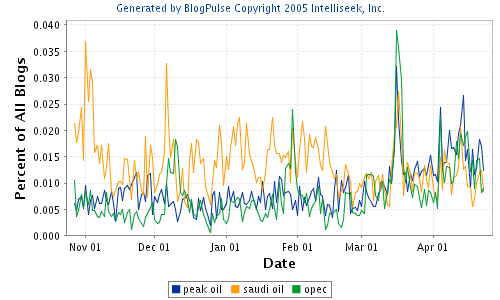
The Oil Drum has a good post up comparing blog references to the term "peak oil" compared to other oil related phrases like "saudi oil" and "OPEC".

Peak Oil is clearly becoming a hot topic out in the general blogosphere, as the graph shows.


Technorati tags:

David Suzuki On Peak Oil  

Posted by Big Gav

In a recent interview, David Suzuki has echoed Chomsky's view of peak oil - it could have a silver lining in terms of the impact we're having on the environment.


Q: With Earth Day here, can we take action to motivate people?

David Suzuki: We're going backwards. After Rachael Carson published "Silent Spring" in 1962, the growth of the environmental movement was immense. She put the environment on the agenda to such an extent that by 1972 we had the first World Environmental Conference in Stockholm.

To me, 1988 was the peak: That was the year Margaret Thatcher was filmed picking up litter in Hyde Park in London, saying, "I'm a greenie too." That was the year a man named George Bush ran for office and said, "If you elect me, I will be an environmental president." So much for election promises -- but that was also the year Canada elevated its minister of the environment into the inner Cabinet. That was the peak, and we've been going down ever since.

Now the economy has become everything. We're told, If the economy is in trouble we can't afford to protect the environment. People feel helpless, because they know we're going in the wrong direction, but they feel there's nothing they can do about the global economy. Ninety-three percent of Canadians believe that nature is absolutely critical to their identity as Canadians, and over 90 percent are willing to have higher taxes in order to protect the environment, and yet our governments dont reflect that.

Q: Do you both feel that governments are failing to act by prioritizing the economy over health and environment?

DS: Yes. I don't know about Japan, but in Canada it's because of the enormous power of the private sector, which funds most political campaigns. So the minute someone gets elected, if they have received major funding from a corporation, you can bet that corporation can call that politician anytime and get straight through. An average person trying to get through will not.

Q: The picture looks bleak. It seems we need to warn people but we also want to encourage them. However, if the message is upbeat then people just think someone else is taking care of it; and if the outlook is fearful they simply tune out. What is the critical tipping point?

DS: Well, that's what you hope, that there is a tipping point. But the reality is that this huge juggernaut of a globalized economy and transnational corporations is hugely powerful -- it's just got so much momentum that it's going to be very, very hard to begin to deflect it.

To me, a hope is that we are going to hit peak oil - and some geologists say we already hit it last year. The business community is now starting to take this very seriously. The first thing to happen would be the big-box stores, like Home Depot and Walmart, collapsing because they are dependent on cheap oil to ship cheap goods. Also, in the suburbs of Canada we have these gigantic homes with two or three people in them, and the heating and cooling bills are enormous, and they depend on cars. But the big thing is food. In Canada, food travels an average of 5,000 miles (8,000 km) from where it's grown to where it's eaten. This can't go on. The impact of [fossil fuel depletion] is going to create enormous suffering, no doubt about it.

CW Nicol: Have you been to China recently? I was there a month ago and the activity was frenetic. You may think Tokyo's air is bad, but there I got rashes all over my body. And this may be too simple, but this anti-Japanese hysteria is not just about textbooks. It's about that contested border on the South China Sea and who gets the natural gas, who gets the energy.

Technorati tags:

Saudi's To Allow Maxiumum Production  

Posted by Big Gav

Land of Black Gold makes the interesting observation that the Saudi's are now saying the OPEC production quote doesn't matter any more - they will pump as much as they can. Indonesia has also given up on OPEC quotas and may become an observer in future.

Maybe the global Hubbert's Peak is here now (as this echoes the TRC giving up on its quota system in the US in the 1970's). Then again, maybe Iran (and Iraq, if the locals would stop blowing up pipelines) still have some swing production capacity - not that it makes much difference in the long run.

Ali Naimi, Saudi Arabia's oil minister, also said the kingdom had tossed aside its production cap set by the Organization of Petroleum Exporting Countries and is willing to sell its customers every barrel of oil they want, up to its current capacity of 11 million barrels a day.

The guys at "The Oil Drum" also have some interesting comments on "The meaning of the Saudi oil mix" which would seem to corroborate the view that the Saudi's are working hard to pump as fast as they currently are.

Technorati tags:

Oil Wars  

Posted by Big Gav

There seem to be a lot of broker reports talking about peak oil these days - here's a Canadian perspective from Safe Haven.

It should not be surprising that you probably would not find many out there who believe we are in the early stages of oil wars that will dominate the first half of this century. And if oil is the commodity of choice in the first half of this century then water will probably become the focal point in the second half of the century. But right now it is oil that is up front. Oil (energy) is the engine of the global economy. Without it we could quickly revert to a Road Warrior type of world run by warlords whose armies fight over the remaining pockets and supplies of oil (energy). That still might be our future baring of course some huge changes in how we run our economies or major discoveries and conversion to alternative forms of energy.

Technorati tags:

America's Peak Experience  

Posted by Big Gav

Common Dreams has a good general peak oil blame allocation story today.

If you are a Monty Python fan, you will remember the famous restaurant scene from "The Meaning of Life." In it a fawning waiter begs his grossly over-weight client, who has just finished a meal of obscene proportions, to have "just one thin mint." The diner's gut is already strained to the breaking point, and when he finally ingests the mint, his body explodes.

Unfortunately, America bears a remarkable resemblance to the diner in the Monty Python skit. On a daily basis we gobble up several times more petroleum than we produce. Our gluttonous appetite for oil has brought the economy to the breaking point. Will we come to our senses and realize that we must curb our oil addiction? Or will we have to "explode" first?

In 1972 Donella and Dennis Meadows, together with Jorgen Randers and William Behrens, published "The Limits to Growth," which analyzed the interrelated impacts of population growth, industrialization, malnutrition, environmental deterioration, and depletion of nonrenewable resources - in particular, oil. They predicted that the planet would reach its limits to growth within the next 100 years. The first crisis would be the world supply of oil, which they predicted to diminish around the year 2000.

After years of cheap oil, Americans are beginning to experience the combined affect of diminishing supplies of oil and increased demand. The price for a barrel of crude oil hovers near the all-time high of $58 and experts are talking about prices in the $75-105 range. The price for a gallon of gasoline will probably hit $3 this summer. Criticism of the Bush Administration usually begins with its poor record at predicting future events. A prime example would, of course, be Iraq, where they promised that Iraqi oil production would pay for the occupation. The truth is that today's Iraqi oil production is less than it was before the invasion and we have to import oil 1.7 million gallons of fuel per day, into Iraq, in order to fuel the American occupation; as a result, the occupation has cost billions more than original estimates. No doubt, this inability to forecast will also be the lasting record of the Bush Administration with regards to peak oil.

History will judge George and company harshly because of their indifference to the looming oil crisis. Rather than lead the US away from its oil addiction, the President seems content to play the role of fawning waiter, approaching gluttonous America, begging, "Please sir, just one thin mint."

Meanwhile, over in the UK ex-Energy Minister Brian Wilson plans to mutter harsh words about 'gas-guzzling' Americans at the ASPO conference in Scotland.

Back in the US, Alan Greenspan thinks it might be a good idea to have an energy policy (I thought they had one - invade whoever has oil) - and he thinks those good old methane hydrates might be the solution (the cornucopian fantasy du jour it seems).
When asked at a hearing of the Senate Budget Committee if he thought America needs a national energy policy, Greenspan said, "I think that we better have one because it's something which is integrated not only into our economic system but into our national security system as well."

He said it is possible new technologies will lead to alternative sources for the fuels consumers use now.

"There's an awful lot of what we call natural gas hydrates (of which) we have in the United States huge reserves. Which is sort of a methane that's encased in ice crystals and which we're now only beginning to look at," the Fed chief said.

Technorati tags:

Chomsky on Peak Oil  

Posted by Big Gav

Noam Chomsky has spoken about peak oil in a recent interview. He doesn't think OPEC production will peak for quite a while (but he's basing his views on Exxon's data), and can actually see a bright side to it.

If you're interested - I don't know if we have time to talk about it - there's quite an interesting article about it in the Bulletin Of The Atomic Scientists, in the current issue ["Oil: Caveat Empty" By Alfred J. Cavallo], which is a very serious journal, and the person who wrote it I know is very good.

He points out that Exxon/Mobil, the biggest energy corporation, and the one that's very quiet and conservative about this, just published its forecasts, and for the first time ever, they bring this up.

What they predict is that within five years - five years - non-Opec oil will have reached the peak. Non-OPEC means U.S., Canada, and so on. Venezuela - Venezuela isn't OPEC, but most of the non-OPEC oil producers will have leveled off. That's five years.

And Exxon does not predict that alternative sources like tar sands, shale and so on will replace it - they think that's way too expensive and uses too much energy in fact.

Their prediction is that it's just going to have to come from OPEC, meaning mainly the Gulf. So the gulf states are going to have to sharply increase oil production even to meet current demand, let alone the future demand, which is rising. And that's not a long way off, they're talking about five years.

So yeah, this is a very serious issue, and my own guess is that if we ever get the secret documents about the planning for the Iraq war, my expectation is that these considerations will have entered significantly.

As to when you get a peak for OPEC, that's farther off - decades, but it's certainly real.

There's another side to this, there's a sense in which it's advantageous if the oil peak is earlier. The reason why is it will compel the world, primarily the U.S. here, to move toward something like sustainable energy.

Technorati tags:

LED Lights - The Future Of Lighting ?  

Posted by Big Gav

The Alternative Energy blog has a good post up on the new wave of energy efficient light bulbs made from LED's.

LED lamps were unthinkable until the technology cleared a major hurdle just a dozen years ago. Since then, LEDs have evolved quickly and are being adapted for many uses, including pool illumination and reading lights, as evidenced at the Lightfair trade show in New York this week.

More widespread use could lead to big energy savings and a minor revolution in the way we think about lighting.

WorldChanging has more detail - "LEDs go mainstream"

Update: Mobjectivist has followed up with a post on the history and physics of the blue laser diode.

Technorati tags:

Sunken Treasure Or Pandora's Box ?  

Posted by Big Gav

Another article on the quest to exploit methane hydrates.

Far beneath the shifting waves of the earth's oceans lie frozen crystals containing enough natural gas to meet the nation's growing energy needs for decades — maybe even centuries. It may sound far-fetched, but nations around the globe are racing to find and ultimately tap vast deposits of gas-bearing methane hydrate, an energy source that could dwarf the planet's remaining accessible oil, coal and natural gas reserves.

Roger Sassen, a gas hydrate geochemist at Texas A&M University, sees methane hydrates as the country's best shot at meeting its ravenous thirst for energy, particularly in the face of an ever-diminishing supply of oil and natural gas.

"It's the last chance," he said. "There is an awful lot of it out there, and unless it works there is going to be a problem. People are complaining about gas prices at $2 a gallon, but we may have to live with prices 10 times that high all of a sudden."

Unfortunately, no one is sure how to accurately find large accumulations of crystals, or safely and economically withdraw the gas from the depths - and some scientists are warning that a misstep in the pursuit of methane hydrate could lead to catastrophic consequences — ruining the ocean environment and speeding up global warming.

Technorati tags:

The Greening of Plastics  

Posted by Big Gav

This sounds almost too good to be true - TreeHugger reports on a company making bioengineered, non-oil based plastic.

The Cambridge Massachusetts based company Metabolix produces a sustainable, biodegradable, high-grade, environmentally friendly plastic. Yes, I too have heard the rumors of how biodegradable plastics just don’t hold up to more traditional oil based products, but not in this case. With partners like BP and a long line of grants at their doorstep, the privately held company appears poised to make a large dent in the market. Their ‘bioplastic’ is produced through clever bioengineering (developed at M.I.T), and a good grasp of plastics chemistry. Metabolix bioplastic are polyhydroxyalkanoates or PHA’s. If you’re a chemistry fan- then well …I don’t know what to say to you, but their website has a wonderful basic overview of the biology and chemistry behind the products that even I can understand.

From the Metabolix web site:
Metabolix produces a wide variety of bioplastics through the fermentation of natural sugars and oils using microbial biofactories. These materials range in properties from stiff thermoplastics suitable for molded goods, to highly elastic grades, to grades suitable for adhesives and coatings. In some cases, bioplastics offer combinations of properties not available in synthetic materials. For example, bioplastics, excellent water resistance with biodegradability, allowing flushable personal hygiene products and wet wipes. In the future, bioplastics will be produced directly in plants, making them cost-competitive with even general purpose resins such as polyethylene. PHAs will serve as environmentally friendly alternatives to over half of the plastics used today.

Who said plastic doesn't grow on trees.

Technorati tags:

Digital Oil Fields ?  

Posted by Big Gav

Rig Zone reports on the tech boom in the oil industry.

The digital oil field of the future has taken shape in ChevronTexaco Corp.'s new headquarters in Houston since early January - and it looks like the set of a Cold War melodrama.

In a screen-filled war room, technicians monitor real-time data flowing via fiber-optic cable and satellite links from sensors behind the drill bit below a Gulf of Mexico platform.

By looking at the acoustic, temperature and pressure information, engineers can almost hear and feel the pulse of the drill, and receive e-mail alerts of any emergency to their Blackberries if they're out of the office.

Developments like these could help add 125 billion barrels to global reserves in the next 10 years, according to Cambridge Energy Research Associates.

CERA analysts predict digital oil fields could improve reserve recovery by 6%, raise production rates by up to 10% and cut operating costs by up to 25% through better reservoir management and reduced on-site crews. The technology would be a boon for oil companies being pressured to find and pump more oil amid a shortage of qualified labor.

Rig Zone is also speculating that OPEC may now be more afraid of an oversupply than a shortage - "OPEC Fearing An Oil Glut ?". Assuming the figures coming out of ODAC and the like lately are correct, its hard to imagine that this would be anything other than temporary - but they could be right if it turns out the peak is still a way off.

Technorati tags:

BBC Video - Oil And War  

Posted by Big Gav

Past Peak notes the BBC has a documentary out on oil and war (a couple of years old now, but very good).

You simply must watch this video from BBC2 (courtesy of ICH).

The desperate worldwide struggle for the oil that remains is only just beginning. Maybe you do not believe it yet, but elite planners clearly do. The scramble is on, and it is likely to accelerate rapidly: when growth is exponential, limits arrive suddenly.

I urge you to watch the video. Then consider what is going to happen to suburbia-based America when oil production no longer meets demand. Will you be ready?

The video has an interesting URL overlaid at the end which is worth poking around in.

Technorati tags:

Reports Reveal Zarqawi Nuclear Threat !  

Posted by Big Gav

Reverend Moon's "Washington Times" is turning up the fear level again - this time its time to worry about Abu Musab Zarqawi detonating a dirty bomb in the US.

Recurrent intelligence reports say al Qaeda terrorist Abu Musab Zarqawi has obtained a nuclear device or is preparing a radiological explosive -- or dirty bomb -- for an attack, according to U.S. officials, who also say analysts are unable to gauge the reliability of the information's sources.

The classified reports have been distributed to U.S. intelligence agencies for several consecutive months and say Zarqawi, al Qaeda's leader in Iraq, has stored the nuclear device or dirty bomb in Afghanistan, said officials familiar with the intelligence.

Between this dire threat to the US population and that posed by Iranian nukes, those members of the american government who are considering opposing the renewal of the "Patriot" act might decide this could be viewed as unpatriotic and a dangerous threat to the nation (not to mention their own reputations). I imagine once the act gets rammed through and the Iran invasion gets underway, these reports will subside - hopefully a demonstration isn't required to keep everyone in line.

Orwell's "Big Brother" had Emmanuel Goldstein to scare the masses with - the American government has gone even better and can choose between Osama, Abu Musab and the Mad Mullahs of Tehran it seems.

Technorati tags:

Wave Power - Alternative Energy Available Today  

Posted by Big Gav

TreeHugger has a review of a selection of wave power projects.

Like all renewable energy systems, wave power isn't perfect, but in the future we will have to get used to getting energy from a variety of renewable sources that are widely distributed.

Sustainable alternative energy is becoming attractive as oil costs rise and the negative side effects of traditional energy systems begin to become apparent. One often overlooked, but rapidly growing alternative is wave power. There are fascinating new designs for harnessing the power of the wave. I found four significant technologies, all of which are in their first steps of operation and succeeding wildly.

Technorati tags:

The Future Of Ethanol  

Posted by Big Gav

CommonDreams has a good article up on the Brazilian biofuels industry.

Want to see the potential of biofuels? Visit Brazil, as I did a few weeks ago.

In Brazil, by law, all gasoline contains a minimum of 25 percent alcohol. Yet ethanol is so popular it actually accounts for 40 percent of all vehicle fuel. By 2007, 100 percent of all new Brazilian cars may be able to run on 100 percent ethanol. Brazilian sugar-cane-fed biorefineries will be capable of producing sufficient ethanol to allow the entire fleet, new and old cars alike, to do so.

In Brazil, ethanol is now being used in aviation. Small planes, like crop dusters, are switching to ethanol because it is a superior fuel and is more widely available, even in remote parts of the country, than conventional aviation fuel.

Its stunning success with ethanol has encouraged Brazil to begin displacing diesel fuel with vegetable oils from its vast soybean crop. Within 15 years it expects to substitute biodiesel for 20 percent of its conventional diesel.

One more detail. Back in the mid 1990s, Brazil ended its ethanol subsidies. Nevertheless, with world oil prices hovering around $55 a barrel, the price of ethanol today is only half that of gasoline. Since its inception, Brazil's ethanol program has displaced imported oil worth $120 billion.

Its quite amazing how much success the Brazilians have been having - if they can afford to produce (unsubsidised) ethanol that sells for half the price of petrol, then you'd have to conclude that the EROEI for sugar cane based ethanol must be pretty good (even if that of ethanol produced from north american corn may be debatable).

This raises the question of why ethanol has fared so poorly in Australia ? We have lots of sugar cane, and its not particularly valuable given the low prices and trade barriers faced by the sugar industry.

Australian ethanol has only made the news on a few occasions that I can remember - firstly as a minor scandal involving the rodent handing out subsidies to his mate Dick Honan at local ethanol monopoly Manildra (while slapping on a sudden excise to prevent Brazilian ethanol being imported), then later with a fear-mongering campaign being conducted suggesting the use of ethanol in car engines is causing them damage (presumably conducted by the oil companies).

Manildra as a company isn't doing well, and according to this article Australian produced ethanol costs around twice as much to produce as petrol (the gap has probably narrowed as oil prices have risen) - so the obvious question is - why is Brazilian ethanol so much cheaper to produce the the local stuff ?

(the article also notes that sugar cane may not be the best feedstock for ehtanol proudction - Instead of wasting millions of dollars on industry handouts, to support an industry and technology that has proved ineffective, and dallying in pork-barreling and cronyism, the government should fund research and development into the production of ethanol from lignocellulosic materials. Lignocellulosic materials such as wood, crop residues, and municipal wastes, provide a large readily available supply of cheap feedstock that can be broken down and used for the production of ethanol. Research shows that the amount of ethanol yielded from lignocellulosic materials is much more than conventional sugarcane and wheat feedstocks.)

Technorati tags:

As The World Burns  

Posted by Big Gav

I've had a post on this topic gestating for a very long time now, so naturally someone else has beaten me to it.

If you're interested in the global warming "debate", have a read of "As The World Burns" in Mother Jones, which does a great job of explaining both science and the background behind the disinformation campaign being waged (largely by Exxon) to try and delay action like carbon taxes and implementation of the Kyoto treaty.

It was around eight in the morning in the vast convention hall in Kyoto. The negotiations over a worldwide treaty to limit global warming gases, which were supposed to have ended the evening before, had gone on through the night. Drifts of paper—treaty drafts, industry talking points, environmentalist press releases—overflowed every wastebasket. Delegates in suits and ties were passed out on couches, noisily mouth breathing. And polite squadrons of workers were shooing people out of the hall so that some trade show—tool and die makers, I think—could set up its displays.

Finally, from behind the closed doors, word emerged that we had a treaty. The greens all cheered, halfheartedly—since it wasn't as though the agreement would go anywhere near far enough to arrest global warming—but firm in their conviction that the tide on the issue had finally turned. After a decade of resistance, the oil companies and the car companies and all the other deniers of global warming had seen their power matched.

Or so it seemed. I was standing next to a top industry lobbyist, a man who had spent the last week engineering opposition to the treaty, huddling with Exxon lawyers and Saudi delegates, detailing the Venezuelans to change this word, the Kuwaitis to soften that number. Right now he looked just plain tired. "I can't wait to get back to Washington," he said. "In Washington we'll get this under control again."


If this sort of thing doesn't drive you crazy, then you might enjoy playing Tim Lambert's "Global Warming Skeptic Bingo" next time you have to listen to one of these nuts spouting some stream of fetid non-science.

Technorati tags:

More Podcasts  

Posted by Big Gav

The Oil Drum notes its not just FTD who has a directory of podcasts up - there is also OilCast as well.

I had a quick look around the iPodder Podcast Directory and couldn't see them in there - but maybe there just isn't an obvious category for peak oil sites...

Technorati tags:

Too Much News  

Posted by Big Gav

EnergyBulletin is moving towards providing a more concise daily news update to handle the growing volume of news - and who can blame them - there's a torrent of articles appearing.

Recent items of note include Marshall Auerbach declaring "High Energy Prices Are Here To Stay", a new interview with Republican Congressman "Roscoe Bartlett", more dire economic prognostications from Morgan Stanley's Steven Roach (""Tilt !"), dependency metaphors from Berkeley Daily Planet "Confronting America's Oil Addiction", a good presentation from Matt Simmons to the Boston Committee On Foreign Relations "The Coming Saudi Oil Shock And The World Economy" and James Kunstler saying that we're heading into "1914" again.

With the warnings about large economic readjustments becoming more frequent, and yesterdays note on the monetary system fresh in my mind, I was reminded of Richard Heinberg's "Meditations on Collapse".

The global economic system and the world's monetary system are becoming increasingly dysfunctional. Currently, the US dollar functions as the global reserve currency, and the dollar (like most other currencies) is loaned into existence at interest. This means that continual economic growth is structurally required in order to stave off a currency crash. Yet infinite growth within a closed system (e.g., the Earth) is impossible. So how long can growth continue? There are strong signs that the American economy, and hence that of the entire world, is headed soon toward a "correction" of unprecedented proportions. US debt (in the forms of consumer debt, government debt, and trade deficits) is at truly frightening levels and the American mortgage and real estate bubbles appear ready to burst at any moment. If one looks deeper, there are still other reasons to conclude that the global economy has nearly reached fundamental and non-negotiable restrictions on expansion. In his book The Limits of Business Development and Economic Growth (Palgrave Macmillan, 2005), business strategist Mats Larsson makes the point that most of technology and business development in the past has had as its goal the reduction of time and cost in manufacturing. But nothing can be done at less than no time or at less than no cost. He cites the example of the printing and distribution of books and other written media: with these, Gutenberg famously reduced time and cost. Now, the Internet enables the electronic reproduction and distribution of books, films, and music at almost no cost and in almost no time. Similarly, labor cost in China is probably now at close to the absolute theoretical minimum. Larsson's conclusion is that economic growth is perilously close to its ultimate bounds, even when resource constraints are not factored into the calculation.

Averting collapse would require changes that must be championed and partly implemented by political leaders: unprecedented levels of national and international cooperation would be needed in order to allocate essential resources in order to avert deadly competition for them as they become scarce, and our economic and monetary systems would have to be reformed despite pressure from the entrenched interests of wealthy elites. Yet the American political regime - the most important in the world, given US military supremacy and economic clout - has evidently become terminally dysfunctional, and is now the province of a group of extremist ideologues who apparently have virtually no interest in international cooperation or economic reform. This is a fact widely recognized outside the US, and by many sober observers within the country. The problem is not merely that politicians are being bought and sold by corporations (this has been going on for decades), but that the entire system has been hijacked by partisans who pride themselves on making decisions solely on the basis of ideology and in supreme disdain for "reality." At the same time, the US electoral system has been eviscerated and commandeered by a single party (using various forms of systematic fraud that have now become endemic), so that a peaceful rectification of the situation by a vote of the people has become virtually impossible. Moreover, the American media have been so cowed and co-opted by the dominant party that most oft he citizenry is blissfully unaware of its plight and is thus extremely unlikely to vigorously oppose the current trends. Diamond shows some limited awareness of this truly horrifying state of affairs, and he realizes that wise political leadership would be essential to the avoidance of collapse. Yet he refuses to draw the obvious conclusion: the most powerful of the world's current leaders are every bit as irrational as the befuddled kings and chiefs who brought the Maya and Easter Islanders to their ruin.

In local news, Brisbane's Courier Mail has an article predicting that major road infrastructure projects will become a thing of the past as peak oil bites and personal motor vehicle usage declines. Quite an optimistic reading of the tea leaves compared to the predictions of doom above I guess.
At an estimated cost of $4 billion, and scheduled to take 20 years to build, the proposed TransApex tunnel network is arguably the most ambitious construction project in Brisbane's history. But chances are the project probably will be discontinued after the tunnel to the airport is completed in 2013.

The reason – what is known as "peak oil" will have solved Brisbane's traffic congestion by making motoring far too expensive. "Peak oil" is the theory that the world will face a sudden and disastrous decline in oil supplies after global production peaks in the next 14 years.

Queensland MLA Andrew McNamara believes peak oil will come sooner rather than later and the impact on our lives will be greater than terrorism, global warming, nuclear war or bird flu. "The challenges we face after peak oil will require localised food production and industry in a way not seen for 100 years," he told Parliament in February. "Local rail lines and fishing fleets will be vital to regional communities. Self-contained communities living close to work, farms, services and schools will not be merely desirable; they will be essential."

One thing most analysts and observers appear to agree on is that the world won't realise that it's reached peak oil until after the phenomenon has been and gone. Predictions put its date at somewhere between 2004 and 2020.

As the world's oil reserves are expected to be totally depleted by about 2040, according to BP, we're left with about a decade at best to effect a century's worth of changes to the way we live. It won't be easy, as it's a change for which we're not prepared. If we're lucky, peak oil will arrive soon and give us more time to adjust to the shock. If we're intelligent, we'll get to work to adapt our cities and lifestyles to something approximating McNamara's vision. But we're not likely to be that lucky.

And – with governments that flog off our remaining oil, gas and coal reserves overseas to help build up US and Chinese energy stockpiles while spending billions of dollars on subterranean freeways that will probably be obsolete long before they're finished – it doesn't look as if we're all that intelligent, either.

Technorati tags:

DKos: Is Peak Oil A Myth ?  

Posted by Big Gav

Lawnorder at DailyKos has a diary up examining the question "is peak oil a myth" ? The author decides it isn't, and gives a new (to me) example of post oil crash agricultural failure - North Korea.

Agriculture in DPRK requires approximately 700,000 tons of fertilizer per year. North Korea used to manufacture 80 to 90% of its own fertilizer... Since [the Soviet Union stopped giving them Oil in 1995] DPRK has had difficulty producing even 100,000 tons per year... The DPRK fertilizer industry relies on coal as both an energy source and a feedstock. They require 1.5 to 2.0 million tons of coal per year to produce 700,000 tons of fertilizer. To obtain this coal, the fertilizer industry must compete with the steel industry, electricity generation, home heating and cooking needs, and a host of other consumers. Flooded mine shafts and broken down mining equipment have severely cut the coal supply. Likewise, delivery of this coal has been curtailed by the breakdown of railway infrastructure. Furthermore, transporting 2 million tons of coal by rail requires 5 billion kilowatt hours of electricity while electricity supply is diminished because of lack of coal, silting of dams and infrastructure failure. So once again, we have another vicious positive feedback loop. Finally, infrastructure failure limits the ability to ship the fertilizer--1.5 to 2.5 million tons in bulk--from factories to farms... The result of this systemic failure is that agriculture in DPRK is operating with only 20 to 30% of the normal soil nutrient inputs... [furthermore, ] North Koreans turned to burning biomass, thus impacting their remaining forests. Deforestation led, in turn, to more flooding and increasing levels of soil erosion. Likewise, soils were depleted as plant matter was burned for heat, rather than being mulched and composted.. Agriculture has been further impacted by the limited availability of diesel fuel... The result is an 80% reduction in the use of farm equipment... Observers in 1998 reported seeing tractors and other farm equipment lying unused and unusable while farmers struggled to work their fields by hand. The observers also reported seeing piles of harvested grain left on the fields for weeks, leading to post-harvest crop losses.

Technorati tags:

A Whiff Of Stagflation  

Posted by Big Gav

Paul Krugman's latest column looks at the signs of stagflation appearing and considers the various risks the world economy is exposed to.

What's driving inflation? Not wages: labor costs have been falling, because wages are growing less than productivity. Oil prices are a big part of the story, but not all of it. Other commodity prices are also rising; health care costs are once again on the march. And a combination of capacity shortages, rising Asian demand and a weakening dollar has given industries like cement and steel new "pricing power."

It all adds up to a mild case of stagflation: inflation is leading the Fed to tap on the brakes, even though this doesn't look or feel like a full-employment economy.

We shouldn't overstate the case: we're not back to the economic misery of the 1970's. But the fact that we're already experiencing mild stagflation means that there will be no good options if something else goes wrong.

Suppose, for example, that the consumer pullback visible in recent data turns out to be bigger than we now think, and growth stalls. (Not that long ago many economists thought that an oil price in the 50's would cause a recession.) Can the Fed stop raising interest rates and go back to rate cuts without causing the dollar to plunge and inflation to soar?

Or suppose that there's some kind of oil supply disruption - or that warnings about declining production from Saudi oil fields turn out to be right. Suppose that Asian central banks decide that they already have too many dollars. Suppose that the housing bubble bursts. Any of these events could easily turn our mild case of stagflation into something much more serious.

How do we get out of this bind? As the old joke goes, I wouldn't start from here. We should have spent the years of cheap oil encouraging conservation; we should have spent the years of modest growth in medical costs reforming our health care system. Oh, and we'd have a wider range of policy options if the budget weren't so deeply in deficit.

Technorati tags:

The World Is Not Enough  

Posted by Big Gav

Apparently secret agent Rumsfeld has been negotiating to set up a base just across from the Iranian border in Azerbaijan. No doubt all those oil wells and the local dictator made him feel right at home.

Hardly any country on the planet sits in a more crucial spot than the harsh dictatorship of Azerbaijan, so that's probably why Don Rumsfeld sneaked off to its rowdy capital, Baku, earlier this week.

Do you hear the neocons beating the oil drums of war?

Rumsfeld's visit this week to Iraq generated some smoke, especially his laughable warnings to the Iraqis about "government corruption". But then, like the mysterious Mr. Arkadin, Rumsfeld left Iraq, flew to Baku for meetings, spent the night, and then sneaked out the next day—with no announcements from the Pentagon and (as a result) no notice from the U.S. press.

Plenty of Azeris, chafing under the Aliyev family's harsh rule and fearing war or other trouble from the oil-hungry U.S., freaked out, and there were stories in the Turkish and Russian press. But leave it to the excellent news service EurasiaNet to capture the not-meant-to-be-captured moment. In a story posted April 13, political analyst Alman Talyshli wrote from Baku:
"Rumsfeld is interested in oil!" read a headline in the April 12 edition of the popular daily Echo. The April 12 visit of the Pentagon chief to Azerbaijan was a natural target for local media hungry for sensational news. But not only the press is looking for answers.

Rumsfeld's visit took place under extreme secrecy, with limited public information, leaving many local analysts and pundits to speculate about the reasons for the U.S. secretary of defense's trip, the third such visit in the past 15 months.

Former U.N. weapons inspector Scott Ritter has warned that the U.S. has been making plans to attack Iran — one of Azerbaijan's neighbors — this summer. That's not as farfetched as you may think. Seymour Hersh has said basically the same thing. In "The Coming Wars," a mid-January piece in The New Yorker that zeroed in on Rumsfeld's various plottings.

Technorati tags:

DonkeyTalk  

Posted by Big Gav

FTD has been very busy lately - if you haven't checked out his collection of peak oil interviews, then click on the link.

Technorati tags:

Rubber - Critical and Vulnerable  

Posted by Big Gav

EnergyBulletin has an article up on the importance of rubber to the industrial world. Rubber can be obtained in its natural form from rubber trees, or produced synthetically from petrochemicals. As oil becomes scarce and more expensive, this means we become more dependent on natural rubber. Unfortunately relying on rubber trees has its own risks.

The world's rubber needs are met through both natural and synthetic sources, each supplying nearly equal amounts. Synthetic rubber requires petrochemicals as a feedstock for its manufacture, using roughly 3.5 times more oil than what is required for a rubber tree plantation. This dependence on oil has led to a dramatic price increase in synthetic rubber over the last few years. Not surprisingly, this has fuelled an increased demand for natural rubber.

Nearly 90% of the world’s natural rubber is supplied by plantations in South East Asia. The millions of rubber trees there are all clones coming from only a handful of seeds originating from the Amazon, and descendents are taken as cuttings from these trees. A huge population of species supporting an extremely small genetic base causes any weaknesses to be greatly amplified. These trees are all known to be very susceptible to the fungal disease known as leaf blight. If one were to become infected, the risk of it spreading is very high.

South America's rubber trees have encountered numerous problems with leaf blight during the history of the industry there. On the other hand, South East Asia has only encountered a few cases, all from different, less damaging, varieties of leaf blight. To date, no epidemics of the South American version have occurred in South East Asia. However, there is speculation that this could happen at any time and cause a major disruption in the world rubber supply.

From the book 'One River' author Wade Davis states "To this day a single act of biological terrorism, the systematic introduction of fungal spores so small as to be readily concealed in a shoe, could wipe out the plantations, shutting down production of natural rubber for at least a decade. It is difficult to think of any other raw material that is as vital and vulnerable."

I can just see the next neocon conspiracy theory being breathlessly announced in World Nut Daily - "The quest for rubber security - US must invade Malaysia to prevent islamic terrorists destroying critical rubber infrastructure using biological weapons supplied by Iran".

Moving back to the real world, the importance of rubber has been underscored in the two world wars, with Germany struggling to find substitutes in World War 1 (as the British denied them access to it) and the US putting a lot of effort into developing synthetic substitutes (as the Japanese denied them access to rubber from south east asia).

While non-oil based alternatives to rubber don't seem to exist, John Dobozy's rubber recycling technology has been getting a bit of attention lately - so if the rubber trees get wiped out by blight we can always mine the tire mountains that blight various regions.

Moving away from the subject of rubber, if you've never read anything by Wade Davis (referenced above) he's worth having a look at - ethnobotany is a lot more interesting than you might imagine. If you'd like to become proficient at raising the dead and commanding a zombie slave army, then I highly recommend "The Serpent and the Rainbow". His other books, including "Shadows in the Sun", "Light at the End of the World" and "Rainforest: Ancient realm of the Pacific Northwest" are excellent as well.

Technorati tags:

The China Syndrome  

Posted by Big Gav

China is getting a lot of attention lately, which reminds me a little of 1995, when the red peril supposedly posed by China was the subject of much discussion in magazines like the Economist.

This time round the muttering seems a lot more serious, with the recent teeth baring over Taiwan now being overshadowed by tensions flaring between China and Japan over oil and gas in the east china sea.

Japan was accused of a "serious provocation" by China Thursday for its plans to drill for oil in a disputed area of the East China Sea. The tension escalated when Japan's Ministry of the Economy, Trade and Industry said Wednesday companies will be permitted to analyze energy deposits in an area east of Shanghai that spans a maritime economic zone partially claimed by both countries.

"This move by Japan is a serious provocation of China's rights and international border norms," Qin Gang, spokesman of China's foreign ministry said. "China has already made a protest to Japan, and reserves the right to take further reaction."

Anti-japan rallies seem to have become the latest fashion in China over the last month, with thousands of people joining protest marches on the weekend.

Its not just Japan that is starting to butt heads with China - the US also seems to adopting a policy of containment that mirrors that used against the Soviet Union. Michael Klare notes in "Imperial Reach":
Most significant, overall, is the revised calculation of America's geopolitical interests. During the cold war, when "containment" was the overarching strategic principle, the United States surrounded the Soviet bloc with major bases. With the end of the cold war, however, this template no longer made sense, and many of these bases lost their strategic rationale. Meanwhile, other concerns--terrorism, the pursuit of foreign oil and the rise of China--have come to preoccupy American strategists. It is these concerns that are largely driving the realignment of US bases and forces.

There is a remarkable degree of convergence among these concerns, both in practical and geographic terms. Oil and terrorism are linked because many of the most potent terrorist groups, including Al Qaeda, arose in part as a reaction to the West's oil-inspired embrace of entrenched Arab governments, and because the terrorists often attack oil facilities in order to weaken the regimes they abhor. Similarly, oil and China are linked because both Washington and Beijing seek influence in the major oil-producing regions. And the major terrorist groups, the most promising sites of new oil and the focal points of Sino-American energy competition are all located in the same general neighborhoods: Central Asia and the Caspian region, the greater Gulf area and the far reaches of the Sahara. And the United States is establishing new basing facilities precisely in these areas.

There is also a very detailed discussion of the economic, energy and military issues related to China here - "Crisis on the China Rim: An Economic, Crude Oil and Military Analysis" (pdf). I recently received this link via email, and it appears I wasn't the only one. The key issue in here is that east asia has very few energy resources of its own, and is extremely dependent on energy from the caspian sea and middle east regions.

Another view of the US - China competition for oil is shown in the "Crude Dashboard" (pdf) from Atlantic Monthly.

From an Australian point of view, this is an increasingly difficult issue to deal with. While we generally adopt a completely subservient pose towards the US, and in many ways act like a colony, China and Japan are our 2 biggest trading partners, with Chinese trade growing rapidly.

Unlike almost every other country in the world, we have a trade deficit with the US (helped along by the "Free" trade Agreement our leaders were weak enough to sign) but large trade surpluses with China and Japan - so tensions to our north and any isolation of China will not be working in our favour economically.

The government has been trying to keep a foot in each camp, with the recent behind-the-scenes arm twisting of BHP to cave in and accept a meagre 74% price increase for iron ore supplies to China the latest move to try and keep in China's good books, after recently trying to stay neutral during the sabre rattling over Taiwan. This has met with some success, as a "free trade agreement with China may be negotiated (hopefully a better one than was signed with the US). Opposition leader Kim Beazley has changed his usual pro-american stance and declared that China and India are the key to our future security (sensibly echoing Jacques Chirac's call for a multipolar world).

Of course, trying to stay friends with everyone can be risky as well - as one Chinese thinktankologist noted, we may end up like the bat in Aesop's fable.

Of course, the rising tension over energy in the east may end up derailing Australian export efforts anyway - The Stinkin Desert Post notes:
Do these people use their heads for anything besides putting their hats on? From an article this weekend in the Japan Times:

"WASHINGTON (Kyodo) Finance Minister Sadakazu Tanigaki and U.S. Treasury Secretary John Snow agreed Friday that stubbornly high oil prices pose a risk for the global economy, Japanese officials said."

Now there's a blinding insight. I hope they are well paid for articulating such a subtle idea.

"Tanigaki said a spike in crude oil prices is a risk for the Japanese economy. In reply, Snow said high oil prices are also a risk for the global economy, including the U.S., the officials said."

And what if it's not a spike? What's going to happen when the price goes up and doesn't come back down? Instead of mouthing platitudes, the "leaders" should be grappling with the really big problems thundering down the pike. I can't speak for other countries, but one of the issues in the US is that our power structure (government+corporations+media+theocrats) has been captured by a collection of scoundrels not seen since the height of the Gilded Age.

As if peak oil wasn't enough, it's worth considering the possibility that China is economically, financially, socially, and environmentally a house of cards. If Snow et. al push on that house too hard, it may come tumbling down.

Of course, some people believe that as we go past the peak, pushing down the house of cards may be US policy. Paraphrasing the speculations of one peak oil maven recently (analysing the situation from a US point of view rather than advocating what should happen):
Given the importance of oil in our civilization, the imminence of Peak Oil, and the fact that most of the world's remaining oil reserves are in the Middle East, control of that region is crucial. We must, at the least, prevent others from getting control of any significant part of that area of the world if we are to remain the world's hegemon.

As push comes to shove over oil, this is likely to mean ongoing and even escalating warfare in that region.

Given that the downside of the Hubbert Curve is imminent, oil in the ground will be increasingly valuable with every passing year. This means that escalating violence in the Middle East - and even short (or intermediate) term chaos in the region - can be in our favor, provided that we end up in control of what's left in the long run.

An alliance of China, India, Russia and others has been forming in opposition to the U.S. - given that this alliance has increasing ties to Iran, and that Iran will soon have nuclear weapons and has very large oil reserves, it is going to be necessary to attack Iran in the near future.

The best justification for this might be an attack on a full oil tanker leaving the Persian Gulf. If we cannot provoke Iran into such an attack, we could have our own operatives carry it out in such a way that Iran can be blamed - for example with a missile hitting the port side (the side facing Iran as a tanker leaves the Gulf).

Given that we get a smaller percentage of our oil from the Middle East than China and some other challengers of the Empire do, if we can dramatically slow or stop the flow of oil from the Middle East it might achieve a number of useful objectives. Not the least of which relates to the world's precarious financial/economic situation. Specifically, if we can dramatically slow or stop the flow of oil from the Middle East in the near future, we can blame the bursting of the Credit Bubble (which is inevitable in the near future anyway) and the collapse of the world's economy (inevitable when the Credit Bubble bursts in any case) on "the enemies of freedom and democracy."

I think we will see significant escalation in the Middle East and significant conflict with China dominating the years ahead.

Technorati tags:

Who Owns East Timor's Oil and Gas ?  

Posted by Big Gav

Some pre-Anzac day TV ads are being run to suggest it might be the East Timorese...

An 85-year-old World War II veteran has defended a series of television commercials that condemn the federal government for its negotiations over Timor Sea oil and gas rights.

The ads feature World war II veterans who served in East Timor and who are critical of Australia's position in the negotiations over the $41 billion oil and gas reserves.

Former engineers sergeant John Jones today rejected criticism from the RSL that the Anzac spirit should not be used to criticise the government over the Timor Sea issue.

"Anzac day is for all Australians and particularly those who fought in any of the wars that Australia was involved in," he told reporters in Melbourne.

"Any of those Australians has the right to say what he wants to say on Anzac Day if it involves him and his experiences."

Mr Jones defended his fellow soldiers who have appeared in the ads saying the federal government's attitude was not in the "Anzac spirit" and Prime Minister John Howard was not welcome at their Anzac Day parade.

"Only for the Timorese we would not be here today," Mr Jones said.

Former Australian Army major Chip Henriss-Anderssen who served with Interfet forces in 1999-2000 said the ads reminded Australians of the Anzac spirit and the "Australian notion of a fair go".

"It is a clear cut, very simple issue," he said.

"They're poor, we are rich. We have a lot of resources, they haven't.

"We need to give them their oil and we need to look after this country."

Technorati tags:

California Dreaming  

Posted by Big Gav

Martin Hastings has a new piece of analysis out on the contenders to supply California with LNG. It would seem both the Woodside and BHP bids are unlikely to succeed (and the possibility of Exxon shipping gas from PNG doesn't even seem to be a starter).

If I was going to bet on it I'd say ChevronTexaco will win (probably in a joint venture) with the gas coming from the Gorgon field.

One ugly prospect this raises is the possiblity of an american military base reappearing on the north west coast (probably at the old cold war base at Exmouth), given the propensity for US forces to appear in numbers wherever energy is to be found.

Technorati tags:

Boing Boing On Peak Oil  

Posted by Big Gav

James Kunstler's "Long Emergency" article made it on to Boing Boing (unnoticed by me) a few days ago.

It provoked a lot more comment than normal on BB, with some people focussing on Viridian solutions, some talking about the nuclear option and some nut saying we need to consider abiotic oil (there's one in every crowd).

I've been reading a lot about Peak Oil, which refers to the year at which oil production hits the peak of a bell curve, and after which oil production goes down, tapering to zero.

There's some argument about the year of the peak, but pretty much everyone agrees -- including the US government -- that the peak is fewer than a couple of decades away. A lot of experts says we've already hit the peak. James Howard Kunstler's piece in Rolling Stone, called "The Long Emergency," argues that the US hit its peak decades ago.

One reader recommended an essay called "The Slow Crash" which looks interesting, and probably more accurate than the rapid collapse foreseen by some.
I'm not ruling out a global supercatastrophe. A runaway greenhouse effect might turn Earth into another Venus and cook us all. Acidification of the oceans might kill the plankton, and with them everything that needs a lot of oxygen. An instant ice age could happen several ways, and this scenario needs more attention because some humans would survive. But what I'm focusing on here is the scenario that includes only events we're reasonably sure about: the end of cheap energy, the decline of industrial agriculture, currency collapse, economic "depression," wars, famines, disease epidemics, infrastructure failures, and extreme unpredictable weather.

If that's all we get, the crash will be slower and more complex than the kind of people who predict crashes like to predict. It won't be like falling off a cliff, more like rolling down a rocky hill. There won't be any clear before, during, or after. Most people living during the decline and fall of Rome didn't even know it. We're told to draw a line at the sack of Rome by the Visigoths, but to Romans at the time it was just one event -- the Visigoths came, they milled around, they left, and life went on. After the 1929 stock market crash, respectable voices said it was a temporary adjustment, that the economy was still strong. Only years later, when we knew they were wrong, could we draw a line at 1929.

Technorati tags:

Rupert Murdoch - Evil, But Not Stupid  

Posted by Big Gav

Lots of commentators have been talking about Rupert Murdoch's speech on changes in the online media world.

Say what you like about Rupert's generally malign influence, but he's no fool and does understand the shifts going on in the media (outside of the ones he is causing).

(You might ask why I've posted this here and not in its more traditional home at Reptile Rants, but I'll get there eventually)

As Dan Gillmor noted, I'm no fan of Rupert Murdoch, a press (robber) baron whose greed and overtly one-sided journalism have been a malevolent force in the media sphere. But in a speech he gave this week to the American Society of Newspaper Editors, he said a bunch of things that needed saying - and for that, he's done a real public service.

The text of the speech can be found here.

But our internet site will have to do still more to be competitive. For some, it may have to become the place for conversation. The digital native doesn’t send a letter to the editor anymore. She goes online, and starts a blog. We need to be the destination for those bloggers. We need to encourage readers to think of the web as the place to go to engage our reporters and editors in more extended discussions about the way a particular story was reported or researched or presented.

At the same time, we may want to experiment with the concept of using bloggers to supplement our daily coverage of news on the net. There are of course inherent risks in this strategy -- chief among them maintaining our standards for accuracy and reliability
[BG: yeah - right]. Plainly, we can’t vouch for the quality of people who aren’t regularly employed by us – and bloggers could only add to the work done by our reporters, not replace them. But they may still serve a valuable purpose; broadening our coverage of the news; giving us new and fresh perspectives to issues; deepening our relationship to the communities we serve. So long as our readers understand the distinction between bloggers and our journalists.

To carry this one step further, some digital natives do even more than blog with text – they are blogging with audio, specifically through the rise of podcasting – and to remain fully competitive, some may want to consider providing a place for that as well.

And with the growing proliferation of broadband, the emphasis online is shifting from text only to text with video. The future is soon upon us in this regard. Google and Yahoo already are testing video search while other established cable brands, including Fox News, are accompanying their text news stories with video clips.

...

The challenge, however, is to deliver that news in ways consumers want to receive it. Before we can apply our competitive advantages, we have to free our minds of our prejudices and predispositions, and start thinking like our newest consumers. In short, we have to answer this fundamental question: What do we – a bunch of digital immigrants -- need to do to be relevant to the digital natives?

Probably, just watch our teenage kids.

What do they want to know, and where will they go to get it?

They want news on demand, continuously updated. They want a point of view about not just what happened, but why it happened.

They want news that speaks to them personally, that affects their lives. They don’t just want to know how events in the Mideast will affect the presidential election; they want to know what it will mean at the gas-pump. They don’t just want to know about terrorism, but what it means about the safety of their subway line, or whether they’ll be sent to Iraq.

Strangely (or maybe not, depending on your view of the purpose of the US media), George Bush (the smirking one) also spoke at this event - on the topic of energy shortages. It looks like he is starting to position himself as the person trying to do something about it (talking up ethanol, biodiesel and increased exploration) while blaming others for rising prices (China, environmentalists). How surprising.
"We got a problem with energy. And it's a problem that didn't happen overnight. It's a problem that's been brewing for quite a while, because the country has yet to implement a strategy that will make us less dependent on foreign sources of energy," Bush told the annual gathering of the American Society of Newspaper Editors in Washington.

Bush noted that in Fort Hood, Texas, recently, a soldier asked him to lower the price of gasoline and Bush said he wished he could. "I said the problem is that supplies are out of balance with demand when it comes to the major feedstock of gasoline, which is crude oil," Bush said.

The president pointed to China and called it a country "that is growing like mad." This growth is being powered, in part, by rising demand for crude oil which has placed new strains on global supplies, Bush said.

Bush said the country must think "long term" about its energy supplies and pursue a variety of options including boosting conservation efforts, spending more on research and development, and encouraging the use of ethanol and biodiesel fuels.

The debate about the effect of rising oil prices on the US economy has "The Left Coaster" asking - who is the economy for anyway ?

So this is the current thinking at the top of our economy and financial system, to wit, that:

·It is actually good that wages aren’t keeping up with inflation;
·Rapidly rising gas prices are a healthy brake on the economy right now to stifle consumer demand from getting too high;
·It is good that we are sucking consumer spending from buying goods that may create jobs here, into the coffers of oil companies;
·These price increases will eventually lead the Fed anyway to have to increase the pace and amount of rate increases as inflation is locked in during the remainder of the year, which will kill consumers and the housing market.

Do you notice the odd man out in this game plan? We, the consumers. And tell me again why it is a good idea for consumers to find it necessary to redirect their spending from buying goods here at home into the coffers of oil companies where the primary economic benefit flows to investors and those outside of this country in unstable parts of the world?

Am I the only one who thinks that such an economic approach and policy is lunacy, and a recipe for stagflation and a tanking job market, along with a growing gap between inflation and what workers earn?

Is this scenario really something to be cheered?

Meanwhile, back in Perth, a USGS representative said "what oil shortage ?".
There are much more oil reserves left in the world than many of the pessimistic forecasts make out, according to Peter McCabe, senior research geologist at the US Geological Survey, speaking at the annual Australian Petroleum Production and Exploration Association (APPEA) conference in Perth.

McCabe presented delegates with an upbeat answer to the questions "how much oil is left, and where can it be found?"

Using figures gleaned from USGS studies, he said cumulative oil production to the end of 2004 amounted to 952 billion bbl, which represents about 32% of the world total available reserves. Some 2,029 billion bbl, or 68%, he placed in a category labeled remaining recoverable oil.

Colin Campbell thinks the official figures used by the USGS are a load of nonsense though - another example of the official story perhaps not being aligned with reality. The Kuwait example is a good one:
Kuwait reported reserves of 65 Gb in 1980, falling to 64 Gb by 1984 in the absence of new discovery, at which point it had produced a total of 21.5 Gb, indicating that the total discovery was 85.5 Gb. But it is entirely possible that these estimates were based on fairly conservative assumptions, so it might be reasonable to round the estimate up to, say, 90 Gb.

In 1985, Kuwait increased its reported Reserves from 64 Gb to 90 Gb, being probably influenced in doing so by new OPEC rules that set production quota partly on reserves. No doubt the other OPEC countries reflected on what their response should be. They were finally goaded into action when Kuwait announced a further increase to 92 Gb in 1987, when several of them evidently decided to simply match Kuwait's number to secure a comparable production quota. In 1988 Abu Dhabi reported 92 Gb to exactly match Kuwait, (up from 31 Gb); Iran went for one better at 93 Gb (up from 49 Gb), while Saddam Hussein, not to be outdone, reported a rounded 100 Gb (up from 47 Gb). It is also worth noting in passing that about 2 Gb of Kuwait s reserves went up in smoke in the First Gulf War.

Then again, oil reserves figures for the middle east have always been notoriously unreliable for a number of reasons - but I'll leave that can of worms for another post.

Technorati tags:

Are These Guys Serious ?  

Posted by Big Gav

Unfortunately probably yes - more consent manufacturing for the upcoming Iran invasion from the Swift Boat Nuts For "Truth" team (see Mobjectivist for some background).

Technorati tags:

Global Warning  

Posted by Big Gav

James Kunstler is getting a lot of press lately - here's a new interview (nothing particularly new here). I don't agree with all of his opinions, but he does get people talking.

Q:Paula Routly: You've long criticized the housing and transportation policies that drove people from the cities to suburbia after World War II. Now it turns out "Levittown" is not only ugly and soul-killing, but unsustainable. Explain your vision of the "Long Emergency."

A:James Howard Kunstler: We poured our national wealth into the construction of a living arrangement that has no future -- and the future is now here. The infrastructure of suburbia can be described as the greatest misallocation of resources in the history of the world. It was deficient and problematic as a human habitat even apart from the question of its sustainability. The way we live in America represents a tragic set of collective and individual choices we made at a particular point in history, the mid-to-late 20th century, when circumstances seemed to suggest there were no limits to our quest for comfort, convenience and leisure. These things turned out to be a poor basis for a value system and for an economy.

Q:So life without oil equals the apocalypse?

A:Your word, not mine. I rather resent being labeled "apocalyptic." It demonstrates how poorly even journalists understand what we face, which is an epochal discontinuity in the conditions of daily life, not the end of the world. In fact, we don't even face a life without oil, at least not imminently. We face a life without cheap oil, which is a big difference. Specifically, we are heading into a period of social, political and economic turbulence, which will probably include a lot of hardship. That's not the end of the world. That's something that the human race has been through many times before. For instance, the Europeans of 1913 would never have conceived the degree of destruction and vicissitude visited upon their societies by two 20th-century world wars. We're equally blind and clueless about what we are facing.

Technorati tags:

The Sanctuary of Freedom  

Posted by Big Gav

Here's one from FTW on the value of the wilderness (via FTD).

Ethics often gets mentioned in connection with the wilderness, usually in the form of the truism that destroying the remainder of the natural world is morally wrong.

But I want to emphasize a different ethical dimension of the wilderness: it is the sanctuary of freedom, and that this is its greatest value. If we are to take seriously the founding images and stories of American identity, we must regard the wilderness as the soul of America: it gave the native peoples their ways; it called to the frontiersmen, the mountainmen and the explorers; and because it bespoke a dignity and self reliance that Europe had lost, it was the source of an American spiritual strength that found expression in the Declaration of Independence and in Whitman's Leaves of Grass.

In the American lexicon, freedom has come to mean the freedom of corporations to generate profit and the freedom of the public to consume. The ugly irony here is that consumption itself is antithetical to freedom, because chasing the illusory fulfillment of artificial needs prevents us from determining our own real needs. If you own a car, or a house, or any other possessions, then you are tied down by your car insurance, your mortgage, your bills, your consumer debt, and the material things themselves. If freedom is measured by the ability to do whatever you want, whenever you want and wherever you want, the freest person you are likely to see is that homeless guy riding his bicycle and rifling through garbage bins. He has his risks and his limits, but he isn't toiling for a salary, servicing debt, or storing possessions. Is he free?

As Thoreau understood, those who have lived in the wilderness are the freest people on the planet. So long as there remains some wilderness where people can go to escape the ties that bind, freedom will retain some of its former meaning.

Technorati tags:

Scrutiny Hooligans  

Posted by Big Gav


These guys have the occasional peak oil post - including a recent note from the Fatal Harvest school.

Imperial Reach  

Posted by Big Gav

Michael Klare has another article out - this one on the migration of US military bases from cold war frontiers to oil rich regions. He notes something I've said previously - all this big power jockeying is remiscent of the lead in to world war 1 (or world war 2 if you want to push the neocon - nazi comparison).

It is not clear exactly when the Defense Department will complete the reassessment of its overseas basing requirements and complete the actual redeployment of American forces. Some of the initiatives described above have already begun, while others remain on the drawing board. There is no doubt, however, that a major realignment of American power is under way that entails a seismic shift in the center of gravity of American military capabilities from the western and eastern fringes of Eurasia to its central and southern reaches, and to adjacent areas of Africa and the Middle East. This is certain to involve the United States more deeply in the tangled internal politics of these regions, and to invite resistance from local forces--and there are many of them--that object to current US policies and will resent a conspicuous American military presence in their midst. Far from leading to a reduction in terrorism, as advertised, these moves are certain to provoke more of it.

Finally, the American power shift from outer Eurasia to its troubled interior is certain to arouse concern and antipathy in Russia, China, India and other established or rising powers in the region. Already, Russian leaders have expressed dismay at the presence of American bases in Uzbekistan and Kyrgyzstan--territories that were once part of the Soviet Union. The recent political upheaval in Kyrgyzstan and the ouster of President Askar Akayev--long considered friendly to Moscow--is certain to exacerbate their concerns. At the same time, Chinese officials have begun to complain about what they view as the "encirclement" of their country. Although reluctant to take on the Americans directly, leaders of Russia and China have talked of a "strategic partnership" between their two countries and have collaborated in the establishment of a new regional security organ, the Shanghai Cooperation Organization. None of this is likely to lead soon to the outbreak of hostilities, but the foundation is being set for a great-power geopolitical contest akin to the European rivalries that preceded World Wars I and II.

Technorati tags:

Oilfields MegaProject Update  

Posted by Big Gav

Energy Bulletin has an interesting article on determining the peak oil point by looking at how many new large projects will be coming online in the coming years.

Since its first appearance more than a year ago, UK Petroleum Review Editor Chris Skrebowski's Oilfield Megaprojects Report, has come to be regarded as a new and vital milepost on the way to Peak Oil. Julian Darley asks Chris to explain the complexities of global depletion and new supply, and why he thinks that this year may well be the year of Peak Oil.

As Richard Heinberg has pointed out, there are at least four ways of predicting the peak in global oil production, the results of which seem to be converging on dates within this decade.

One fairly crude method is to add about 40 years to the date of peak of discoveries, which country by country data tells us is a reasonable guess. Oil discoveries peaked in the mid 1960s.

One can also use M. King Hubbert's method of predicting oil peak as the point when we've used half of all the original available recoverable reserves. We're about at the halfway point now by most estimates.

The third method is like what ASPO does which is to graph regional, or country by country predictions and add these together to get an overall global peak. ASPO predict a peak for conventional oil in 2006 and all liquids in 2007.

Chris Skrebowski's laudable efforts at Petroleum Review represent a fourth, and high resolution, method which seems to confirm the troubling news.

For all the focus on a particular date, it's worth noting that we have probably already passed a more significant peak. If we had the accounting mechanisms to subtract the amount of oil consumed in the extraction and processing of oil, we may find we passed the net energy oil peak as far back as 1979/80. The bad news is that besides the symbolic punch, the now famous gross oil peak will accelerate this declining net energy trend.

Technorati tags:

Natural Gas Release - Gorgon Awakening  

Posted by Big Gav

Bloomberg notes that exploration in Australia is focussing on natural gas, as oil finds and reserves dwindle, and Energy Bulletin reports that Shell is now moving ahead with the Gorgon gas project in north west WA.

The $11 billion Gorgon gas project, off the West Australia coast, moved a step closer yesterday with project partner Shell saying it had finalised the sale of 2.5 million tonnes of Gorgon LNG (liquefied natural gas) a year to the US west coast.

Last week the Gorgon project was restructured after ExxonMobil agreed to add its massive Jansz gas discovery - Australia's biggest single known reservoir - into the development.

Going ahead with this project will continue the minerals and energy boom going on in WA. Looking at it from an investment point of view, and given that local oil and gas companies don't have much of a stake in the Gorgon project, the best way to make some money on it for Australian investors is via the oil and gas services sector - specifically WorleyParsons (WOR.AX), Monadelphous (MND.AX) and PCH (PCG.AX).

There has been a lot of opposition to this project going ahead over the years (although I suspect the main impediment has been the difficulties encountered in signing up a long term customer). Martin Hastings calls the project "Ugly by name, ugly by nature" - this is a good background piece and raises a whole lot of interesting questions.
There are many boundaries being tested with the Gorgon Gas project. This project has commercial, technical, geoscientific, economic, legal, political, geographic and timing elements involved, some of which appear to ‘jump the gun’ on co-operative international agendas that are currently being worked on. There are 2 separate projects on the go here that have been rolled into one development. This has blurred the lines about what is being proposed and turned a scientific discussion that has previously been publicly rejected on more than one occasion into an economic one with a much better chance of success.

The project involves far more than just the development of an isolated, deepwater, sour gas reservoir on an ‘A’ class nature reserve.The second project proposed at Gorgon involves the subterranean storage/disposal of approximately 5 million tonnes a year of CO2 into an underground aquifer. This element of the overall development constitutes a world first and is highly controversial given the history of geologic waste disposal in Australia and the proposed storage location. Currently, there are no laws, rules, indemnities or precedents in place that relate to what is being proposed in this project. Should the project receive final approval then the State government will have to introduce a regulatory framework that is applicable in law. By doing so they will in/advertently also create the necessary legal framework for the subterranean disposal/storage of other more noxious substances, ones that have been rejected in the past, at least in the public eye. This bifurcation is further explored in the article on carbon sequestration in this issue.

When looked at objectively almost every aspect of the proposed CO2 sequestration urges caution and further research to prove up the basic concept, yet here we are with in principle State government approval for the proposed location, subject only to final approvals and production of an environmental impact assessment. The EPA has already advised against the project taking place on Barrow Island but their advice has been ignored by the State government.

The whole issue of carbon sequestration is unusual and I'm not sure what to make of it. The implication that it won't just be CO2 that gets dumped in there is a bit unsettling, but there have been a lot of proposals to dump nuclear waste here that have all been derailed eventually.

I am a bit dubious about the issue of general environmental destruction on Barrow Island as a result of constructing a new LNG plant. Having heard the same concerns voiced about the Burrup penninsula, I was expecting to find a toxic wasteland there when I visited 18 months ago - but in reality the plant didn't seem all that large in the context of the local environment, and didn't seem to have made that much of an impact on the surrounding area - the air seemed clean enough, the water had plenty of wildlife in it and the aboriginal rock art in the surrounding area seemed in the same condition as elsewhere.

The large flare from the plant was the most obvious problem, but even that had an upside for those stupid enough to get stranded by the tide when trying to make a run through a strait and later having to make their way home in the darkness.

Compared to the iron ore port at Dampier and the salt processing works near Karratha it all seemed pretty clean - I'm happy to be corrected with any evidence to the contrary but complaints about environmental impact seemed pretty overblown.


Update: Removed a section about "flaring off" from the Gorgon project that I'd misread in Martin's article - apologies for any confusion caused.

Technorati tags:

The Uranium Report  

Posted by Big Gav

321 Energy has a survey of the uranium mining industry. There are a few contradictions in the data, but overall its an excellent summary of who is digging up what, where.

In the 1940s, the US government began buying large amounts of uranium in the effort to produce the world’s first atomic bomb. After World War II, the Atomic Energy Commission began examining peaceful uses. The first privately funded nuclear energy plant came online in Illinois in 1959. By the 1970s, about 250 nuclear reactors were planned across the United States – but then an accident in Pennsylvania changed all that. Three Mile Island hit, and starting in the 1980s utilities started cancelling plants. The investing public, the lay public, everyone kind of turned on nuclear power at that time. The uranium market collapsed on all those cancelled plants.

A second blow came when the Soviet Union fell apart, and enriched uranium removed from Russian bombs was blended down to reactor-grade fuel and dumped on the market. The third jolt occurred when the Clinton-administration privatised a government-owned uranium-enrichment program, and 70 million pounds of “yellowcake” was unloaded on the market. Exploration also tapered off. Wyoming once had eight uranium operations, producing 12 million pounds per year. Now it has none.

Technorati tags:

Oil: Is the Top In ?  

Posted by Big Gav

Rigzone is speculating that traditional signs of a top are visible in the oil market.

Calling a top in any market is always a gamble (having tried it in the tech stock market in 1998 and the real estate market here in 2000 I'm reluctant to point to a top in any market until a crash has actually begun) and in this case, its hard to imagine any future weakness in oil prices persisting for long (unless peak oil really is a long way off).

The shouts of oil prices remaining high "permanently" are getting louder. Last week Goldman Sachs called for crude oil prices to rise to $105 per barrel. This week, the World Bank described a similar scenario. Venezuela's oil minister also talked about oil prices remaining high. And now the International Money Fund is warning of the risk of a "permanent," oil shock.

A rather prominent fellow approached us yesterday, and with a gleam in his eye that we haven't seen in some time, pronounced that the current market is a "secular" bull market in oil, and that it is a "once in a lifetime" opportunity. The fellow then asked us which discount futures broker would be the best one for the futures trading account that he was about to open.

Few things, especially, in the commodity markets are permanent, other than prices will fluctuate. From a contrarian standpoint, when everyone agrees on something, it usually means that the opposite is about to happen. But the presses are now burning with hot oil stories.

Technorati tags:

The Real Reason (Honesty From The Rodent)  

Posted by Big Gav

Peak Oil Optimist ?  

Posted by Big Gav

Rob over at "Peak Oil Optimist" had a rather demented freak-out this week about the millenialist tendencies in some peak oil circles (and gives a very good example of how not to deal with sensible comments - if you don't like reasoned debate than just ban comments altogether and save people the time of composing a reasonable reply).

I think he's kind of missing the point - a lot of the dire warnings about the peak are intended (I assume) to motivate discussion and action in the same way that "The Day After Tomorrow" was meant to wake some people up about global warming.

And even the most extreme peak oil sites like dieoff.org don't seem gleeful about the imminent demise of humanity that they predict, contrary to Rob's accusations - they just think its inevitable because a large mass of the western world's population clearly doesn't listen to warnings about unsustainable behaviour.

If you want to be optimistic about it thats great - but the optimism should be based on positive actions that are happening to deal with the problem, rather than repeating the "market will solve all problems" religious mantra that seems to be increasingly emanating from the US these days (every single party state needs some simple slogans for the proles to chant I guess).

The original rant was inspired by an interesting article at Anthropik called "The Opposite Of Malthus" which is worth reading. Rob's rant also inspired a reply, "On Optimism", which I guess expresses the primitivist view on peak oil.

Many call me a pessimist, because I see the collapse of civilization in the next 15 years--whether by Peak Oil, global warming, or simply its increasing fragility--as inevitable, as well as the concommitant death of 99% or more of the current human population. But then, in the future I foresee, after breaking its 10,000-year-old fever in the greatest strife any animal has ever had the misfortune to behold, those who choose to survive by changing their lifestyle will get to live the balance of their days in the peace, freedom and simple joy which has been unknown to our civilized kind for 10 millennia. It's not a perfect utopia, except in comparison to civilized life. Civilization is all about living today by indebting the future; eventually, that must be paid. In the future I foresee, we pay it all at once and be done with it.


Rob also has a (much less fraught) post on methane hydrates which views them in a positive light. One article he links to is a good one from "Mechanical Engineering Magazine" that discusses the economic viability of extracting natural gas from methane hydrates. He doesn't comment on the global warming implications unfortunately, something I've morbidly moaned about previously.


Technorati tags:

Oil, Geopolitics, and the Coming War with Iran  

Posted by Big Gav

Tom Dispatch has a new article from Michael Klare on the forthcoming invasion of Iran. For some reason he thinks oil might be behind this...

As the United States gears up for an attack on Iran, one thing is certain: the Bush administration will never mention oil as a reason for going to war. As in the case of Iraq, weapons of mass destruction (WMD) will be cited as the principal justification for an American assault. "We will not tolerate the construction of a nuclear weapon [by Iran]," is the way President Bush put it in a much-quoted 2003 statement. But just as the failure to discover illicit weapons in Iraq undermined the administration's use of WMD as the paramount reason for its invasion, so its claim that an attack on Iran would be justified because of its alleged nuclear potential should invite widespread skepticism. More important, any serious assessment of Iran's strategic importance to the United States should focus on its role in the global energy equation.

Technorati tags:

Australia: We're Running Out Of Oil, says Treasurer  

Posted by Big Gav

Peter Costello has taken some time off from cooking the books and plotting the Rodent's demise to address the Northern Territory Cattlemen's Association on oil depletion.

Treasurer Peter Costello has delivered a blunt warning that Australia is running out of oil as existing fields near the end of their productive lives.

In a speech to the Northern Territory Cattlemen's Association, Mr Costello said it was little known that Australian exports of fuel had been falling for years despite soaring prices.

"The reason why Australia's crude oil exports have fallen over recent years - while world demand and prices have increased to record levels and LNG exports are booming - is that some of our oilfields are approaching the end of their productive lives," he said.

Total production had fallen from about 650,000 barrels a day to less that 430,000 barrels a day since mid-2002. Some fields - for example the Bonaparte field off Western Australia - are now producing only about a quarter of 2002 levels.

Technorati tags:

Analysing Oil Reserves  

Posted by Big Gav

After Goldman Sachs did their best to pump up the oil price with talk of a US$105 "super spike" last week, prices have drifted downwards.

Nevertheless, in the absence of a crushing recession or the magical appearance of some good alternative, oil prices should keep rising - and if you're interested in working out if any money can be made in the meantime, analysing the reserves of individual energy companies can be quite enlightening.

ChevronTexaco's recent takeover of Unocal valued Unocal's oil reserves at US$9.37 (A$12.20) per barrel. (Which seems pretty cheap with oil at US$50+ per barrel - but I haven't seen the estimated extraction costs and likely time taken to extract that oil, so who knows).

If that's the benchmark price, then what are Australian oil companies worth ?

Local broker E. L. and C. Baillieu cast their greedy eyes over the local market last week and ranked producers by market price per barrel of oil reserves.

Looking at it from this viewpoint, Papua New Guinea based Oil Search (OSH.AX) came out as by far the cheapest, at a meagre A$2 (US$1.54) per barrel. This is partly due to their low earnings (so they don't seem so cheap on a PE basis) and partly due to country risk (PNG isn't the most stable place on the planet, but still - its not the middle east or west africa either).

Oil Search are looking to build a pipeline to Australia, with the east coast looking for new supplies of gas. Exxon Mobil is their major partner and supplies most of the expertise, so OSH could be a good long term play, with the possibility of an Exxon takeover at some point also adding interest.

Of the others, Santos (STO.AX) is next cheapest at A$9 per barrel (not including their recent find at Jeruk), with the rest all around the benchmark price set for Unocal.

There is some speculation floating around that Shell may make another takeover attempt on Woodside (WPL.AX) to try and shore up their rapidly depleting reserves, but its hard to imagine the government would change their mind and not block any takeover attempt again.

Technorati tags:

Noam Chomsky Interview  

Posted by Big Gav

Noam Chomsky noted in a recent interview that the US has aimed to control the middle east since the end of world war 2 - referring once again to an oft quoted State Department memo from the late 1940's.

Q:In your opinion, what are the plans of America for Iraq and the future of Middle East? How will the situation effect the Middle East if America is exposed to the same, which was in Vietnam, also in Iraq? May the Middle East get more confused or may a calmness take place?

A:The US presumably seeks to establish a powerful position right at the heart of the world's major reserves of energy, thereby strengthening its control over this "stupendous source of strategic power, and one of the greatest material prizes in world history," as the State Department described the Gulf region at the end of World War II. Formal democracy in Iraq and elsewhere would be acceptable, even preferable, if only for public relations purposes. But if history is any guide, it will be the kind of democracy that the US has tolerated within its own regional domains for a century.

I'm not entirely sure who the author of the original memo was, but I suspect it was George Kennan, who also wrote that U.S. control over Japanese oil imports would help to provide "veto power" over Japan's military and industrial policies.
After the war, U.S. corporations gained the leading role in Middle East oil production, while dominating the Western hemisphere, which remained the major producer until 1968. The United States did not then need Middle East oil for itself. Rather, the goal was to dominate the world system, ensuring that others would not strike an independent course. Despite the general contempt for the Japanese and disparagement of their prospects, some foresaw problems even here. George Kennan proposed in 1949 that U.S. control over Japanese oil imports would help to provide "veto power" over Japan's military and industrial policies. This advice was followed. Japan was helped to industrialize, but the U.S. maintained control over its energy supplies and oil-refining facilities. As late as 1973, "only 10 per cent of Japan's oil supply was developed by Japanese companies," Shigeko Fukai observes. By now, Japan's diversification of energy sources and conservation measures have reduced the power of the "veto" considerably, but it is still a factor not without weight.

It is, furthermore, misleading simply to assert that the U.S. has sought to keep oil cheap, though that has generally been the case. Oil prices declined (relative to other commodities) from the 1940s until the sharp rise of the early 1970s brought them back into line. This was a major boon to the Western industrial powers, though extremely harmful to the long-term interests of the Arab world; and reduction in the real cost of oil was also of critical importance for the Reaganite veneer of prosperity. But cheap oil is a policy instrument, not an end in itself. There is good reason to believe that in the early 1970s, the U.S. was by no means averse to the increase in the price of oil, harmful to its industrial rivals, but beneficial to U.S. energy corporations and exporters. Control over energy is a lever for global dominance; the actual price and production levels gain significance within this context, and the economic effects of fluctuations are not a straightforward matter.

Technorati tags:

Norman Borlaug: Forgotten Benefactor of Humanity  

Posted by Big Gav

While I refer fairly frequently to the "Fatal Harvest" school of thought on industrial agriculture, the original "Green revolution" is worthy of some attention - this article is about Norman Borlaug, the agronomist whose discoveries sparked the Green Revolution.

Borlaug's leading research achievement was to hasten the perfection of dwarf spring wheat. Though it is conventionally assumed that farmers want a tall, impressive-looking harvest, in fact shrinking wheat and other crops has often proved beneficial. Bred for short stalks, plants expend less energy on growing inedible column sections and more on growing valuable grain. Stout, short-stalked wheat also neatly supports its kernels, whereas tall-stalked wheat may bend over at maturity, complicating reaping. Nature has favored genes for tall stalks, because in nature plants must compete for access to sunlight. In high-yield agriculture equally short-stalked plants will receive equal sunlight. As Borlaug labored to perfect his wheat, researchers were seeking dwarf strains of rice at the International Rice Research Institute, in the Philippines, another of the Ford and Rockefeller Foundations' creations, and at China's Hunan Rice Research Institute.

Once the Rockefeller's Mexican program was producing high-yield dwarf wheat for Mexico, Borlaug began to argue that India and other nations should switch to cereal crops. The proposition was controversial then and remains so today, some environmental commentators asserting that farmers in the developing world should grow indigenous crops (lentils in India, cassava in Africa) rather than the grains favored in the West. Borlaug's argument was simply that since no one had yet perfected high-yield strains of indigenous plants (high-yield cassava has only recently been available), CIMMYT wheat would produce the most food calories for the developing world. Borlaug particularly favored wheat because it grows in nearly all environments and requires relatively little pesticide, having an innate resistance to insects.

CIMMYT's selectively bred wheat, no longer a wholly natural plant, would not prosper without fertilizer and irrigation, however. High-yield crops sprout with great enthusiasm, but the better plants grow, the more moisture they demand and the faster they deplete soil nutrients. Like most agronomists, Borlaug has always advocated using organic fertilizers -- usually manure -- to restore soil nutrients. But the way to attain large quantities of manure is to have large herds of livestock, busily consuming the grain that would otherwise feed people. Inorganic fertilizers based on petroleum and other minerals can renew soil on a global scale -- at least as long as the petroleum holds out.

Technorati tags:

What Will You Be Eating When The Revolution Comes?  

Posted by Big Gav

Energy Bulletin has some snippets from an article by Bill McKibben in Harpers about Cuba's enforced transition to semi-sustainable agriculture. The collapse of the Soviet Union meant that Cuba no longer had access to cheap oil - which could be viewed as a country scale experiment in the effects of oil depletion.

In other words, Cuba became an island. Not just a real island, surrounded by water, but something much rarer: an island outside the international economic system, a moon base whose supply ships had suddenly stopped coming.....

What happened was simple, if unexpected. Cuba had learned to stop exporting sugar and instead started growing its own food again, growing it on small private farms and thousands of pocket-sized urban market gardens - and, lacking chemicals and fertilizers, much of that food became de facto organic. Somehow, the combination worked. Cubans have as much food as they did before the Soviet Union collapsed. They're still short of meat, and the milk supply remains a real problem, but their caloric intake has returned to normal - they've gotten that meal back.

In so doing they have created what may be the world's largest working model of a semi-sustainable agriculture, one that doesn't rely nearly as heavily as the rest of the world does on oil, on chemicals, on shipping vast quantities of food back and forth. They import some of their food from abroad - a certain amount of rice from Vietnam, even some apples and beef and such from the United States. But mostly they grow their own, and with less ecological disruption than in most places. In recent years organic farmers have visited the island in increasing numbers and celebrated its accomplishment.

There's always at least the possibility, however, that larger sections of the world might be in for "Special Periods" of their own.

Technorati tags:

Peak Oil To-Do List  

Posted by Big Gav

Resource Insights has a list of actions to mitigate the effects of peak oil, along with reasons why we should do them anyway.

I think the peak oil concept appeals to a lot of green types as it gives them another foundation to support their ideas beyond the obvious "its good for the environment", which a lot of the population could care less about. Peak oil is a lot harder to ignore than degraded ecosystems.

1. Convert to organic agriculture and grow as much of our food locally as possible.
2. Relocalize daily living, work and commerce.
3. Vastly expand public transportation.
4. Convert to non-polluting, renewable energy sources.
5. Seek to stabilize and then gradually reduce world population.
6. Vastly increase the efficiency of industry.
7. Lead fully engaged lives every day.

Technorati tags:

Environmental Heresies  

Posted by Big Gav

Stewart Brand (Founder of the Whole Earth Catalog, The Well and the Long Now Foundation) has an interesting essay on the environmental movement in Tech Review that adds to the chorus advocating the rejuvenation of the nuclear power industry (via Boing Boing).

Over the next ten years, I predict, the mainstream of the environmental movement will reverse its opinion and activism in four major areas: population growth, urbani­zation, genetically engineered organisms, and nuclear power

...

Everything must be done to increase energy efficiency and decarbonize energy production. Kyoto accords, radical conservation in energy transmission and use, wind energy, solar energy, passive solar, hydroelectric energy, biomass, the whole gamut. But add them all up and it’s still only a fraction of enough. Massive carbon “sequestration” (extraction) from the atmosphere, perhaps via biotech, is a widely held hope, but it’s just a hope. The only technology ready to fill the gap and stop the carbon dioxide loading of the atmosphere is nuclear power.

Nuclear certainly has problems—accidents, waste storage, high construction costs, and the possible use of its fuel in weapons. It also has advantages besides the overwhelming one of being atmospherically clean. The industry is mature, with a half-century of experience and ever improved engineering behind it. Problematic early reactors like the ones at Three Mile Island and Chernobyl can be supplanted by new, smaller-scale, meltdown-proof reactors like the ones that use the pebble-bed design. Nuclear power plants are very high yield, with low-cost fuel. Finally, they offer the best avenue to a “hydrogen economy,” combining high energy and high heat in one place for optimal hydrogen generation.

The storage of radioactive waste is a surmountable problem (see “A New Vision for Nuclear Waste,” December 2004). Many reactors now have fields of dry-storage casks nearby. Those casks are transportable. It would be prudent to move them into well-guarded centralized locations. Many nations address the waste storage problem by reprocessing their spent fuel, but that has the side effect of producing material that can be used in weapons. One solution would be a global supplier of reactor fuel, which takes back spent fuel from customers around the world for reprocessing.

The environmental movement has a quasi-religious aversion to nuclear energy. The few prominent environmentalists who have spoken out in its favor—Gaia theorist James Lovelock, Greenpeace cofounder Patrick Moore, Friend of the Earth Hugh Montefiore—have been privately anathematized by other environmentalists. Public excoriation, however, would invite public debate, which so far has not been welcome.

Nuclear could go either way. It would take only one more Chernobyl-type event in Russia’s older reactors (all too possible, given the poor state of oversight there) to make the nuclear taboo permanent, to the great detriment of the world’s atmospheric health. Everything depends on getting new and better nuclear technology designed and built.

Years ago, environmentalists hated cars and wanted to ban them. Then physicist Amory Lovins came along, saw that the automobile was the perfect leverage point for large-scale energy conservation, and set about designing and promoting drastically more efficient cars. Gas-electric hybrid vehicles are now on the road, performing public good. The United States, Lovins says, can be the Saudi Arabia of nega-watts: Americans are so wasteful of energy that their conservation efforts can have an enormous effect. Single-handedly, Lovins converted the environmental movement from loathing of the auto industry to fruitful engagement with it.

Someone could do the same with nuclear power plants. Lovins refuses to. The field is open, and the need is great.

I'm still tending to fall into the "nuclear is evil" camp (albeit with some bets that the other side will have their way), and I'm suspicious that a lot of what he says is wishful thinking rather than pracital and reliable policy. He doesn't address the uranium depletion issue either unfortunately.

Elsewhere, Monkeygrinder has a bit of an anti-nuclear / anti-geo green rant going on over at Peak Energy North called "Give Gaia Cancer" thats worth considering, and Energy Bulletin has published some analysis entitled "The Cyanide Solution", that looks at the nuclear energy from a Peak Oil point of view (with Richard Heinberg being one of the contributors).
Many conservatives and some so-called environmentalists and greens now espouse nuclear power as the solution to combat global warming. Kéllia Ramares investigates whether building a new generation of nuclear power plants is practical, possible, or wise given both their huge expense and that climate change is already occurring and global oil peak is imminent.

The Cyanide Solution refers to the unfortunate new global policies of dramatically increasing coal and nuclear power stations. The chemical formula of cyanide is CN.

In March of 2001, U.S. Vice President Dick Cheney told MSNBC, ``If you want to do something about carbon dioxide emissions, then you ought to build nuclear power plants. They don't emit any carbon dioxide. They don't emit greenhouse gases.''

The pro-nuclear recommendation from the Republican Cheney comes as no surprise to those who see the former Halliburton CEO as a proponent of corporate industrialism.

Former Vice President Al Gore, a reputed environmentalist, authored a book called, “Earth in the Balance: Ecology and the Human Spirit,” published in 1992. Yet on July 25, 1998, Gore visited the Chernobyl Museum in Kiev, Ukraine, and delivered a speech in which he said, “The lesson of Chernobyl is not an indictment of nuclear power as such. Nuclear power, designed well, regulated properly, cared for meticulously, has a place in the world’s energy supply.”

And no less a green figure than British environmentalist James Lovelock, who promoted the Gaia Hypothesis--Earth as a living, self-regulating organism--has decided that nuclear power is needed to combat global warming.

But even as some environmentalists start to rethink the traditional Green opposition to nuclear power, one must ask, “Is nuclear practical?”

Technorati tags:

Re-thinking Energy Use  

Posted by Big Gav

The ABC's "Bush Telegraph" radio show has an interview with David Holmgren (who I mentioned yesterday) and Barry Jones of the Australian Petroleum Production & Exploration Association about ways of dealing with oil depletion and rising fuel prices.

When was the last time you put petrol in the ute or filled up the prime mover with diesel? Pretty expensive isn't it. We all know fuel prices are going up and up but what's not so widely known, outside of industry, is that after a peak, global reserves of fossil fuel may soon be on the decline. According to APPEA - the national petroleum industry body - Australia will face a serious decline in its capacity to meet our oil and gas needs from local production within 10 years - from 75% down to 50%. In light of this, there's a call for a total rethink about our energy use, in particular in transport and food production.

David Holmgren's web site also includes a long presentation on the "Global Energy Peak: Threat or Opportunity?" (3.18 MB PDF).

Play interview (Real Audio):

Technorati tags: peak oil

Peak Oil Effects Rippling Through US Economy  

Posted by Big Gav

GNN has a story (originally from the Christian Science Monitor, who didn't link oil prices to peak oil) about the latest oil price rises rippling through the US economy. Its going to be interesting watching the inflation figures coming out over the next 6 months.

And though prices have eased in recent days, they remain well above $50 a barrel, and many expect them to stay high. So air travelers on international routes are now seeing huge fuel surcharges, the cost of a bunch of grapes is up a few cents, and economists expect to see costs increase on an array of manufactured goods from televisions to toasters.

“The true cost of energy is now being felt more broadly through the entire economy,” says Mark Routt, a senior consultant at Energy Security Analysis, Inc., in Wakefield, Mass.

The reason, according to Mr. Routt, is what he calls the “tale of two economies.” Most consumers focus on gas prices and the impact on their wallets. But diesel, which fuels truckers and some manufacturers, has gone up just as fast, and in some cases, gone higher. Thanks to that competition for consumers, combined with the concurrent growth of cheap imports, most people have so far been sheltered from that impact.

Technorati tags: peak oil

Retrofitting The Suburbs For Sustainability  

Posted by Big Gav

Following on from my mention of permaculture and Bill Mollison this week, here's an article from the co-originator of the permaculture idea, David Holmgren, on how to adapt suburbia to a sustainable way of living (pdf).

The suburbs of our Australian cities have, in the main, become sterile wastelands, lacking in any true spirit of community, impoverished of local resources, and filled with fearful people whose daily efforts are focussed elsewhere. What has happened to the Australian “suburban dream”?

To find the foundation of the so-called ‘suburban dream’ and the reasons why it has proved illusory, we need to look back to the post World War II economic boom of the 1950s. At that time, Australia was riding high on the sheep’s back, with wool prices around $2.40 per kg, and there was also cheap and abundant fossil fuel and timber. Furthermore, the government of the period provided widespread war-service housing, low-interest loans, and substantial public infrastructure such as roads and utilities to facilitate suburban growth.

Technorati tags: peak oil

A spike in prices, a peak to output - will oil be the downfall of global growth?  

Posted by Big Gav

The Independent ponders the peak and its effect on growth.

Oil worries are back, with the oil price this week nudging towards $58 a barrel. From a worm's eye viewpoint here in Britain, the fact that diesel is going to over £4 a barrel will be a worry for many. From an eagle's eye view surveying the global picture, the issue is less how this might hit our pockets but rather whether an oil shock will be the event than ends the current expansion of the world economy.

Technorati tags: peak oil

Natural Paints  

Posted by Big Gav

The list of oil based products we use in our daily lives is pretty vast. Dealing with oil depletion is going to about substituting non-oil based products for oil based ones as much as possible and using oil much more efficiently where it has to be used.

Paints are one oil based product that can be replaced with natural alternatives in many cases.

The Natural Paint Book, by Julia Lawless, offers an in-depth explanation of the differences between conventional and eco-effective paints. Illustrated with many colorful photographs, the book provides complete instructions on how to make all-natural paints and finishes at home, using readily available ingredients such as clay, gelatin, linseed oil, and artist pigments.

An uncle of mine once had a paint factory, but after a while set up a winery instead and gave up paint making. No doubt after the peak there will be plenty of other people quitting the paint factory.

Now the casual reader may wonder why I've included a link that extols the virtues of idleness and warns about the danger of fascism in a peak oil blog - but these are both pretty common memes in some corners of the peak oil world. One of Jay Hanson's earlier rants ("The Foulest Of Them All") talks about pre-peak western society being based on avarice (greed) and the idea of replacing it with "The Society of Sloth". I think he might have given up on this idea at some point though, and simply decided everyone is going to die.

A sloth based society (or at least one where we all work less) is also behind the idea of Timesizing. Some people might even say that France has already adopted this strategy (in the form of the 35 hour week).

Technorati tags: peak oil

How Much Oil Is There To Discover In The Future?  

Posted by Big Gav

The ASPO's Kjell Aleklet analyses how much undiscovered crude oil is out there by extrapolating past discovery trends.

Technorati tags: peak oil

Goodbye To All That Oil  

Posted by Big Gav

GNN reports that the peak oil meme is transforming into conventional wisdom.

Environmentalists may be tempted to anticipate an ever-worsening scarcity of oil as just the thing to shock America into conservation and serious development of alternative energy. But what if – and this is not hard at all to envision – the peak prompts a worldwide fossil-fuel rush instead?

Expensive, energy-inefficient and environmentally disastrous efforts to exploit oil and tar sands in Canada, Venezuela and elsewhere could be cranked up to full speed. The militarization of American society could become total, as the government’s chief mission becomes control of oil across the globe. (The number-one target, of course, would be the Persian Gulf, where resides 63 percent of the world’s remaining oil.) And we would likely exploit our large coal reserves in a big way, breaking new global-warming records as we go.

The best alternative to that nightmare is renewable energy. Geologist Walter Youngquist, author of the 1997 book, Geodestinies, has taken a hard-headed look at the inventory of alternatives to fossil fuels and concluded that to make them work, we’ll have to put an end to our profligate ways. He paints a picture of a frugal, restrained society very different from the one we’ve lived in on the upslope of the oil curve.

Yes, peak oil’s in the news, but it’s only beginning to seep into the national conciousness. Maybe we’ll know the idea is really catching on when Hollywood gets interested. But by the time The Day After the Peak hits your local cineplex, it might turn out to be a reality show.

Technorati tags: peak oil

Why Our Food is So Dependent on Oil  

Posted by Big Gav

321 Energy has an editorial describing what WorldChanging would call the "Fatal Harvest" school view of industrial agriculture and the total dependency of the present day food system on fossil fuels.

"Eating Oil" was the title of a book which was published in 1978 following the first oil crisis in 1973. The aim of the book was to investigate the extent to which food supply in industrialised countries relied on fossil fuels. In the summer of 2000 the degree of dependence on oil in the UK food system was demonstrated once again when protestors blockaded oil refineries and fuel distribution depots. The fuel crises disrupted the distribution of food and industry leaders warned that their stores would be out of food within days. The lessons of 1973 have not been heeded. Today the food system is even more reliant on cheap crude oil. Virtually all of the processes in the modern food system are now dependent upon this finite resource, which is nearing its depletion phase.

Industrial agriculture and the systems of food supply are responsible for the erosion of communities throughout the world. This social degradation is compounded by trade rules and policies, by the profit driven mindset of the industry, and by the lack of knowledge of the faults of the current systems and the possibilities of alternatives. But the globalisation and corporate control that seriously threaten society and the stability of our environment are only possible because cheap energy is used to replace labour and allows the distance between producer and consumer to be extended.

However, this is set to change. Oil output is expected to peak in the next few years and steadily decline thereafter. We have a very poor understanding of how the extreme fluctuations in the availability and cost of both oil and natural gas will affect the global food supply systems, and how they will be able to adapt to the decreasing availability of energy. In the near future, environmental threats will combine with energy scarcity to cause significant food shortages and sharp increases in prices - at the very least.

WorldChanging has also published another of their "Postcards From The Global Food System" - this one describes how industrial agricultural practices have failed in the global South and the harm done by rich world agricultural subsidies and tariffs.
The food system in the South is slowly being re-molded. Agricultural policy developed on the basis of Northern lessons is changing the face of Southern food systems and agriculture. The consequences of this re-molding are clear to see --- given what we know of industrial agriculture in the North. It's leading to many of the problems identified by the Fatal Harvest School. We can no longer, however, think of these problems as unintended consequences. Coupled to these now known consequences are policies which are having somewhat more unique effects in the South.

The surplus of food in Europe and North America has the consequence that it’s detrimental to Western economic interests to have Southern countries producing food surplus to their needs. This becomes a fine line because a lack of food surplus means that any crop failure (due to a failure of rains or other reasons) has the potential of rapidly becoming a disaster because there are no buffers to protect populations. A vast array of mechanisms have been deployed to ensure that the South does not over-produce and flood Northern markets with cheap food and agricultural produce. The effect of these mechanisms has been to make Southern farming increasingly unviable from an economic perspective.

Trade barriers and tariffs make it so that Southern countries cannot afford to sell in the West. Farm subsidies in the OECD countries total some $300 billion annually. A fifth of the European Union’s total budget goes to farm subsidies. (See KickASS for more). They have two basic impacts. The first is to ensure that global commodity prices for agricultural products remain high, even as prices overall slowly drop over time. In percentage terms, Westerns spend perhaps 11% of their family budget on food, whereas Africans spend between 40-75%. The second is to ensure that North American and European commodity farmers can undercut all other sellers on the global market. For decades North America and Europe have used surplus crop as “food aid” -- often on the condition that recipient countries open their markets to Western products. Markets once open can be used to “dump” surplus. All these mechanisms, coupled with more direct trariffs -- which are simply a tax on products from a certain region -- further depress the market for local products, exacerbating the decline of local farming and agriculture.

It also explores the destruction of rural culture and the spread of agricultural monocultures that form the basis of food commodity production, and stresses the need to regenerate local food systems.
Local food systems in the developing world (particularly rural), are more concerned with figuring out for themselves how a plant can be used in a myriad of ways than with how to produce a product that can travel well down the industrial-ag supply chain. The plant is thus not treated as a commodity - it's treated as a food. It's not processed and sent off, coming back to communities in bags. Its usage is direct, diversified and deeply local.

Furthermore, in stark contrast to industrial agriculture, healthy local food systems deal with hundreds of species, not simply with four or five commodities. This is true in the developed as well as developing world. Take a walk through any farmer's market, say for example, New York's Union Square Greenmarket, and you'll see hundreds of species -- many that most of us won't recognise.

Many of the same problems that afflict industrial agriculture on the land are also beginning to crop up (pardon the pun) in the rapidly expanding aquaculture industry - hopefully more sustainable alternatives will be adopted.
As aquaculture has taken off, it has predictably followed the course of industrial agriculture, with fishy feedlots taking a cue from bovine feedlots -- crowded, chemicalized and polluting. So the rapid growth of interest and activity around 'sustainable seafood' is no surprise.

There are more standards, protocols and evaluation schemes emerging than you can shake a fish stick at: Marine Stewardship Council, Monterey Bay Aquarium, National Audubon Society, Blue Ocean Institute, to name a few. This week the UN's Food and Agriculture Organization (FAO) has just released standards and guidelines on Ecolabelling of Marine Fishery Products and Fish and Fishery Products from Marine Capture Fisheries.

Companies ranging from EcoFish to CleanFish are bringing product to market. Funding and investment efforts, including the Packard Foundation's philanthropy, the State of California's [transition fund] and the new SeaChange Investment Fund are trying to provide the capital. NGOs like Environmental Defense, Ecotrust's 'Salmon Nation' initiative, and PassionFish are educating consumers, producers and policy makers.

There are numerous approaches to sustainable agriculture on land, though it will probably take the demise of industrial agriculture for them to be widely adopted (with oil scarcity being the obvious cause of this demise), such as permaculture (apparently invented by australian Bill Mollison), organic farming and the integrated farming system.

Technorati tags:

The Race Is On  

Posted by Big Gav

The Guardian reports that the race for methane hydrates is on. As I've noted previously, this may be a race that is best unfinished - and green groups are warning that this is likely to make a substantial additional impact to global warming.

More than a mile below the choppy Gulf of Mexico waters lies a vast, untapped source of energy. Locked in mysterious crystals, the sediment beneath the seabed holds enough natural gas to fuel America's energy-guzzling society for decades, or to bring about sufficient climate change to melt the planet's glaciers and cause catastrophic flooding, depending on whom you talk to.

No prizes for guessing the US government's preferred line. This week it will dispatch a drilling vessel to the region, on a mission to bring this virtually inexhaustible new supply of fossil fuel to power stations within a decade.

The ship will hunt for methane hydrates, a weird combination of gas and water produced in the crushing pressures deep within the earth - literally, ice that burns.

Ray Boswell, who heads the hydrate programme at the US department of energy's national energy technology laboratory, said the US was determined to be the first to mine the resource.

"Commercially viable production is definitely realistic within a decade. The world is investing in hydrates, and one reason for us to do this is to maintain our leadership position in this emerging technology."

Its new project will see the drilling vessel Uncle John spend about a month in the Gulf of Mexico, where it will bore down to two of the largest expected methane hydrate deposits in the region. Scientists on the ship will collect samples for experiments to see how the methane might be freed and transported to the surface.

This is harder than it sounds. In some deposits the crystals occur in thick layers, in others they are found as smaller nuggets. Puncture one hydrate reservoir and the giant release of gas can disrupt drilling, pierce another and getting the methane out is like sucking porridge through a straw.

Banana Paper  

Posted by Big Gav

Apparently the banana plant is useful for more than just bananas - the copious fibre produced by the plant can be used to make paper.

The perfect product for a banana republic (or should that be banana constitutional monarchy ?).

Primitive Technology  

Posted by Big Gav

A fair few peak oil commentators view the aftermath of the peak as being a descent into some sort of mad max style anarchy that eventually evolves into a peasant style economy where survivors grow their own food and generally live a very localised existance.

If you're inclined to think this way, this book on Primitive Technology could come in handy.

You can't learn how to make friction fire by reading a book. Nor can you learn how to knap a stone edge from diagrams on a page. But you can learn what there is to learn. These two remarkable books collect what is known about primitive tool making skills. Both are compendiums of a research-intensive newsletter published by the Society of Primitive Technology. The depth of their investigations and re-discoveries are extraordinary. Using a recursive chain of simpler tools making the more complex, modern enthusiasts can create artifacts of astounding complexity and beauty entirely by hand. These hefty tomes collect recipes for stone-tool-made compound bows, razor sharp knives, bark canteens, pump drills and reed boats. I get more than survival skills from them; they are the first lessons in material hacking.

If you're more into the survivalist thing and fantasise about becoming a nomad, then the World's most ultralight gear might be useful.

The Peel Deal  

Posted by Big Gav

TreeHugger reports that orange peel can be used for other things besides creating plastic and making cleaning products - it can also be used to make methanol.

Oranges are shaping up to be the real miracle plant. Not only are they delicious, healthy, great at making cleaners and solvents, and even carbon-trapping plastics, but now they may be a source of fuel. A Florida company has received a grant from the state to develop a system which would combine waste oil from foodservice companies with waste oil from orange peels to create methanol. This methanol would power fuelcells in a rest stop building along a major Florida Highway. The project's founders hope to not only reduce petroleum energy dependance, but give passers-by on the highway systems a look at how real and effective alternative power sources are.

Hubbert's Peak In Saudi Arabia ?  

Posted by Big Gav

Bank of Montreal has an interesting review of commodities markets (pdf), including a section that syas that in their view, Saudi Arabia has reached the peak (echoing Matthew Simmons' recent speculation).

Perhaps the biggest oil story of 2004 came when Saudi Arabia announced that it was“ releasing an extra 500,000 barrels/day last summer when oil (as measured by West Texas Intermediate) first reached $50 a barrel. They also announced plans to bring on 5 million b/d by 2012. This was a Page One story that produced many calls and emails from nervous clients wondering whether I would recommend profit-taking in oil stocks "now that the Street's view of vast oil oversupply has been confirmed."

I demurred. It was obvious that we were now at or near OPEC's peak production level, with global demand still rising, so I thought it best to await developments. When they came, they were in a Page 16 story with the actual details of the Saudis' petrogift to an oilshocked world.

Page One readers surely assumed this first flow would be a halfmillion barrels daily of the benchmark Saudi Light, the high-end product that any oil refinery can process.
Instead of the light we got the dark: the new oil was (and is) heavy, sulphurous oil that only a few refineries had the spare capacity to use.

What about those 5 million b/d of new production by 2012? It turned out that only 2.5 million barrels would be net additions to Saudi output: declines from existing fields will slash production by 2.5 million b/d.

As if that weren't bad enough news for consumers, the Saudis claim they need at least $32 a barrel to justify this new production, because it requires waterflooding. Desalinating water from the Gulf and pumping it out to the desert, and then pumping it down into oilfields, is expensive.

Waterflooding on newborn Saudi wells? Isn't waterflooding petroleum Viagra for aging wells?

The combination of the news that there's no new Saudi Light coming on stream for the next seven years plus the 27% projected decline from existing fields means Hubbert's Peak has arrived in Saudi Arabia. The Kingdom's decline rate will be among the world's fastest as this decade wanes. Most importantly, Hubbert's Peak must have arrived for Ghawar, the world's biggest oilfield, and Wall Street's most-cited reason for assuring us month after month that oil prices would plunge because there were so many billions of barrels of readily-available crude overhanging the market.

The author also notes that the rising of both metal prices and energy prices can't keep happening forever - at some point energy costs will kill off the boom that has pushed metals prices up. He also has a grab bag of other financial horrors waiting in the wings (what is the average time period between major financial crises ?):
What could produce a sudden rebirth of Fear?

Let me count the ways:
1. A major terrorist attack.
2. A spreading fear that General Motors will be forced into Chapter
11 to deal with its pension and health care liabilities.
3. A selloff in the US mortgage market, triggered by rising rates and fears for Fannie and Freddie.
4. A sudden breakdown in the dollar, triggered by a new runup in the trade deficit, leading to a cardiac event in the eurodollar market (a la 1987).
5. A runup in oil to $75.
6. A military crisis in the Taiwan Strait.
7. A bursting of the housing bubbles in the major coastal cities.
8. An overzealous Fed that tries a couple of fifty basis point tightenings at a time of negative money supply growth.

Technorati tags:

Peak Oil Day In The Herald  

Posted by Big Gav

Peak Oil ... the end of the world as we know it.The Fairfax papers (the Sydney Morning Herald and The Age in Melbourne) had peak oil on the front page this weekend, leading in with Get Your Foot Off The Gas, then a more detailed look called Running On Empty and finally a biodiesel anecdote called Have chips, will travel, say fry-drive duo.

When the Labor backbencher Andrew McNamara rose from his seat in the Queensland Parliament in February to state a few home truths about falling world oil supplies, he expected, at most, a few catcalls from the Opposition benches.

Instead, the speech by the provincial solicitor from Hervey Bay "bounced around the world".

Although his words were little reported elsewhere in Australia, McNamara was inundated with emails from around the globe congratulating him for addressing an issue that might have seen him labelled a flat-earther.

The issue is Peak Oil, the theory that the world will face a sudden, cataclysmic decline in supplies after global production peaks in the next 20 years.

According to McNamara, who believes it will happen sooner rather than later, the direct impact on our lives will be greater than terrorism, global warming or bird flu.

"The challenges we face after Peak Oil will require localised food production and industry in a way not seen for 100 years," he says. "Local rail lines and fishing fleets will be vital to regional communities. Self-contained communities living close to work, farms, services and schools will not be merely desirable; they will be essential."

Once a net exporter, Australia still exports oil and gas, but now depends on imports for 60 per cent of its crude oil. According to Barry Jones, executive director of the Australia Petroleum Production and Exploration Associatio, oil imports will add $25 billion to our balance of trade deficit, equivalent to last year's entire deficit.

"We find it fascinating that Australian Government experts are quite blase about the risk of importing oil and becoming more and more dependent on imported oil," he says.

Rising prices make conservation measures such as high fuel excise less politically palatable. The Howard Government removed indexation of fuel excise in 2001. "That was a knee-jerk reaction to public pressure. Nobody's thinking long-term," says Jeanes.

The complexities of running a growth economy in a democracy against a backdrop of declining fossil fuel supplies and rising energy costs will test the political agility of future Australian governments.

Renewable energy sources still provide no feasible alternative fuels for aviation and surface transport. And, as McNamara told the Queensland Parliament, most of the world's fertiliser is now made from natural gas, and most of the world's pesticide is made from oil.

"As fuel prices double and then double again in the years after the peak [of oil production], we will be faced with some very hard choices in the fields of agriculture, food distribution and transport generally."

At the Centre for International Economics in Canberra, such hard choices are no bad thing. "To an economist, high prices are the solution to the problem. As long as we let markets work correctly, we'll get through this in the cheapest possible way," says the executive-director, Andrew Stoeckel.

However, to Victorian Liberal Senator Tsebin Tchen, that sounds like an economic rationalist's version of Marie Antoinette's "let them eat cake". "That's how revolutions happen. It's a very painful and risky way of doing it," he says.

Technorati tags:

April ASPO Newsletter  

Posted by Big Gav

This months ASPO newsletter is now out. Nothing particularly newsworthy in there - an analysis of India's oil situation (production peaked in 2001), some geopolitical commentary and this gloomy timeline of collapse:

Shock Stage: Initial paralysis at hearing the bad news. (Inability to relate the prospect of growth cessation to any-thing in past experience.) ca. 2000

Denial Stage: Trying to avoid the inevitable. (Rigid refusal to accept the outlandish notion that cheap oil of the right kind will end soon.) 2000-2007

Anger Stage: Frustrated outpouring of bottled-up emotion. (Outrage at “Big Oil,” Saudi Arabia, China, government taxation, etc.) 2005-2009

Bargaining Stage: Seeking in vain for a way out. (”Throw the bums out” by electing new leaders, heavy investing in expensive alternatives, calls for “science” to save us, expecting a deus ex machina.) 2008-2012

Depression Stage: Final realization of the inevitable. (Even flat-earth economists surrender, presidential politicians state facts publicly, businesses begin collapsing in droves, return of the Great Depression foretokens collapse.) 2011-2015

Testing Stage: Seeking realistic solutions. (National impoverishment forces abandonment of socialist policies and international development aid, various alternative-energy schemes tested and most abandoned, local farming grows, large cities wither, beginnings of martial law to keep order, interregional conflicts.) 2013-2025

Acceptance Stage: Finally finding the way forward. (War, collapse.) 2018-2050

Ads

Contributors

Ads

Statistics


referer referrer referers referrers http_referer

Locations of visitors to this page

Ads

Books

Archives

Followers

News

Loading...