Showing posts with label allotments. Show all posts

Guerilla Gardening: Eating The Suburbs  

Posted by Big Gav in , , ,

The Age recently had an article on the emerging practice of "guerilla gardening", taking a look at the "Gardening guerillas in our midst". This concept seems to have steadily increased in popularity in recent years (admittedly from a very low base) as the permaculture movement's ideas have been propagated through the community.

Unlike the usual approach taken when trying to grow food in the suburbs - converting spare land on your own property (as discussed by aeldric previously and, more recently, in Jeff Vail's series on A Resilient Suburbia) - guerilla gardening involves cultivating any spare patch of urban land that isn't being used for another purpose, which could provide a substantial addition to the food growing potential of suburbia.
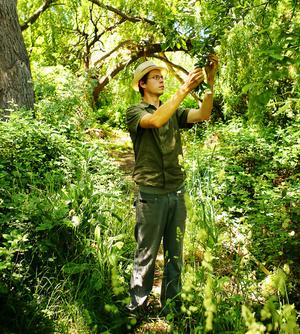


Genesis Of The Guerilla Gardeners

The idea of planting on vacant land has been around since at least 1973 when New Yorker Liz Christy and her "Green Guerilla" group transformed a derelict private lot into a garden in the Bowery Houston area of New York.

Since then the practice has spread to the US west coast, the UK and there have been reports of rogue gardeners in action in Brisbane, Sydney (with the Sydney Morning Herald calling the practitioners "bewilderers") and Melbourne.

What Does It Involve ?

In his book "On Guerrilla Gardening", Richard Reynolds, a 30-year-old former advertising employee who now runs guerrillagardening.org, defines the activity as "the illicit cultivation of someone else's land".

"Our main enemies are neglect and scarcity of land," says Reynolds, "Land is a finite resource and yet areas like this are not being used. That seems crazy to me. And if the authorities want to get in the way of that logic, then we will fight them - but peacefully - through showing them what we can achieve with plants."

Guerilla gardening is a crime in Britain (digging up land you do not own is classed as committing criminal damage) but Reynolds insists it is a victimless crime and is clearly unfazed by encounters with police.

Practitioners plant herbs, vegetables and fruit trees in roadside nature strips, along railway lines and in other unused pieces of urban land. They then encourage the local community to tend the plots and reap the harvest.

Choosing the right sites is important for guerilla gardeners to avoid running foul of councils and other landowners. As one gardener noted in The Age", "It's got to be somewhere that no one wants to use. The whole idea is to turn something that was totally useless into something beautiful and useful. If you can find solutions like that, no one's going to hassle you."

Energy Bulletin co-founder Adam Grubb (sometimes known as Adam Fenderson) runs another web site called "Eat The Suburbs" and has achieved a measure of fame in his home town of Melbourne encouraging people to engage in "urban foraging".

Another person encouraging urban gardening, much to my surprise, is new London mayor Boris Johnson, who has launched a project called "Capital growth" that aims to convert 2012 London rooftops and patches of vacant land into vegetable gardens, with a target date of 2012.

In a way this seems to be a revival of the English tradition of "allotments" - a more organised form of urban gardening from a previous age.

How much food could be grown this way ?

I haven't got the foggiest how much additional agricultural production could be achieved if the world's urban areas were swarmed by bands of guerilla gardeners, but walking around my own suburb and imagining every tree along the roads being a fruit or nut tree, and every little scrap of land that has been abandoned to weeds or scrub turned into a wild herb and vegetable patch, makes me think that everyone could have a much healthier diet and save a lot on their food bills if this was the case.

And we'd avoid a huge amount of 'food miles" (and the oil consumption this involves) while doing so.
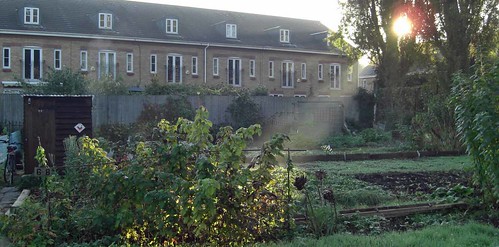
The Great Transformation Of 2012  

Posted by Big Gav in , , , , ,

2012 has always had a lot of significance for various fringe types (thanks primarily to Terrence McKenna's popularisation of Mayan legends I think) and the date seems to be getting lumbered with all sorts of plans and targets as it looms ever closer. Brosi Johnson has an odd (and not particularly ambitious) target for 2012 - creating 2012 vegetable gardens in order to boost the amount of locally grown food in the city - Boris Johnson unveils plan to create 2,012 new vegetable gardens in London.

Londoners will be encouraged to turn flat roofs into vegetable plots as part of a scheme to grow food on 2012 patches of land across the capital by 2012, Boris Johnson said today.

The "Capital Growth" project is the first initiative delivered by Rosie Boycott since she was appointed chair of London Food by the London mayor over the summer.

The former newspaper editor wants councils, schools, hospitals, housing estates, and utility companies to identify derelict land that can be turned into vegetable gardens by green-fingered Londoners keen to grow their own spuds rather than buy transported produce from the supermarket.

Boycott also envisages that spare pieces of land can be found on canal banks, banks of reservoirs, and disused railway yards.

Boycott said: "London has a good deal of green spaces – some derelict or underused - but not being used as well as they could be. We also have a veritable host of enthusiastic gardeners who are well equipped to turning derelict or underused spaces into thriving oases offering healthy food and a fantastic focus for the community.

"Capital Growth will identify spaces across the capital – often in surprising places such as roof gardens – and help London's communities grow their own food."

Boycott said in an interview in yesterday's Times that it was hoped that the 2012 makeshift plots could be found in time for the Olympics so that some of the homegrown food could be provided to athletes.

The demand for allotments has rocketed over recent years as environmental awareness has increased.

But a survey conducted by the London assembly two years ago found Londoners in some parts of the capital were waiting up to 10 years for an allotment, due to a dramatic decline in the number of available plots caused by owners wanting to put the land to other uses.

The London mayor wants to turn back the tide to promote locally grown food in the face of rising food prices and the challenge to protect the environment.

Londoners will receive both financial and practical support to grow their own, such as gardening tools and compost.

Launching the project at a vegetable and herb garden run by a charity for disabled people in Battersea Park, Johnson said: "Linking up currently unloved patches of land with people who want to discover the wonders of growing their own food, delivers massive benefits. It will help to make London a greener, more pleasant place to live while providing healthy and affordable food.

"This will aid people to reconnect with where their fruit and veg comes from and cut the congestion and carbon emissions associated with the transportation of food from miles away. Capital Growth is a win-win scheme - good for our communities and good for our environment."

When I first lived in London in the early 1990's I was amazed to see rows of allotments stretching alongside the railway tracks, usually sprinkled with old guys pottering around tending their vegie patches.

While they seem to have been in decline in recent years, they do have a long tradition behind the, as this NPR report explains -
London's Gardens: Allotments for the People.
London's allotment gardens are an unusual and vibrant system of community gardens that grow across the city. Tended by immigrants, retirees, chefs and fans of fresh food, the allotments make up a kitchen community like no other.

"Allotments" were not a world we knew until we went to Dublin and London to do Kitchen Sister workshops and began to sniff out hidden kitchens in that part of the world.

Wedged between buildings, planted in abandoned open spaces and carved into hillsides, these community plots of open space began to be reserved for neighborhood cultivation with the industrialization of England in the 1860s, when rural people poured into the city.

The allotments started to flourish with Britain's "Dig for Victory" movement of World War II, an effort to feed the starving population of London during the war. They are exploding today with the organic gardening and "good food" movements, and efforts to food self-sufficiency sweeping the country.

Claire Ptak, whose organic and beautiful cupcakes are sold at the Violet stall at Broadway Market in London Fields, first told us about the allotment movement in London. And we just had to see for ourselves.

Bachelors, Artists, Immigrants, Foodies

For about 20 years, retiree Charlie Gregory has been cultivating his plot at Fitzroy Park Allotment in Hampstead Heath, next to hipster artists and an immigrant couple with three Yorkies. There are apple trees, black currant bushes, blueberries, onions and shallots.

"Everybody knows everybody," Gregory said. "I'm a bachelor myself. I'm 78 now, and I'm keeping on the go. It's not expensive. For 27 pounds a year, you've got the space of land, you know, and this beautiful spot. You want to keep fit and live to a good old age? Get an allotment!"

London chef Oliver Rowe gets almost all his food from farmers and producers working within the radius of the city's train system. In the kitchen of Konstam at the Prince Albert, his restaurant in Kings Cross, Rowe's bread is made of wheat that is grown, milled and baked within 20 miles. The walls of his café are lined with jars of Dartford broad beans, sloe gin berries and sweet squash that he canned last year.

"Anywhere where there's a bit of unused green space has the potential to be turned into an allotment," Oliver said. "On the edge of a railroad seating or squeezed in a patch of disused land ... If you go to an allotment in east London, you may have a group of Bangladeshi women who grow all the things they can't buy here, because it's not available or too expensive.

"And you'll find old men, puttering around down there, getting away from the wife, sitting in a chaise reading the newspaper, getting some exercise, bringing home some nice food."

Jo MacDonald, a woman we met selling vintage clothing, has an allotment of her own. "I think it was the thing that kept me sane when my marriage was breaking up," she said. "I used to just go and wallow about in the allotment."

A Long Tradition

John Kelly, publisher of Prospect magazine, says he once had a plot in north London. He said allotments started in the 19th century and were sparked by philanthropy and health concerns.

"So as people fled from agrarian poverty into working in factories, land was given to the city in perpetuity for people to cultivate vegetables," Kelly said. "The allotment boom really happened in 1940s, 1950s."


London has also taken to the guerilla gardening trend with some enthusiasm, according to the Washington Post.
At a few minutes to 11 on a recent balmy night in East London, a black Ford crawled along the dimly lighted street. The suspicious driver rolled down his window to quiz a young woman by the curb. "What are you doing here?" he asked. The reply came quickly, cheerfully. "Gardening."

She was one of two dozen men and women gathered at a long-neglected public flower bed about 20 feet long and 10 feet wide. Under flickering street lamps in the bleak urban landscape, they spent the next four hours transforming the block with pitchforks and spades, fresh soil and plants.

These are London's Guerrilla Gardeners, a fast-growing force of renegades who are breathing life into neglected and timeworn pockets of open land across this vast metropolis.

Similar grass-roots movements are long established in New York, Philadelphia and, on a smaller scale, Washington. But the idea is relatively new to Britain, where people are more likely to wait politely, if vainly, for their municipalities to fix up the public open land.

What makes the British version particularly odd, though, is that it is done under cover of darkness, reinforcing the idea that this is rebellious and illicit. The guerrillas work at night to avoid run-ins with authorities, some of whom may not take kindly to trespassers working on land that is not their own.

The movement was started two years ago by Richard Reynolds, 28, a freelance advertising executive and passionate gardener who first tackled the wasteland around his high-rise apartment in the Elephant and Castle neighborhood in south London. He tells of setting his alarm for the middle of the night and attacking the littered flower bed on his block. He planted vibrant red cyclamens and cordylines, the latter chosen because they were "evergreen, strikingly sculptural, and they echoed the pattern of the spiky metal burglar-preventing fence at the top of the wall."

Soon he was enlisting the help of friends to mount more ambitious raids and, thanks to regular blogs on his Web site ( http://www.guerrillagardening.org/ ) and interest from the British media, Reynolds found he was welcoming more people on every dig.

Today, the Guerrilla Gardeners number more than 1,000 and counting. Reynolds continues to fund most of the plantings himself, but also receives donations from supporters. He tends towards hardy, drought-resistant plants because they won't need much maintenance. A favorite choice is lavender: "It's wind-resistant, drought-resistant, sweet-smelling, floral, honey-bee attracting." Two or three times a month Reynolds sends a group e-mail informing his troops of the next dig's secret location. A select group of the guerrillas comes armed with tools, and sometimes plants, but Reynolds is always at the vanguard, handing out gloves and trowels and directing operations.

Statistics

Locations of visitors to this page

blogspot visitor
Stat Counter

Total Pageviews

Ads

Books

Followers

Blog Archive

Labels

australia (619) global warming (423) solar power (397) peak oil (355) renewable energy (302) electric vehicles (250) wind power (194) ocean energy (165) csp (159) solar thermal power (145) geothermal energy (144) energy storage (142) smart grids (140) oil (139) solar pv (138) tidal power (137) coal seam gas (131) nuclear power (129) china (120) lng (117) iraq (113) geothermal power (112) green buildings (110) natural gas (110) agriculture (91) oil price (80) biofuel (78) wave power (73) smart meters (72) coal (70) uk (69) electricity grid (67) energy efficiency (64) google (58) internet (50) surveillance (50) bicycle (49) big brother (49) shale gas (49) food prices (48) tesla (46) thin film solar (42) biomimicry (40) canada (40) scotland (38) ocean power (37) politics (37) shale oil (37) new zealand (35) air transport (34) algae (34) water (34) arctic ice (33) concentrating solar power (33) saudi arabia (33) queensland (32) california (31) credit crunch (31) bioplastic (30) offshore wind power (30) population (30) cogeneration (28) geoengineering (28) batteries (26) drought (26) resource wars (26) woodside (26) censorship (25) cleantech (25) bruce sterling (24) ctl (23) limits to growth (23) carbon tax (22) economics (22) exxon (22) lithium (22) buckminster fuller (21) distributed manufacturing (21) iraq oil law (21) coal to liquids (20) indonesia (20) origin energy (20) brightsource (19) rail transport (19) ultracapacitor (19) santos (18) ausra (17) collapse (17) electric bikes (17) michael klare (17) atlantis (16) cellulosic ethanol (16) iceland (16) lithium ion batteries (16) mapping (16) ucg (16) bees (15) concentrating solar thermal power (15) ethanol (15) geodynamics (15) psychology (15) al gore (14) brazil (14) bucky fuller (14) carbon emissions (14) fertiliser (14) matthew simmons (14) ambient energy (13) biodiesel (13) investment (13) kenya (13) public transport (13) big oil (12) biochar (12) chile (12) cities (12) desertec (12) internet of things (12) otec (12) texas (12) victoria (12) antarctica (11) cradle to cradle (11) energy policy (11) hybrid car (11) terra preta (11) tinfoil (11) toyota (11) amory lovins (10) fabber (10) gazprom (10) goldman sachs (10) gtl (10) severn estuary (10) volt (10) afghanistan (9) alaska (9) biomass (9) carbon trading (9) distributed generation (9) esolar (9) four day week (9) fuel cells (9) jeremy leggett (9) methane hydrates (9) pge (9) sweden (9) arrow energy (8) bolivia (8) eroei (8) fish (8) floating offshore wind power (8) guerilla gardening (8) linc energy (8) methane (8) nanosolar (8) natural gas pipelines (8) pentland firth (8) saul griffith (8) stirling engine (8) us elections (8) western australia (8) airborne wind turbines (7) bloom energy (7) boeing (7) chp (7) climategate (7) copenhagen (7) scenario planning (7) vinod khosla (7) apocaphilia (6) ceramic fuel cells (6) cigs (6) futurism (6) jatropha (6) nigeria (6) ocean acidification (6) relocalisation (6) somalia (6) t boone pickens (6) local currencies (5) space based solar power (5) varanus island (5) garbage (4) global energy grid (4) kevin kelly (4) low temperature geothermal power (4) oled (4) tim flannery (4) v2g (4) club of rome (3) norman borlaug (2) peak oil portfolio (1)