Posted
by Big Gav
in
britain,
ocean energy,
pembrokeshire,
tidal energy ltd,
tidal power,
wales
The BBC reports another British tidal power project has reached pilot stage - DeltaStream tidal power Pembrokeshire trial approved.
A tidal power scheme designed to generate electricity for 1,000 homes in Pembrokeshire has been approved for a 12-month trial.
The 1.2MW project at Ramsey Sound, near St Davids, features three generators that sit on a triangular frame.
Invented by Pembrokeshire engineer Richard Ayre, the project has more than £500,000 in EU grants.
The DeltaStream device project has landed consents from both the UK and the assembly government.
Cardiff-based Tidal Energy Ltd claims its tidal generator is at the cutting edge of green technology, with three separate horizontal axis turbines mounted on a common triangular frame.
Each turbine has a 15m diameter rotor which turns in the tidal flow and can also turn with the tide, generating electricity on both the ebb and flood tides.
The firm said the device would be easy to manufacture, does not require drilling or piling into the seabed and would have a minimum environmental impact.
Posted
by Big Gav
in
britain,
engineering,
technocracy
The Guardian has a fairly technocractic article on the low value accorded to engineers in Britain and the value of implementing some large scale and tecnically complex infrastructure to rebuild the economy on "solid foundations" - Let engineers make Britain great again.
Orson Welles said film-making was the biggest electric train set a boy ever had. He was wrong. A new high-speed train line would be, if the boy or girl grew up to engineer it.
But in Britain, the train set is broken and has been packed away in the attic. We're not proud of industry and we certainly don't want our kids to grow up to be engineers. It's a tragedy. It never used to be this way. We need to rediscover the power of engineering, its impact and contribution. It can stimulate young minds and it can stimulate the economy. ...
So the young are innately curious about how and why things work. Yet what happens between childhood and adulthood? We stamp it out of them. Engineering gets stigmatised and we encourage our kids to become "professionals" - lawyers, accountants, doctors. Unlike in France or Germany, engineers are a bit of a nonentity here. Engineering is almost a dirty word. We're told it's "old industry" and that we are a "post-industrial nation".
Part of the problem is that engineers are not accorded the status they deserve. We celebrate designers and architects, but forget the clever people who turn the theory into reality. The Millau bridge in France was designed by Norman Foster, but it was French engineer Michel Virlogeux who made it work. A magnificent achievement, but whose name do people remember? In 2005, Ellen MacArthur became the fastest person to sail round the globe, but little was made of Nigel Irens, who engineered her trimaran. ...
The problems come when the moneymen take the reins instead. Take the British car industry. In the 1950s, half of the world's cars were manufactured in Britain. But beginning with the formation of the British Motor Corporation, the car industry's emphasis on invention gradually bowed to commercial pressure and government intervention. In a desperate effort to balance the books, the industry was soon ground down by internal rivalries, lacklustre designs and labour disputes. Good invention was forgotten.
Today, besides the recently appointed science minister Lord Drayson, engineers are not represented in the highest levels of British government. In contrast, Hu Jintao, the Chinese president, graduated in hydraulic engineering from Beijing's Tsinghua University, and Wen Jiabao, the Chinese prime minister, is a postgraduate engineer. China produces 14 times as many engineers as we do.
While we will struggle to compete with growing industrial economies on the speed and efficiency of assembly lines, we can compete through ideas and technology. To do this we need bright engineers. But there aren't enough. Just 4% of undergraduates read engineering and fewer still actually end up in the profession.
This is worrying. Making things is still the future. Manufacturing accounts for half of our exports. But we import more than we export to the total of around £8bn a month. That's more than £90bn a year in the red. Unlike the US, we don't have a huge internal economy we can rely on to help support us in this difficult time. The UK can't afford to be protectionist - we've always been exporters. The trouble is that we're running out of things to sell.
Besides the commercial world, the importance of engineering to us as a society cannot be underplayed. Last year, the first British tidal turbine was connected to the national grid, producing enough power for 1,000 homes. The UK accounts for half of Europe's tidal power and it's been estimated that tidal energy could provide a fifth of British energy needs. These initiatives are what we need to excite and inspire people.
If the government backed these large infrastructure projects, as in France, their importance would be recognised, helping to restore engineering's contribution to our economy and society. I worry that for all the rhetoric about addressing attitudes to science and industry, the action is not dramatic enough to shake the UK out of its apathy.
President Obama has got it right with his "smart grid" project, an electricity network that will use information technology to link the US to renewable sources of energy. Not only will this create jobs and stimulate the US engineering, but in the long run it will save billions on the national electricity bill and cut the country's carbon footprint. Meanwhile, in the UK, projects get caught up in planning regulations, never to see the light of day.
We need to rediscover that fascination with that train set of our childhood. We've built our modern economy on the service sector, loans, banking and the dotcom bubble. Now that's collapsed, we should seek to base it on something long term with solid foundations. If we don't, we risk losing an already weakened position for good. Making money from money should be replaced with making money from making.
Posted
by Big Gav
in
britain,
gordon brown,
nuclear power,
oil,
uk
The Guardian has an open letter from British PM Gordon Brown saying that Britian needs to become a low carbon economy and reduce dependence on oil - "We must all act together".
The global economy is facing the third great oil shock of recent decades. The oil price, just $10 a barrel a decade ago, has reached $135, pushing up the price of petrol and domestic heating as well as contributing to higher food prices. And I know that families up and down the country are feeling the impact in the cost of filling up at the petrol station and in the rise in gas and electricity bills.
As every country faces increased costs, it is now understood that a global shock on this scale requires global solutions. This is why the UK is arguing that at the top of the economic agenda for the forthcoming G8 summit in Japan should be a global strategy for addressing the impact of higher oil prices.
The cause of rising prices is clear: growing demand and too little supply to meet it both now and - perhaps of even greater significance - in the future. Higher demand is one of the major results of the scope, speed and scale of globalisation as Asian economies, as well as Opec countries themselves, demand more oil. To take one example: by 2020 there could be as many as 140m cars in China - more than three times as many as today. Overall, by 2020, global demand for energy will rise by 50%.
It is the market's belief that ever-growing demand will continue to outstrip supply that has pushed up the oil price. And we are becoming increasingly aware of the technical, financial and political barriers to the production of more oil. Every country must find ways of being more efficient and diversifying supply. And as continuing high oil prices present us all with an immense challenge, the way we confront these issues will define our era.
While the world will always seek new sources of supply, and we must continue to reduce barriers to investment, our strategic interests - reducing energy costs, increasing our energy security, tackling climate change - all now point in the same direction: decreasing dependency on oil, through substitution with other energy sources and through energy efficiency. And what we do to change the balance for the medium and long term can have an effect in the short term because it can give greater certainty about future supply and demand, and create a more stable market.
So our goal that Britain becomes a low-carbon economy is now an economic priority as well as an environmental imperative. And if we are to ensure a better deal for consumers, energy security and lower greenhouse gas emissions, Britain, Europe and the world will have to change how we use energy and the type of energy we use.
So, as John Hutton has said, we need to accelerate the development and deployment of alternative sources of energy, reducing global dependence on oil. Britain will increase its investment in renewables, including decentralised generation. We will build one of the world's first commercial-scale carbon capture and storage coal plants and we have committed to a nuclear building programme to ensure that the UK's emissions and dependence on fossil fuels do not rise as existing nuclear stations close.
He might want to rethink that last bit about swapping some new nuclear power stations in for old ones as they stop working - the
decommissioning costs are horrendous.
The cost of cleaning up the UK's ageing nuclear facilities, including some described as "dangerous", looks set to rise above £73bn, the BBC has learned. A senior official at the Nuclear Decommissioning Authority said the bill would rise by billions of pounds.
Nineteen sites across the country, some dating from the 1950s, are due to be dismantled in the coming decades. A spokesman for the Department for Business said it was ready for an adjustment in the clean-up costs. In January, the National Audit Office said that the cost of decommissioning ageing power sites had risen from £12bn to £73bn.
At the largest site, Sellafield, on the Cumbrian coast, I saw for myself one of the "ponds" in which an unknown mass of radioactive material was dumped in the 1950s. Beneath the unruffled surface of the water lies an unrecorded collection of rusting metal containers holding everything from nuclear fuel rods to radioactive waste. Beside it, workers are constructing a vast new building to handle the material when a retrieval operation eventually gets under way.
Speaking to the BBC, Jim Morse, a senior director at the authority, said of the projected cost: "I think it's a high probability that in the short term it will undoubtedly go up. "We've still a lot to discover, we haven't started waste retrieval in those parts of the estate where the degradation and radioactive decay has been at its greatest."
When asked if the cost increases could run into billions of pounds, Mr Morse said: "I'm sure it'll be some billions, I really don't know. "No-one's done this before. It's very difficult to find another measure. There's nothing in engineering terms that allows you to extrapolate from what you have today."
A pilot project to investigate the task of dismantling has been under way for years at one of the most distinctive landmarks at Sellafield - the giant sphere of the 1950s-era Windscale Advanced Gas-cooled Reactor.
And the
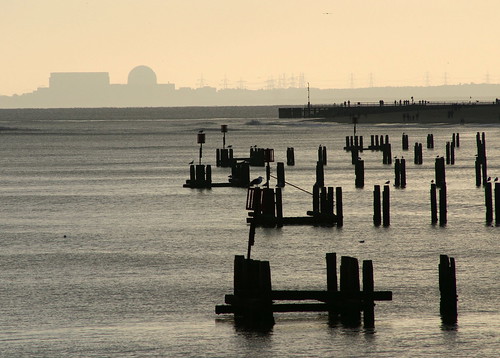
reliability of the things isn't too inspiring either, with Britain's largest reactor, Sizewell B, having a sudden and unexplained outage yesterday.
Hundreds of thousands of people were hit by electricity blackouts yesterday when seven power stations shut down. The unscheduled stoppages were regarded as an unprecedented sign of the fragility of Britain’s power infrastructure.
Operations were cancelled, people were stuck in lifts, traffic lights failed and fire engines were sent out on false alarms. Householders were unable to use any appliances or make phonecalls as the blackouts hit areas including Cleveland, Cheshire, Lincolnshire and London.
It was unclear last night why the power stations had failed. As the cuts escalated, the National Grid was forced to issue the most serious possible warning — “demand control imminent” — and urged suppliers to provide lower-voltage electricity to meet demand.
Energy suppliers affected by the shutdown, including British Energy and EON, said that they could not reveal the reasons for the cuts, nor would they say when some disrupted stations might resume service, because disclosure could affect the wholesale price of electricity. ...
At midday the Sizewell B nuclear power station, run by British Energy in Suffolk, and the Longanett coal-fired power station, run by Scottish Energy in Fife, went offline within two minutes of each other. ... Some power stations remained shut last night. A British Energy spokesman said that the Sizewell B reactor was offline late yesterday, although a restart plan was under way.
Posted
by Big Gav
in
britain,
energy,
ireland,
marine current turbines,
ocean power
The Independent has a look at the latest news in British ocean power generation. Meanwhile Gordon Brown and Nicolas Sarkozy are wasting time and money talking about building expensive and unpopular nuclear power plants (see here for more on ocean energy).
Britain is set this week to enter a new age, generating energy directly from the seas that surge around its shores. On Saturday a strange, 122ft- long contraption – looking like an upside-down windmill – will set off from the Belfast dock that built the Titanic to produce the first electricity ever brought ashore from British tides.
The device – the first of its kind anywhere in the world – is expected to start a revolution which could lead to our island nation getting a fifth of its power from its surrounding waters, and to the far north of Scotland becoming "the Saudi Arabia of marine energy".
Remarkably, the pioneering device, which will start producing power from predictable and clean tidal energy, is the fruit of the vision and persistence of a single campaigning engineer, and has been developed by a small West Country firm. Though it has recently had some Government support, ministers have traditionally preferred to pour resources into much bigger projects, such as nuclear power stations. Indeed, the installation of the new device – near the mouth of Northern Ireland's Strangford Lough – is scheduled to take place only days after the Prime Minister, Gordon Brown, and the French President, Nicolas Sarkozy, are expected to sign a deal to jointly construct a new generation of reactors and to sell the technology around the world.
Yet the inauguration of a tidal turbine, dubbed SeaGen – which will generate enough electricity to power 1,140 homes by being placed directly in the tide race that rushes in and out of the lough – may unexpectedly prove to be the more significant event. While the much-vaunted Severn Barrage has only just begun to undergo a two-year feasibility study, experts are hailing the new turbine as the start of a giant leap in exploiting marine energy, where Britain, for once, is now leading the world.
Later this year, in another global first, a wave energy power station developed by an Edinburgh firm is to be installed in the Atlantic Ocean off the coast of Portugal. Next year, an even bigger one, off Cornwall, is expected to start feeding electricity into the national grid, and yet another is planned for the Orkneys. And Marine Current Turbines, the firm behind SeaGen, has joined with the utility company npower to develop a tidal power station off Anglesey.
Britain has the best tide and wave energy resources in the world – the official Carbon Trust estimates that they could together provide a fifth of our electricity. Yet, until recently, successive governments have set their face against developing them.
In the 1980s the then Department of Energy killed off promising proposals for exploiting the waves amid evidence that it did so because they threatened its (never realised) plans to expand nuclear power. In 1992 an official report concluded that it "did not see any justification for significant public expenditure" on offshore energy, and as recently as 2003 a Government White Paper ruled out the development of a Severn Barrage.
The tide only turned decisively about a year ago when, as The Independent on Sunday exclusively reported, ministers began backing plans for the £14bn, 10-mile barrage. Gordon Brown officially announced a feasibility study at the last Labour Party conference, and this got under way in January.
Launching the study, which will continue until 2010, the Secretary of State for Business, John Hutton, described the barrage's potential as "breathtaking". But though it could alone provide 5 per cent of the country's electricity from a completely dependable, renewable resource it could not be in operation until at least 2020.
And the Government's official environmental advisers – the Environment Agency, Natural England and the Countryside Council for Wales – have warned that the barrage would "cause irreversible impacts" to the estuary's "internationally important habitats" for wildlife and to its "unique ecology".
The scheme in Northern Ireland avoids these drawbacks by using a radically different technology. While the barrage impounds the rising tide behind a dam – letting it out, as it falls, through some 200 turbines in the structure – SeaGen sits in the tidal currents like an inverted windmill, capturing some of the energy by letting the water, rather than air, turn its sails as it flows.
While the barrage is a mammoth and expensive structure, which takes many years to build and then cannot be moved, the turbines can be constructed and sited relatively quickly, cheaply and flexibly. And while damming the Severn estuary inevitably fundamentally alters its ecology, SeaGen is expected to have far less impact on wildlife and the environment. But its technology's potential is no smaller. A report by the Sustainable Development Commission last year estimated that exploiting Britain's tidal currents could generate at least 5 per cent of the nation's electricity. Other authorities put it even higher.
Professor Stephen Salter of Edinburgh University, one of Britain's leading marine energy experts, estimates that the Pentland Firth alone could generate up to a quarter of Britain's electricity – more than is now being provided by all the country's nuclear power stations – making the channel between Orkney and the north Scottish mainland "the Saudi Arabia of marine energy."
Martin Wright, managing director of Marine Current Turbines, calls the firth, the "Mount Everest" of the industry, and describes its tidal currents as "the equivalent of an underwater hurricane". Every second, about 2.5 million cubic metres of water – enough to fill 1,000 Olympic swimming pools – passes at a speed of up to 12 knots across a line traced across the Firth.
This is just the biggest of a host of potential sites, usually where the tides are speeded up by being squeezed through narrow channels, forming one of the most intense resources provided by any form of renewable energy. In all, the Government estimates, Britain has about half of all Europe's such "tidal stream" potential and between 10 and 15 per cent of what has been identified worldwide, making it uniquely blessed.
Some 24 technologies, at various stages of research and development, have been put forward for exploiting tidal currents, but SeaGen – invented by Peter Fraenkel – a renewable energy pioneer who is now Marine Current Turbines' technical director (see right) is well in the lead.
In 2003 a smaller prototype, called Seaflow, was installed off Lynmouth in Devon becoming the first renewable energy device, powered by the sea, to be installed in the open ocean anywhere in the world. It operated through three winters, with regular force 8 gales, without any important technical failures – with an overall performance that exceeded expectations. Dr Fraenkel says it "proved the feasibility" of the technology.
He adds that SeaGen – four times as powerful, with a capacity of 1.2 megawatts – "is the world's first commercial scale system for generating electricity from marine currents" – and is "needed to prove economic and commercial feasibility".
Originally designed to be installed in 2006, it was held up by a series of events including the commercial takeover of the company due to install it, and an accident to a vessel due to carry it.
Hmmm - sounds like there is some good tinfoil potential in that story !
The Independent also says that "
Sea levels are rising too fast for the Thames Barrier".
A fear that sea levels will rise far faster than predicted this century has led to a revision of the plan to protect London from a devastating flood caused by the sort of storm surge in the North Sea that resulted in the closure of the Thames Barrier yesterday.
It was the 108th time that the barrier had to be closed since it became operational in 1982 but scientists are concerned that rapidly rising sea levels could significantly shorten the expected lifespan of one of the world's biggest anti-flood structures.
When the Thames Barrier was being designed in the 1970s, global average sea levels were rising at about 1.8 millimetres a year and global warming was not seen as a threat, but in the past 15 years the rate has nearly doubled to about 3.1mm a year and many scientists expect it to accelerate still further.
Sea levels are rising even faster in south-east England because of local effects, such as land sinking, but officials for the Environment Agency said that the barrier is designed to cope with an 8mm-per-year rate of sea level increase yet still meet its design specifications – such as coping with a one-in-a-thousand-year storm surge by 2030. ...
The Thames Barrier protects about £80bn worth of buildings and capital infrastructure in London. Some 1.25 million people live or work in the at-risk area.
Posted
by Big Gav
in
britain,
energy policy,
renewable energy,
uk
The New Statesman has an article on "How Britain could be supplying Europe with green electricity". Unfortunately its wallowing far behind countries like Germany and Spain in reality.
It may not feel like it on a gusty grey day in Rhyl, but this country is blessed. Take a boat out into the choppy waters off the North Wales coast, and you can see why. Thirty bright white turbines spin continuously just five miles off the coast, producing enough electrical power to supply 40,000 homes with clean, green energy. The wind and waves seem limitless and powerful - and they are. If the UK had been more aggressive and far-sighted in developing renewable energy, we would already be exporting green electricity and wind turbines to Europe and further afield.
In renewable energy terms, we would be the Saudi Arabia of Europe. A full 40 per cent of the continent's wind blows across British shores, enough to meet all our energy needs and more. But instead of leading the world in renewable energy and at the same time cutting carbon emissions, the UK languishes close to the bottom of the European clean energy league. Just 2 per cent of our energy comes from renewable sources and the rest from dirty, climate-changing fossil fuels. This is the legacy of years of contradictory policies, conflicting priorities, ideological pig-headedness and government incompetence.
It's a story that shames Britain.
A good place to start is the government's Low Carbon Buildings Programme (LCBP). This was launched in 2006 to provide grants to householders wanting to instal renewable generation technologies - from solar panels to small hydro schemes - on their properties. Ministers acknowledge that micro-generation could play a big part in our clean energy future, and that turning homes into mini power stations is good for energy security, household income and the environment. But what actually happened? Instead of kick-starting a whole new market sector, the government starved it of funds. A measly £12.7m was allocated, with a monthly cap. On the first day of each month all the available grants were snapped up within hours.
This stop-start approach led to frustrated householders and cash-strapped solar installation companies, many of which began to go bust. The number of grants given for solar hot water systems fell by half last year, and the number for micro wind turbines by two-thirds. For ground-source heat pumps, while 100 grants were made in the last three months of 2006, the equivalent number for 2007 was zero. For electricity, we managed to put only 270 solar panels on British roofs last year, while Germany installed 130,000.
Gordon Brown, first as chancellor, and now as Prime Minister, has successfully ensured that it makes no financial sense whatsoever for householders to invest in generating their own energy renewably. If you put up a solar photovoltaic panel in this country, you do it for altruistic reasons only: at present, you are guaranteed to lose money hand over fist. ...
This catalogue of failure has not only been bad for the climate, it has been bad for business. Britain might once have led the world in wind turbine development. But with no domestic market, production moved elsewhere, and today most turbines installed in this country are imported from Denmark. The leader in solar power is not Britain but Germany, which has pioneered a lucrative export industry in solar photovoltaic cells. In China, too, solar manufacturing is big business: the country's second-richest man leads a solar energy company. This is an energy sector which saw growth last year of roughly 40 per cent, and has attracted tens of billions in venture capital. None of that came to Britain. Instead of creating a brand new industry and thousands of jobs, British-based renewables companies have been going out of business.
Wind should already be our biggest single power source. The BWEA estimates that wind could generate 27 per cent of our electricity by 2020, which, combined with other renewables, could easily meet our EU-assigned target of 15 per cent renewable energy by 2020. Instead, wind accounts for just 1.5 per cent of UK electricity generation today (the equivalent figure in far less windy Denmark is 20 per cent, for Spain 8 per cent and Germany 5 per cent). That 1.5 per cent could be ramped up very quickly if the planning system worked in favour of renewables. According to the BWEA, 220 windpower projects are currently stuck in planning. If all received immediate consent, they could generate 9.3 gigawatts of electricity, enough for an estimated 5.25 million households. If the 39 projects that were refused planning permission last year had instead been allowed it, they could have provided power for 750,000 households, and prevented the emission of three million tonnes of CO2. (Anti-wind campaigners need to recognise their moral liability for these climate-changing emissions.)
While 39 projects were refused planning permission, just 26 projects went ahead. This year, we are level-pegging: seven wind applications have been approved and six refused. It can now take ten years for a windfarm project to get approved and built, and another five for it to get a grid connection (unlike in other countries, renewable generators here have to pay for their own grid connections). This does not look like a country on the fast track to a clean energy future. Indeed, power companies such as E.ON are pro posing to invest billions in hugely polluting coal power plants instead.
The government has proposed to reform the planning system to make it easier for windfarms to get the go-ahead. Environmentalists and conservationists are opposed to the reform, however, for the good reason that it would also make it easier for new motorways, power stations and airports to gain approval, and stifle local democracy in the process.
A greener government might have focused on reforming the planning system for renewable energy projects, gaining support from greens and electricity generators alike. Instead, in its enthusiasm for aviation and nuclear power, the government has bundled windfarms into a planning policy package that will be opposed by almost all. A missed opportunity.
There is some good news. The 1000MW London Array - which will generate enough power from wind for a quarter of London's households - has been given the go-ahead. Several other major projects are under way, and this year the UK will overtake Denmark as the largest offshore generator in the world. The UK also still leads in marine renewables (wave and tidal stream power). With 30 marine technology developers headquartered here, compared to only 15 in the rest of Europe, the UK is able to put its offshore operational skills learned from North Sea oil - now in long-term decline - to good use. At the end of last month the world's largest conference on wave and tidal stream energy, Marine 08, was held in Edinburgh. Tidal power would address the intermittency question: what to do when the wind doesn't blow and the sun doesn't shine. Tidal power is predictable. Wave power is also more dependable. The more sources of energy we can call on, the less vulnerable we will be to losing power in any one sector.
Yet in marine renewables, too, the government has risked Britain losing its competitive edge. The world's first commercial-scale wave-generating array, while built by a UK-based company, is being launched off the Portuguese, not the British, coast. And, mirroring the disaster of the Low Carbon Buildings Programme, the Marine Renewables Deployment Fund - supposed to support the fledgling sector with capital grants and other financial aid - has a tiny budget and a cap per project of £9m, far too little for any British design to make it past the prototype stage into commercial production. Once again, we are wasting a historic advantage.
With the right policy levers pulled, we could in the not-too-distant future be generating 20 per cent of all our electricity out at sea using wave and tidal power, and far more from onshore and offshore wind. We could lead the world in a new manufacturing sector and generate thousands of new jobs. We could have a zero-carbon electricity grid as early as 2030. We could also lead the world in reducing greenhouse-gas emissions.
But, for this to happen, the government will need to admit that its policies have been a cala mitous failure and put clean energy at the top of its long-term agenda, before it is too late.


 Posts
Posts