Showing posts with label ephemeralisation. Show all posts

It’s (still) a materialist world  

Posted by Big Gav in , ,

Singapore Today has an article on Vaclav Smil's ideas about our dependence on large volumes of raw materials (in opposition to Bucky Fuller's about ephermeralisation) - It’s (still) a materialist world.

The guru of modern thinking about the significance of materials is Professor Vaclav Smil of the University of Manitoba, described by Bill Gates as “my favourite author”. In his view, physical substances remain central to modern economies in spite of all the advances in information technology, and the apparent evidence of dematerialisation is often misleading.

In his latest book, Making The Modern World, he cites computer-aided design. The Boeing 747, designed in the 1960s, required 75,000 drawings with a total weight of 8 tonnes. Using computer-aided design (CAD) for the 767 in the 1990s did away with all that paper, and cut costs and design time.

However, as Prof Smil points out, the CAD system required computers, data storage, communications, screens and electricity to run. Given the complexity of the systems involved, it is far from obvious that the switch to CAD cut United States use of materials overall.

It is true that in computing power there has been spectacular dematerialisation. All the computers sold in the world in 2011 weighed 60 times as much as the total sold in 1981, but had 40 million times the memory.

But where microchips are not the dominant component of the total design, Prof Smil wrote, there has been no even remotely similar mass decline. In some sectors, technological progress has actually made products more “material”. The Ford Model T, one of the first automobiles, weighed 540kg; the F-150 pick-up, which is its most popular model today, weighs more than 2 tonnes.

Prof Smil’s conclusion is that while dematerialisation, in the sense of reduced material use for every dollar of gross domestic product, has been a trend for decades and can continue into the future, an absolute reduction in the world’s use of natural resources is highly unlikely. If growth continues, at some point those resources will run low.

While we do not know when we will hit the limits of materials usage, we know they are out there somewhere. Tensions such as the dispute over rare earths or rising commodity costs could have serious consequences for growth.

Prof Smil’s answer is that we need to think about rational futures of moderated energy and material use. As he admits, though, it is hard to see any political leaders being prepared to offer their citizens less and less in the future; particularly not in emerging economies where billions are hoping to come closer to developed world lifestyles.

Remote Data Centres and Renewable Energy  

Posted by Big Gav in , , ,

Technology Review has an article noting "Far-flung data centers could use otherwise unharvestable renewable energy for computation" - Really Remote Data.

Researchers at Cambridge University want to put data centers in places so remote they aren't on any power grid. Their models indicate that moving data-hungry computation to places such as scorching deserts, windswept peaks, and the middle of the Atlantic Ocean—all rich in sunlight and wind energy—could allow this otherwise unharvestable energy to do useful work.

In a paper to be delivered at the 13th annual HotOS conference in May, the authors offer an extreme model of how cloud services could incorporate remote data centers powered only by renewable energy. Their scenario sites one solar- and wind-powered data center in the desert of southwest Australia and a second one in Egypt, on other side of the planet. This placement is no accident: putting them in different hemispheres, on opposite sides of the earth, maximizes the solar and wind energy they can harvest.

One catalyst for such a radical rethinking of how data centers can be sited and powered is the increasing availability of advanced fiber-optic networks. Connecting a remote renewable-energy plant to a power grid remains prohibitively expensive, reasoned the researchers working on this project—Sherif Akoush, Ripduman Sohan, Andrew Rice, Andrew W. Moore, and Andy Hopper—but running fiber-optic cable to such a plant would be relatively easy and cheap.

"We envisage data centers being put in places where renewable energy is being produced and you could never economically bring it back to heat a house," says Andy Hopper, senior author on the paper and head of Cambridge University's computer science department. "But you could lay a fiber and use energy that is otherwise lost, in that it's not economically transportable." One way to think of the underlying principle, he notes, is that it's easier to move bits (made up of photons) than electrons. ...

Hopper, however, points out that the larger effort of which this paper is a part—the Computing for the Future of the Planet project—takes it as a given that more computing is always good, because the virtualization of goods and services displaces more energy-intensive activities in the physical world. He says that a system like the one he proposes would be implemented only at either "no cost to overall performance [of a cloud computing system] or at an attractive cost to performance."

Was Moore's Law Inevitable?  

Posted by Big Gav in , ,

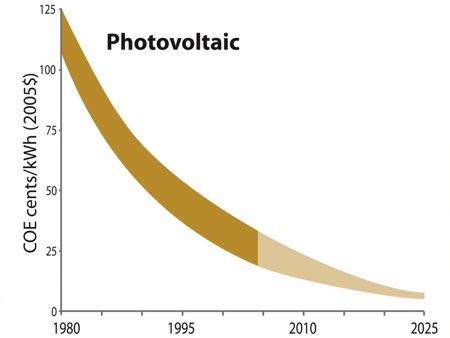
Kevin Kelly has an interesting (and long) article on the history of Moore's Law and exponential growth in technological capability, including some notes on its relevance for solar PV production - Was Moore's Law Inevitable?.

Finally, in a another reference, Mead adds : "Permission to believe that [the Law] will keep going," is what keeps the Law going. Moore agrees in a 1996 article: "More than anything, once something like this gets established, it becomes more or less a self-fulfilling prophecy. The Semiconductor Industry Association puts out a technology road map, which continues this [generational improvement] every three years. Everyone in the industry recognizes that if you don't stay on essentially that curve they will fall behind. So it sort of drives itself."

The " technology road map" produced by Semiconductor Industry Association in the 1990s was a major tool in cementing the role of Moore's law in chips and society. According to David Brock, author of Understanding Moore's Law, the SIA road map "transformed Moore's law from a prediction to a self-fulfilling prophecy. It spelled out what needed to be accomplished, and when." A major factor in semiconductor manufacturing process are the photoresist masks which craft the thin etched conducting wires on a chip. The masks have to get smaller in order for the chip to get smaller. Elsa Reichmanis is the foremost photoresist technical guru in Silicon Valley. She says, "Advances in the [process] technology today are largely driven by the Semiconductor Industry Association." Raj Gupta, a materials scientist and CEO of Rohm and Haas, declares "They" -- the SIA road map -- "say what performance they need [for new electronic materials], and by which date." Andrew Odlyzko from AT&T Bell Laboratories concurs: "Management is *not* telling a researcher, 'You are the best we could find, here are the tools, please go off and find something that will let us leapfrog the competition.' Instead, the attitude is, 'Either you and your 999 colleagues double the performance of our microprocessors in the next 18 months, to keep up with the competition, or you are fired.'" Gordon Moore reiterated the importance of SIA in a 2005 interview with Charlie Rose: "the Semiconductor Industry Association put out a roadmap for the technology for the industry that took into account these exponential growths to see what research had to be done to make sure we could stay on that curve. So it's kind of become a self-fulfilling prophecy."

Clearly, expectations of future progress guide current investments. The inexorable curve of Moore's Law helps focus money and intelligence on very specific goals -- keeping up with the Law. The only problem with accepting these self-constructed goals as the source of such regular progress is that other technologies which might benefit from the same belief do not show the same zooming curve. We witness steady, quantifiable progress in other solid state technologies such as solar photovoltaic panels -- which are also made of silicon. These have been sinking in performance price for two decades, but not exponentially. Likewise the power density of batteries has been increasing steadily for two decades, not again, no where near the rate of computer chips.

Why don't we see Moore's Law type of growth in the performance of solar cells if this is simply a matter of believing in a self-fulfilling prophecy? Surely, such an acceleration would be ideal for investors and consumers. Why doesn't everybody simply clap for Tinkerbelle to live, to *really* believe, and then the hoped for self-made fairy will kick in, and solar cells will double in efficiency and halve in cost every two years? That kind of consensual faith would generate billions of dollars. It would easy to find entrepreneurs eager to genuinely believe in the prophecy. The usual argument applied against this challenge is that solar chips and batteries are governed primarily by chemical processes, which chips are not. As one expert put the failure of exponential growth in batteries: "This is because battery technology is a prisoner of physics, the periodic table, manufacturing technology and economics." That's plain wrong. Manufacturing silicon integrated chips is an intensely chemical achievement, as much a prisoner of physics, the periodic table and manufacturing as batteries. Mead admits this: "It's a chemical process that makes integrated circuits, through and through." In fact the main technical innovation of Silicon Valley chip fabrication was to employ the chemical industry to make electronics instead of chemicals. Solar and batteries share the same chemical science as chips.

So what is the curve of Moore's law telling us that expert insiders don't see? That this steady acceleration is more than an agreement. It originates within the technology. There are other technologies, also solid state material science, that exhibit a steady curve of progress, and just like Moore's Law, their progress *is* exponential. They too seem to obey a rough law of remarkably steady exponential improvement. ...

If you scour the technium for examples of enduring exponential progress, you'll find most candidates within fields related to material science. For instance the maximum rotational speed of an electric motor is not following an exponential curve. Nor is the maximum miles-per-gallon performance of an automobile engine. In fact most technical progress is not exponential, nor steady. Even most progress in material science is not exponential. We are not exponentially increasing the hardness of steel. Nor are we exponentially increasing the percentage yield of say, sulfuric acid, or petroleum distillates, from their precursors.

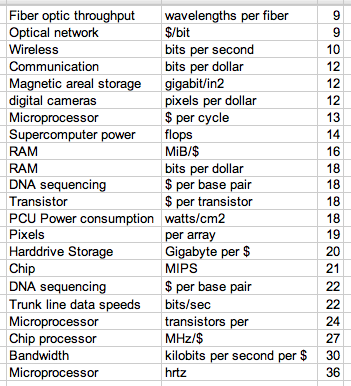
I gathered as many examples of current exponential progress as I could find. I was not seeking examples where the total quantity produced (watts, kilometers, bits, basepairs, traffic, etc) were rising exponentially since these quantities are skewed by our rising populations. More people use more stuff, even if it is not improving. Rather I looked for examples that showed performance ratios (such as pounds per inch, illumination per dollar) steadily increasing if not accelerating. Here is a set of quickly found examples, and the rate at which their performance is doubling. (This will display as halving the time.)

Doubling Times of Various Technological Performance in Months


The first thing to notice is that all these examples demonstrate the effects of scaling down, or working with the small. In this microcosmic realm energy is not very important. We don't see exponential improvement in efforts to scale up, to keep getting bigger, skyscrapers and space stations. Airplanes aren't getting bigger, flying faster, and more fuel efficient at an exponential rate. Gordon Moore jokes that if the technology of air travel experienced the same kind of progress as Intel chips, a modern day commercial aircraft would cost $500, circle the earth in 20 minutes, and only use five gallons of fuel for the trip. However, the plane would only be the size of a shoebox! We don't see a Moore's Law-type of progress at work while scaling up because energy needs scale up just as fast, and energy is a major limited constraint, unlike information. So our entire new economy is built around technologies that scale down well -- photons, electrons, bits, pixels, frequencies, and genes. As these inventions miniaturize, they reach closer to bare atoms, raw bits, and the essence of matter and information. And so the fixed and inevitable path of their progress derives from this elemental essence.

Building With Buckypaper  

Posted by Big Gav in , , ,

The Independent has an article on efforts to commercialise production of "buckpaper" - a thin material made of carbon nanotubes - which could dramatically reduce the weight of objects manufactured using the material - Cars, planes, computers could be made of nanotech 'buckypaper'. Bucky Fuller termed this type of advance in materials "ephemeralisation" and viewed it as one of the keys to a clean (and efficient) energy future.

It's called "buckypaper" and looks a lot like ordinary carbon paper, but don't be fooled by the cute name or flimsy appearance. It could revolutionise the way everything from airplanes to TVs are made.

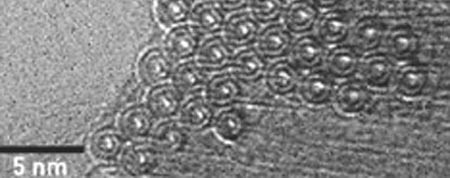
Buckypaper is ten times lighter but potentially 500 times stronger than steel when sheets of it are stacked and pressed together to form a composite. Unlike conventional composite materials, though, it conducts electricity like copper or silicon and disperses heat like steel or brass.

"All those things are what a lot of people in nanotechnology have been working toward as sort of Holy Grails," said Wade Adams, a scientist at Rice University.

That idea - that there is great future promise for buckypaper and other derivatives of the ultra-tiny cylinders known as carbon nanotubes - has been floated for years now. However, researchers at Florida State University say they have made important progress that may soon turn hype into reality.

Buckypaper is made from tube-shaped carbon molecules 50,000 times thinner than a human hair. Due to its unique properties, it is envisioned as a wondrous new material for light, energy-efficient aircraft and automobiles, more powerful computers, improved TV screens and many other products.

So far, buckypaper can be made at only a fraction of its potential strength, in small quantities and at a high price. The Florida State researchers are developing manufacturing techniques that soon may make it competitive with the best composite materials now available.

"If this thing goes into production, this very well could be a very, very game-changing or revolutionary technology to the aerospace business," said Les Kramer, chief technologist for Lockheed Martin Missiles and Fire Control, which is helping fund the Florida State research.

The scientific discovery that led to buckypaper virtually came from outer space.

In 1985, British scientist Harry Kroto joined researchers at Rice University for an experiment to create the same conditions that exist in a star. They wanted to find out how stars, the source of all carbon in the universe, make the element that is a main building block of life.

Everything went as planned with one exception.

"There was an extra character that turned up totally unexpected," recalled Kroto, now at Florida State heading a program that encourages the study of math, science and technology in public schools. "It was a discovery out of left field."

The surprise guest was a molecule with 60 carbon atoms shaped like a soccer ball. To Kroto, it also looked like the geodesic domes promoted by Buckminster Fuller, an architect, inventor and futurist. That inspired Kroto to name the new molecule buckminsterfullerene, or "buckyballs" for short.

For their discovery of the buckyball - the third form of pure carbon to be discovered after graphite and diamonds - Kroto and his Rice colleagues, Robert Curl Jr. and Richard E. Smalley, were awarded the Nobel Prize for chemistry in 1996.

Separately, Japanese physicist Sumio Iijima developed a tube-shaped variation while doing research at Arizona State University.

Researchers at Smalley's laboratory then inadvertently found that the tubes would stick together when disbursed in a liquid suspension and filtered through a fine mesh, producing a thin film - buckypaper.

Statistics

Locations of visitors to this page

blogspot visitor
Stat Counter

Total Pageviews

Ads

Books

Followers

Blog Archive

Labels

australia (619) global warming (423) solar power (397) peak oil (355) renewable energy (302) electric vehicles (250) wind power (194) ocean energy (165) csp (159) solar thermal power (145) geothermal energy (144) energy storage (142) smart grids (140) oil (139) solar pv (138) tidal power (137) coal seam gas (131) nuclear power (129) china (120) lng (117) iraq (113) geothermal power (112) green buildings (110) natural gas (110) agriculture (91) oil price (80) biofuel (78) wave power (73) smart meters (72) coal (70) uk (69) electricity grid (67) energy efficiency (64) google (58) internet (50) surveillance (50) bicycle (49) big brother (49) shale gas (49) food prices (48) tesla (46) thin film solar (42) biomimicry (40) canada (40) scotland (38) ocean power (37) politics (37) shale oil (37) new zealand (35) air transport (34) algae (34) water (34) arctic ice (33) concentrating solar power (33) saudi arabia (33) queensland (32) california (31) credit crunch (31) bioplastic (30) offshore wind power (30) population (30) cogeneration (28) geoengineering (28) batteries (26) drought (26) resource wars (26) woodside (26) censorship (25) cleantech (25) bruce sterling (24) ctl (23) limits to growth (23) carbon tax (22) economics (22) exxon (22) lithium (22) buckminster fuller (21) distributed manufacturing (21) iraq oil law (21) coal to liquids (20) indonesia (20) origin energy (20) brightsource (19) rail transport (19) ultracapacitor (19) santos (18) ausra (17) collapse (17) electric bikes (17) michael klare (17) atlantis (16) cellulosic ethanol (16) iceland (16) lithium ion batteries (16) mapping (16) ucg (16) bees (15) concentrating solar thermal power (15) ethanol (15) geodynamics (15) psychology (15) al gore (14) brazil (14) bucky fuller (14) carbon emissions (14) fertiliser (14) matthew simmons (14) ambient energy (13) biodiesel (13) investment (13) kenya (13) public transport (13) big oil (12) biochar (12) chile (12) cities (12) desertec (12) internet of things (12) otec (12) texas (12) victoria (12) antarctica (11) cradle to cradle (11) energy policy (11) hybrid car (11) terra preta (11) tinfoil (11) toyota (11) amory lovins (10) fabber (10) gazprom (10) goldman sachs (10) gtl (10) severn estuary (10) volt (10) afghanistan (9) alaska (9) biomass (9) carbon trading (9) distributed generation (9) esolar (9) four day week (9) fuel cells (9) jeremy leggett (9) methane hydrates (9) pge (9) sweden (9) arrow energy (8) bolivia (8) eroei (8) fish (8) floating offshore wind power (8) guerilla gardening (8) linc energy (8) methane (8) nanosolar (8) natural gas pipelines (8) pentland firth (8) saul griffith (8) stirling engine (8) us elections (8) western australia (8) airborne wind turbines (7) bloom energy (7) boeing (7) chp (7) climategate (7) copenhagen (7) scenario planning (7) vinod khosla (7) apocaphilia (6) ceramic fuel cells (6) cigs (6) futurism (6) jatropha (6) nigeria (6) ocean acidification (6) relocalisation (6) somalia (6) t boone pickens (6) local currencies (5) space based solar power (5) varanus island (5) garbage (4) global energy grid (4) kevin kelly (4) low temperature geothermal power (4) oled (4) tim flannery (4) v2g (4) club of rome (3) norman borlaug (2) peak oil portfolio (1)