Showing posts with label finance. Show all posts

The Recovery of 2008 ? What Bloody Recovery ?  

Posted by Big Gav in , ,

Crikey has another column from Guy Rundle expounding his theory that the recession in the West (dubbed by some libertarians “the Great Correction") is permanent unless the economic framework is changed (as there is no tool available to policymakers to revive growth in the west under the neoliberal model of globalisation other than letting wages fall to developing world levels, thus inciting some real class warfare - not the nonsense being peddled by demented Fox News pundits about Obama’s proposed tax increases for higher income earners in the US) - The Recovery of 2008 ? What Bloody Recovery ?.

That may well be a more astute judgment about the world than that of the pro forecasters, and more in accord with the notion of materialist economists such as Robert Brenner and David Harvey — that the West is tapped out, and cannot again grow in the neoliberal framework currently imposed on it. In its existing framework, the argument goes, neither free-market nor Keynesian approaches will work. Apply cuts to clear the balance sheet and restore confidence, and the collapse of demand will be so great that the economy will stall — and, something economists never consider, the social unrest from a new wave of poverty will destroy any nascent confidence anyway.

But they also turn on the Keynsians who believe that higher wages and public spending would refloat demand as it did in the postwar period. True, they say, but the aggregate effect, at national and regional levels, will be nothing like you hope. Local industry will not, of course, restart, the money will flow out of the economy to manufacturing sources in the East, and the endlessly promised growth in new sectors — services, etc — won’t eventuate.

Online shopping, automatic checkouts and myriad other automations (of service jobs — hamburger flippers — that it was once assumed would sop up those for whom manufacturing provided employment), narrow the employment base further, and push the poorly educated permanently out of the sphere of work. No public education or training program is in place to make them employable, and individual firms do not need to provide it.

Why is there such a critical assessment of the notion of boom and bust on the street? I suspect it has something to do with the centrepeiece of the “boom" from the ’90s onwards, discretionary consumer spending. In the postwar Keynesian boom, a sense of forward motion was around because people could see not merely consumption but production increasing. Factories reopened after the Depression and the war, cities grew based on rational lending and so on.

In this “boom", people saw not an increase in production, but its dismantling. This occurred as — via franchising, chains, increased advertising presence — consumption spread into every available area of life. Housing became not more affordable but less so, as property prices became dizzyingly unreal, beyond any notion of merely paying for permanent habitation.

In other words, the boom always looked like what it was, a bubble. Its fantastical character was hiding in plain sight. At some level people knew that they were living through an unreality, and that the best thing to do was grab as much sh-t as you can while you can (the English riots were really a repetition of that, done at high speed and in dell’arte style).

Yet even if people were willing to accept this stasis, it is not possible to do so. The Western economy is boxed in. Slash costs? You would need to drive down pay levels, abolish the legally mandated minimum wage and usher in ever greater levels of inequality — effectively restarting large-scale class conflict. Stimulate production? What would be stimulated? What remains of the economic sectors that could grow fresh roots — only low-employment “services", intellectual property rents and the like.

Stimulate consumption? You would deepen the debt reliance of Western economies whose savings levels are zero — and, culturally, simply extend a set of expectations of consumption that cannot be sustained on a mass basis. Indeed it is the near-total reliance on consumption that tells us how late in the day the ’90s/2000s boom-bubble was, how desperate its attempt to fill in the gap. Capitalism has always lived by holding something back — the fruits of people’s labour, and the promise of satisfaction chief among them. For two hundred years, the system has relied on two techniques — violence and ideology — to create compliance. After violence, the system was sold on the notion that a thrifty, modest life was a sign of virtue, that honest work was its own reward.

From the 1870s onward, Western capitalism had a demand crisis, and the modern science of demand creation — advertising, the shopping arcade/mall — dates from this time. Confined initially to a privileged class, such consumption was made general in the 1950s, and then — in the ’90s — was cut loose of any notion of rational accounting. That is surely, a very late, if not a final stage, of system maintenance by demand creation — and what makes the current era interesting is that we are now out the other side of it, and no one knows what to do about it. And everyone knows it.

The Greatest Scam of All ?  

Posted by Big Gav in , , ,

Bloomberg has an interesting take on the credit crisis, quoting one academic who sees a bit of game theory being put into practice - Hundreds of Economists Urge Congress Not to Rush on Rescue Plan . While inter-bank lending does indeed seem to have almost ceased now, the idea that this could be (at least partially) a high stakes game of poker being played in order to extract as much taxpayer money as possible with the least possible oversight does have a lot of appeal given my eye for tinfoil.

More than 150 prominent U.S. economists, including three Nobel Prize winners, urged Congress to hold off on passing a $700 billion financial market rescue plan until it can be studied more closely.

In a letter yesterday to congressional leaders, 166 academic economists said they oppose Treasury Secretary Henry Paulson's plan because it's a ``subsidy'' for business, it's ambiguous and it may have adverse market consequences in the long term. They also expressed alarm at the haste of lawmakers and the Bush administration to pass legislation.

``It doesn't seem to me that a lot decisions that we're going to have to live with for a long time have to be made by Friday,'' said Robert Lucas, a University of Chicago economist and 1995 Nobel Prize winner who signed the letter. ``The situation may get urgent, but it's not urgent right now. Right now it's a financial sector problem.'' ...

Erik Brynjolfsson, of the Massachusetts Institute of Technology's Sloan School, said his main objection ``is the breathtaking amount of unchecked discretion it gives to the Secretary of the Treasury. It is unprecedented in a modern democracy.''

Advocates for a rescue plan this week point to a seizing up of credit markets, reflected in elevated inter-bank lending rates, as reason for action. Some economists are unconvinced.

``I suspect that part of what we're seeing in the freezing up of lending markets is strategic behavior on the part of big financial players who stand to benefit from the bailout,'' said David K. Levine, an economist at Washington University in St. Louis, who studies liquidity constraints and game theory.

The IHT has an article from Garrison Keilor asking "Where were the cops?".
Where were the cops?

It's just human nature that some calamities register in the brain and others don't. The train engineer texting at the throttle ("HOW R U? C U L8R") and missing the red light and 25 people die in the crash - oh God, that is way too real - everyone has had a moment of supreme stupidity that came close to killing somebody. Even atheists say a little prayer now and then: Dear God, I am an idiot, thank you for protecting my children.

On the other hand, the America's federal bailout of the financial market (yawn) is a calamity that people accept as if it were just one more hurricane. An air of crisis, the secretary of the Treasury striding down a hall at the Capitol with minions in his wake, solemn-faced congressmen at the microphones. Something must be done, harrumph harrumph.

The Current Occupant pops out of the cuckoo clock and reads a few lines off a piece of paper, pronouncing all the words correctly. And the newscaster looks into the camera and says, "Etaoin shrdlu qwertyuiop."

Where is the outrage?

Poor Senator Larry Craig got a truckload of moral condemnation for tapping his wingtips in the men's john, but his party proposes to spend 5 percent of the GDP to buy up bad loans made by men who walk away with their fortunes intact while retirees see their 401(k) go pffffffff like a defunct air mattress, and it's business as usual.

John McCain is a lifelong deregulator and believer in letting brokers and bankers do as they please - remember Lincoln Savings and Loan and his intervention with federal regulators in behalf of his friend Charles Keating, who then went to prison? Remember Neil Bush, the brother of the C.O., who, as a director of Silverado S&L, bestowed enormous loans on his friends without telling fellow directors that the friends were friends and who, when the loans failed, paid a small fine and went skipping off to other things?

McCain now decries greed on Wall Street and suggests a commission be formed to look into the problem. This is like Casanova coming out for chastity.

Confident men took leave of common sense and bet on the idea of perpetual profit in the real estate market and crashed. But it wasn't their money. It was your money they were messing with. And that's why we need government regulators. Gimlet-eyed men with steel-rim glasses and crepe-soled shoes who check the numbers and have the power to say, "This is a scam and a hustle and either you cease and desist or you spend a few years in a minimum-security federal facility playing backgammon."

The Republican Party used to specialize in gimlet-eyed, steel-rim, crepe-soled common sense and then it was taken over by crooked preachers who demand Americans trust them because they're packing a Bible and God sent them on a mission to enact lower taxes, less government. Except when things crash, and then government has to pick up the pieces.

Some say the tab might come to a trillion dollars. Nobody knows. And McCain has not one moment of doubt or regret. He switches from First Deregulation Church to Our Lady of Strict Vigilance like you might go from decaf to latte. Where is the straight talk? Does the man have no conscience?

It wasn't their money they were playing with. It was yours. Where were the cops?

What we are seeing is the stuff of a novel, the public corruption of an American war hero. It is painful.

Capitalist Socialism  

Posted by Big Gav in ,

Glenn Greenwald has an insightful look at the spread of bi-partisan financial doomerism and the not unusual sight of the sheep failing to realise they've been fleeced of yet another thing. First it was peace, then it was their freedom, now it's their money - The complete (though ever-changing) elite consensus over the financial collapse. Welcome to the world of corporate socialism (or is it simply corporatism ?).

John Diamond, USA Today, February 4, 2004 -- "A desert mirage: How U.S. misjudged Iraq's arsenal":
The assertion that Saddam had chemical and biological weapons -- and the ability to use them against his neighbors and even the United States -- was expressed in an Oct. 1, 2002, document called a National Intelligence Estimate. The estimate didn't trigger President Bush's determination to oust Saddam. But it weighed heavily on members of Congress as they decided to authorize force against Iraq, and it was central to Secretary of State Colin Powell's presentation to the United Nations Security Council a year ago this week. . . .

The Bush and Clinton administrations, foreign intelligence services, and Republicans and Democrats in Congress all took it as a given that Iraq had chemical and biological weapons.

Walter Pincus, The Washington Post, August 11, 2007 -- "How the Fight for Vast New Spying Powers Was Won":
For three days, Mike McConnell, the director of national intelligence, had haggled with congressional leaders over amendments to a federal surveillance law, but now he was putting his foot down. "This is the issue," said the plain-spoken retired vice admiral and Vietnam veteran, "that makes my blood pressure rise. . . .

McConnell won the fight, extracting a key concession despite the misgivings of Democratic negotiators. Congressional, administration and intelligence officials last week described the events leading up to the approval of this surveillance, including a remarkable series of confrontations that ended with McConnell and the White House outmaneuvering the Democratic-controlled Congress, partly by capitalizing on fresh reports of a growing terrorism threat.

"We had a forcing function," a senior administration official said, referring to the intelligence community's public report last month that said al-Qaeda poses a growing threat to the United States and to lawmakers' desire to leave town in August. . . .

A critical moment for the Democrats came on July 24, when McConnell met in a closed session with senators from both parties to ask for urgent approval of a slimmed-down version of his bill. Armed with new details about terrorist activity and an alarming decline in U.S. eavesdropping capabilities, he argued that Congress had days, not weeks, to act.

"Everybody who heard him speak recognized the absolute, compelling necessity to move," Sen. Kit Bond (R-Mo.), vice chairman of the intelligence panel, said later of the closed session.

Democrats agreed. As delivered by McConnell, the warnings were seen as fully credible. "He's pushing this because he thinks we're in a high-threat environment," the senior aide said. . . .McConnell deemed [the Democratic draft's] fine print unacceptable, however, and in the end, it was the Republican bill, a near-copy of his proposal, that passed both chambers of Congress.

David Herszenhorn, New York Times, today, "Congressional Leaders Stunned by Warnings":
It was a room full of people who rarely hold their tongues. But as the Fed chairman, Ben S. Bernanke, laid out the potentially devastating ramifications of the financial crisis before congressional leaders on Thursday night, there was a stunned silence at first.

Mr. Bernanke and Treasury Secretary Henry M. Paulson Jr. had made an urgent and unusual evening visit to Capitol Hill, and they were gathered around a conference table in the offices of House Speaker Nancy Pelosi.

"When you listened to him describe it you gulped," said Senator Charles E. Schumer, Democrat of New York.

As Senator Christopher J. Dodd, Democrat of Connecticut and chairman of the Banking, Housing and Urban Affairs Committee, put it Friday morning on the ABC program "Good Morning America," the congressional leaders were told "that we’re literally maybe days away from a complete meltdown of our financial system, with all the implications here at home and globally."

Mr. Schumer added, "History was sort of hanging over it, like this was a moment."

When Mr. Schumer described the meeting as "somber," Mr. Dodd cut in. "Somber doesn't begin to justify the words," he said. "We have never heard language like this."

"What you heard last evening," he added, "is one of those rare moments, certainly rare in my experience here, is Democrats and Republicans deciding we need to work together quickly."

Leave aside for the moment whether this gargantuan nationalization/bailout scheme is "necessary" in some utilitarian sense. One doesn't have to be an economics expert in order for several facts to be crystal clear:

First, the fact that Democrats are on board with this scheme means absolutely nothing. When it comes to things the Bush administration wants, Congressional Democrats don't say "no" to anything. They say "yes" to everything. That's what they're for.

They say "yes" regardless of whether they understand what they're endorsing. They say "yes" regardless of whether they've been told even the most basic facts about what they're being told to endorse. They say "yes" anytime doing so is politically less risky than saying "no," which is essentially always and is certainly the case here. They say "yes" whenever the political establishment -- meaning establishment media outlets and the corporate class that funds them -- wants them to say "yes," which is the case here. And they say "yes" with particular speed and eagerness when told to do so by the Serious Trans-Partisan Republican Experts like Hank Paulson and Ben Bernake (or Mike McConnell and Robert Gates and, before them, Donald Rumsfeld and Colin Powell).

So nothing could be less reassuring or more meaningless than the fact that the Democratic leadership has announced that what they heard scared them so much that they are certain all of this is necessary -- whatever "all this" might be (and does anyone think that they know what "this" even is?). It may be "necessary" or may not be, but the fact that Congressional Democrats are saying this is irrelevant, since they would not have done anything else -- they're incapable of doing anything else -- other than giving their stamp of approval when they're told to.

Second, whatever else is true, the events of the last week are the most momentous events of the Bush era in terms of defining what kind of country we are and how we function -- and before this week, the last eight years have been quite momentous, so that is saying a lot. Again, regardless of whether this nationalization/bailout scheme is "necessary" or makes utilitarian sense, it is a crime of the highest order -- not a "crime" in the legal sense but in a more meaningful sense.

What is more intrinsically corrupt than allowing people to engage in high-reward/no-risk capitalism -- where they reap tens of millions of dollars and more every year while their reckless gambles are paying off only to then have the Government shift their losses to the citizenry at large once their schemes collapse? We've retroactively created a win-only system where the wealthiest corporations and their shareholders are free to gamble for as long as they win and then force others who have no upside to pay for their losses. Watching Wall St. erupt with an orgy of celebration on Friday after it became clear the Government (i.e., you) would pay for their disaster was literally nauseating, as the very people who wreaked this havoc are now being rewarded.

More amazingly, they're free to walk away without having to disgorge their gains; at worst, they're just "forced" to walk away without any further stake in the gamble. How can these bailouts not at least be categorically conditioned on the disgorgement of ill-gotten gains from those who are responsible? The mere fact that shareholders might lose their stake going forward doesn't resolve that concern; why should those who so fantastically profited from these schemes they couldn't support walk away with their gains? This is "redistribution of wealth" and "government takeover of industry" on the grandest scale imaginable -- the buzzphrases that have been thrown around for decades to represent all that is evil and bad in the world. That's all this is; it's not an "investment" by the Government in any real sense but just a magical transfer of losses away from those who are responsible for these losses to those who aren't.

And all of this was both foreseeable as well as foreseen -- see the 2002 grave warnings from Warren Buffett on pages 14-15 of his shareholders letter (.pdf), among many other things -- and it's also happened before, when the Federal Government bailed out the S&L industry that (with John McCain's help) was able to gamble recklessly and then force the country to protect them from their losses. The people who did this have no fear of anything -- they completely lack the kind of healthy fear that impedes reckless behavior -- because they know how our Government works and that they control it and thus believe that their capacity to suffer is limited in the extreme. And they're right about that.

What's most vital to underscore is that the beneficiaries of this week's extraordinary Government schemes aren't just the coincidental recipients of largesse due to some random stroke of good luck. The people on whose behalf these schemes are being implemented -- the true beneficiaries -- are the very same people who have been running and owning our Government -- both parties -- for decades, which is why they have been able to do what they've been doing without interference. They were able to gamble without limit because they control the Government, and now they're having others bear the brunt of their collapse for the same reason -- because the Government is largely run for their benefit.

If there is any "pitchfork moment" -- an episode that understandably would send people into the streets in mass outrage -- it would be this. Nobody really even seems to know how much of these losses "the Government" -- meaning working people who had no part in the profits from these transactions -- is undertaking virtually overnight but it's at least a trillion dollars, an amount so vast it's hard to comprehend, let alone analyze in terms of consequences. The transactions are way too complex even for the most sophisticated financial analysts to understand, let alone value. Whatever else is true, generations of Americans are almost certainly going to be severely burdened in untold ways by the events of the last week -- ones that have been carried out largely without any debate and mostly in secret.

Third, what's probably most amazing of all is the contrast between how gargantuan all of this is and the complete absence of debate or disagreement over what's taking place. It's not just that, as usual, Democrats and Republicans are embracing the same core premises ("this is regrettable but necessary"). It's that there's almost no real discussion of what happened, who is responsible, and what the consequences are. It's basically as though the elite class is getting together and discussing this all in whispers, coordinating their views, and releasing just enough information to keep the stupid masses content and calm.

Can anyone point to any discussion of what the implications are for having the Federal Government seize control of the largest and most powerful insurance company in the country, as well as virtually the entire mortgage industry and other key swaths of financial services? Haven't we heard all these years that national health care was an extremely risky and dangerous undertaking because of what happens when the Federal Government gets too involved in an industry? What happened in the last month dwarfs all of that by many magnitudes.

The Treasury Secretary is dictating to these companies how they should be run and who should run them. The Federal Government now controls what were -- up until last month -- vast private assets. These are extreme -- truly radical -- changes to how our society functions. Does anyone have any disagreement with any of it or is anyone alarmed by what the consequences are -- not the economic consequences but the consequences of so radically changing how things function so fundamentally and so quickly?

Other countries are debating it. The headline in the largest Brazilian newspaper this week was: "Capitalist Socialism??" and articles all week have questioned -- with alarm -- whether what the U.S. Government did has just radically and permanently altered the world economic system and ushered in some perverse form of "socialism" where industries are nationalized and massive debt imposed on workers in order to protect the wealthiest. If Latin America is shocked at the degree of nationalization and government-mandated transfer of wealth, that is a pretty compelling reflection of how extreme -- unprecedented -- it all is.

But there's virtually no discussion of that in America's dominant media outlets. All one hears is that everything that is happening is necessary to save us all from economic doom. And what's most amazing about that is that the Natural, Unchallenged Consensus That Nobody Questions can shift drastically in a matter of days and still nobody questions anything.

Regarding that last sentence, both Orwell (unhappily, in 1984) and Hitler (happily, in Mein Kampf) noted that this is an abiding human condition.

Some things never change.

sheep

The Futures Of Coal  

Posted by Big Gav in , , , ,

The SMH has a report on a new coal futures contract being introduced - Futures contract to bridge Australia-Asia divide on coal

THE contentious annual benchmark pricing negotiations between Australian miners and Asian steelmakers could soon be a relic of the past if the parties take the lead from the thermal coal market. GlobalCOAL, which has been facilitating over-the-counter trading in the thermal coal market since the start of the decade, is introducing a futures contract based on coal from Newcastle in late September or early October.

Although market participants - including coalminers, commodities traders and utilities - already take part in over-the-counter swaps through globalCOAL, the addition of a futures contract will reduce credit risk exposure and increase liquidity. Increased liquidity could lead to more accurate pricing based on market demand, which is important in a time of highly volatile commodity prices.

"It is a natural step in the evolution of the coal market," said the globalCOAL chief executive, Eoghan Cunningham, citing demand from investment banks, hedge funds and other institutional investors to gain access to coal price performance. "Rather than benchmark pricing, you are going to have more index linking."

The futures product will be traded on leading energy futures and options exchange, ICE Futures Europe. Earlier this year, the Australian Securities Exchange announced plans for a rival futures product, but it has not yet revealed a start date.

Cryptogon has a look at new derivatives contract for iron ore - The New Chemistry of Speculation.
While this is speculation, I don’t see it as the same type of situation that we’re seeing in the “regulated,” black boxed commodity markets right now.

If I understand what’s happening in the case below with the iron ore, the speculator doesn’t seem to have any way of manipulating the market that I can see. It’s a bet on the spot price in the future without any delivery of goods required, BUT, and this is the difference, after the speculator enters the trade, he or she MUST face the music at the end of the month, good or bad. Either the iron ore producer wins, or the cash speculator wins AT THE END. There’s no way out during the interim period.

This looks like a relatively fair and square gun battle to me, because the participants, who enter into the deals, are forced to face the consequences, good or bad, in the future.

Unless I’ve really misunderstood something here, this actually looks cleaner than the so called regulated commodity markets. Please correct me if I’m wrong. This is the first time I’ve heard of this type of trade, so I’m sure that there’s a lot that I don’t even know that I don’t know.

Far more disturbing than the cash-settled swaps described below are the hedge funds vertically integrating themselves throughout food production infrastructures. This will give elites unprecedented power to collude in order to create artificial scarcity.

One Chart To Rule Them All  

Posted by Big Gav in ,

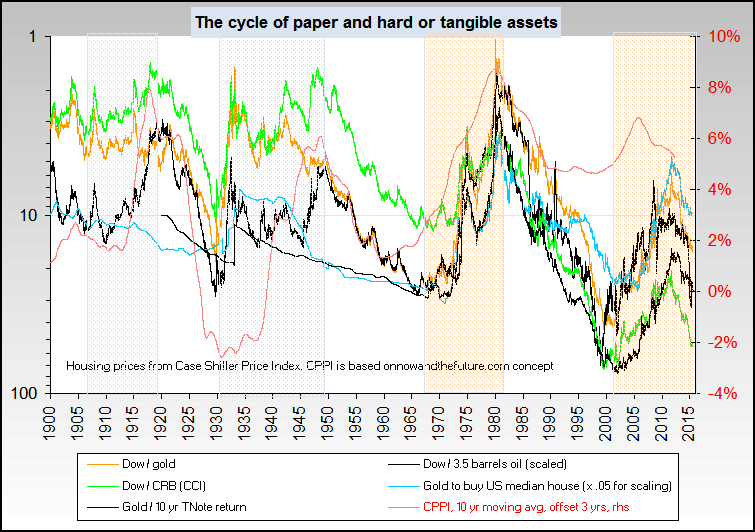
Some interesting statistics from "A World Of Possible Financial Futures".

Financial Doombattery And Kennan's "Quotation"  

Posted by Big Gav in , , ,

I came across the latest installment of extreme financial doomerism from the Leap 2020 guys this week (whom you will hopefully remember got the starting slot in my "Day Of The Doombats" post back in the day).

According to LEAP/E2020, the end of the third quarter of 2008 will be marked by a new tipping point in the unfolding of the global systemic crisis. At that time indeed, the cumulated impact of the various sequences of the crisis (see table below) will reach its maximum strength and affect decisively the very heart of the systems concerned, on the frontline of which the United States, epicentre of the current crisis. In the United States, this new tipping point will translate into a collapse of the real economy, final socio-economic stage of the serial bursting of the housing and financial bubbles (1) and of the pursuance of the US dollar fall. The collapse of US real economy means the virtual freeze of the American economic machinery: private and public bankruptcies in large numbers, companies and public services closing down massively (2),

A revealing harbinger: from March 2008 onward, the US government will stop a service publishing its economic indicators due to budget restrictions (3). Those who read the GEAB N°2 (02/2006) and included Alert certainly keep in mind our anticipation which connected the upcoming fall of the US dollar with the US Fed's decision to cease publishing the M3 indicator. This new decision is another clear sign that US leaders are now anticipating a very bleak economic outlook for their country.

In this 22nd issue of the GEAB, LEAP/E2020's experts try in particular to anticipate very specifically what will come out of the collapse of the US real economy for the United States themselves and for the other regions of the world. Meanwhile our team presents five sets of strategic and operational recommendations helping to protect oneself from the upcoming deterioration of the global systemic crisis.

While the LEAP 2020 guys are Europeans, I occasionally wonder if some of the "Long Emergency" style doomerism emanating from the US is a reaction to the ongoing demise of George Kennan's post war "pattern of relationships" for maintaining the enormous position of economic "disparity" the US found itself in after the second World War.

I sometimes think of the outcome of this as a form of the "Dutch Disease" - instead of being dependent on income from a single depleting resource, the US became dependent on (and wasteful in its use of) a number of depleting resources. Now that period of dominance is waning with the rise / resurrection of Europe, China, India and Russia, and the financial costs of maintaining oil dominance via the Iraq war and the associated "war on terror" help to cripple the US economy, this dependence has become a huge liability. Resource depletion, particularly in the case of oil, makes the situation even worse.

The end result of this is that US based doomers may see through their looking glasses much more darkly than those elsewhere - because the adjustment the US faces will most likely be more severe.

In its favour however, the US still has a large, well educated and creative population (there are some exceptions to this of course), and a reasonable endowment of native resources which should still make for a prosperous economy once a number of adjustments have been made.

The neo-marxist article I linked to yesterday, theorising about dominant capital groups within economies and noting the strange cycles that the oil industry goes through in terms of its dominance relative to other sectors (I'd love to see an overlay of the same data for the military-industrial complex on that chart), made me wonder what will happen if the Democrats - largely beholden to a different set of capital groups - manage to seize control in the US elections later this year. It may well spark a clean tech boom, which would help initiate a lot of the adjustments required, and greatly weaken the capital groups that have been wreaking so much havoc at the same time.

Anyway - enough rambling - when I went to look up the famous Kennan quote about his institutionalised system of disparity, my Google query popped up another one of those fascinating essays from Gilles at Swans - this one noting that Kennan has usually been taken out of context.
"We have about 50% of the world's wealth, but only 6.3% of its population. ... In this situation, we cannot fail to be the object of envy and resentment. Our real task in the coming period is to devise a pattern of relationships which will permit us to maintain this position of disparity. ... To do so, we will have to dispense with all sentimentality and day-dreaming; and our attention will have to be concentrated everywhere on our immediate national objectives. ... We should cease to talk about vague and ... unreal objectives such as human rights, the raising of the living standards, and democratization. The day is not far off when we are going to have to deal in straight power concepts. The less we are then hampered by idealistic slogans, the better."
—George F. Kennan, Policy Planning Study 23 (PPS23), Foreign Relations of the United States (FRUS), 1948

You've all seen this quotation cited countless times on Web sites, listservs and other mailing lists, from the left to the right, and everything in between. Simply google George Kennan, PPS23, and you'll get an idea... Problem is, it's a truncated quotation, patched together from various parts of the original text with ellipses, and taken out of context. It is more than time to debunk this little assemblage. One should not have to resort to this kind of fabrication, either out of sloppiness or willfulness, to elaborate on conjectural analysis. To use and reuse this misquotation does a disservice to all. Please, people, can you check your sources?

George F. Kennan recently died (March 17, 2005). He was 101 years old. Kennan, whether one endorsed his view of the world or not, had a sharp and honed mind; he was a prolific writer with literary skills rarely encountered at foggy bottom (see "George F. Kennan on the Web"); and he was credited for having fathered the containment strategy of the former Soviet Union, which may be giving the man too much credit -- the entire US power apparatus was in the containing mode -- but it appears that Kennan did coin the word "containment" (though I can't certify this contention) and he wrote, aside from PPS23, two important secret (at the time) documents: the February 22, 1946 Telegram from Moscow and "The Sources of Soviet Conduct," published in the July 1947 issue of Foreign Affairs under the name X -- documents that greatly contributed to shaping the US strategy after WWII. These documents have long been analyzed, discussed, parsed, deconstructed and interpreted by legions of historians and political pundits.

Mr. Kennan was a realist (and some suggest a pessimist) as opposed to faith-based neocon Wilsonianism. He eventually left the State Department to pursue a scholarly career at Princeton; was generally opposed to the Vietnam War; and even managed to express his dissatisfaction with Bush's Iraq crusade (again, he was a realist). Upon his death, obits ran large in the mainstream media as well as in the "alternative press" (honestly, I'm having a harder and harder time figuring out the alternatives offered by the majority "alternative press," but this is a story for another time...). Anyhow, the alternative press made ample use of this "quotation" (these are not scare quotes; simply the proposition that one can make up a "quotation" by assembling bits and pieces of what someone actually said, or wrote, in order to further one's line of thinking, a.k.a. ideological preferences according to one's frame of references).

Alexander Cockburn posits ("The Passing Show," AVA, March 23, 2005) that Kennan "will be best remembered for his self-consciously 'realistic' assessment in those postwar years, in State Department PPS23 that, [enter quotation]." In his latest Anti-Empire Report (#19, March 21, 2005) the ever-sharp Bill Blum has an entry on Kennan that includes the PPS23 quotation (see my Blips #15). Even Louis Proyect posted the NYT obit on Marxmail, beginning with the quotation... (See Marxmail archives.) The source is properly indicated, but then, how many people go the source...? And so like some kind of a meme, the "citation" propagates all over Cyberspace...and not just in Cyberspace...but in books, and special reports like that of John Pilger's "Breaking the Silence: Truth and Lies in the War on Terror." ...

What did Kennan actually write? (Note, I've bolded the passages used in the quotation) ...

Once the full quotation is read, one can engage in interpretating, parsing the text according to the historical context and one's own intellectual inclinations. (It is worth noting, especially in light of the current US strategy in the region -- e.g. pushing Japan to re-arm...besides encircling China, and supposedly wanting to elevate India to medium superpower status -- that Kennan's recommendation in regard to Japan has been followed almost to the letter for half a century, while his recommendation regarding Taiwan has been ignored.)

The issue here is not to defend George Kennan, or what he actually meant, but the accuracy of one's sources. While Kennan eventually regretted some of the positions he had taken and the strategies he had advised, one cannot forget that he initiated, or was an ardent proponent of, the covert operations launched by the CIA during the Cold War and thus carried a moral responsibility for the deaths or overthrow of many courageous leaders, from Iran's Mohammad Mossadegh to Chile's Salvador Allende... A brilliant thinker, blessed with the ability to doubt and acknowledge his mistakes, he was nevertheless a cold warrior, deeply conservative, and a supporter of the status quo. But there is no reason, besides sloppy research or willingness to assemble a "quotation" for ideological purposes (here, I'm convinced that it has more to do with the former than the latter), to misquote an author, any authors...

Moving on, Martin Wolf at the Financial Times is also spreading financial fear and loathing in "Twelve steps to meltdown" - although he has a somewhat soothing conclusion.
“I would tell audiences that we were facing not a bubble but a froth – lots of small, local bubbles that never grew to a scale that could threaten the health of the overall economy.” So wrote Alan Greenspan in The Age of Turbulence.

That used to be Mr Greenspan’s view of the US housing bubble. He was wrong, alas. So how bad might this downturn get? To answer this question we should ask a true bear. My favourite one is Nouriel Roubini of New York University’s Stern School of Business, founder of RGE Monitor.

Recently, Professor Roubini’s scenarios have been dire enough to make the flesh creep. But his thinking deserves to be taken seriously. He first predicted a US recession in July 2006. At that time, his view was extremely controversial. It is so no longer. Now he states that there is “a rising probability of a ‘catastrophic’ financial and economic outcome”. The characteristics of this scenario are, he argues: “A vicious circle where a deep recession makes the financial losses more severe and where, in turn, large and growing financial losses and a financial meltdown make the recession even more severe.”

Prof Roubini is even fonder of lists than I am. Here are his 12 – yes, 12 – steps to financial disaster.

Step one is the worst housing recession in US history. House prices will, he says, fall by 20 to 30 per cent from their peak, which would wipe out between $4,000 billion and $6,000 billion in household wealth. Ten million households will end up with negative equity and so with a huge incentive to put the house keys in the post and depart for greener fields. Many more home-builders will be bankrupted.

Step two would be further losses, beyond the $250 billion-$300 billion now estimated, for sub-prime mortgages. About 60 per cent of all mortgage origination between 2005 and 2007 had “reckless or toxic features”, argues Roubini. Goldman Sachs estimates mortgage losses at $400 billion. But if home prices fell by more than 20 per cent, losses would be bigger. That would further impair the banks’ ability to offer credit.

Step three would be big losses on unsecured consumer debt: credit cards, auto loans, student loans and so forth. The “credit crunch” would then spread from mortgages to a wide range of consumer credit.

Step four would be the downgrading of the monoline insurers, which do not deserve the AAA rating on which their business depends. A further $150 billion writedown of asset-backed securities would then ensue.

Step five would be the meltdown of the commercial property market, while step six would be bankruptcy of a large regional or national bank.

Step seven would be big losses on reckless leveraged buy-outs. Hundreds of billions of dollars of such loans are now stuck on the balance sheets of financial institutions.

Step eight would be a wave of corporate defaults. On average, US companies are in decent shape, but a “fat tail” of companies has low profitability and heavy debt. Such defaults would spread losses in “credit default swaps”, which insure such debt. The losses could be $250 billion. Some insurers might go bankrupt.

Step nine would be a meltdown in the “shadow financial system”. Dealing with the distress of hedge funds, special investment vehicles and so forth will be made more difficult by the fact that they have no direct access to lending from central banks.

Step 10 would be a further collapse in stock prices. Failures of hedge funds, margin calls and shorting could lead to cascading falls in prices.

Step 11 would be a drying-up of liquidity in a range of financial markets, including interbank and money markets. Behind this would be a jump in concerns about solvency.

Step 12 would be “a vicious circle of losses, capital reduction, credit contraction, forced liquidation and fire sales of assets at below fundamental prices”.

These, then, are 12 steps to meltdown. In all, argues Roubini: “Total losses in the financial system will add up to more than $1,000 billion and the economic recession will become deeper more protracted and severe.” This, he suggests, is the “nightmare scenario” keeping Ben Bernanke and colleagues at the US Federal Reserve awake. It explains why, having failed to appreciate the dangers for so long, the Fed has lowered rates by 200 basis points this year. This is insurance against a financial meltdown.

Is this kind of scenario at least plausible? It is. Furthermore, we can be confident that it would, if it came to pass, end all stories about “decoupling”. If it lasts six quarters, as Roubini warns, offsetting policy action in the rest of the world would be too little, too late.

Can the Fed head this danger off? In a subsequent piece, Roubini gives eight reasons why it cannot. (He really loves lists!) These are, in brief: US monetary easing is constrained by risks to the dollar and inflation; aggressive easing deals only with illiquidity, not insolvency; the monoline insurers will lose their credit ratings, with dire consequences; overall losses will be too large for sovereign wealth funds to deal with; public intervention is too small to stabilise housing losses; the Fed cannot address the problems of the shadow financial system; regulators cannot find a good middle way between transparency over losses and regulatory forbearance, both of which are needed; and, finally, the transactions-oriented financial system is itself in deep crisis.

The risks are indeed high and the ability of the authorities to deal with them more limited than most people hope. This is not to suggest that there are no ways out. Unfortunately, they are poisonous ones. In the last resort, governments resolve financial crises. This is an iron law. Rescues can occur via overt government assumption of bad debt, inflation, or both. Japan chose the first, much to the distaste of its ministry of finance. But Japan is a creditor country whose savers have complete confidence in the solvency of their government. The US, however, is a debtor. It must keep the trust of foreigners. Should it fail to do so, the inflationary solution becomes probable. This is quite enough to explain why gold costs $920 an ounce.

The connection between the bursting of the housing bubble and the fragility of the financial system has created huge dangers, for the US and the rest of the world. The US public sector is now coming to the rescue, led by the Fed. In the end, they will succeed. But the journey is likely to be wretchedly uncomfortable.

Continuing the credit crunch doomer march, Gary Shilling at Forbes is also spreading a relatively mild form of financial doomerism, predicting that likely the US recession will be a global one (no friend of the decoupling theory either, he), and that commodity prices are due to plummet.

His peak oil analysis is devoid of reasoning - prices will fall because of new output from tar sands, coal liquefaction and "maybe shale". Plus substituting nuclear for liquid fuels. And Petrobras' "enormous" find offshore Brazil (presumably he means Tupi). This sort of amateur analysis in supposedly reputable journals (ignoring Steve Forbes' faux pas a couple of years ago when he got caught publically saying oil prices will fall while at the same time telling clients in his private newsletter to buy) drives me nuts.

The flow from tar sands is subject to a lot of constraints, coal prices are soaring, shale oil has yet to be proven economically practical (and will also be subject to flow limits), the Tupi field is apparently complex and a long way off producing anything, let alone large quantities of oil (I'd bet the jump in production from Iraq over the next 5 years is far larger than that from Brazil), and all of these will be appalling carbon emitters, likely to run into strong interference as the world economy attempts to decarbonise. The only saving grace here is that he isn't a fan of corn ethanol.
What to do? Sell or short commodities, perhaps via exchange-traded funds, stocks in companies that produce them or futures. Commodity prices, still high, are poised to fall hard as the worldwide recession takes hold.

Chinese demand, terrorism and talk of peak oil drove crude prices. Agricultural prices were hyped by biofuel's popularity, droughts and the prospect of a shift in demand in poorer countries from grain to meat. So institutional investors rushed into commodities, believing they are a relatively stable asset class like stocks and bonds. Individuals bought commodity-backed ETFs. That enthusiasm will soon be history.

With global recession, demand for industrial commodities and oil will fade. It will become clear that much of China's demand for commodities was not primarily to supply its citizens but to supply its export market.

No one will be talking anymore about how oil production is peaking. Look at Petrobras' huge oilfield discovery off Brazil and consider the gigantic energy supplies that will come from tar sands, nuclear, coal liquefaction and maybe shale. More supply equals lower prices.

Good weather and weak ethanol prices may knock down ag prices. A recent report in Science magazine has discredited many biofuel schemes as environmental salvations. We're going to stop fueling our cars with taco ingredients.

The WSJ's Environmental Capital blog points to a Richard Branson video up at Grist, with Dick expressing regret for having jumped on the first generation biofuel bandwagon.

They also point to reports about the new carbon tax being introduced in British columbia. I wonder when Alberta will follow suit ?
British Columbia broke ranks with the rest of Canada and announced its own carbon tax of $10 per ton, reports the Toronto Star. The plan, which won’t be levied on petroleum producers but on businesses and consumers, could hit the poor the hardest, notes the Globe and Mail. That’s exactly what some groups in California are afraid will happen with an emissions cap-and-trade scheme favored by Gov. Schwarzenegger, reports the L.A. Times. None of that has deterred Japan, notes Reuters: The country will consider replacing its voluntary emissions caps with a mandatory cap-and-trade scheme like Europe’s.

Finally, Richard Branson says he regrets supporting first-generation biofuels, in a video at Grist.

ABC (the US version) has an article on the peak oil / resource wars war game "Frontlines: Fuel Of War" (long time readers should remember tinfoil from both RI and Cryptogon at various stages regarding the use of video games as a desensitisation / propaganda / recruiting tool for these scenarios).
Sometime in the near future, gas will cost about $20 a gallon. It gets worse: China and Russia will form a military alliance that threatens the security of the United States and Europe.

Amid hunger, water scarcity and power outages, the two sides will go to war. Soldiers will descend upon bombed-out cities and abandoned villages, where rusting appliances and old car engines litter the streets. But don't let that get you down. "What you're trying to deliver in the game is fun," said Luis Cataldi. "We don't want someone to come in and become depressed."

Cataldi, an art director at New York-based KAOS Studios, is one of dozens of minds behind the dystopian vision presented in Frontlines: Fuel of War, a new video game inspired in part by contemporary fears about oil, war and, yes, war over oil.

The game, which cost about $15 million to produce, is set in the year 2024. It is a time when, according to Frontlines' "speculative fiction," the Western Coalition (the U.S. and Europe) are at war with the Red Star Alliance (Russia and China) over the world's last oil reserves on the Caspian Basin in Turkmenistan. Taking on roles as American troops, gamers use futuristic weapons and vehicles to battle their way across Central Asian oil fields, ghost towns and crumbling cities. In the game's multi-player version, gamers can also assume the identities of Red Star troops.

While Cataldi and KAOS emphasize the game's graphics, fast pace and technical prowess — in the game's "open world" setting, just about any object, structure or person you see can be shot at, blown up or otherwise annihilated — they're also passionate about Frontlines' fraught premise.

Conflict over oil "is a very resonant story in the world. It's a global issue that everyone's very much aware of, but it's also fascinating," Cataldi said. He spoke breathlessly of oil's role in World Wars I and II, of the Peak Oil theory – the idea that the world's oil production is on the brink of falling — and of reported military exercises between China and Russia aimed at protecting their oil interests. "You don't have to dig very deep to realize that it isn't a new problem," he said. "There are some great pieces of research that suggest that the world is in a very sensitive place."

Envisioning War

To devise the game's geopolitical context, he said, developers "read everything we could get our hands on." That included the books "The Party's Over: Oil, War and the Fate of Industrial Societies," by Richard Heinberg, and "Resource Wars: The New Landscape of Global Conflict," by Michael Klare.

Heinberg, a senior fellow at the California-based Post Carbon Institute, was surprised but pleased to learn that his book helped to inspire a video game. "I think anything that helps people understand the situation that we're facing is, in general, good," he said. "My hope would be that people who play the game then take the time and trouble to actually research some of these issues and look both into the science of oil depletion and the implications for our economy and our future."

Klare, a professor at Hampshire College in Massachusetts, called the prospect of a world war over oil "very plausible" and said he saw potential for the game to raise awareness of the issue among young people. "If you want to have an impact on young people on important issues, it's important to reach them outside the classroom as well as inside the classroom," he said, "Therefore entertainment has to be part of the mix."

Klare is hoping another form of entertainment will turn more people on to his research: movies. His book "Blood & Oil" is being made into a documentary. "I know the power of visual imagery," he said.


Statistics

Locations of visitors to this page

blogspot visitor
Stat Counter

Total Pageviews

Ads

Books

Followers

Blog Archive

Labels

australia (619) global warming (423) solar power (397) peak oil (355) renewable energy (302) electric vehicles (250) wind power (194) ocean energy (165) csp (159) solar thermal power (145) geothermal energy (144) energy storage (142) smart grids (140) oil (139) solar pv (138) tidal power (137) coal seam gas (131) nuclear power (129) china (120) lng (117) iraq (113) geothermal power (112) green buildings (110) natural gas (110) agriculture (91) oil price (80) biofuel (78) wave power (73) smart meters (72) coal (70) uk (69) electricity grid (67) energy efficiency (64) google (58) internet (50) surveillance (50) bicycle (49) big brother (49) shale gas (49) food prices (48) tesla (46) thin film solar (42) biomimicry (40) canada (40) scotland (38) ocean power (37) politics (37) shale oil (37) new zealand (35) air transport (34) algae (34) water (34) arctic ice (33) concentrating solar power (33) saudi arabia (33) queensland (32) california (31) credit crunch (31) bioplastic (30) offshore wind power (30) population (30) cogeneration (28) geoengineering (28) batteries (26) drought (26) resource wars (26) woodside (26) censorship (25) cleantech (25) bruce sterling (24) ctl (23) limits to growth (23) carbon tax (22) economics (22) exxon (22) lithium (22) buckminster fuller (21) distributed manufacturing (21) iraq oil law (21) coal to liquids (20) indonesia (20) origin energy (20) brightsource (19) rail transport (19) ultracapacitor (19) santos (18) ausra (17) collapse (17) electric bikes (17) michael klare (17) atlantis (16) cellulosic ethanol (16) iceland (16) lithium ion batteries (16) mapping (16) ucg (16) bees (15) concentrating solar thermal power (15) ethanol (15) geodynamics (15) psychology (15) al gore (14) brazil (14) bucky fuller (14) carbon emissions (14) fertiliser (14) matthew simmons (14) ambient energy (13) biodiesel (13) investment (13) kenya (13) public transport (13) big oil (12) biochar (12) chile (12) cities (12) desertec (12) internet of things (12) otec (12) texas (12) victoria (12) antarctica (11) cradle to cradle (11) energy policy (11) hybrid car (11) terra preta (11) tinfoil (11) toyota (11) amory lovins (10) fabber (10) gazprom (10) goldman sachs (10) gtl (10) severn estuary (10) volt (10) afghanistan (9) alaska (9) biomass (9) carbon trading (9) distributed generation (9) esolar (9) four day week (9) fuel cells (9) jeremy leggett (9) methane hydrates (9) pge (9) sweden (9) arrow energy (8) bolivia (8) eroei (8) fish (8) floating offshore wind power (8) guerilla gardening (8) linc energy (8) methane (8) nanosolar (8) natural gas pipelines (8) pentland firth (8) saul griffith (8) stirling engine (8) us elections (8) western australia (8) airborne wind turbines (7) bloom energy (7) boeing (7) chp (7) climategate (7) copenhagen (7) scenario planning (7) vinod khosla (7) apocaphilia (6) ceramic fuel cells (6) cigs (6) futurism (6) jatropha (6) nigeria (6) ocean acidification (6) relocalisation (6) somalia (6) t boone pickens (6) local currencies (5) space based solar power (5) varanus island (5) garbage (4) global energy grid (4) kevin kelly (4) low temperature geothermal power (4) oled (4) tim flannery (4) v2g (4) club of rome (3) norman borlaug (2) peak oil portfolio (1)