Posted
by Big Gav
in
agriculture,
food,
insects
Der Spiegel has an article on the revival of interest in eating insects - Ants, Spiders and Cockroaches - Saving the World...One Mouthful at a Time.
Oxford has a history of hosting odd meals featuring exotic dishes. Around 150 years ago, the well-known zoologist Francis Trevelyan Buckland caused a stir with his culinary flights of fancy. For example, he determined that earwigs taste "horribly bitter" and nearly as bad as moles and bluebottle flies.
This was an era that saw a great deal of fear over the so-called "population trap" outlined by Thomas Robert Malthus. The British economist predicted that agriculture would not be able to keep pace with population growth, leading to famine and human suffering. In 1860, Buckland founded the Acclimatization Society, which aimed to introduce organisms like silkworms, beavers and parrots into the British diet.
Though few followed Buckland's example, the idea survived. "Wood louse sauce is equal, if not superior, to shrimp," British entomologist Vincent Holt wrote in his 1885 book "Why Not Eat Insects?" He also wrote of the joy of "a fat month nicely baked," urging his readers: "Try them, ye epicures! What possible argument can there be against eating a creature beautiful without and sweet within; a creature nourished on nectar, the fabled food of the gods?"
Though Holt was no more successful than Buckland in turning Europeans into insect-eaters, this aversion is only widespread in the West. In fact, there's only one thing more uncommon than eating insects: not eating them. Two-thirds of all 1.5 million known animal species are insects. And for 2.5 billion people, especially those in tropical regions, insects have always been a standard element in the local diet.
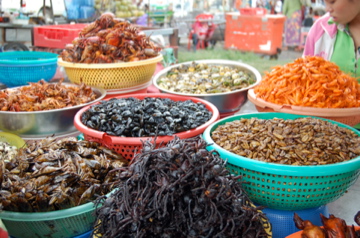
In parts of the Central African Republic, insects satisfy one-third of the population's protein requirements during the rainy season. Dried caterpillars sell for $14 (€10) a kilogram. And high-end restaurants in Mexico City offer a pricy delicacy called escamoles, a sort of insect caviar made of ant larvae.
People in Thailand use sticks with adhesive on them to hunt dragonflies. In Nepal, they strain bee larvae through a cloth before frying the resulting gooey mass like an egg. And, in Africa, termite mounds are a carefully guarded resource because they have a higher protein content than chicken and their queens can grow to the size of a potato.
Butterflies are also popular fare. During the rainy season in southern Africa -- which is harvest time for the large, bristly caterpillars of the saturniid moth known as mopane worms -- beef prices collapse. In the early 1980s, 1,600 metric tons of mopane were sold in the region each year. And, in Italy, insects are also found in a delicacy called casu marzu, a cheese filled with live larvae. ...
Vollrath studied in the southwestern German city of Freiburg and now works as a zoologist at Oxford. He snacked on locusts for the first time during an expedition in Panama, where he plucked them directly off charred shrubs after they had been naturally grilled in a brush fire. "Insects are approximately 10 times more eco-friendly than beef," he says. Harvesting them doesn't require deforestation, he explains, but actually helps preserves forests. "Insects offer us an opportunity to rethink and move away from pork and beef," he says.
Indeed, experts believe putting more bugs on our plates could help solve some of humanity's worst problems. The global population increases by 6 million every month, food prices have nearly doubled in the last two years, and meat consumption is threatening forests and drinking water.
"The protein content (of insects) is comparable to that of conventional meat," according to the United Nations' Food and Agricultural Organization (FAO). It goes on to explain that insects are rich in vitamins, minerals and unsaturated fats as well as hardly contaminated by environmental pollutants in many places. "They are often harvested in areas … where no pesticides are used," one FAO report states.

Posted
by Big Gav
in
agriculture,
food,
insects
The Wall Street Journal points out that artificial meat isn't the only way of augmenting food supplies to fed an expanded population in future - insects may also become part of our diet - The Six-Legged Meat of the Future. Mmmm - fried spider...
At the London restaurant Archipelago, diners can order the $11 Baby Bee Brulee: a creamy custard topped with a crunchy little bee. In New York, the Mexican restaurant Toloache offers $11 chapulines tacos: two tacos stuffed with Oaxacan-style dried grasshoppers.
Could beetles, dragonfly larvae and water bug caviar be the meat of the future? As the global population booms and demand strains the world's supply of meat, there's a growing need for alternate animal proteins. Insects are high in protein, B vitamins and minerals like iron and zinc, and they're low in fat. Insects are easier to raise than livestock, and they produce less waste. Insects are abundant. Of all the known animal species, 80% walk on six legs; over 1,000 edible species have been identified. And the taste? It's often described as "nutty." ...
Insects have a reputation for being dirty and carrying diseases—yet less than 0.5% of all known insect species are harmful to people, farm animals or crop plants. When raised under hygienic conditions—eating bugs straight out of the backyard generally isn't recommended—many insects are perfectly safe to eat.
Meanwhile, our food needs are on the rise. The human population is expected to grow from six billion in 2000 to nine billion in 2050. Meat production is expected to double in the same period, as demand grows from rising wealth. Pastures and fodder already use up 70% of all agricultural land, so increasing livestock production would require expanding agricultural acreage at the expense of rain forests and other natural lands. Officials at the United Nations Food and Agriculture Organization recently predicted that beef could become an extreme luxury item by 2050, like caviar, due to rising production costs.
Raising insects for food would avoid many of the problems associated with livestock. For instance, swine and humans are similar enough that they can share many diseases. Such co-infection can yield new disease strains that are lethal to humans, as happened during a swine fever outbreak in the Netherlands in the late 1990s. Because insects are so different from us, such risks are accordingly lower.
Insects are also cold-blooded, so they don't need as much feed as animals like pigs and cows, which consume more energy to maintain their body temperatures. Ten pounds of feed yields one pound of beef, three pounds of pork, five pounds of chicken and up to six pounds of insect meat.
Insects produce less waste, too. The proportion of livestock that is not edible after processing is 30% for pork, 35% for chicken, 45% for beef and 65% for lamb. By contrast, only 20% of a cricket is inedible.
Raising insects requires relatively little water, especially as compared to the production of conventional meat (it takes more than 10 gallons of water, for instance, to produce about two pounds of beef). Insects also produce far less ammonia and other greenhouse gases per pound of body weight. Livestock is responsible for at least 10% of all greenhouse gas emissions.
Raising insects is more humane as well. Housing cattle, swine or chicken in high densities causes stress to the animals, but insects like mealworms and locusts naturally like to live in dense quarters. The insects can be crowded into vertical stacked trays or cages. Nor do bug farms have to be restricted to rural areas; they could sprout up anywhere, from a suburban strip mall to an apartment building. Enterprising gourmets could even keep a few trays of mealworms in the garage to ensure a fresh supply.
The first insect fare is likely to be incorporated subtly into dishes, as a replacement for meat in meatballs and sauces. It also can be mixed into prepared foods to boost their nutritional value—like putting mealworm paste into a quiche. And dry-roasted insects can be used as a replacement for nuts in baked goods like cookies and breads.
We continue to make progress in the Netherlands, where the ministry of agriculture is funding a new $1.3 million research program to develop ways to raise edible insects on food waste, such as brewers' grain (a byproduct of beer brewing), soyhulls (the skin of the soybean) and apple pomace (the pulpy remains after the juice has been pressed out). Other research is focusing on how protein could be extracted from insects and used in processed foods.
Though it is true that intentionally eating insects is common only in developing countries, everyone already eats some amount of insects. The average person consumes about a pound of insects per year, mostly mixed into other foods. In the U.S., most processed foods contain small amounts of insects, within limits set by the Food and Drug Administration. For chocolate, the FDA limit is 60 insect fragments per 100 grams. Peanut butter can have up to 30 insect parts per 100 grams, and fruit juice can have five fruit-fly eggs and one or two larvae per 250 milliliters (just over a cup). We also use many insect products to dye our foods, such as the red dye cochineal in imitation crab sticks, Campari and candies. So we're already some of the way there in making six-legged creatures a regular part of our diet.
Not long ago, foods like kiwis and sushi weren't widely known or available. It is quite likely that in 2020 we will look back in surprise at the era when our menus didn't include locusts, beetle larvae, dragonfly larvae, crickets and other insect delights.
Posted
by Big Gav
in
global warming,
insects
The Independent has an interesting piece on the potential for global warming to rapidly increase the insect population, with dire effects on food production.
Food crops could be ravaged this century by an explosion in the numbers of insect pests caused by rising global temperatures, according to scientists who have carried out an exhaustive survey of plant damage when the earth last experienced major climate change.
Researchers found that the numbers of leaf-eating insects are likely to surge as a result of rising levels of CO2, at a time when crop production will have to be boosted to feed an extra three billion people living at the end of 21st century.
Scientists found that, during one of the last great episodes of global warming 55.8 million years ago, there was a significant increase in both the amount of damage caused by leaf-eating insects and the variety of injuries they inflicted on plants.
They believe that the 5C rise in global temperatures caused by a tripling of CO2 levels during the palaeocene-eocene thermal maximum (PETM) period sent insect numbers soaring and left an indelible impression on the fossilised leaves preserved since that time.
The percentage of leaves that suffered extensive insect damage rose dramatically during the PETM as foraging became more intensive. The researchers warned that the same effect might be seen during the present period of global warming caused by man-made emissions of CO2, which could double the pre-industrial concentration of the gas by the end of the century.
Ellen Currano of Pennsylvania State University, the lead author of the study, said that although the global warming experienced during the PETM occurred tens of millions of years ago, it is still the best analogy we have for what may happen in the future.
"By looking at the fossil record, we can observe the long-term – thousands to millions of years – response of ecosystems to abrupt warming and increased atmospheric CO2," she said. "Our study shows [that] ... when temperature increases, the diversity of insect-feeding damage on plant species also increases."


 Posts
Posts