Showing posts with label mcdonough. Show all posts

Upcycling: Driving sustainable transformation via the power of design  

Posted by Big Gav in ,

William McDonough (of "Cradle to Cradle" fame) has an article in The Guardian looking at progress in improving industrial production processes - Driving sustainable transformation via the power of design. McDonough and Braungart have a follow up book to C2C called "The Upcycle: Beyond Sustainability--Designing for Abundance".

The most successful companies embrace good design by loudly and clearly stating their positive intentions. When a CEO declares that his or her company will improve the water quality of an entire community or build a workplace that will generate more renewable energy than it requires, this statement alone can unleash enthusiasm, creativity and innovation. A statement of intention places values first. It stresses the good, such as 'we will use and generate only renewable energy,' rather than the more commonly stated less bad; 'we will reduce our use of fossil fuels.' ...

It sets an inspiring goal that tells people where the company wants to be. It signals a commitment to constant improvement, letting employees, customers, partners and shareholders know unequivocally that they are part of a creative, positive force in the world. Intention is powerful. Intention drives change. And values are valuable. Leading companies worldwide have come to understand that the damaging, often unaccounted-for repercussions of modern business – famously called externalities – such as atmospheric carbon, toxic materials and poisoned rivers, arise from design decisions and value judgements.

In other words, pollution and waste are the result of human errors; they are not an inevitable part of commerce. They signal design failure in product development, operations and corporate strategy and call for dramatic changes in how leaders think and how companies make things. That is a values-driven process, an upcycle, and it's proving to be good business. ...

Recognising that good design is about value creation, not risk mitigation, cleaning-products supplier Method made a company-wide commitment to cradle-to-cradle design principles in 2006. C2C certification recognises significant achievement in five categories of product quality: material health, social fairness, water stewardship, material recovery and renewable energy. Method already has developed 60 C2C-certified products. Not only do Method's products aspire to higher and higher C2C standards, but the company also has integrated cradle-to-cradle principles into its DNA: it's working "to create a new sector of the economy that uses the power of business to solve social and environmental problems."

Shaw Industries, an early adopter of cradle-to-cradle principles, is committed to making only C2C certified products by 2030. Currently more than 60% of its $4bn in total annual sales comes from certified carpet and hardwood flooring. Shaw's environmentally safe carpet tiles are separable into component materials for carpet-to-carpet recycling. Customers need only call the toll free number on each tile to have them picked up. In a marvellously convenient and cost-effective exchange, a customer can buy a new carpet while Shaw recovers the material value of a used one. It's a continuously improving system, a continuously upcycling flow of valuable renewable materials and energy.

In 1981, textile manufacturer Carnegie Fabrics introduced a polyethylene textile, Xorel, which became one of the few PVC alternatives for interior panels, wall coverings and upholstery. Soon after, Carnegie became the first company in its industry to go completely vinyl-free. Now, after a seven-year effort to redesign its signature product, it has created the world's first high-performance bio-based interior textile, Biobased Xorel. The fabric is sourced from rapidly renewable sugar cane. All its raw materials, colourants and additives are safe for human and environmental health, it's produced at a facility powered by solar and hydropower sources and it meets all the price, aesthetic and performance standards set by the original Xorel.

They have also set up a new institute to promote C2C innovation and certify products that meet their standards - Cradle to Cradle Certified.

An Interview With Green Architect & Cradle to Cradle Founder William McDonough  

Posted by Big Gav in ,

Inhabitat has an interview with Cradle To Cradle author William McDonough - INHABITAT INTERVIEW: Green Architect & Cradle to Cradle Founder William McDonough.

INHABITAT: What inspired you to write ‘Cradle to Cradle‘ (the book) and launch the Cradle to Cradle system?

William McDonough: From an early age, I was fascinated by differing attitudes towards resources. Growing up in Japan and Hong Kong, I was given my first look at complete material cycles, where waste becomes food, and resources like water are limited and precious. This contrasted greatly with the wastefulness I witnessed when my family moved to the United States, and that difference in attitude left a great impression on me. As a young architect, my thinking continued to evolve. I incorporated elements like solar energy into my designs and began to look closely at the sourcing of materials, but Cradle to Cradle really came to fruition when I met Dr. Michael Braungart. Together we developed the Cradle to Cradle philosophy, which we articulated in Cradle to Cradle: Remaking the Way We Make Things, which came out in 2002.

INHABITAT: Can you explain how the Cradle to Cradle rating system works – both from the perspective of manufacturers and consumers?

William McDonough: Cradle to Cradle products Certification goes beyond the definition of a rating system or a binary pass/fail seal of approval. Cradle to Cradle is a process for managing the total quality of a product and an engine for business innovation, taking into consideration not only environmental impact but also safety, health and social responsibility. The certification is a continuous and rigorous process, and participating companies hope to move their Basic products toward the achievement of Gold, Silver or Platinum. No single company product has yet achieved Platinum.

Certification takes into account five dimensions: materials as nutrients for safe continuous cycling; development of systems to safely close the loop on our biological and technical nutrients; power all operations with 100% renewable energy; regard water as a precious resource; and finally respect for all people and natural systems.

INHABITAT: I was just talking with Paul Murray at Herman Miller about your contribution to their products and it was really extraordinary how closely related their company’s success is with your input. Was this the first company that you’ve worked with on such an intimate level? What helped shift the ethos of the company’s design culture?

William McDonough: We began to work with them when they stopped producing the Eames chairs out of rosewood – an endangered species. Ultimately, you really don’t want to mess with the icon of a company, but Herman Miller had a person working there who was so passionate about these issues that the company as a whole went ahead and changed the specs to walnut and stopped using endangered wood. It was a really nice thing for them to do.

But really what we’re dealing with here is product quality, and as a result a lot of these attributes you see highlighted by companies are various components that are focused on issues such as carbon reduction, and the like – single attributes. You also see a lot of claims to efficiency, which follows the train of thought “we’re less bad because we’ve reduced our badness by 20 percent.” We don’t want to be selling what we’re not. See, if I look at this sign with the word NO you realize that you’re selling what you’re not.

INHABITAT: In your book Cradle to Cradle, you make the point that when we recycled paper – we are giving up the original quality of the paper – we are losing something. Is most recycling just ‘downcycling’? Do we lose quality with every cycle of recycle?

William McDonough: Right, what we want again is product quality, and so with a company like Herman Miller there is an issue of quality. It’s similar to what we are seeing with Construction Specialties here at GreenBuild – it’s about quality products in a fine system. From the market’s perspective you have to start to say things like this because they highlight that there are things to worry about, and that there are people who are genuinely interested and concerned about these things.

In Cradle to Cradle we addressed something that people may not understand when we proposed a form of producer responsibility over their product. The things we don’t talk about is a “life cycle”, so we don’t think that this material is alive. It’s not. We don’t see it as a consumer product because they can’t consume it. I can’t consume a TV, so we would call that a nutrient. We don’t talk about life cycle, we talk about use periods. We don’t talk about take back, we talk about reverse logistics or intelligent materials pooling. If something was removed from a building right, under our protocols, this is a safe thing to remove. That’s stainless steel, and that’s this, and that’s that, and they are defined. So then you go back into a materials pool.

It’s like a Herman Miller chair that ends up in Mexico City fifteen years from now, if somebody throws it out the back and into the dumpster. Well, the scavengers will just come and grab it. It’s worth something. The reason it’s worth something is that’s steel, and that’s aluminum, and that’s polycarbonates, and that polyethylenes. It’s no longer a chair, it’s part of the materials intelligent pool. So the design is that aluminum can come off and go back to aluminum, the steel goes back to steel. They’re not monstrous hybrids that can’t be separated.

Bringing Green Design to the Mainstream  

Posted by Big Gav in , , ,

Joel Makowevr has an interview with "Cradle to Cradle" pioneer Bill McDonough at Greener Buildings - Bringing Green Design to the Mainstream.

Joel Makower: Bill, one of the things you talked about is the fact that recycling or when we recycle, we're simply recycling a lot of the problems that we've already created -- and yet there's opportunities to take some of the products in the waste stream and turn them into less toxic products. Tell me about that.

William McDonough: Well, if you look at the, you know, use of materials which are questionable like PVC or even PET in our water bottles that contains antimony as a residue from a catalytic reaction, we're realizing these are suboptimal products in a Cradle to Cradle world where we would want everything safe and healthy by design. So, when we look at something like PVC, we say, "Well, why can't we park that somewhere until we figure out what to do with it?" When we look at PET, we wonder why we can't bring it back and actually scrub out the antimony and put it back into the marketplace refreshed and clean, so we're essentially what we call up-cycling it. When we look at recycling, we see that typically things are either down-cycled and they're losing quality in the process of being reused or they're recycled and they come back in the same condition effectively or we can up-cycle things and actually purify them and clean them up on their way back through the cycles, so we're excited about the prospect of up-cycling plastics.

JM: Well, why not just create a whole new plastic all together? Why go through all this?

WM: Well, I think in the long run we're gonna need to take advantage of all the feedstocks that are out there and use them effectively. I mean otherwise we'd find ourselves developing strategies to, say, burn the plastics that exist out there that are suboptimal, but when you go burn antimony-laden PET, what you get is antimony trioxide in the air, which is a known carcinogen, so is burning it gonna be the solution? I don't think so. So, you know, what we really want to do is actually put these things back into useful cycles and so we need transitions to the future. We won't be able to do this overnight. ...

JM: So there's all these new sort of design or at least materials, protocols and materials categories, I guess, that are coming out and I'm wondering -- where does it all come together? So, for example, there's biomimicry. There's green chemistry. There's Cradle to Cradle. First of all, is there much of an overlap among those? Biomimicry is not a material; it's a discipline. .. Because ultimately if you're a designer you want a whole toolkit to choose from.

WM: Yeah. Well, I think all those tools are sympathetic. I mean, if you look at biomimicry, which is such a, you know, fabulous way to think about approaching problems, it gives you an inspiration and it gives you touch points and reference points and sort of miracles that you can connect to, the miracles of the world around us. But, you know, you could be designing a product that is unsafe that looks like something that nature might have done in terms of its physical characteristics, in terms of its attributes in the world. It's something that would walk on ceilings but drops bombs, you know. I mean, so a tool only has a value based on the intention and the purpose to which it's put, so when we look at biomimicry, for example, I mean it should be celebrated for all the joyful aspects of its characterization of the world as an inspiration, so that fits really beautifully.

When we look at other systems, green chemistry works perfectly with Cradle to Cradle because Cradle to Cradle incorporates green chemistry. Cradle to Cradle also incorporates this idea of biological and technical nutrition as two distinctions for product development. It includes renewable energy or includes clean water, and it includes social fairness, which, you know, it may not be inherent in green chemistry, per se. So, I think they're all sympathetic with each other and they all fit together as a kit, so, you know, we encourage people to think in biomimicry terms. We encourage them to think in green chemistry terms and we encourage them to think in Cradle to Cradle terms simultaneously.

McDonough + Partners In Isola  

Posted by Big Gav in , ,

Cool green building of the week is this new design from McDonough and Partners in Milan - McDonough + Partners’ Groundbreaking Isola Office.

Sustainable design greats McDonough + Partners will soon be bringing Cradle to Cradle thinking to a city often known first for its fashion: Milan, Italy. Their Isola Office building will be aiming for LEED Gold with a variety of sustainable building strategies including solar and geothermal energy, advanced insulation panels, solar shading, and a high-efficiency climate control system. The structure will be part of the Porta Nuova redevelopment, which will introduce 340,000 square meters of housing, community, commercial and government buildings within Milan’s center - it’s practically a city within a city!

As an office building situated in a residential zone, the 10-story 8,600 square meter Isola building had to accommodate a variety of site constraints, including being re-adaptable as housing units. Working within these tight parameters McDonough + Partners were still able to incorporate a variety of sustainable features.

The Isola office building takes advantage of renewable energy via photovoltaics in addition to ground-source thermal capture. It also features insulation panels composed of of glass, metal, and terracotta that not only provide for a high-performance building envelope, but also allow for operable windows in every office.

Cradle To Cradle  

Posted by Big Gav in ,

The Guardian has an article by comedian Robert Newman on the topic "It's capitalism or a habitable planet - you can't have both" which makes the case that dealing with peak oil and global warming is impossible in a capitalist society.

Much discussion of energy, with never a word about power, leads to the fallacy of a low-impact, green capitalism somehow put at the service of environmentalism. In reality, power concentrates around wealth. Private ownership of trade and industry means that the decisive political force in the world is private power. The corporation will outflank every puny law and regulation that seeks to constrain its profitability. It therefore stands in the way of the functioning democracy needed to tackle climate change. Only by breaking up corporate power and bringing it under social control will we be able to overcome the global environmental crisis. ...

If we are all still in denial about the radical changes coming - and all of us still are - there are sound geological reasons for our denial. We have lived in an era of cheap, abundant energy. There never has and never will again be consumption like we have known. The petroleum interval, this one-off historical blip, this freakish bonanza, has led us to believe that the impossible is possible, that people in northern industrial cities can have suntans in winter and eat apples in summer. But much as the petroleum bubble has got us out of the habit of accepting the existence of zero-sum physical realities, it's wise to remember that they never went away. You can either have capitalism or a habitable planet. One or the other, not both.

I tend to think blaming capitalism (and even continuous economic growth) for the state of the environment is a little misguided and is somewhat beside the point when it comes to the mitigation of peak oil and global warming (plus I've yet to see a meaningful alternative proposed - its not like the communist model was any better at avoiding environmental destruction, other than it generally didn't grow as fast - but it compensated for that "positive" by being less able to adapt once the consequences of various rapid industrialisation programs became apparent).

There is a fairly simple solution to the problems of global warming and peak oil that doesn't involve discarding capitalism entirely - introducing carbon taxes and steadily increasing them.

It is true (and unfortunate) that fossil fuel related industries do currently dominate the political systems in the anglo saxon world, which is largely the cause of our refusal to do anything about global warming or peak oil, and that this does tend to make the process of introducing carbon taxes a bit difficult. Its worth reading Joel Bakan's "The Corporation" to get some ideas about how the system could be adjusted in order to stop this sort of thing happening.

However, these industries aren't the only ones that exist in capitalist societies and at some point all the other industries are going to realise that their profits and ability to survive are being compromised by the effects of global warming and ever increasing energy costs as a result of peak oil. So we can probably expect to see some sort of shift as these problems become obvious to everyone, with political parties that propose dealing with the problems getting more funding from those who don't have an interest in continuing the fossil fuel economy.

The Viridian idea is that you can have capitalism and a sustainable, workable world at the same time - it just requires a restructuring of the way things are done.

Part of this is basically marketing (if you make green / sustainable ideas and products "cool" then the market will shift towards providing them) and partly by adopting processes like the ones described in Bill McDonough and Michael Braungart's book "Cradle to Cradle".

I won't try to describe the whole book (click on the link and read their description) but in summary the book describes a second iteration of the industrial revolution that concentrates on "eco-effectiveness" rather than the traditional industrial system of converting natural resources into waste, or slightly greener ideas of "eco-efficiency", which slow down the process but basically just try to reduce the amount of damage rather than rethinking the process.

Eco-effectiveness involves creating prodcuts in such a way that they can be fully recycled once they are no longer required (and this means recycled into the same quality of product, not "downcycled" like paper waste is for example). The book discusses closed cycles for "biological and technical nutrients" - keeping organic materials that can be returned to the natural environment seperate from synthetic or mineral materials that can be fed back into the industrial cycle.

This involves a lot of changes to the design process in particular but results in an industrial economy which is no longer as subject to the limits to growth, as it tends to be able to reuse a lot of the materials it needs.

Of course, this doesn't apply in the case of non-recyclable resources, such as oil. There is a section that talks about energy called "Brute force" which I'll quote below:
If the first Industrial Revolution had a motto, we like to joke, it would be "If rute force doesn't work, you're not using enough of it". The attempt to impose universal design solutions on an infinite number of local conditions and customs is one manifestation of this principle and its underlying assumption, that nature should be overwhelmed; so is the application of the chemical brute force and fossil fuel energy necessary to make such solutions "fit".

All of nature's industry relies on energy from the sun, which can be viewed as a form of current, constantly renewing income. Humans, by contrast, extract and burn fossil fuels such as coal and petrochemicals that have been deposited deep below the Earth's surface, supplementing them with energy produced through waste incineration processes and nuclear reactors that create additional problems. They do this with little or no attention to harnessing local natural energy flows. The standard operating instruction seems to be "If too hot or too cold, just add more fossil fuels".

You are probably familiar with the threat of global warming brought about by the buildup of heat-trapping gases (such as carbon dioxide) in the atmosphere due to human activities. Increasing global temperatures result in global climate change and shifts of existing climates. Most models predict more severe wqeather: hotter hots, colder colds, and more intense storms, as global thermal contrasts grow more extreme. A warmer atmosphere draws more water from oceans, resulting in bigger, wetter, more frequent storms, rises in sea level, shifts in seasons, and a chain of other climatic events.

The reality of global warming has gained currency not only among environmentalists but among industry leaders. But global warming is not the sole reason to rethink our reliance on the "brute force" approach to energy. Incinerating fossil fuels contributes particulates - microscopic particles of soot - to the environment, where they are known to cause respiratory and other health problems. Regulations for airborne pollutants known to threaten health are growing more severe. As new regulations, based on mounting research about the health threats of airborne toxins resulting from incinerating fossil fuels, are implemented, industries invested solely in continuing the current system will be at a serious disadvantage.

Even beyond these important issues, brute force energy doesn't make good sense as a dominant strategy over the long term. You wouldn't want to depend on savings for all your daily expenditures, so why rely on savings to meet all of humanity's energy needs ? Clearly, over the years petrochemicals will become harder (and more expensive) to get, and drilling in pristine places for a few million more drums of oil isn't going to solve that problem.

In a sense, finite sources of energy, such as petrochemicals derived from fossil fuels, can be seen as a nest egg, something to be preserved for emergencies, then used sparingly - in certain medical situations, for example. For the majority of our simple energy needs, humans should be accruing a great deal of current solar income, of which there is plenty: thousands of times the amount of energy needed to fuel human activities hits the surface of the planet every day in the form of sunlight.

One novel aspect of the book is that is made using a special type of plastic - this is described on the book's website:
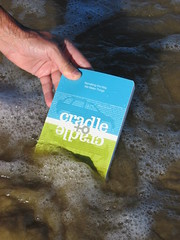
In addition to describing the hopeful, nature-inspired design principles that are making industry both prosperous and sustainable, the book itself is a physical symbol of the changes to come. It is printed on a synthetic 'paper,' made from plastic resins and inorganic fillers, designed to look and feel like top quality paper while also being waterproof and rugged. And the book can be easily recycled in localities with systems to collect polypropylene, like that in yogurt containers. This 'treeless' book points the way toward the day when synthetic books, like many other products, can be used, recycled, and used again without losing any material quality—in cradle-to-cradle cycles.

As a result of this approach, the book is a little unusual - it looks and feels great, but is heavier than it looks. The plastic pages themselves feel a little different to paper but on the whole its a high quality look and feel.

The common (or garden) paperback book has a number of natural enemies in the wild, such as the sun (which can make books discolour or curl up), water (by and large very destructive), small children (which tend to chew on the corners, bend the covers and rip out pages) and your more extreme type of conservative individual (who may want to ban or burn the book).

Once I finished reading it I decided to see how well it stood up to some of these tests of endurance. As I don't tend to hang out with book burners (and I doubt it would survive that sort of treatment), the book avoided trial by fire. However I did give it to a small child, who has a bad track record when it comes to book destruction, and the book survived completely unscathed, in spite of repeated tests.

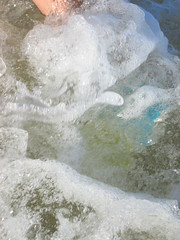
The sun wasn't quite as easily dealt with, with the front cover curling a bit after some exposure. The book did handle water well though - I took it into the ocean for a while and made sure it got thoroughly soaked. The plastic pages really don't absorb water - though they did get a bit salty and sandy, and I eventually had to wipe each page individually to get rid off all the excess moisture and grit. Once this was done the book was as good as new again. I'm not quite sure if it can actually be recycled into another book and I think I'd prefer to keep it on my bookshelf for now in any case.
Statistics

Locations of visitors to this page

blogspot visitor
Stat Counter

Total Pageviews

Ads

Books

Followers

Blog Archive

Labels

australia (619) global warming (423) solar power (397) peak oil (355) renewable energy (302) electric vehicles (250) wind power (194) ocean energy (165) csp (159) solar thermal power (145) geothermal energy (144) energy storage (142) smart grids (140) oil (139) solar pv (138) tidal power (137) coal seam gas (131) nuclear power (129) china (120) lng (117) iraq (113) geothermal power (112) green buildings (110) natural gas (110) agriculture (91) oil price (80) biofuel (78) wave power (73) smart meters (72) coal (70) uk (69) electricity grid (67) energy efficiency (64) google (58) internet (50) surveillance (50) bicycle (49) big brother (49) shale gas (49) food prices (48) tesla (46) thin film solar (42) biomimicry (40) canada (40) scotland (38) ocean power (37) politics (37) shale oil (37) new zealand (35) air transport (34) algae (34) water (34) arctic ice (33) concentrating solar power (33) saudi arabia (33) queensland (32) california (31) credit crunch (31) bioplastic (30) offshore wind power (30) population (30) cogeneration (28) geoengineering (28) batteries (26) drought (26) resource wars (26) woodside (26) censorship (25) cleantech (25) bruce sterling (24) ctl (23) limits to growth (23) carbon tax (22) economics (22) exxon (22) lithium (22) buckminster fuller (21) distributed manufacturing (21) iraq oil law (21) coal to liquids (20) indonesia (20) origin energy (20) brightsource (19) rail transport (19) ultracapacitor (19) santos (18) ausra (17) collapse (17) electric bikes (17) michael klare (17) atlantis (16) cellulosic ethanol (16) iceland (16) lithium ion batteries (16) mapping (16) ucg (16) bees (15) concentrating solar thermal power (15) ethanol (15) geodynamics (15) psychology (15) al gore (14) brazil (14) bucky fuller (14) carbon emissions (14) fertiliser (14) matthew simmons (14) ambient energy (13) biodiesel (13) investment (13) kenya (13) public transport (13) big oil (12) biochar (12) chile (12) cities (12) desertec (12) internet of things (12) otec (12) texas (12) victoria (12) antarctica (11) cradle to cradle (11) energy policy (11) hybrid car (11) terra preta (11) tinfoil (11) toyota (11) amory lovins (10) fabber (10) gazprom (10) goldman sachs (10) gtl (10) severn estuary (10) volt (10) afghanistan (9) alaska (9) biomass (9) carbon trading (9) distributed generation (9) esolar (9) four day week (9) fuel cells (9) jeremy leggett (9) methane hydrates (9) pge (9) sweden (9) arrow energy (8) bolivia (8) eroei (8) fish (8) floating offshore wind power (8) guerilla gardening (8) linc energy (8) methane (8) nanosolar (8) natural gas pipelines (8) pentland firth (8) saul griffith (8) stirling engine (8) us elections (8) western australia (8) airborne wind turbines (7) bloom energy (7) boeing (7) chp (7) climategate (7) copenhagen (7) scenario planning (7) vinod khosla (7) apocaphilia (6) ceramic fuel cells (6) cigs (6) futurism (6) jatropha (6) nigeria (6) ocean acidification (6) relocalisation (6) somalia (6) t boone pickens (6) local currencies (5) space based solar power (5) varanus island (5) garbage (4) global energy grid (4) kevin kelly (4) low temperature geothermal power (4) oled (4) tim flannery (4) v2g (4) club of rome (3) norman borlaug (2) peak oil portfolio (1)