Showing posts with label melbourne. Show all posts

Bubbletecture Stadium Popping Up in Melbourne  

Posted by Big Gav in ,

Green Building of the week from Inhabitat is the new Melbourne soccer and rugby league stadium (with some Bucky Fuller inspired features) - Bubbletecture Stadium Popping Up in Melbourne.

A bubbly new soccer and rugby stadium is popping up in Melbourne that will feature a highly engineered exterior structure combined with many sustainable features. Designed by Cox Architects, the Melbourne Rectangular Stadium is a marvel of architecture and engineering with it’s bubble-like facade inspired by Buckminster Fuller’s geodesic dome. Construction is fully underway, allowing a glimpse into how the cantilevered structure is being put together.

When completed in 2010, the stadium will seat 30,000 spectators as they watch both the Melbourne Victory Soccer Team and the Melbourne Storm Rugby Club. The stadium will also house a sports medicine facility and many administrative offices for the city’s sports organizations. The stadium’s design was inspired by the geodesic dome and it features a unique cantilever design that provides shelter for the spectators without inhibiting their view of the game below.

The structure’s roof is skinned with a triangular panelized facade that uses 50% less steel than a typical cantilevered roof structure. The envelope is currently composed of combination of glass, metal and louvres, and in the future the architects hope to integrate photovoltaic thin-film into the design. During construction scaffolding is in place to put the domes together and once completed the scaffolding can be taken off and the structure will support itself. The dome will be lit up by thousands of LED lights and also feature rainwater collection, natural lighting, and natural ventilation.

Urban sprawl is killing us, but there's another way  

Posted by Big Gav in , ,

The Age has an article on the problems with Melbourne's urban sprawl and a better alternative - Urban sprawl is killing us, but there's another way.

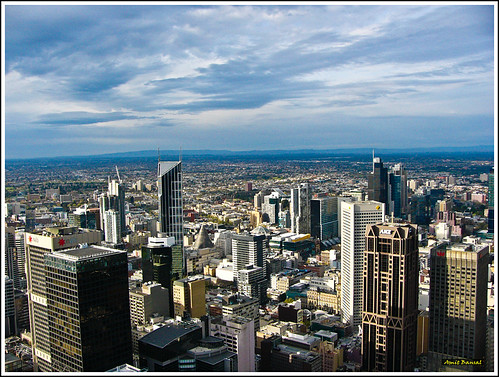
AS THE days grow cooler, many of us are breathing a sigh of relief that the past summer has finally come to an end. As well as the unprecedented and tragic bushfire season, severe summer conditions induced a string of urban disasters that, due to poor planning, were waiting to happen: public transport failures, traffic nightmares and water shortages.

In response, the State Government is proposing quick fixes that involve new roads, longer freeways, rail tunnels and a desalination plant, solutions that will cost taxpayers billions of dollars. Yet in the face of unbounded urban sprawl, such answers are short-term and ultimately unsustainable. If the urban juggernaut of Melbourne continues to roll, expanding at its current rate of 1.65 per cent (or 63,000 people) per year, further road and public transport overhauls, as well as additional desalination plants, are likely to be on the agenda within another 15 years.

Some efforts have been made to curb the urban spread. Amid backlash, there have been cursory nods in the direction of medium-density housing. Last week, Melburnians heard of plans to turn the 128-hectare former Department of Defence site in Maribyrnong into a new suburb. Such a move would absorb population growth that would otherwise settle on Melbourne's fringes.

The move is a temporary solution — Melbourne's growth cannot be directed into unused pockets of land for long, because such land is limited. Victoria and, indeed, the whole of Australia must think creatively and radically about directing growth away from our burgeoning capital cities.

About half of Australia's population is contained in five state capitals. The result is an over-urbanisation that is inefficient and requires the building of ever-expanding infrastructure, including transport, sewerage, water and energy supply, telecommunications and waste disposal.

Smaller planned cities make more sense. Ideas that might generally be considered too difficult suddenly, in the context of a smaller urban centre, become feasible: storm water harvesting for household and industrial use, water recycling, conversion of sewage and garbage into fuel, and greenhouse market gardens and aquaculture using low-grade waste heat. Smaller cities are efficient. Roads, sewers, water supply pipes, electricity lines and telecommunication links can be shorter and economical. Energy that would otherwise go to waste can be used by homes and industry.

Adding The Toll Of The Heat Wave  

Posted by Big Gav in , , ,

Gary at Public Opinion has a post on the toll in South Australia from the latest bout of hot weather - Heat Wave.

In Adelaide the plain trees are already shedding their leaves, the bodies of dead possums litter the parklands, and the death toll of human beings is around 75. As in Melbourne, there have been crippling blackouts due to the failure of the $780 million Basslink interconnector cable linking Victoria and Tasmania, which is unable to operate when temperatures in Launceston Tasmania pass 35C.

NEMMCO continues to talk in terms of the national electricity market having sufficient capacity to deliver reliable supply. Politicians explain the disconnect between assurance and reality by talking in terms of the heatwave being one-in-100-year event, rather than this being an indication of southern Australia's future. Yet there have been a series of rolling blackouts over the past years due to supply falling short of increasing demand --hence the frequent load shedding that causes the blackouts during a heatwave.

A warmed up world means hotter conditions in cities, towns and the regions since long hot, dry summers are becoming the norm. Shouldn't we see the blackouts as a timely warning about a rundown energy system with its old industrial technology utilizing fossil fuels? This is an electricity grid that has seen little new investment in the last decade.


The Age reports the temperature in Melbourne hit an all-time record on the weekend - City swelters, records tumble in heat - causing power outages.
Melbourne's all-time weather record has been broken and the city is sweltering under the twin effects of high temperatures and hot north-west winds. The city hit 46.4 degrees at 3.04pm - the hottest day since the Bureau of Meteorology started keeping records 150 years ago.

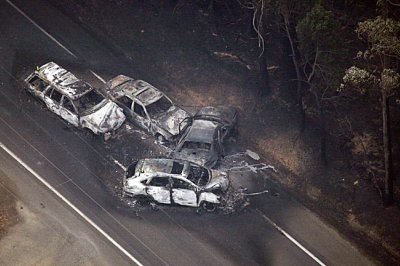
City dwellers had it pretty easy compared to people in country victoria, where the temperature got over 48 degrees and over 100 people lost their lives in bushfires - Australia's bushfire disaster: many good people lie dead in Victoria. Power outages in the country may last for days
AUSTRALIA has witnessed its greatest natural disaster. ... At 7.35am today the official death toll was 108, with at least 750 homes destroyed - 550 of those in Kinglake, north of Melbourne, and surrounding areas.

According to police figures, another 11 people were found dead at Kinglake West, north of Melbourne, taking that community's toll to 20, while another four bodies were found at Marysville taking that town's toll to eight.


The Age has a report on warnings that these events will get worse as global warming proceeds unchecked - It will only get worse as climate changes
AUSTRALIA faces "a very dangerous decade or decades" as climate change increases the intensity of fires and lengthens the bushfire season, scientists and environmentalists warn. Research by the Australian Bureau of Meteorology and the CSIRO has found that bushfire seasons will start earlier, end slightly later and become more intense in coming decades.

A climate study of south-east Australia by the agencies in 2007 found the number of days with "very high" or "extreme" fire danger ratings would increase significantly. The worst changes were predicted for northern NSW. By 2020, days of extreme fire danger are forecast to increase by 5 to 25 per cent if climate change is low and by 15 to 65 per cent if it is high.

An author of the report, Kevin Hennessy from the CSIRO, told the Herald yesterday: "There does seem to be a human element to bushfire risk. In terms of human contribution it is clear that most of the global warming since about 1950 is likely due to increases in greenhouse gases. Higher temperatures clearly increase the risk of bushfires."


The Age notes that the various social media channels are keeping up a running commentary on the fires - Social media rush as Victorian bushfires rage
As the worst bushfires in Australia's history raged across Victoria, Twitter, Flickr and Facebook lit up with condolences and horrific first-hand accounts, while many used innovative online mapping tools to assess the risk of the fires reaching their own homes.

Mainstream news outlets, battling to provide comprehensive coverage of the tragedy, have incorporated accounts published on the social networking sites extensively in their reports.

Using online social media to spread vital information and personal stories is becoming increasingly commonplace in times of crisis, but this may be the first time the social networking sites have been used extensively during an Australian disaster.

Google's engineers have created a map containing the latest up-to-date information about fire locations and their status, based on data provided by Victoria's Country Fire Authority (CFA).

The map, updated in real-time with information about the number, type and size of fires in a particular location, buckled as thousands of web users sought out updates. But the site appeared to be working as normal this morning.

Google created the map after the CFA's website struggled to cope with the surge in people looking for information about the fires.

"We hope that it's of some use to people who may be affected, to emergency services personnel, and that it takes some load off other websites which are being inundated," Google wrote in a blog post.

Aus-emaps.com created its own map of the fire locations - derived from data provided by Federal Government body Geoscience Australia through its Sentinel national bushfire monitoring system - before Google but also reported slowdowns due to high demand. And NASA has published satellite images showing the bushfires here.

On Twitter, "bushfires" is as of this morning the No.1 "trending topic" as users traded first-hand accounts, news, and information on how to donate and seek help. Prime Minister Kevin Rudd, through his Twitter account, has published messages telling his 7000 followers how to make cash and blood donations, find out more information on the fires and seek emergency Government assistance.
Melbourne Meltdown  

Posted by Big Gav in ,

The Age reports that Melbourne has been quite warm this week (though not as warm as Adelaide) - As train tracks melted and trees wilted, we all went a little bit troppo.

SO, HOW'S your week been? Hot enough? The ancient Egyptians worshipped the sun, but Melbourne, and beyond, this week was like some kind of mad punishment from above.

Cold showers, suddenly, were good, not evil. At suburban public pools those arriving after work — or after dinner — tended to wander dumbstruck and zombied to plop in feet-first like lemmings.

Lifesavers were on duty at beaches after dark. By Wednesday night the crowded St Kilda foreshore resembled the Ganges at Varanasi. Overnight on Thursday a small tent city sprang up just past Brighton.

It was the intense heat that did it. People found all sorts of ways to cope. Yesterday it reached 45 degrees about 4pm — before quickly cooling down within an hour, the heatwave over. But last night the chaos continued, with further power cuts and train cancellations.

The week has been our hottest known. It was the first time since records began in 1855 that there had been three consecutive days above 43 degrees.

The extreme heat has caused bushfires, chaos on the trains, power outages and possibly contributed to a particularly horrible crime.
Power outages caused by an explosion at an electrical substation wreaked havoc across heatwave-stricken Victoria last night.

All Melbourne train services were cancelled and about 500,000 homes and businesses were left without electricity in the city's west, some parts of the CBD and western Victoria.

Full power with back-up services won't be restored until the end of the weekend, when two transmission lines are repaired, although most people affected had power again by midnight.

Victorians should brace themselves for more power blackouts as bushfires and the worst heatwave in recorded history threaten power supplies and equipment, a state government spokesman told AAP. ...

CHAOS descended on the rail network last night, capping one of the most disastrous weeks on Melbourne's trains in decades. The rail system's operator, Connex, cancelled more than a quarter of all services, with at least 500 of the day's 2000 scheduled services not running.

Many lines — and, at one point, the City Loop — were shut down mid-afternoon because of train breakdowns, lines buckling in the blistering heat, or power blackouts. Buses were not provided in some cases, leaving people without any means of getting home.

The Opposition demanded that Premier John Brumby explain why at least 1300 train services were cancelled this week.

While its tempting to blame the latest heat wave in southern Australia on global warming, it doesn't make sense to point to individual weather events as evidence of long term trends - however we could look at the chaos caused and realise that this type of event will become more frequent as the planet warms (due partially to the Victorians' bad habit of burning brown coal - the worst emitter of all).
Climate Change Minister Penny Wong said the record heat is yet another sign of global climate change scientists have forecasted.

"Eleven of the hottest years in history have been in the last 12, and we also note, particularly in the southern part of Australia, we're seeing less rainfall," Wong told reporters.

"All of this is consistent with climate change, and all of this is consistent with what scientists told us would happen."

The heat wave began on Wednesday, but the Bureau of Meteorology expects the region will see six days of record temperatures, making this the worst heat wave in a century.

Australia is one of the most vulnerable nations to climate change due to its hot, dry climate and is already gripped by drought. Fire bans have been declared in southern Australia to prevent major bushfires but small fires are already burning, according to Reuters.

Australia’s larger cities were among the most burdened regions, Melbourne, for instance recorded its hottest day in 70 years at 111 on Thursday. Robert Doyle, the city’s mayor called for an increase in water due to a 40 percent drop in soil moisture.

"The signs are there that our precious trees are struggling in this brutal weather," Doyle told Reuters. "Our parks staff have indicated a number of trees are defoliating and canopies are thinning. Once defoliation takes place it is very hard to save the tree," he said.

Statistics

Locations of visitors to this page

blogspot visitor
Stat Counter

Total Pageviews

Ads

Books

Followers

Blog Archive

Labels

australia (619) global warming (423) solar power (397) peak oil (355) renewable energy (302) electric vehicles (250) wind power (194) ocean energy (165) csp (159) solar thermal power (145) geothermal energy (144) energy storage (142) smart grids (140) oil (139) solar pv (138) tidal power (137) coal seam gas (131) nuclear power (129) china (120) lng (117) iraq (113) geothermal power (112) green buildings (110) natural gas (110) agriculture (91) oil price (80) biofuel (78) wave power (73) smart meters (72) coal (70) uk (69) electricity grid (67) energy efficiency (64) google (58) internet (50) surveillance (50) bicycle (49) big brother (49) shale gas (49) food prices (48) tesla (46) thin film solar (42) biomimicry (40) canada (40) scotland (38) ocean power (37) politics (37) shale oil (37) new zealand (35) air transport (34) algae (34) water (34) arctic ice (33) concentrating solar power (33) saudi arabia (33) queensland (32) california (31) credit crunch (31) bioplastic (30) offshore wind power (30) population (30) cogeneration (28) geoengineering (28) batteries (26) drought (26) resource wars (26) woodside (26) censorship (25) cleantech (25) bruce sterling (24) ctl (23) limits to growth (23) carbon tax (22) economics (22) exxon (22) lithium (22) buckminster fuller (21) distributed manufacturing (21) iraq oil law (21) coal to liquids (20) indonesia (20) origin energy (20) brightsource (19) rail transport (19) ultracapacitor (19) santos (18) ausra (17) collapse (17) electric bikes (17) michael klare (17) atlantis (16) cellulosic ethanol (16) iceland (16) lithium ion batteries (16) mapping (16) ucg (16) bees (15) concentrating solar thermal power (15) ethanol (15) geodynamics (15) psychology (15) al gore (14) brazil (14) bucky fuller (14) carbon emissions (14) fertiliser (14) matthew simmons (14) ambient energy (13) biodiesel (13) investment (13) kenya (13) public transport (13) big oil (12) biochar (12) chile (12) cities (12) desertec (12) internet of things (12) otec (12) texas (12) victoria (12) antarctica (11) cradle to cradle (11) energy policy (11) hybrid car (11) terra preta (11) tinfoil (11) toyota (11) amory lovins (10) fabber (10) gazprom (10) goldman sachs (10) gtl (10) severn estuary (10) volt (10) afghanistan (9) alaska (9) biomass (9) carbon trading (9) distributed generation (9) esolar (9) four day week (9) fuel cells (9) jeremy leggett (9) methane hydrates (9) pge (9) sweden (9) arrow energy (8) bolivia (8) eroei (8) fish (8) floating offshore wind power (8) guerilla gardening (8) linc energy (8) methane (8) nanosolar (8) natural gas pipelines (8) pentland firth (8) saul griffith (8) stirling engine (8) us elections (8) western australia (8) airborne wind turbines (7) bloom energy (7) boeing (7) chp (7) climategate (7) copenhagen (7) scenario planning (7) vinod khosla (7) apocaphilia (6) ceramic fuel cells (6) cigs (6) futurism (6) jatropha (6) nigeria (6) ocean acidification (6) relocalisation (6) somalia (6) t boone pickens (6) local currencies (5) space based solar power (5) varanus island (5) garbage (4) global energy grid (4) kevin kelly (4) low temperature geothermal power (4) oled (4) tim flannery (4) v2g (4) club of rome (3) norman borlaug (2) peak oil portfolio (1)