Posted
by Big Gav
in
florida,
gulf stream,
ocean currents,
ocean energy
Scientific American has a slide show on ocean energy from the gulf stream being used to power Florida - Could the Gulf Stream Provide Florida with Renewable Energy?.
Could the Gulf Stream be used as a renewable energy source to supply much-needed electricity to Florida's heavily populated southern region? That's what a team of researchers from Florida Atlantic University (F.A.U.) in Boca Raton are hoping to find out from four acoustic doppler current profilers (ADCP) that they dropped into the Atlantic Ocean between five miles (eight kilometers) and 22 miles (35 kilometers) from the sands of Dania Beach. The ADCPs, which were placed in the water in February at depths between 725 feet (220 meters) and 2,115 feet (645 meters), use high-frequency, low-power sonar to measure the Gulf Stream's water velocity at different locations, according to the school's Center for Ocean Energy Technology (COET).
COET researchers want to determine whether it is feasible to use underwater tidal turbines—like those now being tested in New York City's East River and elsewhere—to generate renewable energy from the powerful Gulf Stream without harming the underwater ecosystem. The scientists plan to gather as much information as possible about the North Atlantic's massive stream over the next eight months, before putting their prototype 20-kilowatt tidal turbine in the water. Their goal, says Howard Hanson, COET's scientific director: to pin down where the current is strongest.
The deployment of the ADCPs is the first step in COET's plans to create a National Open-ocean Energy Laboratory (NOEL) with a permanent infrastructure off the south Florida shore where makers of tidal turbines and other marine-based renewable energy technology would be able to test their devices. NOEL is expected to provide access to federal and state agencies, technology developers, and universities for testing and evaluation of ocean energy systems, from small subscale outfits to full-scale commercial complexes.
"Most companies aren't going to want to put the infrastructure in place to do it themselves," Hanson says. "Our mission is to become a national laboratory for companies to do this."
Posted
by Big Gav
in
ocean,
ocean acidification,
ocean currents
The Economist has a special report on the sea, with the lead article looking at the impact of human activity on the oceans - Troubled waters. There is a companion piece called A sea of troubles which points out "Man is assaulting the oceans. They will smite him if he does not take care".
HUMAN beings no longer thrive under the water from which their ancestors emerged, but their relationship with the sea remains close. Over half the world’s people live within 100 kilometres (62 miles) of the coast; a tenth are within 10km. On land at least, the sea delights the senses and excites the imagination. The sight and smell of the sea inspire courage and adventure, fear and romance. Though the waves may be rippling or mountainous, the waters angry or calm, the ocean itself is eternal. Its moods pass. Its tides keep to a rhythm. It is unchanging.
Or so it has long seemed. Appearances deceive, though. Large parts of the sea may indeed remain unchanged, but in others, especially in the surface and coastal waters where 90% of marine life is to be found, the impact of man’s activities is increasingly plain. This should hardly be a surprise. Man has changed the landscape and the atmosphere. It would be odd if the seas, which he has for centuries used for food, for transport, for dumping rubbish and, more recently, for recreation, had not also been affected.
The evidence abounds. The fish that once seemed an inexhaustible source of food are now almost everywhere in decline: 90% of large predatory fish (the big ones such as tuna, swordfish and sharks) have gone, according to some scientists. In estuaries and coastal waters, 85% of the large whales have disappeared, and nearly 60% of the small ones. Many of the smaller fish are also in decline. Indeed, most familiar sea creatures, from albatrosses to walruses, from seals to oysters, have suffered huge losses.
All this has happened fairly recently. Cod have been caught off Nova Scotia for centuries, but their systematic slaughter began only after 1852; in terms of their biomass (the aggregate mass of the species), they are now 96% depleted. The killing of turtles in the Caribbean (99% down) started in the 1700s. The hunting of sharks in the Gulf of Mexico (45-99%, depending on the variety) got going only in the 1950s.
The habitats of many of these creatures have also been affected by man’s activities. Cod live in the bottom layer of the ocean. Trawlermen in pursuit of these and other groundfish like pollock and haddock drag steel weights and rollers as well as nets behind their boats, devastating huge areas of the sea floor as they go. In the Gulf of Mexico, trawlers ply back and forth year in year out, hauling vast nets that scarify the seabed and allow no time for plant and animal life to recover. Off New England, off west Africa, in the Sea of Okhotsk north of Japan, off Sri Lanka, wherever fish can still be found, it is much the same story.
Coral reefs, whose profusion of life and diversity of ecosystems make them the rainforests of the sea, have suffered most of all. Once home to prolific concentrations of big fish, they have attracted human hunters prepared to use any means, even dynamite, to kill their prey. Perhaps only 5% of coral reefs can now be considered pristine, a quarter have been lost and all are vulnerable to global warming.
A hotter atmosphere has several effects on the sea. First, it means higher average temperatures for surface waters. One consequence for coral reefs is that the symbiosis between the corals and algae that constitute a living reef is breaking down. As temperatures rise, the algae leave or are expelled, the corals take on a bleached, white appearance and may then die.
Warming also has consequences for ice: it melts. Melting sea ice affects ecosystems and currents. It does not affect sea levels, because floating ice is already displacing water of a weight equal to its own. But melting glaciers and ice sheets on land are bringing quantities of fresh water into the sea, whose level has been rising at an average of nearly 2 millimetres a year for over 40 years, and the pace is getting faster. Recent studies suggest that the sea level may well rise by a total of 80 centimetres this century, though the figure could plausibly be as much as 2 metres.
The burning over the past 100 years or so of fossil fuels that took half a billion years to form has suddenly, in geological terms, put an enormous amount of carbon dioxide into the atmosphere. About a third of this CO2 is taken up by the sea, where it forms carbonic acid. The plants and animals that have evolved over time to thrive in slightly alkaline surface waters—their pH is around 8.3—are now having to adapt to a 30% increase in the acidity of their surroundings. Some will no doubt flourish, but if the trend continues, as it will for at least some decades, clams, mussels, conches and all creatures that grow shells made of calcium carbonate will struggle. So will corals, especially those whose skeletons are composed of aragonite, a particularly unstable form of calcium carbonate.
Man’s interference does not stop with CO2. Knowingly and deliberately, he throws plenty of rubbish into the sea, everything from sewage to rubber tyres and from plastic packaging to toxic waste. Inadvertently, he also lets flame retardants, bunker oil and heavy metals seep into the mighty ocean, and often invasive species too. Much of the harm done by such pollutants is invisible to the eye: it shows up only in the analysis of dead polar bears or in tuna served in New York sushi bars.
Increasingly, though, swimmers, sailors and even those who monitor the sea with the help of satellites are encountering highly visible algal blooms known as red tides. These have always occurred naturally, but they have increased in frequency, number and size in recent years, notably since man-made nitrogen fertilisers came into widespread use in the 1950s. When rainwater contaminated with these fertilisers and other nutrients reaches the sea, as it does where the Mississippi runs into the Gulf of Mexico, an explosion of toxic algae and bacteria takes place, killing fish, absorbing almost all the oxygen and leaving a microbially dominated ecosystem, often based on a carpet of slime.
Each of these phenomena would be bad enough on its own, but all appear to be linked, usually synergistically. Slaughter one species in the food web and you set off a chain of alterations above or below. Thus the near extinction of sea otters in the northern Pacific led to a proliferation of sea urchins, which then laid waste an entire kelp forest that had hitherto sustained its own ecosystem. If acidification kills tiny sea snails known as pteropods, as it is likely to, the Pacific salmon that feed upon these planktonic creatures may also die. Then other fish may move in, preventing the salmon from coming back, just as other species did when cod were all but fished out in Georges Bank, off New England.

Posted
by Big Gav
in
ocean currents,
ocean energy,
tidal power,
vivace
The (UK) Telegraph has an article on the Vivace tidal / current power device I mentioned recently - Ocean currents can power the world, say scientists
The technology can generate electricity in water flowing at a rate of less than one knot - about one mile an hour - meaning it could operate on most waterways and sea beds around the globe.
Existing technologies which use water power, relying on the action of waves, tides or faster currents created by dams, are far more limited in where they can be used, and also cause greater obstructions when they are built in rivers or the sea. Turbines and water mills need an average current of five or six knots to operate efficiently, while most of the earth's currents are slower than three knots.
The new device, which has been inspired by the way fish swim, consists of a system of cylinders positioned horizontal to the water flow and attached to springs.
As water flows past, the cylinder creates vortices, which push and pull the cylinder up and down. The mechanical energy in the vibrations is then converted into electricity.
Cylinders arranged over a cubic metre of the sea or river bed in a flow of three knots can produce 51 watts. This is more efficient than similar-sized turbines or wave generators, and the amount of power produced can increase sharply if the flow is faster or if more cylinders are added.
A "field" of cylinders built on the sea bed over a 1km by 1.5km area, and the height of a two-storey house, with a flow of just three knots, could generate enough power for around 100,000 homes. Just a few of the cylinders, stacked in a short ladder, could power an anchored ship or a lighthouse.
Systems could be sited on river beds or suspended in the ocean. The scientists behind the technology, which has been developed in research funded by the US government, say that generating power in this way would potentially cost only around 3.5p per kilowatt hour, compared to about 4.5p for wind energy and between 10p and 31p for solar power. They say the technology would require up to 50 times less ocean acreage than wave power generation.
The system, conceived by scientists at the University of Michigan, is called Vivace, or "vortex-induced vibrations for aquatic clean energy".
Michael Bernitsas, a professor of naval architecture at the university, said it was based on the changes in water speed that are caused when a current flows past an obstruction. Eddies or vortices, formed in the water flow, can move objects up and down or left and right.
"This is a totally new method of extracting energy from water flow," said Mr Bernitsas. "Fish curve their bodies to glide between the vortices shed by the bodies of the fish in front of them. Their muscle power alone could not propel them through the water at the speed they go, so they ride in each other's wake."
Such vibrations, which were first observed 500 years ago by Leonardo DaVinci in the form of "Aeolian Tones", can cause damage to structures built in water, like docks and oil rigs. But Mr Bernitsas added: "We enhance the vibrations and harness this powerful and destructive force in nature.
"If we could harness 0.1 per cent of the energy in the ocean, we could support the energy needs of 15 billion people. In the English Channel, for example, there is a very strong current, so you produce a lot of power."

Posted
by Big Gav
in
global warming,
ocean currents
The Daily Telegraph (not one of my usual sources for science news, but whatever) reports that deep Antarctic waters are freshening, prompting concerns about sudden shifts in ocean current circulation.
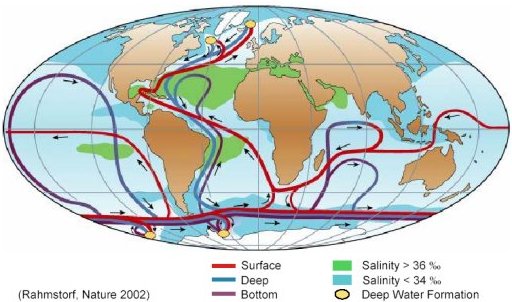
For background reading check out Stefan Rahmstorf's site on Thermohaline Ocean Circulation and these links on the Antarctic Circumpolar Current.
SCIENTISTS studying the icy depths of the sea around Antarctica have detected changes in salinity that could have profound effects on the world's climate and ocean currents.
The scientists returned to Hobart on Thursday after a one-month voyage studying the Southern Ocean to see how it is changing and what those changes might mean for global climate patterns.
Voyage leader Steve Rintoul said his team found that salty, dense water that sinks near the edge of Antarctica to the bottom of the ocean about 5 km down was becoming fresher and more buoyant.
So-called Antarctic bottom water helps power the great ocean conveyor belt, a system of currents spanning the Southern, Pacific, Indian and Atlantic Oceans that shifts heat around the globe.
"The main reason we're paying attention to this is because it is one of the switches in the climate system and we need to know if we are about to flip that switch or not,'' said Rintoul of Australia's government-backed research arm the CSIRO.
"If that freshening trend continues for long enough, eventually the water near Antarctica would be too light, too buoyant to sink and that limb of the global-scale circulation would shut down,'' he said on Friday.
Cold, salty water also sinks to the depths in the far north Atlantic Ocean near Greenland and, together with the vast amount of water that sinks off Antarctica, this drives the ocean conveyor belt.
This system brings warm water into the far north Atlantic, making Europe warmer than it would otherwise be, and also drives the large flow of upper ocean water from the tropical Pacific to the Indian Ocean through the Indonesia Archipelago.
If these currents were to slow or stop, the world's climate would eventually be thrown into chaos.
"We don't see any evidence yet that the amount of bottom water that's sinking has declined. But by becoming fresher and less dense it's moving in the direction of an ultimate shutdown.''


 Posts




