Showing posts with label organic dye. Show all posts

Better Plastic Solar Cells  

Posted by Big Gav in , ,

Technology Review has an article on improvements to organic dye (Grätzel) solar cells - Better Plastic Solar Cells.

Dye-sensitized solar cells, sometimes called Grätzel cells after their inventor, Michael Grätzel, a chemistry professor at the École Polytechnique Fédérale de Lausanne, in Switzerland, have long been considered a promising technology for reducing the cost of solar power. They're potentially cheaper to make than conventional solar cells and can be quickly printed. But this potential hasn't been realized because to achieve efficiency levels high enough to compete with conventional solar cells--about 10 percent--it's been necessary to use volatile electrolytes that need to be carefully sealed inside the cells, an expensive and unreliable step in the manufacturing.

Now Grätzel, along with Peng Wang, a professor at the Changchun Institute of Applied Chemistry, Chinese Academy of Sciences, have made efficient solar cells that use nonvolatile electrolytes, with the best achieving efficiencies of 10 percent. They also showed that the solar cells remained stable when exposed to light and high temperatures for 1,000 hours. The advance "pushes the technology close to over the '10 percent hump,' which is where a thin-film technology needs to be to be economically competitive," says Tonio Buonassisi, a professor of mechanical engineering at MIT.

One of the electrolytes is something called an ionic fluid--a fluid largely made up of ions and often composed of salts that have low melting temperatures. An ionic fluid can be used with plastic electrodes, which would allow for solar cells that are both efficient and flexible, and therefore could be incorporated into clothing, awnings, and covers for cars. "We never dreamt that we could have efficiencies of 9 or 10 percent with ionic liquids," Grätzel says. "Ten years ago, we had 1 percent efficiency, and we never thought it would get any better."

The new solar cells were made possible by advances first published this summer. In that work, the researchers increased the conductivity of electrolytes based on ionic fluids and produced solar cells that were 8.2 percent efficient. In the current work, published last month in the Journal of Physical Chemistry, the researchers further increased the efficiency by pairing the ionic liquid electrolyte with a new dye, the part of the dye-sensitized solar cell that absorbs sunlight. The new dye absorbs light far better than the conventional dye. Because the dye absorbs light so well, it's possible to cut the thickness of the active material in the solar cell in half, which makes it easier for electrons to escape the solar cell and reach an external circuit. That, in turn, increases efficiency, in this case to 9.1 percent.

The researchers also paired the new dye with a nonvolatile solvent-based electrolyte. It's not quite as stable as an ionic liquid, and it can't be used with plastic. But it allowed slightly higher efficiencies--up to 10 percent.

Grätzel is working with two companies to commercialize this technology. One, G24 Innovations, based in Cardiff, U.K., is planning to sell dye-sensitized solar cells for applications such as recharging cell phones, especially in countries with unreliable electricity. Another company, Dyesol, based in Queanbeyan, Australia, is planning to sell solar cells that can double as the facades on buildings. Both companies have already developed dye-sensitized solar cells based on earlier technology, but the recent advances could make the cells cheaper and significantly improve performance.

CleanTechnica has more - Dye-Sensitized Solar Cells Reach Highest Efficiency Ever.
Chinese and Swiss researchers announced earlier this week that they have reached the highest efficiency yet for dye-sensitized solar cells (Grätzel cells). The photovoltaic cells are cheaper than silicon-based solar cells, but until this week’s discovery their drawbacks have outweighed their benefits. ...

While silicon-based solar cells have typical efficiencies of about 12 percent, they are significantly more expensive to produce. And since the prohibitive cost of silicon solar cells prevents many homes and businesses from committing to solar energy, a cheaper solution should be welcomed.

Colourful Concentrators: Organic Solar  

Posted by Big Gav in , , , ,

Technology Review has an article on advanced organic dyes that more efficiently concentrate sunlight, which MIT researchers believe will reduce the cost of producing solar power - A Better Solar Collector.

Looking to make solar panels cheaper, MIT researchers have created sheets of glass coated with advanced organic dyes that more efficiently concentrate sunlight. The researchers, whose results appear in this week's issue of Science, say that the coated glass sheets could eventually make solar power as cheap as electricity from fossil fuels.

The researchers show that the glass sheets can reduce the amount of expensive semiconducting material needed in solar panels and provide a cheap way to extract more energy from high-energy photons, such as those at the blue end of the spectrum. "This could be the cheapest solar technology," says Marc Baldo, a professor of electrical engineering at MIT. "And I think one day, it could be competitive with coal."

The simple, flat sheets of glass have a number of advantages over previous solar concentrators, devices that gather sunlight over a large area and focus it onto a small solar cell that converts the light into electricity. Solar concentrators in use now employ mirrors or lenses to focus the light. Because the new glass sheets are lighter and flat, they can easily be incorporated into solar panels on roofs or building facades. They could also be used as windows, which, connected to solar cells, could generate electricity. What's more, mirrors and lenses require mechanical systems for tracking the sun to keep the light focused on a small solar cell. These tracking systems add cost and can break down over the decades that solar panels are made to be in service. The flat glass concentrators don't require a tracking system.

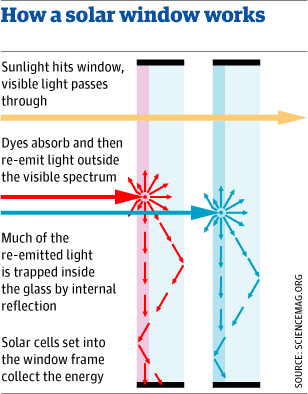
Instead of using optics, the glass sheets concentrate light using combinations of organic dyes specially designed by Baldo and his coworkers. Light is absorbed by the organic dyes coating one side of the glass sheet. The dyes then emit the light into the glass. The glass channels the light emitted by the dye to the edges of the glass, in the same way that fiber-optic cables channel light over long distances. Narrow solar cells laminated to the edges of the glass collect the light and convert it into electricity. The amount of light concentration depends on the size of the sheet--specifically, the ratio between the size of the surface of the glass and the edges. To a point, the greater the concentration, the less semiconductor material is needed, and the cheaper the solar power.

The story has been reported in a lot of mainstream media outlets too, like this one at The Guardian - Dyes turn windows into powerful solar panels.
Windows could be used as powerful solar panels thanks to a clever new technology that concentrates the sun's rays. The technique uses transparent dyes to capture, concentrate and redirect light along the surface of the glass to photovoltaic (PV) cells in the frame, which convert the light into electricity. The breakthrough means that there is a tenfold increase in power output compared to use of the PV cell alone.

The team, from the Massachusetts Institute of Technology (MIT), claims the technology could slash the cost of generating electricity from sunlight, making it more competitive with standard grid power. This is because the expensive PV cells only need to be installed at the sides of the panels, rather than across the whole surface.

Sunlight is concentrated in existing solar power devices using large, mobile mirrors that track the sun as it moves across the sky. But these can be expensive to deploy and maintain. In the MIT device, called an "organic solar concentrator" and described in the latest issue of Science, the researchers painted a mixture of organic dyes onto the surface of a pane of glass. The dyes trap different wavelengths of sunlight and then guide the energy along the glass towards the PV cells at the edges.

"The point of all this is to get away with using far fewer solar cells," said Marc Baldo, an electrical engineer at MIT. "The concentrator collects light over its whole front surface, but the solar cells need only cover the area of the edges."

As the edges of a glass panel can often be 100 times smaller in area than the surface itself, he added, solar panels would need 100 times fewer PV cells to collect the same energy. "So we can save money. Since industry can't produce enough solar cells to satisfy demand, this might also be a good way to stretch production." ...

Greenpeace's chief scientist, Doug Parr, said: "Innovations like this show renewable technologies can take a quantum leap forward if given proper financial support from governments. Rather than betting the farm on outdated nuclear technology and hoping that coal will one day be 'clean', Gordon Brown should be creating green jobs and pushing at the real technological frontier of the 21st century - renewables."

Continuing the solar theme, the San Francisco Chronicle reports the biggest U.S. photovoltaic power plant is to b built in Florida.
SunPower Corp. of San Jose will announce plans today to build the country's largest photovoltaic solar power plant in Florida. Unlike most large-scale solar plants, which use big mirrors to concentrate sunlight, the SunPower project will use the same solar panels that homeowners install on their rooftops.

It will be built in Florida's DeSoto County and will generate up to 25 megawatts of electricity, enough to power 18,750 homes. SunPower also will build a smaller facility, generating 10 megawatts, at Kennedy Space Center.

Organic Dye Solar Cells  

Posted by Big Gav in , ,

Technology Review has an update on progress in the world of Graetzel solar cells - "Toward Cheaper, Robust Solar Cells".

Cheap and easy-to-make dye-sensitized solar cells are still in the early stages of commercial production. Meanwhile, their inventor, Michael Gratzel, is working on more advanced versions of them. In a paper published in the online edition of Angewandte Chemie, Gratzel, a chemistry professor at the École Polytechnique Fédérale de Lausanne in Switzerland, presents a version of dye-sensitized cells that could be more robust and even cheaper to make than current versions.

Dye-sensitized solar cells consist of titanium oxide nanocrystals that are coated with light-absorbing dye molecules and immersed in an electrolyte solution, which is sandwiched between two glass plates or embedded in plastic. Light striking the dye frees electrons and creates "holes"--the areas of positive charge that result when electrons are lost. The semiconducting titanium dioxide particles collect the electrons and transfer them to an external circuit, producing an electric current.

These solar cells are cheaper to make than conventional silicon photovoltaic panels. In principle, they could be used to make power-generating windows and building facades, and they could even be incorporated into clothing. (See "Window Power" and "Solar Cells for Cheap.") A Lowell, MA-based company called Konarka is manufacturing dye-sensitized solar cells in a limited quantity. But the technology still has room for improvement.

In existing versions of the solar cells, the electrolyte solution uses organic solvents. When the solar cells reach high temperatures, the solvent can evaporate and start to leak out. Researchers are now looking at a type of material that may make a better electrolyte: ionic liquids, which are currently used as industrial solvents. These liquids do not evaporate at solar-cell operating temperatures. "Ionic liquids are less volatile and more robust," says Bruce Parkinson, a chemistry professor at Colorado State University.

New dyes are also being investigated. In commercial cells, the dyes are made of the precious metal ruthenium. But researchers have recently started to consider organic molecules as an alternative. "Organic dyes will become important because they can be cheaply made," Gratzel says. In the long run, they might also be more abundant than ruthenium. ...

Parkinson cautions, though, that work on organic-dye solar cells is still at a very early stage. Going from a laboratory prototype to a commercial module typically reduces efficiencies significantly. To capture a larger share of the solar-power market, dye-sensitized solar cells will require some more improvements. "We really need a breakthrough to get up to 15 percent efficiency in the lab," Parkinson says.

Statistics

Locations of visitors to this page

blogspot visitor
Stat Counter

Total Pageviews

Ads

Books

Followers

Blog Archive

Labels

australia (619) global warming (423) solar power (397) peak oil (355) renewable energy (302) electric vehicles (250) wind power (194) ocean energy (165) csp (159) solar thermal power (145) geothermal energy (144) energy storage (142) smart grids (140) oil (139) solar pv (138) tidal power (137) coal seam gas (131) nuclear power (129) china (120) lng (117) iraq (113) geothermal power (112) green buildings (110) natural gas (110) agriculture (91) oil price (80) biofuel (78) wave power (73) smart meters (72) coal (70) uk (69) electricity grid (67) energy efficiency (64) google (58) internet (50) surveillance (50) bicycle (49) big brother (49) shale gas (49) food prices (48) tesla (46) thin film solar (42) biomimicry (40) canada (40) scotland (38) ocean power (37) politics (37) shale oil (37) new zealand (35) air transport (34) algae (34) water (34) arctic ice (33) concentrating solar power (33) saudi arabia (33) queensland (32) california (31) credit crunch (31) bioplastic (30) offshore wind power (30) population (30) cogeneration (28) geoengineering (28) batteries (26) drought (26) resource wars (26) woodside (26) censorship (25) cleantech (25) bruce sterling (24) ctl (23) limits to growth (23) carbon tax (22) economics (22) exxon (22) lithium (22) buckminster fuller (21) distributed manufacturing (21) iraq oil law (21) coal to liquids (20) indonesia (20) origin energy (20) brightsource (19) rail transport (19) ultracapacitor (19) santos (18) ausra (17) collapse (17) electric bikes (17) michael klare (17) atlantis (16) cellulosic ethanol (16) iceland (16) lithium ion batteries (16) mapping (16) ucg (16) bees (15) concentrating solar thermal power (15) ethanol (15) geodynamics (15) psychology (15) al gore (14) brazil (14) bucky fuller (14) carbon emissions (14) fertiliser (14) matthew simmons (14) ambient energy (13) biodiesel (13) investment (13) kenya (13) public transport (13) big oil (12) biochar (12) chile (12) cities (12) desertec (12) internet of things (12) otec (12) texas (12) victoria (12) antarctica (11) cradle to cradle (11) energy policy (11) hybrid car (11) terra preta (11) tinfoil (11) toyota (11) amory lovins (10) fabber (10) gazprom (10) goldman sachs (10) gtl (10) severn estuary (10) volt (10) afghanistan (9) alaska (9) biomass (9) carbon trading (9) distributed generation (9) esolar (9) four day week (9) fuel cells (9) jeremy leggett (9) methane hydrates (9) pge (9) sweden (9) arrow energy (8) bolivia (8) eroei (8) fish (8) floating offshore wind power (8) guerilla gardening (8) linc energy (8) methane (8) nanosolar (8) natural gas pipelines (8) pentland firth (8) saul griffith (8) stirling engine (8) us elections (8) western australia (8) airborne wind turbines (7) bloom energy (7) boeing (7) chp (7) climategate (7) copenhagen (7) scenario planning (7) vinod khosla (7) apocaphilia (6) ceramic fuel cells (6) cigs (6) futurism (6) jatropha (6) nigeria (6) ocean acidification (6) relocalisation (6) somalia (6) t boone pickens (6) local currencies (5) space based solar power (5) varanus island (5) garbage (4) global energy grid (4) kevin kelly (4) low temperature geothermal power (4) oled (4) tim flannery (4) v2g (4) club of rome (3) norman borlaug (2) peak oil portfolio (1)