Posted
by Big Gav
in
pine beetles
TreeHugger has a look at a use for the glut of timber from trees killed by pine beetles - Interlocking Cross Laminated Timber Could Use Up Square Miles Of Beetle-Killed Lumber, and Look Gorgeous, Too.
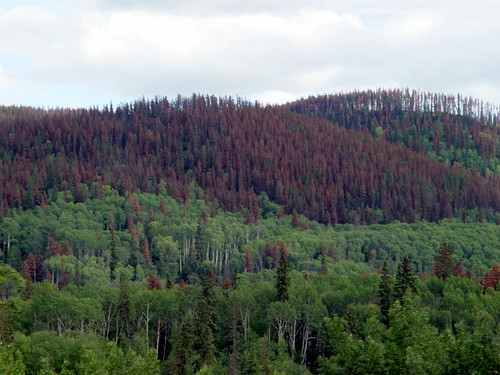
The Mountain Pine Beetle is killing trees across North America, including up to 44% of Colorado's forests. If there was any infrastructure investment to be made right now, I would have thought it would be to set up a pile of cross laminated timber factories fast, and put people to work churning out panels at a standard size and stockpiling them; CLT is strong, fire resistant, it sequesters carbon dioxide and it makes very pretty buildings.
At the University of Utah's Integrated Technology in Architecture Center, (ITAC) they are working on a modification of the design of CLT for the American market, namely figuring out how to make it cheaper.
Posted
by Big Gav
in
global warming,
pine beetles
The NYT has an editorial on pine beetles and global warming - Pines, Beetles and Bears.
White bark pine forests are in trouble all across Wyoming, Idaho and Montana. Great swaths of trees are dead or dying after being attacked by the mountain pine beetle and a disease called white pine blister rust. The forests used to be protected by harsh winters and cool summers. But warmer winters and summers have allowed the beetle to breed more quickly and to move to the higher elevations favored by white bark pines.
Last summer, pilots working with the United States Forest Service and the Natural Resources Defense Council made low-level flights over 25 million acres of forest, trying to gauge how much damage has been done. The results, released this month, are devastating. Just over half the white bark pine forests are dead; one-fourth have medium to high mortality; few forests have escaped some damage.
The wider ecological effects could be serious. These forests slow the rate of spring snowmelt; without them, the spring runoff will happen faster and streams and rivers will see reduced flow and higher temperatures later in the season. The loss of the pines also threatens the symbiotic relation between the Clark’s nutcracker and the pines, which depend on the bird for reseeding, as well as red squirrels, which gather pine nuts.
The worst damage will be done to grizzly bears, which feed heavily on pine nuts before hibernation. Studies have shown that in good pine-nut years, grizzlies stay in the high country where white bark pines prevail. In bad years, the bears are driven down to lower elevations where they interact more frequently — and tragically — with humans.
Slowing the pace of climate change could help, but the bears cannot wait for radical shifts in public policy. Facing possible catastrophe, the bears need all of the help they can get, including continued protection under the Endangered Species Act.
Posted
by Big Gav
in
biochar,
canada,
global warming,
pine beetles
Tyler Hamilton has an interesting article in the Toronto Star about the damage pine beetles are doing to Canadian forests and the impact this will have in terms of increased carbon emissions unless something is done.
One company is suggesting harvesting the dead wood and using it for power generation, thus making use of the material and emitting CO2 instead of more potent methane - another idea being floated is to convert the wood to biochar (see Black Earth for more on biochar).
According to a report last week in the scientific journal Nature, the mountain pine beetle that has killed 130,000 square kilometres of coniferous forest on the west coast has also turned those trees into net emitters of greenhouse gases.
When healthy, the trees act as a carbon sink, absorbing carbon dioxide from the atmosphere and storing it in biomass. When dead, however, the trees no longer absorb CO2. In fact, the opposite happens. As the trees rot and decompose, they release methane and other carbon-equivalent gases.
The B.C. researchers who wrote the report found that the greenhouse gas emissions from these dead trees over a 20-year period would roughly equal all CO2 emissions from Canada's entire transportation sector over five years. "So these are very large numbers in terms of impacts to the atmosphere," said report co-author Werner Kurz, a research scientist with Natural Resources Canada.
No kidding.
But the situation isn't hopeless. When British Columbia released its provincial energy plan last February, it announced that B.C. Hydro would consider proposals for harvesting trees infested with pine beetles for energy generation.
Vancouver-based Nexterra Energy, for example, has teamed up Pristine Power of Calgary to establish a network of small gasification power plants in B.C. that could turn infested wood into 200 megawatts of electricity. Rather than let the trees rot and release methane, which is 21 times more potent than CO2, the idea is to extract usable energy out of them that would displace dirtier electricity and clear the forest for new growth.
The key is to move fast, leaving less time for the dead trees to decay. Another, and arguably more effective, approach is to harvest the trees and convert them to char, or "biochar." Using a process called pyrolysis, the wood is essentially baked in the absence of oxygen and converted into a carbon-rich char.
This char contains about 60 per cent of the carbon in the original wood and, unlike wood, the char won't decay – it remains chemically stable for hundreds of years, trapping the carbon permanently.
Another bonus is that char can be ground up and spread over topsoil to improve crop fertility and enhance nutrients and water retention in soil. Since the carbon is bound in the char, it is effectively sequestered in the soil.
Cornell University's Johannes Lehmann, a leading expert on biochar studies, said it's something the B.C. government might want to look at. "It could be that a good portion of the emissions (from the dead trees) can be avoided by conversion of the damaged biomass into biochar," he wrote in an email.
The beauty with char is that you can pack it and weigh it. You know how much carbon is locked into a kilogram of char, so calculating carbon credits is easy compared to alternatives, such as guessing how much CO2 a new forest will absorb.
Perhaps some clever entrepreneur will see the potential of selling bags of pine-beetle wood char as a way of boosting the performance of residential gardens.


 Posts
Posts