Posted
by Big Gav
in
australia,
beyond zero emissions,
renewable energy,
zero carbon australia
Zero Carbon Australia's Matthew Wright has a response to a recent competing proposal for 100% renewable energy from UNSW's Mark Diessendorf - 100% renewables, no hot air.
The Zero Carbon Australia Stationary Energy project has paved the way for Australian researchers to contribute their best scenarios for transitioning to a 21st century renewable powered economy in a decade.
When we first set out on the momentous task to write the plan, recruiting dozens of engineers, physicists and scientists, we really hoped that we would create a competition around the goal on who could write the best scenarios for transition. We wanted to see reports like ours being written by state and federal governments, public and private research institutions and universities. We congratulate UNSW for being the first institution to take up the challenge.
As the community partner in the ZCA project, Beyond Zero Emissions welcomes the UNSW’s contribution with its soon to be released scenario for taking the economy to 100 per cent renewable energy.
Before we can discuss the merits of their proposal, we need to consider the two schools of thought on how to achieve a completely decarbonised economy: those who think we should have a fossil fuel powered "transition;" and those who think that transition using fossil fuel “lite” technologies – namely fossil gas – is a diversion, not a shortcut. Beyond Zero Emissions fit into the latter category while the UNSW fit somewhere in between.
Based on what is known about the UNSW plan, the research recommends building gas peaker plants to generate 14 per cent of Australia’s electricity needs. These plants would run on fossil gas – which would include petroleum gas and coal seam gas – and switch to gasified biomass at an unspecified point in the future.
We believe that it is simplistic and naïve to believe that fossil gas feedstock will be replaced with biomass feedstock, and think that future scenarios from universities and environmental organisations will send a green light to oil and gas companies Origin Energy, AGL, Santos, etc, to proceed with their massive expansion of coal seam gas in the food producing areas and forests of NSW and QLD; not to mention their intentions for Tasmania, Victoria, West Australia and their shale gas dreams in SA.
Even if the switch to biomass was contemplated on the studies' proposed scale, BZE’s research team had already looked seriously into biomass burning for the specific task of addressing reduced solar and wind resources in the winter. After diligent analysis, it was decided that a combination of overcapacity and biomass co-firing would be the best, least environmentally damaging and cheapest way to meet the more challenging winter demand.
The UNSW team, by their own admission, hasn’t done the economics on their transition plan, and so Beyond Zero Emissions can’t actually comment on the costs directly. What we do know is that our researchers ruled out the gasification of biomass due to the lack of demonstrated commercial-scale projects, the lack of project pipeline and known cost curves, and the fact that storage wasn’t demonstrated on any scale.
The UNSW use of biogas or biomass gasification was investigated, however research found that no technology existed on the scale needed and the costs quoted were as much as 10 times the cost of transporting biomass pellets. Palletisation as chosen by the Zero Carbon Australia team is a very well known process, with a significant scale industry operating in Europe and the US.
The challenge for the UNSW team is to either size their gas production for the maximum peak demand of their turbines, which I would expect would be in the order of 20-50GW of capacity, or to add storage for their gasified biomass, which is a costly option. The UNSW proposals might combust hydrogen and carbon monoxide directly, or alternatively reform the gasified biomass into methane, but both these options would prove to be very expensive. We are confident that our plan will be cheaper than the UNSW plan if they decide to stick to their choice of gasified biomass.
Gas generation is the most notable difference between the Zero Carbon Australia plan and the UNSW scenario but it’s not the only one.
The ZCA included a significant energy efficiency program, the most ambitious one proposed to date, which shows how we can deliver half the end use energy we currently deliver. How we do that is being comprehensively detailed in the work of the Zero Carbon Australia Buildings plan, which will be published in February next year.
Then there’s our plan to link the main electricity grids in Australia: the Mount Isa mine grid in the north and the eastern seaboard grid with the West Australian grids. This proposed updating of infrastructure is on par with what’s happening in China, in South America, and serious plans to connect North Africa and the Middle East to Europe. Our plan to link eastern and Western Australia with HVDC, creating a national grid, is consistent with the recommendation of Siemens Australia. The cost of this technology has come down since we researched and produced our report.
In his article last month, UNSW's Mark Diesendorf questioned whether Australia has the available labour force to build the renewable energy system, even though it is adequately addressed in the ZCA plan. When the coal industry is set to triple in size, we hear a bit about capacity constraints, but nobody concludes it’s a showstopper. When the gas industry decides its going to build $100, $200 or even $400 billion worth of LNG trains, no one says that it can’t be done because of capacity constraints. Not only does the same logic apply to a rapid rollout of renewables, but workers are crying out for jobs in the renewable powered cleantech economy.
Posted
by Big Gav
in
beyond zero emissions,
zero carbon australia
The Climate Spectator has an article from UNSW’s Mark Diesendorf looking at an alternative to the Zero Carbon Australia plan to switch Australia to 100% renewable energy - A cheaper path to 100% renewables.
Australia has enormous renewable energy resources in the form of sunshine, wind, biomass (organic) residues, hot rocks and waves. But is a transition to 100 per cent renewable energy technologically and economically feasible here?
Last year, a ground-breaking study, "Zero Carbon Australia Stationary Energy Plan," claimed that 100 per cent renewable energy is technically possible and would cost about $370 billion.
The core of the ZCA study was an hour-by-hour computer simulation, by Jack Actuarial Consulting, of Australian electricity demand in 2008 and 2009, supplied mostly by concentrated solar thermal power (CST) with thermal storage, and by wind power.
As is inevitable in a first-of-a-kind study of a revolutionary new energy system, some simplifying assumptions were made:
– Western Australia was connected ... to the eastern states with new transmission lines;
– Second-generation CST power stations … were chosen as the principal energy source. These solar stations were given thermal storage equivalent to 17 hours of full power output and so can, in theory, run through the night;
– A daily average was taken for solar energy inputs, although hourly data are much more accurate;
– To compensate for the reduction in sunshine in winter, a vast excess of CST generating capacity was introduced;
– Also for winter, biomass residues were shipped out to the solar power stations to be burned under the thermal storages when necessary.
At the University of New South Wales, PhD candidate Ben Elliston, Associate Professor Iain MacGill and I initiated an independent research project based around some different assumptions, to remove the above assumptions of the ZCA study.
We performed a series of hour-by-hour computer simulations of the 2010 electricity demand in the five Australian states covered by the National Electricity Market. We chose a broader energy mix than ZCA: first-generation CST with thermal storage, wind, solar PV, gas turbines and existing hydro – all commercially available technologies. Gas turbines, which are like jet engines, are highly flexible generating plants ideally suited to supporting fluctuating renewable generation. Some are already being deployed in Australia. They could initially be fuelled on natural gas, however this could be replaced with liquid biofuels produced sustainably from the residues of existing crops.
We found that it is, indeed, technically feasible to supply current electricity demand by 100 per cent renewable energy with the same reliability as the existing fossil fuelled system.
The key challenge is meeting demand on winter evenings. At sunset on overcast days, the thermal energy storages are not full and sometimes wind speeds are low. In our initial simulations, to be presented in a peer-reviewed paper at the forthcoming Australian Solar Energy Society’s annual conference, we used biofuelled gas turbines to fill the gap. This is likely to be lower cost than ZCA’s solution of choosing a vast excess of CST power stations, which would not be used in summer.
However, the UNSW study proposes an even cheaper solution than lots of gas turbines or CST: namely a revitalised energy efficiency program to reduce electricity demand on winter evenings. Furthermore, in a ‘smart’ electricity system it will be easier to reduce demand quickly during periods of low supply.
Both the ZCA and UNSW studies refute the claims by renewable energy sceptics that renewable energy cannot replace baseload (24-hour) coal-fired power. ZCA interprets its results by concluding that CST with thermal storage is baseload.
We interpret the simulation results differently, concluding that although CST can perform in a similar manner to baseload in summer, it does not in winter. However, we maintain that it doesn’t matter. The important result is that our renewable energy mix gives the same reliability of the whole generating system in meeting demand as the existing polluting system.
Although the UNSW study has not yet performed an economic analysis, our scenarios have the potential economic advantage over ZCA’s that they don’t require transmission links between WA and the eastern states and they have a smaller percentage contribution from CST, currently the most expensive component of the energy mix.
It should be emphasised that neither the modelling of ZCA nor UNSW establishes a timescale for the transition to 100 per cent renewable electricity. However, the ZCA study claims that the transition could be made in a decade. That claim is an assumption based on the observations that Australia could supply the raw materials for manufacturing the systems and that solar and wind technologies are suitable for rapid manufacture.
Posted
by Big Gav
in
beyond zero emissions,
sydney theatre company,
zero carbon australia
The ABC will be screening a segment from a Q&A at the Sydney Theatre Company feauturing Beyond Zero Emissions' Matthew Wright on Wednesday - Greening The Wharf.
Moderated by Tony Jones with panellists including The Hon. Bob Carr, Dr Zhengrong Shi, Graham Bradley and Sam Mostyn.
A 15 minute excerpt will run on 15 February on ABC1 TV as part of the Best of Big Ideas broadcast.
The full one hour will feature on ABC1 TV on Wednesday 16 February at 11am and will also be available through ABC online i-view.
BZE will also be featuring at the
Sustainable Living Festival in Melbourne on the weekend.
Posted
by Big Gav
in
australia,
beyond zero emissions,
renewable energy,
zero carbon australia
The SMH has a look at Thursday's launch of Zero Carbon Australia's plan - How to be fully renewable in 10 years.
AUSTRALIA could switch completely to renewable energy within a decade by building a dozen vast, new solar power stations and about 6500 wind turbines, according to a major new study.
The Zero Carbon Australia Stationary Energy Plan - a collaboration between Melbourne University's Energy Research Institute, the environment group Beyond Zero Emissions and engineers Sinclair Knight Merz, puts the cost at $37 billion in private funding and public investment every year for the next decade.
The price tag may make it sound like a pipedream but the scheme earned the endorsement of the federal Liberal MP Malcolm Turnbull who added his support at a forum at Sydney Town Hall last night. ''The work they have done is important,'' Mr Turnbull said. ''It provides the most comprehensive technical blueprint yet for what our engineers, our scientists, can begin to do tomorrow.''
Mr Turnbull contrasted the Coalition's ''direct action'' plan with Labor's policy, which he claimed would lead to longer delays in cutting greenhouse gas emissions. ''I believe our long-term global goal is to very substantially reduce our emissions, a goal that will require almost all of our stationary energy to be produced from zero or near-zero emission sources,'' Mr Turnbull said. ''This report demonstrates we could already be technologically ready to do that.''
The plan has also been endorsed by Australia's former chief scientist Robin Batterham, and a senior official at the International Energy Agency's renewable energy division, Cedric Philibert.
However, the National Generators Forum, which represents power station owners, and the office of the federal Energy Minister, Martin Ferguson, were decidedly lukewarm about the plan when asked about the findings last month. Under the plan, 60 per cent of the nation's electricity would be sourced from 12 huge solar thermal power plants, which use Australian-developed technology to store heat in molten salt, allowing them to operate for long periods when there is no sunshine.
The remaining 40 per cent of the power grid would be filled by about 6500 wind turbines at 23 large-scale wind farms dotted mainly around the coast.
The plan would generate 325 terawatt hours of electricity a year, meeting the nation's entire power demands in the year 2020, if a comprehensive energy efficiency plan is also factored in. Any shortfalls could be made up by biomass energy generation, using a portion of the stubble from the nation's wheatfields.
To properly harness all the renewable energy, the report calls for the unification of Australia's three separate electricity grids and some new transmission lines to link the new power stations to capital cities, at a total cost of $92 billion.
If the cost of completely transforming the energy sector was passed directly on to households, it would add 30 per cent to the average utility bill.
Posted
by Big Gav
in
australia,
beyond zero emissions,
renewable energy,
zero carbon australia
Zero Carbon Australia will be launching their Stationary Energy Plan in Sydney this Thursday.

Thursday 12 August - 6-7.45pm
Sydney Town Hall, 483 George St, Sydney
Featuring:
Hon. Bob Carr - Former NSW Premier
Hon. Malcolm Turnbull - Federal MP for Wentworth
Senator Scott Ludlam - Federal Senator WA
Matthew Wright - Executive Director Beyond Zero Emissions
Allan Jones MBE - Chief Development Officer, Energy & Climate Change, City of Sydney
MC - Quentin Dempster - journalist and broadcaster
Free Entry
You are invited to attend the Sydney launch of the Zero Carbon Australia Stationary Energy Plan.
This cutting-edge plan, the culmination of over 12 months and thousands of hours of pro bono work by engineers, scientists and postgraduate students, is a collaboration between the climate solutions think tank Beyond Zero Emissions, and the University of Melbourne Energy Institute.
This plan is unique in Australia. It is a detailed and costed blueprint for transitioning our stationary energy sector to 100% renewable energy in ten years. The technologies utilised in this plan are commercially available now.
This free public event will cover the details of the plan as well as the state of renewable energy in Australia more broadly. A panel discussion with technical experts will follow the presentations.
Don't miss out!
If you would like to take a look at the report or synopsis they are available here:
Synopsis 16 pages:
http://media.beyondzeroemissions.org/ZCA2020_Stationary_Energy_Synopsis_v1.pdf
Full Report 200 pages:
http://beyondzeroemissions.org/zero-carbon-australia-stationary-energy-plan-available-now-download-or-purchase-your-copy
Posted
by Big Gav
in
australia,
beyond zero emissions,
renewable energy,
zero carbon australia
Phil Hart has a post on the Zero Carbon Australia plan for making Australia's energy supply 100% renewable - Zero Carbon Australia.
The Zero Carbon Australia report attempts to tackle head-on some of the arguments against renewables and to show that they can make much more than a niche contribution to total energy demand. With a target of 100% renewable energy by 2020, clearly this is an ambitious report. While no one suggests this is probable under politics as usual, it shows what might be possible if we are prepared to take a radically new approach.
In the peak oil sphere, there is significant concern about energy return from renewable energy projects. While this report does not explicitly use the term 'Energy Return on Energy Invested' (EROEI), it does provide the numbers for steel and concrete use required to deliver the plan against the current volume of use in Australia. We could get a lot more utility out of those resoures than we do at the moment.
Under the ZCA2020 Plan, it is projected that 2020 grid electricity demand will be over 40% higher than today, from 228TWh/yr up to 325TWh/yr. This increase in electricity demand is due largely to the switch of services currently provided by gas and oil to be supplied more efficiently with, renewable electricity. The increase is significantly offset by ambitious but achievable electrical energy efficient targets.
To meet this demand, a combination of wind and solar thermal with storage are proposed as the primary electricity generation technologies. Biomass and hydro are utilised as backup, supplying about 2% of annual electricity.
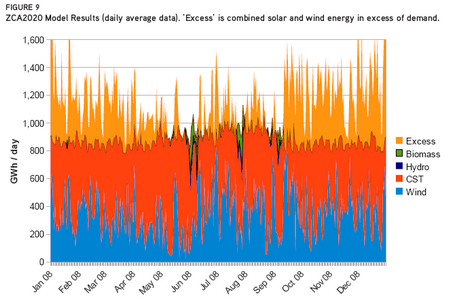
The ZCA2020 electricity generation mix has been quantitatively modelled in high detail using real-world data, with the results demonstrating that Australia’s electricity demand can be met by 100% renewable energy.
The data underlying the model are derived from real meteorological recordings of solar insolation at the 12 proposed CST sites, real wind speeds at existing wind farms, and grid demand based on actual demand in the National Electricity Market (NEM). Modelling has been performed on a half-hourly timescale for the years 2008 and 2009.
The Plan’s proposed combination of 42.5 GW of CST and 50 GW of wind provides enough energy to cover 98% of the electricity demand modelled, with the remaining 2% being supplied by existing hydro power (5 GW) and heat from biomass co-firing on 10 GW of the CST plants. This is represented by the small green and navy blue areas in Figure 9.


 Posts
Posts