Peak Oil In Parliament  

Posted by Big Gav

I went down to Parliament House last night to check out the Peak Oil session organised by the Greens and Sydney Peak Oil. I thought it went pretty well - there was around 70-80 people in the audience, and the one person I chatted to was an MP, so I'd assume that a reasonable proportion of the attendees were our elected representatives rather than curious bloggers.

The MP I chatted to was from a coal mining region and looked aghast when I asked if any of the local miners were talking about coal liquifaction and the like - and instead said that he has watched "End of Suburbia" and thought it was very interesting, and talked about the impact of rising fuel prices on his constituents and the need to improve public transport. He then veered onto the hydrogen economy and looked appalled when I said any move to hydrogen based transport in the near term would probably be at the behest of the nuclear power industry and muttered about intergeneration equity issues and the like. I think a casual observer would have thought he was more convinced about peak oil and the need for sustainable solutions than I am (although I was on my best behaviour and just trying to make non-controversial conversation). Anyway - while I've forgotten his name he seemed like a good guy.

The speakers themselves were Greens MLC Ian Cohen, Rowan Tucker-Evans from Sydney Peak Oil and PeakOil.com, author Brian Fleay and Professor Ian Lowe - President of Australian Conservation Foundation.

Nothing new in the talks themselves but I thought they were all well done - Rowan's presentation looked very professional and Ian Lowe has obviously talked on the topic plenty of times before as he delivered it all very smoothly.

The questions that I stayed for afterwards were a mixed bag, with the subjects that seemed to get the most attention being the idea that Australia should keep its natural gas reserves to itself for future use (nice idea but very difficult to implement and probably a security risk in future should it be successfully implemented - long term contracts with the US and China are probably a wise form of protection money) and the topic of population. Ian Cohen noted that this was a controversial subject even within the Greens, and Ian Lowe said he though immigration should be reduced to around 60,000 per year, which would result in a stable population in around 15 (I think) years times based on demographic trends.

Ian Cohen followed up with a speech in the Legislative Council later on.

I wish to speak about Peak Oil. I attended a public forum at Parliament House tonight where I listened to presentations from Professor Ian Lowe of Griffith University, who is also the President of the Australian Conservation Foundation; Brian Fleay, author of the book Decline of the Age of Oil; and Rowan Tucker-Evans of the Sydney Peak Oil Group. Last week honourable members would have received an informative package produced by the Sydney Peak Oil group on this matter. Oil is a critical resource. Oil, natural gas and petroleum products are central to the functioning of the modern world economy.

Transport, agriculture, mining and construction industries are particularly reliant on the supply of oil. Crude oil provides 90 per cent of the world's transport fuels. Oil is required not only as a fuel for farm machinery, but also as a raw material for the production of pesticides and herbicides. Natural gas is used to synthesise nitrogen fertiliser. Farming implements are constructed and powered using oil. Food storage systems, such as refrigerators, are manufactured in oil-powered plants and distributed across oil-powered transportation networks.

The yields that modern farming obtains could not be sustained without oil. The strain on wheat farmers in America is apparent already. Recently they have had to absorb a tripling in fuel prices, combined with a doubling in fertiliser costs. Mining and construction, vital components of the Australian economy, are dependent on diesel fuel for machinery. Crude oil provides another vital component to any modern economy: plastic. Petrochemicals provide the feedstock for many products, from detergents to pharmaceuticals, prosthetics to contact lenses, and garbage bags to fishing line. The concept of Peak Oil comes from the observation that output from individual oil fields rises from initial production, reaches a maximum peak and then begins to decline. The peak of production occurs when approximately half of the oil has been extracted. With some exceptions, this holds true for a single well, a whole field, an entire region, and the world.

The ascent to world peak is characterised by the ability of oil producers to match or surpass world demand. This production growth has fuelled economic prosperity and enabled us to enjoy the modern world we live in. Oil shocks on this side of the peak have been caused by supply disruptions, such as the OPEC embargo and the Iranian revolution. After the world peak of oil is reached and decline sets in, the price of oil is expected to surge and fluctuate as oil exporters strain, then fail, to meet demand. Oil shocks on the down side of the peak will be very different to those experienced in the 1970s and 80s. They could be longer lasting and more damaging to the world economy. This will not be the end of oil—it will be the end of cheap, affordable oil. Saudi Arabia, the world's biggest oil producer, generates 90 per cent of its oil from just five old mature oil fields. Today we are consuming four to five barrels of oil for every one we find.

The implications of this trend will be immense and far reaching. Higher oil prices will have an inflationary effect. Interest rates will rise. Transportation costs will escalate. The price of food will follow. The effects on the economy and on our standard of living will be profound. There is an urgent need for Federal, State and local governments to respond to Peak Oil. We will need to rethink many aspects of our lives—how we travel, and how we source our good and services. There is an urgent need for transport demand management, with public transport the main priority. We also need to consider where our food comes from. The concept of "food miles" is important. In the United States of America, the average portion of food is transported 1,500 miles before it gets to the plate. In Canada that figure is 5,000 miles. In Australia we import food at a great ecological and energy cost. This will not be a viable option when the price of oil escalates, as it is bound to do. We need to consider food security.

I do not propose any magical solutions to this looming crisis. It certainly will be a wake-up call to many who take the abundance of our earth's resources for granted. I strongly urge the Government to seriously consider the potential impacts of Peak Oil when formulating policy and planning for the future. The path that our State is going down, with its addiction to more roads and motorways, will not be sustainable. The retention of farmland local to population centres is also important for food security. We must not become dependent on food imports. Myriad other social and economic impacts must be addressed. I hope our governments at all levels will be responsible and not bury their heads in the sand. It is interesting to note that if, as I understand it, we were going to consider timber product for fuel we would need the entire Australian agricultural production area.

Hot Hot Hot  

Posted by Big Gav

Australia is on track to have its hottest year ever, as is the world as a whole. The global warming denier camp is going to melt away as quickly as the glaciers and the polar ice caps at this rate.

This year may not have seemed like a scorcher, but it is firming as the hottest year since records began.

The past decade had unusually hot years, but 2005 is the one climatologists are watching closely. The record year, 1998, had the "El Nino of the century", significantly raising temperatures. This year could exceed that benchmark without an El Nino, a warming of the Pacific Ocean that affects Australia's climate.

In a statement to be released today, the Bureau of Meteorology says the first 10 months of 2005 were the warmest equivalent period since monthly records began in 1950, and it probably would be the hottest year since annual records began in 1910. Climate scientists are picking up a similar trend globally.

The record-breaking temperatures were, the bureau said, an indicator of climate change.

"This really emphasises how pervasive global warming actually is," said David Jones, head of climate analysis at the bureau's National Climate Centre.

The BBC has a report on yet another global warming feedback effect, this time in the form of increased humidity.
Water vapour rather than carbon dioxide in the atmosphere is the main reason why Europe's climate is warming, according to a new study. The scientists say that rising temperatures caused by greenhouse gases are increasing humidity, which in turn amplifies the temperature rise. This is potentially a positive feedback mechanism which could increase the impact of greenhouse gases such as CO2.

Global warming is also starting to severely affect fish stocks in the Pacific (and it has also been noted that we are literally devouring the remaining ocean life anyway, as we test all the limits to growth at once).

One of the culprits of global warming (and likely victims of peak oil) is the airline industry. Airbus did a spot of marketing with Qantas yesterday flying the world's largest passenger jet over Sydney harbour. One of the selling points of this behemoth is the improved fuel consumption - which Deutsche Welle notes is "12 percent lower than all other large aircraft according to Airbus -- is an important selling point given that fuel usage now accounts for around 16 to 20 percent of the overall costs of an airline".
Big enough to carry 853 passengers, the aircraft has 50 per cent more floor space than a Boeing 747-400. Qantas plans to have "just under" 500 seats in its 12 A380s. Airbus has been keen to point out that the aircraft is half as noisy as a 747. The French-based aircraft maker says the A380's size and fuel efficiency will also mean it will be up to 20 per cent cheaper to operate per seat than a 747.


ASPO Australia has been launched (pretty quietly if you ask me, as I had no idea this was happening) by the WA Sustainable Transport Coalition. The site also includes a blog by Bruce Robinson, with the first post pondering the future of toll road companies like Transurban and asking if these are a good place to have our super money invested in a post peak world.
ASPO Australia is an association of researchers, professionals and others with an interest in the study of peak oil and gas. ASPO Australia is part of a network of organisations around the world affiliated with the original Association for the Study of Peak Oil and Gas (ASPO) founded by Colin Campbell and Kjell Aleklett. The formation of ASPO-Australia is an initiative of the Sustainable Transport Coalition of WA.

On the ASPO-Oz website you will find a wide range of information and documents on peak oil and its implications. In the future this site will also include ASPO-Oz news, articles, press-releases and a calendar of peak-oil related events.


Energy Bulletin notes that Kuwait's largest field (Burgan) is starting to run out of oil (as predicted by the ASPO a few months ago). More commentary can be found at The Oil Drum.
The peak output of the Burgan oil field will now be around 1.7 million barrels per day, and not the two million barrels per day forecast for the rest of the field's 30 to 40 years of life, Chairman Farouk Al Zanki told Bloomberg.

He said that engineers had tried to maintain 1.9 million barrels per day but that 1.7 million is the optimum rate. Kuwait will now spend some $3 million a year for the next year to boost output and exports from other fields.

However, it is surely a landmark moment when the world's second largest oil field begins to run dry. For Burgan has been pumping oil for almost 60 years and accounts for more than half of Kuwait's proven oil reserves. This is also not what forecasters are currently assuming.

Last week the International Energy Agency's report said output from the Greater Burgan area will be 1.64 million barrels a day in 2020 and 1.53 million barrels per day in 2030. Is this now a realistic scenario?

The news about the Burgan oil field also lends credence to the controversial opinions of investment banker and geologist Matthew Simmons. His book 'Twilight in the Desert: The Coming Saudi Oil Shock and the World Economy' claims that the ageing Saudi oil filed also face serious production falls.

The implications for the global economy are indeed serious. If the world oil supply begins to run dry then the upward pressure on oil prices will be inexorable. For the oil producers this will come as a compensation for declining output, and cushion them against an economic collapse.

However, the oil consumers then face a major energy crisis. Industrialized economies are still far too dependent on oil. And the pricing mechanism of declining oil reserves will press them into further diversification of energy supplies, particularly nuclear, wind and solar power.

Peak Oil is starting to be openly recognised by some sections of the political right (though I'm sure they've been aware of it for a long time) - George Shultz and James Woolsey have an article in Mechanical Engineering Magazine called "The Petroleum Bomb".
Our nation's dependence on imported oil leaves it dangerously vulnerable to attack.

Four years ago, on the eve of Sept. 11, 2001, the need to reduce radically our reliance on oil was not clear to many and, in any case, the path of doing so seemed a long and difficult one. Today, both assumptions are being undermined by the risks of the post-9/11 world and by technological progress in fuel efficiency and alternative fuels.

A single well-designed attack on the petroleum infrastructure in the Middle East could send oil to well over $100 per barrel and devastate the world's economy. That reality, among other risks, and the fact that our current transportation infrastructure is locked in to oil, should be sufficient to convince any objective observer that oil dependence today creates serious and pressing dangers for the United States and other oil-importing nations.

Dependence on petroleum and its products for the lion's share of the world's transportation fuel creates special dangers in our time.

Energy Bulletin notes some background for this one. I've always found the whole "Committee On The Present Danger" concept outrageously Orwellian - the first time I heard of it I thought it was satire. But as usual truth is stranger than fiction.
George P. Shultz is a former Secretary of State and is currently Distinguished Fellow at the Hoover Institution at Stanford University. R. James Woolsey is a former director of the Central Intelligence Agency and is currently vice president of Booz Allen Hamilton Inc., a management consulting firm based in McLean, Va. This article is adapted from a position paper the authors wrote in their capacity as co-chairmen of the Committee on the Present Danger.
(October 2005 issue)

Peak oil is mentioned in the article. The complete article from which this text version is drawn is: Oil and Security. More is available on the website for Committee on the Present Danger. Jerome a Paris at the liberal Daily Kos comments on this paper in the following entry.

Jerome a Paris also has a detailed look at the potential for non-conventional oil out, summarised by Jonathan at Past Peak.

One for the gold bugs - this article over at Daily Kos examines the elimination of measurement of the M3 money supply by the US Federal Reserve starting March next year (which some people have noted coincides with the opening of euro denominated oil trading at the Iranian Oil Bourse). There are no shortage of bearish commentators forecasting accelerating inflation.
The Federal Reserved released a statement yesterday that went almost completely unreported by the news media.
On March 23, 2006, the Board of Governors of the Federal Reserve System will cease publication of the M3 monetary aggregate. The Board will also cease publishing the following components: large-denomination time deposits, repurchase agreements (RPs), and Eurodollars.

For those of you who aren't econo-geeks this probably doesn't mean much to you...but it should. Because the implications of this rather banal statement is enormous and will effect everyone.

...

At this point it is worth emphasizing that our new Fed Reserve chief to-be has mentioned the idea of buying unlimited amounts of securities from the nation's GSE's. By coincidence the Federal Reserve will no longer report the amount of repurchase agreements just as Fannie Mae is sinking into financial trouble and the housing market is topping.

The coincidences here are far too numorous to ignore. What we are looking at is a calculated plan to print helicopter money to bail out our flawed financial institutions and the mess that Greenspan got us into.

An Educated Guess  

Posted by Big Gav

A while ago I made the following offhand observation in passing as the bird flu news flow started increasing.

So what has bird flu got to do with peak oil (other than being another meme that attracts the attention of apocaphiliacs) ? Quite a few people around the traps (even with Matt no longer blogging) still seem to be keeping a wary eye on the progress of this new flu strain, which I tend to put down to Jay Hanson's throwaway line that the ultimate solution in the "dieoff" scenario is for the "elites" to use a bioweapon to depopulate the planet (thereby making sure that "they" aren't part of this aforesaid dieoff). I haven't noticed any conspiracy theory sites out there brooding obsessively on this line of reasoning, but no doubt somewhere out in the vastnesses of the internet someone is developing just such a theory.

So it came as no surprise to see that Jay himself has begun doing so. He did recently put forward an alternative to his recent plea for military dictatorship to handle his vision of the post peak period by suggesting something that sounded more like a socialist ("common interest") centrally planned economy - I didn't keep track of where that idea went, but he now seems to have merged this idea back into the military government idea.
I think I see what's coming... I was watching a TV program on the next flu... One of the guests said a new "bird flu" pandemic would end the global economy and economists didn't know how to start it again...

BINGO!

A new bird flu pandemic seems to accomplish all of the objectives I have been discussing WITHOUT the catastrophe of a nuclear war or anarchy.

#1. Most importantly, a pandemic will end "the global economy", thereby reducing reduce natural resource use by 90%. This could add decades to the life span of America and other developed countries.

#2. A pandemic will replace the current bunch of elected fuckups (a "special interest government") with the military (a "common interest government") in order to distribute NEEDS to people.

#3. A pandemic will keep the gangsters INDOORS so they won't rape and pillage.

It's brilliant. Of course, it's just a guess...

I'm not sure "briliiant" is the right word for this theory but it was predictable at least (though perhaps I should be concerned that I can now predict Jay's theories in advance).

Continuing on the bird flu and conspiracy topics, Financial Sense Online has a new article (or conspiracy theory, depnding on how you classify these things) by energy politics commentator William Engdahl on the links between Donald Rumsfeld and the company which invented Tamiflu.

As someone who is fairly conservative (in the old sense of the word) I've always found the idea of public officials profiting from large governnment programmes pretty distasteful (and Rummy isn't the only example of this) - people should make a choice between business and government and not flit between the two so that any perception of conflict of interest or corruption can be avoided.

Oil Price Trends  

Posted by Big Gav

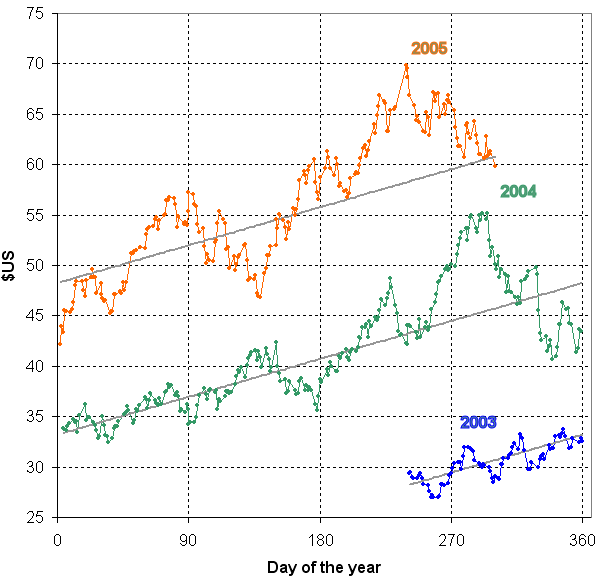
One of the comment threads on The Oil Drum posted this graph of oil price trends over the past couple of years which is quite illuminating. While there is a lot of volatility the up trend line (as far as you can accurately describe such a thing) is pretty steady.

Totem Poles Of Power  

Posted by Big Gav

WorldChanging has a post on "Native Wind" which looks at the development of wind power generation on Native North American reservations, which will helpfully help to alleviate some of their problems as well as being a good example to their neighbours. I like the suggestion that the "Indian" nations could sign onto Kyoto - which would be a good way of giving George the finger.

We're accustomed to talk about leapfrogging as a process that happens elsewhere. But nearly every advanced industrialized country has pockets of poverty that are as damaging and as pervasive as you'd find in the developing world. They're also opportunities for leapfrogging -- and Native Wind may have the key.

In the United States, among the locations most in need of transformation are the Native American reservations. Native Wind wants to turn the reservations around by making them centers of wind power development. Most reservation areas in the western and mountain states have some amount of wind power potential. But it turns out that some of the richest areas for wind power can be found on reservation territories in the northern plains states: twenty reservation locations have a combined potential of around 300 gigawatts of wind power.

The Native Wind project is bringing together wind energy experts and tribal leaders to work out ways to build wind farms on tribal lands. Two wind facilities have already been built -- a 750kW turbine at the Rosebud Sioux Indian Reservation and another at the Fort Berthold reservation in North Dakota -- and two more should be completed by the end of this year. Fort Berthold alone is believed to have over 17 gigawatts of wind power potential. In 2006, the Rosebud location will be expanded into a 30MW wind farm, and another 80MW of wind farms are in development.

Next week will see the Native Renewables Energy Summit in Denver, Colorado. Among the questions the conference will tackle: should Native American tribes, as sovereign nations, sign on to the Kyoto treaty?

WorldChanging also has a post on the "Greening of China" - which discusses some positive steps. Given the huge number of new coal fired power stations they are building its hard to see that a few green urban developments are going to compensate for all the additional damage caused by Chinese growth though.
As China goes, so goes the future.

A successful bright green world requires a green China. A China that continues to spew tons of coal smoke into the air, tear up the landscape for dams and minerals, and push the adoption of the automobile as a "pillar industry" is a China that could drive the world past the environmental tipping point, regardless of the efforts of the rest of the planet. A year or two ago, the likelihood of Chinese leaders seeing this disaster unfolding and changing direction in time seemed slim. Now, we may well see a glimmer of hope.

The last month or so brought us a bonanza of reports about the new choices the Chinese leadership is making regarding the environment. Some are doubtlessly motivated by wanting to look good for the 2008 Olympics. But many of the proposals look to be the kinds of steps necessary for China to head off further environmental disaster -- big, risky steps, with the possibility of significant benefit should they succeed.

The BBC has a report on the large energy shortfall facing Britain.
Britain is facing a shortfall in energy supply in the near future, according to a major report. Within a decade, the country may be generating only about 80% of the electricity it needs.

A panel of 150 experts says fossil fuels will remain the mainstay of supply, with renewables expanding and nuclear power almost certainly needed. The panel urges the government to take steps quickly to solve the issue; doing nothing, it says, is not an option.

...

"Doing nothing is not an option," commented Shaun Fitzgerald from the BP Research Institute at Cambridge University. "If you don't want nuclear, there are hard choices to be made on other issues."

However, there was clearly some dissent from these conclusions among experts consulted for the report. "In the case of nuclear, the government should take a decision soon, and the decision should be 'no'," the chief executive of the solar energy company solarcentury Jeremy Leggett told the BBC News website.

"More than 50% of Britain's greenhouse gas emissions come directly or indirectly from buildings; and the key to reducing that lies in renewables and energy efficiency."

Tom Whipple has another article out in his series on peak oil at the Falls Church News Press that looks at the new resolution proposed by Roscoe Bartlett to the House of Representatives.
In a perfect world, the US Congress would have recognized decades ago that one day the world would run short of oil and would have initiated programs to mitigate the consequences. The initial steps are obvious: start a major conservation program and start moving the nation as quickly as possible to alternative sources of renewable energy— wind, solar, biomass, and waves. Along the way it might be nice to prepare for rationing, and the considerable social and economic distress that will ensue when oil depletion sets in, but conservation and alternatives would be a good start.

Democracies, however, simply don't work that way. It is very nearly impossible to convince people and their elected representatives something very bad is about to happen until it actually does. The New Orleans flood is a perfect example of this reluctance to recognize and deal with looming disasters.

Peak oil, therefore, is yet another example of denial with potentially much more serious consequences. Nearly every unbiased observer who has looked seriously at the issue comes to the conclusion world oil production will peak within ten years— tops. Nearly everybody who has seriously studied what we can do about it is saying it will take 10 to 20 years to develop significant alternatives to our voracious use of oil- and gas-based liquid fuels.

To effect a policy change in America of the magnitude needed to deal with peak oil, a critical mass of administration officials, industry leaders, members of Congress, opinion makers, and just plain citizens will need to form before serious Congressional action occurs. How long, and what it will take to induce this critical mass to form is one of the more interesting questions surrounding the advent of peak oil.

Two weeks ago Congressman Roscoe Bartlett of Maryland, who heretofore had been the only member of Congress speaking out about peak oil, introduced a resolution in the House of Representatives to the effect that peak oil is coming and we had better do something about it — now.

The preamble to the resolution reads as follows:

"Expressing the sense of the House of Representatives that the United States, in collaboration with other international allies, should establish an energy project with the magnitude, creativity, and sense of urgency that was incorporated in the `Man on the Moon' project to address the inevitable challenges of `Peak Oil'."

What was interesting about this resolution was not that Congressman Bartlett introduced it, but that he had 14 other members of Congress, including Falls Church's Jim Moran, sign on to it. Fifteen is a start. Not enough to pass a peak oil mitigation program, but a lot better than one.

Past Peak points to another article by Bill McKibben which the UnPlanner might enjoy, this one on the Brazilian city of Curitiba (which I've seen mentioned occasionally in the Economist over the years as a good example of development in the third world as well - which is even-handed of them given that the Curitibans aren't following neo-liberal principles).
This city has slums: some of the same shantytown favelas that dominate most Third World cities have sprouted on the edge of town as the population has rocketed. But even they are different, hopeful in palpable ways. They are clean, for instance — under a city program, a slumdweller who collects a sack of garbage gets a sack of food from the city in return. And Curitiba is the classic example of decent lives helping produce a decent environment. Because of its fine transit system, and because its inhabitants are attracted toward the city center instead of repelled out to a sprawl of suburbs, Curitibans use 25 percent less fuel per capita than other Brazilians, even though they are actually more likely to own cars. [...]

And so the story of Curitiba begins with its central street, Rua Quinze...[Longtime Curitiba mayor Jaime] Lerner insisted...that it should become a pedestrian mall, an emblem of his drive for a human-scale city. "I knew we'd have a big fight," he says. "I had no way to convince the store-owners a pedestrian mall would be good for them, because there was no other pedestrian mall in Brazil. But I knew if they had a chance to actually see it, everyone would love it."

To prevent opposition, he planned carefully. "I told my staff, 'This is like war.' My secretary of public works said the job would take two months. I got him down to one month. Maybe one week, he said, but that's final. I said, 'Let's start Friday night, and we have to finish by Monday morning.'" And they did — jackhammering the pavement, putting down cobblestones, erecting streetlights and kiosks, and putting in tens of thousands of flowers.

"It was a horrible risk — he could easily have been fired," said Oswaldo Alves, who helped with the work. But by midday Monday, the same storeowners who had been threatening legal action were petitioning the mayor to extend the mall. The next weekend, when offended members of the local automobile club threatened to "reclaim" the street by driving their cars down it, Lerner didn't call out the police. Instead, he had city workers lay down strips of paper the length of the mall. When the auto club arrived, its members found dozens of children sitting in the former street painting pictures. The transformation of Curitiba had begun.

Cheapness is one of the three cardinal dictates of Curitiban planning. Many of the city's buildings are "recycled." The planning headquarters is in an old furniture factory; the gunpowder depot became a furniture factory; a glue plant was turned into the children's center. An old trolley stationed on the Rua Quinze has become a free babysitting center where shoppers can park their kids for a few hours. The city's parks provide the best example of brilliance on the cheap. When Lerner took office for the first time in 1971, the only park in Curitiba was smack downtown — the Passeio Publico, a cozy zoo and playground with a moat for paddleboats and a canopy of old and beautiful ipĂ© trees, which blossom blue in the spring. "In that first term, we wanted to develop a lot of squares and plazas," recalls Alves. "We picked one plot, we built a lot of walls, and we planted a lot of trees. And then we realized this was very expensive."

At the same time, as luck would have it, most Brazilian cities were installing elaborate flood-control projects. Curitiba had federal money to "channelize" the five rivers flowing through town, putting them in concrete viaducts so that they wouldn't flood the city with every heavy summer rain and endanger the buildings starting to spring up in the floodplain.

"The bankers wanted all the rivers enclosed," says Alves; instead, city hall took the same loan and spent it — on land. At a number of sites throughout the city, engineers built small dams and backed up the rivers into lakes. Each of these became the center of a park; and if the rains were heavy, the lake might rise a foot or two — perhaps the jogging track would get a little soggy or the duck in the big new zoo would find itself swimming a few feet higher than usual. "Every river has a right to overflow," insists parks chief Nicolau Klupel.

Mostly because of its flood-control scheme, in 20 years — even as it tripled in population — the city went from two square feet of green area per inhabitant to more than 150 square feet per inhabitant...From every single window in Curitiba, I could see as much green as I could concrete. And green begets green; land values around the new parks have risen sharply, and with them tax revenues.

TreeHugger has an article on using micro-windpower to power wireless networks, along with another on people using biodiesel to heat their homes.
Wireless networks have freed us from miles of cumbersome wiring needed to carry information, but the electronic 'nodes' of such networks still need power. If geologists want to place hundreds of sensors on a mountain to monitor seismic activity, for example, they either have to supply electricity using cables or hike out to each sensor every six months or so to replace batteries." The windmill developed by Shashank Priya, an electrical engineer from the University of Texas, can get power from the most gentle breeze. It is about 10 centimeters (a bit less than 4 inches) across and it is attached to a rotating cam that flexes a series of piezoelectric crystals that generate a current as the blades rotates.

The Oil Drum has a report on the ASPO USA conference in Denver.
Next up was Chris Skrebowski, well known to the Peak Oil community for his recent MegaProject Reports. Chris is a long time oil industry person and has edited Petroleum Review for the last eight years. He basically gave a summary of his current views on the near term situation. In essence, he agrees with CERA that there are about 16-17mbpd of new capacity coming on between now and 2010, and the key differences are around depletion. He assumes 5% depletion of the fields in production, which gets us in trouble pretty quickly.

Following Chris's talk, he and Tom sat for a Q&A session. I think the dominant message sent during the first sessions was "Credible people believe this stuff". There was a limited amount of really new material for peak oil followers, but probably these talks were more aimed at the folks at the conference that hadn't already drunk the cool-aid.

...

One of the speakers that I personally got the most out of was Henry Groppe, founder of Groppe, Long, and Littel, an energy analysis firm. While he is now a gentleman of increasing years, he struck me as extremely savvy and thoughtful and likely to be calling the future better than anyone else I've heard.

On the supply side, he believes oil is pretty much at peak and will flatten out and then start declining. But what caught my attention was his opinion on the demand side. He believes that something like 20mbpd of the current 84mbpd of oil demand is going for heat and power generation primarily in developing countries. He thinks that with oil in the $50-$60 range, all of this will get converted to coal or natural gas, and that, along with vehicle fuel efficiency, will be the main initial responses to peaking, and will keep us out of serious economic pain for a decade or so.

I need to research it, but that story made a lot of sense to me. Fuel switching in heat and power was exactly what the US and Europe did back in the late 70s and early eighties, so it's believable that developing countries would do that this time around. Combine that with a lot of OECD fuel efficiency improvements (which have already begun) and we can probably maintain economic growth through quite a bit of the early post-peak era (except for geo-political shocks). That also buys us more time to start doing the harder things that will need to be done down the road.

And I'll close with a link to an article by John Cusack on where we are today, which includes a good quote from Winston Churchill.
"The power of the Executive to cast a man into prison without formulating any charge known to the law, and particularly to deny him the judgment of his peers, is in the highest degree odious and is the foundation of all totalitarian government whether Nazi or Communist."

Leave Us in Our Time of Greed  

Posted by Big Gav

Grist comments on the recent US Senate hearings into windfall oil company profits. This of course reminds me of similar investigations after the 1970's oil price spike which seemed to suggest that the oil companies were intimately involved with that paritcular supply side crunch. Some peak oil analysts shrug their shoulders and say "what do you expect - demand is beginning to exceed supply ?", but I'm not so sure - the peak may be upon us or close by, but I have few doubts that the big oil companies will use every trick they've learned over the past century to squeeze every cent out of us that they can.

I saw Jabba the Hutt on TV today talking pompously at one of these hearings about letting markets work their magic unmolested, which was a bit rich coming from the figurehead of an industry that has probably received more tax breaks and government subsidies (direct and indirect) than any other.

Oil execs defend profits, drink all the beer, leave the place trashed

The nation was treated to an exquisite piece of Kabuki theater yesterday, as Big Oil executives trudged to Congress to justify their record profits at a time when pricey gasoline and the looming threat of sky-high home-heating costs have Americans up in arms. The Republican leadership decided to give the oil chieftains a stern talking-to. But not too stern, mind you: Sen. Ted Stevens (R-Alaska), who chaired the hearing, refused to have them testify under oath. Despite the deference, the execs didn't do much to provide anxious senators with political cover. They said any temporary tax or fee on their profits is a bad idea. They don't particularly feel like voluntarily chipping in to defray heating costs. They want regulations governing refinery construction eased. And, most amusing, they don't even need all the tax breaks and subsidies Congress insists on lavishing on them. In short, the message was: Leave us alone. Shoo, now. Shoo.

The Prince  

Posted by Big Gav

With a title like that you may be excused for thinking I'm about to embark on a rant about the Neocons and Machiavelli, but instead, I'm going to quote wih approval (for the second time this week) the Prince of Wales.

While I'm a republican myself, I do quite like the idea of Charlie becoming King one day purely because of the annoyance it is likely to cause the shrinking band of monarchists who yet aren't willing to come to grips with the fact that we gained independence over a century ago and that the British Empire no longer exists.

Charlie has burnished his already good pro-reality credentials by delivering a keynote address at a conference in San Francisco recently on "Peak Oil, Climate Change, and Business Action" (he sounds like a Viridian kind of guy really). He was followed later on by Richard Heinberg (thereby neatly closing the circle to my original link).

"We simply can't go on as we are," Prince Charles said to the select audience, according to the San Francisco Chronicle. He cited statistics and stories about global warming and oil depletion, contending, "Somehow we have to find the courage to reassert the once commonplace belief that human beings have a duty to act as the stewards of creation."

Prince Charles later added, "We have to accept that globalization comes at an alarming price for the future. That price may be paid in terms of displaced rural communities and the destruction of social and cultural systems built up over many centuries." He concluded his talk by encouraging "the United States (to) use its power and influence to help create a sense of purpose around environmental stewardship."

Do You Believe In Fairies ?  

Posted by Big Gav

Following on from my disparaging yesterday of conspiracy theorists who believe that engines generating vast amounts of energy from water will smoothly transition us away from oil dependence, The Guardian has an article by a entrepeneur claiming that he can liberate vast amounts of energy by making the electron in a hydrogen atom move closer to the proton (why this never happens naturally isn't specified).

While I don't claim to be an expert on quantum mechanics I'm more than a bit skeptical about this - I suspect the only miraculous discovery will end up being that some investors lose all their money - but lets wait and see what the coming months bring.

It seems too good to be true: a new source of near-limitless power that costs virtually nothing, uses tiny amounts of water as its fuel and produces next to no waste. If that does not sound radical enough, how about this: the principle behind the source turns modern physics on its head.

Randell Mills, a Harvard University medic who also studied electrical engineering at Massachusetts Institute of Technology, claims to have built a prototype power source that generates up to 1,000 times more heat than conventional fuel. Independent scientists claim to have verified the experiments and Dr Mills says that his company, Blacklight Power, has tens of millions of dollars in investment lined up to bring the idea to market. And he claims to be just months away from unveiling his creation.

The problem is that according to the rules of quantum mechanics, the physics that governs the behaviour of atoms, the idea is theoretically impossible. "Physicists are quite conservative. It's not easy to convince them to change a theory that is accepted for 50 to 60 years. I don't think [Mills's] theory should be supported," said Jan Naudts, a theoretical physicist at the University of Antwerp.

What has much of the physics world up in arms is Dr Mills's claim that he has produced a new form of hydrogen, the simplest of all the atoms, with just a single proton circled by one electron. In his "hydrino", the electron sits a little closer to the proton than normal, and the formation of the new atoms from traditional hydrogen releases huge amounts of energy.

This is scientific heresy. According to quantum mechanics, electrons can only exist in an atom in strictly defined orbits, and the shortest distance allowed between the proton and electron in hydrogen is fixed. The two particles are simply not allowed to get any closer.

According to Dr Mills, there can be only one explanation: quantum mechanics must be wrong.

Moving from Neverland back somewhere closer to reality, the IEA says that energy demand will rise by 50% over the next 25 years, and that greenhouse gas emissions will rise with it. Even they recognise that something will have to give eventually though.
Global greenhouse gas emissions will rise by 52% by 2030, unless the world takes action to reduce energy consumption, a study has warned.

The prediction comes from the latest annual World Energy Outlook report from the International Energy Agency (IEA). It says that under current consumption trends, energy demand will also rise by more than 50% over the next 25 years.

The IEA adds that oil prices will "substantially" rise unless there is extra investment in oil facilities. It says the world has seen "years of under-investment" in both oil production and the refinery sector. The organisation estimates that the global oil industry now needs to invest $20.3 trillion (£12 trillion) in fresh facilities by 2030, or else the wider global economy could suffer.

"These projected trends have important implications and lead to a future that is not sustainable," said IEA chief Claude Mandil. "We must change these outcomes and get the planet onto a sustainable energy path."

And here's the latest from Jim Kunstler, observing that the hurricane induced supply disruptions to North American oil supplies haven't gone away, even if everyone seems to have forgotten about them (then following up with some Old Europe bashing that I'm rather dubious about).
The American public's failure to pay attention reached supernatural levels this week as our mass media gloated over falling gasoline prices -- down 24 cents, average, to pre-hurricane levels. The news media took this to mean that all the end-of-the-summer trouble is over with and things can now get back to normal, including especially an economy based on trade in suburban houses.

What they failed to notice is this: since the hurricanes shredded our Gulf of Mexico oil and gas capacity, Europe has been sending us 2 million barrels of crude oil and "refined product" a day from its collective strategic petroleum reserve. The "refined product" includes 800,000 barrels of gasoline, plus diesel, aviation, and heating fuel. Meanwhile, US domestic production has fallen to around 4 million barrels of conventional crude a day. America uses close to 22 million barrels of oil a day. Bottom line: post-hurricane, total imports have accounted for 80 percent of America's oil consumption.

Now, the important part of all this is that last week the International Energy Agency (IEA), Europe's energy security watchdog, declared that it would now end the 2 million barrel a day shipments to the US. Not because they are hateful meanies, but because, after all, it is Europe's strategic reserve and they can't sell it all to us because, well, some strategic emergency might come up for them, too.

It will take a few weeks for the last of Europe's tankers to offload supplies and for the various fuels to work their way through the US fuels retail system. With US production and refining still crippled, we can look forward to watching the price of gasoline, heating oil, diesel and aviation fuel kick back up through Thanksgiving and on into the heart of the Christmas shopping season. At the same time, homeowners will be getting their first substantial heating bills of the season.

This will be very bad news to the guys in charge. The Hooverization of George W. Bush will resume and accelerate.

The Energy Blog has a look at a new vertical windmill design which apparently offers dramatically improved efficiency.
Privately held Tera Moya Aqua unveiled there new vertical windmill which it says is more efficient than traditional propeller designs. They claim their windmill creates up to 80% more power from the same wind as conventional wind turbines. They claim several advantages for their design including:

* Less dangerous to birds
* Very quiet operation
* Lower maintenance costs because their critical equipment is more accessible
* Lower capital costs due to simpler design
* More acceptable because of lower profile - less visual pollution
* Superior handling of high gusts of winds

The turbine assembly consists of two primary components, the rotor and a set of air foils/stators. The gearbox, generator and controls for the unit are housed in the building at the base of the unit.The company plans to sell turbines generating from 500 watts to 1 megawatt. The smaller ones are portable and can be used by farmers, the military and remote cabin owners.

The Energy Blog also has a post on a US fertilizer plant that is being converted to produce liquids from coal instead (probably a wise move as north american gas supplies deplete and coal-to-liquids becomes more desirbale to make up for oil depletion).
Rentech (RDC) announced today that it would purchase Royster-Clark Nitrogen of East Dubuqe, IL, a fertilizer producer, and convert the existing natural gas-fed plant to coal-fed gasification plant. The conversion calls for two gasification trains and a spare, standby gasifier, to process 5,200 tons per day of coal. The conversion will increase the capacity of the plant from 830 tons per day to 900 tons per day of nitrogen (in the form of ammonia) as well as producing 87 million gallons per year of Fischer-Tropsch (FT) liquid fuels and a surplus of electricity. The conversion is estimated to take three and one-half years.

RDC will use the Conocco-Phillips gasification process with its slurry reactor, iron-based catalyst FT process. Rentech believes that when the project is completed it will be the first U.S. plant to produce commercial quantities of fuel using coal-to liquids (CTL) technology.

And to close, Mobjectivist has performed his latest act of modelling, this time taking a look at the depletion curve for the Former Soviet Union states.

Random Notes  

Posted by Big Gav

Online Opinion's first post of this month's energy series has been posted, with Russ grayson declaring : Oil no longer the dressing for the '3,000 mile Caesar salad'. The first comments out of the blocks on the article are disappointing, with someone immediately trotting out the old conspiracy theory about the oil companies buying up all sorts of fabulous renewable energy technologies in the 1970's then suppressing them - and that these will be trotted out on demand for a seamless changeover as the oil slowly runs out.

Go local. That’s the suggestion of NSW North Coast community educator, Tim Winton, for coping with the approaching peak oil crisis.

“Peak oil” describes the reaching of a peak in global oil production. After that, an inevitable decline kicks in, with increasing scarcity and rapidly rising prices. Far from being the idea of doomsayers, economists and the petroleum industry are taking the threat seriously. The basic underpinning of industrial economies may be about to disappear.

“Decline will follow the peaking of oil extraction”, warns Tim. “Economists say we have 30, perhaps 40 years before the supply reaches its peak but others put the time as much less, some as little as 5 years. I believe the economists are a little over-optimistic. Whatever the figure, it leaves precious little time to develop alternative sources. The International Energy Agency says it will take around 30 years' lead time to scale up alternative energy sources to avoid economic dislocation.”

Jeff Vail has a couple of posts on the slow eroison of fungibility in the oil market - The New Energy Mercantilism and Pipeline Mercantilism. The proposed Russia / China pipeline is the example given, though obviously Hugo Chavez's politically based redirecting of Venezuelan oil is the first real sign of this that we are seeing.
It's a slippery subject: How does a freely-exchange-traded commodity become subject to mercantilistic influences? Well, here's one example:

Russian and China Agree to Pipeline Project

How is this mercantilsm in action? Well, oil only goes where the infrastructure exists to ship it. Market forces will fund capital projects to build infrastructure to ship it where there is demand--but the key is that this pipeline project is not operating under the auspices of market forces, but is instead being subsidized by the two respective governments. So these government subsidies are intentionally directing market forces--this is subsidy mercantilism. It certainly isn't new, but we are definitely seeing more of it with regards to energy. So far almost all mercantilistic efforts have focused on negative barriers--making it cheaper for oil to flow the direction that a government wants it to, for example.

The more dangerous phase in energy mercantilism will come with the increase in positive barriers--legal or financial barriers that make it more expensive for oil to flow any direction OTHER THAN the route desired by a given government. The critical difference here is that any nation willing to spend money can lower barriers through subsidy. Only nations with either 1) oil on ther own territory (or that must pass through their territory), or 2) sufficient military force to exert control over oil that does not directly flow through their territory. So the transition from creating negative barriers to creating positive barriers to oil flow is the "tipping point" between peaceful energy mercantilism and non-peaceful energy mercantilism.

On a related note, Tom Whipple's latest peak oil piece at the Falls Church News Press looks at emerging Canadian qualms about sending most of their fossil fuel reserves south of the border.
Currently, distribution of the world's oil production is relatively simple. Whoever wants oil, and has the money to pay for it, can buy as much as they want. No questions. No limits. Historically there have been a few exceptions, such as during World War II or the Arab Oil embargo, but in general if you have the money, importing oil has not been a problem.

Last month, the gorilla began to stir in the form of a report prepared by the folks up at the University of Alberta in Canada . It seems 68 percent of the crude oil and 55 percent of the natural gas produced in Canada is being exported to the US . Under the fine print of North American Free Trade Agreement (NAFTA), the Canadians are obligated to continue shipping this portion of their oil and gas production to us even after they go into depletion and can no longer produce enough to satisfy their own needs.

Not unexpectedly, a number of Canadian writers have started to ask why on earth 32 million Canadians should be obligated to send over half of their oil and gas production to help meet the energy appetite of 300 million Americans.

Rex at "LaborFirst Blog" has a post up noting that the "5 Star Energy Rating" system for houses in Australia is under threat (it seems we are rapidly heading in the wrong direction on many fronts when it comes to energy usage, which will make the carbon tax and post peak transitions we are going to go through one day all the more painful - and unnecessarily so).
An intense lobbying effort by representatives of the building and construction industry is rumoured to be underway, with the intent of scrapping the 5 star energy rating system for homes. The lobbying effort is understood to be focused on getting the support of the Prime Minister and the Environment Minister.

The Victorian State Government introduced its 5 star rating system just last year, but now this may very well be under threat.

Why? Because building industry lobby groups claim that having mandatory efficiency levels for building makes homes more unaffordable, adding to the cost of housing.

The timber industry doesn't like the 5-star rating at all, but their motivation is not only because of claims that it increases the cost of housing. You see although timber is fine for frames, timber floors have a low thermal mass and therefore do not contribute to a well designed home's energy efficiency. High efficiency homes do not use timber floor. The timber industry is not pleased with this at all.

...

Lets face it. The Building and Construction industry want to scrap this because they want the option of building us cheap and crappy homes like they've always done. Gaps under the doors, draughts, cookie-cutter designs. That way they can keep it affordable for the first home buyer who is just grateful to finally get out of the rental market and is happy to accept any old shoddy construction.

Well if they want to keep homes affordable, then pick on something else. Pick on stamp duty, or even better, pick on negative gearing that ratchets up demand and reduces the available housing stock for the first home buyer (pigs might fly!), but don't trash something that has barely left the starting block.

In some shorter notes - Rigzone reports that BP's Lord Browne is once again claiming that "Current High Oil Prices are 'Unsustainable'" (while I think the whole feudal system of titles etc sucks, at risk of being hauled off for sedition against the monarch I might add, 60 minutes had an interview last night with Prince Charles which took a brief look at his successful organic farming endeavours. Charlie is one royal I do quite like - and you can definitely see where the plot line for the "To Play The King" episodes in "House of Cards" came from).

Rigzone also reports that Woodside plans to start drilling in Libya early in 2006 and that Taiwan has found "huge" Natural Gas reserves off its coast.

On a slightly amusing note, MonkeyGrinder points to a report on an excess of Hummers. How long until the Hummer dies a well deserved death as a transportation product ?

The SMH reports that the CSIRO is to axe 200 research jobs and, even worse, reduce its research on renewables while increasing the focus on geosequestration of carbon dioxide and other fossil fuel consumption enhancing technologies (what is Australia's number one export earner again ?).

PeakOil.com has links to an article claiming that growth in US wind power could reduce the amount of natural gas used to produce electricity by up to 5 percent at the end of the year (which would be very encouraging if true) and one on the great strides being made by Portland, Oregon on reducing CO2 emissions.

TreeHugger has an article on the development of floating wind turbines by Norway's Hydro, while WorldChanging examines "Renewable Energy's Investment Hockey Stick".
Global investments in renewable energy seem to be growing faster than any of us thought. If current trends continue, we'll soon be seeing the hockey-stick-shaped growth curves that have become iconic shorthand in technology sectors for hyper-paced growth.

According to a report released today (Download - PDF) by the Renewable Energy Policy Network for the 21st Century, or REN21, global investment in renewable energy set a new record of $30 billion in 2004. That's a far, far bigger number than others have projected, such as the Cleantech Venture Network, which just ten days ago projected that investments in clean technology -- a broader category than just renewable energy -- would total $10 billion between 2005 and 2009.

(My firm, Clean Edge, projected earlier this year that markets for just three technologies -- solar photovoltaics (PV), wind power, and fuel cells -- would grow to $15 billion annually by 2014, but that measures purchases of these technologies, not investments in them.)

And a few non-energy related notes, just to satisfy my urge to watch the evolution (and devolution) of communication and surveillence systems - Past Peak notes that "Big Brother Really Is Watching" (and we may as well get used to it, because it isn't going to go away) and William Grieder has an article on "All The King's Media" (via Energy Bulletin) which takes a look at the state of the media and of democracy in the 21st century.
Amid the smoke and stench of burning careers, Washington feels a bit like the last days of the ancien régime. As the world's finest democracy, we do not do guillotines. But there are other less bloody rituals of humiliation, designed to reassure the populace that order is restored, the Republic cleansed. Let the perp walks begin. Whether the public feels reassured is another matter.

George W. Bush's plight leads me to thoughts of Louis XV and his royal court in the eighteenth century. Politics may not have changed as much as modern pretensions assume. Like Bush, the French king was quite popular until he was scorned, stubbornly self-certain in his exercise of power yet strangely submissive to manipulation by his courtiers. Like Louis Quinze, our American magistrate (whose own position was secured through court intrigues, not elections) has lost the "royal touch." Certain influential cliques openly jeer the leader they not so long ago extolled; others gossip about royal tantrums and other symptoms of lost direction. The accusations stalking his important counselors and assembly leaders might even send some of them to jail. These political upsets might matter less if the government were not so inept at fulfilling its routine obligations, like storm relief. The king's sorry war drags on without resolution, with people still arguing over why exactly he started it. The staff of life--oil, not bread--has become punishingly expensive. The government is broke, borrowing formidable sums from rival nations. The king pretends nothing has changed.

The burnt odor in Washington is from the disintegrating authority of the governing classes. The public's darkest suspicions seem confirmed. Flagrant money corruption, deceitful communication of public plans and purposes, shocking incompetence--take your pick, all are involved. None are new to American politics, but they are potently fused in the present circumstances. A recent survey in Wisconsin found that only 6 percent of citizens believe their elected representatives serve the public interest. If they think that of state and local officials, what must they think of Washington?

...

Heroic truth-tellers in the Watergate saga, the established media are now in disrepute, scandalized by unreliable "news" and over-intimate attachments to powerful court insiders. The major media stood too close to the throne, deferred too eagerly to the king's twisted version of reality and his lust for war. The institutions of "news" failed democracy on monumental matters. In fact, the contemporary system looks a lot more like the ancien régime than its practitioners realize. Control is top-down and centralized. Information is shaped (and tainted) by the proximity of leading news-gatherers to the royal court and by their great distance from people and ordinary experience.

People do find ways to inform themselves, as best they can, when the regular "news" is not reliable. In prerevolutionary France, independent newspapers were illegal--forbidden by the king--and books and pamphlets, rigorously censored by the government. Yet people developed a complex shadow system by which they learned what was really going on--the news that did not appear in official court pronouncements and privileged publications. Cultural historian Robert Darnton, in brilliantly original works like The Literary Underground of the Old Regime, has mapped the informal but politically potent news system by which Parisians of high and low status circulated court secrets or consumed the scandalous books known as libelles, along with subversive songs, poems and gossip, often leaked from within the king's own circle. News traveled in widening circles. Parisians gathered in favored cafes, designated park benches or exclusive salons, where the forbidden information was read aloud and copied by others to pass along. Parisians could choose for themselves which reality they believed. The power of the French throne was effectively finished, one might say, once the king lost control of the news.

...

What will come of all this? Possibly, not much. The cluster of scandals and breakdown may simply feed the people's alienation and resignation. The governing elites, including major media, are in denial, unwilling to speak honestly about the perilous economic circumstances ahead, the burgeoning debt from global trade, the sinking of the working class and other threatening conditions. When those realities surface, many American lives will be upended with no available recourse and no one in authority they can trust, since the denial and evasion are bipartisan. That's a very dangerous situation for a society--an invitation to irrational angers and scapegoating. It will require a new, more encompassing politics to avert an ugly political contagion. We need more reliable "news" to recover democracy.

And to close, while Big Brother might be watching everyone now, at least modern technology has made it possible for us to watch back - today's visitor award goes to Saudi Aramco (an unusual addition to the honour roll) - hey guys - how about publishing some decent (ie. reliable and transparent) figures on your oil reserves ? It would clear up a lot of "when is the peak" uncertainty amongst us armchair peakologists...

Mad Max Meets American Gothic  

Posted by Big Gav

Bill McKibben takes a look at which crisis will hit first - peak oil or global warming (via Synearth). He notes something I like to point out occasionally - the solutions to both problems are the same - so why not get started now instead of debating when and how bad the effects of either will be if we don't do anything now.

Can you feel the mood shifting? I can. A year of spiking speculation about peak oil and the death of suburbia has rattled lots of Americans. Plenty of people suddenly feel that real, civilization-shaking change might be around the next corner. And plenty of them also feel frozen in the headlights, unsure what, if anything, to do about it. Other than wait.

It reminds me a little of the very early days in the fight over global warming. Appalled at the forecasts of global destruction, some of us demanded immediate and strong action—high taxes on carbon emissions, for instance, and never mind the pain. Others—more moderate or more politically realistic—advocated a suite of what they called "no regrets" policies. They suggested, say, gradual rises in gas mileage, higher efficiency standards for appliances. Even if climate change proved to be overblown hooey, they pointed out, such rational and easy measures would still save us money, reduce conventional pollution, and so on. These steps were like taking out a modest amount of insurance; whatever happened we'd have no regrets about having adopted them. In actual fact, of course, we took neither the urgent nor the more relaxed steps. Instead we bought Ford Explorers.

Now everything that was frozen is melting and soon we will have . . . regrets. Who knows if we're actually going to see oil production peak sometime soon? Not me. I've read persuasive arguments that we will from writers like Michael Klare and James Howard Kunstler and Paul Roberts. I've also read confident counterarguments from people who've been right in the past, like Daniel Yergin of Cambridge Energy Research Associates. Oil depletion is not a straightforward physical law, like the fact that the molecular structure of carbon dioxide traps heat that would otherwise radiate back out to space. Instead it's a detective story that turns on questions like, are the Saudis lying about how fast oil is being depleted in their giant field at Ghawar?

My suspicion had always been that we'd run out of sinks before sources — that is, run out of atmosphere before oil wells — but it's beginning to look like the race will be tight.

In any event, the real question is what to do in the face of uncertainty. In policy terms, the answer is easy, since cushioning the end of oil would require precisely the same steps as slowing down climate change: raising gas mileage, converting to hybrid cars, building trains, imposing carbon taxes, giving tax breaks for insulation.

Running On Empty  

Posted by Big Gav

The Guardian has more on the drying up of the Amazon and the weather systems that are affected by this. It appears everything really is connected...

Not far from the mouth of the Amazon, dead animals, including manatees - mammals up to 10ft long with flat, paddle-shaped fins - and distinctive pink dolphins, line the banks of some tributaries. Normally, you would have to take a boat to cross these rivers but today, because of the Amazon basin's worst drought in memory, they are little more than mudflats with a trickle of water in the middle.

So far, the drought has had its most serious impact in the upper reaches of the river and its hundreds of tributaries in Brazil, Colombia and Peru. There, along many stretches, the water has fallen to the lowest levels ever recorded and has become impassable even for canoes. Some 600 Brazilian schools in Amazonas state have had to be closed and many hamlets, whose only contact with the outside world is by river, are running short of food and medicines. Several districts have been declared disaster areas and the army is having to bring emergency supplies to 900 towns and villages.

The problems are expected to get worse before the drought eventually breaks, perhaps in the next month when the Amazon's rainy season usually comes. "Most little towns don't have sewage treatment," says Dan Nepstad, a US scientist based in Brazil. "Their sewerage is to put a pipe into the river. When you reduce the flow of these rivers, you have less water to dilute the sewage and cesspools build up. That has got all the makings for intestinal diseases and cholera. Water that's not moving is also a breeding ground for insects that carry malaria, dengue and other diseases."

But what is worrying some scientists even more than the growing scale of the humanitarian crisis is a suspicion that this year's drought may be the harbinger of a much greater disaster that could push the whole Amazon forest to a critical flip-over point and into an unstoppable process of self-destruction.

This is how the theory goes: the Amazon river contains a fifth of the planet's fresh water. Two hundred miles wide at its estuary, it carries more water than the world's next nine largest rivers combined. In a remarkable process, much of this water is recycled within the forest....

PeakOil.com has a post on the role of the insurance industry in forcing us to do something about global warming.
The Center for Health and the Global Environment at Harvard Medical School, along with co-sponsors Swiss Re and the United Nations Development Programme, today released a study showing that climate change will significantly affect the health of humans and ecosystems and these impacts will have economic consequences. The study, entitled "Climate Change Futures: Health, Ecological and Economic Dimensions," surveys existing and future costs associated with climate change and the growing potential for abrupt, widespread impacts. The study reports that the insurance industry will be at the center of this issue, absorbing risk and helping society and business to adapt and reduce new risks.

PeakOil.com also has a post on the emerging shortfall of natural gas supply in China.

WorldChanging has a post on the progress of the "zero footprint" concept.

It's interesting to watch the progress of the "environmental footprint" concept. We've been talking about the idea from early on, and we're hardly alone. The argument that the goal of modern environmentalism should be to reduce one's overall footprint nicely encompasses many of the core elements of new school greens, in particular a focus on systemic thinking and an emphasis on efficiency. The latest appearance of the footprint concept is at 0footprint (zero footprint), a new website combining magazine, information resource, and movement.

Cool Tools has a post on the ever popular Lister(oid) Diesel Engine.
From 1930 to 1987 the Lister company made diesel motors for pumps, generators, and general-purpose use, using mostly the same design of big, slow-speed, heavy flywheels and simple, easily-repaired parts. The Lister company then sold the designs. Today there are many Indian and Chinese companies that produce Lister copies (aka: "Listeroids") for export. These are fairly faithful to the original design -- with varying quality. The price for these engines *per kilowatt* is cheap, when compared to the more commonly found gasoline-powered generators, though they are not very portable.

What is truly amazing is the efficiency of the Lister: one user reports an average of 8000 watts and 0.3 gallons of diesel per hour. They can be made nearly silent with cheap car mufflers or a water muffler. They run fairly cool, and home-built radiators (water tanks, house radiators, car radiators) seem to work well. These slow-rotating workhorse machines are good for nearly 100% duty cycle if properly maintained. (A 100% duty cycle means running 24/7, with no down time due to heat and lubrication needs).

The Listers can run all the time, and there are even some people who have figured out how to do oil changes while the motor is still running, thus removing even the lubrication issues. Their efficiency and raw power makes them perfectly suited for electrical generation for long-term use versus "emergency-only" generators which have an extremely short lifespan. They are also works of mechanical art, and will keep a mechanically-minded hacker occupied for weeks, experimenting and tuning. I'm sure that vegetable oil or waste motor oil would work as fuel in these engines as well, but more research is needed.

The ABC has an interview with permaculture inventor Bill Mollison.
In 1970, the man who changed the way we think about sustainability, Bill Mollison, is still 30 years on just as passionate about the cause and says it is anger that motivates him.

His anger is spurred on by what he says is the ridiculous way in which we humans normally behave, the silly things we do and the damage that we’ve done to the planet when we could do so much better.

Permaculture has been a runaway success story, particularly in developing countries, but in the developed world, energy efficient housing is still a rarity.

Bill Mollison says that we continue down an agricultural, industrial, energy use and social path that is having such damaging effects on the planet that issues such as the oil peak and global change have become critical.

It amazes Bill Mollison that after all this time the human race still baulks at these principles that have been demonstrated time and time again to make a real and lasting difference.

Bill Mollison had not spoken to the media for over a decade, but in a recent discussion on ABC South East, he joined Tim Holt and regular guest, John Champagne and spoke with the same passion, a


The Alternative Energy Blog has a post on micro windpower generation at home.

Rigzone reports on a global shortage of tools for the oil industry (not to mention trained people to use them).

MIT Technology Review has an article on Corning's development of technologis to clean up diesel exhaust.

Australian online journal "Online Opinion" is looking to make peak oil the topic of discussion this month. This site has lots of politicians, academics and journalists amongst the readership, so its good to see the topic getting this sort of exposure. If you wish to write a discussion piece email the editors (see the link on the right of the front page).

And to conclude, some short notes. The Energy Blog has a post on longer life, more power and faster recharging lithium ion batteries. TomDispatch has an article on the difficulties of reporting from Iraq. Billmon morosely ponders where we are heading as he considers the revelations in the Washington Post about the CIA's "mini archipelago" of detention camps in eastern europe. Past Peak points to an article in The New Yorker on the perverted imagination of disgraced ex-Cheney aide Scooter Libby (for those who like the more out there conspiracy theory oriented view of these things, RI also posted this story). Past Peak also notes Bush's approval rating is at another all time low and that American voters apparently regard the Plame scandal as seriously as Watergate. The local media has been in something of a frenzy about terrorist attacks that the PM (no longer the Rodent now the new sedition laws are in place, just in case) claims are imminent, as the detention without charge and sedition laws were rushed through parliament yesterday and today (conspiracy theories come from all sources these days it seems - though you'd think security and intelligence services tracking terrorists would be a bit annoyed about this sort of thing being announced in the media). This served as a very effective smokescreen for the tumult over the proposed changes to industrial relations laws (which seem to be ignoring the lessons of history), which had the national press gallery and lots of minor party senators all busy conspiracy theorising today as well. Apparently government backbenchers (to their credit) have managed to soften the blow to civil liberties somewhat today. Perhaps this recently escaped Al Qaeda member is the one Howard and Ruddock are worried about ?

The power of nightmares were on display in the office this afternoon as well, with email rumours that were flying around Sydney about possible bomb threats to the train system causing plenty of excited chatter. I'm starting to think the fear / adrenaline combo is rather too addictive - how many years will it take for this stuff to wear off ? Welcome to the age of paranoia (to steal a line from Green Day).

One last note, I haven't been handing out "visitor of the week" awards for a while though I have seen all sorts of weird domains in the logs (the US Senate probably being this week's highlight - exactly what they made of my notes on the Inhofe / Crichton show I'm not so sure). My occasional virtual visitor from the PM's office has become a semi-regular though, so this reader letter in today's Crikey caught my eye as one possible explanation (even though local politics isn't really a focus of this collection of loosely linked rantings).
Anonymous writes:
I'm sure you guys already know of the history of government media monitoring – we had the aNiMaLS (National Media Liason Unit) under Hawke and Keating and now have the GMS (Government Media Service) under Howard. Essentially both services utilise staff members from the local offices of Member of Parliament (ie paid for by taxpayers out of members electoral allowances) to monitor local and national media for party political purposes and then report relevant items back to the GMS in Parliament House (Room G47 from memory). From there information is distributed to government members, relevant members of the Press Gallery and suitably receptive journos. For more information please see "Selling the Australian government: politics and propaganda from Whitlam to Howard" by Greg Barns.

Orwell had us pegged so many years ago - obviously some things never change...

The Sunball  

Posted by Big Gav

WorldChanging has a post on Australian company "Green and Gold Energy"'s SunBall which looks like something every home should have in the back yard and/or on the roof (Update: PeakOil.com has some more links on the SunBall).

The Sunball, a "solar appliance" due out in mid-2006, is an example of something I expect to see quite a bit more of in the coming months and years: a renewable energy system combining a novel design with promises of easy installation and use. I have no idea whether the Sunball will perform up to the claims made by the manufacturers, Australia's Green & Gold Energy, but in many respects that's secondary. What's important is that we're now seeing more kinds of renewable energy systems aimed not at hobbyists and those willing to fiddle with clumsy tech, but at people who want something relatively stylish (whether the Sunball meets that criteria is a matter of taste, of course) and something relatively "plug and play." Building-integrated photovoltaics are another example, albeit a less-radical departure.

The technology of the Sunball is unusual, but not unprecedented. Rather than a flat panel, it uses fresnel lenses to concentrate sunlight onto an arrangement of high-efficiency cells, increasing the amount of light hitting the cells. This allows the Sunball to be less-costly than standard pv, with an estimated cost of AU$1,400 (about US$1,050) per 330 W peak unit. We've talked about solar concentrators before, but the previous examples were clearly meant for larger-scale power generation; one advantage of solar concentrator technology is that it can produce more power in a limited space than normal photovoltaic panels. What's novel about the Sunball is that it's meant for home users, particularly those who don't want to cover their rooftops with black glass panels.

The manufacturers have handy calculators and maps for figuring out whether the Sunball will produce cost-competitive electricity in a given location in the US or Australia. As noted above, the units aren't yet shipping, so early cost estimates -- US$6,000, without rebates, for an installed 4-unit system able to supply half of a typical household's power -- may be way off. And while the Sunball is less-clumsy than traditional flat solar panels, neither is it a particularly wonderful example of industrial design. In short, even if it's a flop, it will blaze the trail for subsequent competitors.

The era of the solar panel is over; long live the age of solar design.

WorldChanging also has a post linking to some energy scenario modelling exercises (one of the good things to come out of Shell - being a scenario modeller would be quite a cool career).

You Can't Handle The Truth  

Posted by Big Gav

Kunstler comments on the unfortunate problem with facing up to reality - its unpleasant.

The cry across the land grows increasingly shrill: "THEY LIED TO US!"

For going on three years, the American public, especially on the political left, has been complaining that the Iraq War was some kind of a shuck-and-jive. The Bush government pulled the wool over everybody's eyes. They ran a vicious propaganda operation. We were fooled by all those fairy tales about WMDs, Saddam and Osama, and African radioactive yellowcake.

Now, through the fog of the Valerie Plame affair and the indictment of Scooter Libby, the cry is reaching a crescendo: "THEY LIED TO US!"

Being a Democrat myself, and therefore nominally in opposition to Bush-and-Cheneyism, one has to contend with all sorts of embarrassing nonsense emanating from one's own side. In Sunday's New York Times op-ed section, for instance, Nicholas Kristoff wrote: "Mr. Cheney, we need a stiff dose of truth." I'm sorry to tell you this Nick (and the rest of my homies), but what Jack Nicholson's character said in that court martial movie some years back still applies: you can't stand the truth.

If the American public could stand the truth, we would stop calling it the Iraq War and rename it the War to Save Suburbia. Of all the things that Bush and Cheney have said over the last six years, the one thing the Democratic opposition has not challenged is the statement that "the American way of life is not negotiable." They're just as invested in it as everybody else. The Democrats complain about the dark efforts by Bush and Cheney to cook up a rationale for the war. Guess what? The Democrats desperately need something to oppose besides the truth. If they would shut up about WMDs for five minutes and just take a good look around, they'd know exactly why this war started.

When the American people, Democrat and Republican both, decided to build a drive-in utopia based on incessant easy motoring and massive oil dependency, who lied to them? When tens of millions of Americans bought McHouses thirty-four miles away from their jobs in Boston, Atlanta, Minneapolis, and Dallas, who lied to them? When American public officials adopted the madness of single-use zoning and turned the terrain of this land into a tragic crapscape of strip malls on six-lane highways, who lied to them? When American school officials decided to consolidate all the kids in gigantic centralized facilities serviced by fleets of yellow buses that ran an average of 150,000 miles per year per school, who lied to them? When Americans trashed their public transit and railroad system, who lied to them? When Americans let WalMart gut Main Street, who lied to them? When Bill and Hillary Clinton bought a suburban villa in farthest reaches of northern Westchester County, New York, who lied to them?

You want truth, Progressive America? Here's the truth: the War to Save Suburbia entailed an unavoidable strategic military enterprise.

Random Notes  

Posted by Big Gav

Mobjectivist has done a post of his own on the loss of Richard Smalley.

The Sydney Morning Herald has some follow on comments about the AGL takeover of Southern hydro and accompanying restructuring. Crikey also had a look at the windfall gain the New Zealand government has made from this transaction.

The Age's Stephen Bartholomeusz had a typically thoughtful column on Saturday on the $3 billion-plus in capital to be raised by two forthcoming energy sector floats, Spark Infrastructure and SP Ausnet.

This represents a major selldown of equity, but not control, by the two biggest Asian investors in Australia over the past decade, the Singapore Government-owned Singapore Power and Hong Kong billionaire Li Ka-shing's Cheung Kong (CKI).

Add to that this morning's reported $1.425 billion purchase of Southern Hydro by AGL, which in turn has announced a demerger and the departure of CEO Greg Martin, and you have another flurry of deals over assets that were, in the main, first broken up and privatised by the Kennett Government.

With three $1 billion-plus energy sector deals and a major demerger going down at the moment, the only way to understand the flurry of activity is to refer back to Crikey's world famous power sell off list, which tracks every power sector deal and many of the advisers since 1992. The detail around the four big deals are not totally clear so the entries are as follows:

October 2005: AGL pays $1.425 billion for Southern Hydro's renewable business of 737mW of power across Victoria, NSW and South Australia.

November 2005: AGL to demerge its energy and infrastructure businesses after Southern Hydro acquisition.

November 2005: Hong Kong conglomerate CKI to float 50% of Victorian and South Australian electricity distribution businesses in a $1.5 billion-plus raising through a float of Spark Infrastructure.

November 2005: Singapore Power to raise more than $1.5 billion though the partial float of its largely Victorian gas and electricity assets in a partial float to be called SP Ausnet.

The real challenge will be trying to work out who has made and lost money on these latest deals, most of which relate to assets sold in the original $30 billion Kennett government sell off of Victoria's gas and electricity assets. For instance, the record on Southern Hydro is as follows:

November 1997: Infratil and NZ company Contact Energy pay $391 million for Southern Hydro, Victoria's small hydro power outfit.

1999-2000: Alliant Energy Corporation (AEC) trading as Alliant Energy Australia (AEA) progressively bought Southern Hydro and now owns each of the three partner companies that form the Southern Hydro Partnership, having bought the Contact Energy share in 1999 and the Infratil share in 2000.

March 2003: Alliant Energy sells Southern Hydro to government-owned Kiwi utility Meridian for $550 million which was close to what they paid in 1999 and 2000 to another Kiwi company Contact Energy and utility company Infratil.

Has the New Zealand taxpayer really made close to a $1 billion capital profit on today's deal with AGL?

On a bizarre note, Chinese / Kiwi "gnat" King Win Laurel is reportedly following up their failed Telstra bid with a $US450 billion offer to buy Exxon Mobil. The Oil Drum also has some notes on Russian investment in Nigeria.

Rigzone reports tha Japanese are taking a less hardline stance with China over oil and gas in the east china sea.

The Energy Blog has some comments on the slightly misleading news recently that Chinese oil consumption (or to be exact, demand growth) had "dropped" by 14% (meaning it fell from 19% to 5%). Jim also points out that Chinese coal production jumped over 10% during the past year. I suspect we're all in for a lot more global warming than anyone imagines. Except perhaps Lawrence Livermore laboratories, who are forecasting a 14.5 degree median temperature rise over the next 200 odd years, which presumably means everything dies.
Bala said the most drastic changes during the 300-year period would be during the 22nd century in which precipitation change, an increase in atmospheric precipitable water and a decrease in sea ice size are the largest when emissions rates are the highest. During the model runs, sea ice cover disappears almost completely in the northern hemisphere by the year 2150 during northern hemisphere summers.

"We took a very holistic view," Bala said. "What if we burn everything? It will be a wake up call in climate change."

As for the global warming skeptics, Bala said the proof is already evident. "Even if people don't believe in it today, the evidence will be there in 20 years," he said. "These are long-term problems."

He pointed to the 2003 European heat wave, and the 2005 Atlantic hurricane season as examples of extreme climate change. "We definitely know we are going to warm over the next 300 years," he said. "In reality, we may be worse off than we predict."

Back at RigZone, they are reporting that BP is looking at building a "super rig" to exploit the Liberty field offshore northern Alaska. They also have a report on the "fuels paradise" that is Canadian tar sands. I always tend to think that if increasing supply involves massive investments for offshore polar oil or tar sand extraction that the peak must be close.
Americans' love affair with the automobile is a key driver for global gasoline demand. Each man, woman and child in Dallas, for example, travels an average of 28.3 miles by car every day, according to federal estimates. Add surging consumption from China and elsewhere, and the pursuit of new oil reserves is white hot.

Companies working the sands have tripled production since 1999 and now produce 1.1 million barrels a day, nearly all of it for U.S. markets in the Midwest and Rocky Mountain states.

An additional million barrels a day will be in the market within five years. By 2015, the rate could rise to as much as 3 million barrels a day; by 2030, as much as 6 million.

Indeed, the extraction of oil from the sands is now so vast that it has become Canada's biggest source of greenhouse gases. The strip mines from which the oil-soaked dirt is removed are a spreading bruise on the landscape and in the skies. They gobble up miles of forest and prairie with sulfur piles, pipelines and tailing ponds.

"Industry and government are kind of going on a hope and a prayer ... that we don't cross the tipping point of ecological destruction," said Dan Woynillowicz, an environmentalist with the Pembina Institute in Calgary.

TreeHugger points out that at least the danger of global warming is slowly starting to penetrate the mass american psyche, with Oprah Winfrey devoting a show to the subject. Deltoid has a couple of posts performing the valuable public service of concisely debunking the global warming denial industry, while noting that Federal environment minister Ian Campbell has had the sense to declare that the global warming debate is really over (which was true about 5 years ago really). Its a shame he can't convince the rest of his party to do something about it.
Emerging from a bushwalk through the Tarkine forest in northwest Tasmania, Environment Minister Ian Campbell told The Australian that argument about the causes and impact of global warming had effectively ended.

“There is a very small handful of what we call sceptics who, in the face of seeing all of the evidence about carbon increases and all of the evidence about impacts on the climate, would still say that it’s only natural variability that is causing it,” Senator Campbell said.

“On global warming, I have spent an enormous amount of my time getting to understand the problem and getting to understand the solutions, and I think the Australian Government owes it to the public to tell it like it is - it is a very serious threat to Australia.”

Senator Campbell said he agreed broadly with the contention promoted recently in environmental scientist Tim Flannery’s book The Weather Makers that Australia and other industrialised nations need to take urgent action to avert environmental disaster.

Sustainablog points out the green buildings are more valuable than their primitive energy wasteful counterparts.

SafeHaven has an article on "trading the oil bull" that predicts the current downtrend will end at US$55 per barrel. I always find technical analysis to be basically gibberish - what if the US economy goes into recession and everyone else follows - does your (garish) chart reading help in that situation ? On the other hand, I'm a cynical enough trader to simply watch for medium term trends and ride them while they last, and I've been watching patiently for this latest correction to end while keeping an eye on the economy in general.


Green Car Congress has a post noting that Exxon's production is dropping even though their drilling organization has developed an optimization process that consistently reduces the time required to drill oil and gas wells by up to 35%.

And to close on a dispiriting note, a collection of links to posts on the decline of western civilisation. Deconsumption points to ex-Reagan speechwriter Peggy Noonan's article in the Wall Street Journal that declares that the US is no longer governable, and that "the wheels are coming off the trolley and the trolley off the tracks." (I still have a lot of respect for the various members of the paleo-con community who are least vaguely in touch with reality, as unpleasant as that is these days, rather than simply entering the wingnut denial state). Steve also has a little entreaty to some sections of the scientific community. SW looks at Senator Harry Reid's brief moment of triumph in search of the truth about the Iraq war.

To close, there is a movie out called "Blowin In The Wind" that looks at the use of depleted uranium weapons in military exercises in Australia. I always wonder why on earth would anyone approve this sort of thing ? Surely you can conduct a decent exercise using regular munitions (which are probably a lot cheaper to make as well) with the added benefit of not giving our soldiers "gulf war syndrome" and leaving a trail of radioactive dust behind to afflict the local townspeople. What's the point of it ?
Blowin' In The Wind is the latest film from two-time Academy Award nominee, David Bradbury - arguably Australia's most contentious and provocative documentary filmmaker.

It examines the secret treaty that allows the US military to train and test its weaponry on Australian soil. It looks at the impact of depleted uranium (DU) weapons and the far reaching physical and moral effects on every Australian.

This film shocked, angered and surprised large audiences recently when shown at the Sydney and Brisbane Film Festivals.

Statistics

Locations of visitors to this page

blogspot visitor
Stat Counter

Total Pageviews

Ads

Books

Followers

Blog Archive

Labels

australia (619) global warming (423) solar power (397) peak oil (355) renewable energy (302) electric vehicles (250) wind power (194) ocean energy (165) csp (159) solar thermal power (145) geothermal energy (144) energy storage (142) smart grids (140) oil (139) solar pv (138) tidal power (137) coal seam gas (131) nuclear power (129) china (120) lng (117) iraq (113) geothermal power (112) green buildings (110) natural gas (110) agriculture (91) oil price (80) biofuel (78) wave power (73) smart meters (72) coal (70) uk (69) electricity grid (67) energy efficiency (64) google (58) internet (50) surveillance (50) bicycle (49) big brother (49) shale gas (49) food prices (48) tesla (46) thin film solar (42) biomimicry (40) canada (40) scotland (38) ocean power (37) politics (37) shale oil (37) new zealand (35) air transport (34) algae (34) water (34) arctic ice (33) concentrating solar power (33) saudi arabia (33) queensland (32) california (31) credit crunch (31) bioplastic (30) offshore wind power (30) population (30) cogeneration (28) geoengineering (28) batteries (26) drought (26) resource wars (26) woodside (26) censorship (25) cleantech (25) bruce sterling (24) ctl (23) limits to growth (23) carbon tax (22) economics (22) exxon (22) lithium (22) buckminster fuller (21) distributed manufacturing (21) iraq oil law (21) coal to liquids (20) indonesia (20) origin energy (20) brightsource (19) rail transport (19) ultracapacitor (19) santos (18) ausra (17) collapse (17) electric bikes (17) michael klare (17) atlantis (16) cellulosic ethanol (16) iceland (16) lithium ion batteries (16) mapping (16) ucg (16) bees (15) concentrating solar thermal power (15) ethanol (15) geodynamics (15) psychology (15) al gore (14) brazil (14) bucky fuller (14) carbon emissions (14) fertiliser (14) matthew simmons (14) ambient energy (13) biodiesel (13) investment (13) kenya (13) public transport (13) big oil (12) biochar (12) chile (12) cities (12) desertec (12) internet of things (12) otec (12) texas (12) victoria (12) antarctica (11) cradle to cradle (11) energy policy (11) hybrid car (11) terra preta (11) tinfoil (11) toyota (11) amory lovins (10) fabber (10) gazprom (10) goldman sachs (10) gtl (10) severn estuary (10) volt (10) afghanistan (9) alaska (9) biomass (9) carbon trading (9) distributed generation (9) esolar (9) four day week (9) fuel cells (9) jeremy leggett (9) methane hydrates (9) pge (9) sweden (9) arrow energy (8) bolivia (8) eroei (8) fish (8) floating offshore wind power (8) guerilla gardening (8) linc energy (8) methane (8) nanosolar (8) natural gas pipelines (8) pentland firth (8) saul griffith (8) stirling engine (8) us elections (8) western australia (8) airborne wind turbines (7) bloom energy (7) boeing (7) chp (7) climategate (7) copenhagen (7) scenario planning (7) vinod khosla (7) apocaphilia (6) ceramic fuel cells (6) cigs (6) futurism (6) jatropha (6) nigeria (6) ocean acidification (6) relocalisation (6) somalia (6) t boone pickens (6) local currencies (5) space based solar power (5) varanus island (5) garbage (4) global energy grid (4) kevin kelly (4) low temperature geothermal power (4) oled (4) tim flannery (4) v2g (4) club of rome (3) norman borlaug (2) peak oil portfolio (1)