Is This Tesla's Newest Rival?  

Posted by Big Gav in

Bloomberg has a report on a Japanese electric car manufacturer - Is This Tesla's Newest Rival?.

Electric vehicles are yet to become a common sight on the world’s roads, but the small list of electric vehicle manufacturers is slowly growing. Paul Allen takes a look at GLM’s latest electric sports car, a Japanese made rival to Elon Musk’s Tesla. And it’s just as fast.

China's Island Factory  

Posted by Big Gav in ,

The BBC has a look at China's efforts to establish a foothold in the Spratley islands - China's Island Factory.

At the beginning of this year, the Chinese presence in the Spratly Islands consisted of a handful of outposts, a collection of concrete blockhouses perched atop coral atolls. Now it is building substantial new islands on five different reefs.

We are the first Western journalists to have seen some of this construction with our own eyes and to have documented it on camera.

On one of these new islands, perhaps Johnson South Reef, China seems to be preparing to build an air base with a concrete runway long enough for fighter jets to take off and land. Plans published on the website of the China State Shipbuilding Corporation are thought to show the proposed design.

China’s island building is aimed at addressing a serious deficit. Other countries that claim large chunks of the South China Sea - Vietnam, the Philippines, Taiwan, Malaysia - all control real islands. But China came very late to this party and missed out on all the good real estate.

Beijing only took control of Johnson South Reef in 1988 after a bloody battle with Vietnam that left 70 Vietnamese sailors dead. Hanoi has never forgiven Beijing. Since then China has shied away from direct military confrontation.

But now Beijing has decided it is time to move, to assert its claim and to back it up by creating new facts on the ground - a string of island bases and an unsinkable aircraft carrier, right in the middle of the South China Sea. ...

It is an oft-repeated statement that the coral atolls of the South China Sea sit atop potentially huge reserves of oil and gas. The struggle to control the Spratlys would certainly make more sense if it were true. But a recent study by the US government suggests the main oil and gas reserves under the South China Sea do not lie anywhere near the Spratly Islands.

For China the struggle over the South China Sea is less about resources, though, than it is about sovereignty and strategic space. Nor is this just a quarrel with the Philippines and other countries bordering the sea. Instead it is about China’s real strategic rival - the United States. The US government does not acknowledge China’s claim, and the US Pacific fleet continues to sail regularly through the South China Sea. But the Chinese navy is beginning to grow more assertive.

It’s (still) a materialist world  

Posted by Big Gav in , ,

Singapore Today has an article on Vaclav Smil's ideas about our dependence on large volumes of raw materials (in opposition to Bucky Fuller's about ephermeralisation) - It’s (still) a materialist world.

The guru of modern thinking about the significance of materials is Professor Vaclav Smil of the University of Manitoba, described by Bill Gates as “my favourite author”. In his view, physical substances remain central to modern economies in spite of all the advances in information technology, and the apparent evidence of dematerialisation is often misleading.

In his latest book, Making The Modern World, he cites computer-aided design. The Boeing 747, designed in the 1960s, required 75,000 drawings with a total weight of 8 tonnes. Using computer-aided design (CAD) for the 767 in the 1990s did away with all that paper, and cut costs and design time.

However, as Prof Smil points out, the CAD system required computers, data storage, communications, screens and electricity to run. Given the complexity of the systems involved, it is far from obvious that the switch to CAD cut United States use of materials overall.

It is true that in computing power there has been spectacular dematerialisation. All the computers sold in the world in 2011 weighed 60 times as much as the total sold in 1981, but had 40 million times the memory.

But where microchips are not the dominant component of the total design, Prof Smil wrote, there has been no even remotely similar mass decline. In some sectors, technological progress has actually made products more “material”. The Ford Model T, one of the first automobiles, weighed 540kg; the F-150 pick-up, which is its most popular model today, weighs more than 2 tonnes.

Prof Smil’s conclusion is that while dematerialisation, in the sense of reduced material use for every dollar of gross domestic product, has been a trend for decades and can continue into the future, an absolute reduction in the world’s use of natural resources is highly unlikely. If growth continues, at some point those resources will run low.

While we do not know when we will hit the limits of materials usage, we know they are out there somewhere. Tensions such as the dispute over rare earths or rising commodity costs could have serious consequences for growth.

Prof Smil’s answer is that we need to think about rational futures of moderated energy and material use. As he admits, though, it is hard to see any political leaders being prepared to offer their citizens less and less in the future; particularly not in emerging economies where billions are hoping to come closer to developed world lifestyles.

Dalek Relaxation  

Posted by Big Gav

Idleworm points to this relaxation video - "Dr. Who fans, sit back and prepare to have your tension exterminated" - Dalek Relaxation.

Graph of the Day: Solar parity with wholesale market  

Posted by Big Gav in , , ,

RNE has a post on a report on countries that have reached (or are close to reaching) price parity for solar power with other forms of wholesale power generation - Graph of the Day: Solar parity with wholesale market.

Retail parity – knows as socket parity – for rooftop solar is a reality in many countries, including Australia. What has been a bigger challenge for the solar industry is to attain wholesale parity – where the cost of solar farms can compete with the prevailing wholesale price of electricity.

A new European study has found that large scale solar PV with single axis tracking is already at grid parity with wholesale prices in one country, and soon will be with others.

The study by research firm Eclareon find that Chile – with high electricity prices and excellent solar resources – is already at grid parity, which explains why it is one of the hottest markets for large scale solar at the moment.

The study notes that Morocco, Italy and Mexico are also, or have been close recently to grid parity. In Italy, though, the recent slump in wholesale prices has temporarily taken wholesale parity away from solar, while Mexico is also implementing a large restructure of its market.

See all the copper from a mine in one giant ball  

Posted by Big Gav

New Scientist has a post on some interesting images from Dillon Marsh showing how much copper was extracted from various mine sites - See all the copper from a mine in one giant ball.

IT'S not an alien invasion or a scene from Doctor Who. For over a hundred years, the West O'okiep Mine in South Africa yielded large amounts of copper. This eerie image, created nearly half a century after it closed, represents the copper extracted throughout the mine's lifetime – all 284,000 tonnes of it.

"South Africa has great mineral wealth, but this has come at a cost to the environment," says photographer Dillon Marsh. "Air and water pollution, acid mine drainage, toxic waste and abandoned, non-rehabilitated mines continue to be detrimental to the environment."

To visualise this, Marsh photographed South African copper mines that had been mined out and abandoned, creating a series called For What It's Worth. Using estimates of each mine's historical output, he calculated the size of an equivalent sphere of pure copper. Marsh then used a combination of Google Earth, a 3D rendering program and Photoshop to plant each sphere at its corresponding mine, complete with accurate reflections of the surroundings on its surface.

How Wolves Change Rivers  

Posted by Big Gav in

I quite liked this video on the impact of re-introducing wolves in Yellowstone national park - How Wolves Change Rivers.

The narration is taken from this talk by George Monbiot at TEDGlobal in 2013 - George Monbiot: For more wonder, rewild the world.

Wolves were once native to the US' Yellowstone National Park — until hunting wiped them out. But when, in 1995, the wolves began to come back (thanks to an aggressive management program), something interesting happened: the rest of the park began to find a new, more healthful balance. In a bold thought experiment, George Monbiot imagines a wilder world in which humans work to restore the complex, lost natural food chains that once surrounded us.

Born in 2010 - How much is left for me ?  

Posted by Big Gav in

Interesting graphic from Reddit via Australian Mining News - Peak oil and peak coal: When will we run out of resources.

Banff Mountain Film Festival 2014  

Posted by Big Gav in

I quite enjoyed this year's Banff Mountain Film Festival - particularly the winner featuring a pair of Norwegian guys spending a year surfing up above the Arctic Circle called "North of the Sun".

Why Peak Oil Refuses To Die  

Posted by Big Gav in

OilPrice.com has a repost of a Richard Heinberg article proclaiming peak oil is not dead - Why Peak Oil Refuses To Die.

Perhaps you’ve seen one of the recent barrage of articles claiming that fears of an imminent peak and decline in world oil production have either been dispelled (because we actually have plenty of oil) or are misplaced (because climate change is the only environmental problem we should be concerned with). I’m not buying either argument.

Why? Let’s start with the common assertion that oil supplies are sufficiently abundant so that a peak in production is many years or decades away. Everyone agrees that planet Earth still holds plenty of petroleum or petroleum-like resources: that’s the kernel of truth at the heart of most attempted peak-oil debunkery. However, extracting and delivering those resources at an affordable price is becoming a bigger challenge year by year. For the oil industry, costs of production have rocketed; they’re currently soaring at a rate of about 10 percent annually. Producers need very high oil prices to justify going after the resources that remain—tight oil from source rocks, Arctic oil, ultra-deepwater oil, and bitumen. But oil prices have already risen to the point where many users of petroleum just can’t afford to pay more. The US economy has a habit of responding to oil price hikes by swooning into recession, and during the shift from $20 per barrel oil to $100 per barrel oil (which occurred between 2002 and 2011), the economies of most industrialized countries began to shudder and stall. What would be their response to a sustained oil price of $150 or $200? We may never know: it remains to be seen whether the world can afford to pay what will be required for oil producers to continue wresting liquid hydrocarbons from the ground at current rates. While industry apologists who choose to focus only on the abundance of remaining petroleum resources claim that peak oil is rubbish, the market is telling Houston we have a problem.

Peak Oil Trader Who Scored $100 Million Payday Bets Shale Is A Dud  

Posted by Big Gav in , ,

Bloomberg has an article on peak oil trader Andy Hall - Trader Who Scored $100 Million Payday Bets Shale Is Dud.

Andrew John Hall -- known as the God of Crude Oil Trading to some of his peers -- has built his success on a simple creed: Everyone who disagrees with him is wrong.

For most of the past 30 years, that has been a killer strategy. Like a poker player on an endless hot streak, Hall has made billions for the companies for which he’s traded by placing one aggressive bet after another. He was one of the few traders who anticipated both the run-up in and the eventual crash of oil prices in 2008.

Hall was so good that he bagged a $98 million payday in 2008, when he ran Citigroup Inc.’s Phibro LLC trading unit, and was up for about $100 million more in 2009. ...

His wager that oil prices would rise and rise has run headlong into an unanticipated energy revolution -- the frenetic push in the U.S. and elsewhere to wring crude out of shale. Shale drilling has boosted U.S. oil output to the highest level in 27 years; it helped the U.S. supply 84 percent of its energy demand last year. Oil prices, far from taking the upward trajectory Hall predicted, have been essentially unchanged since 2011. ...

“At one point, Phibro traders were the rulers of the world,” says Carl Larry, a former trader who publishes a newsletter on oil markets. “The best always learn how to adapt. Maybe it’s taking him longer to do that now. Or maybe his time has come.”

Hall, based on comments in his letters to investors, is unfazed by the losses and secure in his view that the price of oil is destined to rise. In those letters, he regularly mocks those who are convinced that a shale boom will mean long-term cheap, abundant energy. “When you believe something, facts become inconvenient obstacles,” Hall wrote in April, taking issue with an analyst who predicted a shale renaissance could result in $75-a-barrel oil over the next five years.

Hall is going all in on a bet that the shale-oil boom will play out far sooner than many analysts expect, resulting in a steady increase in prices to as much as $150 a barrel in five years or less.

Investing ever-larger sums of his own money, he’s buying contracts for so-called long-dated oil, to be delivered as far out as 2019, according to interviews with two dozen current and former employees and advisers who are familiar with Hall’s trading but aren’t authorized to speak on the record. To attract buyers, the sellers of these long-dated contracts -- typically shale companies that have financed the boom with mounds of debt -- need to offer them at a discount to existing prices.

Reboot or Die Trying  

Posted by Big Gav

Grist's David Roberts is back from sabbatical, with an article in Outside Online describing his year unplugged from blogging and social media - Reboot or Die Trying.

As my mind began to spin down, I discovered that calm was like a drug. It felt so good, so decadent, just to sit in the early afternoon with my feet propped on the windowsill, watching wind brush the trees in the front yard. I was hooked.

In December, I called psychology professor and researcher Larry D. Rosen, author of iDisorder: Understanding Our Obsession with Technology and Overcoming Its Hold on Us. “I could put an EEG tap on your head and measure the activity while you’re sitting at your computer,” he said, “and then I could have you go take a walk. What I would likely see is your brain activity diminish rapidly.” What this suggests, he said, is that “technology is highly overloading our brains” and, conversely, that “certain things calm our brains.” Simple enough.

Rosen mentioned taking lots of short breaks, finding offline social groups, and, of course, meditation, but I kept coming back to walking. Just before I started my sabbatical, my wife bought me one of those wristband fitness trackers that count your steps. (The absurdity of wiring myself for a break from technology did not escape me.) 
It comes with a built-in goal of 10,000 steps a day—about five miles. Running, you could do that in 40 minutes, but I loathe running with great fervor, so I walked. My dog Forest and I have since logged 1,400 miles on winding urban hikes through Seattle’s tucked-away paths, stairways, and parks. That’s 2,723,487 steps, but who’s counting?

My rambles have taken me through many miles of greenspace, which, as scientists are belatedly discovering, is a kind of wonder drug itself, with many of the same benefits as meditation. When I chatted with researcher and naturopathic physician Alan Logan, coauthor of 2012’s Your Brain on Nature, he described experiments in which cognitively fatigued subjects are taken on a walk, some through a concrete environment, some through urban greenspace. “You come back and you repeat the cognitive testing,” he said, “and whether it’s memory recall, target identification, or your attention overall, it’s consistently far better after having taken a nature walk.”

What’s going on? Nature provides what University of Michigan psychologist Stephen Kaplan has termed soft fascinations. (Dibs on the band name.) We are shaped by evolution to heed the ebb and flow of drifting clouds, rustling grass, and singing birds. Unlike voluntary or directed attention—the kind required by, say, a spreadsheet—“effortless attention” produces no fatigue. It’s the mental equivalent of floating on your back, and a rested mind is a more productive mind.

Japan JV to build world’s largest floating solar array  

Posted by Big Gav in , ,

RNE has an article on a Japanese plan to building a solar power plant offshore - Japan JV to build world’s largest floating solar array.

A Japanese joint venture is set to build what could be the world’s largest floating solar project – a 2.9MW PV plant in Hyogo Prefecture, west Japan.

Japanese solar company Kyocera announced the project on its website this week, which it began developing in 2o12, in conjunction with local real estate and industry group, Century Tokyo Leasing, shortly after the introduction of Japan’s solar feed-in tariff (FiT). The two companies have already developed 92.8MW of PV across 28 locations in Japan, of which 21.6MW is now online at 11 plants, according to Kyocera, and plan to develop around 60MW of floating PV on roughly 30 sites by May 2015.floating_pv_kyocera_200_150_s_c1

This latest floating solar project will consist of two arrays – one 1.7MW, making it the world’s largest floating solar plan, and one 1.2MW – which are designed to float on the surface of reservoirs. The use of floating solar technology addresses both the energy deficits created by Japan’s shift away from nuclear, as well as its chronic shortage of land on which to build large-scale solar projects.

RIP Mike Ruppert  

Posted by Big Gav in ,

I was sorry to see that Mike Ruppert passed away a few months ago.

Ruppert was one of the first peak oil writers I came across, back in the distant past of 2004, via a Swedish technology blogger named Rickard Oberg who had links to Ruppert's "From The Wilderness" web site (and a similar one called "OilEmpire.us") in a section of his blogroll dubbed "Reality Check" (possibly not entirely accurately - perhaps it should have been titled "Take a look down a rabbit hole" or suchlike).

The site was pretty much a grab-bag of almost every conspiracy theory friendly topic you could think of, with Ruppert primarily writing about the events of 9/11 (publishing a book called "Crossing the Rubicon: The Decline of the American Empire at the End of the Age of Oil"" around this time) but with increasingly large doses of peak oil and Iraq war related material thrown into the mix.

Ruppert had apparently become famous in conspiracy minded circles in the period following the Iran-Contra affair. He was credited with causing the resignation of then CIA Director John Deutch who had gone to Los Angeles to try to refute allegations in Gary Webb's "Dark Alliance" articles, only to be publicly confronted by (ex Los Angeles Police Department officer) Ruppert about CIA involvement in the trafficking of crack cocaine.

Shortly after I started keeping an eye on "From the Wilderness" (as part of my in depth observation of all things peak oil related for a few years), Ruppert bombastically announced that he was going to Washington to confront then US vice-President Dick Cheney about his role (in Ruppert's eyes) organising the 9/11 attacks.

A brief period of silence followed, with Ruppert then returning to his online writing, making vague excuses for the absence of any personal confrontation of Cheney (which was never likely to eventuate of course).

I mostly lost interest in FTW around that time but did notice Ruppert pop up elsewhere from time to time - most memorably at the "Petrocollapse" peak oil conference which took place shortly after Hurricane Katrina severely damaged New Orleans and shut in a lot of oil production in the Gulf of Mexico. Ruppert was quick to declare that the collapse of the US would occur within a few weeks - but somehow managed to carry on his relentless writing afterwards without ever acknowledging, as far as I'm aware, that this prophecy of doom had, in fact, been wrong (something JD of "Peak Oil Debunked" did like to remind him of periodically).

The following year Ruppert fled to Hugo Chavez's Venezuela, citing government persecution. The Venezuelans apparently weren't as welcoming as Mike had hoped, and he eventually returned to North America and started a blog, "From the Wilderness' Peak Oil Blog" and later an online doomer hangout called "CollapseNET".

During the last years of his life he seemed to become even gloomier and starred in a few movies exploring the Collapse theme - "Collapse" and "Apocalypse, Man".

While I never thought much of Ruppert's over the top style of peak oil doomerism and I frequently found his reporting and predictions to be wildly inaccurate (at best) he did seem to have his heart in the right place and did cause of lot of people to think about issues they might otherwise have remained unaware of.

Ruppert's passing attracted obituaries from a wide (and very eclectic) range of sources, amongst them :

I'm sure if Mike was still around he'd find plenty to write about (though beating the peak oil drum in the era of $100+ per barrel unconventional oil would no doubt have become very boring).

One topic that conspiracy theorists latched onto with a vengeance in recent months was the downing of Malaysian Airlines flight MH17 (many of them pondering why so many AIDS researchers died in the crash - though apparently this was a case of chinese whispers in the media). The SMH had an entertaining roundup of the main theories - Top conspiracy theories sparked by MH17 disaster.

1. A world power shot the plane down to start World War III.
2. A major world power shot the plane down to distract from Gaza/the border crisis/the “World Currency Reset”/the next Snowden release/fill-in-the-blank.
3. A major world power shot the plane down to cover up the man-made origins of HIV/AIDS.
4. Ukraine shot the plane down to kill Vladimir Putin.
5. The plane was not shot down at all.
6. In fact, the plane never even took off!
7. MH17 is actually MH 370.

Ruppert's bete noire Dick Cheney appeared in some other topics popular with conspiracy theorists recently, the rise of ISIS in Iraq and America's apparently porous southern border. Here's an example from Cryptogon - And Now… Former CIA Officer: ‘A Lot of Communication’ Between ISIS, Mexican Cartels.

U.S. Intelligence Connections to Mexican Cartels – Check

U.S. Funded and Armed “ISIS” – Check

Southern Border of U.S. Left Wide Open On Purpose – Check

Back on 20 June, I wrote the following about the border mess: So what you have here is some sort of scam designed to get Americans to accept a “solution” that wouldn’t be accepted under anything like normal circumstances. The poor immigrants are being used as props.

Maybe the purpose of the border catastrophe is coming into focus…

Maybe some of this is being ordered up for inside The Homeland.

Here’s Cheney to enlighten us:

Former Vice President Dick Cheney was on “Hannity” to discuss the threat of ISIS and the horrific beheading of American journalist James Foley.

“After watching this [beheading] video, I’m pretty convinced that we have a group of people at war with us. Would you agree with that?” Hannity asked.

“Absolutely,” Cheney said, calling ISIS “very much a threat to the United States” and to our friends and allies.

While Cheney said the beheading of an American reporter is a terrible development, he cautioned, “Magnify that a million times over because that’s what’s in store for the rest of the world if we don’t deal effectively with this crisis.”

One common area of conspiracy theory that Ruppert avoided (or opposed) was climate change skepticism - so he probably wouldn't have picked up on the latest trend amongst skeptics to try and cast doubt over the legitimacy of temperature records - Climate sceptics see a conspiracy in Australia's record breaking heat.

You could cut the triumphalism on the climate science denialist blogs right now with a hardback copy of George Orwell’s Nineteen Eighty-Four.

Their unbridled joy comes not in the wake of some key research published in the scientific literature but in the fact that a climate sceptic has got a mainstream newspaper to give their conspiracy theory another airing.

The sceptic in question is Dr Jennifer Marohasy, a long-time doubter of human-caused climate change whose research at Central Queensland University (CQU) is funded by another climate change sceptic.

I choose the Nineteen Eighty-Four analogy in my introduction because it is one of Marohasy’s favourites. She likes to compare the work of the Bureau of Meteorology (BoM) to the various goings on in Orwell’s fictional dystopian novel.

The conspiracy theory is that BoM is using a technique to selectively tamper with its temperature data so that it better fits with the global warming narrative.

The people at NASA are in on it too.

Now the great thing about conspiracy theories is that, for believers, attempts to correct the record just serve to reinforce the conspiracy. Like a video clip of the moon landing on a constant loop, the whole thing feeds back on itself.

The Limits to Growth was right ?  

Posted by Big Gav in ,

The Guardian has an article on "The Limits to Growth", written by a pair of Australians researchers from the University of Melbourne, claiming we are currently tracking to LTG's "baseline scenario" - Limits to Growth was right. New research shows we're nearing collapse.

Unlike most media reports referencing LTG it demonstrates the authors actually read and understood the book. The paper it is based on is here (pdf).

The 1972 book Limits to Growth, which predicted our civilisation would probably collapse some time this century, has been criticised as doomsday fantasy since it was published. Back in 2002, self-styled environmental expert Bjorn Lomborg consigned it to the “dustbin of history”.

It doesn’t belong there. Research from the University of Melbourne has found the book’s forecasts are accurate, 40 years on. If we continue to track in line with the book’s scenario, expect the early stages of global collapse to start appearing soon.

Limits to Growth was commissioned by a think tank called the Club of Rome. Researchers working out of the Massachusetts Institute of Technology, including husband-and-wife team Donella and Dennis Meadows, built a computer model to track the world’s economy and environment. Called World3, this computer model was cutting edge.

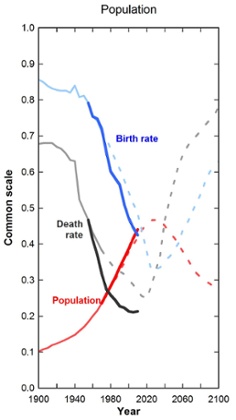
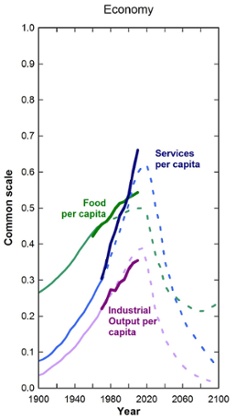
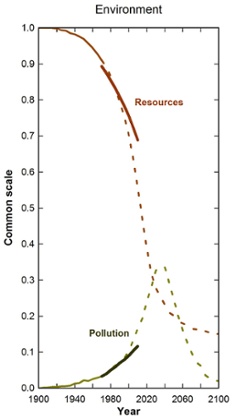
The task was very ambitious. The team tracked industrialisation, population, food, use of resources, and pollution. They modelled data up to 1970, then developed a range of scenarios out to 2100, depending on whether humanity took serious action on environmental and resource issues. If that didn’t happen, the model predicted “overshoot and collapse” – in the economy, environment and population – before 2070. This was called the “business-as-usual” scenario.

The book’s central point, much criticised since, is that “the earth is finite” and the quest for unlimited growth in population, material goods etc would eventually lead to a crash.

So were they right? We decided to check in with those scenarios after 40 years. Dr Graham Turner gathered data from the UN (its department of economic and social affairs, Unesco, the food and agriculture organisation, and the UN statistics yearbook). He also checked in with the US national oceanic and atmospheric administration, the BP statistical review, and elsewhere. That data was plotted alongside the Limits to Growth scenarios.

The results show that the world is tracking pretty closely to the Limits to Growth “business-as-usual” scenario. The data doesn’t match up with other scenarios.

These graphs show real-world data (first from the MIT work, then from our research), plotted in a solid line. The dotted line shows the Limits to Growth “business-as-usual” scenario out to 2100. Up to 2010, the data is strikingly similar to the book’s forecasts.

I'd like to think with a bit of determined effort that instead of falling into the "baseline scenario" outlined above that we can instead switch gears to "scenario 9" as outlined in Limits to Growth (shown below).

Battery Electric Truck From EV-Fleet  

Posted by Big Gav in ,

Gas2.0 has a post on a new electric truck model - Battery Electric Truck From EV-Fleet.

EV-Fleet, of Charlotte, North Carolina, will begin selling its first battery electric truck, called Condor, in September. About the size of a Ford Ranger , the Condor features a robust 5 speed transmission, a carrying capacity of 1000 lbs, and a range of more than 100 miles when equipped with a 50 kWh battery. Recharge time is under an hour when using a 90 amp DC charger. ...

The factory can produce 300 trucks a month. The are priced at $49,995 before rebates and incentives. EV-Fleet says the Condor is the first fully electric light delivery truck in America. With luck, the company will do for trucks what Tesla has done for cars.

Global Biofuels Status Update  

Posted by Big Gav in , ,

Robert Rapier has an article on biofuels drawing on the recent Renewables 2014 Global Status Report (the BP for this year is also out) - Global Biofuels Status Update.

Global biofuel production falls primarily into three categories; ethanol, biodiesel, and hydrotreated vegetable oil (HVO), also known as “green diesel.” Of the 30.8 billion gallons (116.6 liters) of biofuel produced globally in 2013, 23 billion gallons (75%) were ethanol. ...

Biodiesel is the second largest category of global biofuel, accounting for 6.9 billion gallons globally in 2013 — 22.6% of total biofuel production. Biodiesel is derived from reacting fats like vegetable oil with an alcohol like methanol. The products of the reaction are biodiesel and glycerin. The chemical structure of biodiesel is distinctly different from that of petroleum diesel. Petroleum diesel is composed of only hydrogen and carbon (hydrocarbons), but biodiesel also contains oxygen. This gives biodiesel somewhat inferior physical and chemical properties compared with petroleum diesel. ...

Global biofuel production continues to be dominated by ethanol, and the US is the world’s dominant biofuel producer — leading in both ethanol and biodiesel. HVO is the world’s third largest volume biofuel and its production is growing at a faster pace than the more mature ethanol and biodiesel industries.

Vestas Wins First Order For Biggest Offshore Wind Turbine  

Posted by Big Gav in ,

Bloomberg reports that Vestas has made its first sale of their 8MW wind turbine model - Vestas Wins First Order For Biggest Offshore Wind Turbine.

Vestas Wind Systems won its first commercial order for the world’s most powerful offshore wind turbine, pending buyer Dong Energy’s final investment decision in a U.K. project.

The conditional agreement is for 32 8-megawatt V164 devices to be installed in Dong’s Burbo Bank Extension project in Liverpool Bay off northwest England, Dong said today in an e-mailed statement. The machines would be supplied by MHI Vestas Offshore Wind, the venture set up earlier this year by Vestas and Mitsubishi Heavy Industries Ltd.

“Larger and more cost-efficient wind turbines are key elements in the realization of Dong Energy’s strategy towards reducing the cost of electricity from offshore wind,” said Samuel Leupold, an executive vice president at Dong. “Competition among the offshore wind turbine manufacturers will increase.”

The Climate Spectator has a post looking at a report on wind power that includes an impressive array of graphs - Why wind wreckers are often left snatching at air.

Each year, Ryan Wiser and Mark Bolinger from the Lawrence Berkeley National Laboratory put out a superb report documenting developments in the US wind power market. Even though the report concentrates on the US market it provides one of the most insightful reference documents into how wind power technology and its economics are evolving over time on a global basis. This is built from a database which tracks a wide array of key metrics on a very large number of wind power projects across the country. ...

Wind turbine manufacturers have put intensive effort into how to adjust the shape, flexibility and construction of blades to make them longer while keeping weight down and maintaining strength and reliability. Longer blades that remain relatively light provide a greater surface area exposed to the wind, enabling them to turn a generator with lower wind speeds.

In the end – as we find in so many other areas of natural resource exploitation – technological efficiency advances faster than the rate at which the resource is consumed. So even though many of the best wind speed sites are already taken, the total economically viable resource is actually expanding.

Of course, the great thing about wind, versus non-renewable resources, is that the best wind speed sites don’t deteriorate over time because they host a wind farm. So when the first lot of wind turbines wear out we’ll be able to replace them with the more advanced turbines – and considerably expand the amount of power we can extract from the high quality wind sites.

These advancements in turbine technology are a key reason for why the Victorian Government’s recent decision to allow developers to adjust wind turbine layout without obtaining a new planning approval was so important. For many Victorian wind farm development sites, their planning approvals were based on turbine designs that are now as much as four years old. By being allowed to employ turbines with larger rotors, which will often require a higher hub height than older designs, it should substantially improve the economics of these Victorian wind farms.

What’s also interesting from this recent report is that wind continues to expand its level of power generation market share in a range of countries to levels the naysayers said weren’t possible. Denmark is now past 30 per cent wind penetration and approaching 35 per cent. And there are now another three further countries in, or on the verge of, the beyond 20 per cent club. Twenty per cent penetration used to have an almost mystical quality to it, seen as the absolute limit to how much wind a grid could absorb, but that’s now been consigned to an old wives' tale.

So the lesson from all this is that wind turbine technology, and the associated market, are never standing still. Anyone using data from more than a year or so ago is likely to be getting it wrong.

McKinsey: Capturing value in global gas  

Posted by Big Gav in ,

McKinsey has a look at developments in the global market for natural gas, including some analysis of the impact of potential LNG exports from North America - Capturing value in global gas: Prepare now for an uncertain future.

Liquefied natural gas (LNG), while only accounting for 10 percent of the global gas market currently, will be a key determinant of market prices and eventual value creation, as it is the only supply source mobile enough to plug supply and demand gaps in international markets. At the moment, it is in short supply. But because uncertainty about future prices has made buyers reluctant to sign new long-term contracts under traditional terms that link gas prices to oil prices, developers of gas reserves outside North America have been hesitant to sanction new LNG facilities, particularly as LNG project costs are rising rapidly. ...

Over the past decade, regional gas markets have become much more connected, with the number of LNG or pipe routes carrying over five billion cubic meters per annum (bcma)—more than doubling between 2001 and 2011. Yet despite increased linkages, gas prices in regional markets have diverged (Exhibit 1). Three market disruptions explain this. ...

In North America, rapid growth in shale-gas production has led to four years of oversupply and plummeting gas prices. Between 2008 and 2012, production grew at an annual compound rate of 29 percent. However, gas demand failed to keep pace as consumers were slow to switch from other fuels, energy-efficiency measures offset demand growth, and exports have not been an option, since it can take five years to build an LNG export terminal and acquire the necessary permits. Consequently, gas prices in North America fell from $8.9 per million British thermal units (MMBtu) to $2.8 per MMBtu over the same period.

In Asia, LNG prices have been boosted by economic growth, coupled with Japan’s decision in 2011 to shut down its nuclear capacity following the Fukushima disaster. Japanese gas demand grew by more than 20 percent between 2010 and 2012, from 95 bcma to 117 bcma. As Japan has no domestic gas, this all had to be imported as LNG.

Finally, in Europe, an economic slowdown—combined with energy-efficiency improvements and the availability of cheap coal—contributed to an annual decline in gas demand of 1.6 percent between 2005 and 2012. This is in marked contrast to annual growth of 2.7 percent over the previous 15 years. At the same time, liquidity on traded gas markets rose as buyers who found they had contracted excess capacity sought to sell it on. As a result, prices in Europe have fallen, breaking the traditional link with oil prices. Getting to grips with longer-term uncertainty

The impact of all three developments is likely to persist in the medium term (see sidebar “Why supply will likely remain tight this decade”). But the longer-term outlook is far less clear. Four factors will be major drivers of future market dynamics and prices.

North American gas developers are eager to export their plentiful supply of cheap LNG to higher-priced markets. By the end of 2013, they had applied for export permits for more than 380 bcma—equivalent to all of the world’s current liquefaction capacity. If even one-third of this capacity were built, it would have a significant impact on global LNG prices, threatening the viability of higher-cost capacity additions in countries such as Australia and Russia and in Africa, as shown in Exhibit 2. North American exports could be highly profitable at recent LNG prices of $18 per MMBtu but could still turn a profit even if they fell to as low as $12 per MMBtu

India poised to be world solar leader – adding 145GW in 10 years  

Posted by Big Gav in , , ,

RNE has a post on some Indian scenario planning around increasing uptake of solar power - India poised to be world solar leader – adding 145GW in 10 years.

India’s raft of ambitious plans and policies to ramp up national solar development have been generating plenty of headlines over the past few months, and new data has suggested tthe best-case scenario for India’s solar sector could boost the sub-continent’s PV capacity by more than 140GW over the next decade

In a report by Tata Power Solar and cleantech experts Bridge to India, analysts argue that India’s solar potential is huge enough to revolutionise the nation’s energy mix, as long as decision-makers followed the best possible solar roadmap.

The report, How should India drive its solar transformation? Beehives or Elephants, compares four different scenarios, each with a different solar focus – residential rooftops (solar bees); large rooftops (solar pigeons); utility-scale (solar horses); and ultra-mega projects (solar elephants) – evaluating their potential speed of deployment, implementation challenges and job creation potential.

“The realizable potential for solar power generation in India is between 110GW to 145GW across (all four) different types of systems,” said Bridge to India founder and director Tobias Engelmeier. “The four scenarios together could easily create over 675,000 solar jobs in India in the next 10 years.

Statistics

Locations of visitors to this page

blogspot visitor
Stat Counter

Total Pageviews

Ads

Books

Followers

Blog Archive

Labels

australia (619) global warming (423) solar power (397) peak oil (355) renewable energy (302) electric vehicles (250) wind power (194) ocean energy (165) csp (159) solar thermal power (145) geothermal energy (144) energy storage (142) smart grids (140) oil (139) solar pv (138) tidal power (137) coal seam gas (131) nuclear power (129) china (120) lng (117) iraq (113) geothermal power (112) green buildings (110) natural gas (110) agriculture (91) oil price (80) biofuel (78) wave power (73) smart meters (72) coal (70) uk (69) electricity grid (67) energy efficiency (64) google (58) internet (50) surveillance (50) bicycle (49) big brother (49) shale gas (49) food prices (48) tesla (46) thin film solar (42) biomimicry (40) canada (40) scotland (38) ocean power (37) politics (37) shale oil (37) new zealand (35) air transport (34) algae (34) water (34) arctic ice (33) concentrating solar power (33) saudi arabia (33) queensland (32) california (31) credit crunch (31) bioplastic (30) offshore wind power (30) population (30) cogeneration (28) geoengineering (28) batteries (26) drought (26) resource wars (26) woodside (26) censorship (25) cleantech (25) bruce sterling (24) ctl (23) limits to growth (23) carbon tax (22) economics (22) exxon (22) lithium (22) buckminster fuller (21) distributed manufacturing (21) iraq oil law (21) coal to liquids (20) indonesia (20) origin energy (20) brightsource (19) rail transport (19) ultracapacitor (19) santos (18) ausra (17) collapse (17) electric bikes (17) michael klare (17) atlantis (16) cellulosic ethanol (16) iceland (16) lithium ion batteries (16) mapping (16) ucg (16) bees (15) concentrating solar thermal power (15) ethanol (15) geodynamics (15) psychology (15) al gore (14) brazil (14) bucky fuller (14) carbon emissions (14) fertiliser (14) matthew simmons (14) ambient energy (13) biodiesel (13) investment (13) kenya (13) public transport (13) big oil (12) biochar (12) chile (12) cities (12) desertec (12) internet of things (12) otec (12) texas (12) victoria (12) antarctica (11) cradle to cradle (11) energy policy (11) hybrid car (11) terra preta (11) tinfoil (11) toyota (11) amory lovins (10) fabber (10) gazprom (10) goldman sachs (10) gtl (10) severn estuary (10) volt (10) afghanistan (9) alaska (9) biomass (9) carbon trading (9) distributed generation (9) esolar (9) four day week (9) fuel cells (9) jeremy leggett (9) methane hydrates (9) pge (9) sweden (9) arrow energy (8) bolivia (8) eroei (8) fish (8) floating offshore wind power (8) guerilla gardening (8) linc energy (8) methane (8) nanosolar (8) natural gas pipelines (8) pentland firth (8) saul griffith (8) stirling engine (8) us elections (8) western australia (8) airborne wind turbines (7) bloom energy (7) boeing (7) chp (7) climategate (7) copenhagen (7) scenario planning (7) vinod khosla (7) apocaphilia (6) ceramic fuel cells (6) cigs (6) futurism (6) jatropha (6) nigeria (6) ocean acidification (6) relocalisation (6) somalia (6) t boone pickens (6) local currencies (5) space based solar power (5) varanus island (5) garbage (4) global energy grid (4) kevin kelly (4) low temperature geothermal power (4) oled (4) tim flannery (4) v2g (4) club of rome (3) norman borlaug (2) peak oil portfolio (1)