Port Augusta's ageing coal mines and coal fired power plants have been destined for closure for some time, with the clock finally winding down on them and the remaining Northern Power plant scheduled to close down in May.
There have been various proposals to build alternative solar power based generation facilities in the region as a replacement, leveraging some of the existing infrastructure, however most of these have been abandoned.
Now that new Prime Minister Malcolm Turnbull has decided to keep the Clean Energy Finance Corporation alive (dumping plans by his incompetent predecessor to shut it down), a new push has begun to build a solar thermal power plant in the Port Augusta area.
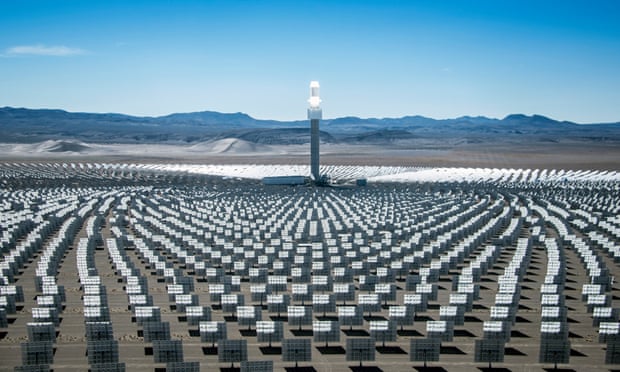
The latest plan is for US company SolarReserve to build a 110MW solar tower plant, similar to the Crescent Dunes facility in Nevada.
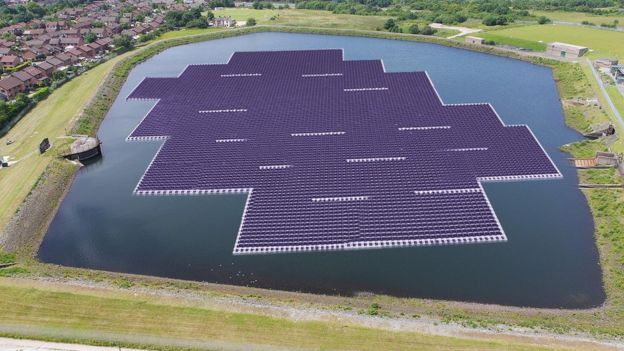
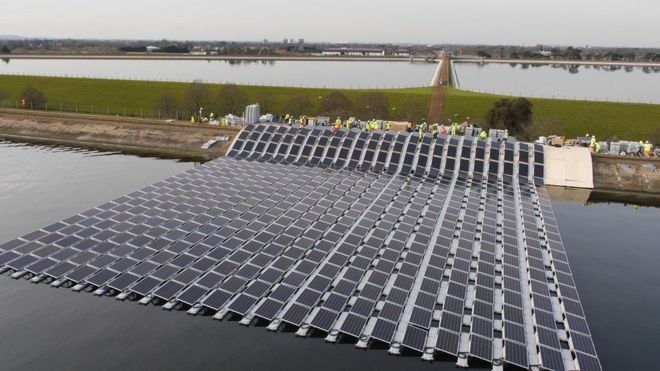
This idea also helps reduce evaporation from the dam - and where the dam is also used for hydro-electric power, has a ready made, intermittently used grid connection available too.
An example of this is being put into practice in Brazil - Cleantechnica has a report on one 10MW project (out of a total of 350MW of floating solar plants planned for the country) - Brazil Pairs Hydro & Floating Solar.
Brazil isn't the only country in the Americas building floating solar plants - the concept has spread to the united States as well - Partners Start Building 3.2 MW Floating Solar Project In N.J..
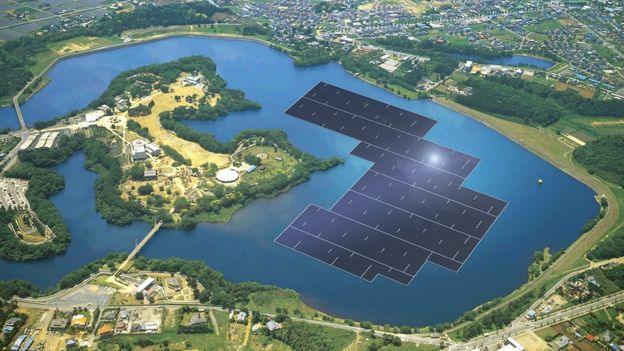
The country which has taken the greatest interest in floating solar plants is Japan (unsurprising given the huge build out of solar in the country since the Fukushima nuclear disaster and the lack of empty land for large scale solar power plants). The world's largest example is under construction by Kyocera in Chiba prefecture - Japan begins work on 'world's largest' floating solar farm.
Tesla is launching the home battery business partly because it’s already making vehicle batteries—and as a result it can benefit from the economies of scale that come from making both. Another reason is that the market for storage is expected to grow in concert with the use of solar power. Tesla needs both electric vehicles and solar power to boom if it hopes to fulfill the projected output from a vast $5 billion battery “gigafactory” it’s building in Nevada.
The primary use case for home storage is daily cycling, also known as peak shaving, which can be applied a few different ways. The primary reason for the product existing is to store up solar energy made from customer panels during the day, which can then be used at night. In markets with net metering, there is no financial incentive for doing this. In markets with no net metering regulation, Powerwalls — and residential battery storage in general — could be game changers.
Ben Kallo at equity analyst firm RW Baird believes that Tesla's current battery costs are ~$150 to ~$200 per kilowatt-hour, well below the industry average pack costs of ~$350 per kilowatt-hour. ... Kallo suggests that the Chevy Bolt's battery costs "are significantly higher" than those of Tesla. Kallo suggests that Tesla "could reach its <$100 per kilowatt-hour target in the intermediate term as Gigafactory production ramps." ... GM sees its battery cell cost hitting $100 per kilowatt-hour in 2022. (GM is quoting cell cost, while Kallo is talking about battery packs. A complete battery pack "typically adds 20 percent above the cost of cells," according to David Snydacker, a battery expert at Dosima Research.)
Last month, Elon Musk predicted that the electric vehicle industry will "definitely suffer" from low oil prices—a barrel of crude is about $33 today, down from more than $100 a year ago. Why invest in an electric car when gas is so cheap? And sure enough, sales of gas-guzzling SUVs jumped 10 percent in 2015, while electric vehicle sales dipped 4 percent.
But don't expect that trend to last, even if oil prices stay relatively low. A new market forecast from Bloomberg New Energy Finance paints a rosy picture for the future of electric vehicles, rising from about 1 percent of global annual vehicle sales today to 35 percent by 2040—about 41 million cars.
Wired has a report on the same topic, noting "by 2022, the unsubsidized total cost of ownership of battery electric vehicles will fall below that of an internal combustion engine vehicle" - The Electric Car Revolution Is Now Scheduled for 2022.
Fortune notes there has been a steady shift of focus towards EVs at GM in recent years, claiming "Half of the 8,600 designers and engineers who work on the products and controls that make GM cars and trucks move—literally—are involved with alternative and electric propulsion systems" - GM's Electric Car Ambitions Are Reshaping the Company.
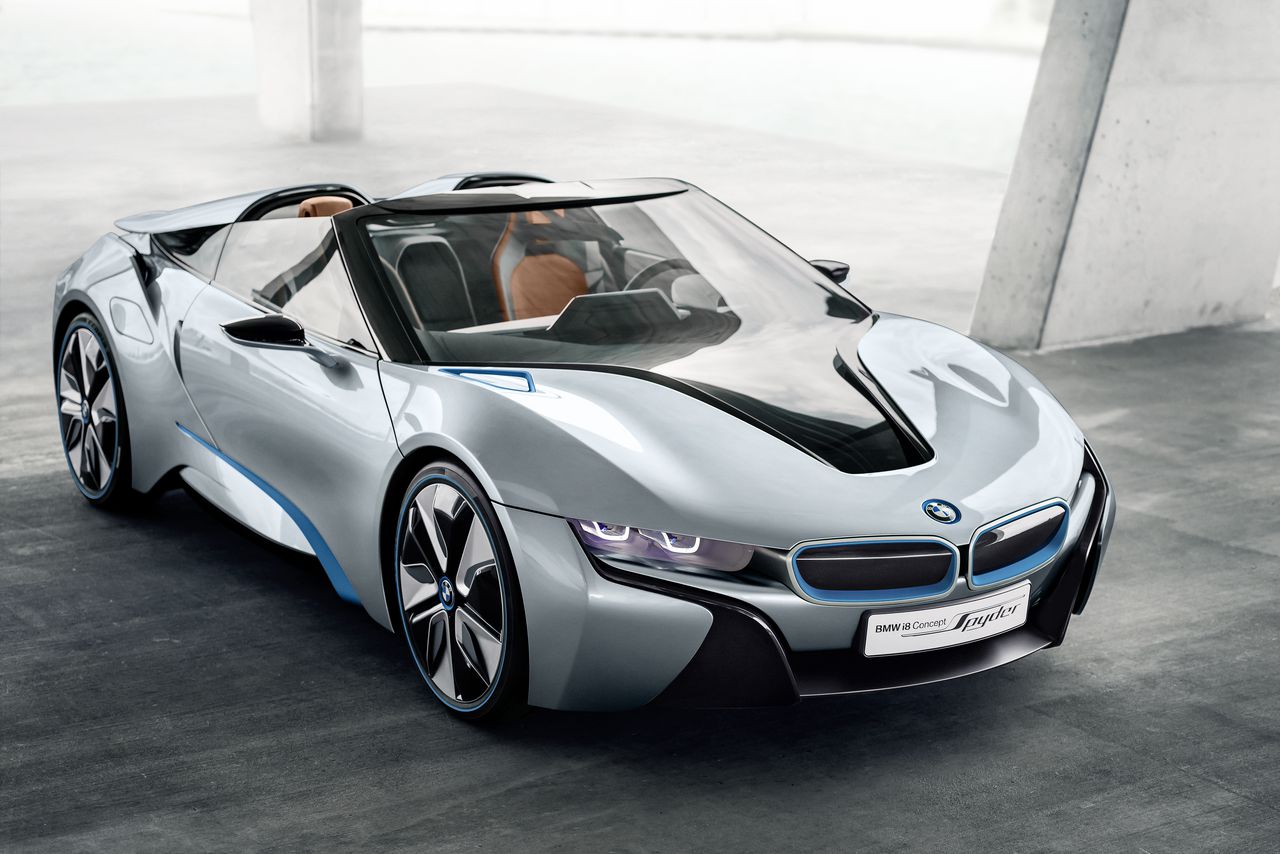
Bloomberg has an article on BMW's refocus on EVs as well, noting the BMW iNext is a "self-driving, electric car to supplant the 7-Series sedan as its flagship model in the coming years, responding to the challenges posed by the likes of Apple and Uber Technologies" - BMW Counters Apple Threat With Self-Driving, Electric Car Push.
Tesla is still leading the way when it comes to EV sales. The NY Post reports that Tesla is rolling out a network of 105 charging stations in New York city - claiming "this means there could soon be three times as many electric-car charging stations in Manhattan as gas stations" - .
Think Progress has a post on the "peak oil demand" theory that seems to have come into vogue to replace traditional peak oil theory based on supply depletion - Peak Oil Returns: Why Demand Will Likely Peak By 2030.
Is it possible that the world is actually going to follow the path of the “Transport Transformation Scenario” and peak in oil demand by 2030 or so? At this point I think is not only possible, but likely.
It is increasingly clear that technology will be here to make that possible — indeed, the technology is almost here now (see this recent post, “Tesla And GM Announce Affordable, Long-Range Electric Cars”). Same with the renewables needed to power electric cars carbon-free (see “Why The Renewables Revolution Is Now Unstoppable“).
The core issue now is whether the nations of the world will embrace the policies needed to accelerate those technologies into the marketplace fast enough to cause demand to actually peak in one to two decades globally — much as oil demand in the industrialized countries appears to have peaked a decade ago.
I quite enjoyed this BBC piece from late last year on the origins of Donald trump's campaign for the Republican nomination - Is Donald Trump a Democratic secret agent?.
"If Donald Trump were a Democratic mole placed in the Republican Party to disrupt things, how would his behaviour be any different?" asked conservative political commentator George Will in July. "I don't think it would be."
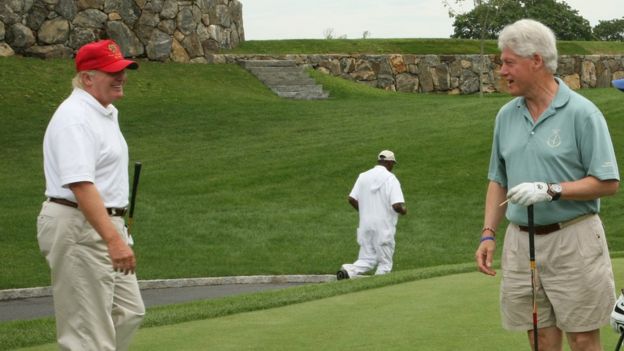
Just over a week later Republican Congressman Carlos Curbelo of Florida called Mr Trump "a phantom candidate recruited by the left to create this entire political circus." And he laid out what is the foundation of the Trump conspiracy theories. "Mr Trump has a close friendship with Bill and Hillary Clinton," he said. "They were at his last wedding. He has contributed to the Clintons' foundation. He has contributed to Mrs Clinton's Senate campaigns. All of this is very suspicious."
Of course Mr Trump has also contributed to plenty of Republicans. He likes to boast that he has "bought" politicians of all stripes. And Mr Trump's wedding was a coveted invitation for all of New York City's elite, of which the Clintons were definitely part.
Also suspicious - for those predisposed to suspicion, at least - is a "mystery" phone call between Mr Trump and Bill Clinton in May, less than a month before the real-estate tycoon tossed his hat into the presidential ring.
Kevin at Cryptogon seems to think Trump's purpose is to elect Hillary as well - what choice to voters have when they are faced with an establishment favourite and a populist conman from the 1% ? Bernie Sanders has an uphill battle to take the Democratic nomination but at least he offers an alternative to the status quo that seems to have so many Americans angry - At Secretive Meeting, Tech CEOs and Top Republicans Plot to Stop Trump.
I’m trying to understand this Trump situation and the hysterical freakout that’s ensuing in elite and media circles.
Trump could have been vote-frauded into oblivion by now.
Why hasn’t that happened?
My best guess is that the primary purpose of the Donald Trump candidacy—whether he knows it or not—is to escort Hillary to the White House by simply drawing attention away from the Clintons’ life of crime.
The peak oil debate has taken an interesting turn. It seems now that we may hit peak demand before we hit peak oil (in terms of physical production limits). By "peak demand," I mean the globe may see a permanent decline in oil demand before we hit long-term physical production limits. If this is the case, the cornucopians will have been proven right -- not the peak oilers. Time will tell.
Why would we see a decline in demand any time soon, with the developing world population and consumption still growing strongly? As I’ve described in previous columns, exponential growth in electric vehicles and steadily declining costs may well lead to a relatively rapid transformation in how we move people and goods in the coming two to three decades.
We can’t at this point make any firm predictions about sales of EVs even in the next few years. But we are seeing a classic learning curve with EV technologies that suggests a coming boom in EV sales. The real game-changers will be the pending crop of 200+ mile range EVs, including Tesla’s planned Model 3, the Chevy Bolt, the new and improved Nissan Leaf, VW’s planned 300+ mile range car, and probably many other manufacturers already plotting developments in this space. Once these cars are available and affordable, we may well see the exponential growth curve turn sharply upward. Globally, we’re seeing a very robust sales growth trend continuing.
Independently of EVs, we’re also seeing many other technologies leading to lighter and more efficient cars. Some kind of fuel economy standard is in place now for 80 percent of the world’s passenger vehicles sold in 2013, according to the International Council on Clean Transportation.
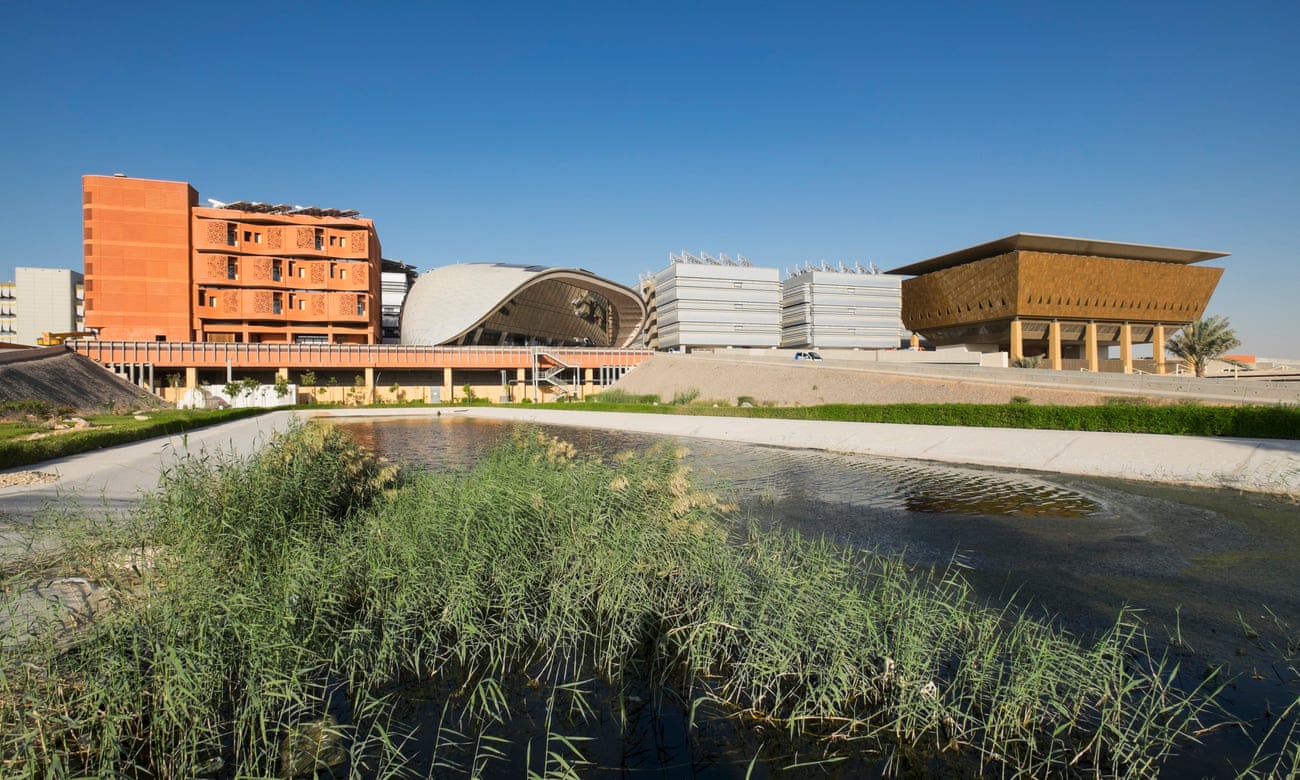
the rationale for Masdar City – demonstrating a model of green living – has been abandoned. “The original aim was to be net zero, yes, but that was when we were looking at the city in isolation,” Wan said. He maintained it was important to look at Masdar City within the context of the other renewable energy holdings of the parent company. Among Mubadala’s other holdings, Masdar Clean Energy is developing the Shams solar farm. “Masdar as a family company is supply[ing] much, much more clean energy than what is being consumed in the city, for sure,” Wan said. ...
With the downward pressure from oil prices, the UAE has stepped up its efforts to wean itself off oil, lifting fossil fuel subsidies and billing Emiratis – not just expatriates – for water and electricity.
But delivering on the original dream of Masdar has been elusive. Crews broke ground in 2008, but plans withered in the global economic recession which soon followed when investors put their green dreams on hold. “A lot of the people who were considering investing in Masdar City decided to take a breather,” Wan said.
Meanwhile, the jet-set transport system was overtaken by technological developments in the auto sector. The expensive purpose-built system no longer made sense in an era when zero-emission electric cars were widely available. “Five years ago it’s true that we did not perceive the speed with which the electric vehicle would be developed,” Wan said.
CSP was anticipated to take the region by storm when Shams 1 was being developed, with projects also cropping up in Morocco. As a result, Shams was expected to have two additional projects added. Mr Al Obaidli said the land was originally reserved for three CSP plants, but times have changed and more cost-competitive options are now availab .
Although he declined to give exact figures, Mr Al Obaidli said that the Shams 1 costs more than the average price of CSP. According to Abu Dhabi-based International Renewable Energy Agency (Irena), production costs for the technology range between 20 and 25 US cents per kilowatt-hour.
But Mr Al Obaidli pointed to the fact that Shams was one of the first CSP projects in the region. “It’s not at today’s electricity prices because when we built Shams, there was only one supplier in the world for mirrors. Now there are at least seven bankable mirror suppliers in the market." In comparison, Dubai’s Mohammed bin Rashid Al Maktoum Solar Park, which uses PV technology, was awarded at a tender of 5.84 cents per kilowatt-hour.
Shams 1 is a 100 megawatt facility with 258,048 mirrors arranged in parabolic troughs covering 2.5 square kilometers. It’s the only plant of its kind in the world completely surrounded by a solid wall - and that’s a critical difference between Shams 1 and other concentrating solar power (CSP) plants. As explained by Al Obaidli, the wall provides a significant measure of protection from desert wind and sandstorms. Storm-grade winds can take out large sections of equipment in a conventional CSP plant, but according to Al Obaidli, one of the strongest storms in recent memory passed through last year and it only damaged 20 out of the 258,048 mirrors.
The parabolic troughs themselves also include design features that prevent wind damage. On just a few minutes’ notice they can be rotated into a “safety” position, and then locked in place.
There are more than one billion cars on the road worldwide today, and only one tenth of one percent of them have a plug. OPEC contends that even in the year 2040, EVs will make up just one percent. But don't be so sure. By 2020, some electric cars and SUVs will be faster, safer, cheaper, and more convenient than their gasoline counterparts. What if people just stop buying oil?
According to NASA analysis, average temperatures last month were 1.35 degrees above the norm for the 1951-1980 period. They smashed the previous biggest departure from the average - set only in the previous month - by 0.21 degrees.
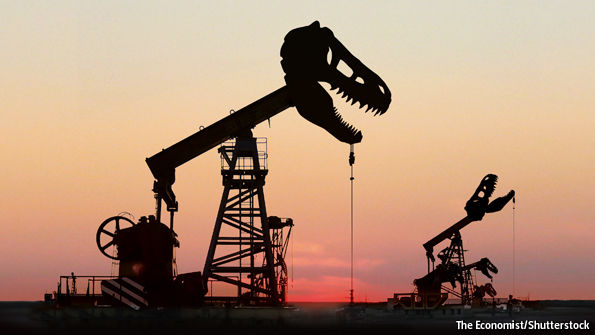
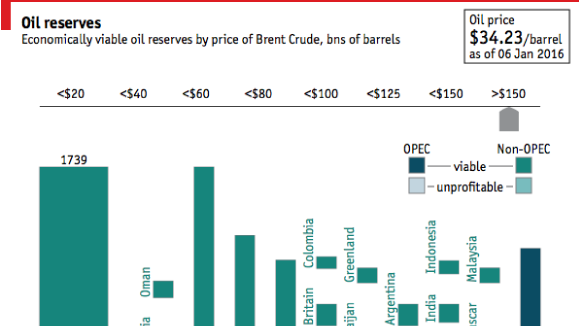
The Economist has an article (from January) on the gyrations of the oil price, reviving their circa-2000 prediction of $10 per barrel oil (this doesn't look like occurring and if it did it would be for but a fleeting moment) - Who’s afraid of cheap oil?.
The world is drowning in oil. Saudi Arabia is pumping at almost full tilt. It is widely thought that the Saudis want to drive out higher-cost producers from the industry, including some of the fracking firms that have boosted oil output in the United States from 5m barrels a day (b/d) in 2008 to over 9m b/d now. Saudi Arabia will also be prepared to suffer a lot of pain to thwart Iran, its bitter rival, which this week was poised to rejoin oil markets as nuclear sanctions were lifted, with potential output of 3m-4m b/d.
Despite the Saudis’ efforts, however, producers have proved resilient. Many frackers have eked out efficiencies. They hate the idea of plugging their wells only for the wildcatter on the next block to reap the reward when prices rebound. They will not pack up so long as prices cover day-to-day costs, in some cases as low as $15 a barrel (see article). Meanwhile oil stocks in the mostly rich-country OECD in October stood at 267 days’ net imports, almost 50% higher than five years earlier. They will continue to grow, especially if demand slows by more than expected in China and the rest of Asia. Forecasting the oil price is a mug’s game (as the newspaper that once speculated about $5 oil, we speak from experience), but few expect it to start rising before 2017. Today’s price could mark the bottom of the barrel. Some are predicting a trough of as low as $10.
Christmas did not offer much good cheer to the world’s bankers, who have received a sustained kicking since the financial crisis erupted in 2008. In the latest blow, Switzerland announced that it would hold a referendum on a radical proposal that would strip commercial banks of the ability to create money, depriving them of a great deal of their profitmaking capabilities. If the Swiss proposal catches on around the world, it could shred core business assumptions that have underpinned the banking model over the past three centuries. ...
It is into this atmosphere that the idea of stripping banks of their money-creating abilities has gained currency (regained, in fact, since calls for it date back at least to the 1930s). According to its proponents, the way to root out the instability inherent to the system is to require banks to back their loans 100 per cent with reserves. This essentially would be a step back to the point where banks would again function as conduits rather than creators of capital.
Under the reformed system the creation of new money would instead be the prerogative of the central bank and the government. These national institutions would in theory be motivated by the needs of the state rather than by short-term profit and would keep the money supply growing at a fixed rate, doing away with the wild fluctuations of the credit cycle. (One challenge to overcome would be politicians attempting to hijack the money supply for short-term political gain.)
Proponents of such a system point to many expected benefits: Bank runs would be eliminated, the proceeds of money creation would go to the government and, thus, the taxpayer rather than to the banking elite, government debt would be a thing of the past, and private debt would be greatly reduced. (Indeed, the predominance of debt in today’s world is partly a product of it being required in the money creation process.)
But there also would be great risks involved, the main one being the fear of the evil unknown. Though the economic instabilities of the past 300 years appear to have resulted largely from the fractional reserve system, was it also responsible for the relatively breakneck growth over the same period? Moreover, the changeover from one system to the other would be extremely tricky, requiring vast quantities of central bank money-printing and debt buybacks. That would be a recipe for an extremely fraught period carrying immense risks of mismanagement. In truth, another full-blown financial crisis may have to take place before such a changeover could be made at the global level.
But the theoretical upsides are great, as are frustrations with the current system, and the idea has begun to gather momentum. In 2012, the International Monetary Fund published an influential research paper laying out the case for the proposed system, and in 2015 the Icelandic government commissioned a report on the prospect of undertaking the changes. In Switzerland, a law requiring a referendum to take place should 100,000 signatures be gathered has set the country on a course to possibly being first to undertake the great experiment.
I've been watching the Trump spectacle with a degree of amusement, with "Donald Drumpf" (as John Oliver dubbed him, resurrecting his original German family name) doing a great job of showing where the Republican strategy of appealing to racist, sexist and militarist voters over the past 30 odd years leads - to a narcissistic fascist conman taking over the party and sidelining its traditional conservative rulers. It's like watching a 1930's history book turned into a tele-movie.
On the left Bernie Sanders is doing a reasonable job of trying to revive left wing populism (albeit of a very mild social democrat variety, he's no socialist even if he calls himself one). I'm hoping he can manage to take Hillary Clinton down to the wire, though I expect she's the slightly more viable presidential candidate given the entire US establishment will line up behind her to maintain business as usual should Trump grab the Republican nomination and no third-party candidate emerge from that process.
Like every right wing populist he will occasionally speak the truth (belatedlycriticising the Iraq war for example, something I can't remember any Republican candidate other than Ron Paul doing in the last decade) - unfortunately the average angry white voter doesn't seem to realise (or care) that even a broken clock tells the time correctly twice a day.
In an eerie evocation of fascist rallies the world might have thought had been consigned to history, leading Republican presidential contender Donald Trump demanded that thousands at a rowdy Saturday rally in Florida should swear they would vote for him – "no matter what."
"Let's do a pledge. Who likes me in this room," Trump demanded, between interruptions as protesters were manhandled out of the rally. He raised his hand as a court witness might.
Donald Trump asks supporters to pledge their allegiance to him during a rally in Florida.
But, recreating images that became hallmarks of Italian Fascist and German Nazi rallies and watched by the cameras of the world's media, the crowd then stretched their right arms much as followers of Hitler and Mussolini did.
Performing as in a grainy Movitone News clip, most in the crowd held their right arms outstretched at an angle while Trump demanded again, "I've never done this before. Can I have a pledge? A swearing? Raise your right hand."
A #NeverTrump campaign has been launched and there is a reported gusher of donations to fund an advertising campaign to tear down the real estate mogul.
Their difficulty is, that in leaving their run so late; they might be too late. Trump has harnessed, and now owns, the rank-and-file conservative voter anger that the GOP failed to address in any meaningful way and for which they were rebuked by a weekend editorial in The New York Times.
"It is an excellent thing that the Republican leaders have noticed the problem they have fostered, now embodied in the Trump candidacy. But until they see the need to alter the views and policies they have expressed for years, removing Mr Trump will not end the party's crisis."
It's asymmetric war – Trump appeals to the gut; the party leadership talks to the brain.
Sounding more like Mussolini, whose quotes he happily retweets, Trump says he wants to "open up the libel laws", by which he means he wants to rip down the First Amendment, so that he can go after his media critics; and he menaces contributors to the campaigns of his opponents that "they better be careful, they have a lot to hide".
He incites the ugly side of his audiences, ordering his security to "throw [protesters] out in the cold"; or weighing in himself with incendiary threats like, "I'd like to punch him in the face".
For Trump, torture is the go; international law is to be ignored and his fellow Republican and House speaker Paul Ryan might as well be road kill – "I'm sure I'm going to get along with him; and if I don't, he's going to pay a big price."
Ruth Marcus, writing in The Washington Post, warns Americans of what they might be getting: "Trump is [Richard] Nixon with all of the megalomaniacal willingness to abuse power and none of the crafty realpolitik. He's attracted to strongmen, past and present – unapologetically retweeting a quote from Mussolini and basking in praise from Vladimir Putin."
Art Berman has an article in Forbes on the ending of the crude oil export ban in the US - The Crude Oil Export Ban--What, Me Worry About Peak Oil?. It's quite amazing just how much oil the US still imports after 10 years of the shale oil boom.
Congress ended the U.S. crude oil export ban last week. There is apparently no longer a strategic reason to conserve oil because shale production has made American great again. At least, that’s narrative that reality-averse politicians and their bases prefer.
The 1975 Energy Policy and Conservation Act (EPCA) that banned crude oil export was the closest thing to an energy policy that the United States has ever had. The law was passed after the price of oil increased in one month (January 1974) from $21 to $51 per barrel (2015 dollars) because of the Arab Oil Embargo.
The EPCA not only banned the export of crude oil but also established the Strategic Petroleum Reserve. Both measures were intended to keep more oil at home in order to make the U.S. less dependent on imported oil. A 55 mile-per-hour national speed limit was established to force conservation, and the International Energy Agency (IEA) was founded to better monitor and predict global oil supply and demand trends.
Above all, the export ban acknowledged that declining domestic supply and increased imports had made the country vulnerable to economic disruption. Its repeal last week suggests that there is no longer any risk associated with dependence on foreign oil.
The Australian company has developed what it hopes will be a low-cost, high-efficiency Concentrated Solar Power (CSP) generation technology. The Jemalong pilot plant will be ready for commissioning in mid-January and is designed to prove the technology works.
AMP's Shane Oliver believes that, rather than facing a peak oil shock, consumers and industries will continue to move away from fossil fuels in an orderly manner as a wider range of renewable technologies get closer to affordable reality. "What's going to happen is that oil production globally will at some point peak but it's going to be because the world has moved away from oil towards the use of other things," Dr Oliver told AM. "The electrification of automobiles and greater efficiency in the use of oil will drive a decline in the demand through time anyway."
Dr Oliver said that, rather replicating a shock in the 1970s when OPEC restricted supply, the globe is undergoing a quiet revolution that will see the world requiring less oil. "Only a decade ago I was being told that I've got to get rid of my car and replace it with a horse and buggy. That prospect appears as less likely," Dr Oliver said. "The reality is the days of the internal combustion engine using oil are numbered, and I won't be getting rid of the car and getting a horse and buggy - I'll perhaps be getting a car with an electric engine."
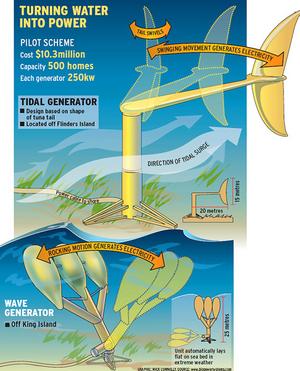
Another Australian-designed wave energy project has been deployed, with the completion this week of the 250kW bioWAVE pilot demonstration unit off the Victorian coast near Port Fairy.
The $21 million project has been in development by Sydney and US-based company, BioPower Systems, for three years, with $11 million funding from the Australian Renewable Energy Agency (ARENA) and $5 million funding from the Victorian Government.
The world has lost a third of its arable land due to erosion or pollution in the past 40 years, with potentially disastrous consequences as global demand for food soars, scientists have warned.
New research has calculated that nearly 33% of the world’s adequate or high-quality food-producing land has been lost at a rate that far outstrips the pace of natural processes to replace diminished soil.
The University of Sheffield’s Grantham Centre for Sustainable Futures, which undertook the study by analysing various pieces of research published over the past decade, said the loss was “catastrophic” and the trend close to being irretrievable without major changes to agricultural practices. The continual ploughing of fields, combined with heavy use of fertilizers, has degraded soils across the world, the research found, with erosion occurring at a pace of up to 100 times greater than the rate of soil formation. It takes around 500 years for just 2.5cm of topsoil to be created amid unimpeded ecological changes.
















 Posts
Posts