Posted
by Big Gav
in
abengoa,
chile,
csp,
solar power,
solar thermal power
CSP Today reports that Spanish developer Abengoa will build a 110 MW solar thermal power plant in Chile with 17.5 hours of storage - Abengoa wins first CSP tender in Chile, will build a 110 MW tower plant to generate around the clock.
The plant will be a 110 MW tower type with molten salts as working fluid and energy storage medium, this will be the first commercial project for Abengoa with the molten salt technology for tower plants. With the design provided by the Spanish company, the plant will be able to generate electricity for up to 17.5 hours without solar radiation, only with the heat stored in the molten salt tanks.
The project will be located in the Atacama Desert, the region with the highest solar radiation concentrations in the world. It will be the first solar-thermal plant for direct electricity production in South America.
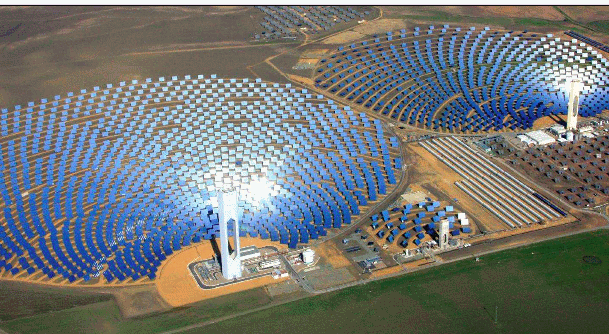
Solar-thermal tower technology uses a series of mirrors (heliostats) that track the sun on two axes, concentrating the solar radiation on a receiver on the upper part of the tower where the heat is transferred to the molten salts. The salts then transfer their heat in a heat exchanger to a water current to generate superheated and reheated steam, which feeds a turbine capable of generating around 110 MW of power.
Posted
by Big Gav
in
abengoa,
csp,
mexico,
solar thermal power
Bloomberg has a report on a solar thermal power plant to be constructed in Mexico - Abengoa to Develop Mexico’s First Solar-Thermal Power Plant in Agua Prieta.
Abengoa SA (ABG), the world’s largest developer of solar thermal plants, plans to build Mexico’s first solar-thermal power plant as part of a gas-fueled combined cycle project in the northern state of Sonora. The Spanish group will build a 12-megawatt solar field using parabolic trough technology in Agua Prieta for the Mexican Federal Electricity Commission, it said today in an e-mail. The plant is expected to start operating in 22 months.
The plant will be one of the first solar and gas-fired hybrid power plants in the world. In such plants, parabolic mirrors concentrate solar energy to heat liquids and power the same turbines used at the much-larger gas power plant. Abengoa commissioned two plants of the same type in Morocco and Algeria last year and Germany’s Solar Millennium AG (S2M) opened a 20-megawatt facility near a 130-megawatt gas project in December.
Posted
by Big Gav
in
abengoa,
chile,
csp,
solar thermal power
HelioCSP has a post on a solar thermal power plant project in Chile - Abengoa develops its first concentrating solar power (CSP) plant in Chile.
Abengoa will be responsible for the engineering, design and start-up of the new solar-thermal plant in the Atacama Desert, which will comprise a solar field of 1,280 parabolic trough collectors.
Abengoa, the international company that develops innovative technology solutions for sustainable development in the energy and environment sectors, will undertake its first concentrating solar power (CSP) project using parabolic trough technology in the Atacama Desert in Chile.
The Desert is considered to have one of the highest levels of solar radiation on the planet. The plant, which will require an investment of $12 million, will be capable of supplying heat in an efficient and sustainable way to the production processes of Minera El Tesoro, a subsidiary of Anafagasta Minerals based in northern Chile.
Abengoa will be responsible for the engineering, design and start-up of the new solar-thermal plant in the Atacama Desert, which will comprise a solar field of 1,280 parabolic trough collectors. In energy terms, the plant will enable Minera El Tesoro to further reduce its current use of fossil fuels by more than 50%.
Posted
by Big Gav
in
abengoa,
csp,
energy storage,
solar thermal power,
spain
SustainableBusiness.com reports that Abengoa have begin operation of their Solnova 1 solar thermal power plant in Spain Abengoa Begins Operation of 50MW Concentrating Solar Power Plant.
Abengoa Solar, a unit of Spanish corporation Abengoa (ABG.MC), has begun commercial operation of a new 50-megawatts (MW) solar thermal power plant in Spain.
The company said Solnova 1's performance matches the theoretical output of the design, validating the potential of parabolic trough technology for capturing and converting the sun's heat into electricity.
Abengoa Solar built a smaller pilot plant in 2007. And the company has contracts to build two much larger plants in the US--one in California (250 MW) and the other in Arizona (280 MW).
Solnova 1 is made up of around 980,000 square feet (300,000 square meters) of mirrors that cover an area totalling approximately 280 acres (115 hectares). The plant employs technology which concentrates solar radiation onto a heat-absorbing pipe inside of which flows a liquid that reaches high temperatures. This fluid transfers its energy to the water vapor that reaches a turbo-generator, where it expands to produce electricity.

Martin LaMonica at CNet reports that Abengoa are one of the companies the DOE has allocated energy storage research funding to -
DOE funds to stretch solar power via salt storage.
The Department of Energy is funding a series of projects that marry concentrating solar power with storage, which offers the potential of solar power plants that operate 18 hours a day.
The DOE said Friday that it has made $62 million available to 13 companies to test equipment and materials, such as molten salts, to add storage to solar power systems that use heat to produce electricity.
Concentrating solar power, in which the sun's heat creates steam to drive an electricity turbine, is seeing a renaissance because it can be used for large-scale power plants in deserts. Adding storage can extend the time these plants supply electricity to the grid and can potentially improve the economics of solar versus fossil fuels.
The DOE's target is to extend the output of concentrating solar power systems to 18 hours, covering the peak times of electricity usage.
The top three recipients are Abengoa Solar, eSolar, and Pratt & Whitney Rocketdyne, each of which received more than $10 million for molten-salt research.
Abengoa Solar is already operating a solar storage facility and will test a solar tower that operates at a higher temperature, which could improve the overall output for a given land area. Solar tower designs use heliostats, or mirrors that track the sun, to reflect light onto a tower to heat a liquid.
Posted
by Big Gav
in
abengoa,
csp,
seville,
solar power,
solar thermal power,
spain
Reve has a report on the opening of Abengoa's PS20 solar plant, the largest commercial solar thermal power plant in the world - Abengoa's PS20 solar plant, the largest commercial solar tower plant in the world.
Don Juan Carlos and Doña Sofía, today presided over the inauguration of Abengoa's PS20 solar plant, the largest commercial solar tower plant in the world, located at the Solúcar Platform in Sanlúcar la Mayor, Seville.
Abengoa's PS20 solar plant, the largest commercial solar tower plant in the world
The Chairman of Abengoa, Felipe Benjumea, explained the functioning and the advantages of tower technology, a mature solution that offers the most efficient performance compared to other similar technologies, by concentrating solar radiation onto a single spot.
During his speech, Abengoa's Chairman pointed out that the plant's operations "are based on generating electricity by obtaining heat from solar radiation. More than 1,000 mirrors, each one 120 square metres in size, placed at the base of the tower, track the sun just like sunflowers".
The 20 megawatts of power produces enough clean energy to supply 10,000 homes, preventing the emission of approximately 12,000 tonnes of CO2 into the atmosphere per annum. Felipe Benjumea added that "energy in the 21st century has to be clean with no greenhouse gas emissions; competitive, internalising all costs, including from the CO2; and storable. These three conditions have all been fulfilled here and we believe that this is the real future for today, a possible future".

Posted
by Big Gav
in
abengoa,
csp,
solar power,
solar thermal power
Technology Review has a look at the new 280 MW CSP (solar thermal) power plant to be built in Arizona by Spanish company Abengoa Solar. The article notes that one of the important features of CSP is that it is much easier to store heat energy directly than it is to store electricity (from wind or solar PV), which makes the economics of CSP much more compelling. The upshot of which is that while PV is great for distributed generation on rooftops, centralised solar power generation is probably better left to CSP.

Investors and utilities intent on building solar power plants are increasingly turning to solar thermal power, a comparatively low-tech alternative to photovoltaic panels that convert sunlight directly into electricity. This month, in the latest in a string of recent deals, Spanish solar-plant developer Abengoa Solar and Phoenix-based utility Arizona Public Service announced a 280-megawatt solar thermal project in Arizona. By contrast, the world's largest installations of photovoltaics generate only 20 megawatts of power.
In a solar thermal plant, mirrors concentrate sunlight onto some type of fluid that is used, in turn, to boil water for a steam turbine. Over the past year, developers of solar thermal technology such as Abengoa, Ausra, and Solel Solar Systems have picked up tens of millions of dollars in financing and power contracts from major utilities such as Pacific Gas and Electric and Florida Power and Light. By 2013, projects in development in just the United States and Spain promise to add just under 6,000 megawatts of solar thermal power generation to the barely 100 megawatts installed worldwide last year, says Cambridge, MA, consultancy Emerging Energy Research.
The appeal of solar thermal power is twofold. It is relatively low cost at a large scale: an economic analysis released last month by Severin Borenstein, director of the University of California's Energy Institute, notes that solar thermal power will become cost competitive with other forms of power generation decades before photovoltaics will, even if greenhouse-gas emissions are not taxed aggressively.
Solar thermal developers also say that their power is more valuable than that provided by wind, currently the fastest-growing form of renewable energy. According to the U.S. Department of Energy, wind power costs about 8 cents per kilowatt, while solar thermal power costs 13 to 17 cents. But power from wind farms fluctuates with every gust and lull; solar thermal plants, on the other hand, capture solar energy as heat, which is much easier to store than electricity. Utilities can dispatch this stored solar energy when they need it--whether or not the sun happens to be shining. "That's going to be worth a lot of money," says Terry Murphy, president and chief executive officer of SolarReserve, a Santa Monica, CA, developer of solar thermal technology. "People are coming to realize that power shifting and 'dispatchability' are key to the utility's requirements to try to balance their system."
In fact, the capacity to store energy is critical to the economics of the solar thermal plant. Without storage, a solar thermal plant would need a turbine large enough to handle peak steam production, when the sun is brightest, but which would otherwise be underutilized. Stored heat means that a plant can use a smaller, cheaper steam turbine that can be kept running steadily for more hours of the day. While adding storage would substantially increase the cost of the energy produced by a photovoltaic array or wind farm, it actually reduces the cost per kilowatt of the energy produced by solar thermal plants.
The amount of storage included in a plant--expressed as the number of hours that it can keep the turbine running full tilt--will vary according to capital costs and the needs of a given utility. "There is an optimal point that could be three hours of storage or six hours of storage, where the cents per kilowatt- hour is the lowest," says Fred Morse, senior advisor for U.S. operations with Abengoa Solar. Morse says that the company's 280-megawatt plant in Arizona, set to begin operation by 2011, will have six hours of storage, while other recent projects promise seven to eight.
The WorldWatch Institute is predicting 2008 will be the year
solar thermal power takes off.
Yet another renewable energy technology-concentrating solar power (CSP)-may be ready for the explosive growth that has marked solar photovoltaic and wind power systems in recent years.
CSP, a utility-scale technology ideally suited to desert areas, is resurging around the world, with major facilities being built or planned in the U.S. Southwest, Spain, North Africa, Peru, Chile, and even Germany, write Susan Moran and J. Thomas McKinnon in the March/April issue of World Watch magazine. In the United States, a "perfect storm" of influences-especially growing public concern about coal, new venture capital, high oil prices, and state renewable energy mandates-is positioning CSP to become a much bigger part of the energy mix.
CSP delivers power in the middle of the day, when demand is typically highest. And CSP facilities can be equipped with thermal storage capacity that enables them to supply "off-peak" power long after the sun has gone down. Costs are currently around 17 cents per kilowatthour (kWh), but Moran and McKinnon cite one set of projections suggesting that cost could drop to 8 cents/kWh with experience. Department of Energy research grants have been awarded to nine U.S. companies in an effort to bring costs down to 7 cents/kWh by 2020.
Although Congress failed to extend a solar investment tax credit earlier this year, many U.S. states are more sympathetic. In California, for instance, several utilities have signed power purchase agreements with builders of CSP facilities.


 Posts




