Spanish startup Vortex has an interesting bladeless wind turbine design that generated quite a lot of publicity last year as they went through a crowdfunding phase.
Technology Review explains that the turbines harness "vorticity" - the spinning motion of air or other fluids.
When wind passes one of the cylindrical turbines, it shears off the downwind side of the cylinder in a spinning whirlpool or vortex. That vortex then exerts force on the cylinder, causing it to vibrate. The kinetic energy of the oscillating cylinder is converted to electricity through a linear generator similar to those used to harness wave energy.
The TR author warns that the "turbine looks intriguing, but it may not solve wind power’s challenges".
Wired reports the company founders claim their Vortex Mini, which stands at around 41 feet tall, can capture up to 40 percent of the wind’s power during ideal conditions (this is when the wind is blowing at around 26 miles per hour).
Based on field testing, the Mini ultimately captures 30 percent less than conventional wind turbines, but that shortcoming is compensated by the fact that you can put double the Vortex turbines into the same space as a propeller turbine.
The ground-breaking Gemasolar Concentrated Solar Power (CSP) plant with storage near Seville, Spain, has marked its second anniversary with another breakthrough – producing round the clock power for a record breaking 36 consecutive days.
The power plant, owned by Torresol Energy, has been producing energy for two years since its official opening on October 4, 2011. It was the first large scale solar tower power plant to use molten salt, which captures heat during the day so that the plant can still produce energy at night.
Torresol said in a statement marking the anniversary that the plant has exceeded the expected results and has demonstrated the sturdiness of the design. Producing energy 24/7 for 36 consecutive days from solar energy “is something that no other plant has performed so far.”
Wind power has the support of the majority of Australians, so it's painful to hear a small minority, most of them backed by fossil fuel interests, undermining one of the great universally available energy sources to power the world out to 2100. It is telling that the technology has very few detractors in those countries that aren't big net fossil fuel exporters. As of this year, Spain has 20,000 wind turbines. If these were transplanted to Australia they would easily power our biggest state. That’s because wind turbines in Australia produce twice as much electricity as those installed in Spain, due to our superior resource.
With over 21,000MW capacity installed, Spain is 18 per cent wind powered and, with annual electricity demand the same as Australia's, is doubling their wind capacity by 2020. It's still full steam ahead on Spain's renewables program, despite a housing boom/bust that has sent their economy into a tailspin and caused over a million construction workers to lose their jobs. Spain enjoys lower wholesale energy prices thanks to wind power, due to the merit order effect. Wind power significantly drives down electricity prices – and Australians, in 2011, are still missing out on the benefits of the price-lowering effect that large-scale wind deployments can deliver.
Using a fleet of modern Enercon E-125 or Siemens 6MW wind turbines, for the same installed capacity we would generate twice the amount of annual electricity generated, and we'd get twice the annual contribution of wind to our electricity mix. In other words we'd be on 35 per cent renewable electricity today.
It's a no brainer; to achieve the same amount of electricity as Spain from wind would come at a 75 per cent discount to what the Spanish have invested. That's because of the combination of "buy one get one free" – our wind resource generates twice as much as theirs and we're starting in 2011, 15-20 years after the Danes, Spanish and Germans who have done the heavy lifting and got the technology down the cost curve. Add to that the bonus that comes from the much cheaper turbines coming out of China exerting downward pressure on European turbine prices and you have a very cheap, well tested renewable resource. Time to get on with the job.
I’d hate to call it bludging, but we are also benefiting from the heavy lifting of countries like Denmark, Germany and Spain through their deployment programs to date. These European leaders have really got wind turbines (along with other renewable technologies) down the cost curve through the optimum combination of deployment – learning through doing and public and private research and development.
Many of Spain's turbines are older models. The new ones are more efficient, taking up as much as a third less space on the ground than much of the fleet in Spain, leaving more area for existing uses such as cropping. Australia, with 15 times the land area, and a huge choice on wind resource, could achieve 50 per cent wind with as few as 7,000 modern turbines. Or, with the same installed capacity as Spain, we would be getting 40 per cent of our electricity from wind and at a 75 per cent discount.
The potential for Australian wind doesn't stop there. Spain is on target to double their wind capacity to 35 per cent by 2020. With a practical near-term target like that we know that Australia could easily be getting 50 per cent of our energy from wind in a similar timeframe, with our combination of favourable conditions, less turbines, better sites, twice the output, half the cost, much bigger land area, better opportunities geographical distribution leading to better meteorological diversity, as well as much lower density of population and easier to access sites.
But Spain will actually have enough wind turbines to produce 70 per cent of our electricity by 2020. So what would happen if we installed that much capacity of wind here? Studies have already been done that give us an idea: they show that in the UK and Denmark, with 40 per cent penetration, 4 per cent of wind is actively curtailed and at 50 per cent, 7 per cent is to be curtailed. That is, if we install wind turbines across the grid with an annual capacity factor so they are able, theoretically, to deliver 54 per cent of our electricity, due to a number of hours of oversupply and some transmission constraints, 7 per cent active curtailment would mean that 50 per cent of our energy would actually come from wind.
Mr Windsor, a member of the government's multi-party climate change committee, spent last week researching clean energy facilities and policy-making in Europe, including an inspection of Torresol Energy's 20 megawatt Gemasolar power station near Seville, Spain.
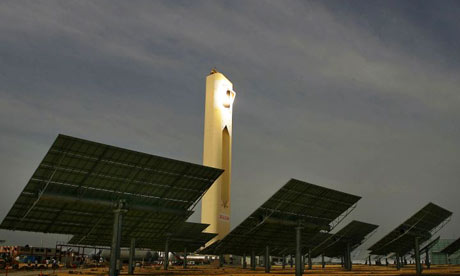
Gemasolar uses 2650 mirrors to concentrate the sun's rays on to the top of a central ''power tower'' and heat salt to more than 500 degrees. The molten salts store heat that is slowly released to power a steam turbine, generating enough electricity for 25,000 households.
Last month, Gemasolar became the first solar thermal power station to supply electricity into the grid for 24 hours - including throughout the night - a key test for solar energy's ability to provide baseload power.
Mr Windsor visited the facility with Ross Garnaut, a climate change adviser, and Matthew Wright, head of Beyond Zero Emissions, a think-tank which proposed last year the extensive use of baseload solar power in its stationary energy plan to re-power Australia with 100 per cent renewable energy.
Mr Windsor said the Gemasolar plant was ''an incredible sight''.
''I was in the vehicle with the project manager, Santiago [Arias], and when we drove in, we drove down this track between the reflectors. The tower was some hundred yards away as we started this drive and I made the point, 'we're driving into our future here', and we really are!
''I have no doubt that this sort of stuff is where we should be going.''
Mr Windsor's tour took in a full range of renewable and low-emissions technologies that could receive funding from the multi-party climate committee's proposed clean energy finance corporation, which will provide $10 billion of debt and equity finance, and loan guarantees.
A Spanish solar plant built by an Abu Dhabi company is set to power homes even during the night. Masdar, which is owned by Mubadala Development, and a Spanish joint venture partner have completed the final tests on a solar plant in Seville, in southern Spain. …
Thousands of mirrors at the plant concentrate the sun's energy on a single tower holding molten salt, which developers believe is so effective at retaining heat that it will be able to produce power 24 hours a day from March to October. "We're basically decoupling the solar [input] from the electricity generation," said Frank Wouters, the director of Masdar Power.
The tower is the first part of Masdar's €1 billion (Dh5.18bn) investment in Spanish power production. That includes two 50 megawatt solar parks being built by Torresol Energy, Masdar's 40-60 joint venture with the Spanish engineering company Sener.
In Spain, the company has three solar projects worth about $1 billion, Wouters said at a media briefing in Abu Dhabi today. A 20-megawatt plant will start producing power this month and two 50-megawatt facilities will start this year, he said. Masdar also has stakes in the 1-gigawatt London Array offshore windfarm and a 6-megawatt offshore wind project in the Seychelles.
Abu Dhabi, which holds almost all the oil reserves in the United Arab Emirates, is investing in solar and wind power all over the world to pioneer the use of renewable energy. The emirate is building Masdar City, a business and residential complex designed to minimize carbon emissions, and serves as headquarters for the International Renewable Energy Agency.
Masdar is a key component of Abu Dhabi’s aim to generate at least 7 percent of the power it uses from renewable sources by 2020. Growth in power demand to more than 20,000 megawatts by the end of the decade would require about 1,500 megawatts from projects such as wind and solar plants, according to data from Abu Dhabi’s utility.
The company’s domestic projects include the Shams 1 project, the largest concentrated solar plant in the Middle East, which is 45 percent complete and will be ready next year, according to a statement received by e-mail today. Masdar expects to award a construction contract for the 100-megawatt Noor 1 photovoltaic plant by the end of 2011 and may start building a 30-megawatt wind farm on Sir Bani Yas island.
Renewable Energy World has a detailed look at the technology being used in the Spanish solar thermal plants - CSP: Targeting Grid-Parity in Spain
Concentrated solar power (CSP) uses mirrors to concentrate sunlight and generate heat and is typically used to generate electricity via a conventional steam cycle. Unlike photovoltaic farms or wind energy — which has grown to become Spain's third largest power source — CSP plants can cost-effectively store energy that cannot immediately be used. In Spain, which has a second demand peak in the evening, this is important. Most new CSP projects incorporate storage so they can keep generating electricity several hours after the sun has gone down, or even right through the night.
But, while CSP is more dispatchable than other renewable energy sources, it also currently costs more. So Spain is the focus for efforts to drive down costs, both through economies of scale and improvements in technologies.
'All the CSP technologies are expensive so a lot of research seeks to reduce component costs and optimise production and installation,' says Eduardo Zarza, head of R&D for solar concentrating systems at the Plataforma Solar de Almería (PSA), Spain's leading solar energy research centre, which researches all four types of CSP technologies. The most mature CSP technology is the parabolic trough design, which accounts for 93% of the 2500 MW of new CSP capacity that Spain has authorised up to 2013. While the other three technologies — solar tower, Fresnel collector and Stirling dish — all have commercial potential, the financial backers of Spain's CSP projects have opted to reduce their risks through parabolic trough's longer track record. In the US, parabolic-trough plants date back to the 1980s.
'With a tower system, for example, it is difficult to get project finance because no one knows how long the receiver will last,' says Frank Dinter, head of solar at RWE, the German utility, which is investing in several Spanish renewable projects.
To benefit from Spain's generous feed-in CSP tariff — currently 28 euro cents/kWh for 25 years — CSP plants cannot exceed 50 MW. This size limit is seen as less than optimal, given the current maturity of parabolic-trough technology, and limits potential benefits from economies of scale. Several costs in a CSP project are not proportional to its size. For example, a 200 MW turbine costs less than four times as much as a 50 MW turbine. Dinter estimates that a 200 MW plant would be about 25% cheaper per megawatt than a 50 MW plant. ...
The best places to locate CSP plants tend to be arid regions with little cloud, but such environments are often subject to water restrictions. A plant such as Andasol 3 consumes 500,000 m² of water a year, mostly to condense steam, but also to clean mirrors.Investors in Novatec Solar's PE2 plant insisted on air cooling to avoid such controversy, even though reduces the economic return.
'Air cooling costs much more and it reduces the output by 5%-6%,' says Selig. Opinions are nevertheless divided on this issue. RWE's Dinter says water cooling is essential to boost the thermodynamic efficiency of the steam cycle of parabolic-trough plants like Andasol 3 with a relatively low inlet temperature. 'With dry cooling, you cannot reduce the outlet temperature as much as with water,' he says.
Burgaleta of Torresol Energy says that even though the Gemasolar central tower plant works at higher temperatures, water access was not a problem, and so the designers opted for water cooling. But one of Torresol's central tower projects planned for the future will have air cooling instead, he adds.
As Spain is now discovering, concentrating solar power is far from being a single technology, but rather embraces a wide range of designs and key technologies, each with different operating characteristics, risk profiles and trade-offs. 'There is no clear winner,' clarifies Siemens' Mürau. Even without any radical technological breakthroughs, improvements in technologies and greater economies of scale are expected to drive a 30% reduction in the cost of CSP-generated electricity in Spain by 2015. And by 2025, costs may fall as much as 50%, at which point CSP plants will finally be in a position to substitute conventional sources in Spain's energy mix.
Spain has become the world's largest producer of solar thermal energy after the connection of the La Florida solar farm in Alvarado; and also now boasts the world's biggest solar power plant.
The 50 MW La Florida solar farm uses parabolic trough technology and a thermal storage system using molten salt "batteries" - meaning the solar farm can now provide baseload power. The facility covers a massive 550,000 m2, consisting of consists of 11 plants in operation and 20 at an advanced stage of construction.
According to Protermosolar, the association that represents the Spanish solar energy sector, Spain already has 432 MW of installed solar thermal power, compared to 422 MW in the U.S. Protermosolar says taking into account those projects under construction, Spain may add additional capacity of around 600MW in under a year and by 2013, 2500MW.
Investment in solar thermal power plants in Spain currently comes to around EUR 2.5 billion and will reach EUR 15 billion by 2013. By that year, a total of 60 solar thermal power plants are expected to be operating in Spain.
According to Wikipedia, the Spanish government is committed achieving 12 percent of its primary energy coming from renewable sources by the end of this year, with an installed solar generating capacity of 3000 megawatts; including all solar technologies. Spain is the fourth largest manufacturer in the world of solar power technology and exports 80 percent of its production to Germany.
Abengoa Solar, a unit of Spanish corporation Abengoa (ABG.MC), has begun commercial operation of a new 50-megawatts (MW) solar thermal power plant in Spain.
The company said Solnova 1's performance matches the theoretical output of the design, validating the potential of parabolic trough technology for capturing and converting the sun's heat into electricity.
Abengoa Solar built a smaller pilot plant in 2007. And the company has contracts to build two much larger plants in the US--one in California (250 MW) and the other in Arizona (280 MW).
Solnova 1 is made up of around 980,000 square feet (300,000 square meters) of mirrors that cover an area totalling approximately 280 acres (115 hectares). The plant employs technology which concentrates solar radiation onto a heat-absorbing pipe inside of which flows a liquid that reaches high temperatures. This fluid transfers its energy to the water vapor that reaches a turbo-generator, where it expands to produce electricity.
The Department of Energy is funding a series of projects that marry concentrating solar power with storage, which offers the potential of solar power plants that operate 18 hours a day.
The DOE said Friday that it has made $62 million available to 13 companies to test equipment and materials, such as molten salts, to add storage to solar power systems that use heat to produce electricity.
Concentrating solar power, in which the sun's heat creates steam to drive an electricity turbine, is seeing a renaissance because it can be used for large-scale power plants in deserts. Adding storage can extend the time these plants supply electricity to the grid and can potentially improve the economics of solar versus fossil fuels.
The DOE's target is to extend the output of concentrating solar power systems to 18 hours, covering the peak times of electricity usage.
The top three recipients are Abengoa Solar, eSolar, and Pratt & Whitney Rocketdyne, each of which received more than $10 million for molten-salt research.
Abengoa Solar is already operating a solar storage facility and will test a solar tower that operates at a higher temperature, which could improve the overall output for a given land area. Solar tower designs use heliostats, or mirrors that track the sun, to reflect light onto a tower to heat a liquid.
Carbon Commentary has an excellent article on how renewables can provide large amounts of electricity into an electrical grid - in this case Spain's - (Spain’s variable wind and stable electricity networks. Yet if you listened to some people spouting PR for the nuclear power industry, you'd believe this is impossible.
One of the frequent criticisms of wind energy is that national distribution systems (‘the grid’) cannot cope with large number of turbines because of the variability and unpredictability of their output. Grids need to match supply and demand precisely, the critics say, and because wind varies so much it causes huge problems. Recent data from two meteorologically unusual days in Spain – the world leader in the management of renewable energy supplies – shows this assertion is almost certainly false.
* During part of 8 November, Spain saw over 50% of its electricity come from turbines as an Atlantic depression swept over the country’s wind parks. (They are so big that no one seems to call them ‘farms’.) Unlike similar times in November 2008, when Spanish turbines were disconnected because the grid had an excess of electricity, the system accepted and used all the wind power that was offered to it. * A very different event in January of this year saw unexpectedly high winds shut down most of the country’s turbines with little warning. The grid coped with this untoward incident as well. These two events show that a well run transmission system can cope with extreme and unexpected events even with a large fraction of power provided by wind.
Over the course of this year Spain will generate about 14% of its total electricity from wind and this number is likely to rise to the high twenties by 2020. Spain is showing the rest of the world that these figures are not incompatible with grid stability. Although wind is ‘variable’, ‘intermittent’ and ‘unpredictable’, a well functioning grid system can still use wind to help stabilise electricity costs, reduce carbon emissions and improve energy security.
At some periods on the night of 8/9 November, wind provided 53% of Spain’s need for electricity. This was a new record for the Spanish system. As the country continues to install thousands of new wind turbines a year, this record will not stand for long.
Although Denmark has had similar percentages of its electricity provided by wind, the Spanish numbers are particularly significant. As its electricity transmission company, Red Eléctrica de España or REE, reminds us, the country is unusually isolated from international interconnections. It is ‘a peninsula electrically speaking, with weak electrical interconnections with the European Union’.[1] A country with limited capacity to import or export power has more issues accommodating large amounts of wind power. Denmark has international connections to cover 50% of its electricity while Spain has less than a tenth this amount. (The UK also scores extremely poorly on this dimension.)
Spain is able to manage the integration of wind power into its grid primarily because it has reasonable amounts of hydro-electricity and pumped storage.[2] Hydro-electricity can be used when winds are less than expected and pumped storage can assist both when wind is unexpectedly high or unexpectedly low.
One of the main criticisms levelled at wind is that its power is so unpredictable that huge amounts of fossil fuel generating capacity needs to be kept ready to replace it at a moment’s notice. Those antagonistic to wind believe that the carbon cost of keeping power stations in a state of what the industry calls ‘spinning reserve’ is enormous. Power stations, they say, are burning fuel so that they can instantaneously start producing electricity if and when the wind drops.
But is wind so variable that power stations need to provide immediate backup? The utterly superb REE website provides easy-to-use data to test this theory. I’ve used this data to try to demonstrate that wind production was remarkably consistent during the peak day of 8 November.[3] Not only is wind speed largely predictable with good meteorology, but REE data shows that even in the windy days of early November, the amount of electricity generated only varied gradually.
During this 24-hour period the total generated varied from about 9.3 gigawatts (9,300 megawatts) at the start, to a peak of around 11.5 gigawatts at about 14.30 in the afternoon. For most of the day, the wind output was very stable around 10 gigawatts. (The wind output estimate is provided every ten minutes on the REE website.) The mean percentage variation from one reading to the next was 0.72%. On only three occasions out of 143 observations did the output vary more than 2% between two readings.
When the wind is blowing strongly, any local variations in wind speeds tend to be balanced out by compensating changes elsewhere. A country like Spain, with over ten thousand turbines spread across a large landmass, will have low variability of electricity output from wind. As a country adds wind turbines, the degree of variability in electricity output will tend to fall. In Spain, the variations on 8/9 November represented no threat to the stability of the electricity system, even when wind was meeting half of total power demand.
Wind energy provided more than half of Spain's total electricity needs for several hours over the weekend as the country set a new national record for wind-generated power.
With high winds gusting across much of the country, Spain's huge network of windfarms jointly poured the equivalent of 11 nuclear power stations' worth of electricity into the national grid.
At one stage on Sunday morning, the country's wind farms were able to cover 53% of total electricity demand – a new record in a country that boasts the world's third largest array of wind turbines, after the United States and Germany.
For more than five hours on Sunday morning output from wind power was providing more than half of the electricity being used. At their peak, wind farms were generating 11.5 gigawatts, or two-thirds of their theoretical maximum capacity of almost 18GW.
The new record, which beat a 44 % level set earlier last week, came as strong winds battered the Iberian peninsula.
The massive output of wind turbines meant the Spanish grid had more electricity than was needed over the weekend. In previous years similar weather has forced windfarms to turn turbines off but now the spare electricity is exported or used by hydroelectric plants to pump water back into their dams — effectively storing the electricity for future use.
José Donoso, head of the Spanish Wind Energy Association, recalled that just five years ago critics had claimed the grid could never cope with more than 14% of its supply from wind.
"We think that we can keep growing and go from the present 17GW megawatts to reach 40GW in 2020," he told El País newspaper.
Don Juan Carlos and Doña Sofía, today presided over the inauguration of Abengoa's PS20 solar plant, the largest commercial solar tower plant in the world, located at the Solúcar Platform in Sanlúcar la Mayor, Seville.
Abengoa's PS20 solar plant, the largest commercial solar tower plant in the world The Chairman of Abengoa, Felipe Benjumea, explained the functioning and the advantages of tower technology, a mature solution that offers the most efficient performance compared to other similar technologies, by concentrating solar radiation onto a single spot.
During his speech, Abengoa's Chairman pointed out that the plant's operations "are based on generating electricity by obtaining heat from solar radiation. More than 1,000 mirrors, each one 120 square metres in size, placed at the base of the tower, track the sun just like sunflowers".
The 20 megawatts of power produces enough clean energy to supply 10,000 homes, preventing the emission of approximately 12,000 tonnes of CO2 into the atmosphere per annum. Felipe Benjumea added that "energy in the 21st century has to be clean with no greenhouse gas emissions; competitive, internalising all costs, including from the CO2; and storable. These three conditions have all been fulfilled here and we believe that this is the real future for today, a possible future".
The Pyrenees mountains have lost almost 90% of their glacier ice over the past century, according to scientists who warn that global warning means they will disappear completely within a few decades.
While glaciers covered 3,300 hectares of land on the mountain range that divides Spain and France at the turn of the last century, only 390 hectares remain, according to Spain's environment ministry.
The most southerly glaciers in Europe are losing the battle against warming and look set to be among the first to disappear from the continent over the coming decades. Their loss will have a severe impact on summer water supplies in the foothills and southern plains south of the Pyrenees.
"This century could see (perhaps within a few decades) the total, or almost total, disappearance of the last reserves of ice in the Spanish Pyrenees and, as a result, a major change in the current nature of upper reaches of the mountains," the authors of the report on Spain's glaciers said.
Scientists have ruled out the idea that the progressive deterioration of glaciers around the globe are part of normal, long-term fluctuations in their size. Europe's glaciers are thought to have lost a quarter of their mass in the last 8 years.
Prof Wilfried Haeberli, director of the World Glacier Monitoring Service, said that the rate of glacier loss is particularly quick. "Small glaciers disappear faster so the relative loss is much larger." "They are the best indicators of climate change," he said . "I would even say these figures (for Spain) are optimistic. If the loss of ice goes on at the speed of the past 10 years they may disappear within ten to 20 years."
Scientists warn of potentially dramatic effects to agriculture as glaciers that feed rivers disappear, taking away a major source of summer water. ...
The World Glacier Monitoring Service last year reported that glaciers around the planet were melting at a rate unseen for 5,000 years. "It has become obvious that the ongoing trend of worldwide and fast, if not accelerating, glacier shrinkage … is of a non-cyclic nature," the service's report for the decade up to 2005 said.
The rate of melting more than doubled over that period when compared to the previous decade. Changes were "without precedent in history" and would produce "dramatic scenarios", including the complete loss of glaciers in some mountains systems, according to the report.
One of the benefits of solar PV is that you can find convenient locations to install panels throughout urban areas. While most people tend to think of the tops of buildings as the obvious location, those sun loving Spaniards have come up with a new idea - using the roof's of mausoleums in graveyards - Solar panels on graves give power to Spanish town.
A new kind of silent hero has joined the fight against climate change.
Santa Coloma de Gramenet, a gritty, working-class town outside Barcelona, has placed a sea of solar panels atop mausoleums at its cemetery, transforming a place of perpetual rest into one buzzing with renewable energy.
Flat, open and sun-drenched land is so scarce in Santa Coloma that the graveyard was just about the only viable spot to move ahead with its solar energy program.
The power the 462 panels produces - equivalent to the yearly use by 60 homes - flows into the local energy grid for normal consumption and is one community's odd nod to the fight against global warming.
"The best tribute we can pay to our ancestors, whatever your religion may be, is to generate clean energy for new generations. That is our leitmotif," said Esteve Serret, director Conste-Live Energy, a Spanish company that runs the cemetery in Santa Coloma and also works in renewable energy.
In row after row of gleaming, blue-gray, the panels rest on mausoleums holding five layers of coffins, many of them marked with bouquets of fake flowers. The panels face almost due south, which is good for soaking up sunshine, and started working on Wednesday - the culmination of a project that began three years ago.
The concept emerged as a way to utilize an ideal stretch of land in a town that wants solar energy but is so densely built-up - Santa Coloma's population of 124,000 is crammed into four square kilometers (1.5 square miles) - it had virtually no place to generate it.
In the desert of southern Spain, 20 miles outside Seville, more than 1,000 mirrors are being carefully positioned. Each is about half the size of a tennis court, so the adjustments will take time. But when they are complete in a few weeks, it will mark a major moment in the quest for renewable energy.
The mirrors are part of the world's biggest solar tower plant, a technology that reflects sunlight to superheat water at a central tower. Once this €80m (£67m) plant is inaugurated in January, it will generate 20MW of electricity, enough to power 11,000 Spanish homes.
Concentrated solar power (CSP) technology, as it is known, is seen by many as a simpler, cheaper and more efficient way to harness the sun's energy than other methods such as photovoltaic (PV) panels. But CSP only works in places with clear skies and strong sunshine.
The Andalucian deserts are an ideal location, and Spain hopes the PS20 plant will enable it to take advantage of its huge solar resource and lead the field in CSP technology.
"The radiation hitting the earth is 10,000 times the consumption of energy," said José Domíngues Abascal, chief technology officer at Abengoa, the Spanish energy company behind the plant. "There is great potential in solar energy."
Abengoa has already built a smaller version of the tower technology to test that the idea works. The 11MW PS10 system has been generating electricity for almost two years. Its new design uses an area larger than 100 football pitches, with 1,255 mirrors, called heliostats, each with a collecting area of 120 sq m. These track the sun as it moves through the day and reflect the energy to the top of a 160-metre tower at the centre of the field. Here, the concentrated light is used to heat water to more than 1000C, producing steam that can turn an electricity generating turbine.
When switched on, the new plant will be the world's largest commercial CSP plant feeding electricity into a national grid. It will be also be a significant step for tower technology, seen as a candidate for the large-scale solar plants of the future.
Spanish firms are charging ahead with CSP: more than 50 solar projects around Spain have been approved for construction by the government and, by 2015, the country will generate more than 2GW of power from CSP, comfortably exceeding current national targets. The companies are also exporting their technology to Morocco, Algeria and the US.
"CSP is at the very beginning of a big boom," said José Luis García, at Greenpeace in Spain. "Spain is in a good position to develop and implement the technology. We have the sun so we are in the best position to lead in this field."
The country's clean energy targets are in line with the EU's plan to source 20% of primary energy from renewables by 2020, which means that 30% of electricity would have to come from carbon-free sources. A new EU renewables directive would increase that electricity target to 40%, but García said Spain could easily reach for more, up to 50%.
The thermal energy storage system of one of Europe's first parabolic trough power plant, Andasol 1, has been successfully put into operation by Solar Millennium. The commissioning of the storage system and the turbine, along with the feeding of electricity into Spain's grid (on a test basis) will follow within the coming days. In a few weeks, Andasol 1 will then go into regular operation.
The Andasol 1 storage system absorbs part of the heat produced in the solar field during the day. A turbine produces electricity using this heat during the night, or when the sky is overcast. This process almost doubles the number of operational hours at the solar thermal power plant per year, the company said.
The heat generated in the solar field will be stored in a molten mixture of 60% sodium nitrate and 40% potassium nitrate. Both substances are used in food production as preservatives and are also used as fertilizer. The storage tank consists of two, 14-meter high tanks with a diameter of 36 meters and a capacity of 28,500 tons of molten salt.
During the pumping process from the cold to the hot tank, the molten salt absorbs additional heat at an outlet temperature of approximately 280°C, reaching a temperature of 380°C. A fully loaded storage system can keep the turbine in operation for 7.5 hours, which means almost 24-hour operation of the power plant in during high sunshine periods.
While Rioja is a name that is normally associated with red or white, the autonomous Spanish province will soon be just as synonymous with green - building green, that is. This week the local government gave the green light to the Logroño Montecorvo Eco City project, an ambitious carbon neutral development north of its capital city, Logroño. Designed by Dutch firm MVRDV and Spanish firm GRAS, the stunning development will feature enough photovoltaic cells and wind turbines to produce 100% of it’s energy.
The Logroño Montecorvo Eco City will sit on a large 56-hectare site that spans two hills, Montecorvo and La Fonsalada. The development will follow the contours of the hills, affording each of the 3,000 carbon neutral homes views of the city below without disfiguring the natural landscape. Logroño Montecorvo will also feature sport facilities, retail, restaurants, and both private and public gardens. A museum and viewing point hidden in the top of one of the hills will house a research and promotion center for renewable and energy-efficient technology. The structures will only occupy about 10% of the overall site.
The remainder of the property will be an eco-park that will include wind turbines at the crest of each hill and a tapestry of photovoltaic cells spanning the southern slopes is expected to generate 100% of the energy needed by the new eco city. Of the 388 million euros ($558 million) it will cost to build this project, 40 million euros ($56 million) will be invested in renewable energy technology. The onsite production of clean energy and quality and efficiency of construction will allow the Logroño Montecorvo Eco City to save an excess of around 6,000 tonnes of carbon emissions annually.
A few years ago, if you were to say that the largest rooftop solar panel was going to be installed in a car manufacturing plant we’d probably say that you were, well, bonkers. If you had mentioned that not only would this be true, but that it would be installed in the roof of a General Motors plant, we’d have gladly tried to sell you a bridge. Surprisingly though you’d have been correct. Last week General Motors announced that its Zaragoza plant in Spain will be fitted with the world’s largest rooftop solar power station.
Granted, we didn’t quite know that GM already owns two of the largest solar power stations in the United States, but those are small change compared to the installation that will be undertaken in its European factory. Under Spanish skies, GM plans to install 85,000 solar panels on top of its factory covering over 2 million square feet. These will provide over 10 megawatts of power to both the station (responsible for over 480,000 vehicles) and the local power grid.








 Posts




