Posted
by Big Gav
in
glaciers,
global warming,
himalayas
Dave Breashears has an article at Yale Environment 360 on the melting Himalayan icecap - Tracking the Himalaya’s Melting Glaciers.
For those who know the Himalaya well — I have climbed to the summit of Mount Everest five times in the past three decades — the warming of this great mountain chain is something that we have come to experience personally. The Sherpas who live atop “the roof of the world” and the climbers who often return are acutely aware of how much temperatures have risen at high altitudes in recent years, and how extensively the snow and ice on the massive Himalayan glaciers has thinned and retreated.
But it wasn’t until 2007, when I went back to Everest as part of a documentary for the Public Broadcasting Service series, Frontline, that I fully grasped the magnitude of the melting in this region, often called “The Third Pole” because of the massive volumes of ice in the Himalaya and the Tibetan Plateau. Trekking in Tibet, not far from the northern slope of Mount Everest, I carried with me a black-and-white photograph taken by the great English mountaineer, George L. Mallory, in 1921. It showed the ice-encrusted north face of Everest and, below it, the great river of ice known as the Main Rongbuk Glacier, flowing in a sweeping, S-shaped curve down a broad, stony valley.
Eighty-six years after Mallory took that photograph, I sat in the exact spot where he had snapped his iconic picture. Pulling out his photo, I was stunned by the changes that had swept over this region. The wide river of ice had retreated more than half a mile, leaving a field of separated ice pinnacles melting into the rocky ground. In the distance, the ice streams on Everest’s flank also had shrunk, exposing more of the mountain’s dark face.
It was at that moment I decided to proceed with the project whose results are visible in the accompanying photographs. The Glacier Research Imaging Project, which I helped found, has retraced the steps of some of the world’s greatest mountain photographers as they took pictures — many of them not previously published or displayed — over the past 110 years across the Himalaya and the Tibetan Plateau. I then returned to those same vantage points and took photographs that bear witness to the rapid warming of the Himalaya and the swift retreat of its glaciers. The result is an exhibition — “Rivers of Ice: Vanishing Glaciers of the Greater Himalaya” — a collaboration with the Asia Society Center on U.S.-China Relations and now on display at the Asia Society Museum in New York through Aug. 15.
These then-and-now pictures have a powerful effect on the viewer, one that I hope will bring home the reality — and serious consequences — of global warming. Gazing at Italian photographer Vittorio Sella’s 1899 picture of the Jannu Glacier in Nepal — a huge ice tongue filling a valley — and then comparing it to my 2009 photo, in which the glacier has disappeared, creates a profound sense of unease.
And we should be uneasy. The loss of these frozen reservoirs of water will have a huge impact, as the glaciers provide seasonal flows to nearly every major river system in Asia. From the Indus, Ganges, and Brahmaputra in South Asia, to the Yellow and Yangtze Rivers in China, hundreds of millions of people are partially dependent on this vast arc of high-altitude glaciers for water. As the glaciers recede and release stored water, flows will temporarily increase. But once these ice reservoirs are spent, the water supply for a sprawling, overpopulated continent will be threatened, and the impacts on water resources and food security could be dire.

Posted
by Big Gav
in
africa,
glaciers,
global warming,
ruwenzori
Yale Environment 360 has a look at Africa's disappearing glaciers - In the Mountains of the Moon, A Trek to Africa’s Last Glaciers.
I am hiking through a moss-draped forest more than 10,000 feet above sea level in the Rwenzori Mountains in western Uganda, not far from the border of the Democratic Republic of the Congo. The trail ahead is steep as a ladder and slippery with mud, and every few minutes my guide and I stop to rest.
Most people who come to this part of Africa do so for its wildlife, especially the endangered mountain gorilla. I have made the journey for another reason. I am looking for a glacier.
In the popular imagination, glaciers and Africa intersect at one location: Mt. Kilimanjaro, the iconic dormant volcano that rises from the grasslands of Tanzania and whose shrinking snowcap has become a symbol of climate change.
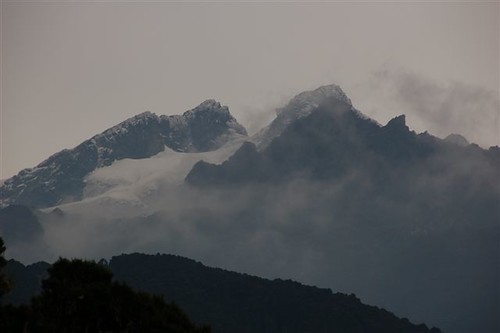
But there are glaciers in steamy Uganda, too, hidden in the eaves of jagged 16,000-foot peaks that are lost in the clouds most of the year. And these glaciers have a climate change story to tell, too — one that scientific research suggests better reflects the impact of global warming than the fading snows of Kilimanjaro.
But their story is also nearing its close. In just two decades, scientists expect the Rwenzori glaciers — as well as Africa’s few other remaining ice fields — to be gone. Kilimanjaro has already lost 84 percent of its ice since 1912, and what’s left is not expected to last more than a couple of decades. The Lewis glacier on Mount Kenya is also expected to wink out soon.
That prognosis comes as no surprise to my guide, a local Bakonjo tribesman named Baluku Josephat, who has guided climbers through the Rwenzori range since 1982 and has seen the consequences of global warming firsthand.
“If you go to Mount Baker,” he says, referring to a massive, ship-like peak in the center of the range where glaciers have already melted, “you can now go without crampons. It was not that way in the past. Now people just walk over rocks.”
Posted
by Big Gav
in
bolivia,
glaciers,
global warming
The BBC reports that shrinking glaciers have the residents of La Paz worried - Glacier threat to Bolivia capital.
Fears are growing for the future of water supplies in one of Latin America's fastest-growing urban areas - Bolivia's sprawling capital of La Paz and its twin El Alto.
Scientists monitoring the glaciers high in the Andes mountains - a key source of water - say the ice is showing signs of shrinking faster than previously forecast.
Faced with a booming population and a combination of glacial retreat and reduced rainfall, the governor of the La Paz region is even contemplating moving people to other parts of Bolivia.
Water is already in short supply among the poorest communities and has become a cause of tension.
Posted
by Big Gav
in
glaciers,
global warming,
pyrenees,
spain
The Guardian has a report on Spain's disappearing glaciers - Climate change lays waste to Spain's glaciers.
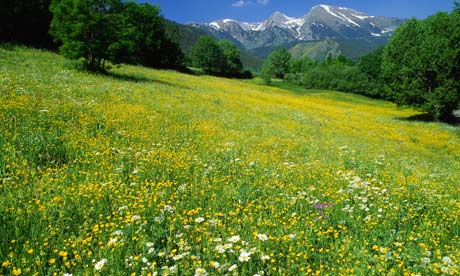
The Pyrenees mountains have lost almost 90% of their glacier ice over the past century, according to scientists who warn that global warning means they will disappear completely within a few decades.
While glaciers covered 3,300 hectares of land on the mountain range that divides Spain and France at the turn of the last century, only 390 hectares remain, according to Spain's environment ministry.
The most southerly glaciers in Europe are losing the battle against warming and look set to be among the first to disappear from the continent over the coming decades. Their loss will have a severe impact on summer water supplies in the foothills and southern plains south of the Pyrenees.
"This century could see (perhaps within a few decades) the total, or almost total, disappearance of the last reserves of ice in the Spanish Pyrenees and, as a result, a major change in the current nature of upper reaches of the mountains," the authors of the report on Spain's glaciers said.
Scientists have ruled out the idea that the progressive deterioration of glaciers around the globe are part of normal, long-term fluctuations in their size. Europe's glaciers are thought to have lost a quarter of their mass in the last 8 years.
Prof Wilfried Haeberli, director of the World Glacier Monitoring Service, said that the rate of glacier loss is particularly quick. "Small glaciers disappear faster so the relative loss is much larger." "They are the best indicators of climate change," he said . "I would even say these figures (for Spain) are optimistic. If the loss of ice goes on at the speed of the past 10 years they may disappear within ten to 20 years."
Scientists warn of potentially dramatic effects to agriculture as glaciers that feed rivers disappear, taking away a major source of summer water. ...
The World Glacier Monitoring Service last year reported that glaciers around the planet were melting at a rate unseen for 5,000 years. "It has become obvious that the ongoing trend of worldwide and fast, if not accelerating, glacier shrinkage … is of a non-cyclic nature," the service's report for the decade up to 2005 said.
The rate of melting more than doubled over that period when compared to the previous decade. Changes were "without precedent in history" and would produce "dramatic scenarios", including the complete loss of glaciers in some mountains systems, according to the report.
Posted
by Big Gav
in
glaciers,
global warming
The Guardian (and others) report on our rapidly disappearing glaciers.
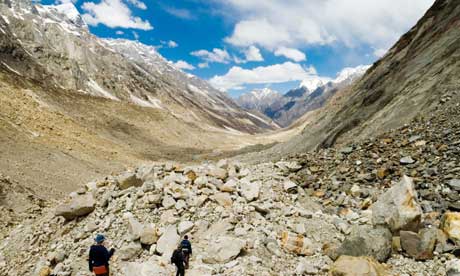
The world's glaciers are melting faster than at any time since records began, threatening catastrophe for hundreds of millions of people and their eco-systems.
The details are revealed in the latest report from the World Glacier Monitoring Service and will add to growing alarm about the rise in sea levels and increased instances of flooding, avalanches and drought.
Based on historical records and other evidence, the rate at which the glaciers are melting is also thought to be faster that at any time in the past 5,000 years, said Professor Wilfried Haeberli, director of the monitoring service. 'There's no absolute proof, but nevertheless the evidence is strong: this is really extraordinary.'
Experts have been monitoring 30 glaciers around the world for nearly three decades and the most recent figures, for 2006, show the biggest ever 'net loss' of ice. Achim Steiner, head of the UN Environment Programme (UNEP), told The Observer that melting glaciers were now the 'loudest and clearest' warning signal of global warming.
The problem could lead to failing infrastructure, mass migration and even conflict. 'We're talking about something that happens in your and my lifespan. We're not talking about something hypothetical, we're talking about something dramatic in its consequences,' he said
Lester Brown, of the influential US-based Earth Policy Institute, said the problem would have global ramifications, as farmers in China and India struggled to irrigate their crops.


 Posts




