Showing posts with label ceto. Show all posts

CETO wave power in Cornwall  

Posted by Big Gav in , , , , ,

Inhabitat reports that Perth based wave energy company is deploying a pilot plant at the UK "wave hub" in Cornwall - The UK’s first wave energy plant will produce enough energy for 6,000 homes.

Australia-based company Carnegie Wave Energy (CWE) will bring their wave power and desalination technology to Wave Hub in Cornwall, England. The European Regional Development Fund (ERDF) granted 9.6 million pounds (around $11.8 million) to CWE for the first phase of their Wave Hub project. Ultimately CWE aims to install enough of their wave power converter devices to generate 15 megawatts (MW) of clean energy at Wave Hub.

Carnegie to test CETO 6 at world-leading wave energy hub  

Posted by Big Gav in , , , , ,

ReNew Economy reports that Australian wave power Carnegie Energy is to test it's CETO technology at the UK wave hub - Carnegie to test CETO 6 at world-leading wave energy hub.

ASX-listed wave energy developer Carnegie Wave Energy has won a berth at the world’s largest purpose built wave energy demonstration facility in the south west England, to test its CETO 6 commercial-scale technology.

The berth – and the generous tariff being paid for a demonstration plant – means that Carnegie could have two full scale projects underway with the latest version of its technology. This comes after the Clean Energy Finance Corporation allocated a $20 million loan facility if it built a similar plant in Australia. However, the UK deal provides Carnegie with a ready-made, grid-connected berth at the “Wave Hub” in Cornwall, to deploy and test an array of CETO 6 Units in open water conditions.

Weighing in at 1MW, the CETO 6 array will have a power capacity some four times that of the current CETO 5 generation being deployed in a world first 3 unit array in Carnegie’s Perth Project in Western Australia.

RNE also has a report on the demise of wave power company Oceanlinx - Wave energy company Oceanlinx goes into receivership.

Australia’s Oceanlinx, whose home-grown, commercial-scale wave energy converter technology was unveiled with some fanfare last October, has been placed in receivership after the Sydney-based company hit troubled waters in February.

Rahul Goyal, one of two receivers appointed to the case from KordaMentha, said the company had “suffered financially” after an incident at sea several weeks ago delayed the final installation of its 1MW GreenWave wave energy converter – billed, at the time, as the world’s first such machine to be deployed.

The commercial-scale unit was damaged en route to its destination of Port MacDonnell, in the south-east of South Australia. This caused delays in funding, said Goyal, which was dependent on meeting installation deadlines.

Oceanlinx’s plan had been to install the 24m by 21m, 3,000 tonne unit 3km offshore and transfer the electricity it generated to the grid via a subsea cable. Once operational, the 1MW turbine was expected to produce enough electricity to power 1000 homes. Instead, the commercial-scale unit, which sits on a base of prefabricated reinforced concrete, was towed into shallow waters at Carrickalinga, where it remains.

Formed more than 15 years ago, Oceanlinx was a promising player in Australia’s ocean energy sector, having a number of wave power prototypes, including three units off the NSW coast, and had plans to expand to North America, Asia and Europe.

Carnegie Wave raises funds to fast-track CETO 6  

Posted by Big Gav in , , , ,

RNE has an update on wave power company Carnegie Wave Energy - Carnegie Wave raises funds to fast-track CETO 6.

ASX-listed ocean energy developer Carnegie Wave Energy Limited has completed a capital raising of $4 million, part of which will go towards fast-tracking the design of its CETO 6 project – the WA-based company’s next generation CETO unit, which is expected to have at least twice the capacity of the CETO 5 unit. Carnegie’s CETO 5 is being manufactured for the Perth Wave Energy Project, which once completed will be Australia’s first commercial-scale CETO grid-connected wave energy system.

Carnegie set to catch the next energy wave  

Posted by Big Gav in , , , , ,

While interest (and progress) in wave power projects has lagged that of tidal power projects in recent years, ocean energy company Carnegie Wave Energy has continued plugging away in the field and recently announced that it has successfully activated its first commercial-scale CETO unit off Garden Island in Western Australia on the weekend - ahead of schedule.

The West Australian has a report on the launch - Carnegie makes waves with renewable energy

Carnegie's technology, developed by company founder and inventor Alan Burns, relies on buoys anchored on the ocean floor that use the motion of passing waves to drive pumps which then deliver pressurised water to shore.

The company will monitor power produced at the Garden Island site over the next month and if all goes to plan, will eventually install up to 30 units, enough to produce power for 3500 homes.

Carnegie managing director Michael Ottaviano said yesterday the unit was producing power "exactly as expected". "This is the most significant milestone in Carnegie's history," Dr Ottaviano said.

The State Government has invested $12.5 million in Carnegie's efforts to bring its CETO technology to market. But despite Australia's reliable wave source, the company has increasingly been forced to look overseas for development funds. In 2009, it scrapped plans to develop the world's biggest wave power project near Albany after it was overlooked for a major Federal Government grant. The $300 million pilot project had aimed to produce 50MW of power, enough electricity for 30,000 homes.


The Climate Spectator has more, noting the company is looking to make wave power as cheap as wind power - All set to catch the next energy wave.
Wave energy, in theory at least, could provide up to one third of Australia’s energy needs, according to Carnegie, although the CSIRO has predicted even greater potential. In a country rich with renewable sources such as wind, solar and geothermal, not to mention its fossil fuels, it will likely never meet that capacity. But it could play a key role in some areas, particularly if it delivers on its cost predictions, and may become critical to the energy needs of countries in Europe, Africa and South America, that have few other options. ...

Ottaviano says Carnegie will monitor the unit’s performance over the next 6-8 weeks, but within the next few months will make a decision on where to deploy its first full-scale demonstration plant, likely to be up to 20 units generating around 2MW of power.

Garden Island is the most likely option, because it can deliver the project in the quickest time, but the company is also being courted by Reunion Island, where its partner, the French energy giant EDF, is offering to pay half its costs and the French government offering to pay a generous feed in tariff.

Wherever the first demonstration plant is built, the future roll-out of multiple units is likely to take place overseas, where some countries such as Ireland and Scotland are battling to become the world centre for ocean energy.

“The countries pursuing wave energy are doing so because they see a competitive advantage,” Ottaviano says. “They want to own the space. It’s not just about generating kilowatt hours into the grid, it’s about industry development and IP generation. That sort of argument doesn’t penetrate in Australia. All we hear about is the costs in developing the technologies.”

Ottaviano notes that Ireland, where Carnegie has developed strong commercial relationships, is the only country in the world with a defined wave energy target – it wants to install 500MW of capacity by 2020.

Carnegie’s own goal is to have 40-50MW of installed capacity by 2015, and it is likely to happen either in western European countries that are offering generous tariffs, or on remote islands, where local authorities are seeking to displace expensive diesel.

Ottaviano says analysis by Parsons Brinckerhoff suggested that once economies of scale are achieved, costs could fall to as low as 12c per kilowatt hour. “We will start higher than that, so the best markets for us will be where we can get the best tariffs.”

In Bermuda, for instance, where the company has recently installed a wave-monitoring buoy, the proposed tariff is 42c/kWh. “The trick for us is in the next five years, deploy 50MW of projects in high tariff region and use them to generate economies of scale to get costs down to 12-13c/kWh,” Ottaviano says. “At that point we will be competitive with wind.”

A buoyant future in wave power  

Posted by Big Gav in , , , ,

Reuters has a report on Australian wave power company Carnegie Corp and the vast potential for wave power in southern Australia - Aussie firm sees buoyant future in wave power.

For millennia, Australia's rugged southern coast has been carved by the relentless action of waves crashing ashore. The same wave energy could soon be harnessed to power towns and cities and trim Australia's carbon emissions.

"Waves are already concentrated solar energy," says Michael Ottaviano, who leads a Western Australian firm developing a method to turn wave power into electricity. "The earth has been heated by the Sun, creating wind, which created the swells," he told Reuters from Perth, saying wave power had the potential to supply all of Australia's needs many times over.

Ottaviano heads Carnegie Corp (CNM.AX), which has developed a method of using energy captured from passing waves to generate high-pressure sea water. This is piped onshore to drive a turbine and to create desalinated water.

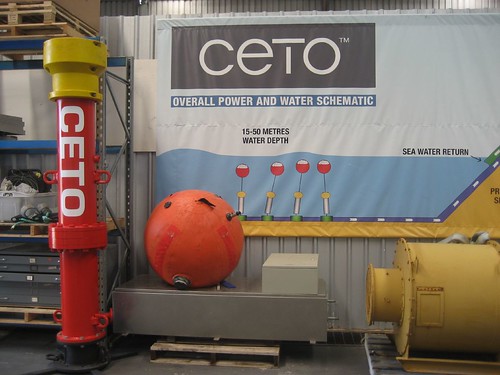
A series of large buoys are tethered to piston pumps anchored in waters 15 to 50 metres deep (49 to 131 feet). The rise and fall of passing waves drives the pumps, generating water pressures of up to 1,000 pounds per square inch (psi).

This drives the turbine onshore and forces the water through a membrane that strips out the salt, creating fresh water in a process that normally requires a lot of electricity.

The CETO (named after a mythical Greek sea creature) pumps and buoys are located under water, differing from some other wave power methods, for example, those that sit on the surface.

The CETO concept was invented in the 1970s by a Western Australian businessman Alan Burns and initial development began in 1999, followed by completion of a working prototype by 2005.

Ottaviano says the company, which works in partnership with British-based wind farm developer Renewable Energy Holdings and French utility EDF (EDF.PA) (EEN.PA), is in the process of selecting a site for its first commercial demonstration plant in Australia.

The 50 megawatt plant, enough to power a large town, would cost between A$300 million to A$400 million ($193 million to $257 million) and cover about 5 hectares (12.5 acres) of seabed. Funding could be raised from existing or new shareholders, he believed.

Several sites in Western Australia, including Albany in the south and Garden Island off Perth, looked promising. "There's significant interest in these sorts of projects, even in the current financial environment," he added. And a 50 MW plant was just a drop in the ocean.

He pointed to a study commissioned by the company that said wave power had the potential to generate up to 500,000 MW of electricity along the southern half of Australia's coast at depths greater than 50 metres (165 feet). At shallower depths, the potential was 170,000 MW, or about four times Australia's installed power generation capacity.

Interest in renewable energy in Australia and elsewhere is being driven by government policies that enshrine clean energy production targets as well as state-backed funding programmes for emerging clean-tech companies.

"Australia is going to be one of those markets because of what the government is doing to drive investment in this sector. For starters, there's quite a bit of direct government funding for projects like this," he said.

The federal government has also set a renewable energy target of 20 percent by 2020, which is expected to drive billions of dollars worth of investment in Australia over the next decade, with much of it going into wind farms. A second company, BioPower Systems, is developing underwater wave and tidal power systems and expects to complete pilot projects off northern Tasmania this year.

A Nation Powered By Waves  

Posted by Big Gav in , , , ,

I like to think I'm pretty bullish about the potential of ocean energy, but the guys at Carnegie Corp are thinking a lot bigger than I am, claiming that Australia has a resource base of 171 GW of wave power and that it could provide 35% of our power needs in this report from the SMH - Nation could be powered by waves: report.

Clean power developer Carnegie Corporation says more than a third of Australia's base-load power needs could be economically generated by wave technology, according to a report commissioned by the company.

The report, compiled by RPS MetOcean, says that Australia has a potential near-shore wave energy resource of about 171,000 megawatts (MW) - four times the country's total installed power generation capacity, Carnegie said.

"This report further supports Carnegie's view that Australia has the world's best wave energy resource - a resource we hope will be utilised through technologies such as CETO for base-load power generation," managing director Michael Ottaviano said in a statement.

CETO technology uses submerged units anchored to the sea floor that move with the motion of passing waves, driving the pumps which in turn pressurise seawater that is delivered ashore through a pipeline. The high-pressure seawater is used to drive hydroelectric turbines and generate base-load electricity.

Carnegie said a "conservative" ten per cent of Australia's calculated near-shore wave resource is estimated to be economically extractable. This means that around 35 per cent of Australia's current power usage could be met by harnessing wave energy, the company said.

CETO In New Zealand ?  

Posted by Big Gav in , , ,

While Carnegie Corp is lagging in the race to build the first wave power facility in WA, the New Zealand Herald reports that are generating some interest across the ditch - Australian firm wants to catch West Coast waves for energy project.

Perth-based Carnegie Corporation wants to harness the power of West Coast waves to produce energy using new technology. The company has lawyers studying legislation covering New Zealand's coastal seabed and water columns above it to see if legal tenure can be gained and will present its ideas to a wave energy conference in Wellington on Thursday.

The ASX-listed company's chief operating officer, Greg Allen, said testing of the technology was about to step up to another level after tests in relatively shallow water off Fremantle, near Perth.

The experimental Ceto (Cylindrical Energy Transfer Oscillating) technology is different from other wave energy devices as it rests out of sight on the ocean floor. An array of submerged buoys is tethered to seabed pump units. Buoys move with the motion of the passing waves, driving the pumps which in turn pressurise seawater and deliver it ashore via a pipeline.

High-pressure seawater drives hydro turbines and can also be used to supply a reverse osmosis desalination plant. "The main aim is to provide baseload energy," Allen said. Allen said on present modelling 50 megawatt wave energy plants could provide sufficient power for 80,000 households. Such a plant would cost around A$300 million ($365 million).

One of the attractions of New Zealand was the Government's commitment to renewable energy and the abundant wave energy resource.

Ideal locations were where water was deep close to the coast, power transmission systems were nearby and there was no conflict with other marine users. Because the system was fully submerged there was no visual impact and greatly enhanced storm survivability. ...

Carnegie is now exploring sites in Western Australia for a deeper water trial and hopes to have a small commercial plant in operation by 2010 or 2011. This could be in South Australia or even New Zealand.

The company's exploration in New Zealand comes as Christchurch company Neptune Power looks to harness tide power, rather than wave power, in Cook Strait next year. Neptune has received resource consent from the Greater Wellington Regional Council for a trial that can last up to 10 years.

Statistics

Locations of visitors to this page

blogspot visitor
Stat Counter

Total Pageviews

Ads

Books

Followers

Blog Archive

Labels

australia (619) global warming (423) solar power (397) peak oil (355) renewable energy (302) electric vehicles (250) wind power (194) ocean energy (165) csp (159) solar thermal power (145) geothermal energy (144) energy storage (142) smart grids (140) oil (139) solar pv (138) tidal power (137) coal seam gas (131) nuclear power (129) china (120) lng (117) iraq (113) geothermal power (112) green buildings (110) natural gas (110) agriculture (91) oil price (80) biofuel (78) wave power (73) smart meters (72) coal (70) uk (69) electricity grid (67) energy efficiency (64) google (58) internet (50) surveillance (50) bicycle (49) big brother (49) shale gas (49) food prices (48) tesla (46) thin film solar (42) biomimicry (40) canada (40) scotland (38) ocean power (37) politics (37) shale oil (37) new zealand (35) air transport (34) algae (34) water (34) arctic ice (33) concentrating solar power (33) saudi arabia (33) queensland (32) california (31) credit crunch (31) bioplastic (30) offshore wind power (30) population (30) cogeneration (28) geoengineering (28) batteries (26) drought (26) resource wars (26) woodside (26) censorship (25) cleantech (25) bruce sterling (24) ctl (23) limits to growth (23) carbon tax (22) economics (22) exxon (22) lithium (22) buckminster fuller (21) distributed manufacturing (21) iraq oil law (21) coal to liquids (20) indonesia (20) origin energy (20) brightsource (19) rail transport (19) ultracapacitor (19) santos (18) ausra (17) collapse (17) electric bikes (17) michael klare (17) atlantis (16) cellulosic ethanol (16) iceland (16) lithium ion batteries (16) mapping (16) ucg (16) bees (15) concentrating solar thermal power (15) ethanol (15) geodynamics (15) psychology (15) al gore (14) brazil (14) bucky fuller (14) carbon emissions (14) fertiliser (14) matthew simmons (14) ambient energy (13) biodiesel (13) investment (13) kenya (13) public transport (13) big oil (12) biochar (12) chile (12) cities (12) desertec (12) internet of things (12) otec (12) texas (12) victoria (12) antarctica (11) cradle to cradle (11) energy policy (11) hybrid car (11) terra preta (11) tinfoil (11) toyota (11) amory lovins (10) fabber (10) gazprom (10) goldman sachs (10) gtl (10) severn estuary (10) volt (10) afghanistan (9) alaska (9) biomass (9) carbon trading (9) distributed generation (9) esolar (9) four day week (9) fuel cells (9) jeremy leggett (9) methane hydrates (9) pge (9) sweden (9) arrow energy (8) bolivia (8) eroei (8) fish (8) floating offshore wind power (8) guerilla gardening (8) linc energy (8) methane (8) nanosolar (8) natural gas pipelines (8) pentland firth (8) saul griffith (8) stirling engine (8) us elections (8) western australia (8) airborne wind turbines (7) bloom energy (7) boeing (7) chp (7) climategate (7) copenhagen (7) scenario planning (7) vinod khosla (7) apocaphilia (6) ceramic fuel cells (6) cigs (6) futurism (6) jatropha (6) nigeria (6) ocean acidification (6) relocalisation (6) somalia (6) t boone pickens (6) local currencies (5) space based solar power (5) varanus island (5) garbage (4) global energy grid (4) kevin kelly (4) low temperature geothermal power (4) oled (4) tim flannery (4) v2g (4) club of rome (3) norman borlaug (2) peak oil portfolio (1)