Showing posts with label oceanlinx. Show all posts

Carnegie to test CETO 6 at world-leading wave energy hub  

Posted by Big Gav in , , , , ,

ReNew Economy reports that Australian wave power Carnegie Energy is to test it's CETO technology at the UK wave hub - Carnegie to test CETO 6 at world-leading wave energy hub.

ASX-listed wave energy developer Carnegie Wave Energy has won a berth at the world’s largest purpose built wave energy demonstration facility in the south west England, to test its CETO 6 commercial-scale technology.

The berth – and the generous tariff being paid for a demonstration plant – means that Carnegie could have two full scale projects underway with the latest version of its technology. This comes after the Clean Energy Finance Corporation allocated a $20 million loan facility if it built a similar plant in Australia. However, the UK deal provides Carnegie with a ready-made, grid-connected berth at the “Wave Hub” in Cornwall, to deploy and test an array of CETO 6 Units in open water conditions.

Weighing in at 1MW, the CETO 6 array will have a power capacity some four times that of the current CETO 5 generation being deployed in a world first 3 unit array in Carnegie’s Perth Project in Western Australia.

RNE also has a report on the demise of wave power company Oceanlinx - Wave energy company Oceanlinx goes into receivership.

Australia’s Oceanlinx, whose home-grown, commercial-scale wave energy converter technology was unveiled with some fanfare last October, has been placed in receivership after the Sydney-based company hit troubled waters in February.

Rahul Goyal, one of two receivers appointed to the case from KordaMentha, said the company had “suffered financially” after an incident at sea several weeks ago delayed the final installation of its 1MW GreenWave wave energy converter – billed, at the time, as the world’s first such machine to be deployed.

The commercial-scale unit was damaged en route to its destination of Port MacDonnell, in the south-east of South Australia. This caused delays in funding, said Goyal, which was dependent on meeting installation deadlines.

Oceanlinx’s plan had been to install the 24m by 21m, 3,000 tonne unit 3km offshore and transfer the electricity it generated to the grid via a subsea cable. Once operational, the 1MW turbine was expected to produce enough electricity to power 1000 homes. Instead, the commercial-scale unit, which sits on a base of prefabricated reinforced concrete, was towed into shallow waters at Carrickalinga, where it remains.

Formed more than 15 years ago, Oceanlinx was a promising player in Australia’s ocean energy sector, having a number of wave power prototypes, including three units off the NSW coast, and had plans to expand to North America, Asia and Europe.

Oceanlinx moving forward with wave power project in South Australia  

Posted by Big Gav in , , , ,

The ABC reports that wave power company Oceanlinx is moving forward with a project off South Australia, with construction due to be complete by the end of the year - Oceanlinx applies for licence to generate electricity using ocean waves off south-east coast of South Australia.

The Essential Services Commission (ESC) has received the first application in South Australia for a licence to generate electricity using the energy of ocean waves. The application has been lodged by New South Wales-based company Oceanlinx. A generator is being built off the coast from Port MacDonnell in the south-east of South Australia and all energy generated would be sold to electricity suppliers.

Canberra grants pave way for world’s biggest wave turbine  

Posted by Big Gav in , , , , ,

Giles Parkinson at ReNewEconomy has an article on the release of some government funding to wave power companies BioPower (mentioned in this post on biomimicry) and long time developer OceanLinx to build pilot plants (following an earlier funding round to Carnegie Corp in WA) - Canberra grants pave way for world’s biggest wave turbine.

The Australian government as upped its investment in two nascent, Australian-developed wave energy technologies, announcing new grants worth almost $10 million to help bring the two new systems to the market, including what is believed to be the world’s biggest wave energy turbine.

The government is providing $5.6 million to BioPower Systems to install a 250kW full-scale pilot plant of its bioWAVE technology off the coast of Victoria, and is also providing just under $4 million to Oceanlinx, to install a 1MW demonstration plan of its Greenwave technology in South Australia.

Both grants are being made under the $126 million Emerging Renewables program, and follow an earlier $9 million grant to Carnegie Wave Energy, which is building a $31 million, 2MW grid-connected demonstration of its CETO technology near Fremantle in Western Australia.

BioPower CEO Tim Finnigan said the grant, along with a $5 million grant from the Victorian state government, means that its $15 million project was now fully funded. “This puts us into a position to complete the project, get it on the grid, and prove the technology at scale,” he told RenewEconomy. “It’s a pretty big development for us.”

The technology is best described with an image, see below. It’s designed to lay flat on the ocean floor when the waves become too big (it calculated this to be around 1 per cent of the time).

It is designed to absorb energy both at the surface and below. It is mounted on sea-floor, the demonstrator will be in about 30m of water, and the array of buoyant floats, sways back-and-forth in tune with the waves, and the energy contained in this motion is converted to electricity by an onboard self-contained power conversion module, and is delivered through a cable.

However, the first demonstration plan will weigh 400 tonnes when it is installed at a site 4kms from Port Fairy on the southern coast of Victoria. “We not trying to prove a light-weight structure right now,” Finnigan says. “We will carve our way to that over time.”

Like Carnegie Energy, Finnigan says the long term goal for wave energy has to be to match wind – which means capital costs of around $2 million/megawatt and a levellised cost of energy at $100/MWh or below. He says BioPower has a four-stage plan to reach that target by the end of the decade. ...

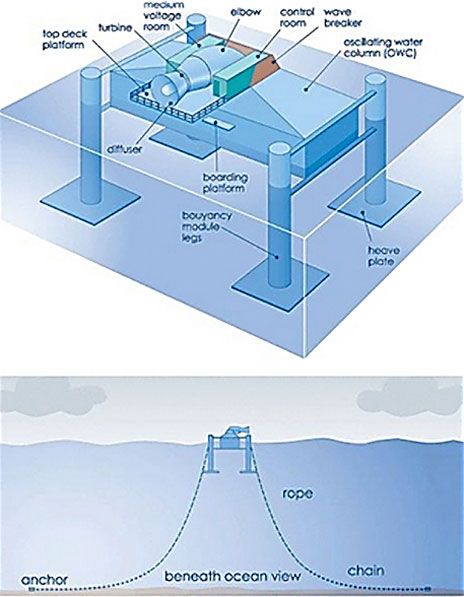
Meanwhile, Oceanlinx says it believes its GreenWave device (see below) is the first in the world to be rated at 1MW, and its efficiency has improved 50 per cent since an earlier, smaller version that was deployed near Port Kembla in NSW. The 20m by 20m structure, around 17m high, will sit in around 10m of water. It features an oscillating water column, with the turbine and other moving parts above the waterline. The 2,000 tonne concrete structure will sit on the ocean floor.

CEO Ali Baghaei says this demonstration unit will have an LCOE of 28c/kWh, which will fall to 16c/kWh once 5MW have been installed and to below 10c/kWh once 75MW have been installed. The initial project will cost $7.2 million, with the balance coming from a recent $8 million fund raising from existing investors. ...

Resources and Energy Minister Martin Ferguson said the grants made Australia “one of the world’s largest supporters” of wave energy technology. “Wave energy is still very much an emerging technology and this funding will position Australia as a global leader in developing this technology,” he said in a statement, adding that wave energy had the potential of providing 1300 terawatt hours per year, or about five times Australia’s total electricity requirements.

$5m Port Kembla wave generator wrecked  

Posted by Big Gav in , ,

The Illawara Mercury reports the Oceanlinx wave power generator at Port Kembla has suffered a mishap - $5m Port Kembla wave generator wrecked.

A $5 million wave energy project off Port Kembla is facing ruin after it broke free from its moorings and crashed into rocks in rough seas.

The barge-like prototype, one of the first of its type in the world, snapped free of pylons 150m offshore about 1.30pm and was swept into the eastern breakwall, where it was grounded last night. ...

Fears were held for the safety of the barge overnight, with a heavy swell and 4m waves expected. The rough seas are expected to ease from midday today. ...

A spokesman for the project's Sydney-based developer, Oceanlinx, said there were more than double the required mooring lines in place to ensure its safe operation. "The unit was safely disconnected from the power grid and efforts are now underway to retrieve the unit from the breakwater."

It will be a blow to Oceanlinx, which had been keen to prove the project was commercially viable. The wave-to-energy barge, known as the Mk3, was at the forefront of marine renewable technology and has operated for four years.

Bringing cheap power to our shores  

Posted by Big Gav in , , ,

The Business Spectator has a look at the prospects for wave power in Australia - Bringing cheap power to our shores.

As guests and dignitaries gathered under a marquee to celebrate the launch of the third iteration of Oceanlinx’s wave technology – the MK3PC – the question of the barge-like structure was this: Yes, it looks great, but will it work? ...

Coastal wave power could, in theory, provide twice the world’s energy requirements. In reality, it will provide a good deal less than that, but will still be an important component of the global energy mix, particularly in wave rich regions such as England and Ireland, Spain and Portugal, and the coasts of Africa and much of the Americas. And, of course, Australia.

Right now, the problem is how best to harness that energy. The sector is unique in that there is no technology standard. The prototypes on offer range from machines that resemble giant sea-snakes to oysters, and upturned Apollo space capsules, to those – like Australia’s Carnegie and BioPower Systems – that seek to mimic the action of the sea by having forests of underwater buoys driven by the ocean’s movements.

Oceanlinx’ technology uses a series of oscillating chambers in a large structure that allows water to enter, compress the air and drive a turbine, and do the same as air is sucked back in as the water recedes. The 170-tonne demonstration model is 8m high, 12m wide and 30m long – the commercial model will be three times the size. A facility with numerous modules could create a 50MW power plant.

Baghaei, a former nuclear plant boss who was brought in to turn the ideas of a 'bunch of enthusiasts' into a viable commercial venture, expects his technology to be competitive with offshore wind by the middle of next year, and with onshore wind within three years. “This is a significant day,” he said. “It is actually doing what it is supposed to be doing.”

Oceanlinx is backed by Australian clean energy venture capital investor Cleantech Ventures, along with Espirito Santo, the largest private bank in Portugal, and the Swiss-based Emerald Technology Ventures.

The involvement of the European investors is crucial because the big leaps in wave energy will likely occur overseas, even if Australian technologies rank among the most advanced in the world. Earlier this month, the UK’s Crown Estate announced the successful tenders for a $6 billion program to trial 10 different wave technologies. The UK believes one quarter of its energy could be supplied from marine sources. Elsewhere in Europe, countries are offering significant feed-in-tariffs and other measures, such as multiple renewable energy certificates, to attract developers to their coastlines. Spain and Portugal are in the forefront, as are some US states on the western seaboard and countries like Chile.

Environment Minister Peter Garrett said wave energy was an 'under-recognised' part of the renewable energy mix, both here and abroad, and seemed to admit, at least tacitly, that that could continue to remain the case in Australia, as he talked of the significant opportunities for development overseas.

But it is not the lack of R&D or wave energy resources that holds Australia’s wave energy producers back, or pushes them to find expansion projects overseas: quite the contrary, it’s the lack of government incentive, a legacy of the thrall that most politicians still have for the fossil fuel industry, and the lack of influential lobbying support for renewables – apart from wind – from Australia’s established industries.

There’s no reason why Australia could not do the same as the UK or the Iberian nations. But as we’ve seen in solar, and more recently in the allocation of the one commercial scale wave energy farm that the government has promised to back, this government much prefers to export the ideas, import the finished product back from what is now a foreign-owned entity and pay an Australian company to screw the thing together.

The Latest Developments in Wave Power Technology  

Posted by Big Gav in , ,

Beyond Zero Emissions is organising a talk on Oceanlinx's wave power technology which might be of interest to Melbourne based readers - The Latest Developments in Wave Power Technology.

Guest speaker: Scott Hunter
Time: 6.30 ~ 8pm Monday 1st February 2010
Event location: Sans Frontiers Room, 2nd Floor, Kindness House, 288 Brunswick St, Fitzroy VIC.

Scott Hunter is the Engineering Manager and Naval Architect for Oceanlinx. Oceanlinx is a leading renewable energy company based in Australia with a unique and efficient system for extracting energy from ocean waves.

Scott's current role as Engineering Manager involves assisting the general manager of engineering in bringing the concepts developed through R&D to reality.

In this discussion group we will discuss how wave power technology works, discuss current projects in NSW and its potential to provide zero carbon electricity.

Oceanlinx commission final demonstration wave power plant  

Posted by Big Gav in , , ,

IEEE Spectrum has an article on wave power company Oceanlinx, who have commissioned their final demonstration unit before commencing construction of a commercial facility - This Renewable Energy Source Is Swell (via Cleantechnica).

The ocean is a potential treasure trove for renewable energy—one NASA study estimated more than 91 000 terawatt-hours annually of accessible energy worldwide. But wave-power technology development has been plagued by the unpredictability of the source and technical troubles stemming from the harsh ocean water environment. Now an Australia-based company has found a new way, to predictably and reliably generate energy from the ocean. The technology relies on the power of ocean swells, which are easy-to-predict long-wavelength oscillations.

Earlier this month, off the coast of Port Kembla, near Sydney, Oceanlinx began installation of its final demonstration-scale, grid-connected unit before it begins commercial construction. (The company is disassembling its first demo plant there, which has been in operation since 2006.) The new plant will be ready in early 2010, and its power can be connected to the Australian grid. Oceanlinx CEO Ali Baghaei says the new plant ”will validate a capacity over 2.5 megawatts” per unit—enough energy for about 2000 Australian homes.

The technology behind the power involves tugboat-sized platforms that convert ocean swells to energy as they pass beneath them. Unlike other ocean-energy schemes, the platform converts the energy of the swells into air pressure to turn a wind turbine.

Oceanlinx’s technology has its roots in the oil industry. Oil platforms no longer sit on the seabed; instead, they float, kept relatively stable by enormous heave plates (which look like big duck feet) situated many meters below the surface and stabilized by mooring lines. The same technology that keeps oil platforms in place can generate energy, which Oceanlinx demonstrated in 2007 with their second-generation prototype. ...

The generators, which have a modular design, can be combined and configured to provide a range of generation capacities, which will leave a smaller footprint than other renewables schemes, Baghaei says. For example, he estimates, the company’s third-generation platforms could form an array a few hundred meters across to generate hundreds of megawatts, on a par with the biggest commercial tidal power facility in the world, the 240-MW La Rance tidal power plant, in France.


Cleantech.com reports that aerospace company Lockheed Martin are partnering with wave power company OPT in the US - Lockheed dives into developing wave energy, buoyed by OPT tech.
Lockheed Martin and Ocean Power Technologies (OPT) said today they have officially signed a commercial engineering services agreement to develop OPT's wave energy systems to be used in future utility-scale power generation projects. ...

A 10-megawatt utility power station using OPT’s PowerBuoy technology would take up about 30 acres (0.125 square kilometers) of ocean space, the company said. However, the first project between OPT and Lockheed slated five miles off the coast of Reedsport, Ore., would start with a 10-buoy array, with each one capable of producing 150 kilowatts. The project would start at 1.5 MW, Taylor said, and expand in phases up to 50 MW.

OPT is already working on its next-generation 500-kW buoy, which would replace the 150-kW version because it's more economical, Taylor said. The Reedsport project would be followed by a 100-MW deployment in Coos Bay, Ore.

Also at Cleantech.com, a report on an Israeli company looking to develop wave power projects in India - Gujarat government commits $5M to new wave power plant.
Wave power plant developer and engineering company SDE Energy said today its subsidiary signed a memorandum of understanding with the Gujarat government to build a 5 megawatt power plant that harnesses energy from ocean waves. ...

The government has also authorized a $700 million budget for the next phase—a 100 MW sea wave power plant to be built by SDE.

Oceanlinx seeks funds for wave power tests  

Posted by Big Gav in , ,

The Australian reports that wave power company Oceanlinx is looking for investors to fund their latest device - Oceanlinx seeks funds.

ENEWABLE energy company Oceanlinx expects to finalise a new round of funding in the next few weeks as it looks to install a demonstration-sized unit of the latest model of its wave energy converters at its Port Kembla facility in coming months.

New CEO Ali Baghaei says design improvements mean the Mark III model will be able to capture several times as much energy as the first unit, originally deployed in 2005, and will have a capacity in excess of 2.5Mw, making it the largest of any ocean energy unit being developed in Australia.

Baghaei expects that, within 10 years, the company will be able to produce a single project of more than 200Mw that is able to compete "with the best renewable energy" in costs per kilowatt hour.

Oceanlinx is seeking to raise "tens of millions" in its latest round of funding, with much of the interest coming from Europe, along with some strategic investors in Australia. However, Baghaei says fundraising is not easy, as most money in the current climate is directed towards "low-risk" technologies such as wind, which will be well supported by the planned Renewable Energy Target.

He notes that support from Australian energy utilities seems conditional on the level of government support. "Overseas utilities are much more receptive," he says.

Statistics

Locations of visitors to this page

blogspot visitor
Stat Counter

Total Pageviews

Ads

Books

Followers

Blog Archive

Labels

australia (619) global warming (423) solar power (397) peak oil (355) renewable energy (302) electric vehicles (250) wind power (194) ocean energy (165) csp (159) solar thermal power (145) geothermal energy (144) energy storage (142) smart grids (140) oil (139) solar pv (138) tidal power (137) coal seam gas (131) nuclear power (129) china (120) lng (117) iraq (113) geothermal power (112) green buildings (110) natural gas (110) agriculture (91) oil price (80) biofuel (78) wave power (73) smart meters (72) coal (70) uk (69) electricity grid (67) energy efficiency (64) google (58) internet (50) surveillance (50) bicycle (49) big brother (49) shale gas (49) food prices (48) tesla (46) thin film solar (42) biomimicry (40) canada (40) scotland (38) ocean power (37) politics (37) shale oil (37) new zealand (35) air transport (34) algae (34) water (34) arctic ice (33) concentrating solar power (33) saudi arabia (33) queensland (32) california (31) credit crunch (31) bioplastic (30) offshore wind power (30) population (30) cogeneration (28) geoengineering (28) batteries (26) drought (26) resource wars (26) woodside (26) censorship (25) cleantech (25) bruce sterling (24) ctl (23) limits to growth (23) carbon tax (22) economics (22) exxon (22) lithium (22) buckminster fuller (21) distributed manufacturing (21) iraq oil law (21) coal to liquids (20) indonesia (20) origin energy (20) brightsource (19) rail transport (19) ultracapacitor (19) santos (18) ausra (17) collapse (17) electric bikes (17) michael klare (17) atlantis (16) cellulosic ethanol (16) iceland (16) lithium ion batteries (16) mapping (16) ucg (16) bees (15) concentrating solar thermal power (15) ethanol (15) geodynamics (15) psychology (15) al gore (14) brazil (14) bucky fuller (14) carbon emissions (14) fertiliser (14) matthew simmons (14) ambient energy (13) biodiesel (13) investment (13) kenya (13) public transport (13) big oil (12) biochar (12) chile (12) cities (12) desertec (12) internet of things (12) otec (12) texas (12) victoria (12) antarctica (11) cradle to cradle (11) energy policy (11) hybrid car (11) terra preta (11) tinfoil (11) toyota (11) amory lovins (10) fabber (10) gazprom (10) goldman sachs (10) gtl (10) severn estuary (10) volt (10) afghanistan (9) alaska (9) biomass (9) carbon trading (9) distributed generation (9) esolar (9) four day week (9) fuel cells (9) jeremy leggett (9) methane hydrates (9) pge (9) sweden (9) arrow energy (8) bolivia (8) eroei (8) fish (8) floating offshore wind power (8) guerilla gardening (8) linc energy (8) methane (8) nanosolar (8) natural gas pipelines (8) pentland firth (8) saul griffith (8) stirling engine (8) us elections (8) western australia (8) airborne wind turbines (7) bloom energy (7) boeing (7) chp (7) climategate (7) copenhagen (7) scenario planning (7) vinod khosla (7) apocaphilia (6) ceramic fuel cells (6) cigs (6) futurism (6) jatropha (6) nigeria (6) ocean acidification (6) relocalisation (6) somalia (6) t boone pickens (6) local currencies (5) space based solar power (5) varanus island (5) garbage (4) global energy grid (4) kevin kelly (4) low temperature geothermal power (4) oled (4) tim flannery (4) v2g (4) club of rome (3) norman borlaug (2) peak oil portfolio (1)