Showing posts with label greenland. Show all posts

Greenland ice sheet melt breaking records  

Posted by Big Gav in , ,

Climate Change News has a slightly alarming report about the accelerating warming of the Arctic - Greenland sees record-smashing early ice sheet melt - "Even a weather station 1840 metres above sea level recorded a maximum of 3.1C, which data analysts said would be warm for July, let alone April".

Global warming melts edge of Greenland ice sheet  

Posted by Big Gav in , ,

The SMH has a look at monitoring of the melting of Greenland's glaciers - Global warming melts edge of Greenland icesheet.

The last edge of the Greenland ice sheet that had resisted global warming has now become unstable, adding billions of tonnes of meltwater to rising seas, scientists say. In a study published in the journal Nature Climate Change, they say a surge in temperature from 2003 has eased the brakes on a long "river" of ice that flows to the coast in northeastern Greenland.

Known as an ice stream, the "river" takes ice from a vast basin and slowly shifts it to the sea - in the same way the Amazon River drains water.

In the past, the flow from this ice stream was constrained by massive buildups of ice debris choking its mouth. But a three-year spell of exceptionally high temperatures removed this blockage - and like a cork removed from a bottle helped accelerate the flow, the study said.

Greenland - The Rare Earth Frontier  

Posted by Big Gav in ,

The Economist has a report on Greenland's rare earth potential - Why does Greenland’s election have global implications?.

The world may not often be very interested in Greenland but it is fascinated by what lies beneath it. As the country’s ice cap melts, hidden mineral wealth is coming tantalisingly within reach. The country’s riches include “rare earth” metals that are essential in the production of many electronic devices, from electric-car batteries to television screens. Metals such as cerium (used in glass manufacturing) and yttrium (which goes into electronic displays) are among those that are hidden under the ice. Many rare earths are not as scarce as their misleading name suggests, but they are scattered thinly and can be difficult to extract. In Greenland they are often mixed up with uranium, which under the country's current laws is illegal to mine. Most of the precious metals therefore remain underground. ...

Should Ms Hammond’s plans go ahead, and Greenland manage to ramp up its extraction of rare earths, it could deliver a jolt to the market for the valuable metals. At the moment rare-earth supply is dominated by China. In recent years China has restricted its exports of rare earths, citing environmental concerns. Extraction of the metals is dirty and dangerous, and stories of poisoning are common. But some see an ulterior motive in China’s cutbacks: by controlling the supply of high-value materials, China can also control their use in finished products. That could help it in its broader strategy to move from low- to high-value manufacturing. If Greenland becomes a big supplier of those same minerals, China’s grip on the market could loosen, and prices around the world may fall. Polar politics therefore matter to many more than the 57,000 people who live in Greenland.

A Melting Greenland Weighs Perils Against Potential  

Posted by Big Gav in , ,

The New York Times has a look at the jockeying going on in Greenland to try and extract resources from previously ice-covered lands - A Melting Greenland Weighs Perils Against Potential (via Smart Planet).

As icebergs in the Kayak Harbor pop and hiss while melting away, this remote Arctic town and its culture are also disappearing in a changing climate.

Narsaq’s largest employer, a shrimp factory, closed a few years ago after the crustaceans fled north to cooler water. Where once there were eight commercial fishing vessels, there is now one.

As a result, the population here, one of southern Greenland’s major towns, has been halved to 1,500 in just a decade. Suicides are up.

“Fishing is the heart of this town,” said Hans Kaspersen, 63, a fisherman. “Lots of people have lost their livelihoods.”

But even as warming temperatures are upending traditional Greenlandic life, they are also offering up intriguing new opportunities for this state of 57,000 — perhaps nowhere more so than here in Narsaq.

Vast new deposits of minerals and gems are being discovered as Greenland’s massive ice cap recedes, forming the basis of a potentially lucrative mining industry.

One of the world’s largest deposits of rare earth metals — essential for manufacturing cellphones, wind turbines and electric cars — sits just outside Narsaq.

This could be momentous for Greenland, which has long relied on half a billion dollars a year in welfare payments from Denmark, its parent state. Mining profits could help Greenland become economically self sufficient, and may someday even render it the first sovereign nation created by global warming.

“One of our goals is to obtain independence,” said Vittus Qujaukitsoq, a prominent labor union leader.

But the rapid transition from a society of individual fishermen and hunters to an economy supported by corporate mining raises difficult questions. How would Greenland’s insular settlements tolerate an influx of thousands of Polish or Chinese construction workers, as has been proposed? Will mining despoil a natural environment essential to Greenland’s national identity — the whales and seals, the silent icy fjords, and mythic polar bears? Can fishermen reinvent themselves as miners?

“I think mining will be the future, but this is a difficult phase,” said Jens B. Frederiksen, Greenland’s housing and infrastructure minister and a deputy premier. “It’s a plan that not everyone wants. It’s about traditions, the freedom of a boat, family professions.”

The Arctic is warming even faster than other parts of the planet, and the rapidly melting ice is causing alarm among scientists about sea-level rise. In northeastern Greenland, average yearly temperature have risen 4.5 degrees in the past 15 years, and scientists predict the area could warm by 14 to 21 degrees by the end of the century.

Reuters is quoting an FT interview with Total's chief saying that oil extraction in Greenland is a bad idea - Total chief warns against Arctic drilling: FT
Energy companies should not drill for crude oil in Arctic waters because the environmental risks are too high, Total SA Chief Executive Officer Christophe de Margerie said in the Financial Times on Wednesday. The newspaper described de Margerie's comments as the first time a major oil company has publicly criticised offshore exploration in the Arctic.

The risk of an oil spill in such an environmentally sensitive area was simply too high, according to de Margerie. "Oil on Greenland would be a disaster. A leak would do too much damage to the image of the company," he said.

Updates on Greenland’s Ice  

Posted by Big Gav in , ,

The NYT's Dot Earth blog has an update on Greenland's melting ice - Updates on Greenland’s Ice.

New research on the dynamics of Greenland’s ice sheets complicates efforts to forecast sea level rise in this century, as the Green Blog reports. Expanding fields of crevasses appear to be limiting the flow of water to the base of the ice through tube-like moulins. That flow has been thought to ease the seaward movement of the ice over bedrock. But the crevasses also warm the ice as liquid water descends deep inside the frozen mass, with that process also potentially speeding its flow. This diagram shows the two types of plumbing.

In the meantime, the high recent rate of ice loss in Greenland, according to other new research, has largely continued.

Another Crack: Petermann Glacier, Giant Ice Island, Breaks Off Into The Sea  

Posted by Big Gav in , ,

TreeHugger has a post on Greenland's glaciers - Another Crack: Petermann Glacier, Giant Ice Island, Breaks Off Into The Sea.

While the Senate, the White House, and delegates in Bonn at the international climate negotiations dither, Mother Nature keeps the hits coming. Russia is of course baking in record heat and now the Petermann Glacier in northern Greenland has lost an iceberg of 87 square kilometers in size. For scale, the ice sheet is said to be 4 times the size of Manhattan.

A University of Delaware researcher has been tracking the Petermann Glacier, and in a news release he says that the ice chunk is the largest since 1962.
"In the early morning hours of August 5, 2010, an ice island four times the size of Manhattan was born in northern Greenland," said Andreas Muenchow, associate professor of physical ocean science and engineering at the University of Delaware's College of Earth, Ocean, and Environment. Muenchow's research in Nares Strait, between Greenland and Canada, is supported by the National Science Foundation (NSF).

Satellite imagery of this remote area at 81 degrees N latitude and 61 degrees W longitude, about 620 miles [1,000 km] south of the North Pole, reveals that Petermann Glacier lost about one-quarter of its 43-mile long [70 km] floating ice-shelf.

Similar to the media coverage of the Russian heatwave and forest fires, the news accounts about the glacier have largely not included mentions of climate change. Is this cognitive dissonance, willful omission, or some other cause? Whatever it is, these events are in line with what climate models have shown will happen with rising concentrations of pollution.

Greenland challenge to Chinese over rare earth metals  

Posted by Big Gav in ,

I've seen some investment newsletters touting a Greenland based mining development that is "foil China's master plan" to achieve dominance in rare earth mineral production - this article from The Times back in October discusses the company being promoted - Greenland challenge to Chinese over rare earth metals.

An obscure, desolate plateau on the southwestern shores of Greenland could transform the future of consumer technology and shift the balance of power in the global supply of rare earth metals.

The treasure trove beneath the rocks and ice of the Ilimaussaq Intrusion represents the world’s largest known reserve of rare earth metals, the “technology” group of lanthanide elements used in products from mobile phones and low-energy light bulbs to hybrid cars and missile guidance systems.

The find has the potential, its developers claim, to severely dent China’s global monopoly over rare earth production, a 95 per cent dominance of total worldwide output that Beijing has strategically nurtured for 15 years and recently has started to treat as a potent trade weapon.

According to the Australian mining company with rights to develop it, the site could also spectacularly change the national fortunes of Greenland, which is undergoing significant political change as it draws closer to independence from Denmark. From January next year, Greenland will gain full sovereignty over its natural resources. The rare earths alone have the potential to double the country’s effective GDP.

Studies of the site show that the Ilimaussaq reserves would comfortably meet at least 25 per cent of global rare earth demand for the next halfcentury.

“This site is a country-maker for Greenland and the first big opportunity to represent a monopoly-breaker of Chinese dominance,” Roderick McIllree, the chief executive of Greenland Minerals & Energy, said.

The company has engaged advisers with a view to listing on the main board of the London Stock Exchange early next year, The Times has learnt. The site is expected to be able to produce about 50,000 tonnes per year of rare earth-bearing ore by 2014. The chairman of the subsidiary operating in Greenland will include Lars Emil Johansen, the country’s former prime minister.

The cost of extracting the rare earths will be offset by the profits from extracting uranium from the same site, effectively preventing China from undercutting the operation on price, which is how it obtained its dominance over the world market in the first place.

Green Tomorrows: Four Scenarios  

Posted by Big Gav in , , ,

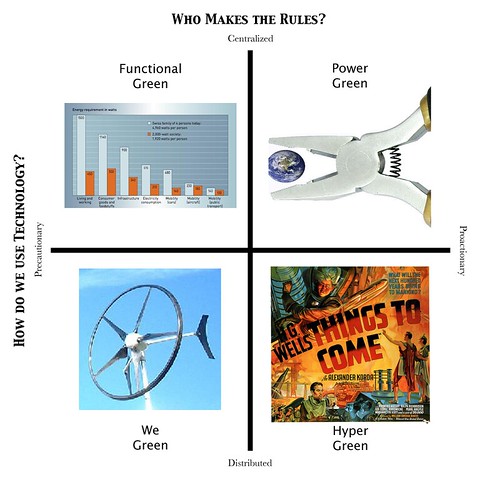
Jamais Cascio at Open The Future has an interesting look at 4 green future scenarios (with one of his customary nifty graphics from his Flickr account) - looking at a set of options similar to the usual 2/2 political map and considering what the green version of each of the quadrants would look like.


... The Drivers

The two critical uncertainties used as scenario axes aren't meant to cover every possible force driving change; rather, they're what I've come to see as issues that are fundamental to how the next few decades play out. ...

The first driver is Who Makes the Rules?, with end-points of Centralized and Distributed. This driver looks at the locus of authority regarding the subject (in this case, climate responses) -- are outcomes dependent upon choices made by top-down, centralized leadership, or made by uncoordinated, distributed decision-making? ...

Although my bias tends towards distributed/collaborative, top-down models are often better-able to respond quickly to rapid developments, and can also offer a more predictable environment for business and organizational planning.

The second driver is How Do We Use Technology?, with end-points of Precautionary and Proactionary. ...

My bias here is towards a limited precautionary approach, but the need for rapid response may end up pushing towards a proactionary world.

The Scenarios

The combination of these two drivers give us four distinct worlds.

"Power Green" -- Centralized and Proactionary: a world where government and corporate entities tend to exert most authority, and where new technologies, systems and response models tend to be tried first and evaluated afterwards. This world is most conducive to geoengineering, but is also one in which we might see environmental militarization (i.e., the use of military power to enforce global environmental regulations) and aggressive government environmental controls. "Green Fascism" is one form of this scenario; "Geoengineering 101" from my Earth Day Essay is another.

"Functional Green" -- Centralized and Precautionary: a world in which top-down efforts emphasize regulation and mandates, while the deployment of new technologies emphasizes improving our capacities to limit disastrous results. Energy efficiency dominates here, along with economic and social innovations like tradable emissions quotas and re-imagined urban designs. The future as envisioned by Shellenberger and Nordhaus could be one form of this scenario; the future as envisioned by folks like Bill McDonough or Amory Lovins could be another. Arguably, this is the default scenario for Europe and Japan.

"We Green" -- Distributed and Precautionary: a world in which collaboration and bottom-up efforts prove decisive, and technological deployments emphasize strengthening local communities, enhancing communication, and improving transparency. This is a world of micro-models and open source platforms, "Earth Witness" environmental sousveillance and locavorous diets. Rainwater capture, energy networks, and carbon labeling all show up here. This world (along with a few elements from the "Functional Green" scenario) is the baseline "bright green" future.

"Hyper Green" -- Distributed and Proactionary: a world in which things get weird. Distributed decisions and ad-hoc collaboration dominate, largely in the development and deployment of potentially transformative technologies and models. This world embraces experimentation and iterated design, albeit not universally; this scenario is likely to include communities and nations that see themselves as disenfranchised and angry. Micro-models and open source platforms thrive here, too, but are as likely to be micro-ecosystem engineering and open source nanotechnology as micro-finance and open source architecture. States and large corporations aren't gone, but find it increasingly hard to keep up. One form of this scenario would end with an open source guerilla movement getting its hands on a knowledge-enabled weapon of mass destruction; another form of this scenario is the "Teaching the World to Sing" story from my Earth Day Essay.

The Choice

Which scenario is most likely? It depends a bit on how fast the truly disastrous manifestations of climate change hit. Climate catastrophe happening earlier than currently projected would push towards the more proactionary worlds. It also depends a bit on whether governments and corporate leaders continue to lag community and activist groups in terms of willingness to embrace big changes to fight environmental risks. Centralized responses may end up being too little, too late if wide-spread bottom-up models take root.

Ultimately, which one of these scenarios comes to dominate depends on the choices we make today. We simply can't go on pretending that we don't have to deal with this problem for awhile yet, that "the market" or "the government" or "new technologies" will fix everything in time, that we aren't responsible. The more we abandon our responsibilities, our agency, the more likely it is that the world that emerges will not pay attention to our interests. Acting now is no guarantee that we'll get the world we want -- but not acting is as close as you'll get to a guarantee that we won't.

Potatos And Broccoli Without Ice Please  

Posted by Big Gav in , , , , ,

The BBC has an article on the devastating effect of global warming on potato prices in Greenland - the rapidly lengthening growing season (and amount of land available) have led to a surge in vegetable supplies. This may be the only place on the planet carbohydrate prices are going down instead of up. Until they build a taters-to-ethanol plant of course...

Top scientist Professor Minik Rosing was stunned to hear the news from his native Greenland a few days ago. The main weekly newspaper, Sermitsiaq, was highlighting a quarrel between shop owners and farmers about the price of potatoes. "The price of potatoes was a headline," says Professor Rosing. "That would have been a hilarious joke in Greenland a few years ago."

Professor Rosing is one of his country's most famous sons, after discovering the earliest traces of life in rocks in West Greenland, that are more than 3,800 million years old. Like his fellow countrymen, he is deeply concerned about global warming, and particularly the effects of rapidly melting ice on the traditional life of hunters in the north of the country. But higher temperatures are also bringing some benefits to the sub-Arctic south part of the island.

"I could buy broccoli in the shops for the first time this year," says Buuti Pedersen, a 52-year-old artist who was born and lives in the southern town of Qaqortoq. "And the potatoes are big, fresh and tasty - much better than the ones that come from Denmark."

Potatoes have been grown in southern Greenland for several years, but because of global warming they can be planted earlier, which means better yields. Local farmers are now selling a surplus to the rest of the country. "There's been an explosion of potatoes," says Lene Holm, a member of the Inuit Circumpolar Council, which is overseeing a project studying how climate change is affecting local communities. "There are also many more flowers, like the Alaska Lupin. You can see more green further up the mountains as the glaciers retreat. People are ringing up the national radio station about birds they had never seen here before."

Preliminary results suggest that Greenland's ice cover has shrunk to a record low this summer. Dr Bob Corell, chairman of the Arctic Climate Impact Assessment, told a symposium of scientists and religious leaders in Greenland, which finished this week, that the acceleration of the Arctic ice melt was now "massive".

Dr Corell has been monitoring one particular glacier near the western town of Ilulissat, which was probably the source of the iceberg which sunk the Titanic. It is now flowing into the sea at a rate of 15 km per year - about four times faster than 10 years ago. He is predicting that the best bet for the year in which the Arctic will be totally free of summer ice is now 2040, "give or take a decade". Not so long ago, scientists were projecting the end of the century.

The government of Greenland is worried about the human impact of the ice melt. "There is sea ice for two to three months less every year," says Aleqa Hammond, Minister for Finance and Foreign Affairs. "For the communities in the north who live solely off hunting and fishing, it's like your boss taking away your pay for a couple of months without giving you notice."

While Ms Hammond is very concerned about how quickly northern communities will have to adapt to climate change, she is also optimistic about the positive developments it could bring. She points to the greater volumes of halibut being caught off the west coast due to warmer sea temperatures, and the return of cod to some areas. In addition to achieving more self-sufficiency in food products, she wants to develop hydroelectric power, oil and gas exploration, and the mining of Greenland's rich mineral deposits. All of this could become technically easier as the ice melts.

Greenland has signed a memorandum of understanding with the US company Alcoa to build a huge aluminium smelter using the country's plentiful water reserves. "All of this can help us to reduce our economic dependence on Denmark," says Ms Hammond, "and could eventually lead to political independence." Denmark currently gives about US$600m a year to Greenland, equivalent to about half its budget. Since 1979 Greenland has had home rule, but not full independence.

So will Greenland be a net beneficiary or a loser from climate change? On the one hand, it could lose a proud Inuit heritage of dog sleds and whale hunting, walruses, seals and polar bears. But on the other it may gain economically. "You are not really comparing like with like," says Professor Rosing. "Loss of cultural identity and economic benefits are two different categories. You can't quantify the loss of our traditions. The real problem is that we are having to adapt so quickly."


The BBC also reports that Chernobyl is about to be enclosed in a huge steel sarcophagus.
The authorities in Ukraine have approved a giant steel cover for the radioactive site of the world's worst nuclear disaster - Chernobyl. Ukraine has hired a French firm to build the structure to replace the crumbling concrete casing put over the reactor after the 1986 accident. The casing project is expected to cost $1.4bn (£700m). It will take five years to complete and the authorities say they will then be able to start dismantling the reactor.

Ukrainian President Viktor Yushchenko hailed the project: "Today is probably the first time that we can openly look into the eyes of the national and international community and say that a solution to the problem that has long been called the Chernobyl problem was formally found," he said.

The French construction company Novarka will build a giant arch-shaped structure out of steel, 190 metres (623 feet) wide and 200m long. It will cover the existing containment structure which stands over the reactor and radioactive fuel that caused the accident in 1986. The reactor still contains 95% of its original nuclear material, and exposure to weather and poor construction has left the existing casing weak.

Maxwell Technologies has a press release describing their latest ultracapacitor module "for Renewable Energy and Industrial Applications".
Maxwell Technologies Inc. is introducing a 75-volt BOOSTCAP(R) ultracapacitor module to provide a scaleable, cost-effective, low-maintenance solution to meet the backup power and power quality requirements of wind turbines and other renewable energy generation and industrial equipment applications.

Maxwell developed the new module, which will be generally available early in the fourth quarter, in response to market demand for an easy-to-integrate energy storage building block for a variety of electrical system functions, including:

-- Backup power for orderly shutdown of wind turbine blade pitch mechanisms and automated manufacturing equipment;
-- Buffering to enhance the consistency of wind, solar and wave power input into the utility grid;
-- Low-maintenance alternative to batteries for short-term bridge power for uninterruptible power supplies (UPS). ...

BOOSTCAP ultracapacitor products deliver up to 10 times the power and longevity of batteries, require no maintenance and operate reliably in extreme temperatures. In transportation applications, they efficiently recapture energy from braking for reuse in hybrid and all-electric drive trains, reducing energy consumption and emissions. They also provide compact, lightweight, "life-of-the vehicle" solutions to stabilize automotive power networks and power new, all-electric subsystems, such as drive-by-wire steering. In mission-critical industrial applications, where backup power ensures continued operation or a soft shutdown in the event of power interruptions, they provide reliable, cost-effective, maintenance-free energy storage. In wind turbine blade pitch and braking systems and other industrial applications, they provide a simple, solid state, highly reliable, solution to buffer short-term mismatches between the power available and the power required.

I haven't done much big brother news lately, so here is an article from the SMH about local authorities trying to catch up with the FBI in terms of surveillance capability (and no doubt adding all the same sort of vulnerabilities to the network the Americans have done) - "spy laws track mobile phones". These sort of articles make me laugh - I'm not sure if they are serious or if there is some sort of rigid compartmentalisation of which organisations can listen to what and these guys are trying to struggle up a rung. Call and internet records are the least of it - besides enabling your location to be tracked, most new phones can be listened in to even when they are off (as can onboard car equipment). There was a scene along these lines in "The Bourne Ultimatum" where the good female CIA analyst tracks down who leaked some information by determining which staff hadn't used their phones over an 8 hour period - because they would know not to take their phone with them when they were talking to a journalist in another city. Another good example of this was those German academics who recently got into trouble for studying protester groups (and using the word "gentrification") because they didn't take their phones with them when they were talking to their study subjects. Phones are just one part of the panopticon of course - arphid tags are starting to get into everything now (something which can be used for good as well as mass surveillance, which I'll talk about in a later post), and video phones give Orwell's all seeing big brother a range of camera angles to choose from...
SECURITY agencies would be able to secretly track people via their mobile phones and monitor their internet browsing for up to three months without obtaining a warrant under new laws due to go before the Senate this week.

The powers could be used in a range of even relatively minor criminal investigations, not just terrorism cases. They would allow ASIO and federal and state police forces to demand that phone companies and internet service providers stream information to them in "near real-time" - just a few minutes after calls are made or websites visited. The information would have to be provided for up to 90 days for ASIO investigations, and 45 days if state or federal police are involved.

Justified as a counter-terrorism measure, the legislation has already been passed by government and Labor members of the lower house. But it remains deeply unpopular with legal experts and privacy advocates.

As well as not requiring a warrant signed by a judicial officer, the powers could be used in any criminal investigation into a suspected offence that carries a jail term of three years or more. The regime applies to all "telecommunications data", including the time and destination of phone calls made and received, the duration of the calls and the location of the callers. For computers, security agencies would be told what website addresses and chat rooms the user has visited and what files have been downloaded. The laws would also enable authorities to track internet conversations.

Security agencies would still need a judicial warrant to listen in on phone calls, or peruse emails.

The Greens senator Kerry Nettle said the powers would allow authorities to glean huge amounts of information. Every mobile phone could potentially become a tracking device for police and ASIO. The bill "is more like something from East Germany than a party claiming to support liberal principles", she said. "There is no judicial oversight. Police and ASIO should have to get a warrant to track and tap people's mobile phones or web browsing." ...

The Law Council of Australia argues that technological advances mean the powers pose new dangers to privacy. Tracking someone with a mobile phone was far easier than secretly affixing a listening device without breaking and entering, it said. Therefore the proposed powers were "far more amenable to misuse or over-use by law enforcement agencies".

Links:

* IHT - Oil rises to new intraday record above US$81 on anticipation of U.S. rate cut. New record price (in USD anyway).
* Bloomberg - Australia Cuts Grain Crop Estimate 31% on Dry Weather. The biofuel boom really didn't pick a good year to start.
* EcoGeek - Whole House Electricity Meters
* EcoGeek - Brits Proposes Abolishing Gasoline by 2040. The Liberal Democrats anyway.
* Technology Review - The High Costs of Biofuels
* SMH - Water bills to rise by a third. Recycled water goes to new coal fired power stations while we pay for a desalination plant we don't really need.
* The Australian - Vic faces summer power restrictions if drought continues. Solar, wind, wave, geothermal power don't need water for cooling...
* The Australian - Future cars may run on filings. Minister McTiernan goes to the Oak Ridge National Laboratory.
* The Australian - Oil Search jumps on possible bid. The cheapest oil and gas reserves going, about to go to China. One day we'll regret not building that PNG pipeline.
* The Australian - Woodside finally begins Otway exports
* The Australian - MEO steps up the pace. Another LNG / gas to liquids plant in northern Australia gets closer to reality.
* The Australian - Nigeria looks to Saudi's Aramco as its model
* Huffington Post - Greenspan, Kissinger: Oil Drives U.S. in Iraq, Iran. Kissinger: "control over oil is the key issue that should determine whether the U.S. undertakes military action against Iran". Peter Costello gets a mention amongst the great list of liars who said it wasn't about the oil. Conclusion: "What lessons are to be drawn from the Greenspan-Kissinger revelations, other than that political leaders routinely lie or engage in mass self-delusion? Controlling the U.S. war machine will require ending the U.S. addiction to oil -- not just foreign oil, but oil. There are of course other reasons that ending reliance on fossil fuels is imperative and of the greatest urgency. "
* EarthTimes - Kucinich Calls News Conference to Address Greenspan's Stunning Admission: 'The Iraq War is Largely About Oil'
* Daily Kos - Chris Dodd's "Letters from Nuremberg"
* AFP - Military intervention in Iran would be "catastrophic": Moscow. "Iran denies Western allegations it seeks atomic weapons, saying its nuclear drive is aimed at providing electricity for a growing population whose fossil fuels will one day run out."
* Ha'aretz - Iranian TV series follows fate of Jews in World War II
* Past Peak - Barbarian Invasion. The antiquities of Iraq are being stolen a lot faster than the oil.
* Past Peak - Cashing In On Shock
* Alternet - Are You on the Government's 'No Fly' List?. From "End of America: Letter of Warning to a Young Patriot".
* The Register - German police raid home of man who operated Tor server
* Cory Doctorow - Scroogled
* EcoGeek - Don't Mess with Bikes in Toronto. Using the panopticon to track bike thieves.
* BLDG BLOG - Welcome To My Squash Cave
* BLDG BLOG - Chemical Radiance: A review of the film Sunshine
* LA Times - The legacy of Hollywood's favorite sci-fi writer. "Ubik" to be a movie soon ?
* The Age - Robot Takes A leaf Out Of Sci Fi. What did happen to this android ?

Statistics

Locations of visitors to this page

blogspot visitor
Stat Counter

Total Pageviews

Ads

Books

Followers

Blog Archive

Labels

australia (619) global warming (423) solar power (397) peak oil (355) renewable energy (302) electric vehicles (250) wind power (194) ocean energy (165) csp (159) solar thermal power (145) geothermal energy (144) energy storage (142) smart grids (140) oil (139) solar pv (138) tidal power (137) coal seam gas (131) nuclear power (129) china (120) lng (117) iraq (113) geothermal power (112) green buildings (110) natural gas (110) agriculture (91) oil price (80) biofuel (78) wave power (73) smart meters (72) coal (70) uk (69) electricity grid (67) energy efficiency (64) google (58) internet (50) surveillance (50) bicycle (49) big brother (49) shale gas (49) food prices (48) tesla (46) thin film solar (42) biomimicry (40) canada (40) scotland (38) ocean power (37) politics (37) shale oil (37) new zealand (35) air transport (34) algae (34) water (34) arctic ice (33) concentrating solar power (33) saudi arabia (33) queensland (32) california (31) credit crunch (31) bioplastic (30) offshore wind power (30) population (30) cogeneration (28) geoengineering (28) batteries (26) drought (26) resource wars (26) woodside (26) censorship (25) cleantech (25) bruce sterling (24) ctl (23) limits to growth (23) carbon tax (22) economics (22) exxon (22) lithium (22) buckminster fuller (21) distributed manufacturing (21) iraq oil law (21) coal to liquids (20) indonesia (20) origin energy (20) brightsource (19) rail transport (19) ultracapacitor (19) santos (18) ausra (17) collapse (17) electric bikes (17) michael klare (17) atlantis (16) cellulosic ethanol (16) iceland (16) lithium ion batteries (16) mapping (16) ucg (16) bees (15) concentrating solar thermal power (15) ethanol (15) geodynamics (15) psychology (15) al gore (14) brazil (14) bucky fuller (14) carbon emissions (14) fertiliser (14) matthew simmons (14) ambient energy (13) biodiesel (13) investment (13) kenya (13) public transport (13) big oil (12) biochar (12) chile (12) cities (12) desertec (12) internet of things (12) otec (12) texas (12) victoria (12) antarctica (11) cradle to cradle (11) energy policy (11) hybrid car (11) terra preta (11) tinfoil (11) toyota (11) amory lovins (10) fabber (10) gazprom (10) goldman sachs (10) gtl (10) severn estuary (10) volt (10) afghanistan (9) alaska (9) biomass (9) carbon trading (9) distributed generation (9) esolar (9) four day week (9) fuel cells (9) jeremy leggett (9) methane hydrates (9) pge (9) sweden (9) arrow energy (8) bolivia (8) eroei (8) fish (8) floating offshore wind power (8) guerilla gardening (8) linc energy (8) methane (8) nanosolar (8) natural gas pipelines (8) pentland firth (8) saul griffith (8) stirling engine (8) us elections (8) western australia (8) airborne wind turbines (7) bloom energy (7) boeing (7) chp (7) climategate (7) copenhagen (7) scenario planning (7) vinod khosla (7) apocaphilia (6) ceramic fuel cells (6) cigs (6) futurism (6) jatropha (6) nigeria (6) ocean acidification (6) relocalisation (6) somalia (6) t boone pickens (6) local currencies (5) space based solar power (5) varanus island (5) garbage (4) global energy grid (4) kevin kelly (4) low temperature geothermal power (4) oled (4) tim flannery (4) v2g (4) club of rome (3) norman borlaug (2) peak oil portfolio (1)