“HELLO, you’ve called Rosneft,” goes a joke making the rounds in Moscow. “If you have an oil asset and you don’t plan to sell, press the hash key.” The Russian word for hash key, reshetka, also means “bars”, as in jail—where those who cross Rosneft’s head, Igor Sechin, tend to land.
Mr Sechin is one of the most feared men in Russia and an essential instrument of Vladimir Putin’s power. A major player among the siloviki (former and current members of the security services), he epitomises Russia’s nexus between political power and property. Despite being a target of American sanctions, earlier this month he succeeded in selling a 19.5% stake in Rosneft to Glencore, a commodities firm, and the Qatar Investment Fund, raising $11bn. The deal, the biggest foreign investment in Russia since the start of the Ukraine crisis in 2014, pleased the Kremlin no end. “Putin needs that like he needs air,” says Olga Kryshtanovskaya, a sociologist who studies the Russian elite.
Another boost to Mr Sechin’s prestige came with the nomination of Rex Tillerson, the boss of ExxonMobil, as America’s secretary of state. The two men’s long relationship was consummated by the deal they struck in 2011 for their firms to work jointly in the Arctic. Mr Sechin is now poised to become an intermediary between Moscow and Washington.
In 2015 Obama blocked Arctic drilling permits after grassroots pressure; today Rosneft & Exxon set for massive drilling across Arctic pic.twitter.com/RX4Pp5xTPC
Apparently Antarctic sea ice is likely to hit new record lows in the coming days as well...
2016 was the warmest year on record in the Arctic, and 2017 has picked up right where it left off. “Arctic extreme (relative) warmth continues,” Ryan Maue, a meteorologist with WeatherBell Analytics, tweeted on Wednesday, referring to January’s temperatures.
Veteran Arctic climate scientists are stunned. “[A]fter studying the Arctic and its climate for three and a half decades, I have concluded that what has happened over the last year goes beyond even the extreme,” wrote Mark Serreze, director of the National Snow and Ice Data Center in Boulder, Colo., in an essay for Earth magazine.
At the North Pole, the mercury has rocketed to near the melting point twice since November, and another huge flux of warmth is projected by models next week. Their simulations predict some places in the high Arctic will rise over 50 degrees above normal.
Two complete failures and one aborted test drill -- a miserable outcome. When Scottish company Cairn Energy published the preliminary results of its search for oil off the coast of Greenland last October, the firm's share price plunged 7 percent in one day. Its findings revealed not a trace of black gold. On the contrary: the company said it would have to write off costs totalling €180 million ($246 million).
And still, the Arctic fascinates oil and gas firms more than virtually any other region at the moment. Companies are hoping to tap massive, undiscovered reserves in this remote area that is free from the political instability plaguing other oil-rich parts of the world. The polar treasure was the subject of the conference "Arctic Frontiers" that began on Monday in the northern Norwegian town of Tromsö. Almost 1,000 visitors made the journey far beyond the Arctic circle to attend.
Cairn's oil exploration off the western coast of Greenland has attracted intense interest because it was the first such venture in years. It's unclear how many will follow, because the vast cost of drilling in the Arctic is likely to become evident in the coming years. This is made abundantly clear in unpublished interim findings by the US Geological Survey obtained by SPIEGEL ONLINE. They refer to an area in the northeast of Greenland that had so far been regarded as a particularly promising location for oil exploration. Geologist Don Gautier and his research team examined what it would cost to search for oil in the East Greenland Rift Basins.
Scientists had previously estimated that the region could yield some 7.5 billion barrels of oil -- 1.2 trillion liters. But statistically, the likelihood of producing that amount is the same as failing to find even a drop. However, the geology of the area is interesting -- after all, on the other side of the Greenland Sea, along Norway's west coast, there are attractive oil reserves that have been bringing in billions of euros for the Norwegian government for decades. Greenland is hoping for a similar boom.
Significantly Lower?
But the amount of oil that can actually be pumped out of this region is likely to be significantly lower than previous estimates indicated, according to the latest findings. Assuming production costs of up to $100 per barrel, only 2.5 billion barrels of oil could be lifted, according to the USGS calculations -- and only with a 50 percent probability.
In order to reach further reserves, companies would have to spend much more. Even based on outlandish exploitation costs of $300 per barrel, only 4.1 billion barrels could be raised, with the same 50 percent probability. "And that is before paying a cent of tax or making any profit," says Gautier.
The figures are based on statistical calculations and should therefore be treated with caution. But they indicate that only a fraction of the oil and gas believed to be in the Arctic could likely be exploited at economically viable costs. Canadian companies have already found that out for themselves. They carried out major exploration projects in the 1970s but ended up sealing off even promising test drillings because commercial production would have been too expensive.
While the Senate, the White House, and delegates in Bonn at the international climate negotiations dither, Mother Nature keeps the hits coming. Russia is of course baking in record heat and now the Petermann Glacier in northern Greenland has lost an iceberg of 87 square kilometers in size. For scale, the ice sheet is said to be 4 times the size of Manhattan.
A University of Delaware researcher has been tracking the Petermann Glacier, and in a news release he says that the ice chunk is the largest since 1962.
"In the early morning hours of August 5, 2010, an ice island four times the size of Manhattan was born in northern Greenland," said Andreas Muenchow, associate professor of physical ocean science and engineering at the University of Delaware's College of Earth, Ocean, and Environment. Muenchow's research in Nares Strait, between Greenland and Canada, is supported by the National Science Foundation (NSF).
Satellite imagery of this remote area at 81 degrees N latitude and 61 degrees W longitude, about 620 miles [1,000 km] south of the North Pole, reveals that Petermann Glacier lost about one-quarter of its 43-mile long [70 km] floating ice-shelf.
Similar to the media coverage of the Russian heatwave and forest fires, the news accounts about the glacier have largely not included mentions of climate change. Is this cognitive dissonance, willful omission, or some other cause? Whatever it is, these events are in line with what climate models have shown will happen with rising concentrations of pollution.
TomDispatch has an article asking "Will the Obama Administration Allow Shell Oil to Do to Arctic Waters What BP Did to the Gulf?" - BPing the Arctic ?.
Unfortunately, as you've already guessed, I’m not here just to tell you about the glories -- and extremity -- of the Alaskan Arctic, which happens to be the most biologically diverse quadrant of the entire circumpolar north. I’m writing this piece because of the oil, because under all that life and beauty in the melting Arctic there’s something our industrial civilization wants, something oil companies have had their eyes on for a long time now.
If you’ve been following the increasing ecological devastation unfolding before our collective eyes in the Gulf of Mexico since BP’s rented Deepwater Horizon exploratory drilling rig went up in flames (and then under the waves), then you should know about -- and protest -- Shell Oil’s plan to begin exploratory oil drilling in the Beaufort and Chukchi Seas this summer.
On March 31st, standing in front of an F-18 "Green Hornet" fighter jet and a large American flag at Andrews Air Force Base, President Obama announced a new energy proposal, which would open up vast expanses of America’s coastlines, including the Beaufort and Chukchi Seas, to oil and gas development. Then, on May 13th, the United States Ninth Circuit Court of Appeals handed a victory to Shell Oil. It rejected the claims of a group of environmental organizations and Native Inupiat communities that had sued Shell and the Interior Department's Minerals Management Service (MMS) to stop exploratory oil drilling in the Arctic seas.
Fortunately, Shell still needs air quality permits from the Environmental Protection Agency as well as final authorization from Interior Secretary Ken Salazar before the company can send its 514-foot drilling ship, Frontier Discoverer, north this summer to drill three exploratory wells in the Chukchi Sea and two in the Beaufort Sea. Given what should by now be obvious to all about the dangers of such deep-water drilling, even in far less extreme climates, let’s hope they don’t get either the permits or the authorization.
On May 14th, I called Robert Thompson, the current board chair of Resisting Environmental Destruction on Indigenous Lands (REDOIL). “I’m very stressed right now,” he told me. “We’ve been watching the development of BP’s oil spill in the Gulf on television. We’re praying for the animals and people there. We don’t want Shell to be drilling in our Arctic waters this summer.”
As it happened, I was there when, in August 2006, Shell’s first small ship arrived in the Beaufort Sea. Robert’s wife Jane caught it in her binoculars from her living-room window and I photographed it as it was scoping out the sea bottom in a near-shore area just outside Kaktovik. Its job was to prepare the way for a larger seismic ship due later that month.
Since then, Robert has been asking one simple question: If there were a Gulf-like disaster, could spilled oil in the Arctic Ocean actually be cleaned up?
He’s asked it in numerous venues -- at Shell’s Annual General Meeting in The Hague in 2008, for instance, and at the Arctic Frontiers Conference in Tromsø, Norway, that same year. At Tromsø, Larry Persily -- then associate director of the Washington office of Alaska Governor Sarah Palin, and since December 2009, the federal natural gas pipeline coordinator in the Obama administration -- gave a 20-minute talk on the role oil revenue plays in Alaska’s economy.
During the question-and-answer period afterwards, Robert typically asked: “Can oil be cleaned up in the Arctic Ocean? And if you can’t answer yes, or if it can’t be cleaned up, why are you involved in leasing this land? And I’d also like to know if there are any studies on oil toxicity in the Arctic Ocean, and how long will it take for oil there to break down to where it’s not harmful to our marine environment?”
Persily responded: “I think everyone agrees that there is no good way to clean up oil from a spill in broken sea ice. I have not read anyone disagreeing with that statement, so you’re correct on that. As far as why the federal government and the state government want to lease offshore, I’m not prepared to answer that. They’re not my leases, to be real honest with everyone.”
A month after that conference, Shell paid an unprecedented $2.1 billion to the MMS for oil leases in the Chukchi Sea. In October and December 2009, MMS approved Shell’s plan to drill five exploratory wells. In the permit it issued, the MMS concluded that a large spill was “too remote and speculative an occurrence” to warrant analysis, even though the agency acknowledged that such a spill could have devastating consequences in the Arctic Ocean’s icy waters and could be difficult to clean up.
It would be an irony of sorts if the only thing that stood between the Obama administration and an Arctic disaster-in-the-making was BP’s present catastrophe in the Gulf of Mexico.
During the summer of 2007, lightning strikes sparked five tundra fires on Alaska’s North Slope. Two of the fires — rare events north of the Arctic Circle — began in neighboring drainages, only a couple of days apart. That, in itself, might have gained the attention of tundra researchers. But the 2007 fire season would ultimately burn a record swath across the North Slope, while reshaping the way scientists think about the Arctic’s response to global warming.
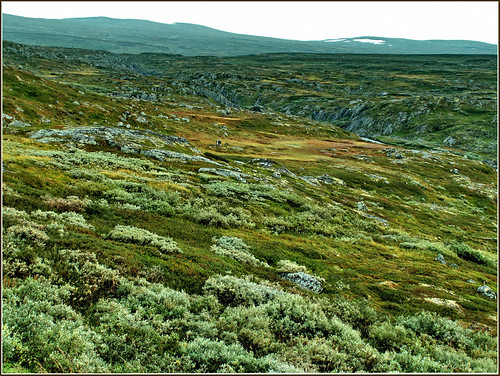
Researchers have known for years that the Arctic landscape is being transformed by rising temperatures. Now, scientists are amassing growing evidence that major events precipitated by warming — such as fires and the collapse of slopes caused by melting permafrost — are leading to the loss of tundra in the Arctic. The cold, dry, and treeless ecosystem — characterized by an extremely short growing season; underlying layers of frozen soil, or permafrost; and grasses, sedges, mosses, lichens, and berry plants — will eventually be replaced by shrub lands and even boreal forest, scientists forecast.
Much of the Arctic has experienced temperature increases of 3 to 5 degrees F in the past half-century and could see temperatures soar 10 degrees F above pre-industrial levels by 2100. University of Vermont professor Breck Bowden, a watershed specialist participating in a long-term study of the Alaskan tundra, said that such rapidly rising temperatures will mean that the “tundra as we imagine it today will largely be gone throughout the Arctic. It may take longer than 50 or even 100 years, but the inevitable direction is toward boreal forest or something like it.”
With temperatures increasing across the Arctic, the Alaskan tundra as we know it could be gone before the end of the century, some scientists predict. Dominique Bachelet, a climate change scientist at Oregon State University, forecasts that by 2100 tundra “will largely disappear from the Alaskan landscape, along with the related plants, animals, and even human ecosystems that are based upon it.” She made that prediction in 2004, and now says “the basic premise still holds, but the mechanism of change may be different than we thought.” Instead of long-term, incrementally complex changes caused by gradually warming temperatures, “extreme events will be the important triggers for change.” Hot-burning fires or slumping hillsides tied to melting permafrost could “clean the slate and allow new species to establish themselves,” Bachelet said.
Scientists have recorded a massive spike in the amount of a powerful greenhouse gas seeping from Arctic permafrost, in a discovery that highlights the risks of a dangerous climate tipping point.
Experts say methane emissions from the Arctic have risen by almost one-third in just five years, and that sharply rising temperatures are to blame.
The discovery follows a string of reports from the region in recent years that previously frozen boggy soils are melting and releasing methane in greater quantities. Such Arctic soils currently lock away billions of tonnes of methane, a far more potent greenhouse gas than carbon dioxide, leading some scientists to describe melting permafrost as a ticking time bomb that could overwhelm efforts to tackle climate change.
They fear the warming caused by increased methane emissions will itself release yet more methane and lock the region into a destructive cycle that forces temperatures to rise faster than predicted.
Paul Palmer, a scientist at Edinburgh University who worked on the new study, said: "High latitude wetlands are currently only a small source of methane but for these emissions to increase by a third in just five years is very significant. It shows that even a relatively small amount of warming can cause a large increase in the amount of methane emissions."
Global warming is occuring twice as fast in the Arctic than anywhere else on Earth. Some regions have already warmed by 2.5C, and temperatures there are projected to increase by more than 10C by 2100 if carbon emissions continue to rise at current rates.
Palmer said: "This study does not show the Arctic has passed a tipping point, but it should open people's eyes. It shows there is a positive feedback and that higher temperatures bring higher emissions and faster warming."
The change in the Arctic is enough to explain a recent increase in global methane levels in the atmosphere, he said. Global levels have risen steadily since 2007, after a decade or so holding steady.
The new study, published in the journal Science, shows that methane emissions from the Arctic increased by 31% from 2003-07. The increase represents about 1m extra tonnes of methane each year. Palmer cautioned that the five-year increase was too short to call a definitive trend.
It's as predictable a feature of the British winter as log fires and roasting chestnuts: a national outpouring of idiocy every time some snow falls.
Here's what Martyn Brown says in today's Express:
As one of the worst winters in 100 years grips the country, climate experts are still trying to claim the world is growing warmer.
There's a clue as to where he might have gone wrong in that sentence: "country" has a slightly different meaning to "world". Buried at the bottom of the same article is the admission that " ... other areas including Alaska, Canada and the Mediterranean were warmer than usual." But that didn't stop Brown from using the occasion to note that "critics of the global warming lobby said the public were no longer prepared to be conned into believing that man-made emissions were adding to the problem."
The ability to distinguish trends from complex random events is one of the traits that separates humans from the rest of the animal kingdom. It is also the basis of all science; detecting patterns, distinguishing between signal and noise, and the means by which the laws of physics, chemistry and biology are determined. Now we are being asked to commit ourselves to the wilful stupidity of extrapolating a long-term trend from a single event.
The Express would have us return to the days in which the future course of human affairs could be predicted by solar eclipses and the appearance of comets. It has clearly made a calculated decision in recent months that climate scepticism plays to its readership - and therefore shifts papers - just as the daily drip-feed of conspiracy theories about Princess Diana and Madeleine McCann has done in the past.
Brown is by no means alone in his idiocy. On Sunday, the Telegraph and the Mail published almost identical articles; one by Christopher Booker, the other by his long-term collaborator, Richard North. Both claimed that the Met Office had predicted a mild winter, and that it had made this prediction because it has been "hijacked" by a group of fanatics - led first by its former chief executive Sir John Houghton, now by the current boss Robert Napier - who stand accused of seeking to to corrupt forecasts to make them conform to their theories on climate change.
If this story were true, it would be huge: the UK's official weather forecasting service is deliberately changing its forecasts to make them fit a political agenda. It would also be fantastically stupid, as forecasts can always be checked against delivery. Booker and North offer no evidence to support this humongous conspiracy theory, just a load of unrelated facts cobbled together in the usual fashion.
The Independent has an article on melting permafroist in the Arctic and the methane being emitted as it melts - The methane time bomb.
The first evidence that millions of tons of a greenhouse gas 20 times more potent than carbon dioxide is being released into the atmosphere from beneath the Arctic seabed has been discovered by scientists.
The Independent has been passed details of preliminary findings suggesting that massive deposits of sub-sea methane are bubbling to the surface as the Arctic region becomes warmer and its ice retreats.
Underground stores of methane are important because scientists believe their sudden release has in the past been responsible for rapid increases in global temperatures, dramatic changes to the climate, and even the mass extinction of species. Scientists aboard a research ship that has sailed the entire length of Russia's northern coast have discovered intense concentrations of methane – sometimes at up to 100 times background levels – over several areas covering thousands of square miles of the Siberian continental shelf.
In the past few days, the researchers have seen areas of sea foaming with gas bubbling up through "methane chimneys" rising from the sea floor. They believe that the sub-sea layer of permafrost, which has acted like a "lid" to prevent the gas from escaping, has melted away to allow methane to rise from underground deposits formed before the last ice age.
They have warned that this is likely to be linked with the rapid warming that the region has experienced in recent years.
Methane is about 20 times more powerful as a greenhouse gas than carbon dioxide and many scientists fear that its release could accelerate global warming in a giant positive feedback where more atmospheric methane causes higher temperatures, leading to further permafrost melting and the release of yet more methane.
The amount of methane stored beneath the Arctic is calculated to be greater than the total amount of carbon locked up in global coal reserves so there is intense interest in the stability of these deposits as the region warms at a faster rate than other places on earth. ...
The Arctic region as a whole has seen a 4C rise in average temperatures over recent decades and a dramatic decline in the area of the Arctic Ocean covered by summer sea ice. Many scientists fear that the loss of sea ice could accelerate the warming trend because open ocean soaks up more heat from the sun than the reflective surface of an ice-covered sea.
The British Antarctic Survey has a report (including video) on the collpase of part of the Wilkins ice shelf in Antarctica. More at The Australian.
A CHUNK of Antarctic ice about seven times the size of Manhattan has suddenly collapsed, putting an even greater portion of glacial ice at risk. Satellite images show the disintegration of a 415 sq km chunk in western Antarctica, which started on February 28. It was the edge of the Wilkins ice shelf and has been there for hundreds, perhaps 1500, years.
British Antarctic Survey scientist David Vaughan said the collapse was the result of global warming. Because scientists noticed satellite images within hours, they diverted satellite cameras and even flew an airplane over the collapse for rare pictures and video.
"It's an event we don't get to see very often," said Ted Scambos, lead scientist at the National Snow and Ice Data Center in Boulder, Colorado. "The cracks fill with water and slice off and topple... That gets to be a runaway situation."
While icebergs naturally break away from the mainland, collapses like this are unusual but are happening more frequently in recent decades, Mr Vaughan said. The collapse is similar to what happens to hardened glass when it is smashed with a hammer, he said.
The rest of the Wilkins ice shelf is holding on by a narrow beam of thin ice. Scientists worry that it too may collapse. Larger, more dramatic ice collapses occurred in 2002 and 1995. Mr Vaughan had predicted the Wilkins shelf would collapse about 15 years from now.
Scientists said they are not concerned about a rise in sea level from the latest event, but say it's a sign of worsening global warming. Such occurrences are "more indicative of a tipping point or trigger in the climate system," said Sarah Das, a scientist at the Woods Hole Oceanographic Institute in the US.
Meanwhile the disappearing arctic ice cap has oil prospectors salivating at the prospect of further accelerating global warming - "Shrinking icecap lures oil giants".
WINTER sea ice around a Norwegian Arctic island has thinned to less than one metre since the 1960s, according to a study of a region that may be more attractive to oil firms because of climate change. The Norwegian Polar Institute said ice around Hopen island south-east of the Svalbard archipelago had thinned by more than 40cm over the past 40 years, in what it called the first long-term study of ice thickness in the Barents Sea.
"Since the year 2000 there have been no observations of ice thicker than one metre at Hopen, and the local air and water temperature has also risen," the institute said in a statement.
Hopen is a narrow island about 30km long off north Norway which is home to polar bears. Ice around the entire Arctic reached a record low in September 2005, the end of the northern summer.
The UN Climate Panel says temperatures are rising more rapidly in the Arctic than on most of the planet because of global warming, stoked by human use of fossil fuels. Darker water and land soak up more heat than reflective ice and snow.
"The reduced see ice thickness at Hopen is in line with the generally reduced volume of ice in the Barents Sea and the whole Arctic," said Sebastain Gerland of the Polar Institute. The study was being published in the journal Geophysical Research Letters, the institute said.
Oil and gas companies are pushing north into the Barents Sea, seeking new reserves. Scientists say climate change may make the region less inhospitable and prices around $US100 a barrel can justify exploration despite high costs.
The most direct route through the Northwest Passage has opened up fully for the first time since records began, the European Space Agency (Esa) says. Historically, the passage that links the Atlantic and Pacific Oceans through the Canadian Arctic has been ice-bound. But the agency says ice cover has been steadily shrinking, and this year's drop has made the passage navigable. The findings - based on satellite images - have raised concerns about the speed of global warming.
The Northwest Passage is one of the most fabled sea routes in the world - a short cut from Europe to Asia through the high Arctic. Recent years have seen a marked shrinkage in its ice cover, but this year it was extreme, Esa says. It says this made the passage "fully navigable" for the first time since monitoring began in 1978.
"We have seen the ice-covered area drop to just around 3m sq km (1,2 sq miles)," Leif Toudal Pedersen of the Danish National Space Center said. He said it was "about 1m sq km (386,000 sq miles) less than the previous minima of 2005 and 2006". "There has been a reduction of the ice cover over the last 10 years of about 100, 000 sq km (38,600 sq miles) per year on average, so a drop of 1m sq km (386,000 sq miles) in just one year is extreme," Mr Pedersen said.
The Northeast Passage through the Russian Arctic has also seen its ice cover shrink and it currently "remains only partially blocked," Esa says.
Scientists have linked the changes to global warming which may be progressing faster than expected. The opening of the sea routes are already leading to international disputes. Canada says it has full rights over those parts of the Northwest Passage that pass through its territory and that it can bar transit there. But this has been disputed by the US and the European Union. They argue new route should be an international strait that any vessel can use.
TreeHugger reports that the first geoengineering experiment is about to begin in the South Atlantic - "International Team Of Scientists To Test South Atlantic Carbon Sink In 2009". Yikes - isn't reducing our carbon emissions a lot easier than conducting these sorts of dangerous experiments for evermore ?
In an attempt to test the possibility of mitigating the effects of global warming, scientists from India, Germany, Italy and Chile plan on “sinking” carbon emissions into the Scotia Sea, off the Antarctic Peninsula in the South Atlantic, during January to March 2009.
By depositing 20 tonnes of non-toxic iron sulfate into a 1,000 square kilometre area of the sea, it is hoped that the iron particles will create fertile conditions for the explosive growth of phytoplankton or algae and microorganisms that will soak up carbon dioxide.
Carbon sinking (also called ocean seeding, iron fertilization, carbon capture and sequestration) was first tested 15 years ago as alternative method of “managing” global warming, though there are questions to the long-term environmental ramifications of experiments on this kind of scale.
Earlier this year, companies such as Planktos have conducted trials in seeding an area near the Galapogos to observe the effects. According to Planktos, the process involves dilute infusions of iron over large areas and if ocean seeding is successful in the long term, it will apparently not only restore plankton populations but also improve water quality, buffer the surface water acidity and assist in sinking large amounts of carbon into the ocean to slow climate change.
However, the amount of carbon absorbed or “sunk” will hinge on how much plankton sinks to the sea bed. There are concerns that the increase in plankton will result in more methane and nitrous oxide being released into the atmosphere – possibly worsening the situation.
Nevertheless, it is obvious that the sea’s capacity to absorb carbon has decreased: recent data published in Science shows that the Southern Ocean’s ability to absorb carbon from the atmosphere has been reduced approximately 15% every decade since 1981, due to changing levels of substances such as iron sulfate. The result is a possible feedback loop from the intensification of increasing carbon emissions, coupled with the ocean’s declining ability to absorb carbon. It is a worrying scenario and only time will tell if large-scale, international experiments such as these will have a positive impact on slowing climate change.






 Posts
Posts