Posted
by Big Gav
in
inflation,
oil price
Paul McCulley at Pimco has an interesting article on the wave of inflation that is about to break, saying that it is inevitable and people shouldn't get too excited about the prospect of negative real interest rates, as both capital and labour need to suffer together. A remarkably progressive (albeit realistic) attitude for a bond fund manager - although I don't think too many Libertarians would read it without gnashing their teeth - maybe I should send it on to the guys at The Daily Reckoning and await the explosion...
From A Kind Word for Inflation:
No, I have not lost my mind. I’m fully aware that inflation is not kind to bonds, so offering a kind word for inflation is de facto offering an unkind word about my own business. Investment managers don’t tend to do that. But facts are facts. And the essential fact right now is that the American economy needs an inflation rate above the Fed’s comfort zone. Needs, you ask?
Yes. Soaring commodity prices, particularly for petroleum and food, and especially in recent months, are an unambiguous negative real terms of trade shock to America. For those not familiar with the term, a nation’s terms of trade is the ratio of what it must give up to get what it imports. The easiest way to understand the concept, at least for me, is to think of the number of hours of work necessary, at the average national hourly pay rate, to buy a barrel of oil – a real variable compared to another real variable. The chart below tells that simple story.
Americans are working more hours for the same barrel of oil. That is a negative real terms of trade shock. Put differently, we are less rich or more poor than we were before oil prices took off. There is no getting ‘round this. In turn, there is no escaping collateral adjustments of temporarily higher inflation and temporarily lower growth and employment. The question of the hour is how this pain should be apportioned. Last week, Fed Vice Chairman Don Kohn provided the right answer, presuming there is a right answer:
“… an appropriate monetary policy following a jump in the price of oil will allow, on a temporary basis, both some increase in unemployment and some increase in price inflation. By pursuing actions that balance the deleterious effects of oil prices on both employment and inflation over the near term, policymakers are, in essence, attempting to find their preferred point on the activity/inflation variance-tradeoff curve introduced by John Taylor 30 years ago. Such policy actions promote the efficient adjustment of relative prices: Since real wages need to fall and both prices and wages adjust slowly, the efficient adjustment of relative prices will tend to include a bit of additional price inflation and a bit of additional unemployment for a time, leading to increases in real wages that are temporarily below the trend established by productivity gains.”
Mr. Kohn was preaching the raw, honest truth: a surge in oil prices raises the Misery Index, temporarily lifting both inflation and the unemployment rate. In turn, those outcomes beget lower real wages and, presumably, lower real profits, too. We are less rich or more poor – period. Thus, those who holler and scream at the Fed for letting the inflation genie out of the bottle need to calm down. A negative terms of trade shock is a real shock, so it must be translated into lower real wages and profits. That simple and that painful. Logically, it also must be translated for a time into lower, even negative, real short-term interest rates, the rate of return on money. ...
In the wake of a negative terms of trade shock, all factors of production should absorb a negative hit to their real returns. If indexing to headline inflation is inappropriate for labor wages and capital’s profits, why should cash yields be indexed by the Fed?
And what if holders of cash don’t like it? Then they can step out on the risk spectrum. After all, a basic of capitalism is no risk, no reward. And temporarily higher inflation in the wake of a negative terms of trade shock is an efficient lubricant for the economy to make the necessary real adjustments.

Posted
by Big Gav
in
agriculture,
food prices,
inflation
The FT reports that middle eastern countries are struggling to afford rising food prices, even with soaring oil export revenues.
For years, food policy in the Middle East and North Africa was very simple: hydrocarbon exports paid for carbohydrate imports.
Rising agricultural commodities prices and a large population increase mean that the traditional policy is now untenable even if crude oil trades at about $120 a barrel, forcing countries in the region, including Saudi Arabia, to reconsider how it feeds its population.
“The region has woken up to the new food market reality,” says Abdolreza Abbassian, an expert at the Food and Agriculture Organisation in Rome.
The FAO estimates the region’s cereals import bill will hit $22.6bn this year (£11.4bn, €14.5bn), a 40 per cent increase on 2007. Since 2000, it has jumped almost 170 per cent. The rising bill is the latest signal of the looming food crisis hanging over the Middle East and north Africa, the region of the world most dependent on imports of food staples.
Jonathan Calland, of Tilda, India’s largest exporter of basmati rice, says: “Security of food supplies is for the first time since the 1970s back on the agenda in the Middle East.”
In the past few months, food riots have hit Egypt, the United Arab Emirates and Yemen as prices jumped almost 60 per cent in a year. A general strike, demanding action on rising prices, has been called in Lebanon on Wednesday. The discomfort over food price hikes is aggravated by a huge dependence on the international food market. Middle East and north African countries buy almost a quarter of all the cereals traded globally.
Abah Ofon, agricultural commodities analyst at Standard Chartered in Dubai, says: “The region is in a very precarious position.”
Two countries in the region, Morocco and Jordan, have an even more acute problem because not only are they facing higher food prices rises, they are also net importers of fuel.
The dependence on imports is a consequence of the meagre agricultural supply – a result of paltry land and water resources – and booming demand – the upshot of fast rising populations and strong economic growth courtesy of high oil prices.
Posted
by Big Gav
in
agriculture,
fertiliser,
inflation
The New York Times has an article on the difficulties US farmers are having obtaining fertiliser (via Cryptogon).
The squeeze on the supply of fertilizer has been building for roughly five years. Rising demand for food and biofuels prompted farmers everywhere to plant more crops. As demand grew, the fertilizer mines and factories of the world proved unable to keep up.
Some dealers in the Midwest ran out of fertilizer last fall, and they continue to restrict sales this spring because of a limited supply. “If you want 10,000 tons, they’ll sell you 5,000 today, maybe 3,000,” said W. Scott Tinsman Jr., a fertilizer dealer in Davenport, Iowa. “The rubber band is stretched really far.”
The ABC reports that a
Chinese export tax on fertiliser is set to send prices soaring.
The latest National Australia Bank agribusiness survey shows a skewed picture in rural Australia, with farmers feeling better about the future, but agribusiness not so sure. A facade of confidence is emerging as world commodity prices stay high, masking the pain being felt from rising input costs, such as fertiliser, fuel and chemicals.
The situation hasn't been helped by a decision from China to impose a 100 per cent tariff on exports of fertiliser. Former head of the Australian Fertiliser Services Association, Shane Dellavedova, says while Australia has some carry-over stocks following several poor seasons, farmers need to get ready for a big price rise.
Posted
by Big Gav
in
australia,
economics,
inflation
The Australian reports that some people (with Bernie Fraser leading the way) are finally starting to question the wisdom of raising interest rates as a response to rising inflation when the factors causing the aforesaid rising inflation (rising energy prices feeding into rising prices of everything else) will not be affected in any meaningful way by Australian interest rate levels - "Reserve 'must lift inflation target'".
This is something I've been muttering about to anyone who will listen for some months, so I'm glad to see it reaching mainstream conversation now - all interest rate rises are doing is killing highly leveraged homeowners in outer-ring suburbs and making life even more difficult for exporters who are exposed to the exchange rate - and wiping out either or both of these groups won't bring inflation that is being imported via global market prices down at all (though the rising currency does mitigate this to a certain extent).
THE Reserve Bank should tolerate inflation running above its 2-3 per cent comfort zone for the time being to support economic growth and jobs, according to former RBA governor Bernie Fraser.
He also said the Rudd Government would "probably get away" with the tax cuts due to pour into voters' pockets on July1 without damage to the economy because demand was slowing. "We are very much back into the trade-off game and central bankers are going to have to start working hard again for their money," Mr Fraser said yesterday.
His warning was backed by respected economist and former Reserve Bank board member Bob Gregory, who said Australia risked a severe downturn if the 2-3 per cent inflation target were strictly adhered to when the China-led resources boom was forcing up food and fuel prices. "We ought to be talking about how long it is acceptable to be outside the range when most of the inflation is imported," Professor Gregory said.
The two monetary policy heavyweights were responding to a call from former senior Reserve Bank officer Peter Jonson to suspend the 2-3 per cent inflation target to avoid a recession.
Mr Jonson, a former monetary policy hardman and editor of the Henry Thornton website, now believes that soaring international food and oil prices have changed the ground rules.
The comments, in a series of interviews with The Weekend Australian, confirm a debate is under way about whether monetary policy needs to be rethought to cope with the two-speed world economy in which the US and Europe face recession while China and India are feeding inflation.
Mr Fraser and Professor Gregory emphasised that inflation targeting remained the best approach for an independent Reserve Bank, and did not support a shift to another mechanism. But they believe there should be flexibility in how the regime is applied to ensure the Reserve Bank does not over-cook the response to inflation.
Interest rates have already been lifted to their highest level since 1996, yet there is no sign that inflation is under control. The latest consumer price index showed inflation at 4.2 per cent in the year to the March quarter, with prices jumping across the board.
Posted
by Big Gav
in
agriculture,
food prices,
food sovereignty,
inflation
The FT reports "Rice traders hit by panic as prices surge" as Bangladesh and The Philippines struggle to find anyone to sell rice to them.
Rice prices hit the $1,000-a-tonne level for the first time on Thursday as panicking importers scrambled to secure supplies, exacerbating the tightness already provoked by export restrictions in Vietnam, India, Egypt, China and Cambodia. The jump came as the Philippines, the largest rice importer, failed for the fourth time to secure as much rice as it wanted. The unsuccessful tender followed Bangladesh’s inability to buy any rice at all this week.
Traders and analysts warned that rice demand was escalating in spite of prices rising to three times the level of a year ago as countries try to build up stocks. Vichai Sriprasert, president of Riceland International, a leading rice exporter in Bangkok, said several of its customers, including governments, were buying far more than they usually did amid fears about scarcity. “It is panic,” he said. “My customers are demanding double the usual volume. We would not have enough supplies for all the demand we are facing.”
Michael Whitehead, a rice specialist at Rabobank in New York, added: “The potentially destabilising social effect of rice shortages in most high-consumption countries has strengthened the resolve of governments to build supply.”
The Progressive says that the way to
solve the food crisis is by changing policies - their prescription being to embrace the idea of "food sovereignty" (a concept I mentioned in
The Fat Man, The Population Bomb And The Green Revolution) instead of global free(ish) trade in cash crops.
Food riots are erupting all over the world. To prevent them and to help people afford the most basic of goods, we need to understand the causes of skyrocketing food prices and correct the policies that have fueled them.
World food prices rose by 39 percent in the last year. Rice alone rose to a 19-year high in March – an increase of 50 per cent in two weeks alone – while the real price of wheat has hit a 28-year high. As a result, food riots erupted in Egypt, Guinea, Haiti, Indonesia, Mauritania, Mexico, Senegal, Uzbekistan and Yemen. For the 3 billion people in the world who subsist on $2 a day or less, the leap in food prices is a killer. They spend a majority of their income on food, and when the price goes up, they can’t afford to feed themselves or their families.
Analysts have pointed to some obvious causes, such as increased demand from China and India, whose economies are booming. In the last thirty years, developing countries that used to be self-sufficient in food have turned into large food importers. Rising fuel and fertilizer costs, increased use of bio-fuels and climate change have all played a part. But less obvious causes have also had a profound effect on food prices.
Over the last few decades, the United States, the World Bank and the International Monetary Fund have used their leverage to impose devastating policies on developing countries. By requiring countries to open up their agriculture market to giant multinational companies and by persuading them to specialize in exportable cash crops such as coffee, cocoa, cotton and even flowers, Washington, the IMF and the World Bank created a downward spiral. They made matters worse by demanding the dismantling of marketing boards that kept commodities in a rolling stock to be released in event of a bad harvest. These boards shielded both producers and consumers against sharp rises or drops in prices. But the shield is no longer there.
Here’s what we must do to prevent an epidemic of starvation from breaking out.
First, it is essential to have safety nets and public distribution systems put in place. Donor countries should provide more aid immediately to support government efforts in poor countries and respond to appeals from U.N. agencies, which are desperately seeking $500 million by May 1.
Second, we should help affected countries develop their agricultural sectors to feed more of their own people and decrease their dependence on food imports. We should promote production and consumption of local crops raised by small, sustainable farms instead of growing cash crops for Western markets. And we should support a country’s effort to manage stocks and pricing so as to limit the volatility of food prices.
To embrace these crucial policies, however, we need to stop worshipping the golden calf of the so-called free market and embrace, instead, the principle of food sovereignty. Every country and every people have a right to food that is affordable. When the market deprives them of this, it is the market that has to give.
Kevin Bullis at Technology Review has an article on
Battling Ethanol-Propelled Food Prices, noting "Demand for corn-derived fuel is driving up food prices, but new technologies could help" and quoting from an article in Foreign Affairs last year on "
How Biofuels Could Starve the Poor".
Food prices worldwide have risen dramatically in the past few years, due in part to a similarly dramatic rise in the amount of corn used for ethanol production in the United States. Now, in an effort to make food less expensive, experts are calling for limits on ethanol production, subsidies for corn, and more incentives for biofuels made from nonfood sources.
According to statistics released Wednesday by the U.S. Department of Labor, food prices for the first three months of the year rose at a rate that translates to an annual increase of 5.3 percent (adjusted for seasonal variations). That's slightly higher than last year's increase, and much higher than the increases in previous years. From 2001 to 2006, the price of food increased each year by an average of only 2.5 percent. According to the World Bank, the situation worldwide is more dire: food prices have nearly doubled over the past three years. That's erased a decade of economic gains for the poor in some countries.
Part of this increase is due to corn being diverted from use as animal feed and food to use as a feedstock for ethanol production. Many other factors are also important--such as growing demand for food imports in India and China and a drought in Australia that hurt grain harvests. But the use of corn for biofuels has been singled out because it is one factor over which governments have some control. Some analysts, such as C. Ford Runge, a professor of applied economics and law at the University of Minnesota, say that the use of corn for fuel rather than food could account for about one-third of the rise in prices worldwide. The other two-thirds is split between the effects of weather and increases in demand, he says. (Runge presents his argument in "How Biofuels Could Starve the Poor," in Foreign Affairs.) A look at the grain markets gives a good idea of the role that ethanol demand plays in food prices, says Patrick Westhoff, codirector of the Food and Agricultural Policy Research Institute at the University of Missouri. In the past two years, global consumption of grains has risen by about 80 million tons, he says. About half of that increase, or 40 million tons, comes from corn used to make ethanol.
To reverse the effects of corn going to fuel rather than to food, some experts are calling for an end to the biofuel mandates signed into law late last year. The mandates require an increase in biofuel production in the United States, including 15 billion gallons of corn ethanol production by 2015--considerably more than the 6.5 billion gallons produced last year. Repealing the mandates would certainly have some effect on food prices, Westhoff says. According to an analysis done by his organization, the mandates will decrease U.S. corn exports by more than 13 percent from 2011 to 2016. That decrease will tighten corn supplies worldwide, driving up not only corn prices, but also the prices of other staples, such as wheat, that could serve as a replacement for corn. Removing the mandates could improve export numbers, Westhoff says. (Notably, higher demand for corn for use in ethanol production has actually increased corn exports in the short term. High corn prices have led farmers to plant more corn, and last year, not all of the increased supply went to ethanol. Much of the excess went overseas.)
But the effect of repealing the mandates on food prices depends strongly on the cost of energy. If oil prices stay around $100 a barrel, ethanol will remain an attractive alternative even without the mandates, Westhoff says. As a result, ethanol production could reach levels as high as those set by the mandates anyway, putting just as much strain on the corn supply. High energy costs increase food prices in other ways, too, says Simla Tokgöz, an economic analyst at the Center for Agricultural and Rural Development at Iowa State University. Growing crops takes energy, and countries that have to import food are now paying a high price for shipping because of fuel costs. Bringing down food prices requires addressing these problems as well.
One thing that could help is reducing or eliminating subsidies that give corn ethanol an economic advantage over ethanol from other sources, such as sugar cane, Runge says. Ethanol can be made from sugar more efficiently than it can from corn, so diversion of sugar to fuel production wouldn't have as much of an effect on food markets.
Scaling up technology for making ethanol from nonfood sources, such as grass and wood chips, could also help. Federal grants are already starting to make that happen, and certain provisions in the U.S. biofuels mandates call for the use of cellulosic ethanol. But so far, technologies for producing cellulosic ethanol have not been commercially deployed. The jump in food prices "increases the urgency to get them developed," says Bruce Babcock, director of the Center for Agricultural and Rural Development at Iowa State University.
I've seen a
couple of
reports that corn plantings have actually decreased by 8% in the US this year (somewhat offset by increased soy plantings) which surprised me - especially considering how few reports mention this as a potential factor in further price rises going forward. Explanations for why this is so are scarce, though
one commenter pointed the finger at rising fuel, fertiliser and pesticide prices, combined with the credit crunch possibly making farmers less able to afford to plant new crops.
All in all it doesn't augur well for next year.
Posted
by Big Gav
in
agriculture,
food prices,
grain,
inflation,
potatoes
The Globe And Mail reports that Kazahkstan and Indonesia have become the latest countries to join the grain export ban bandwagon.
Some of the world's biggest grain exporters barred their farmers from selling in global markets yesterday, exacerbating the food price crisis for poorer nations that import their food and highlighting the failure of governments to nurture stronger rules for agricultural trade.
Rice and corn prices soared to records on U.S. markets and wheat jumped to its highest in a week after Kazakhstan, the world's fifth-largest wheat exporter, and Indonesia, a major rice producer, became the latest nations to impose export bans. The price increases further inflated global food costs that already had surged 48 per cent since the end of 2006.
The latest moves highlight the difficulty of solving a problem that has its roots in years of trade policy indecision, the push by richer nations to produce more fuel from food crops, growing demand from developing countries such as China, and Wall Street investors who see a money-making opportunity in surging commodity demand.
"Business as usual is no longer an option," Paris-based UNESCO says in a sweeping report on the world agriculture system that was three years in the making and released yesterday. "There is a recognition that the mounting crisis in food security is of a different complexity and potentially different magnitude than the one of the 1960s."
Kazakhstan and Indonesia are trying to put a lid on food inflation to avoid the riots that have beset countries such as Egypt and Haiti.
While their policies may ease tensions at home, they threaten to make things worse for poorer countries that don't have the luxury of good agricultural land and temperate climates to feed their populations.
Cryptgon has a post on one crop that isn't part of the price spiral - potatoes - "
As Other Staples Soar, Potatoes Break New Ground".
There’s one sentence in the article below that I’d like to highlight:
One factor helping the potato remain affordable is the fact that unlike wheat, it is not a global commodity, so it has not attracted speculative professional investment.
If you don’t understand why that sentence is so important, please see, CBOT Resembles Carnival Act as Billion Dollar Black Box Operators Move In.
Anyone concerned with food security should be growing their own potatoes. We grow our own and and they’re delicious.
Beware, though, because the Satanic FrankenpHood Cult is hard at work trying to wreck things for profit, or worse. BASF—split off from IG Farben, a company that was involved with the Third Reich’s human extermination industries—is developing GE potatoes.
Have a nice day.
Via: Reuters:
As wheat and rice prices surge, the humble potato — long derided as a boring tuber prone to making you fat — is being rediscovered as a nutritious crop that could cheaply feed an increasingly hungry world.
Potatoes, which are native to Peru, can be grown at almost any elevation or climate: from the barren, frigid slopes of the Andes Mountains to the tropical flatlands of Asia. They require very little water, mature in as little as 50 days, and can yield between two and four times more food per hectare than wheat or rice.
“The shocks to the food supply are very real and that means we could potentially be moving into a reality where there is not enough food to feed the world,” said Pamela Anderson, director of the International Potato Center in Lima (CIP), a non-profit scientific group researching the potato family to promote food security.
Like others, she says the potato is part of the solution.
The potato has potential as an antidote to hunger caused by higher food prices, a population that is growing by one billion people each decade, climbing costs for fertilizer and diesel, and more cropland being sown for biofuel production.
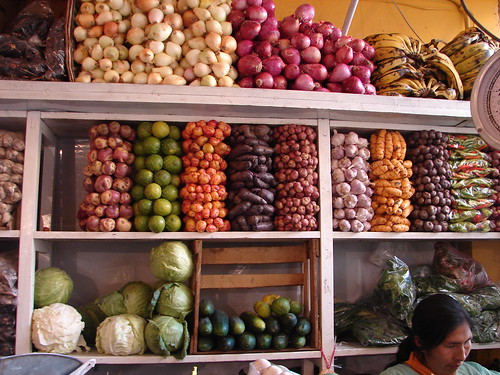
Posted
by Big Gav
in
agriculture,
food prices,
inflation
Dan at The Daily Reckoning (no fan of Peak Energy I believe, but no matter) has a column on the food vs fuel issue, containing a few choice turns of phrase about dinosaurs and meteor showers (along with some unsubstantiated population doomerism, which I wish people would avoid).
While the share market digests the news of collapsing brokers and falling financial profits, the grand poobahs of the world's economy are wringing their hands in worry. What's keeping them up at night? The three Fs, each its own kind of crisis: food, fuel, and finance.
"The World Bank met on Sunday faced with a mounting food price crisis that has sparked deadly unrest in developing countries, underscoring the urgency of fighting hunger and poverty," reports Channel News Asia. How urgent, you ask? The Prime Minister of Haiti was sent packing this weekend by crowds protesting soaring food and fuel prices. We don't even know who the man is but reckon he won't be the last public official to be ridden out of town on a rail before this current crisis is over (and it may not be any time soon).
As usual, it's the people at the margin (whether lending or with food) that are affected first when surplus turns to scarcity. Despite all the daily signs of abundance here in Australia, let us not forget that there are about four and half billion people on the planet who have little margin for error in their daily lives. If food prices go up, many of these people go hungry.
World Bank President Robert Zoellick, doing his best impersonation of Franklin Delano Roosevelt, wants a "new deal" for global food programs. He's asked richer nations to contribute US$500 million immediately to help get food to poorer nations.
IMF President Dominique Strauss-Kahn was less pragmatic but more rhetorical. Wrapping up his organisation's annual spring meeting, he said that, "Food prices, if they go on like they are doing today ... the consequences will be terrible…Hundreds of thousands of people will be starving…As we know, learning from the past, those kinds of questions sometimes end in war."
People often talk about resource wars being a common feature of the coming century (or decade). But it's usually oil and energy they're talking about, not rice and wheat. Food is fuel for the body (we've been watching the Biggest Loser). If you don't have access to cheap calories, what good is cheap fuel?
It's our contention here at the Daily Reckoning that both food and fuel are getting more expensive. The scary thought is that artificially low interest rates and cheap energy have, for many years now, sent bogus signals to the world about how much and how fast the population can grow. Agricultural abundance is only a very recent (and perhaps temporary) historical phenomenon. It's no coincidence that it occurred alongside the energy boom from cheap oil.
Not that it's any consolation to starving people stranded in long petrol lines, but businesses in the agricultural sector are going to boom (provided they aren't nationalised). Farm equipment, fertilizer, and large producers should all see earnings rise this year. And next year. And the year after that.
The second "f" crisis is in finance. It's been with us so long now it doesn't seem like it's new. But some people are slow on the uptake. The nerve endings of large institutions like the IMF and World Bank are few and far removed from the tiny central brains that direct the movements of these mammoths. Brontosaurus Banks.
Like a bunch of dinosaurs standing under a meteor shower, the G-7 meeting this weekend produced lots of talk and no action. The ministers agreed that concrete steps need to be taken in the global financial system to improve transparency and the way the banks value certain assets. The G-7 statement also paid lip service to issue of credit ratings and how to make sure in the future that garbage debt doesn't get a Triple A investment grade rating. ...
The conclusion? There is no one solution to the credit crisis. That is bad news for people who think of the economy like a machine. It's not just a matter of changing the oil or checking the fuel pump. The engine is sputtering, the drive train is wrecked, the tires are flat, and someone seems to have cut the brake lines. There are no air bags. As they say in the used car business, it's not the years, it's the miles. You wonder if this globalisation jalopy is going to make it. ...
This is why the day-to-day movements in the dollar index and in gold don't tell you much. The most important fact about the gold price is that that the official policy of the U.S. government is to cheapen its currency. Rates are being lowered. The government is spending money. It's also giving away money, hoping Americans can spend the country out of recession.
Do you know of any person or any nation that ever spent its way to prosperity? Neither do we.
The fuel crisis hasn't reached the same acute stage as global food markets. But in time, it will...
Tom Philpott at Grist continues his series on
Can industrial agriculture feed the world? with the "Global food riots edition".
A couple of months ago, I raised the question, can industrial agriculture feed the world? I was being intentionally provocative. For decades, policymakers have treated low-input, diversified agriculture -- "organic" in the sense described by the great British agriculture scholar Sir Albert Howard -- as a kind of hippy indulgence. Sure, it's nice to grow food without poison, but you can't feed the world that way.
To feed the globe's teeming masses, you need loads of mined and fossil-fuel synthesized fertilizers, pesticides by the tons, patent-protected genetically modified seeds, heroic irrigation projects, gargantuan, petroleum-fueled "combine" machines, etc. But as I wrote in the earlier post, evidence is mounting that organic agriculture is just as productive as chemical-based.
Moreover, even before the recent spike in global food prices, some 800 million people lacked access to food worldwide. Industrial agriculture excels at cranking out calories, but its productive capacity tends to be hyper-consolidated in hands of a few corporations and a relatively small group of landowners. The people who most need the food it generates can't always get their hands on it. Vaunted for its efficiency, industrial ag generates massive amounts of wasted food, even as hundreds of millions go without enough.
And now, the system has come under severe strain. Global grain stocks are at all-time lows, prices are escalating, and hunger riots are erupting in Egypt, Cameroon, Haiti, and Burkina Faso -- and could well spread, the FAO warns. ...
What's being described here is a full-on crisis in industrial ag. And I don't think the reflexive official response -- more industrial ag -- will work this time. The above-linked FAO document talks about finding ways to get more "inputs" to smallholder farmers in the global south. But prices for fertilizers, GM seeds, and insecticides are all escalating, rising even faster than food prices. Just as urban dwellers in the global south are being priced out of food markets, farmers in the global south are being priced out of ag-input markets.
Moreover, the use of these inputs -- particularly synthetic nitrogen fertilizer -- contributes massively to climate change, degrades water, blots out sea life, etc. Under these circumstances, yet another push to consolidate industrial agriculture in the global south seems imbecilic. The time has come for global institutions like the FAO to take low-input, intensive organic agriculture -- intellectually rooted in smallholder farming styles in India -- seriously as a response to the crisis in industrial agriculture.
The SMH reports that the
World Bank is calling for food crisis action.
The World Bank has called for the international community to beef up its response to soaring food prices that have led to starvation and are threatening political stability in the developing world. Many ministers gathered for the World Bank's annual spring meeting also raised concerns over the increased use of bio-fuels, which share much of the blame for the lack of food supplies, as an alternative energy source.
A joint statement by the ministers urged countries to meet a $US500 million ($A536.88 million) aid shortfall at the World Food Program to help the world's poorest regions, where hundreds of thousands are threatened with starvation.
Global food prices have jumped 83 per cent over the last three years, and World Bank President Robert Zoellick warned that the crisis had already toppled a government in Haiti and could push ever more people into poverty. "We have to put our money where our mouth is now, so that we can put food into hungry mouths," Zoellick said. "It is as stark as that."
Many countries put the blame for the food crisis squarely on the increased production of certain bio-fuels that use food crops as an alternative energy source. The United States, Europe and other regions have boosted their production of bio-fuels in recent years to reduce their dependence on imported oil and cut greenhouse-gas emissions that contribute to global warming.
Indian Finance Minister P Chidambaram called on industrial nations to cut off all subsidies for such bio-fuel production. "In a world where there is hunger and poverty, there is no policy justification for diverting food crops towards bio-fuels," Chidambaram said. "Converting food into fuel is neither good policy for the poor nor for the environment."
Tyler Hamilton's latest Clean Break column looks at
space cadet Robert Zubrin and his efforts to extend government biofuel mandates even further.
My Clean Break column today is based on an interview with Robert Zubrin, the author of Energy Victory and the engineer that has been most vocal about sending humans to Mars. Zubrin's main thesis is that the Organization for the Petroleum Exporting Countries (OPEC) has been manipulating and benefitting from high oil prices and that this monopoly grip on the fossil-fuel market must be broken. He wants legislators to mandate that every new vehicle manufactured have flex-fuel capability, a move that would boost investment in and availability of biofuels and essentially water down OPEC's influence.
Now, this is quite the contentious argument given it seems more focused on energy security than on sustainability. There's no shortage of headlines trashing the environmental benefits of ethanol and emphasizing the impact on food prices and, in some cases, the negative environmental effects of growing corn for fuel. Mandating flex-fuel in all new vehicles would merely amplify the problems being discussed today, critics say.
I have to admit, I'm torn on this one. I see the value of biofuels, assuming our increased production of the fuel can be done sustainably, guided by regulation, and assuming we can transition quickly to cellulosic ethanol. The question is, would a flex-fuel mandate create such a huge, instant demand that all rules go out the window in order to meet this demand? Would it require we import ethanol from other countries where environmental track records are poor and beyond the oversight of North American governments?
Posted
by Big Gav
in
agriculture,
food prices,
inflation,
permaculture
I'm finding the global outbreak of food doomerism this year a little bizarre as, the biofuel folly aside, it seems like any perceived scarcity is because we are planting less crops this year and I haven't seen this explained yet. Some of the food price rises can be attributed to rising fuel prices - but that doesn't explain all of it - and the higher prices should be stimulating more planting - it's not like we've run out of arable land yet.
Cryptogon has the latest update, with his own unique take on it. See also Philippines Threatens Rice Hoarders with Life Imprisonment.
This situation is maddening. I’ve been reading our Bill Mollison permaculture books again (Intro and Design) and the path to abundance is right there. I have to conclude that the governments involved want the chaos they’re experiencing, or are about to experience. Rather than yielding some control to localities and supporting smaller, integrated animal/garden/food forest systems, these states are trying to do the old top-down command economy nonsense, and the result is totally predictable: famine.
Remember the one about give-a-man-a-fish vs. teach-a-man-to-fish? What happened to that?
Oh yeah, I remember. If the man is out fishing he’s not working in a mobile phone factory, etc…
What I find most amazing is that we made it as far as we have, as long as we have, without system wide failures. I’d like to think that people will get together and say, “F&@$ this, let’s produce our own food instead of waiting for it to arrive in a plastic bag on a military convoy.” Hint: Don’t wait for that day to come.
What’s going through Bill Mollison’s head right now, in the twilight of his days, as he sees all of this crap unfolding? Is it weird to have seen this coming for 30 years, to have dedicated his life to building and teaching people about other realities, and then, well, watch this unfold? I’ve seen some interviews with him, none of them recent, and he comments on agricultural devastation in a matter-of-fact, detached way; sometimes, with a hint of a smile and benign wonder at the intractable stupidity of people.
Via: The Guardian:
Rising food prices could spark worldwide unrest and threaten political stability, the UN’s top humanitarian official warned yesterday after two days of rioting in Egypt over the doubling of prices of basic foods in a year and protests in other parts of the world.
Sir John Holmes, undersecretary general for humanitarian affairs and the UN’s emergency relief coordinator, told a conference in Dubai that escalating prices would trigger protests and riots in vulnerable nations. He said food scarcity and soaring fuel prices would compound the damaging effects of global warming. Prices have risen 40% on average globally since last summer.
“The security implications [of the food crisis] should also not be underestimated as food riots are already being reported across the globe,” Holmes said. “Current food price trends are likely to increase sharply both the incidence and depth of food insecurity.”
Posted
by Big Gav
in
coal price,
inflation
The Australian has a report on the huge coal price increases being won by BHP and Rio Tinto in Asia (and beyond) and the impact on the Australian dollar exchange rate. The sound of weeping you can hear is coming from Asian importers, Australian non-mineral exporters and American consumers. On the bright side, the more expensive coal gets the sooner we'll be able to replace it with solar thermal power.
AUSTRALIAN coal exporters are expected to win a tripling in prices this year following an unprecedented standoff with China that sent the trade deficit plunging to a record $3.3 billion in February.
Export revenue dropped by $800million in the month as shipments of coal and iron ore were held up by floods, cyclones and the negotiating tactics of Australian mining companies and the Chinese Government over new contracts for the two key ingredients needed in steel-making. The trade deficit was 30 per cent bigger than the previous month. "It is extraordinary to see such a large trade deficit in the middle of the largest resources boom in more than 50 years," said ABN Amro chief economist Kieran Davies.
The mining companies appear set to triumph, with BHP Billiton close to a deal with South Korean steel giant Posco for a price of $US300 ($325) a tonne for coking coal in 2008-09, up from $US97 in 2007-08.
Negotiations with the Chinese on iron ore sales are likely to lead to a much bigger increase than the 65 per cent won by BHP's and Rio Tinto's Brazilian rivals. Iron ore prices could rise by between 71 and 85 per cent for the year that started on April 1.
Thermal coal, which is used for power stations rather than steel-making, is expected to more than double from its existing level of $US56 a tonne. The impact of the coking and thermal coal price rises alone would boost Australia's annual 2008-09 export revenue by $35 billion to $56billion. ...
Mr Meer said the effect of the increases would be to lift Australia's terms of trade - the level of export prices relative to import prices - by about 17 per cent this year. As with previous increases in the terms of trade, there will be a big boost to budget revenue, with the Government collecting almost a third of the additional sales revenue in company tax.
The price gains may push the value of the Australian dollar from the current US92.4c to parity with the US dollar, increasing the pressure on manufacturing and service industries such as tourism and education.
The rises will also increase the gap in performance between the resource-rich states and the southeast states.
Posted
by Big Gav
in
agriculture,
food prices,
hoarding,
inflation,
rice
Technology Review has some thoughts about the strange combination of rising corn prices and declining plantings (aren't rising prices supposed to encourage an increase in supply - or have costs risen faster than prices ?) and the additional influence of ethanol mandates.
That strong wind you might have felt earlier this week was just more air rushing out of the biofuel bubble. Monday's statistics from the U.S. Department of Agriculture--that farmers expect to plant 8 percent fewer acres of corn in 2008, compared with 2007--is very bad news for the already struggling ethanol industry. It takes a lot of corn to make ethanol, and the feedstock is a major cost of creating the biofuel. U.S. farmers' plan to plant less corn this year means that record-high corn prices, which are already above $5 a bushel, will likely stay high. It doesn't take an economist to figure out what the grim numbers portend for ethanol manufacturers. Higher feedstock costs, at the same time that yet more ethanol production capacity is coming online, could mean another very tough year for the ethanol market.
Beyond being a pain for ethanol producers, the high corn prices will further exasperate the tensions between using the crop for fuel rather than for food. In a New York Times article, one expert issues a frightening warning:
"We're hoping for good yields," said David Orden, a senior research fellow at the International Food Policy Research Institute in Washington. "If we get bad yields and tight commodity markets are pushed even tighter, we'll get food prices skyrocketing, inflationary pressures and food riots in developing countries, and countries cutting off their exports."
No one knows, of course, whether it will be a good year or not for growing corn in the United States. If it is a bad year, look for even more criticism of ethanol biofuel and, in particular, the Renewable Fuel Standards that mandate that petroleum suppliers use nine billion gallons of ethanol this year. But even if it's a good year for growing corn, expect the poor profit margins for ethanol producers to continue and more grumbling about the economics of biofuels.
The SMH has an article on worldwide inflation - particularly
food prices.
Governments are in for a rougher time. The rise in commodities since the start of the decade has been largely masked by subsidies and export controls. That's becoming too expensive now as prices soar and leaders have a grim choice to make: vastly increase debt levels or let the public bear the brunt. Food costs alone are a clear and present danger. In many Asian countries, Ali says, food and edible oils account for 60% of the consumer-price index. Even before recent increases, Asian families on average shelled out 50% of income on food. That portion is rising at this very moment. Economists in the US and Europe often focus on ''core'' inflation, which excludes food and energy. That's impossible in developing Asian economies. Looking at core CPI only masks what Ali calls a ''pauperizing effect'' knocking back hard-won gains in living standards.
Hence World Bank President Robert Zoellick's call last week for a ''New Deal'' to end hunger and an additional $US500 million for a United Nations food program. He also urged rich countries to cut agricultural subsidies and open markets for food imports. ...
In the late 1990s, turmoil sent economies such as Indonesia, South Korea and Thailand hat-in-hand to the International Monetary Fund for bailouts. Asian governments are now cumulatively sitting on trillions of dollars of currency reserves. That's money that can be used to buy food stocks.
For most people in the world, filling a gas tank is a choice. If speculators drive oil prices higher, you find a way around it as best you can. If gold prices surge, you buy silver. When it comes to the costs of food that can't easily be substituted, like rice, wheat, corn, soybeans, pork and palm oil, Asia has a problem. ''This inflation issue has a direct impact on basic well- being,'' Ali says. ''That's why it is so politically and socially explosive.''
The Observer has a report on the rising price of rice, predicting unrest in Asia and Africa - "
Food riots fear after rice price hits a high".
A global rice shortage that has seen prices of one of the world's most important staple foods increase by 50 per cent in the past two weeks alone is triggering an international crisis, with countries banning export and threatening serious punishment for hoarders.
With rice stocks at their lowest for 30 years, prices of the grain rose more than 10 per cent on Friday to record highs and are expected to soar further in the coming months. Already China, India, Egypt, Vietnam and Cambodia have imposed tariffs or export bans, as it has become clear that world production of rice this year will decline in real terms by 3.5 per cent. The impact will be felt most keenly by the world's poorest populations, who have become increasingly dependent on the crop as the prices of other grains have become too costly.
Rice is the staple food for more than half the world's population. This is the second year running in which production - which increased in real terms last year - has failed to keep pace with population growth. The harvest has also been hit by drought, particularly in China and Australia, forcing producers to hoard their crops to satisfy local markets.
The increase in rice prices - which some believe could increase by a further 40 per cent in coming months - has matched sharp inflation in other key food products. But with rice relied on by some eight billion people, the impact of a prolonged rice crisis for the world's poor - a large part of whose available income is spent on food - threatens to be devastating.
The consequences are visible across the globe. In Bangladesh, government-run outlets that sell subsidised rice have been besieged by queues comprised largely of the country's middle classes, who will queue for hours to purchase five kilograms of rice sold at 30 per cent cheaper than on the open market.
The FT reports that Africa is now
scrambling for rice supplies, causing further price jumps.
Rice prices rose more than 10 per cent on Friday to a fresh all-time high as African countries joined south-east Asian importers in the race to head off social unrest by securing supplies from the handful of exporters still selling the grain in the international market. The rise in prices – 50 per cent in two weeks – threatens upheaval and has resulted in riots and soldiers overseeing supplies in some emerging countries, where the grain is a staple food for about 3bn people. The increase also risks stoking further inflation in emerging countries, which have been suffering the impact of record oil prices and the rise in price of other agricultural commodities – including wheat, maize and vegetable oil – in the last year.
Kamal Nath, India’s trade minister, said the government would crack down on hoarding of essential commodities to keep a lid on food prices. “We will not hesitate to take the strongest possible measures, including using some of the legal provisions that we have against hoarding,’’ he said on Friday. Thai medium-quality rice, a global benchmark, traded at about $850 a tonne on Friday, up from $760 a tonne last week, while the price of less representative top-quality aromatic rice broke the $1,000-a-tonne level for the first time, traders said. They added that the grain was being sold to African destinations. In Chicago, US rice futures hit an all-time high of $20.45 per 100 pounds.
Although only a small amount of the grain is traded internationally, the rise in Thai prices signals the trend for the global market and also for domestic prices in countries where local production is enough to meet demand. The price jump came as leading exporting countries, including Vietnam, India, China and Egypt, banned foreign sales. Hanoi extended its ban for two extra months until June.
The IHT reports that
High rice prices are no windfall for many Asian farmers.
It should be happy times in the radiant green rice paddies that Pomchan Luanguanna has spent more than three decades tilling: The price of his crop is soaring faster and higher than anyone can remember, and local newspapers are comparing rice, once a relatively inexpensive and neglected commodity, to gold sprouting from the black soil. But Pomchan, like many small farmers across Asia, is not rejoicing. His extended family eats more or less all the rice he harvests from his small plot. His neighbors are worse off: They put down their tools when the prices of gasoline, fertilizer and pesticides soared. "Their fields are empty," Pomchan said. In the sprawling, high-tech farms of the United States, the oil fields of Saudi Arabia and the coal mines of Australia, farmers, drillers and miners are rubbing their hands in anticipation of a continued windfall from the boom in commodity prices.
But for many rice farmers in Asia, the commodity they produce ends up as food in their stomachs, not cash in their bank accounts.
"The assumption is that all farmers are better off when prices go up," said Robert Zeigler, director general of the International Rice Research Institute in the Philippines. "The problem is that a large proportion of rice producers in the world are actually net rice buyers - they produce less than their actual needs."
Rice prices have been creeping upward since the beginning of this decade, but it was not until February that they spiked sharply. The price of Thai B grade rice, a widely traded variety, reached $795 per ton last week, an increase of 147 percent from a year earlier. "Nobody has ever seen such a jump in the price of rice," said Kwanchai Gomez, the executive director of the Thai Rice Foundation, a research center. "Certainly not in my lifetime, and that's a long time." ...
Experts say rice prices are rising because of a mix of irrational panic, weather problems - typhoons in the Philippines, a cyclone in Bangladesh, flooding in Indonesia and Vietnam - and an overall reduction in the amount of land dedicated to rice farming. There are also strong suspicions of hoarding, something that the Thai commerce minister recently encouraged before reversing himself.

Grist points to a Time article on the impact the
biofuel boom is having on the world's rainforests (as long ago noted in "
From Rainforest to Biodiesel". More at
Celsias.
Indonesia has bulldozed and burned so much wilderness to grow palm oil trees for biodiesel that its ranking among the world's top carbon emitters has surged from 21st to third according to a report by Wetlands International. Malaysia is converting forests into palm oil farms so rapidly that it's running out of uncultivated land. But most of the damage created by biofuels will be less direct and less obvious. In Brazil, for instance, only a tiny portion of the Amazon is being torn down to grow the sugarcane that fuels most Brazilian cars. More deforestation results from a chain reaction so vast it's subtle: U.S. farmers are selling one-fifth of their corn to ethanol production, so U.S. soybean farmers are switching to corn, so Brazilian soybean farmers are expanding into cattle pastures, so Brazilian cattlemen are displaced to the Amazon. It's the remorseless economics of commodities markets. "The price of soybeans goes up," laments Sandro Menezes, a biologist with Conservation International in Brazil, "and the forest comes down."
Jamais at Open The Future has a post on "
Yeats Signals" - noting some oddities occurring in the crop markets.
Turning and turning in the widening gyre
The falcon cannot hear the falconer;
Things fall apart; the centre cannot hold;
Mere anarchy is loosed upon the world,
The blood-dimmed tide is loosed, and everywhere
The ceremony of innocence is drowned;
The best lack all conviction, while the worst
Are full of passionate intensity.
-William Butler Yeats, The Second Coming
Setting aside its religious imagery, the opening stanza of The Second Coming remains one of my favorite go-to sources for "uh oh" language in my writing.
In conversation at IFTF this morning, a reference to a profound oddity in crop markets led to the coining of the phrase "Yeats Signals," a play on the IFTF term "weak signals" (referring to subtle indicators of big changes). The profound oddity is this:
Whatever the reason, the price for a bushel of grain set in the derivatives markets has been substantially higher than the simultaneous price in the cash market. When that happens, no one can be exactly sure which is the accurate price in these crucial commodity markets, an uncertainty that can influence food prices and production decisions around the world. [...]
Market regulators say they have ruled out deliberate market manipulation. But they, too, are baffled. The Commodity Futures Trading Commission, which regulates the exchanges where these grain derivatives trade, has scheduled a forum on April 22 where market participants will discuss these anomalies and other pressure points arising in the agricultural markets.
This simply should not be happening, and yet it is. As an indicator of major instabilities in what had been structurally stable (if not always predictable) markets, it's a big one. Big enough that it wouldn't take much to imagine this as a sign of a major financial crisis in the global food market -- something with profound economic and health implications for everyone, including the rich countries. It seems to me that we've been seeing more than our fair share of Yeats Signals lately.
I'll close with an article via Cryptogon on organic farming in the US - "
U.S. Farm Bill Perpetuates Disastrous Agricultural Practices: There Is Another Way".
Like his neighbors, Matthew did just fine last year, but he did it without growing a single ear of corn, and that’s where his family’s story begins to diverge from that of the other farmers. “I’ve got a philosophical problem with growing corn. Most corn goes to livestock. I prefer to feed grain to people, and I prefer for cattle to eat grass.” He also has practical reasons. “I hate to cultivate. We’ve got rolling land. We’re always dealing with erosion problems. In Iowa, they have four feet of topsoil. We have four inches. Besides, I can’t use pesticides.”
In this bastion of industrial agriculture, where people are quick to tell you that heavy machinery, synthetic fertilizers, pesticides, genetically modified seeds, and the federal safety net make farming possible, Matthew’s family has gone back to an old-fashioned, diversified, organic family farm. While Congress, President Bush, and lobbyists are trapped in a vitriolic debate about capping subsidy payments to the nation’s richest farmers, the Stiegelmeiers are asking a totally different question: How do we use the land?
Matthew sits at the head of the supper table next to his wife, Danelle, and his baby girl, Katya. His brother and four sisters squeeze along the sides of the table, which is used for meals, school lessons, and prayer. Emily, the matriarch, sits with her back to the kitchen.
The meal comes entirely from the farm: hamburger from a steer, a salad of organic peppers, tomatoes, and basil. Steamed kale. Cheese and butter from Rachel’s dairy cow. Homemade bread.
Emily, originally from Pennsylvania, didn’t have much interest in organic farming in college. Back in the ’70s, Cornell was preaching the industrial model, and she came slowly to the idea of sustainable agriculture. After college, she joined the Peace Corps and met Jim Stiegelmeier, her future husband and a fellow volunteer, in the Philippines. They came back to Walworth County to farm.
Grandpa Milton gave land to his son and his new bride, and they tried industrial agriculture. But Jim hated the farm program, thought it made farmers dependent on the government. “Grandpa Milton thinks Roosevelt walked on water,” Matthew offers. “Daddy thought he was a Communist.” Most of all, Jim hated pesticides. Several times in the late ’60s and early ’70s he got sick from them.
“One night at dinner, my sister-in-law told him, ‘I don’t see how you can be a Christian and put poison on food.’ That was the clincher,” Emily remembers. It was the early ’80s. Jim and Emily converted the farm to organic. They home-schooled the children and put them to work. “I’d rather sit on a tractor than in front of a computer,” Ben insists.
Jim and Emily turned the logic of the farm program upside down. Instead of planting one or two commodity crops and accepting whatever price the elevator offered, they went looking for organic processors who, ideally, would lock in a premium before they planted. Matthew shrugs. “Why put a crop in the ground that no one wants to pay for?”
The Stiegelmeiers diversified into organic spring and winter wheat, flax, rye, barley, and buckwheat and relied on age-old ways to fight weeds and fertilize the soil. They certified their pastures as organic and grew alfalfa to feed a herd of registered British White beef cattle. Danelle started a small herd of sheep.
This past year, Matthew made $11 a bushel on winter wheat at mills in Kansas and North Dakota, at the time a four-dollar premium over commodity wheat. Organic flax sold for $19.50 a bushel, a premium of ten dollars.
Most mainstream economists and farm-state politicians look at the Stiegelmeier experiment as a quirky, barely viable enterprise in an ocean of commodity grain. But agricultural economist Tom Dobbs sees something else. A professor emeritus at South Dakota State University and a Food and Society Policy Fellow, Dobbs is convinced that the Stiegelmeier farm is a model for the future—not because it is idealistic or good for the land, which it is, but because it works on the most remote, improbable farmland in the nation. “We think of the Great Plains as a buffer. In good times, grain production should expand, in bad times contract. But with farm subsidies, instead of buffering, we have created permanent overproduction, and disaster payments just encourage production on marginal lands. What the Stiegelmeiers are doing is an entirely different approach, and they are not alone.”
Posted
by Big Gav
in
agriculture,
food prices,
inflation
The Washington Post has more on rising grain prices and the impact on the developing world - apparently cases of rice hoarding are starting to be seen in Hong Kong. Biofuels get part of the blame, though rising fuel, fertiliser and pesticide prices don't get a mention. Meanwhile, the price of corn has hit US$6 per bushel - a new record.
A spike in the price of rice and other food staples is triggering consumer panic, including food riots in Yemen and Morocco, and hoarding in Hong Kong.
Governments around the world have taken radical measures in recent weeks to control their countries' supplies of rice. Egypt last week said it would ban all rice exports for six months. Cambodia has stopped all private-sector exports of rice, and India and Vietnam also have imposed restrictions.
The price of grains -- corn, wheat, and rice -- has been rising since 2005 under pressure from farmers who would rather plant crops for biofuels than for food, the lack of technological breakthroughs in crop yields, and drought and disease. The sharpest increase has been this year, with the price of Thai rice, a world benchmark, nearly doubling since January, to $760 per metric ton. Some analysts expect that price to reach $1,000 in the next three months.
Tang Min, a former chief economist for the Asian Development Bank, said the price increase is the inevitable consequence of supply and demand. "The world population is increasing, but the increase in the planting of rice has not been as fast," he said.

Posted
by Big Gav
in
food prices,
inflation,
oil price
CNN has an article on the worldwide phenomenon of rising food prices and the stresses they are causing.
If you're seeing your grocery bill go up, you're not alone. From subsistence farmers eating rice in Ecuador to gourmets feasting on escargot in France, consumers worldwide face rising food prices in what analysts call a perfect storm of conditions. Freak weather is a factor. But so are dramatic changes in the global economy, including higher oil prices, lower food reserves and growing consumer demand in China and India. ...
No one knows that better than Eugene Thermilon, 30, a Haitian day laborer who can no longer afford pasta to feed his wife and four children since the price nearly doubled to $0.57 a bag. Their only meal on a recent day was two cans of corn grits. "Their stomachs were not even full," Thermilon said, walking toward his pink concrete house on the precipice of a garbage-filled ravine. By noon the next day, he still had nothing to feed them for dinner.
Their hunger has had a ripple effect. Haitian food vendor Fabiola Duran Estime, 31, has lost so many customers like Thermilon that she had to pull her daughter, Fyva, out of kindergarten because she can't afford the $20 monthly tuition. Fyva was just beginning to read.
In the long term, prices are expected to stabilize. Farmers will grow more grain for both fuel and food and eventually bring prices down. Already this is happening with wheat, with more crops to be planted in the U.S., Canada and Europe in the coming year. However, consumers still face at least 10 years of more expensive food, according to preliminary FAO projections.
Among the driving forces are petroleum prices, which increase the cost of everything from fertilizers to transport to food processing. Rising demand for meat and dairy in rapidly developing countries such as China and India is sending up the cost of grain, used for cattle feed, as is the demand for raw materials to make biofuels.
What's rare is that the spikes are hitting all major foods in most countries at once. Food prices rose 4 percent in the U.S. last year, the highest rise since 1990, and are expected to climb as much again this year, according to the U.S. Department of Agriculture. As of December, 37 countries faced food crises, and 20 had imposed some sort of food-price controls.
For many, it's a disaster. The U.N.'s World Food Program says it's facing a $500 million shortfall in funding this year to feed 89 million needy people. On Monday, it appealed to donor countries to step up contributions, saying its efforts otherwise have to be scaled back.
In Egypt, where bread is up 35 percent and cooking oil 26 percent, the government recently proposed ending food subsidies and replacing them with cash payouts to the needy. But the plan was put on hold after it sparked public uproar. "A revolution of the hungry is in the offing," said Mohammed el-Askalani of Citizens Against the High Cost of Living, a protest group established to lobby against ending the subsidies. ...
In decades past, farm subsidies and support programs allowed major grain exporting countries to hold large surpluses, which could be tapped during food shortages to keep prices down. But new trade policies have made agricultural production much more responsive to market demands -- putting global food reserves at their lowest in a quarter century.
Without reserves, bad weather and poor harvests have a bigger impact on prices. "The market is extremely nervous. With the slightest news about bad weather, the market reacts," said economist Abbassian. That means that a drought in Australia and flooding in Argentina, two of the world's largest suppliers of industrial milk and butter, sent theprice of butter in France soaring 37 percent from 2006 to2007.
Posted
by Big Gav
in
agriculture,
biofuel,
food prices,
inflation
The FT is making the link between rising commodity prices and resource depletion (exacerbated by the first generation biofuels disaster) - "Financial system faces commodity-led crisis".
The global economy is facing twin shocks. Natural resource markets are delivering a supply shock of 1970s dimensions, while the financial system is delivering a shock comparable to the bank and thrift crises of the 1988-1993 period. The magnitude of each shock is very different. The financial markets require a recapitalisation of the banking system, with estimates ranging from $300bn to $1,000bn.
By contrast, prospective capital requirements in the resource markets dwarf the current needs of the banking system. According to the International Energy Agency, the global energy sector alone needs a real $22,000bn over the next two decades to meet the anticipated rise in primary energy demand. There is also the unavoidable necessity to reduce the CO2 intensity of energy production, a good 80 per cent of which is derived from the dirtiest of fossil fuels. While an accurate quantification of the size of the required green energy investment is not possible, it is likely to be of a similar scale to the expansion of energy supply.
The energy sector is just one example of the more generalised supply problems afflicting the natural resources markets. Scarcity is endemic across most commodity markets, as existing capacity has struggled to meet a demand shock from the rapidly developing middle income economies. Historically low stock-to-consumption ratios show how severely the supply-demand imbalance has eaten into the margins of comfort in many – if not most – commodity markets. Global grain inventories, for example, are at 40-year lows, equivalent to just 15-20 per cent of annual demand. Most industrial metal inventories are at a 30-year trough relative to consumption.
The broad story is of depletion. Most of the easily obtainable resource deposits have already been exploited and most usable agricultural land is already in production. Natural resource discoveries, where they continue to occur, tend to be of a lower quality and are more costly to extract. Meanwhile, the dwindling supply of unutilised land faces competing demands from biodiversity, biofuels and food production.
The Times reports that Britain's chief science advisor that
biofuels are pushing up food prices and using food that will be needed to cater for an increased population in the future. He is also concerned about the "insane" conversion of rainforest into biofuel cropland (I'm glad people are
catching on at last). One interesting datapoint - US farmland devoted to corn production jumped 15% last year - does anyone have data on how much was at the expense of other crops, and how much was previously fallow land ? (As always, see "
The Fat Man, The Population Bomb and The Green Revolution" for further background on this subject).
THE rush towards biofuels is theatening world food production and the lives of billions of people, the British Government's chief scientific adviser said yesterday. John Beddington put himself at odds with ministers who have committed Britain to large increases in the use of biofuels over the coming decades.
In his first important public speech since he was appointed, Professor Beddington described the potential impacts of food shortages as the “elephant in the room” and a problem which rivalled that of climate change. “It’s very hard to imagine how we can see the world growing enough crops to produce renewable energy and at the same time meet the enormous demand for food,” he told a conference on sustainability in London yesterday. “The supply of food really isn’t keeping up.”
By 2030, he said, the world population would have increased to such an extent that a 50 per cent increase in food production would be needed. By 2080 it would need to double. But the rush to biofuels – allegedly environmentally friendly – meant that increasing amount of arable land had been given over to fuel rather than food.
The world’s population is forecast to increase from the six billion at the start of the millennium to nine billion by 2050. Already biofuels have contributed to the rapid rise in international wheat prices and Professor Beddington cautioned that it was likely to be only a matter of time before shoppers in Britain faced big price rises because of the soaring cost of feeding livestock. ...
Last year US President George W. Bush called for a massive increase in the use of ethanol in the US over the next decade. The US now devotes more acreage to growing corn than at any time since 1944. Farmers planted 90.5 million acres in 2007, 15 per cent more than a year before. If White House efforts to double ethanol production this year are achieved, and in due course 40 per cent of that corn ends up in petrol tanks, the world will face a harder and costlier time feeding itself.
A spokesman for Ruth Kelly, the Transport Secretary, insisted that the Government was well aware of the possible negative effects of biofuels. “We take this issue very seriously and we are not prepared to go beyond current target levels for biofuels until we are satisfied it can be done sustainably.”
Professor Beddington said that the prospect of food shortages over the next 20 years was so acute that politicians, scientists and farmers must begin to tackle it immediately. “Climate change is a real issue and is rightly being dealt with by major global investment,” he said afterwards. “However, I am concerned there is another major issue along a similar time scale, an elephant in the room – that of food and energy security. This is giving me and many of my scientific colleagues much concern.” ...
Biofuels have been put forward as a means of reducing the greenhouse gas emissions pumped out by fossil fuels but recent studies have questioned their impact when all factors, such as the use of fertilisers on the crops, are taken into account. Critics have been angered by the loss of tropical rainforests, which have been cleared to allow farmers to grow biofuel crops.
Deforestation has been calculated to account for about 18 per cent of world greenhouse gas emissions and Professor Beddington said that to destroy rainforests in order to grow biofuel crops was “insane”. He added: “Some of the biofuels are hopeless, in the sense that the idea that you cut down rainforest to actually grow biofuels seems profoundly stupid.” He said that human ingenuity was extraordinary and he was confident that food production could be boosted, including by growing genetically modified crops.
Josette Sheeran, executive director of the World Food Program, told the European Parliament in Brussels yesterday: “The shift to biofuels production has diverted lands out of the food chain. Food prices such as palm oil in Africa are now set at fuel prices. It may be a bonanza for farmers – I hope it is true – but in the short term, the world’s poorest are hit hard.”
After Gutenberg has a great graphic showing the environmental cost and net greenhouse gas emissions of various biofuel alternatives, as part of a post on "
The Mcgyan Process".
while the Saka method uses super-critical methanol, the Mcgyan process has worked successfully with methanol, ethanol, or propanol. According to the inventors, the Mcgyan process has the following benefits:
* Flexible feedstock; animal or plant sources of lipids can be used. Current waste products can be turned into fuel.
* No use of strong acids or bases in the process.
* Fast reaction times (seconds).
* Cheap feedstocks such as waste grease and animal tallow as well as a variety of plant oils can be converted to biodiesel.
* The metal oxide based catalyst is a contained in a fixed bed reactor thereby eliminating the current need to continuously add catalyst to the reaction mixture thereby reducing the amount of waste produced.
* Unwanted side reactions with free fatty acids producing soaps are eliminated, thereby reducing the amount of waste that must be disposed of properly.
* Insensitive to free fatty acid and water content of the feedstocks.
* The catalyst does not poison over time.

Informed Comment also has a look at food prices in "
More on Wheat, Afghanistan, Pakistan, and Global Security".
I previously showed how the rising global wheat shortage and the resultant price increase is feeding conflict (as it were) in both Pakistan and Afghanistan.
The media are starting to catch on to the political implications of the commodity boom. It's not just oil: today's New York Times analyzes A Global Need for Grain That Farms Can’t Fill. Most of the article focuses on how rising prices for grains and other agricultural commodities are reviving the U.S. farm economy. (Of course the article misleadingly uses a few family farmers as examples rather than the multi-national agro-businesses that account for most of the production and market).
An earlier article in the Wall Street Journal (behind subscription firewall, excerpted here) attributed the shortage and price increase to "drought in Australia and poor weather in other grain-producing countries." The Times article attributes it mainly to increasing demand:
Many factors are contributing to the rise, but the biggest is runaway demand. In recent years, the world’s developing countries have been growing about 7 percent a year, an unusually rapid rate by historical standards.
But the Times article also highlights the global implications:
A tailor in Lagos, Nigeria, named Abel Ojuku said recently that he had been forced to cut back on the bread he and his family love.
“If you wanted to buy three loaves, now you buy one,” Mr. Ojuku said.
Everywhere, the cost of food is rising sharply. Whether the world is in for a long period of continued increases has become one of the most urgent issues in economics....
The increases that have already occurred are depriving poor people of food, setting off social unrest and even spurring riots in some countries. . . .
Around the world, wheat is becoming a precious commodity. In Pakistan, thousands of paramilitary troops have been deployed since January to guard trucks carrying wheat and flour. Malaysia, trying to keep its commodities at home, has made it a crime to export flour and other products without a license. Consumer groups in Italy staged a widely publicized (if also widely disregarded) one-day pasta strike last fall.
As I mentioned in the previous post, one of the most common themes in messages from Pakistan since the assassination of Benazir Bhutto has been the wheat flour (atta) shortage, which many people ascribed to the political instability in the country, though it is a global phenomenon. In response, Pakistan has stopped wheat exports to Afghanistan.
As I also reported, rising food prices in Afghanistan are creating a crisis that is so far silent but that could manifest itself in urban riots, increased recruitment to the insurgency, and increased planting of both opium poppy and cannabis to earn cash incomes to buy food at the higher prices.
Posted
by Big Gav
in
biofuel,
inflation,
miscanthus,
switchgrass,
vinod khosla
Grist has the second installment of Vinod Khosla's series on biomass energy - this one looking at ways to produce biomass for cellulosic ethanol sustainably, in-line with his CLAW requirements. This episode has a lot in common with one of the chapters in Janine Benyus' book "Biomimicry"
I believe improved crop practices are a vital aspect in meeting our cellulosic feedstock needs. There are a few areas that offer significant potential:
1. crop rotation,
2. the use of polyculture plantations,
3. perennials as energy crops, and
4. better agronomic practices.
We address all four issues here. Though none of these have been extensively studied, early studies and knowledgeable speculation point to their likely utility. Further study of these techniques is urgently needed, especially the use of grasses or other biomass-optimized winter cover crops.
Crop rotation
I have proposed the usage of a 10 year x 10 year energy and row crop rotation. As row crops are grown in the usual corn/soy rotation, lands lose topsoil and get degraded, need increased fertilizer and water inputs, and decline in biodiversity. By growing no-till, deep-rooted perennial energy crops (like miscanthus or switchgrass -- see below) for ten years following a ten year row crop cycle, the carbon content of the soil and its biodiversity can be improved and the needs for inputs decreased. The land can then be returned to row crop cultivation after ten years of no-till energy crops.
Currently unusable degraded lands may even be reclaimed for agriculture using these techniques over a few decades. A University of North Dakota study highlights some of the benefits for food crops. I expect similar or even greater benefits for food crop/energy crop long cycle rotations, especially in soil carbon content:
* Improved yields: a crop grown in rotation with other crops will show significantly higher yields than a crop grown continuously.
* Disease control: changing environmental conditions (by changing crops) changes the effect of various diseases that may set in with an individual crop, and crop rotation can limit (and often eliminate) diseases that affect a specific crop.
* Soil nitrogen: legumes (or other nitrogen-fixing crops) used as part of a rotation help to restore the nitrogen that has been depleted by previous crop harvests allow a field to remain fertile for longer periods. Energy crops in the rotation can increase soil carbon content and reduce the impact of topsoil loss materially.
* Better land: the study notes that farmers practicing crop rotations comment on improvements in soil stability and friability. In addition, crop rotations have the potential to increase the efficiency of water usage (by rotation deep-rooted and more moderately rooted crops, or rotation of perennials in long cycles with row crops).
One aspect of the crop-rotation approach is utilizing cover crops such as grasses, legumes, or small grains that are grown between regular crop production periods (i.e., winter for most crops, and summer for winter-specific crops such as winter wheat). As Part I details, Professor David Bransby has noted that such crops require no additional irrigation, and use about 30 percent of the fertilizer of regular crops like corn. Elsewhere, Professor Greg Roth at Penn State is studying the usage of specific winter cover crops (like hulless barley) and has noted it could be used to increase biofuel yields per acre. ...
In addition to providing biomass, winter cover crops provide the benefits of crop rotation -- adding organic matter to the soil, recycling nutrients, and more efficient usage of soil and water resources. Further study of these winter cover crops as a potential biomass source is needed, but they could provide a significant portion of our biofuel land needs while improving the land's ecology over just planting row crops and leaving the land unused during the winter. This will also improve row crop agriculture during the summer. It is even possible that winter cover crops could eliminate the need for most additional lands to meet our biofuels needs in the U.S.
Use of polyculture plantations
Another important crop practice is the idea of utilizing polyculture species instead of monocultures. This is particularly possible for energy crops, as many processes can accept a mixture of biomass types. The Land Institute notes that polycultures (and the resulting plant diversity) have significant benefits, from the provision of an "internal supply of nitrogen, management of exotic and other harmful organisms, soil biodiversity, and overall resilience of the system." Further research shows that grasslands that suffer from overgrazing or drought tend to recover faster if there is greater biodiversity.
The Australian Rural Industries Research and Development Corporation notes (PDF) that "polyculture is shown to offer the proverbial 'free lunch' by producing more from less." The report goes on to note that polycultures yield in greater amounts from smaller areas, and their yields are generally more stable than monocultures (with regards to income level and general risk). Furthermore, polycultures were found to be more efficient in gathering resources such as light, water, and soil nutrients. Elsewhere, Professor David Tilman at the University of Minnesota has highlighted the yield and environmental benefits of polyculture crops. These benefits are starting to gain recognition -- Ceres Corporation has proposed an alternative approach they call polycultivation. ...
Part 3 of Vinod's series looks at what he considers the most important factor -
biomass yields.
My most critical assumption with cellulosic biofuels is on land efficiency: tons of biomass per acre, and hence gallons of fuel produced per acre, and more accurately, miles driven per acre. I believe biomass yields per acre will multiply by two to four times from today's norms.
The lack of genetic optimization and research on cultural practices, harvesting, storage, and transport with would-be energy crops -- miscanthus, sorghum, switchgrass, and others -- means that there is significant potential for improvement. The application of advanced breeding methods like genetic engineering and marker-assisted breeding, limiting water usage through drought resistant crops, and large-scale application of biotechnology (i.e., optimizing the process by which plants conduct photosynthesis, or reducing stress-based yield losses) will also contribute to increased yields with fewer inputs.
More importantly, different energy crops are likely to be optimal for different climates -- jatropha makes sense on degraded Indian land, but not in the American Midwest. Rather than a single dominant energy crop, we are likely to see a variety of feedstocks that allow specialization to local conditions, mixes, and needs, while mitigating the risks.
Some reported examples and datapoints of biomass yields speak to the reasonableness of our estimates of yields between 18-24 tons per acre by 2030 (e.g., Prof. Lee Lynd at Dartmouth):
* Miscanthus averaged 16.5 dry tons per acre per year, where switchgrass averaged 4.6 at 3 Illinois sites, with data taken over 3 years. Research in Europe notes yields ranging up to 16 dry tons per acre (PDF).
* Sugarcane ventures in Brazil (Allelyx is using GMO techniques, Canavalis is using more traditional plant breeding) are breeding energy cane that will likely result in a yield of 25 dry tons per acre/year of harvestable biomass. Similar progress is being made by USDA sugarcane geneticists in Louisiana.
* Megaflora Corp. has measured productivities of 28 dry tons per acre per year from crossing North American hardwoods with the paulownia tree in North Carolina. Similar progress is being made by USDA sugarcane geneticists in Louisiana.
* Anagenesis Corp claims of their trees, "one acre can yield 48x times as much ethanol as an acre of corn."
* DOE estimates (PDF) suggest that collecting existing biomass with only a small change in agricultural practices could generate 1.3 billion dry tons of biomass in the U.S. (most of our biomass needs) and still be able to meet all food, feed, and export demands. This would be an alternative scenario to get biomass without energy crops.
* According to Prof. Mark Holtzapple at Texas A&M, high-yield sorghum can be grown in 35 U.S. states and produce yields as high as 25 dry tons per acre/year with low water usage.
* Researchers at Texas A&M have developed new "freakishly tall sorghum plants" that reach heights of nearly 20 feet -- more than double the height of regular sorghum and yielding double the amount of crop per acre. They use little water and have been bred to prevent flowering (thus trapping more energy), and can be grown on marginal crop lands.
A wide variety of crops have potential as feedstocks for cellulosic ethanol. Bical notes: "The criteria for the ideal energy crop are high dry matter yield, perennial growth, and efficient use of nitrogen, water, other resources, and pest and disease resistance." The previously cited Univ. of Illinois study compared corn, short-rotation coppice, and miscanthus versus a set of idealized criteria for energy crops and found miscanthus (and by extension, other C4 photosynthetic grasses) to meet most of the requirements (PDF, or see charts below). Of particular interest to me is miscanthus that "partitions nutrients back to the roots in the fall just before harvesting." I figure crops that provided (and survived) energy for mammals in the prairies can now provide energy for humans!
Many of the advantages of miscanthus are also applicable to some of the other proposed feedstocks. The new, higher-yielding strains of sorghum developed at Texas A&M use less water than conventional sorghum (making them more drought-resistant) and are sterile (not flowering prevents the escape of energy). Their 20-feet height means that yields have effectively doubled. ...
While its great to see someone like Vinod posting at Grist and providing some detailed reasoning about why he chooses to invest in biofuels, I'm still far from convinced that this is the way to go, believing that converting to a clean energy / electric transport system is a much better (and less risky) way to go. But I suspect we will see a fair amount of biofuel (or biomass fueled power generation) in use in the future - and I'm glad Vinod isn't just investing in lots of corn ethanol facilities and trying to defend that option as a valid one.
On the subject of corn ethanol, the Christian Science Monitor has an article wondering if
global food price rises can be blamed on the biofuel boom.
The biofuels industry plans on producing record amounts of ethanol this year to meet a mandate of the new US energy law – and will need a lot of corn to do it. At the same time, global food prices are at near-peak levels. The question is, how big is the connection between those two developments?
It's a topic getting more scrutiny as the world enters 2008 with the lowest grain stockpiles on record, near-record grain prices, and prospects for even tighter supplies as global demand rises for food and fuel.
Political instability over higher food prices is a key concern. Last year saw tortilla demonstrations in Mexico, pasta protests in Italy, and unrest in Pakistan over bread prices. Soybean prices, meanwhile, prompted demonstrations in front of Indonesia's presidential palace. Food inflation in China is a major problem.
But the connection between the expansion of biofuels and higher global food prices is not clear cut, with the biofuels industry saying its impact is relatively small and biofuel critics saying that ethanol plants are driving up the price of corn and biodiesel producers are taking a bite out of the soybean crop.
"The United States, in a misguided effort to reduce its oil insecurity by converting grain into fuel for cars, is generating global food insecurity on a scale never seen before," says Lester Brown, president of the Earth Policy Institute (EPI), an environmental think tank in Washington. World population growth will require food for an additional 70 million people this year, the EPI said in a report last week.
Driven mostly by population growth, world grain consumption rose an average of 21 million tons per year from 1990 to 2005, the US Department of Agriculture reported this month. Demand for grain to make ethanol soared by 27 million tons last year, USDA reported.
"Putting [corn-ethanol] land back into food use would have a profound effect on the price of corn," says Bruce Babcock, an economist at Iowa State University's Food and Agricultural Policy Research Institute. This year, he estimates, the US will produce about 8 billion gallons of ethanol. To do that, nearly one-fifth of the 80 million acres now devoted to corn will go to make ethanol.
That demand is helping to boost feed prices for cattle, as well as for crops like peas and beans because less land is devoted to growing them, he says.
In a counterpoint study last month by corn growers and the biofuels industry, higher corn prices were found to be only a small element in rising food costs overall – although higher energy costs for fuel to transport crops and grow them were a larger factor.
"This analysis puts to bed the argument that a growing domestic ethanol industry is solely responsible for rising consumer food prices," Bruce Scherr, CEO of Informa Economics, a food and agriculture research and consulting firm based in Memphis, Tenn., said in a statement.
The "farm value" of commodity raw materials used in foods accounts for 19 percent of total US food costs, down from 37 percent in the 1973. Higher costs for labor, packaging, transportation, and energy were a "key driver" behind higher food costs, the report said.
While higher corn prices cause lower profit margins for livestock and poultry producers, "the statistical evidence does not support a conclusion that there is a strict 'food-versus-fuel' trade-off" driving consumer food prices higher, the study said.
Whatever the reason, prices for grains such as corn and soybeans are up. Despite a record US corn crop in fall 2007, corn prices are near a record high of about $5 a bushel in mid-January.
Because corn is feedstock, higher corn prices can affect food prices. The average price of milk rose 29 percent last year, for instance, and eggs 36 percent.
"More people are coming to the conclusion that there is a food-fuel link," says Siwa Msangi of the International Food Policy Research Institute (IFPRI), a Washington food-security research organization. "The historic pattern of the past, where food prices were in a long-term decline, could be at an end."
But the major reason grain prices are spiking, he and others note, is fast-rising demand for higher-quality food like meat, poultry, and dairy products by the increasingly affluent people of China and India.
Still, biofuels play a role in higher grain prices, says Dr. Babcock.
His findings are bolstered by a study last month in which Mr. Msangi's IFPRI estimated that future biofuel expansion could increase international corn prices between 26 and 72 percent by 2020, depending on how aggressive the expansion turns out to be.
Under two scenarios IFPRI examined, "the increase in crop prices resulting from expanded biofuel production was accompanied by a net decrease in the availability of ... food" for the world's poor, the study found.
As prices rise, of course, producers worldwide have incentive to grow more corn – or other crops, such as wheat, that might be in demand instead of corn.
But that's not happening yet. In an apparent effort to moderate food prices and quell social unrest – which in turn curbs growers' incentive to produce more – Russia this month is expected to place a 40 percent export tax on wheat. Argentina, too, has limited its wheat exports.


 Posts
Posts