Showing posts with label potatoes. Show all posts

Super Spuds  

Posted by Big Gav in , , ,

My recent post on in vitro meat sparked a little discussion about whether or not man can live on potatos alone. I'm not quite sure what the truth of the matter is (some say they lack Vitamin A and calcium, so you need to supplement them with milk for example - in which case man could perhaps live on mashed potatos alone - others that if you eat the skins as well you will radiate health - assuming you can make yourself eat enough of them every day).

It turns out that 2008 is the year of the potato and as I've seen a few stories on them lately I'll do a mini spud news roundup.


Reuters recently noted that potatos are avoiding the food price spiral, as they aren't an internationally traded commodity (though South African prices recently jumped 25% courtesy of rising fertiliser prices, so they may not remain immune forever).
As wheat and rice prices surge, the humble potato -- long derided as a boring tuber prone to making you fat -- is being rediscovered as a nutritious crop that could cheaply feed an increasingly hungry world. Potatoes, which are native to Peru, can be grown at almost any elevation or climate: from the barren, frigid slopes of the Andes Mountains to the tropical flatlands of Asia. They require very little water, mature in as little as 50 days, and can yield between two and four times more food per hectare than wheat or rice.

"The shocks to the food supply are very real and that means we could potentially be moving into a reality where there is not enough food to feed the world," said Pamela Anderson, director of the International Potato Center in Lima (CIP), a non-profit scientific group researching the potato family to promote food security. Like others, she says the potato is part of the solution.

The potato has potential as an antidote to hunger caused by higher food prices, a population that is growing by one billion people each decade, climbing costs for fertilizer and diesel, and more cropland being sown for biofuel production.

Governments are also turning to the tuber. Peru's leaders, frustrated by a doubling of wheat prices in the past year, have started a program encouraging bakers to use potato flour to make bread. Potato bread is being given to school children, prisoners and the military, in the hope the trend will catch on.

Supporters say it tastes just as good as wheat bread, but not enough mills are set up to make potato flour. "We have to change people's eating habits," said Ismael Benavides, Peru's agriculture minister. "People got addicted to wheat when it was cheap."

Even though the potato emerged in Peru 8,000 years ago near Lake Titicaca, Peruvians eat fewer potatoes than people in Europe: Belarus leads the world in potato consumption, with each inhabitant of the eastern European state devouring an average of 376 pounds (171 kg) a year.

India has told food experts it wants to double potato production in the next five to 10 years. China, a huge rice consumer that historically has suffered devastating famines, has become the world's top potato grower. In Sub-Saharan Africa, the potato is expanding more than any other crop right now. Some consumers are switching to potatoes. In the Baltic country of Latvia, sharp price rises caused bread sales to drop by 10-15 percent in January and February, as consumers bought 20 percent more potatoes, food producers have said.

The developing world is where most new potato crops are being planted, and as consumption rises poor farmers have a chance to earn more money. "The countries themselves are looking at the potato as a good option for both food security and also income generation," Anderson said.

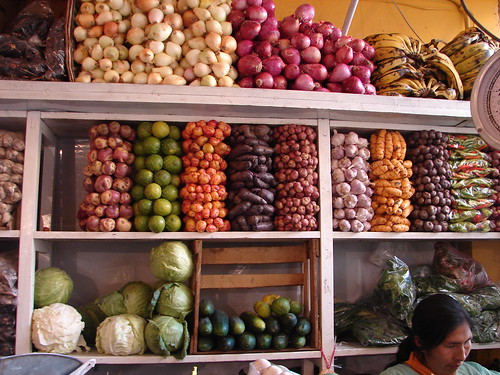
The potato is already the world's third most-important food crop after wheat and rice. Corn, which is widely planted, is mainly used for animal feed. Though most Americans associate potatoes with the bland Idaho variety, they actually come in some 5,000 types. Peru is sending thousands of seeds this year to the Doomsday Vault near the Arctic Circle, contributing to a gene bank for food crops that was set up in case of a global disaster.

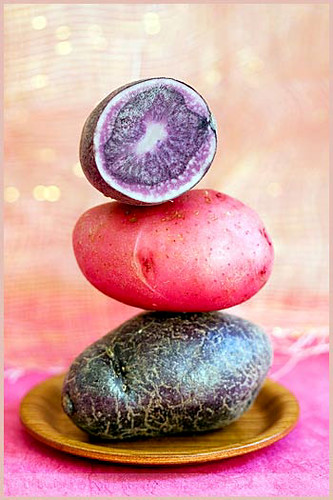
With colors ranging from alabaster-white to bright yellow and deep purple and countless shapes, textures, and sizes, potatoes offer inventive chefs a chance to create new, eye-catching plates.


Bart at Energy Bulletin commented :

I recall that potatoes do well on energy returned on energy invested (EROEI) - calories of food required to produce a calorie of food value. My wife delights in quoting her high school nutrition teacher: "Our much-maligned friend, the potato." It looks as if she was right

More at The Independent - Let Them Eat Spuds.
When the order came down from the top brass of Bangladesh's armed forces it sounded like a joke. Some of the soldiers and sailors who were told that from now on their daily rations would include increased servings of potatoes almost certainly did not take it seriously either.

But in a country where rice is overwhelmingly the staple dish, this was no laughing matter. With Bangladesh and the rest of Asia gripped by a rice crisis that has sent governments into panic, last Friday's announcement by the military that it was turning to the potato to supplement its troops' rations was for real. "The daily food menu now includes 125g of potato for each soldier irrespective of ranks," it said.

But it is not just in Bangladesh that the humble spud is being turned to for help. With world food prices soaring and with riots breaking out everywhere from Egypt to Indonesia, experts believe that increased use of potatoes could provide at least part of the solution. Easy to grow, quick to mature, requiring little water and with yields two to four times greater than that of wheat or rice, the potato is being cultivated more in an effort to ensure food security, agronomists say. ...

The potato was first cultivated 7,000 years ago by the Incas in Peru and the name is thought to have derived from the Indian word batata. The Incas revered them and buried them with their dead. Spanish conquistadors in search of gold discovered the vegetables in Peru in 1532. They used them on their ships to prevent scurvy. It was not long before farmers in the Basque region began to grow them and the potato spread across Europe throughout the 16th and 17th centuries. It wasn't a smooth path, however. Most people knew more of the potato's disadvantages – the crop hails from the same family as deadly nightshade – than they did of its considerable benefits. The Orthodox Church in Russia rejected it outright as it was not mentioned in the Bible. Potatoes arrived in England towards the end of the 16th century. Although popular legend has it that Sir Walter Raleigh introduced the crop to England, it is more likely that English pirates stole it as booty from Spanish ships. The nutritious vegetable caused a population explosion in Europe, especially in Ireland. But the failure of the Irish crop in 1845 led to a devastating famine. In 1995, the potato became the first vegetable to be grown in space.
More grain exports halted  

Posted by Big Gav in , , , ,

The Globe And Mail reports that Kazahkstan and Indonesia have become the latest countries to join the grain export ban bandwagon.

Some of the world's biggest grain exporters barred their farmers from selling in global markets yesterday, exacerbating the food price crisis for poorer nations that import their food and highlighting the failure of governments to nurture stronger rules for agricultural trade.

Rice and corn prices soared to records on U.S. markets and wheat jumped to its highest in a week after Kazakhstan, the world's fifth-largest wheat exporter, and Indonesia, a major rice producer, became the latest nations to impose export bans. The price increases further inflated global food costs that already had surged 48 per cent since the end of 2006.

The latest moves highlight the difficulty of solving a problem that has its roots in years of trade policy indecision, the push by richer nations to produce more fuel from food crops, growing demand from developing countries such as China, and Wall Street investors who see a money-making opportunity in surging commodity demand.

"Business as usual is no longer an option," Paris-based UNESCO says in a sweeping report on the world agriculture system that was three years in the making and released yesterday. "There is a recognition that the mounting crisis in food security is of a different complexity and potentially different magnitude than the one of the 1960s."

Kazakhstan and Indonesia are trying to put a lid on food inflation to avoid the riots that have beset countries such as Egypt and Haiti.

While their policies may ease tensions at home, they threaten to make things worse for poorer countries that don't have the luxury of good agricultural land and temperate climates to feed their populations.

Cryptgon has a post on one crop that isn't part of the price spiral - potatoes - "As Other Staples Soar, Potatoes Break New Ground".
There’s one sentence in the article below that I’d like to highlight:
One factor helping the potato remain affordable is the fact that unlike wheat, it is not a global commodity, so it has not attracted speculative professional investment.

If you don’t understand why that sentence is so important, please see, CBOT Resembles Carnival Act as Billion Dollar Black Box Operators Move In.

Anyone concerned with food security should be growing their own potatoes. We grow our own and and they’re delicious.

Beware, though, because the Satanic FrankenpHood Cult is hard at work trying to wreck things for profit, or worse. BASF—split off from IG Farben, a company that was involved with the Third Reich’s human extermination industries—is developing GE potatoes.

Have a nice day.

Via: Reuters:

As wheat and rice prices surge, the humble potato — long derided as a boring tuber prone to making you fat — is being rediscovered as a nutritious crop that could cheaply feed an increasingly hungry world.

Potatoes, which are native to Peru, can be grown at almost any elevation or climate: from the barren, frigid slopes of the Andes Mountains to the tropical flatlands of Asia. They require very little water, mature in as little as 50 days, and can yield between two and four times more food per hectare than wheat or rice.

“The shocks to the food supply are very real and that means we could potentially be moving into a reality where there is not enough food to feed the world,” said Pamela Anderson, director of the International Potato Center in Lima (CIP), a non-profit scientific group researching the potato family to promote food security.

Like others, she says the potato is part of the solution.

The potato has potential as an antidote to hunger caused by higher food prices, a population that is growing by one billion people each decade, climbing costs for fertilizer and diesel, and more cropland being sown for biofuel production.

Statistics

Locations of visitors to this page

blogspot visitor
Stat Counter

Total Pageviews

Ads

Books

Followers

Blog Archive

Labels

australia (619) global warming (423) solar power (397) peak oil (355) renewable energy (302) electric vehicles (250) wind power (194) ocean energy (165) csp (159) solar thermal power (145) geothermal energy (144) energy storage (142) smart grids (140) oil (139) solar pv (138) tidal power (137) coal seam gas (131) nuclear power (129) china (120) lng (117) iraq (113) geothermal power (112) green buildings (110) natural gas (110) agriculture (91) oil price (80) biofuel (78) wave power (73) smart meters (72) coal (70) uk (69) electricity grid (67) energy efficiency (64) google (58) internet (50) surveillance (50) bicycle (49) big brother (49) shale gas (49) food prices (48) tesla (46) thin film solar (42) biomimicry (40) canada (40) scotland (38) ocean power (37) politics (37) shale oil (37) new zealand (35) air transport (34) algae (34) water (34) arctic ice (33) concentrating solar power (33) saudi arabia (33) queensland (32) california (31) credit crunch (31) bioplastic (30) offshore wind power (30) population (30) cogeneration (28) geoengineering (28) batteries (26) drought (26) resource wars (26) woodside (26) censorship (25) cleantech (25) bruce sterling (24) ctl (23) limits to growth (23) carbon tax (22) economics (22) exxon (22) lithium (22) buckminster fuller (21) distributed manufacturing (21) iraq oil law (21) coal to liquids (20) indonesia (20) origin energy (20) brightsource (19) rail transport (19) ultracapacitor (19) santos (18) ausra (17) collapse (17) electric bikes (17) michael klare (17) atlantis (16) cellulosic ethanol (16) iceland (16) lithium ion batteries (16) mapping (16) ucg (16) bees (15) concentrating solar thermal power (15) ethanol (15) geodynamics (15) psychology (15) al gore (14) brazil (14) bucky fuller (14) carbon emissions (14) fertiliser (14) matthew simmons (14) ambient energy (13) biodiesel (13) investment (13) kenya (13) public transport (13) big oil (12) biochar (12) chile (12) cities (12) desertec (12) internet of things (12) otec (12) texas (12) victoria (12) antarctica (11) cradle to cradle (11) energy policy (11) hybrid car (11) terra preta (11) tinfoil (11) toyota (11) amory lovins (10) fabber (10) gazprom (10) goldman sachs (10) gtl (10) severn estuary (10) volt (10) afghanistan (9) alaska (9) biomass (9) carbon trading (9) distributed generation (9) esolar (9) four day week (9) fuel cells (9) jeremy leggett (9) methane hydrates (9) pge (9) sweden (9) arrow energy (8) bolivia (8) eroei (8) fish (8) floating offshore wind power (8) guerilla gardening (8) linc energy (8) methane (8) nanosolar (8) natural gas pipelines (8) pentland firth (8) saul griffith (8) stirling engine (8) us elections (8) western australia (8) airborne wind turbines (7) bloom energy (7) boeing (7) chp (7) climategate (7) copenhagen (7) scenario planning (7) vinod khosla (7) apocaphilia (6) ceramic fuel cells (6) cigs (6) futurism (6) jatropha (6) nigeria (6) ocean acidification (6) relocalisation (6) somalia (6) t boone pickens (6) local currencies (5) space based solar power (5) varanus island (5) garbage (4) global energy grid (4) kevin kelly (4) low temperature geothermal power (4) oled (4) tim flannery (4) v2g (4) club of rome (3) norman borlaug (2) peak oil portfolio (1)