Technology Review has an article on advances in solar cells made from nanowires.
Researchers at Harvard University have made solar cells that are a small fraction of the width of a human hair. The cells, each made from a single nanowire just 300 nanometers wide, could be useful for powering tiny sensors or robots for environmental monitoring or military applications. What's more, the basic design of the solar cells could be useful in large-scale power production, potentially lowering the cost of generating electricity from the sun.
Each of the new solar cells is a nanowire with a core of crystalline silicon and several concentric layers of silicon with different electronic properties. These layers perform the same functions that the semiconductor layers in conventional solar cells do, absorbing light and capturing electrons to create electricity. To make the cells, Charles Lieber, a professor of chemistry at Harvard University, modified methods he'd previously used to make nanowires that could serve as sensors or transistors. He then demonstrated that his solar cells can power two of his earlier nanowire devices, a pH sensor and a set of transistors.
"This paper provides the very first example of using a single silicon nanowire for harvesting solar energy," says Zhong Lin Wang, professor of materials science and engineering at Georgia Tech. He calls Lieber's work "breakthrough research in the field of nanotechnology."
At first, the nanowire solar cells will most likely be useful in niche applications where their small size is key, such as extremely small sensors, or robots whose sensors and electronics might benefit from an integrated power source. "There has been a lot of talk recently about making independent nanomachines and nanosystems," says Phaedon Avouris, a fellow at IBM Research. "The issue has always been, how are you going to power them? If you want to have an independent nanosystem that's self-contained, that's not plugged into a central power supply, then you need something like this."
The ultimate goal would be to build electronic components that can self-assemble into devices that might not be possible to make otherwise. (Lieber has shown that it's possible to make such components from nanowires, which can then be assembled into regular arrays in solution.) "We'd like to incorporate memory, a nanoprocessor, maybe a sensor, and a power source to drive that," Lieber says. "If you try to put together all of these pieces with conventional technology, it gets pretty cumbersome."
In addition to powering tiny machines, solar cells made from microscopic wires might eventually be bundled together into large arrays to replace conventional rooftop solar panels. Lieber's research is still at an early stage, but his new nanowires suggest that a theoretical solar cell proposed by researchers at the California Institute of Technology could be viable. Harry Atwater, a professor of applied physics and materials science at Caltech, and Nathan Lewis, a professor of chemistry there, have suggested that solar cells made of microscopic wires would be much cheaper than conventional solar cells, since they could be made from less expensive materials--including, Lewis says, rust.
Transmaterial has a post on
Light-Emitting Roof Tiles.
The roof has historically focused on one primary function: keeping out the elements. New technologies, as present in Light-Emitting Roof Tiles, allow the integration of additional functions within roof surfaces. Manufactured by Lambert Kamps, the transparent roof tiles are integrated light-emitting diodes (LEDs) and designed to display text, pictures, and other graphical content in multiple colors. Information may also be animated, such as with an illuminated news trailer. Light-Emitting Roof Tiles also come with their own self-supporting solar-photovoltaic power system.
AFP reports that a German University has won the
solar decathlon competition - "
Germans win international competition to design solar house".
A German university team was named on Friday the winner of the 2007 Solar Decathlon, a competition to design, build and run the most attractive and energy-efficient solar-powered home. "I want to congratulate this year's Solar Decathlon champion, Technische Universitaet Darmstadt, and the 19 other teams for their innovative designs and application of solar technologies," US Energy Secretary Samuel Bodman said at the awards ceremony in Washington, where the decathlon began last week.
Teams from universities in Canada, Germany, Puerto Rico, Spain and the United States took part in the competition, which, like the sports version of the decathlon, consists of 10 categories. "It was a close race with the University of Maryland, which also built a beautiful house, with very good architecture and a good system," Barbara Gehrung, the German team's spokeswoman, told AFP.
Teams in the competition erected their energy-efficient homes, powered exclusively by the sun, on the National Mall in Washington, in the shadow of the White House. The homes were open to the public for the duration of the competition. They were judged on whether they maintained a comfortable temperature, had adequate lighting, sufficient power for household appliances and home electronics, and hot water -- all produced using solar energy. The houses also had to power an electric vehicle.
"We'll keep from this experience the fact that solar energy works," Gehrung said. "We have proved that we can live better in the future without fossil fuels. We can, if we work together internationally, achieve something."
Inhabitat has a post on the runner up entry from Maryland - "
LEAFHOUSE: Maryland’s Solar Decathlon Zero Energy Home".
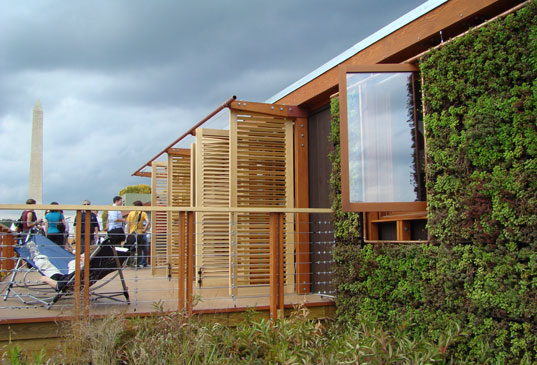
The second place winner of this year’s Solar Decathlon is the University of Maryland’s Leaf House, which is, as the name would imply, green, naturally inspired, and modular to boot. When designing the zero energy home, the student team drew inspiration from the simple, yet vastly complex leaf. The abode boasts every sustainable system from the obvious high-tech solar panels to a liquid desiccant waterfall to control humidity, grey water recycling, green wall, and even a plug to charge an electric car.
In concept, the Leaf House hoped to meet goals like creating an open and flexible space, connecting to the landscape, material responsibility and durability, and energy efficiency. The team addressed the need for transformability in today’s housing using a series of movable, translucent panels that transform a small house into a large space. The modular approach lends itself to both easily housing the green systems as well as constant flexibility of space.
The photovoltaic system which spans the entire sloped roof provides 100% of the electrical energy to the home and solar hot water tubes, and is all monitored by the adaptive control energy monitor system. The most innovative feature of the Maryland house may be the indoor waterfall—a liquid desiccant wall system that’s used to control humidity. As far as the team knows, such a system has never been used for a home. A grey water system also helps the recycling, filtering, and storage of water.
The weekend SMH had a pair of article on the interaction between grain production, drought and biofuel and the resulting impact on food prices - "
Energy boost may come a cropper" and "
Rising grain prices put a dent in fuel revolution".
Biofuels are not necessarily an easy fix to the energy crisis.
This year tens of thousands of Mexicans took to the streets to protest that the cost of tortillas, their national staple, had doubled. The reason? Local farmers were shipping their corn to the US to be made into ethanol. Generous government subsidies for the green fuel were ensuring higher prices for the crops.
The tortilla demonstrations were a stark illustration of the global battle brewing between food and energy producers for crops. Made from crops such as corn, sugar or grain rather than crude oil, biofuels have been embraced for their potential to cut greenhouse emissions and protect energy security, while delivering cheaper petrol in an era of soaring oil prices.
But there is mounting concern that the biofuel industry's burgeoning demand for food crops will create profound shifts in world agricultural markets. The food v fuel debate, as it is known, is gaining momentum in Australia, as governments move to regulate the ethanol content in petrol at a time when the prolonged drought has already pushed crop prices to record highs.
David Lamb from the CSIRO estimates Australia could produce three-quarters of its fuel needs domestically from food crops, "but we'd have to stop eating and tear up our exports". He predicts a future where land and water resources are increasingly contested between food, energy, fibre and conservation needs.
The Organisation for Economic Co-operation and Development has warned that any diversion of land from food or feed production to energy production will inflate food prices as supplies are cut. "The rapid growth of the biofuels industry is likely to keep these prices high and rising throughout at least the next decade," it said in a report - titled Biofuels: Is the Cure Worse Than The Disease? - released last month.
These warnings were echoed by Charles Coventry from Graincorp at a recent ethanol conference in Brisbane. "Linking agricultural land to the price of energy is a radical change in the way grain markets work," he said. "We'll see an increase in food prices, which will bring the issue of food security back to the table."
The OECD report suggested, somewhat ironically, that the growth of the biofuels industry also could be to the detriment of the environment. "There will be powerful incentives to replace natural ecosystems such as forests, wetlands and pasture land with dedicated bio-energy crops." This is a particular risk in Australia, where the availability of suitable land is limited.
As the drought continues to suck the life out of local crops, many Australian grain buyers oppose regulating the ethanol content in fuel, or any form of government subsidy for the industry, arguing that this will simply force crop prices up even further. Coventry says the drought has slashed production of wheat, sorghum and barley by more than half on the eastern seaboard. Meanwhile, the global price of wheat has risen 60 per cent in the past year, and it peaked at a record $492 a tonne on the Australian Stock Exchange last month.
"Mandated ethanol production is going to magnify price pressures," the executive director of the Australian Lot Feeders' Association, Helen Murray, told the ethanol conference in Brisbane. "It would effectively be adding to the drought."

Think Progress has a classic video clip of Iraqi National Security Adviser delivering a
‘Big fat no’ to US bases in Iraq.
The Iraqi government has “put the U.S. on notice” that they do not want permanent U.S. bases in Iraq, CNN reports today. The message was “delivered directly to Vice President Dick Cheney at the White House” by Iraqi National Security Adviser Mowaffak Al-Rubaie, who told CNN that Iraqis say, “No, big fat no, N-O for the bases in Iraq”:
The people of Iraq, the parliament, the council of representatives and the government of Iraq, they all say no, big fat no, N-O for the bases in Iraq. No military bases for Iraq because we believe that is in direct encroachment to our soveriegnty, and we don’t need it.
As one commenter noted:
WTF! How dare these ingrates say we can’t have full run of their country. They won’t sign over their oil, they won’t let us keep Darth’s Mercenary Scumbags stay and kill at will, now they won’t let us use their country for a terrestrial aircraft carrier.
Links:
* Forrester -
Creating The Green IT Action Plan* Technology Review -
A New Nanogenerator: Researchers are experimenting with a novel nanowire material to power tiny biosensors and portable devices* NewsWise -
Researchers Develop Wireless Bridge Sensors Without Batteries.
* Sustainable Is Good -
Target Mirel Bioplastic Gift Card Pictures* Core 77 -
Connecting '07: Paul Saffo, Dunne + Raby, Janine Benyus* Biomimicry News -
Mimicking Mussel Proteins, Scientists Develop Super-Adhesive from Dopamine* Globe And Mail -
Canadian Investors slowly warming to clean tech* Renewable Energy Access -
Solar Hot Water Set To Go Mainstream with California's AB 1470* Clean Break -
Solar thermal as art* Clean Break -
Electrovaya shares rocket as battery JV revealed in India* Technology Review -
Measuring the Polar Meltdown* AP -
Rising seas threaten 21 mega-cities* Energy Bulletin -
Drought and water wars* The Oil Drum ANZ -
Drumbeat Down Under - Sunday 21 October 2007* The Guardian -
Steep decline in oil production brings risk of war and unrest, says new study* Jerome A Paris -
Countdown to $100 oil (49) - peak oil and libertarians* CNN -
Houston's Cancer Canal* AlterNet -
Bioneers: Groundbreaking Ways to Repair the Earth. "It's all connected. Because the world will always be changing, the ultimate goal is not stability but some sense of dynamic equilibrium. Businesses and governments use something called scenario planning, where they try to envision different scenarios for how the future might unfold so that they can anticipate how to respond. We're going to have a session at the conference with one of the leading lights in that field, Peter Schwartz of Global Business Network. The premise of Peter's book, Inevitable Surprises, is that if you're paying attention, things should not come entirely as surprises."
* Grist -
Chris Dodd on the Record* Glenn Greenwald -
Majority Leader Harry Reid -- in violation of all Senate customs and rules -- intends to ignore the "hold" placed on the FISA bill by Chris Dodd. Spineless clearly isn't the right word for Reid.
* Talking Points Memo -
Chris Dodd Will Filibuster Telecom Immunity Bill If Reid Brings It To Vote



 Posts
Posts