Showing posts with label power. Show all posts

Power Falling From The Sky  

Posted by Big Gav in ,

Plenty Magazine has an article on harvesting power from raindrops - not a large scale power source of course, but suitable for powering sensors and other small devices.

Scientists from Europe’s Atomic Energy Commission, in Grenoble, France, have shown that vibrations from raindrops landing on a certain type of plastic can generate enough energy to operate some low-power wireless sensors, like battery-powered outdoor thermometers. But the results, published in the February issue of the journal Smart Materials and Structures, could do much more than save you the inconvenience of replacing a drained battery in your outdoor thermometer. The findings could help improve networks of wireless sensors that measure conditions like temperature, pressure, or the presence of pollutants. By continually monitoring the environment, these networks provide early warning systems for dangerous air quality, severe storms, or disease outbreaks. Networks that exist now use batteries that require annual replacement. To be completely reliable—not to mention sustainable—sensor networks would have to power themselves.

To address this shortfall, researchers have focused their efforts on capturing and storing energy from the environment. For example, solar-powered sensors are sometimes connected to a battery that stockpiles power collected by the cells in the daytime. But solar cells only work on clear, sunny days. That’s why it’s essential to find more ways to match sensors to the environments they monitor. “People think of light and wind when they think of free energy,” says Jean-Jacques Chaillout, one of the paper’s authors. “But there is much more out there. There is no one answer for powering sensors.”

To make electricity in rainy locales, Chaillout’s team is using a piezoelectric material—in this case, a plastic—that translates mechanical energy from the impact of the raindrop into electric energy that powers a sensor. During a rainstorm, the material dribbles electrical energy to a battery, storing it for later use. The scientists examined raindrops that range in diameter from a 1-millimeter drizzle to the 5-millimeter drops dumped in a downpour. Their experiments suggest they can collect up to 12.5 milliwatts of instantaneous power from one large droplet; you’d need nearly 5,000 of these drops to light up a 60-watt bulb, but the sensors require only a fraction of that power.

Piezoelectric sensors are already in use. Some cars use them to trigger airbags. Other devices capture vibrational energy from ocean waves and humans—including backpack-wearers, people pushing turnstiles, and pedestrians climbing stairs.

The Power Of Osmosis  

Posted by Big Gav in , ,

The Guardian has an interesting article on a very unusual alternative energy source - capturing the energy released when salt water and fresh water mix, known as "pressure-retarded osmosis" - "Salt could shake up world energy supply". While the chances of this being implemented on a large scale seem remote (and the environmental consequences potentially large), the numbers mentioned are quite impressive.

More background can be found at the ABC, Renewable Energy World, Exergy and Forbes.

Only up to powering light bulbs so far, "salt power" is a tantalising if distant prospect as high oil prices make alternative energy sources look more economical.

Two tiny projects to mix sea and river water -- one by the fjord south of Oslo, the other at a Dutch seaside lake -- are due on stream this year and may point to a new source of clean energy in estuaries from the Mississippi to the Yangtze.

The experiments, which seek to capture the energy released when fresh and salt water are mixed, build on knowledge that has been around for centuries -- in one case imitating the process of osmosis used by trees to suck water from their roots.

Although they are far from being economically viable, if eventually successful they might help a long-term quest to diversify away from fossil fuels such as coal and oil, widely blamed for stoking global warming.

"We might well be able to find new promising solutions such as generating power naturally from osmotic forces occurring when salt and fresh water are mixing," Norwegian deputy Energy Minister Liv Monica Stubholt said in a speech earlier this month. ...

The science at the heart of the projects is the fact that when salt and fresh water mix at river mouths, they are typically warmed by 0.1 degree Celsius (0.2 Fahrenheit). Dutch scientists say such energy at all the world's estuaries is equivalent to 20 percent of world electricity demand.

The plants may support hopes the technology can overcome hurdles, the most significant of which is poor cost-effectiveness of the membranes used in the process.

In Norway, power group Statkraft, which says it is Europe's top producer of hydro and wind energy alongside Electricite de France, is building a test plant costing $20 million. "Ours will be the world's first saline power plant based on osmosis," said Stein Erik Skilhagen of the state-owned company. The plant, at Tofte on the Oslo fjord, will have output of up to about 5 kilowatts -- enough to run household appliances such as washing machines or heaters or a few dozen lightbulbs.

The Dutch Centre for Sustainable Water Technology (Wetsus) will also in three to four months start a pilot "blue power" test at IJsselmeer in the Netherlands, from where water flows into the sea. "At the start, it will be on the scale of 100 watts...but we aim at this salt factory to obtain 1-5 kilowatts within one year," said Jan Post, a researcher at Wetsus.

The Norwegian and Dutch plants use different systems but both depend on membranes placed between the salt and fresh water, which are currently prohibitively expensive and highly energy-intensive to produce. "The Achilles' heel for this process is that there is no commercial membrane," said Menachim Elimelech, a professor of chemical and environmental engineering at Yale University in the United States. "It's not even close to being economical."

The membranes are similar to, but thinner, than those used at many desalination plants, when sea water is pressed against membranes that allow only fresh water through in a process known as reverse osmosis.

Makers of membranes such as General Electric, Dow Chemical, Hydranautics or Japan's Toray Industries focus most on membrane technology for desalination -- a market growing by about 15 percent a year worldwide.

Ellen Mellody of GE Infrastructure, Water and Process Technology said the company has "an aspirational goal" of producing fresh water from salt through membranes at a cost of 10 cents per cubic metre, down from 70 cents to a dollar. Asked about prospects for a separate market for power-generating membranes, she saw one "potentially, but not for about 5-10 years".

The Norwegian project will include 2,000 square metres (21,530 sq ft) of plastic membranes, through which fresh water will be sucked into salt water by osmosis.
Osmosis' power was shown in 1748 when French physicist Jean-Antoine Nollet put a pig's bladder filled with alcohol in a trough of water. The bladder swelled and burst -- the more concentrated liquid draws pure water into it.

At Tofte, the power exerted by salt water sucking in fresh water is equivalent to water falling 270 metres in a waterfall. The only emissions are brackish water.
Unlike the osmosis of the Norwegian system, the Dutch scheme captures salt particles which give off electrical currents.

Yale's Elimelech said a full scale plant would demand membranes covering perhaps 100 acres (40 hectares), at risk of damage by pollutants dissolved in the river or the sea. Also, filters have to be in place to avoid sucking in fish and there are environmental concerns about drawing water away from estuaries, perhaps threatening plants and creatures in the area.

"The membrane is the challenge," agreed Skilhagen. "In tests we have come over three watts per square metre (of membrane), but we have to reach five. When we do that it will be industrially interesting."

The Dutch project is close to producing two watts per square metre of membrane. "In theory, both techniques use the same energy source and you could in theory get the same amount of energy out," said Sybrand Metz, project leader at Wetsus.

The Dutch government, utility Eneco and Redstack research group are also making a feasibility study of a plant on the Afsluitdijk dam between the IJsselmeer and the Wadden Sea, with a 10-50 kilowatt installation to be built that could lead to a 200 megawatt capacity if it works.

"Membrane-based technologies are voracious energy consumers," said France's Veolia, which runs huge desalination plants. It wants to cut energy consumption of membrane desalination by 80 percent over 15 years.

Hydro-Kinetic Power Systems  

Posted by Big Gav in , , , ,

Adam Siegel at Energy Smart has a post on hydro-kinetic power generation (putting turbines directly into a river, in similar fashion to tidal and ocean current generation) - "A quick fix to up hydro power globally?".

In the United States, traditional hydropower (dams) provides roughly 10% of the electricity. Traditional hydro plants, in many cases, are century+ old with embedded technology that is far from 21st century in terms of productivity for every gallon that passes by. Thus, opportunities exist for taking existing hydropower facilities and making them more productive with the existing water resources. And, there are literally 1000s of dams and spillways across the country that do not have existing electricity production. But, modernization operations can cost millions and take years to go through regulatory processes to seek to minimize environmental impacts (or, in the case of old facilities, perhaps to reduce environmental impact). The hydro industry often comments that the hydro regulatory process is more difficult than nuclear power’s.

Is there, however, an opportunity for getting a quick 3-7% increase at existing hydropower facilities and to put electricity production at some non-power producing dam sites with a far easier regulatory process, low per kilowatt installation costs (with, then, near free fuel), and do so quickly? Until yesterday, at WIREC, the options didn’t really seem apparent. Now, however, my head is whirling with the possibilities.

Hyrdo Green Energy has developed a hydro-kinetic power system that can be placed in-stream for generating power, for example, along rivers without the massive installation requirements of a dam and, thus, minimal implications on the river’s natural flow. Their approach got some attention a couple years ago and seemed quite Energy COOL at the time. They mount their system on a barge, lowering the turbine into the water, rather than building from the river bottom (or damning the river), and generate power from the river’s current. The barge enables moving the system (as it makes sense or is required) and also provides a platform for any required maintenance. Hmm. This looked of real interest as a way to quickly establish power generation on rivers around the world at relatively low cost and in a distributed fashion.

A specific application of their technology, one that they are actively pursuing for a test program in Minnesota, seems potentially quite valuable as some Silver Dust to help change the energy equation. Rather than putting the system somewhere on a river, for example, independent of existing infrastructure, Hydro Green will be putting one of their systems in the spillway of an existing dam. What are some of the benefits of this approach?

* It is reusing a resource, gaining more power from the water that has already generated power. This is a quick ‘boost’ to the plant’s energy efficiency.

* The dam has existing infrastructure (such as transformers, power lines) that can be used to move the power ‘to market’.

* Permitting processes are, as mentioned above, a real nightmare for hydro projects. As this is within a spillway, the licensing process is different, within the existing plant’s “capacity”, and thus lowering the cost/time for getting permitted. [Note: fast permitting isn’t necessarily “good”, but work through the negatives here. The only serious one (and it does matter) seems likely to be the potential impact on fish survivability for fish that have gone through the dam and are disoriented coming through the turbine. Thus, this merits better understanding and evaluation before this technology is deployed on a massive scale.]

* If it works (as promised), this is a quite fast way to increase clean power production from existing facilities with (it seems on the first blush) minimal (if any) environmental impact.

They will be testing the system at an existing 4.4 mw plant and expect to see about 200 kilowatts of addition production. This is a 5.7% increase in the dam’s productivity.

Hmmm …. Multiple 5.7% by 95,000 megawatts and we’re talking some real power generation. Could Hydro Green (or similar) technology provide a path for 5+ gigawatts of additional green power over, let’s say, the next decade. (And, by the way, in a ‘mind spinning’ fasion, there is the consideration of what the implications for this technology would be for pumped hydro storage, which is generally discussed at 80-90% efficiency. Adding 5.7% more to that efficiency potentially helps make the wind/pumped hydro storage combination even more effective for displacing coal-fired electricity.) This isn’t a Silver Bullet to solve Global Warming and keep coal in the ground, but it is some nice Silver Dust to add to the pile for holistic solutions.

Turning Glare Into Watts  

Posted by Big Gav in , ,

The New York Times has an article on solar thermal power (via Grist) - part of their Back to the future series.

At first, as he adjusted pumps and checked temperatures, Aaron Boucher looked like any technician in the control room of an electrical plant. Then he rushed to the window and scanned the sky, to check his fuel supply. Especially in areas of intense sun, an array of reflectors can concentrate sunlight, heating a fluid to create steam and power. Mr. Boucher was battling clouds, timing the operations of his power plant to get the most out of patchy sunshine. It is a skill that may soon be in greater demand, for the world appears to be on the verge of a boom in a little-known but promising type of solar power.

It is not the kind that features shiny panels bolted to the roofs of houses. This type involves covering acres of desert with mirrors that focus intense sunlight on a fluid, heating it enough to make steam. The steam turns a turbine and generates electricity. The technology is not new, but it is suddenly in high demand. As prices rise for fossil fuels and worries grow about their contribution to global warming, solar thermal plants are being viewed as a renewable power source with huge potential.

After a decade of no activity, two prototype solar thermal plants were recently opened in the United States, with a capacity that could power several big hotels, neon included, on the Las Vegas Strip, about 20 miles north of here. Another 10 power plants are in advanced planning in California, Arizona and Nevada. On sunny afternoons, those 10 plants would produce as much electricity as three nuclear reactors, but they can be built in as little as two years, compared with a decade or longer for a nuclear plant. Some of the new plants will feature systems that allow them to store heat and generate electricity for hours after sunset.

Aside from the ones in the United States, eight plants are under construction in Spain, Algeria and Morocco. Another nine projects are in various stages of planning in those countries as well as Israel, Mexico, China, South Africa and Egypt, according to a count kept by Frederick H. Morse, formerly in charge of solar energy at the Energy Department and now a consultant.

Mr. Morse and others say that solar thermal plants could meet most of the galloping growth in power demand in Phoenix, Las Vegas and the rest of the southwestern United States. In fact, experts say enough sunshine hits the deserts of the Southwest that such plants could theoretically power the entire United States. But that is a far-off dream, since it would require big new transmission cables. The workability of solar thermal power was established in the 1980s, when developers in California built a series of plants in the Mojave Desert, eventually reaching 354 megawatts of capacity.

The California plants grew more sophisticated and costs shrank as the project progressed. But then the price of a competing fuel, natural gas, collapsed in the 1990s and building new solar plants became uneconomic. Today, natural gas prices are much higher, and political opposition is rising to construction of new coal-burning power plants. Many states, including California, are imposing mandates for renewable energy. All of that is reviving interest in solar thermal plants.

The power they produce is still relatively expensive. Industry experts say the plant here produces power at a cost per kilowatt- hour of 15 to 20 cents. With a little more experience and some economies of scale, that could fall to about 10 cents, according to a recent report by Emerging Energy Research, a consulting firm in Cambridge, Mass. Newly built coal-fired plants are expected to produce power at about 7 cents per kilowatt-hour or more if carbon is taxed. ...

Still, solar plants do tend to produce peak power during the hottest part of the day, when demand is highest and electricity is costly, so at certain times they are already competitive with plants using natural gas. And they have an advantage over the other widely available form of renewable power, wind turbines: they are more predictable.

With California utilities struggling to meet a state quota of 20 percent renewable power by 2010, the state has grown interested in solar plants. Pacific Gas and Electric has committed to building several plants and is expected to make announcements about new solar plants soon.

Coalition goes cool on nuclear energy plants  

Posted by Big Gav in , ,

The Age reports that the Australian opposition has decided to jettison one of their many unpopular policies that helped them lose the last election - abandoning support for nuclear power.

THE Federal Opposition has quietly ditched its support for a nuclear power industry in Australia. Environment spokesman Greg Hunt has told The Age: "In the next 40 years, I think there is a zero chance of a nuclear power industry in Australia." Mr Hunt said the Coalition's policy was changed at a shadow cabinet meeting in December, although no statement was issued at the time.

The new policy does not explicitly oppose nuclear-generated electricity, but goes close. The Coalition will no longer advocate nuclear power, recognising that its introduction would only be possible with bipartisan political support and widespread community support. The decision represents an abrupt departure from the policy the Howard government took to last November's election. In the year before the poll, then prime minister John Howard repeatedly stated that nuclear must be one of the options considered as part of Australia's future energy mix.

Tapping The Source: The Power Of The Oceans  

Posted by Big Gav in , , , , , ,

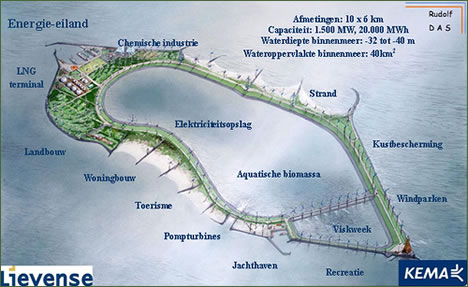
Last year I came across the story of Dutch company Kema and their energy island idea - basically a variant on the usual pumped hydro energy storage concept where water is pumped out of a space below sea level then allowed to flow back in, generating power as it does. The "island" uses wind power to pump water out of the enclosed area. An obvious extension to this idea would be to harness ocean energy as well - letting wave and/or tidal power supplement the output of the wind turbines. An attraction of this concept is that it potentially allows a large amount of new energy storage to be brought online - and this storage would be along the world's coastlines, where most of the population lives.


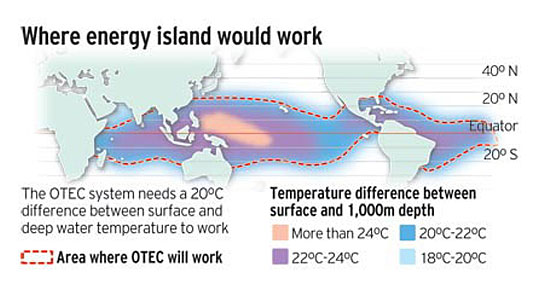
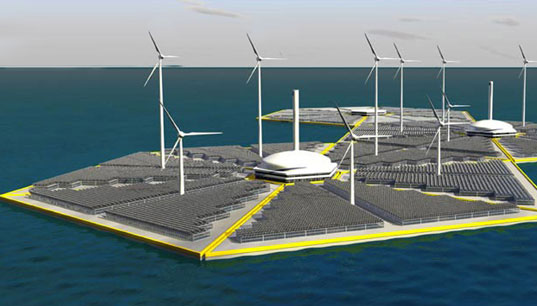
Another form of energy island has been in the news recently, this one a substantially more ambitious proposal which envisions artificial islands to collect wind, wave, ocean current and solar power in the tropics, along with a more unusual energy source - harnessing the difference in water temperatures between the warm surface and the cold depths using a technique called OTEC (Ocean Thermal Energy Conversion). These islands are being proposed by architects Dominic Michaelis and his son Alex Michaelin as a response to Richard Branson’s Virgin Earth Challenge, which offers $25 million in prizes for innovative solutions for combating global warming.


While the practicality of these particular proposals has yet to be put to the test, the various forms of ocean power are probably the most overlooked of the big 6 renewable energy sources (along with solar, wind, geothermal, biomass and hydro).

Other forms of renewable energy are sometimes criticised for being more intermittent and less predictable than traditional power generation, however ocean energy is much more reliable - steady ocean currents could provide good baseload power, as could OTEC, tidal power is diurnal and highly predictable and waves are predictable days in advance.

In this post I'll have a look at the amount of energy that could potentially be harvested from these sources and the various projects underway to try and make this a reality.

Tidal and Ocean Current Power

Tidal power stations usually take the form of a dam (or barrage) built across a narrow bay or river mouth. As the tide flows in or out, it creates uneven water levels on either side of the barrier. The water flows through the barrier, turning turbines to generate electricity.

Benefits of tidal barrage power generation include :

* Predictable source of clean energy
* No dependence on foreign fuel sources
* Flood protection
* Transport links for road and/or rail
* Better shipping and boating conditions behind the barrier

Disadvantages include :

* The timing of the tides doesn't often correlate with peak demand times (less of a problem if there are good energy storage options available)
* Existing ecosystems behind the barrage tend to be heavily altered
* Likely to stimulate silting in some areas and coastal erosion in others
* Enhance flood risk on the seaward side
* Shipping would have to navigate locks
* Industrial discharges behind the barrage are less likely to be dispersed out to sea

Variations on this theme include offshore tidal lagoons, which use a water impoundment structure and low-head hydroelectric generating equipment on shallow tidal flats, and tidal fences, which are composed of a number of individual vertical axis turbines mounted within the fence structure, known as a caisson.

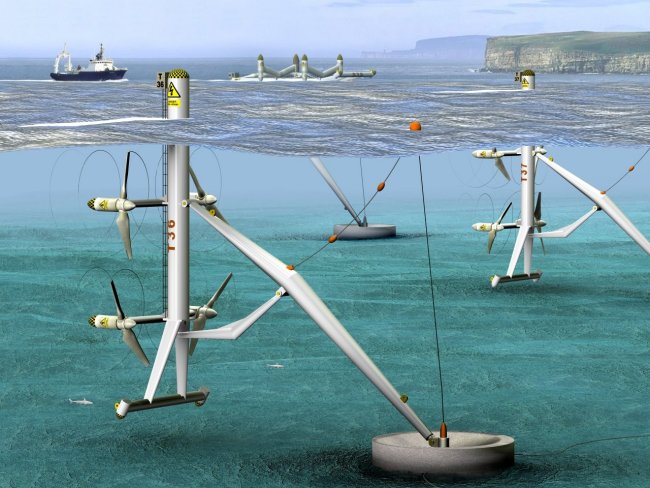
Underwater turbines can also be used to harness both tidal power and ocean current power. The turbines (sometimes called aquanators) are similar to wind turbines. In water moving between 6 and 9 km per hour, a 15 m diameter water turbine could generate as much energy as a 60 m diameter wind turbine. Given the smaller amount of infrastructure required and the larger range of possible sites that this technology could be deployed to, it seems likely that underwater turbines will become much more widespread than tidal barrage style generation.


World tidal energy resources have been estimated at around 3000 GW, however less than 3% of this is located in areas considered suitable for power generation (these figures probably don't include ocean current power, which doesn't seem to be well studied).

A 240 MW tidal-barrage power plant has been operating at La Rance in Brittany since 1966. Other operational barrage sites are at Annapolis Royal in Nova Scotia (18 MW), the Bay of Kislaya near Murmansk and at Jangxia Creek in the East China Sea.

The largest tides in the world are found in Canada's Bay of Fundy, which has been earmarked to become a 4-berth test site for tidal power generation next year.

On the west coast of Canada, Marine Current Turbine and BC Tidal Energy Corporation plan to install at least three 1.2 MW tidal energy turbines in Vancouver Island's Campbell River by 2009. This the first step in a plan to develop larger tidal farms off British Columbia's coast, which the company says have a tidal energy potential of up to 4,000 MW.

In the United States, at the southern end of the Bay of Fundy, lies Passamaquoddy Bay, which has long been a target for a tidal power development - first initiated in 1935 by the Public Works Administration under the Roosevelt administration, then halted by Congress a year later. John F Kennedy revived the 550 MW project in 1963, however the plan died with him (spawning one of the stranger JFK assassination conspiracy theories I have come across).

Further south, in the Martha's Vineyard area, two underwater turbine projects are trying to get started - one a 300 MW proposal from Oceana Energy Company and the other from Natural Currents Energy Services. Other projects are being considered in the Cape Cod and New Bedford areas - part of a "gold rush" for good tidal power sites (the most desirable ones usually have hourglass figures, to get maximum force in the incoming tide) which has seen the FERC issue 47 preliminary permits for ocean energy projects (and generated mainstream news coverage on the NBC network).

New York's East River is the location of one of the more high profile tidal power experiments currently underway, with Verdant Power experimenting with underwater turbines there. The first attempt eventually ended in failure, with the strong tides breaking the devices.

The Gulf Stream has also caught the eye of hopeful ocean energy companies, particularly in Florida, with the 30 mile wide current pushing 8.5 billion gallons of water along per second and prompting some observers to consider the prospect of "Infinite Underwater Energy".

Californian utility PG&E is also investigating tapping tidal power in San Francsico Bay, with some observers talking about a plant of up to 400 MW in size.

Another bay famous for its tides is the Severn river estuary in Britain, with a tidal range of 14 metres. Plans for damming the Severn estuary or Bristol channel have existed since the 19th century (with tidal power generation being just one proposed application). The UK government recently proposed a new barrage design, which could produce 5% of the UK's electricity requirements, with a peak rate of 8.6 GW. A feasibility study is expected to be complete by 2010. An alternative proposal, by Tidal Electric, involves a series of lagoons, the first of which would be built in Swansea Bay. Some observers have noted underwater turbines may be more appropriate than a barrage.

Pentland Firth in Scotland is another UK location that is considered to have a large amount of tidal power potential - a DTI study in 1993 indicated that if all potential sites were developed, the total UK tidal stream resource could be about 60 TWh. Of this, almost half (28 TWh) could come from the Pentland Firth. The water depth is 60m or more, making potential energy capture huge but technically difficult - 63% of the tidal stream resource is estimated to be in waters deeper than 40m.

Marine Current Turbines launched the world's first underwater turbine project off north Devon in 2003. MCT also began installing a 1.2 MW "SeaGen" tidal current turbine in Northern Ireland's Strangford Lough in 2007, with the company planning to scale up to build a 10MW tidal power farm off Anglesey in North Wales, and to have 500MW of tidal capacity by 2015. Also in Wales, Lunar Energy and Eon are hoping to build an underwater tidal project off Pembrokeshire.

Another UK tidal power proposal is part of a plan by Metrotidal to build a tunnel under the Thames, currently under fire from environmental groups. There is also talk about regions like the Isle Of Wight and the Humber estuary harnessing tidal power as part of initiatives to become energy self-sufficient (like other "Transition Towns").

Norway has also begun investigating the use of tidal power, with an experimental facility opening in Hammerfest in 2003. The company that developed that technology, Hammerfest Strøm, is working with Scottish Power to develop a project near the Orkney Islands (the islands have also been a test site for another venture by Lunar Energy and Rotech).

There has been no tidal power development in Australia thus far, though the Kimberly region has long been a target for would be developers of tidal power projects, due to its enormous potential (a tidal range of 11 metres). Thus far all of the proposed projects have been stymied by the remoteness of the location from the Western Australian and national electricity grids and by environmental concerns. A number of possible sites have been identified, including Secure Bay, Walcott Inlet, George Water and St. George's Basin.

Liberal backbencher Wilson "Ironbar" Tuckey has been the most vocal supporter of a Kimberly tidal project, pointing out if a link was built to the eastern states grid it would obviate the need for any consideration of nuclear power. Some Kimberly tidal power advocates have also tried to base the idea of a "hydrogen economy" on the resource, though this seems a lot more far-fetched than a grid link (the grid link could also potentially include large scale CSP solar in the western australian deserts, which are one of the best solar resources in the world) .

The Bass Strait area is also considered to have significant potential for tidal / ocean current power generation (one estimate claiming there is potential for 3000 MW of generation in the channel between King Island and Cape Otway).


New Zealand is another country with large tidal resources but without any existing tidal energy generation. According to TVNZ, there are at least 24 wave and tidal power projects currently under development. Trying to get a handle on who might be behind these projects isn't easy - there is an NZ wave and tidal power association, but it doesn't list members or projects - according to their latest newsletter they have 59 members. Crest Energy seems to be the most prominent local company, with a plan for a 200 MW plant in Kaipara Harbour using underwater turbines. Other potential locations include Manukau and Hokianga Harbours, and Tory Strait and French Pass in the Marlborough Sounds. The harbours produce 5 to 6-knot currents and tidal flows of 100,000 cu m a second from the flood and ebb tides, with tidal volumes 12 times greater than the flow in the largest local rivers.

The Phillipines is another potential location for tidal power, with a 2.2GW tidal fence proposed for the Dalupiri Passage using the Davis turbine, from the Blue Energy company and an estimated cost of $US 2.8 Billion is unfortunately on hold due to political instability.


South Korea also has ambitions to generate power from ocean currents, with pilot underwater turbines being installed at Uldolmok, in the country's south-west. Researchers at the Korea Ocean Research and Development Institute (KORDI) chose the site because it has flows up to 12 knots, believed to be among the fastest in Asia. The strong currents have resulted in a number of accidents, hampering progress. KORDI is also trying to improve the efficiency of more conventional barrage-type tidal power plants. The primary project involves building a power plant with a capacity of 250 MW at Lake Sihwa, with another plant up to 520 MW being considered for Garolim Bay.


Taiwan is another Asian nation considering the the possibility of large-scale ocean current power generation. There have been discussions about using the strong Kuroshio current off the east coast of Taiwan to generate up to 1.68 trillion kilowatt-hours per year (compared to Taiwan's current annual demand of electricity of around 98 billion kilowatt-hours).

Wave Power

Surface waves and pressure variations below the ocean's surface can be used by floating buoys or submerged platforms to generate intermittent power. Wave energy sources are widely available, are relatively consistent and predictable and (According to analysts Frost and Sullivan) have the highest energy density among all renewable energy sources. The best resource is found between 40-60 degrees of latitude where the available resource is 30 to 70 kW/m, with peaks of 100 kW/m. The potential global wave power potential has been estimated to be around 8,000-80,000TWh/y (1-10TW), which is the same order of magnitude as world electrical energy consumption.

The UK, for example, is estimated to possess the capacity to generate approximately 87 TWh of wave power per year - equivalent to almost 25 per cent of current UK demand. There are two main research centres in Europe focusing on the development and commercialisation of ocean energy technologies. The first is the European Marine Energy Centre located in Orkney, Scotland, which provides developers with sites to test their prototypes. The other is the Wave Energy Centre in Portugal.

Wave energy ideas are plentiful but real world examples are still rare - there are around 1000 patents for wave energy converters currently on the market and no consensus has emerged yet on which technologies will succeed.

Australian company Oceanlinx (previously known as Energetech) has had a 450 kilowatt wave power unit running at Port Kembla in NSW for a number of years, and plans to connect to the commercial power grid in early 2008. Oceanlinx is also at the advanced permitting stage for a project in Portland, Victoria which would deploy eighteen 1.5MW units for a total capacity of 27MW, which the company claims will be the largest wave energy project in the world.

The company has other projects planned in Rhode Island, Hawaii and Namibia, and intends to participate in the South West of England Regional Development Agency's "Cornwall Wave Hub" in the UK.

The Cornwall Wave Hub aims to create the world's first large scale wave energy farm by constructing a wave hub, or "socket", on the seabed. Oceanlinx is participating along with Ocean Power Technologies, Fred Olsen Renewables and WestWave. Ireland is looking to build a similar grid connected test facility on the Mullet Peninsula in Ireland's County Mayo. While the marine renewables industry in the UK seems to be quite vibrant, government programs to fund the sector have been criticised for not spending the money they have been allocated.

Another Australian company, Carnegie Corp has installed a small array of its CETO II units off Fremantle in WA, and is looking to set up a 50 MW facility in South Australia to desalinate seawater for the Adelaide market and the mining industry. The CETO technology was devised in the 1970s by Carnegie's chairman Alan Burns, a well-known Perth oil man who also founded Hardman Resources. It operates mostly underwater rather than on the surface like many buoy based alternatives, which the company believes will result in a much lower likelihood of damage from storms and rough conditions.

Another Australian company exploring wave (and tidal) power is Sydney based BioPowerSystems, which is trying to is commercialise "biomimetic ocean energy conversion technologies" (an example of "biomimicry", which I'll be doing a post on at a later date). BioPower has been awarded a $5 million grant under the Australian Government's AusIndustry Renewable Energy Development Initiative to test prototypes of the wave energy device (most likely at King Island) and the tidal energy device (at Flinders Island), with each generating around 250 kW.

Pelamis Wave power is a Scottish company that is constructing a 3 MW wave farm off the coast of the Orkney Islands. The company is also involved in the construction of a 2.25 MW plant in Portugal at Aguçadoura, which will soon be expanded to 20 MW, and is providing the technology for the WestWave project in Cornwall. The Pelamis design is a distinctive device resembling a 150m long red snake.

The Scottish government is considering building a connection linking the north and west coasts of Scotland with England, Norway, Germany and the Netherlands by 2020 which could be connected to the proposed European Supergrid, with the aim of harvesting up to 10 GW of wind and wave power.


Spain is also dipping a toe into the waters of wave generation, with a 300 kW "breakwater wave energy plant" being constructed on the north coast, using Wavegen (now owned by Siemens) equipment.

In the US, the wave energy company getting the most attention has been Finavera, which has received preliminary approval to build a 100 MW facility off northern California (and has signed a power purchase agreement with PG&E for part of this). At hasn't all been plain sailing for Finavera however, with a test AquaBuoy device sinking off Oregon late last year.

The Electric Power Research Institute (EPRI) estimated that waves off the Washington, Oregon and California coasts could produce from 250 to 500 terawatt-hours per year - around 12% of US energy demand. Finavera also has approval for a project in Washington state, along with others in South Africa and Canada.

Another US based company is Ocean Power Technologies, which is looking at developing projects in Hawaii, New Jersey and Spain.


OTEC

Ocean Thermal Energy Conversion is not a new idea, it has been around for more than a century. OTEC uses the temperature difference between warm surface water and cold deep water to drive a power-producing cycle. For this to be practical, the temperature difference needs to be at least 20 degrees C, which tends to limit potential application to the tropics. The potential of this energy source has been estimated to be about 10 TW, according to some experts.

The economics of energy production today have delayed the financing of a permanent, continuously operating OTEC plant. However, OTEC is promising as an alternative energy resource for tropical island communities that rely heavily on imported fuel. OTEC plants in these markets could provide islands with power and desalinated water. Other applications that have been considered are aquaculture and mineral extraction.

OTEC plants have been trialled in Nauru and India (along with extensive research in Hawaii). There are also plans to build plants for the US military base on Diego Garcia, and in the Marianas Islands.

One unusual apparent application of this energy source that I came across recently is a robotic "thermal glider" which, at the least, seems like a very interesting tool for environmental monitoring.

Regular news updates on OTEC can be found at OTEC News.

Energy Island Ideas

The thinking behind harnessing ocean power has traditionally focussed on systems built on or near the shoreline. The amount of power available is large, however we are still at the very early stages of learning to harness it, and it is unlikely that ocean power will provide a significant proportion of our energy needs in the next decade or two.

The Energy Island concepts that I began the post with show that people are now beginning to consider harnessing ocean power out at sea as well, which vastly increases the amount of energy that could be tapped.

(The term "energy island" is an overloaded one unfortunately - the Danish island of Samso, for example, calls itself Energy Island as it is completely self-sufficient. There is also a "solar island" being developed off Dubai known as Ras Al Khaima.)

Dominic Michaelis' energy islands are by far the most ambitious plan I've seen for harnessing ocean power in the open seas. These hexagonal islands, are designed to generate electricity using wave, ocean current, OTEC, wind and solar sources. The group estimates that each island complex could produce around 250 MW of power. 50,000 energy islands could meet the world’s energy requirements - ands provide two tons of fresh water per person per day for the entire world population as a byproduct of the OTEC process.

The island design also supports farming seafood in small pens below deck and growing vegetables in shaded areas on the platform. The group is planning to conduct a pilot in the waters off the British Virgin Islands or in the Indian Ocean over the coming year.

Most observers consider the likelihood of energy islands appearing in the near term as remote, however the ideas are thought provoking and put into context just how much energy could be obtained out at sea.

One of the main issues with generating power offshore is how to store or transfer the energy (assuming that the islands don't simply become mobile aquatic arcologies of the sort science fiction writers used to dream about). One possible way of storing the energy would be to produce hydrogen, and to use the islands as refuelling stations for ships that use hydrogen fuel cells. Alternatively, the energy could be used to process raw materials, or to produce materials like ammonia.

The Finite Four - Dead Industries Walking  

Posted by Big Gav in , , , , , , ,

Jospeh Romm at grist has a look at the bleak future for some of our legacy (sunset) energy industries which he calls the "finite four".

It has not been a good year so far for King Coal, Big Oil, and whatever nickname we give to the nuclear energy industry.

Two weeks ago, TIME reported that nuclear plants in the southeastern U.S. may be forced to cut power production or temporarily shut down later this year because the year-long drought has left too little water to cool the reactors.

There already has been one drought-related shutdown in Alabama. And while officials aren't yet predicting brownouts, utilities will be forced to buy expensive replacement power from other places, leading to "shockingly high electric bills for millions of southerners."

Unfortunately, the Southeast is precisely where the nuclear energy industry has been looking as the best location for new power plants, in part because they believe there is less public resistance there. We'll see how the public feels when those "shockingly high electric bills" arrive in the mail.

The South's problems are not unique. The Associated Press reports that 24 of the nation's 104 nukes are in areas experiencing the most severe drought.

Then came an email from the chief executive of Royal Dutch Shell to his staff, predicting that the production of conventional oil supplies won't be able to keep pace with world demand after 2015 -- a mere seven years from now.

That's very bad news for oil-dependent economies, including ours. Five of the last seven recessions in the U.S. economy have been preceded by big increases in the price of oil (PDF), and today's oil prices are one of the factors being blamed for the economic slowdown and possible recession we're experiencing now. The email from Shell's Jeroen van der Veer suggests that unless we figure out how to replace conventional oil or how to stop economic development and population growth around the world, high oil prices are here to stay. It's the old law of supply and demand.

Next came word from the U.S. Department of Energy that it has cancelled plans to build the country's first clean-coal plant in Illinois. The DOE cited economics -- the cost to taxpayers has gone from $800 million when the project was announced five years ago to $1.33 billion today -- and said it wasn't ready to find the plant environmentally acceptable.

To make matters worse, the Wall Street Journal reported last week that three of the nation's biggest investment banks are going to make it harder to build coal-fired power plants in the United States. Citigroup, J.P. Morgan Chase & Co., and Morgan Stanley anticipate that the federal government will cap greenhouse-gas emissions from power plants before long. Investors don't want to loan money to a new power plant whose debt could go bad under the additional expense of carbon allowances.

What does all this bad news mean? For those who have the courage to look, the end of the era of finite fuels is in sight. The end always was inevitable, of course. That's what finite is all about. But I believe that oil, coal, natural gas, and nuclear energy -- let's call them the Finite Four -- are entering their end game.

Like prisoners on the way to the gallows, they're bargaining desperately for a reprieve. Van der Veer recommends more effort to harvest unconventional oil from tar sands and more environmentally sensitive and harder-to-reach places. But tar sands, oil shale, liquid fuels from coal, and other unconventional fossil fuels promise nothing but more problems. They are filthy. They accelerate global warming. They use a lot of energy and water.

And water may be their biggest problem of all. Water already is considered a global crisis by some experts, and it seems to be reaching that status in the United States. A new study shows that the water crisis already underway in the far West is due to global warming. Snow pack is the source for 75 percent of the West's water -- and snow pack is declining. ...

Declining supplies, rising prices, worsening water problems ... it is time for the big, entrenched, troubled Finite Four to recognize that the end is near. Elizabeth Kubler-Ross, the well-known expert on dying, identified five stages through which patients pass when they discover they have a terminal illness: denial, anger, bargaining, depression, and acceptance.

The Finite Four have entered Stage 3. Perhaps when they progress to State 5 -- acceptance -- they will grasp the new reality the world faces today: If they want life, they must end their own addiction to finite resources and join in a transition to sustainable, renewable energy.

Grist also has an interview with Google's "green energy czar", Bill Weihl about his RE<C initiative.
Question What exactly are your responsibilities?

Answer Narrowly speaking, my job is to make Google's energy supplies much cleaner, particularly focused on our data centers, which make up the bulk of our energy consumption.

But my boss and the founders have made clear that the goal isn't just to make Google green. We could green our operations completely tomorrow, but if we just did that, the world wouldn't care, the climate certainly wouldn't care -- we're not that big.

The real goal is to do this in a way that has a much broader impact. So it really gets into how we might invest in both renewable energy companies and internal R&D to help advance the state of technology and renewable markets -- to make renewable energy truly mainstream, not just a tiny fraction of the energy supply.

Question Your mandate, specifically, is to produce one gigawatt of renewable energy capacity more cheaply than coal-generated energy within years, not decades. That's an immense challenge. What's your plan of action?

Answer We're going to invest tens of millions of dollars each year over the next few years in our own people, lab space, building prototypes, and investing in start-up companies. All of this will be aimed at developing technologies that are proved at least at a pilot scale, and then ready to be manufactured and deployed at gigawatt-and-beyond scales in, say, five years.

There are lots of companies and research groups doing work on technologies that have a reasonable chance of getting to the price point we're talking about in 15 or 20 years, but we feel that there's both an urgent problem as well as an opportunity that demands getting there much faster, if at all possible. From a climate point of view, we can't afford to wait 15 or 20 years to really start to curb global emissions in a big way.

Question What renewable technologies are you focusing on -- far-out concepts, or proven technologies like solar panels and wind turbines?

Answer We are not at the moment focused on solar panels and traditional wind turbines. We are looking quite generally at solar, wind, and geothermal because those are pretty large resources that could potentially, any one of them, supply a very large fraction of the world's energy needs.

But there are technology problems that need to be solved, including cost and the fact that solar and wind are intermittent resources, they're not there all the time, which means if you want to have them be a large fraction of your electricity supply, you need to figure out how to store that kind of energy on a very large scale. There's also the issue of transmission, because the best solar and wind resources are in regions of the country where there aren't a lot of people and a lot of demand. So we need better high-voltage lines to allow you to move more power long distances.

Question What's an example of something you are working on?

answer In the realm of solar, we're concentrating on solar thermal technologies that capture the sun's energy as heat and use that to make steam, which then drives a steam turbine -- just as a coal plant might burn coal and use steam. (Photovoltaic panels, by contrast, convert the sun's light directly into electricity.) It's actually relatively cheap and easy to store the heat for a few hours, which makes this thermal plant one of most promising options for making solar a constant, base-load power source.

Question Many argue that coal's price advantage over renewables is an illusion, that the real costs of coal are not represented in its market price. So effectively you're fighting on a tilted playing field. Would Google lobby for regulatory measures that would level the playing field, like a carbon tax or a cap-and-trade system?

Answer We might. We've been talking about that. I think generally we are supportive of internalizing those externalities.

At the same time, if you realistically look at the price differential between renewables and nonrenewables today, even with, say, a $30-per-ton price on carbon -- which is pretty high compared to what's been seen in the European trading system so far, or what's been proposed as a likely target of a carbon cap or tax in this country -- that might still not quite narrow the gap between renewables and coal. So we need the technology side, too.

At Google, our focus for the moment is on driving the cost of renewables down as much as possible. And if society manages to raise the cost of coal, then that will help renewables compete.

But remember, this is a global problem, it's not just a U.S. problem. China and India are rapidly increasing their use of coal. It strikes me as unlikely that they will put a substantial price on carbon anytime soon. So even if we make renewables competitive with coal in the U.S. with a carbon price, that still won't be cheap enough to really matter in China and India -- in which case the climate is still in deep trouble. ...

Question You are also charged with the task of making Google carbon neutral. What strategies are you implementing to this end?

Answer There are three pieces. The first is energy efficiency, and that really should be the first on anybody's list. For a number of years, we've been designing our own servers and data centers. Our computing facilities use less than half the energy of a typical industry facility for the same amount of useful computing. That is a huge competitive advantage for us.

Second thing is to deploy renewables as widely as you can, and the major step we've taken to date on that is the 1.6-megawatt photovoltaic array here on our Mountain View campus. We committed in June to deploy a minimum of 50 megawatts of renewables by 2012; I would expect that we'll do more than that.

Third, once we've done everything we can around energy efficiency and renewables to reduce our emissions, we're investing in offset projects that, for example, eliminate methane emissions from landfills, coal mines, or agricultural waste.

Grist notes that a move to clean energy will create jobs, jobs, jobs.
Right on the heels of Tappergate, The New York Times comes out with a couple of articles exploring the economic benefits of fighting global warming. As is evident to anyone but a Taphole, the energy business is the largest business there ever is or was or will be, and therein lies not only enormous money-making opportunities but jobs, jobs, jobs. These things, we hear, are good for the economy.

So, take California, which decided to get serious about developing a solar industry. The state committed $3 billion in declining incentives over a 10-year period, and in return leveraged a lot more than that in private equity. Venture capitalists have put $625 million into California solar companies in 2007 alone. Manufacturers are feverishly commercializing new technologies, and if you can spell solar you can get a job out here.

So, how does an enterprising young state get a piece of that action? I'm glad you asked. Last Wednesday, in Denver, with Governor Ritter on hand, we released a report that we developed with the Center for American Progress titled "Developing State Photovoltaic Markets" (PDF). It's a blueprint for making a solar market work. The premise here is that the key to lowering solar's costs -- and generating good jobs while you are at it -- is creating markets. The folks at NREL have done a great job in developing the technology; photovoltaics work great. Government R&D efforts should be redoubled, but using policy to open markets will leverage orders of magnitude more in private equity and further accelerate solar's entry into the mainstream.

Continuing on the theme, one more from Grist, this time from Jon Rynn on "converting the permanent military economy to a green economy".

The way I see it, we need to understand three things: the nature of the military budget, the needs of the current infrastructure, and how infrastructure renewal could be used to create a green economy.

First, how much of the military budget could theoretically be transferred to civilian work? According to Chalmers Johnson, quoting other experts, in fiscal year 2009 the Department of Defense wants to spend $766.5 billion for "salaries, operations ... and equipment" ($481.4 billion), as well as to fight "the two on-going wars" in Iraq and Afganistan ($141.7 billion), "hitherto unmentioned war costs in the remainder of 2007" ($93.4 billion), and an "allowance" ($50 billion).

Then there's the "$23.4 billion for the Department of Energy [that] goes toward developing and maintaining nuclear warheads; and $25.3 billion in the Department of State budget" for "foreign military assistance." There's a couple of extra billions for various expenses (why count those?), and another $7.6 billion "for the military-related activities of NASA."

Thus, there is about $825 billion in direct expenses, and also another $230-billion-plus that is used to repay interest on past military expenditures and payments to veterans, and also the $46 billion for Homeland Security; but let's use the $825 billion as the available pot of money.

The second area to understand is the current needs of the infrastructure. According to the American Society of Civil Engineers, we need to spend $1.6 trillion in the next five years in order to bring the infrastructure up to an adequate level. So that's $320 billion a year for five years, or about 39 percent of the available military budget.

Now, Johnson quotes Thomas Woods, to the effect that between 1947 and 1987, the U.S. military had spent enough money that the entire network of factories and infrastructure could have been rebuilt instead. Woods is a libertarian economist who once contacted me concerning the work of the late Professor Seymour Melman, a friend of mine.

Melman was, according to Johnson, "The pioneer in analyzing what has been lost as a result of military Keynesianism," that is, the use of military spending to try to keep the economy moving; Melman wrote several books and many articles backing up his assertions with in-depth research and analysis, and published several op-ed pieces in The New York Times showing the trade-offs between expensive military programs and critical infrastructure needs in the U.S., such as education and housing.

At the rate we're going, then, the military budgets will preempt the building of a green infrastructure and economy. Unless the military budget is reined in, it will be very difficult to find the resources to create the "green engine," to quote Barack Obama, that "can drive growth for many years to come."

As Miriam Pemberton showed in a recent report for the Institute for Policy Studies, there is an enormous gulf between spending for the military and spending to reverse global warming.

The third major consideration I proposed was greening the economy. Including the $320 billion that the ASCE advocates spending on infrastructure, what could the $825 billion military budget be used to for? Here are a few ideas, which I will grandly call the National Program of Economic Reconstruction and Environmental Restoration:

1. A high-speed rail network among all of the bigger cities;
2. Light rail networks within most cities
3. Bus rapid transit between cities and near suburbs
4. Bike lanes with physical barriers along most city streets
5. A program to put solar panels on most rooftops
6. A program to put geothermal exchange units under most buildings (for heating and cooling)
7. A federally owned, or at least regulated, national high-voltage DC electrical grid, hooking up to:
* Environmentally sensitive wind farms
* Environmentally sensitive solar thermal farms, and
* Environmentally sensitive deep geothermal plants
8. A policy of encouraging organic, permaculture-like farm belts around most cities;
9. A policy of encouraging the building of walkable communities in cities and near suburbs
10. A national policy of no more than 15 students per classroom, with:
* Universal pre-kindergarten, starting with one-year-olds, and
* Universal health insurance, of course
11. Contribution to Lester R. Brown's global plan for alleviating poverty and environmental destruction, as laid out in his book, Plan B 3.0: Mobilizing to Save Civiliation

In other news :

Reuters also reports on Google's clean energy investment plans, announced at the Cleantech investor summit.

Triple Pundit has a post looking at the question "has world oil supply peaked" ?


The Wall Street Journal has a post on ASPO USA's offer of a wager on the peak date to CERA.

The Wall Street Journal is also wondering Siberia will be Solar Power's Next Heartland, looking at Russian company nitol solar's plans to join Wacker Chemie and Hemlock Semiconductor in producing high purity silicon for solar panel manufacturers.

Cleantech.com has an article on China-based Yingli Green Energy Holding which says it has trimmed the thickness of its solar wafers by 10 percent, cutting the amount of polysilicon needed and reducing the cost of production. The company plans to expand its capacity to 400 MW by the end of 2008 and to 600 MW by the end of 2009.

Cleantech.com also reports that iceland's Glitnir Bank looking to invest in geothermal projects in India.

Cleantech.com also has an article on the Earth-1 tire from Yokohama, which they claim reduces rolling resistance by 21 percent (and thus is more fuel efficient) by using a proprietary compound they call Super Nanopower Rubber made from orange oil and natural rubber.

Renewable Energy Access reports that the Ontario government has had a change of policy and the Great Lakes May Soon be Home to Offshore Wind.

Grist reports that wind power technicians are in high demand.

The Energy Blog notes that the National Geographic Special on Global Warming, "Six Degrees Could Change the World", starts on Sunday.

The Energy Blog also reports that MIT and TI have teamed up to develop a chip that is up to 10 times more energy-efficient than current chips.

After Gutenberg notes Google isn't the only tech giant going green - Intel is purchasing 1.3 Billion kWh of Renewable Energy.

Popular Science has a look at wireless electricity transmission - also known as "WiTricity" (one of Nicola Tesla's old ideas).

Tom at EE/RE Investing has a post on another reason to drive a hybrid - you never need to replace your brake pads (thanks to regenerative braking).

Technology Review has a post on generative-braking power system that converts energy expended while a person is walking into electricity, without adding any extra drag.

Inhabitat also has a couple of posts on human power, looking at a "Energy-Generating Green Microgym in Seattle" and an energy generating revolving door from Fluxxlab, seeking to help us all empathise with hamsters.


There is plenty more at Inhabitat including a Tesla Motors have announced a hybrid car as well as their pure electric vehicle and some guerilla gardening strategies.

One final image from Inhabitat, this one from a post noting the plans for Norman Foster’s Masdar carbon neutral city have made their debut.


I'll close with Tyler Hamilton from Clean Break, looking at "Harnessing Back EMF to create "free" energy?". Yes - this is the first time Tyler has made it to the tinfoil slot - but its worth a read - the free energy memeworld has endless energy and refuses to admit defeat...
The story, published in the Toronto Star today, takes a look at an Ottawa-area inventor who stumbled upon a way of making electric induction motors work, at the very least, more efficiently. At most, he believes he's figured out a way to manipulate magnetic fields so that instead of slowing down a generator (according to Lenz's law in physics) it speeds it up. In fact, it gets caught in a positive feedback loop, resulting in a dramatic acceleration without any change to power input.

The story is divided into two links. The first is more about the inventor's journey, the second is a closer look at what he has found.

Normally I would shy away from covering such stories, but three things convinced me it was worth telling: 1) The University of Ottawa has opened its doors and is currently putting the invention through tests; 2) A respected MIT electromagnetics engineer/professor who recently saw a demonstration admitted to me afterwards that he was stumped, and while he didn't admit (or deny) it broke any laws of physics his reaction was telling: "It's an unusual phenomenon... But I saw it. It's real. I'm just now trying to figure it out."; 3) The inventor, Thane Heins, has conviction and understands that what he has found seems, on the surface, ludicrous. He wants to find out what's going on as much as the next guy. He is no scammer, in my judgement.

As a reporter who isn't an engineer or physicist, I'm in no position to say I believe Heins claims. I'll leave that debate up to people smarter than, but hopefully as open-minded as myself. I will say I believe that Heins believes, and that several well-trained, highly respected academics he has demonstrated it to can't seem to explain it. At least not yet.

A Solar Grand Plan  

Posted by Big Gav in , , , , ,

Scientific American has a reasonably ambitious plan to derive a large part of the energy required by the US from solar power by 2050, which they deem "A Solar Grand Plan". The point out this could end US dependence on foreign oil and slash greenhouse gas emissions (though there would still be more work required to slash greenhouse emissions by the required amount). They put more emphasis on photovoltaic power plants compared to CSP power plants than I would prefer - I would have thought getting PV on as many rooftops as possible (at least in the sun belt) would be the best bet and leave CSP for large scale generation out in the deserts.

Key Concepts

* A massive switch from coal, oil, natural gas and nuclear power plants to solar power plants could supply 69 percent of the U.S.’s electricity and 35 percent of its total energy by 2050.
* A vast area of photovoltaic cells would have to be erected in the Southwest. Excess daytime energy would be stored as compressed air in underground caverns to be tapped during nighttime hours.
* Large solar concentrator power plants would be built as well.
* A new direct-current power transmission backbone would deliver solar electricity across the country.
* But $420 billion in subsidies from 2011 to 2050 would be required to fund the infrastructure and make it cost-competitive.

Introduction


Well-meaning scientists, engineers, economists and politicians have proposed various steps that could slightly reduce fossil-fuel use and emissions. These steps are not enough. The U.S. needs a bold plan to free itself from fossil fuels. Our analysis convinces us that a massive switch to solar power is the logical answer.

Solar energy’s potential is off the chart. The energy in sunlight striking the earth for 40 minutes is equivalent to global energy consumption for a year. The U.S. is lucky to be endowed with a vast resource; at least 250,000 square miles of land in the Southwest alone are suitable for constructing solar power plants, and that land receives more than 4,500 quadrillion British thermal units (Btu) of solar radiation a year. Converting only 2.5 percent of that radiation into electricity would match the nation’s total energy consumption in 2006.

To convert the country to solar power, huge tracts of land would have to be covered with photovoltaic panels and solar heating troughs. A direct-current (DC) transmission backbone would also have to be erected to send that energy efficiently across the nation.

The technology is ready. On the following pages we present a grand plan that could provide 69 percent of the U.S.’s electricity and 35 percent of its total energy (which includes transportation) with solar power by 2050. We project that this energy could be sold to consumers at rates equivalent to today’s rates for conventional power sources, about five cents per kilowatt-hour (kWh). If wind, biomass and geothermal sources were also developed, renewable energy could provide 100 percent of the nation’s electricity and 90 percent of its energy by 2100.

The federal government would have to invest more than $400 billion over the next 40 years to complete the 2050 plan. That investment is substantial, but the payoff is greater. Solar plants consume little or no fuel, saving billions of dollars year after year. The infrastructure would displace 300 large coal-fired power plants and 300 more large natural gas plants and all the fuels they consume. The plan would effectively eliminate all imported oil, fundamentally cutting U.S. trade deficits and easing political tension in the Middle East and elsewhere. Because solar technologies are almost pollution-free, the plan would also reduce greenhouse gas emissions from power plants by 1.7 billion tons a year, and another 1.9 billion tons from gasoline vehicles would be displaced by plug-in hybrids refueled by the solar power grid. In 2050 U.S. carbon dioxide emissions would be 62 percent below 2005 levels, putting a major brake on global warming. ...

The Energy Blog points out that solar cell production increased by 50% last year.
According to The Earth Policy Institute production of photovoltaics (PV) jumped to 3,800 megawatts worldwide in 2007, up an estimated 50 percent over 2006. At the end of the year, according to preliminary data, cumulative global production stood at 12,400 megawatts, enough to power 2.4 million U.S. homes. Growing by an impressive average of 48 percent each year since 2002, PV production has been doubling every two years, making it the world’s fastest-growing energy source.

A key force driving the advancement of thin-film technologies is a polysilicon shortage that began in April 2004. In 2006, for the first time, more than half of polysilicon production went into PVs instead of computer chips. While thin films are not as efficient at converting sunlight to electricity, they currently cost less and their physical flexibility makes them more versatile than traditional solar cells. Led by the United States, thin film grew from 4 percent of the market in 2003 to 7 percent in 2006. Polysilicon supply is expected to match demand by 2010, but not before thin film grabs 20 percent of the market.


MSNBC has an article on using molten salt to store energy - a storage mechanism that reportedly only loses 1% of the energy stored per day. There is a discussion at Slashdot
An aerospace manufacturer is developing a way to use molten salt to store solar energy that could produce enough electricity to power 250,000 to 500,000 homes a year. Hamilton Sundstrand, a subsidiary of United Technologies Corp., announced last week that it is working with a California venture capital firm on the project.

The partnership between Hamilton Sundstrand, which makes power systems for the Space Station and Boeing's Dreamliner aircraft, and US Renewables Group in Santa Monica, Calif., would use molten salt to store the sun's heat, which will then be converted to electrical power that could be added to utilities' grids at times of peak demand. ...

Molten salt, a mixture of sodium and potassium nitrate, circulates through a central receiver, is heated by sunlight to more than 1,000 degrees, stored in a tank and dispatched into a steam generator. The steam drives a turbine that generates electricity. The cooled salt re-circulates and the process begins again. The salt loses only 1 percent of its heat per day, which is far better than water and other materials, said Dan Coulom, a spokesman for Hamilton Sundstrand.

Popular Mechanics has an article on the Super Soaker inventor who "aims to cut solar costs in half". His invention is more like a stirling engine than a photovoltaic or CSP set up - but has no moving parts and a claimed conversion efficiency of over 60%. It will be interesting to see how this technology fares out in the wild.
Solar energy technology is enjoying its day in the sun with the advent of innovations from flexible photovoltaic (PV) materials to thermal power plants that concentrate the sun’s heat to drive turbines. But even the best system converts only about 30 percent of received solar energy into electricity—making solar more expensive than burning coal or oil. That will change if Lonnie Johnson’s invention works. The Atlanta-based independent inventor of the Super Soaker squirt gun (a true technological milestone) says he can achieve a conversion efficiency rate that tops 60 percent with a new solid-state heat engine. It represents a breakthrough new way to turn heat into power.

Johnson, a nuclear engineer who holds more than 100 patents, calls his invention the Johnson Thermoelectric Energy Conversion System, or JTEC for short. This is not PV technology, in which semiconducting silicon converts light into electricity. And unlike a Stirling engine, in which pistons are powered by the expansion and compression of a contained gas, there are no moving parts in the JTEC. It’s sort of like a fuel cell: JTEC circulates hydrogen between two membrane-electrode assemblies (MEA). Unlike a fuel cell, however, JTEC is a closed system. No external hydrogen source. No oxygen input. No wastewater output. Other than a jolt of electricity that acts like the ignition spark in an internal-combustion engine, the only input is heat.

Here’s how it works: One MEA stack is coupled to a high- temperature heat source (such as solar heat concentrated by mirrors), and the other to a low-temperature heat sink (ambient air). The low-temperature stack acts as the compressor stage while the high-temperature stack functions as the power stage. Once the cycle is started by the electrical jolt, the resulting pressure differential produces voltage across each of the MEA stacks. The higher voltage at the high-temperature stack forces the low-temperature stack to pump hydrogen from low pressure to high pressure, maintaining the pressure differential. Meanwhile hydrogen passing through the high-temperature stack generates power.

“It’s like a conventional heat engine,” explains Paul Werbos, program director at the National Science Foundation, which has provided funding for JTEC. “It still uses temperature differences to create pressure gradients. Only instead of using those pressure gradients to move an axle or wheel, he’s using them to force ions through a membrane. It’s a totally new way of generating electricity from heat.”

The bigger the temperature differential, the higher the efficiency. With the help of Heshmat Aglan, a professor of mechanical engineering at Alabama’s Tuskegee University, Johnson hopes to have a low-temperature prototype (200-degree centigrade) completed within a year’s time. The pair is experimenting with high-temperature membranes made of a novel ceramic material of micron-scale thickness. Johnson envisions a first-generation system capable of handling temperatures up to 600 degrees. (Currently, solar concentration using parabolic mirrors tops 800 degrees centigrade.) Based on the theoretical Carnot thermodynamic cycle, at 600 degrees efficiency rates approach 60 percent, twice those of today’s solar Stirling engines.

This engine, Johnson says, can operate on tiny scales, or generate megawatts of power. If it proves feasible, drastically reducing the cost of solar power would only be a start. JTEC could potentially harvest waste heat from internal combustion engines and combustion turbines, perhaps even the human body. And no moving parts means no friction and fewer mechanical failures.

Gizmag has a post on solar power that works at night using "nanoantennas" - and this technology is claimed to have a conversion efficiency of 80%. Cryptogon also has some comments - both point to this article from the Idaho National Laboratory.
Idaho National Laboratory (INL) reports that research conducted in conjunction with partners at Microcontinuum Inc. (Cambridge, MA) and Patrick Pinhero of the University of Missouri is promising a method for developing cheap solar energy technology that could be imprinted on flexible materials and still draw energy after the sun has set. The technology uses a special manufacturing process to stamp tiny square spirals, or “nanoantennas”, of conduction metal onto a sheet of plastic and the team estimates individual nanoantennas can absorb close to 80 percent of the available energy in comparison to current commercial solar panels which usually transform less that 20 percent of the usable energy that strikes them into electricity – this is even more impressive than the 30% conversion rate offered by the recently discussed development of nano flakes.

Due to their size – each interlocking spiral nanoantenna is as wide as 1/25 the diameter of a human hair - the nanoantennas absorb energy in the infrared part of the spectrum, just outside the range of what is visible to the eye. Since the sun radiates a lot of infrared energy, some of which is soaked up by the earth and later released as radiation for hours after sunset, nanoantennas can take in energy from both sunlight and the earth's heat, with higher efficiency than conventional solar cells. The new approach, which garnered two 2007 Nano50 awards, was made possible by the boom in nanotechnology, but finding an efficient way to stamp out arrays of atom-scale spirals took a number of years. The INL team says that the antennas might one day be produced like foil or plastic wrap on roll-to-roll machinery and so far they have demonstrated the imprinting process with six-inch circular stamps, each holding more than 10 million antennas.

The nanoantennas could prove to be a more efficient and sustainable alternative to current commercial solar panels, which are made of processed silicon – the supply of which is lagging – and doped with exotic elements to boost efficiency. In contrast the nanoantenna circuits can be made of a number of different conducting metals, and the nanoantennas can be printed on thin, flexible materials like polyethylene. By focusing on readily available materials and rapid manufacturing the team’s aim is to make nanoantenna arrays as cheap as inexpensive carpet. The team says nanoantenna collectors might be used to charge portable battery packs, coat the roofs of homes or even be integrated into polyester fabric.

As exciting as the potential of the technology is, not all the hurdles have been passed yet. While the nanoantennas are easily manufactured, the problem of creating a way to store or transmit the electricity is yet to be solved. Although infrared rays create an alternating current in the nanoantenna, the frequency of the current switches back and forth ten thousand billion times a second - much too fast for electrical appliances, which operate on currents that oscillate only 60 times a second. The team is exploring ways to slow that cycling down and has a patent pending on a variety of potential energy conversion methods. They anticipate they are only a few years away from creating the next generation of solar energy collectors.

Promise Boiling Over  

Posted by Big Gav in , , , , ,

Kurt Kleiner at Nature has a good summary article on geothermal industry - "Promise Boiling Over" (focusing on Iceland, the US and Australia rather than trying to survey the whole planet like I did in "Geothermia Revisted").

Iceland is famously rich in geothermal energy. The country sits on a geological hot spot that provides enough power to generate one-quarter of its electricity and heat 90% of its homes.

Now, the Icelandic bank Glitnir has decided that the time is ripe to take advantage of geothermal opportunities elsewhere. In September, the bank opened an office in New York to pursue what it boldly predicts will be $40 billion worth of geothermal investment in the United States over the next 20 or so years.

Glitnir's move is one of a growing number of signs that geothermal energy is ready to become a more significant player in world energy production. "If you're a utility, your first choice of renewable energy is geothermal," says Thomas King, managing director of the US Renewables Group investment fund in New York. "It's the cream of the crop."

King's bullishness reflects a growing belief among energy analysts that although the technology hasn't received as much attention as wave or solar power, geothermal companies have outstanding long-term potential. Robert Wilder, chief executive of Californian clean-energy consultancy WilderShares, points to Ormat Technologies, a maker of geothermal plants based in Reno, Nevada, as a sign of the trend: its share price has risen from about $16 a share in April 2005 to $50 this week. Nevertheless, with just 9 gigawatts or so of installed capacity, geothermal energy accounts for only about 0.2% of all electricity produced around the world. In theory, geothermal heat can be found anywhere in the world if you dig deep enough. But in practice, it has only been worth harnessing in regions where water is found in combination with hot, porous rock close to the surface.

For instance, just north of San Francisco, a geothermal field called The Geysers generates 760 megawatts of electric power. The plants there take advantage of a large, naturally occurring underground steam reservoir that can be tapped by drilling relatively shallow wells.

The Geysers are examples of 'dry-steam' power plants: the steam that comes out of the reservoir contains little or no liquid water, and can therefore be routed directly to a turbine to create electricity. However, most plants are of the 'flash-steam' variety. These plants use water that has been heated to about 180 °C, but remains liquid because it is highly pressurized underground. The water is then pumped to the surface. Because the pressure there is lower, most of the water 'flashes' into steam, which can be used to operate a turbine. ...

Even in favourable geological locations, geothermal power has a high capital cost, mainly because it costs a lot to dig the wells. Balancing that are its low fuel costs. Overall, conventional geothermal plants in the United States deliver electricity for between 5 cents and 8 cents per kilowatt-hour: not much more than the average of 4 cents per kilowatt-hour for electricity from a coal-fired power plant.

In Australia, a firm called Geodynamics is trying to develop a new technique that can take advantage of geothermal energy in the absence of a ready-formed reservoir of water. "We believe that our area is probably the best location in the world to make this approach economically viable," says Doone Wyborn, a founder and executive director of Geodynamics in Queensland. The firm plans to use the Cooper Basin, a geological feature of the Australian interior, in which rocks with a temperature of about 270 °C are available quite close to the surface.

Geodynamics aims to drill two wells to a depth of 4.3 kilometres, and to fracture the hot granite in the rocks by pumping down cold water. Once the rock is permeable enough, the system will act as a heat exchanger — water will be pumped down one well, migrate through the rock to the other well, from which it will be extracted and used to generate electricity.

The company plans to have a 50-megawatt power plant in operation by 2010. It estimates the potential capacity of the Cooper Basin at 10,000 megawatts of power, which could be realized by drilling hundreds of wells.

The Geodynamics project is an example of a technology called 'hot-dry-rock' or 'hot-fractured-rock' geothermal. A report by the Massachusetts Institute of Technology (MIT) in Cambridge published in January concluded that this type of 'enhanced' geothermal power generation could greatly enhance our ability to tap geothermal energy. "I feel it's been an ignored option," says Jefferson Tester, the chemical engineer at MIT who headed the panel that wrote the report, The Future of Geothermal Energy. "But I'm very optimistic about the possibility if a lot of things come into place."

Eventually, geothermal energy could be available almost everywhere, the report contends. Deep drilling from any location will eventually hit hot rock. In the United States alone, the report says, the amount of energy available by drilling up to 10 kilometres below the surface is a stunning 13 yottajoules (1024 joules), or 130,000 times the annual energy consumption of the entire country.

Only a fraction of that is economical to exploit. Even so, the report concluded, in the United States alone, enhanced geothermal electrical capacity could reach 100 gigawatts in the next 50 years — enough to fill about 10% of the country's electricity needs.

An important benefit of such systems is their flexibility, Tester says. They could prove to be economical from a very large scale, all the way down to a relatively small, 1-megawatt plant that also provides direct heating to buildings. As in Iceland, this combined heat-and-power approach greatly enhances the economics of geothermal power. But it requires building communities that can make use of the heat. ...

Tester says that geothermal power will make economic sense even without special incentives or restrictions on carbon emissions. As governments move to restrict greenhouse-gas emissions, geothermal power is set to look even better.

King adds that the standards for renewable energy being set by individual states have kicked off a flurry of interest in geothermal power. "It's clean, it's close to zero emissions, and it's baseload power that runs 24 hours a day, 7 days a week. And a well-managed reservoir can keep going practically forever," he says.

Statistics

Locations of visitors to this page

blogspot visitor
Stat Counter

Total Pageviews

Ads

Books

Followers

Blog Archive

Labels

australia (619) global warming (423) solar power (397) peak oil (355) renewable energy (302) electric vehicles (250) wind power (194) ocean energy (165) csp (159) solar thermal power (145) geothermal energy (144) energy storage (142) smart grids (140) oil (139) solar pv (138) tidal power (137) coal seam gas (131) nuclear power (129) china (120) lng (117) iraq (113) geothermal power (112) green buildings (110) natural gas (110) agriculture (91) oil price (80) biofuel (78) wave power (73) smart meters (72) coal (70) uk (69) electricity grid (67) energy efficiency (64) google (58) internet (50) surveillance (50) bicycle (49) big brother (49) shale gas (49) food prices (48) tesla (46) thin film solar (42) biomimicry (40) canada (40) scotland (38) ocean power (37) politics (37) shale oil (37) new zealand (35) air transport (34) algae (34) water (34) arctic ice (33) concentrating solar power (33) saudi arabia (33) queensland (32) california (31) credit crunch (31) bioplastic (30) offshore wind power (30) population (30) cogeneration (28) geoengineering (28) batteries (26) drought (26) resource wars (26) woodside (26) censorship (25) cleantech (25) bruce sterling (24) ctl (23) limits to growth (23) carbon tax (22) economics (22) exxon (22) lithium (22) buckminster fuller (21) distributed manufacturing (21) iraq oil law (21) coal to liquids (20) indonesia (20) origin energy (20) brightsource (19) rail transport (19) ultracapacitor (19) santos (18) ausra (17) collapse (17) electric bikes (17) michael klare (17) atlantis (16) cellulosic ethanol (16) iceland (16) lithium ion batteries (16) mapping (16) ucg (16) bees (15) concentrating solar thermal power (15) ethanol (15) geodynamics (15) psychology (15) al gore (14) brazil (14) bucky fuller (14) carbon emissions (14) fertiliser (14) matthew simmons (14) ambient energy (13) biodiesel (13) investment (13) kenya (13) public transport (13) big oil (12) biochar (12) chile (12) cities (12) desertec (12) internet of things (12) otec (12) texas (12) victoria (12) antarctica (11) cradle to cradle (11) energy policy (11) hybrid car (11) terra preta (11) tinfoil (11) toyota (11) amory lovins (10) fabber (10) gazprom (10) goldman sachs (10) gtl (10) severn estuary (10) volt (10) afghanistan (9) alaska (9) biomass (9) carbon trading (9) distributed generation (9) esolar (9) four day week (9) fuel cells (9) jeremy leggett (9) methane hydrates (9) pge (9) sweden (9) arrow energy (8) bolivia (8) eroei (8) fish (8) floating offshore wind power (8) guerilla gardening (8) linc energy (8) methane (8) nanosolar (8) natural gas pipelines (8) pentland firth (8) saul griffith (8) stirling engine (8) us elections (8) western australia (8) airborne wind turbines (7) bloom energy (7) boeing (7) chp (7) climategate (7) copenhagen (7) scenario planning (7) vinod khosla (7) apocaphilia (6) ceramic fuel cells (6) cigs (6) futurism (6) jatropha (6) nigeria (6) ocean acidification (6) relocalisation (6) somalia (6) t boone pickens (6) local currencies (5) space based solar power (5) varanus island (5) garbage (4) global energy grid (4) kevin kelly (4) low temperature geothermal power (4) oled (4) tim flannery (4) v2g (4) club of rome (3) norman borlaug (2) peak oil portfolio (1)