Posted
by Big Gav
in
ocean energy,
osmosis,
renewable energy,
salt
Wired Science has a post on a new way of generating power using salt water (albeit in a different way to the salinity gradient driven generation mechanism in the preceding link - a topic which still seems to be generating some interest)- Salt Water Shows Promise as Battery Juice.
When people think of harvesting energy from the oceans, it’s typically in the form of wave or tidal power, in which the motion of the water drives the production of electricity. A paper in Nano Letters suggests an alternate way to turn the ocean into power: using the fact that it’s salty. There have been a few ideas about how to extract energy from the salinity difference between salt and fresh water, but the paper suggests a rather intriguing approach: Treat the entire ocean a bit like a battery medium.
The battery charge cycle generally involves the exchange of electrons with ions that shuffle between a storage medium and electrodes; normally, the ions themselves remain encased within the battery. The new device takes a very different approach, allowing the ions to exchange freely with water that flows through it.
The device has electrodes that specifically react with some of the salt ions normally found in sea water. One is made of manganese dioxide, which can react with a sodium ion to form Na2Mn5O10. The material also happens to be cheap, environmentally benign, and has a high energy density. The authors weren’t so careful when they chose the other electrode, as they used silver, which can react with chlorine. Thus, the two electrodes in the device can sequester the ions that form when sodium chloride — common salt — dissolves in water.
This allows for a simple cycle. When salt water flows over the electrodes, they capture the ions, producing a charged battery. When the salt water is replaced by freshwater, the cycle can be reversed, but in order to do so, electrons have to flow between the two electrodes, creating a usable current. The authors call their device a “mixing entropy battery,” and show some examples that perform at about 75 percent of the theoretical efficiency, with no decline over 100 cycles. They also show that it works perfectly well with environmental samples.
There’s not a huge amount of energy available per device, but the authors calculate that a freshwater flow of 40 cubic meters a second could generate up to 100 megawatts. For context, Niagara Falls sees more than 1,800 cubic meters a second. Globally, about 2 terawatts of energy could be harvested. That’s not a lot compared to our energy needs, but the approach could be part of a renewable portfolio, because it could run around the clock provided that the fresh water stream is kept separate from the salt.
But the authors also offer a less-grand but possibly more-compelling application: a simple system for storing solar power. A closed solar till could evaporate fresh water from a salt stock, allowing a source of material to discharge the battery. The authors also demonstrate one of these devices, and show it can run for more than 100 cycles with no loss of efficiency.
For all their devices, the authors say that it should be possible to improve the geometry of the electrodes to boost efficiencies even further. This doesn’t seem like the sort of thing that’s going to set the world on fire — the energy involved is simply too small — but an improved version may provide a simple, flexible way of storing renewable power in some specific contexts.

Posted
by Big Gav
in
osmosis
Gizmag has an article on the world's first osmosis power plant - The world's first osmotic power plant from Statkraft.
The principle of harnessing osmosis has the potential to produce enormous amounts of energy anywhere that salt water and fresh water meet. We looked at some of the approaches to turning this theory into reality earlier this year, including Statkraft's plans to build a prototype power plant. The company's plans are now coming to fruition with Her Royal Highness Crown Princess Mette-Marit of Norway officially opening the world's first osmotic power plant prototype on November 24.
The osmotic power plant guides sea water and fresh water into separate chambers, which are divided by an artificial membrane. Salt molecules pull the fresh water through the membrane, increasing the pressure in the sea water chamber. This pressure is then utilized in a power generating turbine.
The prototype has a limited production capacity and will be used primarily for testing and data validation leading to the construction of a commercial power plant in a few years time. Statkraft claims that the technology has the global potential to generate clean, renewable energy equivalent to China's total electricity consumption in 2002 or half of the EU's total power production (some 1600 to 1700 Twh).
In theory, such power plants could be located wherever sea water and fresh water meet, such as the mouth of a river. They run without producing noise pollution or polluting emissions and can be integrated into existing industrial zones, perhaps being installed within unused areas of existing buildings.

Posted
by Big Gav
in
osmosis,
salt,
water
Cleantech.com has an article on a Norwegian power plant demonstrating power from osmosis, quoting some large potential numbers for global power generation (I'd love to see an EROEI calculation for this - could it be positive ?) - Osmotic power plant to receive royal debut in Norway.
The world’s first osmotic power plant is expected to open next month at Tofte, outside of Oslo. And the facility will be getting an imperial unveiling from the Crown Princess Mette-Marit of Norway.
The plant, being developed by Norwegian state-owned electricity company Statkraft, is expected to generate power from energy retrieved from the difference in the salt concentration between seawater and river water, Statkraft said today.
With the technology, saltwater and freshwater are funneled into separate chambers, divided by an artificial semi-permeable membrane, according to Statkraft. The salt molecules in the seawater pull the freshwater through the membrane, increasing pressure on the seawater side. The pressure comes in the form of a 120-meter water column or waterfall that can be utilized in a power generating turbine.
Statkraft said today it has been researching the renewable and emissions-free energy source for the past 10 years.
In theory, osmotic power plants can be located wherever rivers meet the sea. The plants are quiet and can be integrated into existing industrial zones, such as the basements of industrial buildings, the company said.
The prototype—which has been under development for more than a year in cooperation with research and development organizations from various countries—is expected to open Nov. 24, with limited, undisclosed production capacity. It will be used for testing and development. Financial details were also not disclosed.
Within a few years, Statkraft plans to construct a commercial osmotic power plant.
Statkraft said the global potential of osmotic power is estimated at 1,600-1,700 terrawatt hours per year, or the same as 50 percent of the European Union’s total power production.
Posted
by Big Gav
in
osmosis,
salt,
water
Physics Central has an article on generating power using salinity differentials between different bodies of water (which I once dubbed "The Power Of Osmosis") - Electricity From Salty Water.
A device that gleans usable energy from the mixing of salty and fresh waters has been developed by University of Milan-Bicocca physicist Doriano Brogioli. If scaled up, the technology could potentially power coastal homes, though some scientists caution that such an idea might not be realistic.
Extracting clean, fresh water from salty water requires energy. The reverse process?mixing fresh water and salty water?releases energy. Physicists began exploring the idea of extracting energy from mixing fresh and salty waters, a process known as salination, in the 1970s. They found that the energy released by the world?s freshwater rivers as they flowed into salty oceans was comparable to "each river in the world ending at its mouth in a waterfall 225 meters [739 feet] high," according to a 1974 research paper in the journal Science. But those who have chased the salination dream have collided with technological barriers.
Brogioli has developed a new approach to salination, a prototype cell that relies on two chunks of activated carbon, a porous carbon commonly used for water and air filtration. Once he jump starts the cell with electric power, all that is required to produce electricity are sources of fresh and salty water and a pump to keep the water flowing. When the separate streams of salty and fresh water mix, energy is released.
A typical cell would require about three dollars worth of activated carbon, and, given a steady flow of water, the cell could produce enough electricity to meet the needs of a small house. It's the equivalent, in hydroelectric power, of running your appliances from a personal 100 meter (338 feet) high waterfall.
Salination would be an ideal technique for places where fresh and salty waters naturally mix, such as estuaries, according to Brogioli. He said that a coastal community of about a hundred houses could set up a plant with minimal damage to the ecosystem. "A salinity difference plant will be much smaller than a solar plant," he said. The only waste product is slightly brackish water that can be poured directly into the sea or, Brogioli suggested, into ponds that support estuary-friendly flora and fauna.
Instead of using fresh water, an increasingly scarce global resource, a salinity power plant could use water that is polluted or slightly contaminated with salt, giving new life to unusable water, Brogioli said. Seawater could also be mixed with high-salinity water, obtained by evaporating seawater?perfect for a desert community with little fresh water but sunshine to spare.
"Preliminary evaluations confirm that the setup can be scaled up to very big plants suitable for powering whole cities," said Brogioli.
Scientists agree that Brogioli's concept is sound but are cautious to declare it practical on a large scale.
"I don't see any reason why it should not work," said Yury Gogotsi, director of the A.J. Drexel Nanotechnology Institute at Drexel University in Philadelphia. "Capacitor desalination has been demonstrated and commercialized, and this can be called reverse capacitance desalination. It appears to be a logical approach. Of course the challenge is the practical implementation."
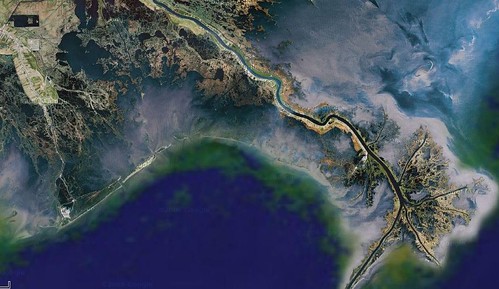
George Crabtree, a senior scientist at Argonne National Laboratory in Illinois, said he likes that the device extracts the energy as immediately usable electricity. But he sees difficulties in scaling up from a lab experiment to megawatt plants that could compete with wind turbines or other clean energy sources. Crabtree thinks the water requirements might limit the technology to large river deltas, like the mouth of the Mississippi. The energy it could potentially generate, he said, "is significant ... [but] not enough to solve everyone's problems."
Posted
by Big Gav
in
osmosis,
power,
salt
 The Guardian has an interesting article on a very unusual alternative energy source - capturing the energy released when salt water and fresh water mix, known as "pressure-retarded osmosis" - "Salt could shake up world energy supply". While the chances of this being implemented on a large scale seem remote (and the environmental consequences potentially large), the numbers mentioned are quite impressive.
More background can be found at the ABC, Renewable Energy World, Exergy and Forbes.
Only up to powering light bulbs so far, "salt power" is a tantalising if distant prospect as high oil prices make alternative energy sources look more economical.
Two tiny projects to mix sea and river water -- one by the fjord south of Oslo, the other at a Dutch seaside lake -- are due on stream this year and may point to a new source of clean energy in estuaries from the Mississippi to the Yangtze.
The experiments, which seek to capture the energy released when fresh and salt water are mixed, build on knowledge that has been around for centuries -- in one case imitating the process of osmosis used by trees to suck water from their roots.
Although they are far from being economically viable, if eventually successful they might help a long-term quest to diversify away from fossil fuels such as coal and oil, widely blamed for stoking global warming.
"We might well be able to find new promising solutions such as generating power naturally from osmotic forces occurring when salt and fresh water are mixing," Norwegian deputy Energy Minister Liv Monica Stubholt said in a speech earlier this month. ...
The science at the heart of the projects is the fact that when salt and fresh water mix at river mouths, they are typically warmed by 0.1 degree Celsius (0.2 Fahrenheit). Dutch scientists say such energy at all the world's estuaries is equivalent to 20 percent of world electricity demand.
The plants may support hopes the technology can overcome hurdles, the most significant of which is poor cost-effectiveness of the membranes used in the process.
In Norway, power group Statkraft, which says it is Europe's top producer of hydro and wind energy alongside Electricite de France, is building a test plant costing $20 million. "Ours will be the world's first saline power plant based on osmosis," said Stein Erik Skilhagen of the state-owned company. The plant, at Tofte on the Oslo fjord, will have output of up to about 5 kilowatts -- enough to run household appliances such as washing machines or heaters or a few dozen lightbulbs.
The Dutch Centre for Sustainable Water Technology (Wetsus) will also in three to four months start a pilot "blue power" test at IJsselmeer in the Netherlands, from where water flows into the sea. "At the start, it will be on the scale of 100 watts...but we aim at this salt factory to obtain 1-5 kilowatts within one year," said Jan Post, a researcher at Wetsus.
The Norwegian and Dutch plants use different systems but both depend on membranes placed between the salt and fresh water, which are currently prohibitively expensive and highly energy-intensive to produce. "The Achilles' heel for this process is that there is no commercial membrane," said Menachim Elimelech, a professor of chemical and environmental engineering at Yale University in the United States. "It's not even close to being economical."
The membranes are similar to, but thinner, than those used at many desalination plants, when sea water is pressed against membranes that allow only fresh water through in a process known as reverse osmosis.
Makers of membranes such as General Electric, Dow Chemical, Hydranautics or Japan's Toray Industries focus most on membrane technology for desalination -- a market growing by about 15 percent a year worldwide.
Ellen Mellody of GE Infrastructure, Water and Process Technology said the company has "an aspirational goal" of producing fresh water from salt through membranes at a cost of 10 cents per cubic metre, down from 70 cents to a dollar. Asked about prospects for a separate market for power-generating membranes, she saw one "potentially, but not for about 5-10 years".
The Norwegian project will include 2,000 square metres (21,530 sq ft) of plastic membranes, through which fresh water will be sucked into salt water by osmosis.
Osmosis' power was shown in 1748 when French physicist Jean-Antoine Nollet put a pig's bladder filled with alcohol in a trough of water. The bladder swelled and burst -- the more concentrated liquid draws pure water into it.
At Tofte, the power exerted by salt water sucking in fresh water is equivalent to water falling 270 metres in a waterfall. The only emissions are brackish water.
Unlike the osmosis of the Norwegian system, the Dutch scheme captures salt particles which give off electrical currents.
Yale's Elimelech said a full scale plant would demand membranes covering perhaps 100 acres (40 hectares), at risk of damage by pollutants dissolved in the river or the sea. Also, filters have to be in place to avoid sucking in fish and there are environmental concerns about drawing water away from estuaries, perhaps threatening plants and creatures in the area.
"The membrane is the challenge," agreed Skilhagen. "In tests we have come over three watts per square metre (of membrane), but we have to reach five. When we do that it will be industrially interesting."
The Dutch project is close to producing two watts per square metre of membrane. "In theory, both techniques use the same energy source and you could in theory get the same amount of energy out," said Sybrand Metz, project leader at Wetsus.
The Dutch government, utility Eneco and Redstack research group are also making a feasibility study of a plant on the Afsluitdijk dam between the IJsselmeer and the Wadden Sea, with a 10-50 kilowatt installation to be built that could lead to a 200 megawatt capacity if it works.
"Membrane-based technologies are voracious energy consumers," said France's Veolia, which runs huge desalination plants. It wants to cut energy consumption of membrane desalination by 80 percent over 15 years.


 Posts
Posts