Showing posts with label networks. Show all posts

Epic Fail ? Networked Networks Are Prone to Epic Failure  

Posted by Big Gav in , ,

Wired has an article on research into the resilience of interconnected networks - Networked Networks Are Prone to Epic Failure.

Networks that are resilient on their own become fragile and prone to catastrophic failure when connected, suggests a new study with troubling implications for tightly linked modern infrastructures.

Electrical grids, water supplies, computer networks, roads, hospitals, financial systems – all are tied to each other in ways that could make them vulnerable.

“When networks are interdependent, you might think they’re more stable. It might seem like we’re building in redundancy. But it can do the opposite,” said Eugene Stanley, a Boston University physicist and co-author of the study, published April 14 in Nature.

Most theoretical research on network properties has focused on single networks in isolation. In reality, many important networks are tied to each other. Anecdotal evidence — the crash of communications networks (.pdf) in lower Manhattan after 9/11, the plummeting of markets around the world after the Black Monday stock market collapse of 1987 — hints at their fragility, but the underlying mathematics are largely unexplored.

The Nature researchers modeled the behavior of two networks, each possessing what’s known as “broad degree distribution”: A few nodes have many connections, some have an intermediate amount of links and many have just a few. Think of the networks as having only a few branches, but many leaves. On their own, such networks are known to be stable. A random failure is likely to disable a leaf, leaving the rest of the network’s connections mostly intact.

In the new study, the researchers connected two of these networks. While many node failures were required to crash the networks when they were independent, a few failures crashed the networks when they were linked.

“Networks with broad distributions are robust against random attacks. But we found that broad interconnected networks are very fragile,” said study co-author Gerald Paul, a Boston University physicist.

The interconnections fueled a cascading effect, with the failures coursing back and forth. A damaged node in the first network would pull down nodes in the second, which crashed nodes in the first, which brought down more in the second, and so on. And when they looked at data from a 2003 Italian power blackout, in which the electrical grid was linked to the computer network that controlled it, the patterns matched their models’ math.

That broad networks could be so fragile is surprising, but even more important is how rapidly the crash happened, with sudden catastrophic collapse instead of a gradual breakdown, said Indiana University informaticist Alessandro Vespignani in a commentary accompanying the paper. “This makes complete system breakdown even more difficult to control or anticipate than in an isolated network,” he wrote.

Read More http://www.wired.com/wiredscience/2010/04/networked-networks/#ixzz0lpHRbeRi

Yochai Benkler on the emergent science of sharing  

Posted by Big Gav in

The Edge has a talk with Wealth of networks author Yochai Benkler on the shortcomings of economic models based purely on (narrowly defined) self interest - THE END OF UNIVERSAL RATIONALITY (via P2P Foundation).

The big question I ask myself is how we start to think much more methodically about human sharing, about the relationship between human interest and human morality and human society. The main moment at which I think you could see the end of an era was when Alan Greenspan testified before the House committee and said, "My predictions about self-interest were wrong. I relied for 40 years on self-interest to work its way up, and it was wrong." For those of us like me who have been working on the Internet for years, it was very clear you couldn't encounter free software and you couldn't encounter Wikipedia and you couldn't encounter all of the wealth of cultural materials that people create and exchange, and the valuable actual software that people create, without an understanding that something much more complex is happening than the dominant ideology of the last 40 years or so. But you could if you weren't looking there, because we were used in the industrial system to think in these terms. ...

The big question I ask myself is how we start to think much more methodically about human sharing, about the relationship between human interest and human morality and human society.

There are lots of different disciplines where people have been doing work for a long time. In many cases, doing work that was peripheral during the period of the rise of selfish rationality. Really we’re talking about a period from about the 1950s until roughly now, when in economics, in political science, in law, in evolutionary biology, you got an increasing relative importance for explanations that depended on individuals acting in ways that maximize their returns, where their returns largely are assumed, though not universally, to be material with self-interest.

Game theory and mechanism design imagines people as acting with self-interest and guile. Political science builds models that are based on self-interested voters and self-interested Senators and self-interested Congressmen, each one trying to understand what is their interest. Is it to get elected again? Is it to maximize a particular position? And each time you build a system around this idea of individuals interacting, trying to maximize their own returns.

In evolutionary biology, for example, one thing that you saw was the rise of very sophisticated ways of explaining behavior that seemed to be altruistic, purely in terms that redounded to the benefit of the individual organism. This is where reciprocity becomes so important. What we see again throughout all of these different disciplines is that somewhere around the 80s in some places, like organizational sociology, somewhere closer to the 90s, if you talk for example about evolutionary biology and the resurgence of the possibility of multi-level selection and group selection where it’s not all reduced to the individual, there are also components that happen at the group level.

Certainly in the context of political science and the emergence of some studies of commons and common property regimes and collective actions — successful collective action models. In economics, we see a substantial work in experimental economics, like Ernst Fehr’s group in Zurich and Sam Bowles and Herb Gintis in Santa Fe, starting to do experiments that show that people deviate from selfish rationality. That people systematically and predictably behave in ways that are much more cooperative than would be predicted by the game theoretical impact.

You’ve got theoretical economists, like Roland Benabou, Jean Tirole, and Matthew Rabin, who begin to build quite sophisticated models that try to implement very different kinds of motivations, like even a sense of self image and a sense of ‘I’m okay’ relative to the world. (There is a beautiful study, for example, from two or three years ago about knowledge workers. (Bruno Frey and Margit Osterloh)) A sense of what’s normal and moral. A sense of what’s socially preferable. You begin to see even in economics in the ’90s and early ’00s, an increased salience and attention and major complications to(?) efforts to build much more sophisticated models of multiple motivations including pro-(Inaudible) motivations.

In organizational sociology, in management science, you look — Toyota production system was the big ah-ha moment, when Toyota came to the U.S. for the first time and created the first NUMMI plant in GM’s Fremont plant in the early ’80s. All of the stories that used to be “oh it’s Japanese culture, it’s something completely different, it’s not about us,” were flipped. One of the worst performing GM plants in 1980 closes down, opens up two years later under Toyota management, almost the entire same employees said the entire union leadership. Within a couple of years it becomes the most productive plant in the U.S.

Who knows what the situation is now, but as of the numbers last year, it continued to be one of the three most productive plants in the U.S. Same people, same industry, very different organizational structure built a lot less on hierarchy, a lot less on precise specification of exactly what everybody needs to do. Much more on teamwork, much more on supporting normative commitment to innovation, to process innovation. And still relatively very constrained. It is the automobile industry.

We’re not talking about high-tech industries. But there you have a very different orientation in terms of setting up the motivation and relationships among workers, between workers and management. You move from having 70 process engineers on the floor telling each employee exactly what to do, to having none. And having the teams have a lot of autonomy on how they do things.

Nature's Internet: The Vast, Intelligent Network Beneath Our Feet  

Posted by Big Gav in , , ,

Derrick Jensen (who I've always categorised as interesting, but fundamentally unhelpful) has an interview with Paul Stamets, author of Mycelium Running: How Mushrooms Can Help Save the World, in "The Sun Magazine" about the "Vast, Intelligent Network Beneath Our Feet" that few think about, but which has a huge influence on life on earth as we know it - Going Underground.

Fun fact: mycellium break down hydrocarbons.

When we think of fungi, most of us picture mushrooms, those slightly mysterious, potentially poisonous denizens of dark, damp places. But a mushroom is just the fruit of the mycelium, which is an underground network of rootlike fibers that can stretch for miles. Stamets calls mycelia the “grand disassemblers of nature” because they break down complex substances into simpler components. For example, some fungi can take apart the hydrogen-carbon bonds that hold petroleum products together. Others have shown the potential to clean up nerve-gas agents, dioxins, and plastics. They may even be skilled enough to undo the ecological damage pollution has wrought.

Since reading Mycelium Running, I’ve begun to consider the possibility that mycelia know something we don’t. Stamets believes they have not just the ability to protect the environment but the intelligence to do so on purpose. His theory stems in part from the fact that mycelia transmit information across their huge networks using the same neurotransmitters that our brains do: the chemicals that allow us to think. In fact, recent discoveries suggest that humans are more closely related to fungi than we are to plants.

Almost since life began on earth, mycelia have performed important ecological roles: nourishing ecosystems, repairing them, and sometimes even helping create them. The fungi’s exquisitely fine filaments absorb nutrients from the soil and then trade them with the roots of plants for some of the energy that the plants produce through photosynthesis. No plant community could exist without mycelia. I’ve long been a resident and defender of forests, but Stamets helped me understand that I’ve been misperceiving my home. I thought a forest was made up entirely of trees, but now I know that the foundation lies below ground, in the fungi.

Stamets became interested in biology in kindergarten, when he planted a sunflower seed in a paper cup and watched it sprout and lift itself toward the light. Somewhere along the way, he developed a fascination with life forms that grow not toward the sun but away from it. In the late seventies he got a Drug Enforcement Administration permit to research hallucinogenic psilocybin mushrooms at Evergreen State College in Washington. Stamets is now fifty-two and has studied mycelia for more than thirty years, naming five new species and authoring or coauthoring six books, including Growing Gourmet and Medicinal Mushrooms (Ten Speed Press) and The Mushroom Cultivator (Agarikon Press). He’s the founder and director of Fungi Perfecti (www.fungi.com), a company based outside Olympia, Washington, that provides mushroom research, information, classes, and spawn — the mushroom farmer’s equivalent of seed. Much of the company’s profits go to help protect endangered strains of fungi in the old-growth forests of the Pacific Northwest. I interviewed Stamets in June 2007.

Jensen: How many different types of mushrooms are there?

Stamets: There are an estimated one to two million species of fungi, of which about 150,000 form mushrooms. A mushroom is the fruit body — the reproductive structure — of the mycelium, which is the network of thin, cobweblike cells that infuses all soil. The spores in the mushroom are somewhat analogous to seeds. Because mushrooms are fleshy, succulent, fragrant, and rich in nutrients, they attract animals — including humans — who eat them and thereby participate in spreading the spores through their feces.

Our knowledge of fungi is far exceeded by our ignorance. To date, we’ve identified approximately 14,000 of the 150,000 species of mushroom-forming fungi estimated to exist, which means that more than 90 percent have not yet been identified. Fungi are essential for ecological health, and losing any of these species would be like losing rivets in an airplane. Flying squirrels and voles, for example, are dependent upon truffles, and in old-growth forests, the main predator of flying squirrels and voles is the spotted owl. This means that killing off truffles would kill off flying squirrels and voles, which would kill off spotted owls.

That’s just one food chain that we can identify; there are many thousands more we cannot. Biological systems are so complex that they far exceed our cognitive abilities and our linear logic. We are essentially children when it comes to our understanding of the natural world. ...

Jensen: Of course this raises the question of boundaries: Is that tomato-fungus-virus one entity or three? Where does one organism stop and the other begin?

Stamets: Well, humans aren’t just one organism. We are composites. Scientists label species as separate so we can communicate easily about the variety we see in nature. We need to be able to look at a tree and say it’s a Douglas fir and look at a mammal and say it’s a harbor seal. But, indeed, I speak to you as a unified composite of microbes. I guess you could say I am the “elected voice” of a microbial community. This is the way of life on our planet. It is all based on complex symbiotic relationships.

A mycelial “mat,” which scientists think of as one entity, can be thousands of acres in size. The largest organism in the world is a mycelial mat in eastern Oregon that covers 2,200 acres and is more than two thousand years old. Its survival strategy is somewhat mysterious. We have five or six layers of skin to protect us from infection; the mycelium has one cell wall. How is it that this vast mycelial network, which is surrounded by hundreds of millions of microbes all trying to eat it, is protected by one cell wall? I believe it’s because the mycelium is in constant biochemical communication with its ecosystem.

I think these mycelial mats are neurological networks. They’re sentient, they’re aware, and they’re highly evolved. They have external stomachs, which produce enzymes and acids to digest nutrients outside the mycelium, and then bring in those compounds that it needs for nutrition. As you walk through a forest, you break twigs underneath your feet, and the mycelium surges upward to capture those newly available nutrients as quickly as possible. I say they have “lungs,” because they are inhaling oxygen and exhaling carbon dioxide, just like we are. I say they are sentient, because they produce pharmacological compounds — which can activate receptor sites in our neurons — and also serotonin-like compounds, including psilocybin, the hallucinogen found in some mushrooms. This speaks to the fact that there is an evolutionary common denominator between fungi and humans. We evolved from fungi. We took an overground route. The fungi took the route of producing these underground networks that are highly resilient and extremely adaptive: if you disturb a mycelial network, it just regrows. It might even benefit from the disturbance.

I have long proposed that mycelia are the earth’s “natural Internet.” I’ve gotten some flak for this, but recently scientists in Great Britain have published papers about the “architecture” of a mycelium — how it’s organized. They focused on the nodes of crossing, which are the branchings that allow the mycelium, when there is a breakage or an infection, to choose an alternate route and regrow. There’s no one specific point on the network that can shut the whole operation down. These nodes of crossing, those scientists found, conform to the same mathematical optimization curves that computer scientists have developed to optimize the Internet. Or, rather, I should say that the Internet conforms to the same optimization curves as the mycelium, since the mycelium came first.
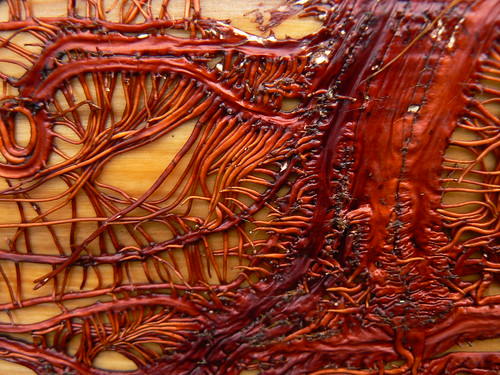


The subject of the great network of mycellium came up in Bruce Sterling's last "State of the world" gabfest, however Bruce gave it short shrift. Bruce's acolytes at WorldChanging are more enthusiastic about mushrooms though, so there is still a chance their filaments may spread throughout the Viridian world.
Well, if a hallucinatory network of intelligent fungal filaments is in charge of the planet's ecosystem, it needs to do a better damn job.

Y'know, as a science fiction writer, I dote on that kind of daft deep-green whimsy, I'm kind of a connoisseur of it. It's not much use in case of trouble, though. It's like going to a broken levee in New Orleans and signalling the sky with bottle rockets because, you know, the Space Brothers might help out.

Statistics

Locations of visitors to this page

blogspot visitor
Stat Counter

Total Pageviews

Ads

Books

Followers

Blog Archive

Labels

australia (619) global warming (423) solar power (397) peak oil (355) renewable energy (302) electric vehicles (250) wind power (194) ocean energy (165) csp (159) solar thermal power (145) geothermal energy (144) energy storage (142) smart grids (140) oil (139) solar pv (138) tidal power (137) coal seam gas (131) nuclear power (129) china (120) lng (117) iraq (113) geothermal power (112) green buildings (110) natural gas (110) agriculture (91) oil price (80) biofuel (78) wave power (73) smart meters (72) coal (70) uk (69) electricity grid (67) energy efficiency (64) google (58) internet (50) surveillance (50) bicycle (49) big brother (49) shale gas (49) food prices (48) tesla (46) thin film solar (42) biomimicry (40) canada (40) scotland (38) ocean power (37) politics (37) shale oil (37) new zealand (35) air transport (34) algae (34) water (34) arctic ice (33) concentrating solar power (33) saudi arabia (33) queensland (32) california (31) credit crunch (31) bioplastic (30) offshore wind power (30) population (30) cogeneration (28) geoengineering (28) batteries (26) drought (26) resource wars (26) woodside (26) censorship (25) cleantech (25) bruce sterling (24) ctl (23) limits to growth (23) carbon tax (22) economics (22) exxon (22) lithium (22) buckminster fuller (21) distributed manufacturing (21) iraq oil law (21) coal to liquids (20) indonesia (20) origin energy (20) brightsource (19) rail transport (19) ultracapacitor (19) santos (18) ausra (17) collapse (17) electric bikes (17) michael klare (17) atlantis (16) cellulosic ethanol (16) iceland (16) lithium ion batteries (16) mapping (16) ucg (16) bees (15) concentrating solar thermal power (15) ethanol (15) geodynamics (15) psychology (15) al gore (14) brazil (14) bucky fuller (14) carbon emissions (14) fertiliser (14) matthew simmons (14) ambient energy (13) biodiesel (13) investment (13) kenya (13) public transport (13) big oil (12) biochar (12) chile (12) cities (12) desertec (12) internet of things (12) otec (12) texas (12) victoria (12) antarctica (11) cradle to cradle (11) energy policy (11) hybrid car (11) terra preta (11) tinfoil (11) toyota (11) amory lovins (10) fabber (10) gazprom (10) goldman sachs (10) gtl (10) severn estuary (10) volt (10) afghanistan (9) alaska (9) biomass (9) carbon trading (9) distributed generation (9) esolar (9) four day week (9) fuel cells (9) jeremy leggett (9) methane hydrates (9) pge (9) sweden (9) arrow energy (8) bolivia (8) eroei (8) fish (8) floating offshore wind power (8) guerilla gardening (8) linc energy (8) methane (8) nanosolar (8) natural gas pipelines (8) pentland firth (8) saul griffith (8) stirling engine (8) us elections (8) western australia (8) airborne wind turbines (7) bloom energy (7) boeing (7) chp (7) climategate (7) copenhagen (7) scenario planning (7) vinod khosla (7) apocaphilia (6) ceramic fuel cells (6) cigs (6) futurism (6) jatropha (6) nigeria (6) ocean acidification (6) relocalisation (6) somalia (6) t boone pickens (6) local currencies (5) space based solar power (5) varanus island (5) garbage (4) global energy grid (4) kevin kelly (4) low temperature geothermal power (4) oled (4) tim flannery (4) v2g (4) club of rome (3) norman borlaug (2) peak oil portfolio (1)
