Posted
by Big Gav
in
electric vehicles,
obama
The ABC has a report on Obama's recent (apparently underwhelming, based on most commentary) speech on foreign oil dependence and clean energy - Obama's War on Oil.
After being forced to lobby for every single vote to pass basic healthcare regulation, the US president is now tied down by the Deepwater Horizon oil spill disaster. Both events represent deep challenges facing American society - its out of control health care costs and its desperate addiction, shared by us all, to fossil fuels.
The struggle to solve both problems has illustrated the weakness of the American state in terms of its ability to respond to and resolve such crises on both a political and institutional level. Just a year and a half into Obama's first term the United States remains divided and weak, with deep partisanship making unified responses nearly impossible, and structural weaknesses in terms of state capacity challenging the delivery side of what compromises can be salvaged from the political maelstrom.
In this first Oval Office address yesterday, President Obama sought to revive a flagging political agenda with a very real sense of crisis. His speech was redolent with the language of war, the image of 'a menacing cloud of black crude' evoking the black clouds that rose from the World Trade Centre on 11 September 2001.
He not only laid out his 'battle plan' in response of his administration in terms of holding BP to account, but also reaffirmed his belief that action is necessary to reduce and ultimately break fossil fuel addiction. If George W Bush seized on the 11 September attacks to declare a 'war on terror', Obama has declared nothing less than a war on oil.
On the Gulf Coast this means the deployment of 17,000 National Guard troops to help the physical cleanup, the involvement of tens of thousands of personnel, thousands of ships and the deployment of five million feet of water booms.
For all of this, BP will be expected to foot the bill. This is the 'war on oil' on an immediate and local level, with both the slick itself and BP as the villains.
It is the future and global War on Oil however that provides the bigger picture for Obama's speech. With global efforts to break fossil fuel addiction faltering since Copenhagen, Obama casts the Deepwater Horizon as emblematic of a greater struggle not only environmental and economic in proportions but also geopolitical.
Having failed to carry anti-carbon pollution legislation on environmental grounds at Copenhagen, Obama is appealing to American nationalism.
This is because dependence on 'foreign oil' is the geopolitical demon that unites both Republicans and Democrats, even where they cannot agree on climate change or pollution. Obama reminded his audience that 'each day, we send nearly a billion dollars of our wealth to foreign countries for their oil'.
It is a fact that galls every American for a range of reasons ranging from the noble to the xenophobic.
In this global picture the enemy is not dissimilar to that evoked by the war on terror - the transition is almost seamless, because the origins of both terrorists and so much 'foreign oil' is Saudi Arabia and the Middle East it represents.
America's struggle for energy independence, Obama tells us, is not only like the mission to the moon, but like World War II. There too, a looming threat was known but ignored, at vital cost:
"For decades, we have known the days of cheap and easily accessible oil were numbered. For decades, we have talked and talked about the need to end America’s century-long addiction to fossil fuels. And for decades, we have failed to act with the sense of urgency that this challenge requires. Time and again, the path forward has been blocked – not only by oil industry lobbyists, but also by a lack of political courage and candor."
But there is also another threat in the piece. This is China, which, Obama warns his audience, has been 'investing in clean energy jobs and industries that should be here in America'.
Obama thus casts the war on oil as a struggle to maintain not only America's independence from the Middle East in which it is so disastrously mired, but as a battle in America's much feared decline as a superpower. ...
The coming months will tell whether the War on Oil will do just that, or whether the United States will remain paralysed by its political division as well as its fossil fuel addiction.
The Washington Post has an editorial saying Obama didn't go far enough -
Obama's TV speech undersells how energy policy must change.
FROM THE Oval Office on Tuesday, President Obama argued that the catastrophic oil spill in the Gulf of Mexico underscores the need for America to transition from fossil fuels. But even as he attempted to rally Americans by invoking heroic American achievement in World War II and in space, the president didn't talk much about what could make such a transition happen.
The answer is that oil, gas and coal have to become more expensive to spur research into cleaner energy and encourage efficiency and switching. This could be achieved with a gradually rising tax on fossil fuels or a "cap-and-trade" system that makes utilities and others pay to pollute. The government could rebate most of the proceeds directly to Americans and invest the rest in energy research and transition assistance. When a price is placed on burning dirty fuels, market forces will drive the sort of transition Mr. Obama proposes.
The president knows this. In other speeches before and after the gulf spill, he has argued for it. Yet on Tuesday he only hinted at this and seemed to suggest he'd be open to energy legislation that doesn't raise the price of carbon.
For that, Republicans bear considerable blame. To be consistent with both science and their philosophy, they should favor a market-based approach. Most on the national stage instead prefer irresponsibly to pillory the idea as a "job-killing national energy tax"; they propose command-and-control energy programs that they think might be more popular. Democrats with ties to coal or manufacturing interests meanwhile dilute the policy, demand payoffs to support it or shortsightedly oppose it. Legislators in both parties champion more federal spending for their favored technologies.
But the harsh political climate is all the more reason why presidential leadership is essential. Passing comprehensive climate legislation isn't likely to be easier in the next Congress. As the president begins to push on crafting a compromise energy proposal next week, he'll have to be more forthright on what true change will require.
The Wall Street Journal has an article noting Obama should be putting some additional energy intp pushing electric vehicles -
Time to Plug In Electric Cars.
It's fair to say that President Barack Obama's speech to the nation on the oil spill this week didn't exactly get rave reviews. It was variously described as flat and vague—and that was by his friends.
And maybe there was just nothing he could say at this moment of helplessness in the face of the gushing oil that could have made it otherwise.
Perhaps, though, the president should have uttered two words: electric cars.
One of Mr. Obama's goals, in the speech and beyond, is to turn the BP crisis into a clarion call for moving more quickly to a post-oil energy future. Indeed, the White House believes that, once the trauma of the spill subsides, the chances of passing broad energy legislation—suspended in a partisan coma before the spill—actually will have improved, because the crisis will have a galvanizing effect on America's yearning for a different energy future.
If that's the case, there may well be broader support for building that future around electric cars than any other approach. In short, perhaps electric vehicles are something both parties can agree to ride into a new and brighter energy future.
Already, similar bills are pending in both houses of Congress to push electric cars, and they have bipartisan support from real, live Democrats and Republicans. A blue-ribbon group of corporate leaders has formed to push the bills; they also are backed by retired military leaders who see electric cars as a way to ease the national-security concerns of dependence on Mideast oil.
So maybe this is the rallying point the president was seeking in his Oval Office address. "When the president got to the end, it seemed to me he should have said, 'Let's have a mini-Manhattan Project. Let's electrify half our cars and trucks in 20 years.' " said Sen. Lamar Alexander of Tennessee, third-ranking Republican in the Senate and a kind of missionary for electric cars. "That's a very ambitious goal, but it's a goal that cries out for presidential leadership."
That doesn't mean electric cars are an easy answer; if they were, we'd all be driving them, and oil wouldn't be lapping up on the Louisiana coast. The technology to produce batteries long-lasting enough to satisfy American drivers, and the infrastructure to recharge them, aren't there yet.
But the point is that smart people with a real stake in the outcome of the quest think the answers are close enough to make this the centerpiece of a new energy equation. "You have a chance in the next two years to make a real difference," said Fred Smith, chief executive of FedEx Corp., the shipping giant. His company already is operating some all-electric vehicles.
"I'm a free-market person," Mr. Smith says. "I'd prefer that all of this take place with nothing but the free market. But the reality is that, to push things down the cost-price curve, the government is sometimes important."
Posted
by Big Gav
in
china,
global warming,
obama
The SMH has an article on reducing the urban heat island effect via smarter design of roads and buildings - We are stewing in our own oven.
You, reader, live in a primitive city. In a hundred years from now, the society we are building will look back and marvel at how little we really understood about the world we have constructed for ourselves.
We are stewing in our own juices.
Last Wednesday, a night of driving rain, I attended a seminar where more than 100 professionals, a standing room-only crowd, had gathered to learn about practical, cheap, achievable ways of stopping Sydney's pot from simmering. These were not wide-eyed utopians. In purely parochial terms, the heating of our biggest cities is even bigger than the global warming debate. Because the rise in temperature is mostly and demonstrably caused by outdated thinking.
The story starts on Observatory Hill, at the southern end of the Harbour Bridge, where weather records have been kept daily since 1860. What the observatory has recorded is a rise in the average temperature at the centre of Sydney from 20.5 degrees to 22 degrees. As Sydney grows, Sydney slowly heats.
At last Wednesday's seminar we learnt why - 27 per cent of the surface of the metropolitan area is covered by bitumen, the black tar which soaks and retains heat and thus changes the city's climate.
Nearly all the rainwater run-off on this 27 per cent of the city is lost to productive use, flowing into Sydney Harbour because it is designed that way. The city's rooftops also gather heat. Roads and pavements maximise the waste of arable land. Tree-planting is stunted for legal reasons. Topsoil is "scalped" by roadworks. The increasing use of air-conditioners is creating more energy. More heat begets more heat.
It is not just a Sydney story. The most telling detail lost amid all that was written and broadcast about the Black Saturday bushfires in Victoria, which killed 173 people, was that more people died from heat stress in Melbourne than in the fires. During the oven-like temperature peak (three consecutive days above 43 degrees) Melbourne saw a spike of 1400 emergencies requiring an ambulance.
An extra 374 people died in Victoria that week compared to the average week. Most were heat stress related.
"To break this heating cycle we don't need more money, we need more intelligent use of what we already have," says the person who organised Wednesday's seminar, Michael Mobbs, the creator of Sydney's most famous experiment in sustainable housing. He was stunned by the size and quality of the turnout. The room was full of planners from councils across Sydney. He was especially pleased that the gathering was addressed by Arjan Rensen, a senior executive from ARRB, the company which writes the specification guidelines for all the road agencies in Australia.
"It was hugely symbolic having him there, willing to be associated with what we're trying to do," Mobbs told me. "It means the road authorities are at last starting to deal with the impact their roads are having on our cities."
The roads are Mobbs's starting point for reform, because they take up so much room and are so taken for granted. "We should just use existing bitumen and gravel but choose pale gravel, and mix it so that the gravel shows through the bitumen," Mobbs says. "We could also use dyes like those used in bus lanes, but paler than green or red. These were first used in the Harbour Tunnel, which was privately owned, because the owners wanted to cut the cost of their electricity bill. On streets with low traffic volume, these dyed surfaces will last 15 to 20 years."
Then there is the overlooked space, the humble pavements. They should be planted and widened where possible because of the cooling powers of plants and trees. Fruit trees and vegetable gardens should also be grown in public space such as roadsides. The practice is common in Germany.

The SMH also has an article on Obama's call for the US to embrace clean energy technology and act on global warming -
Act now on climate: Obama.
THE Obama Administration's climate change negotiator has warned that any country that delays enacting laws will miss out on a huge wave of investment waiting for the regulatory dam to break.
Indicating the US was ready to act without India or China, Todd Stern said the Obama Administration was determined to lead on this issue. "In our view, you can become an economic winner by acting," he said in an interview with the Herald.
"Some say we should wait in terms of our domestic legislation to see what others do. The President doesn't accept that. Our Administration doesn't accept that. We totally think that the Chinese and Indians and others need to act. But it's not our view that our decision to act ought to be made contingent on them."
With the global negotiations on carbon emissions set for Copenhagen in December, the US hopes to have new carbon emissions laws in place by the end of the year.
Mr Stern, the special envoy for climate change, said laws to tackle carbon emissions would deliver the certainty investors needed, unlocking enormous sums to go into energy industries.
Last year the International Energy Agency estimated investment of $US26,000 billion would go into new energy infrastructure worldwide by 2030, with $1500 billion of that destined for the US.
As in Australia, the US House of Representatives has passed a bill to create a carbon emissions trading system, but in both countries the bill has yet to win Senate approval.
The Australian has an article on Chinese clean energy and energy efficiency initiatives -
Chinese energy is greener than ours.
T'S hard to comprehend, Martin Ferguson said last week. The federal Minister for Resources and Energy was referring to the fact that, in the next decade, China will bring on line about 1000 average-sized coal-fired power stations, equivalent to 34 times Australia's present coal-burning generation capacity.
Ferguson's government and others in the developed world are being asked to comprehend even more than that, however. They have been repeatedly warned by the International Energy Agency that, even if the Organisation for Economic Co-operation and Development countries collectively reduce their greenhouse gas emissions to zero by 2030, they cannot put the world on track to achieve stablisation of carbon dioxide levels in the atmosphere at 450 parts per million.
When the IEA delivers its new world energy outlook in September, ahead of the Copenhagen global warming treaty summit in December, this gobsmacking message can only be reinforced. Non-OECD countries are heading towards a collective volume of emissions of more than 25 billion tonnes a year by 2030, compared by then with less than 15 billion tonnes for the OECD nations.
In the vanguard, of course, is China, but not because it is ignoring the issue.
Ferguson could have also cited a set of startling Chinese green power statistics in his mid-July speech to the Queensland Resources Council.
By 2020 China aims to have installed 300,000MW of hydro power (equal to 80 Snowy Mountains schemes), 30,000MW of plants fuelled by agricultural waste, 1800MW of solar power and more than 50,000MW of wind farms (about four times what will be needed here to meet the Rudd renewable energy target).
This will involve spending $US33billion ($40.3bn) a year on renewable energy.
Everything about the Chinese effort is mindboggling. For example, it now employs 600,000 people (twice the population of Canberra) installing solar hot-water heaters in a $US2bn a year business. Its electric bicycle business is worth more than $US6bn a year.
Nor are its efforts to reduce the environmental impact of its coal-burning generators to be underestimated. Since 2005 China has required all new large power plants to use at least high-efficiency, super-critical technology and since 2007 it has shut down smaller, inefficient plants with a capacity of 14,380MW (more generation capacity than in NSW).
This is allowing China to leapfrog the less efficient coal technology that is dominant in the developed world, including Australia.
At Yuhuan, it has commissioned 4000MW, almost as much capacity as the largest generating complex in Australia, Bayswater-Liddell, of ultra-super-critical generation, the largest operation of its kind in the world, providing power to 10 million households, with a thermal conversion efficiency of 45 per cent, about one-quarter better than conventional coal-burning generators.
Posted
by Big Gav
in
obama
Talk about a green new deal seems to have waned this year, but Obama is still making the occasional speech promoting the need for the US to become independent of oil and to switch to clean energy sources. Reuters reports on his latest speech at a Nevada air force base - Obama touts solar power to break U.S. oil addiction.
President Barack Obama provided a spending boost to the solar and geothermal energy industries on Wednesday and said increased use of the fuels would make America more secure.
"We know the cost of our oil addiction all too well," Obama said in a speech at Nellis Air Force Base, which is home to the biggest solar electric plant in the Western Hemisphere.
"It's the cost measured by the billions of dollars we send to nations with unstable or unfriendly regimes. We help to fund both sides of the war on terror because of our addiction to oil," Obama said, one week before visiting Saudi Arabia, the world's top oil exporter, to discuss the nuclear standoff with Iran and reviving the Israeli-Palestinian peace process.
Obama said the federal government would spend $467 million from the recent $787 billion U.S. economic stimulus package to expand and accelerate the development and use of solar and geothermal energy throughout the United States.
"More than 72,000 solar panels built on part of an old landfill provide 25 percent of the electricity for the 12,000 people who live and work here at Nellis. That's the equivalent of powering about 13,200 homes during the day," Obama said.
"We have to lay a new foundation for prosperity, a foundation constructed on the pillars that will grow our economy and help America compete in the 21st century. And a renewable energy revolution is one of those pillars.
Nevada Senator Harry Reid said the state's solar and geothermal resources gave it the potential to be the "Saudi Arabia ... for renewable energy."
The U.S. solar energy industry grew about 9 percent in 2008, but the recession cut demand for some solar installations.
Posted
by Big Gav
in
green jobs,
obama
Bloomberg has an article on an Obama speech on the importance of green collar jobs ("The choice we face is not between saving our environment and saving our economy; it’s a choice between prosperity and decline") and opening up the outer continental shelf to wind and ocean power projects - Obama Says U.S. Moving to Open Coast for Wind Power.
President Barack Obama said his administration is taking steps to begin leasing tracts off U.S. shores for electricity-generation projects using wind and ocean currents.
The president said the initiative will open the way to “major investments” in projects on the Outer Continental Shelf and that interest already is high in putting wind-power turbines off the coasts of New Jersey and Delaware. He also said he will continue pursuing a “market-based cap” for emissions of carbon dioxide, a gas linked to climate change. “The nation that leads the world in creating new sources of clean energy will be the nation that leads the 21st century global economy,” Obama said in Newton, Iowa. “America must be that nation.”
Obama delivered his Earth Day message in a central Iowa town that is trying to rebound from the loss of traditional manufacturing jobs by replacing them with work tied to alternative energy. The president, in promoting his budget plans, ties the goal of greater energy production with building a sustained economic recovery. ...
The areas off the Atlantic and Pacific coasts have the potential for 1,900 gigawatts of electricity, more than twice the nation’s current power capacity, according to the Interior Department. There is also potential power from wave and tidal projects offshore.
Posted
by Big Gav
in
obama
Technology review reports on another positive move from Obama, "clearing away obstacles to reducing U.S. gasoline consumption" - Obama Orders Fuel Efficiency
On Monday morning, President Barack Obama signed executive orders that could speed the reduction of greenhouse-gas emissions from automobiles by improving fuel economy and setting stricter emissions standards. While the technology exists to reach the stricter standards, it's not clear that automakers can implement them fast enough. What's more, additional policy measures may be needed to reduce overall fuel consumption.
Obama signed two orders on Monday. One required the Department of Transportation (DOT) to enforce a law that will increase fuel-economy standards to a minimum of 35 miles per gallon by 2020. The law was passed in 2007, but detailed rules telling automakers how to comply were never implemented by the Bush administration. The second order signed by the president calls for the Environmental Protection Agency (EPA) to revisit a request from the state government of California asking for permission to implement emissions standards that are more strict than federal rules. Those standards call for decreasing carbon-dioxide emissions from new vehicles by 30 percent by 2016; 13 other states have since followed California's example. Under President Bush, that request was denied, but experts say it's likely that the EPA will now approve it.
The orders are meant to reduce both carbon emissions and gasoline consumption, Obama said on Monday. They will help on the country's "journey toward energy independence" and will "spark the innovation needed to ensure that our auto industry keeps pace with competitors around the world," he added.
The technology does exist to make it possible, and much of it is simple. For example, low-rolling resistance tires can help make cars more efficient by reducing the amount of energy lost through waste heat. Reducing the weight of vehicles by using lightweight steels and aluminum can also boost fuel efficiency. And automakers can use smaller engines to improve efficiency, making up for lost power by turbo-charging them. Greater improvements can come from advanced technologies such as plug-in hybrids, which run electricity part of the time. But there may not be enough time "to get the technology out there in the volumes needed," says John Heywood, a professor of mechanical engineering at MIT.
Posted
by Big Gav
in
energy policy,
obama,
smart grids
The FT has an editorial supporting smart grid initiatives in the US - Smart Idea For US Energy Policy.
When President Barack Obama talks about his priorities, energy always comes high on the list, and with good reason. The plunge in oil prices may have reduced their political salience, but securing energy supplies and averting the threat of climate change are as important as ever. An idea at the heart of his programme is the creation of a “smart grid”: an electricity network that uses information technology to manage flows of power. The cost of such a grid would be enormous, but it would be money well spent.
The smart grid has become today’s equivalent of the “information superhighway”: a piece of trendy high-tech jargon. Yet that fashionability should not be allowed to obscure its merits. One of its strongest supporters is Steven Chu, Mr Obama’s energy secretary, and no one could accuse him of being a dilettante. A Nobel Prize-winning physicist, he has been serving on the electricity transmission sub-committee of America’s Energy Future, a research group backed by the national academies of science and engineering.
A smart grid would be a national asset comparable to the interstate highways launched by President Dwight D. Eisenhower in the 1950s. It would make possible a huge increase in the use of renewable energy in the US, connecting up vast wind farms in South Dakota or solar arrays in New Mexico to the centres of population on the coasts. It would enable the network to manage the intermittency that is inherent to wind and solar power, balancing supply and demand when the wind does not blow and the sun does not shine. It would also cut the losses caused by transmitting electricity, and make the network more resilient to equipment failure, preventing blackouts.
Supported by “smart meters” – devices in the home that monitor energy use and can send and receive information – the grid can also cut consumers’ energy use. Trials in the US have suggested household electricity use can be cut by between 10 and 15 per cent. Those that generate their own power, for example with solar panels on their roofs, would also be able to sell any excess to the grid.
Mr Chu has suggested a national smart grid would cost up to $1,000bn. But with the US spending $400bn a year on electricity, a mere 10 per cent reduction in power use would cover the cost in 25 years. Rural electrification was one of the great, lasting achievements of President Franklin D. Roosevelt’s New Deal. It would be fitting, as well as a sound investment, if Mr Obama were to update that project for the 21st century.
Posted
by Big Gav
in
civil liberties,
obama
The SMH reports that Obama is making a good start to erasing the stain of the Bush presidency, ordering the close of the Guantanamo Bay camp - President Barack Obama signs order to close Guantanamo Bay. Obama has also outlawed CIA torture practices and called on Israel to open the border with Gaza to allow humaitarian aid through.
On his second day in office, US President Barack Obama has made good on his campaign promises to close the detention facility at Guantanamo Bay within a year and end the practice of torture by the spy agency the CIA immediately.
At a ceremony this morning in the Oval Office, witnessed by a dozen former military officers, Mr Obama signed four presidential orders including the much-anticipated order to close the controversial detention facility within 12 months.
The Guantanamo Bay order sets up a commission to look at options for relocating the remaining 245 inmates of Guantanamo Bay. This is likely to include asking allies such as Australia to take inmates.
Prime Minister Kevin Rudd has already rejected similar overtures from the former president George Bush, but Portugal and Switzerland have indicated they may be willing to take some detainees.
Other options include moving inmates to US military prisons, returning some to their native countries, and finding third countries to take them.
The President also signed an order saying that all interrogations conducted by the United States would abide by the army field manual, effectively banning the CIA from using "enhanced interrogation" techniques including waterboarding.
"The message we are sending around the world is the US intends to prosecute the ongoing struggle against violence and terrorism but we are going to do so consistent with our values," he said.
"As I said during the inauguration, we are not going to continue with a false choice between our safety and our ideals," he said. "We are going to win this fight but we will win it on our terms."
The order also sets up a process to review rendition practices, where prisoners are sent to CIA prisons in countries without any human rights protections.
Glenn Greenwald says the signs are encouraging for civil libertarians, even if they have conservative bed-wetters wringing their hands with fear and suffering frequent anxiety attacks -
The newest fear-mongering campaign from the Right and the media.
The latest fear-mongering campaign in the U.S. -- this one devoted to scaring Americans that they will be slaughtered if Guantanamo is closed and Terrorism suspects are brought into the U.S. for real trials -- is now in full swing. The New York Times today prints a front-page article claiming that a detainee released from Guantanamo last year has now become "the deputy leader of Al Qaeda’s Yemeni branch" (it's always amazing how bureaucratically structured Al Qaeda is alleged to be and how well we can discern the structure: "Deputy Leader, Yemen Branch"; do they have business cards and organizational charts?).
But the real fear-mongering is focused on all of the attacks that American communities will suffer if we imprison dangerous Terrorists inside the U.S. rather than in Guantanamo. House Minority Leader John Boehner wants you to be frightened: "I think the first thing we have to remember is that we're talking about terrorists here. Do we bring them into our borders?" GOP House Minority Whip Eric Cantor warned: "Actively moving terrorists inside our borders weakens our security. Most families neither want nor need hundreds of terrorists seeking to kill Americans in their communities." The always frightened Wall St. Journal Editorial Page shrieks that any place that houses Al Qaeda Terrorists will become a "target" for attack:
The military base [at Ft. Leavenworth] is integrated into the community and, lacking Guantanamo's isolation and defense capacities, would instantly become a potential terror target. Expect similar protests from other states that are involuntarily entered in this sweepstakes.
National Review's Jim Geraghaty spent all day yesterday fantasizing about all the scary things that could happen if we have Al-Qaeda Terrorists in our communities (near nuclear facilities and airports!). Former Bush aide and chief speechwriter Marc Thiessen warned yesterday in The Washington Post that if there is a Terrorist attack on U.S. soil, Americans will blame Obama because he stopped torturing and closed Guantanamo, and Democrats will be "unelectable for a generation." Today, at National Review, Thiessen, citing yesterday's Executive Orders, declared Obama "to be the most dangerous man ever to occupy the Oval Office." And yesterday, of course, The Washington Post's Fred Hiatt echoed the standard claim that our regular federal courts were inadequate to try dangerous Terrorists.
All of this is pure fear-mongering -- the 2009 version of Condoleezza Rice's mushroom cloud and Jay Rockefeller's "we'll-lose-our-eavesdropping-capabilities" cries. Both before and after 9/11, the U.S. has repeatedly and successfully tried alleged high-level Al Qaeda operatives and other accused Islamic Terrorists in our normal federal courts -- in fact, the record is far more successful than the series of debacles that has taken place in the military commissions system at Guantanamo. Moreover, those convicted Terrorists have been housed in U.S. prisons, inside the U.S., for years without a hint of a problem.
Glenn also notes the polls are showing American citizens (unlike their amoral mass media and a small tribe of conservative blowgards) think that shutting Gitmo and giving terrorism suspects fair trials is a good thing -
New poll on torture and investigations negates Beltway conventional wisdom.
One of the most common and most corrosive aspects of our political discourse is the endless assertions -- based on nothing -- about what "Americans believe." It is exceedingly conventional wisdom that Americans generally view the world through the prism of Jack Bauer and therefore want our government to torture, want Guantanamo kept opened, and do not want suspected Terrorists to be tried in civilian courts inside the U.S. It is even more commonly asserted that Americans do not want, and even further, would never tolerate, criminal investigations into the various crimes of Bush officials.
A new Washington Post/ABC News poll released yesterday negates all of those beliefs. Here was the question that was asked about torture -- note that it's phrased in the most pro-torture manner possible, because it is grounded in the ludicrous, 24-clichéd "ticking time bomb" excuse that is the most commonly used argument by torture advocates:
Q. Obama has said that under his administration the United States will not use torture as part of the U.S. campaign against terrorism, no matter what the circumstance. Do you support this position not to use torture, or do you think there are cases in which the United States should consider torture against terrorism suspects?
By a wide margin -- 58-40% -- Americans say that torture should never be used, no matter the circumstances. Let's repeat that: "no matter the circumstance." That margin is enormous among Democrats (71-28%) and substantial among independents (56-43%). As usual these days, Republicans hold the minority view, but even among them there is substantial categorical opposition to torture (42-55%).
Moreover, a majority of Americans (53-42%) favor the closing of Guantanamo, with large support among Democrats (68%) and independents (55%). Even more significantly, a very solid majority of those favoring the closing of Guantanamo recognize exactly what ought to be done with detainees who the government believes are guilty of terrorism-related crimes -- it's exactly what the ACLU and civil libertarians generally urge be done:
Posted
by Big Gav
in
obama
Some of you may have already noticed that Obama has been sworn in as US President, but for those who don't read or watch anything other than Peak Energy I'll post some of his speech just so you aren't left behind.
I liked some of the passages, both those repudiating the actions of the previous administration and his call to harness the sun and wind, expand the grid, deal with global warming and restore science to its rightful place (We will build the roads and bridges, the electric grids and digital lines that feed our commerce and bind us together. We will restore science to its rightful place, and wield technology's wonders to raise health care's quality and lower its cost. We will harness the sun and the winds and the soil to fuel our cars and run our factories).
We remain the most prosperous, powerful nation on Earth. Our workers are no less productive than when this crisis began. Our minds are no less inventive, our goods and services no less needed than they were last week or last month or last year. Our capacity remains undiminished. But our time of standing pat, of protecting narrow interests and putting off unpleasant decisions — that time has surely passed. Starting today, we must pick ourselves up, dust ourselves off, and begin again the work of remaking America.
For everywhere we look, there is work to be done. The state of the economy calls for action, bold and swift, and we will act — not only to create new jobs, but to lay a new foundation for growth. We will build the roads and bridges, the electric grids and digital lines that feed our commerce and bind us together. We will restore science to its rightful place, and wield technology's wonders to raise health care's quality and lower its cost. We will harness the sun and the winds and the soil to fuel our cars and run our factories. And we will transform our schools and colleges and universities to meet the demands of a new age. All this we can do. All this we will do.
Now, there are some who question the scale of our ambitions — who suggest that our system cannot tolerate too many big plans. Their memories are short. For they have forgotten what this country has already done; what free men and women can achieve when imagination is joined to common purpose, and necessity to courage.
What the cynics fail to understand is that the ground has shifted beneath them — that the stale political arguments that have consumed us for so long no longer apply. The question we ask today is not whether our government is too big or too small, but whether it works — whether it helps families find jobs at a decent wage, care they can afford, a retirement that is dignified. Where the answer is yes, we intend to move forward. Where the answer is no, programs will end. Those of us who manage the public's dollars will be held to account — to spend wisely, reform bad habits, and do our business in the light of day — because only then can we restore the vital trust between a people and their government.
Nor is the question before us whether the market is a force for good or ill. Its power to generate wealth and expand freedom is unmatched, but this crisis has reminded us that without a watchful eye, the market can spin out of control — and that a nation cannot prosper long when it favors only the prosperous. The success of our economy has always depended not just on the size of our gross domestic product, but on the reach of our prosperity; on our ability to extend opportunity to every willing heart — not out of charity, but because it is the surest route to our common good.
As for our common defense, we reject as false the choice between our safety and our ideals. Our founding fathers ... our found fathers, faced with perils we can scarcely imagine, drafted a charter to assure the rule of law and the rights of man, a charter expanded by the blood of generations. Those ideals still light the world, and we will not give them up for expedience's sake. And so to all the other peoples and governments who are watching today, from the grandest capitals to the small village where my father was born: know that America is a friend of each nation and every man, woman, and child who seeks a future of peace and dignity, and that we are ready to lead once more.
Recall that earlier generations faced down fascism and communism not just with missiles and tanks, but with sturdy alliances and enduring convictions. They understood that our power alone cannot protect us, nor does it entitle us to do as we please. Instead, they knew that our power grows through its prudent use; our security emanates from the justness of our cause, the force of our example, the tempering qualities of humility and restraint.
We are the keepers of this legacy. Guided by these principles once more, we can meet those new threats that demand even greater effort — even greater cooperation and understanding between nations. We will begin to responsibly leave Iraq to its people, and forge a hard-earned peace in Afghanistan. With old friends and former foes, we will work tirelessly to lessen the nuclear threat, and roll back the specter of a warming planet. We will not apologize for our way of life, nor will we waver in its defense, and for those who seek to advance their aims by inducing terror and slaughtering innocents, we say to you now that our spirit is stronger and cannot be broken; you cannot outlast us, and we will defeat you.

Dave Roberts at Grist has an unfond look back at the dispiriting Bush years -
Lights! Camera! Inaction!.
Imagine that back in 1999 you were a Hollywood studio executive and a movie producer brought you the following pitch:
A bumbling, incurious child of privilege wastes his youth on Oedipal rebellion. After stumbling through a series of failed business ventures and an undistinguished stint as governor of a state in which the governor has no power, he finds himself on the brink of the presidency. He is intercepted there by a bitter old veteran of Washington infighting, a man eager to repay old slights by radically remaking the federal government. Under the guise of helping the bumbler find a vice president, the veteran installs himself in that role.
Upon taking office, the bumbler and his shadowy consigliere immediately begin dismantling environmental protections and reversing campaign promises to regulate pollution. Consigliere develops a new energy policy by convening secret meetings with representatives of the nation's dirtiest industries, while refusing to release any information about who participated or what was said. The federal bureaucracy, newly stocked with industry lobbyists, drives through measures that allowed increased toxics in drinking water, massive mine waste dumps in streams and rivers, and an explosion of energy exploration and drilling on public lands. Environmental enforcement drops off sharply; government scientists and scientific reports are censored.
Would you make that movie? Probably not. It's over the top. Lacks depth. The characters are two-dimensional. No real-world politician is so uniformly hostile to environmental protection and social justice, so committed to partisanship over science, so single-mindedly dedicated to looting the public trust for the benefit of large corporations.
To be fair, Oliver Stone got such a movie made, but only after the Bush years were almost over. It's hard to see how anyone from the pre-Sept. 11 years could have envisioned how W.'s time in office would unfold.
Therein lies the unique challenge that the administration of George W. Bush posed to journalists, particularly environmental journalists. People are drawn to journalism by curiosity about the rich textures and complexities of the real world. By temperament and training they're inclined to see every issue as multi-faceted, a clash of competing perspectives. So what do reporters do in the face of a real-world leader who for all intents and purposes might as well be Snidely McEvil, twirling his mustache and tying damsels to the railroad tracks? What do they do when there's barely a patina of policy or ideological rationale behind the sheer will to crush political opponents and elevate political allies? When the most interesting question about any given act is whether it's better explained by ignorance or malice?
Turns out they blow it. Mainstream journalists' fear of two-dimensionality -- perhaps more importantly, the fear of being branded as "biased" -- turned out to be stronger than their will to tell the truth as it unfolds. The result has been a kind of normalizing filter around officialdom, whereby every act, no matter how mendacious or destructive to the public interest, is a reasonable, good-faith position that "environmentalists" object to (down in paragraph five).
Grist tried to tell the truth about the Bush administration as we see it. Frankly, it wasn't always a picnic. Monochromatic hostility toward the environment, reported honestly, is, well, monochromatic, no matter how clever your headlines. Not only that, but it gets you labeled as "activist," the worst epithet available in media circles. It's a price worth paying -- not like mainstream media outlets are reveling in their success -- but let's face it, it's dispiriting and eventually, boring.
As we look back over the astonishingly and almost uniformly dismal Bush record on the environment, we are above all relieved and excited, if only for selfish reasons. Despite the pressing challenges facing humanity and the planet, and however events end up playing out, the next few years promise a richness and drama that we as journalists have sorely missed.
Posted
by Big Gav
in
obama,
smart grids,
smart meters
SmartMeters.com reports that IBM have been pushing for smart grids to be a part of Obama's economic stimulus plans - Obama team consults IBM on plans for smart grid.
In considering their planned economic stimulus package, President-elect Obama’s transition team pondered how beneficial the plan would be if information technology were highlighted. Instead of consulting government bureaucrats or even academic experts at leading universities the team went to IBM. ...
According to an article appearing in December in the Wall Street Journal, IBM chairman and CEO Sam Palmisano presented information directly to Carol Browner, coordinator of climate and energy policy for the incoming administration, and Julius Genachowski – a technology adviser to the president who is rumoured to be in the running for the newly created position of United States chief technology officer. In the presentation, Palmisano explained how a $30 billion information technology stimulus would create jobs.
As part of the technology stimulus, IBM recommended three areas of primary focus: increased broadband Internet access throughout the country, continued computerization of medical records, and rolling out the smart grid to revolutionise the country’s power distribution system. IBM worked with the Information Technology and Innovation Foundation think tank based in Washington D.C. to come up with the focus areas.
According to their study, IBM found that a $10 billion investment to boost America’s smart grid infrastructure would create 239,000 new jobs. IBM would stand to benefit considerably from any IT investment but would particularly within these focus areas. Big Blue figures prominently in the healthcare digitisation process as well as smart grid technology.
In his presentation to the Obama transition team, Palmisano said that small businesses would create more than half of the new jobs as a result of so-called “network effects.” For example, economic activity would naturally increase from a higher presence of broadband Internet. Rolling out the smart grid would bring a wealth of new energy technologies online.
Some countries have made major strides installing smart grids. Italy, for one, blanketed the country with the money and energy-saving devices several years ago. Power providers around the world are realising that their power infrastructure is at or past its useful age and that the time has come to make the technological leap. Typically, transformers in North American power substations are designed to last 40 years, but the average age of these devices is 42 years.
How much of the advice will be incorporated into the stimulus package that lawmakers and the Obama team are working on remains to be seen. At the end of December, Obama aides said that part of the two-year plan would include spending on traditional infrastructure, including highways, and reduced taxes.
GreentechMedia has a post on a project by a UK organisation to map smart meter projects around the world -
A Smart Meter Map of the World.
Have you had trouble keeping track of smart metering projects? So have we, which is why we’re glad to see the Smart Metering Projects Map run by the Energy Retail Association in the UK.
The map essentially pinpoints smart metering projects across Europe, North America, Oceania and Asia on a zoom-able Google map. If you click on one of the flags, a few paragraphs pop up explaining the scope and purpose of the project. Distrigaz Sud, for instance, is installing 1.1 gas meters in southern Romania to offset gas network balancing concerns. The meters in the trial utilize snap-on Zigbee devices to permit communication.
In Kyrgyzstan, a utility will test out pre-paid gas meters. (Pre-paid gas meters used to be a common fixture in the U.K. after World War II and are going to be trialed in parts of the U.S. for lower-income housing developments.)
And my personal favorite, Bosnia Herzegovina’s Elektroprivreda HZ HB Mostar is installing meters that communicate through power-line networking provided by Echelon. Echelon has also landed deals, and installed, power line-enabled meters and street lights in Italy, Norway and Texas. Italy already has 30 million smart meters, according to the map, which makes the country one of the more popular nations for smart meters. Elektroprivreda will initially only put in 200 meters but wants to boost the number to 200,000.
There are no projects yet, according to the map, in South America or Africa, but there are proposals in the works for South Africa.
At the risk of sounding redundant, smart metering will be one of the major issues and market for greentech in 2009 and beyond. Proponents say that smart meters and demand response programs can substantially curb greenhouse gases and energy consumption by more finely controlling the distribution and consumption of electricity, water and natural gas. Electrical grids, water utilities and gas pipelines, however, weren’t designed with two-way communication and control in mind so bringing intelligence to these systems will require investments in networking, hardware and software.
Posted
by Big Gav
in
credit crunch,
obama
Grist reports that environmentalists in the US are generally upbeat about Obama's economic stimulus plans, but would like more support for mass transit - Green leaders stimulated by Obama's plan.
Environmental leaders gave a big thumbs-up to Barack Obama's economic stimulus proposal on Thursday, though they pledged to continue pushing to make the bill as green as possible, particularly on transportation issues. ...
Sierra Club Executive Director Carl Pope was also effusive in a statement: "These initiatives are a win-win for a strong economy and a healthier environment. They will create good jobs here in America and reduce our dependence on dirtier energy sources like oil and coal by promoting the shift to wind and solar power and high-energy-performance, low-carbon cars and buildings." ...
Said Cathy Zoi, CEO of the Alliance for Climate Protection, "This increased investment in renewables, efficiency, and our energy infrastructure is a crucial first step in boosting our economy, ending our reliance on dirty coal and foreign oil, and solving the climate crisis."
Blue Green Alliance Executive Director David Foster told Grist that he thinks the plan is on the right trajectory, though he hasn't seen enough detail yet to determine whether there's adequate funding for green programs. ...
"I think we're waking up and realizing that this is not just the worst fiscal crisis since the Great Depression, it's actually going to turn into the greatest unemployment crisis since the Great Depression, and we need to focus on that human aspect of this," Foster continued. "Alcoa announced that it was laying off 13,000 employees a few days ago. All other manufacturing companies I'm aware of are thinking about this situation as in free fall. I don't think we've quite grasped yet how serious the economic devastation is out in Main Street, and we need to be thinking about all the different ways we're going to transform the economy so that long-term it delivers on the jobs we need both now and in the future."
One area of concern for environmentalists is transportation. They had hoped to see dedicated funding for mass transit in the Obama plan, but the draft in circulation doesn't include any.
Natural Resources Defense Council President Frances Beinecke told Grist she hasn't yet reviewed the entire Obama plan, but will be working with Congress to make sure that mass transit sees increased funding, either through a stimulus bill or the transportation bill expected later this year. "There will be more than one opportunity, but it's critical that in the stimulus package transportation, particularly transit, get much greater attention," she said. "We need greater investment not only to improve the transit systems we have, but to get more light rail, bus services, and rail, so not all Americans are as dependent on the car as they are now. People want choices and we need to provide them."
Posted
by Big Gav
in
obama,
science
Bruce reports that Obama has made some positive moves on the science administration front (with his interjections marked betweeen parentheses as per usual) - White House science advisor is climate and energy specialist.
(((Okay, this isn't the customary BEYOND THE BEYOND freakout parade, but I'm blogging it for the sheer satisfaction of reading it in my own blog.)))
http://planetark.org/wen/51003
CHICAGO - President-elect Barack Obama underscored on Saturday his intent to push initiatives on climate change by naming John Holdren, an energy and climate specialist, as the new White House science adviser.
Holdren is a Harvard University physicist who has focused on the causes and consequences of climate change and advocated policies aimed at sustainable development. He has also done extensive research on the dangers of nuclear weapons. (((Gosh, how handy.)))
Obama pledged to put a priority on encouraging scientific breakthroughs in areas such as alternative energy solutions and finding cures to diseases, as he announced the pick of Holdren and other top science advisers in the Democratic weekly radio and video address.
"Today, more than ever before, science holds the key to our survival as a planet and our security and prosperity as a nation," Obama said. (((What a sensible thing to say.))) "It's time we once again put science at the top of our agenda and worked to restore America's place as the world leader in science and technology." (((Yeah, maybe, if we beg really hard, we can lure back some of our Chinese and Indian scientists!)))
"From landing on the moon, to sequencing the human genome, to inventing the Internet, America has been the first to cross that new frontier," Obama said.
Obama said that government has played an important role in encouraging those breakthroughs and could do so in the future....
The Bush administration has had a rocky relationship with the scientific community... (((Yeah, they caught it so hard in 8 years of Lysenkoist culture-war that I'm not sure what's to be done for 'em. Maybe somebody should consider *arming* the scientific "community" and turning it into the world's first scientific army.)))
Posted
by Big Gav
in
obama
The Age has an article on the challenges awaiting Obama and the opportunity to make history via the green new deal - All eyes are on Obama, as history is his to write.
Franklin Roosevelt told Americans in his first inaugural address in 1933 that "the only thing we have to fear is fear itself", before embarking on the New Deal, an ambitious and expansive recasting of government that lifted the country out of the Great Depression.
48 years later, Ronald Reagan stood on the same steps and declared: "Government is not the solution to our problem. Government is the problem." With that, Reagonomics was born and FDR's New Deal consensus was usurped by a philosophy built around free markets, privatisation, deregulation and lower taxes.
At this time of new turmoil, all eyes are trained on Obama. As with FDR and Reagan before him, the next chapter of American economic and political history is Obama's to write, and he will not waste time. On his first day in office, it is likely he will sign an economic stimulus bill into law that will authorise the greatest single federal expenditure in US history. Within this bill lies a package of measures to tackle climate change and develop a new energy economy that would not have been politically feasible were it not for the financial meltdown. As both FDR and Reagan understood, vision is nothing without opportunity.
Obama's approach to climate change provides encouraging insight into his governing philosophy.
Obama's head is neither in the sand nor the clouds on climate change. Instead, he sees an opening for a new era of opportunity in clean energy. He envisages a green goldrush with $US150 billion to support private-sector efforts to develop and commercialise wind, solar, geothermal and other technologies. He believes that this will create 5 million "green collar" jobs to compensate for the decline of old, unsustainable industries. He imagines yesterday's car workers in Detroit building tomorrow's wind turbines and solar panels. He also believes that, by replacing oil imports from the Middle East with domestic sources of alternative energy, there are national security and balance-of-trade pay-offs as well.
Obama resets the table by tackling climate change as an engine for economic prosperity as much as an environmental imperative. George Bush's ambivalence on the issue has seen America fall to the back of the pack, and Obama is determined to surge to the front through huge government and private-sector investment in technology, innovation and infrastructure.
Much has been and will be written about how Obama is a unique figure in American politics. However, his vision of a new, clean-energy economy owes much to the dual legacies of FDR and Ronald Reagan. It simultaneously embraces the New Deal belief that government is a positive force for economic change while tapping into Reagan's unshakeable confidence that the innovation and entrepreneurial instincts of the American people will prevail though any crisis.
Meanwhile, back in Chicago, the Illinois governor has found himself in a spot of bother after apparently being caught trying to sell the Senate seat Obama is vacating. The day before he'd stopped the state doing business with Bank Of America, which has the tinfoil brigade wondering if Blagojevich has been taken down in the same fashion that Eliot Spitzer was when he tried to derail the subprime menace -
Illinois Governor Rod Blagojevich Suspends State Business with Bank of America and Is Then Promptly Arrested by the FBI on Corruption Charges.
Less than 24 hours later… Whamo.
I’m not saying that the guy isn’t a crook. He could be as crooked as the day is long. The timing of his arrest, however, is priceless.
Posted
by Big Gav
in
obama,
smart grids
CNN reports that Obama is planning an economic stimulus package based on energy efficient buildings and improved internet access - Obama outlines initiative to create 2.5 million jobs.
President-elect Barack Obama on Saturday outlined some of his plan to create 2.5 million jobs by 2011, and said he will push for immediate action by Congress when he takes office in January.
Obama wants to make public buildings more energy-efficient, repair roads and bridges, modernize schools, increase broadband access and ensure that health care professionals have access to the latest technology. "Our government now pays the highest energy bill in the world," he said in the weekly Democratic radio address.
"We need to upgrade our federal buildings by replacing old heating systems and installing efficient light bulbs. That won't just save you, the American taxpayer, billions of dollars each year. It will put people back to work." Video Watch how bad roads lead to good jobs »
In addition, he said, "It is unacceptable that the United States ranks 15th in the world in broadband adoption. Here, in the country that invented the Internet, every child should have the chance to get online.
The CNN report doesn't mention grid expansion and (smart grid) modernisation, but the WSJ does -
Stimulus Push Gets Greener Tint.
The goal is to create a portfolio of programs, according to transition officials. Some initiatives, including tax rebates and traditional infrastructure projects like road repaving, would inject money into the economy immediately. Others would kick into gear months after enactment. For instance, a massive expansion of the federal program to weatherize homes and federal buildings would include a six-month training period for new workers.
Complex green infrastructure initiatives -- such as building renewable energy plants, improving the electrical grid and installing "smart" meters that allow consumers to reap benefits from using electricity at off-peak hours -- would take effect well into the second year.
The recovery package also will include tax relief, though what form it will take remains unclear. Many Democrats want to include a rebate of perhaps $500. Other initiatives, like a broadening of the child credit and payroll-tax relief, are also under consideration.
Green-technology advocates, for their part, want to include such elements as a multiyear extension of a tax credit for investment in wind power, plus another credit for solar-power makers. All told, they estimate the green component could be $50 billion, or 10% of the overall package.
"America's unique excellence is innovation, and it's easy to understand businesses that innovate are the ones that have the longest and largest kinds of impact," said Eric Schmidt, chief executive of Google Inc. and an Obama economic adviser, in an interview. "You would want to invest in something that would not just physically build a bridge, but would help build businesses that would create more wealth."
GreenTech Media reports that the Electric Power Research Institute (EPRI) says "bringing information and communications technology to the nation's power grid could reduce America's electricity usage by up to 4.3 percent by 2030" -
EPRI Plugs Smart Grid for Energy Savings.
Companies looking to make money by making the nation's electricity grid smarter just got a big stamp of approval from the Electric Power Research Institute.
Advertisement
Smart grid technologies – information and communications equipment and software that track and control electricity generation, transmission and usage – could help America reduce its future electricity needs by 200 billion kilowatt-hours, or 4.3 percent, by 2030, according to a report released Thursday by the Palo Alto-based research organization.
The report studied on-the-ground examples of smart grid technologies, then considered how they'd work if adopted in a widespread manner, said Omar Siddiqui, EPRI's energy efficiency program manager. "It doesn't discuss how we get there, but rather, if we had these features, what could we expect to see?" he said.
Right now the "smart grid" is more idea than reality, though its building blocks are being laid. Utilities have been pushing deployments of smart meters, which can monitor and transmit information on customers' energy usage, for some time now (see SCE Preps $1.63B Smart-Meter Program Silver Spring Smart Meters Get New Homes). They've also been installing demand and response systems, which seek to control the use of power to avoid blackouts and reduce peak-time consumption.
All that activity has been directing the attention of venture capitalists and other investors to companies in the smart grid arena. In the third quarter, VCs invested more money in smart grid and efficiency than biofuels, pushing smart grid to the number two spot in greentech investing (see Acquisitions in Smart Grid: Get Used to It).
Companies in the field include Comverge (NSDQ: COMV), Echelon (NSDQ: ELON), EnerNOC (NASD: ENOC), GainSpan, GridNet, GridPoint, Itron Inc. (NSDQ: ITRI), Landis+Gyr, Silver Spring Networks, SmartSynch and Trilliant, to name a few.
SmartMeters.com has a post on a group called Environment Texas and their plans to clean up Texas' energy supply -
Environmentalists say plan will revitalise economy.
A group of advocates for the environment have put forward a strategy they claim would breathe new life into the Texas economy. The plan calls for significant investments into smart meter technology and renewable power generation. State officials say this strategy is already coming to fruition.
The advocacy group, called Environment Texas, has formed a coalition of 100 like-minded Texans who are calling on state lawmakers to adapt policies that encourage clean and efficient energy usage through the use of new technology.
“Our economy is struggling and unstable energy prices are only making things worse,” said Alexis Illyn, field organizer for Environment Texas at a press conference held last week in Waco, Texas. “But Texas has the technological prowess and vast resources of renewable energy from the sun, wind and crops that can revitalise our economy, power the nation, create thousands of high-paying manufacturing jobs and renew Texas’ role as the energy capital of the world.”
Key points within the Environment Texas plan call for state lawmakers to:
* Establish a mandate that would require utilities reduce energy usage by 1 percent annually by 2015 and then 2 percent annually by 2020
* Establish incentives for the development of 4 gigawatts of solar power by the year 2020
* Establish building codes that increase efficiency standards for new homes by 15 percent every three years
* Require specific household appliances meet standards for efficiency
* Provide help for local governments, schools, and universities through low-interest loans so they can make energy-efficiency improvements
According to State Senator Troy Fraser, the aforementioned steps have already been taken but he appreciates the group coming forward with the proposal. ...
Illyn acknowledges the progress the state has made but believes much more still can be done. She cites statistics from the American Council for an Energy Efficient Economy that rank Texas 25th in the country in terms of utility investment in energy efficiency. The council goes on to extrapolate that if Texas made major investments in energy efficiency that consumers in the state would save $5 billion in energy costs over the next 15 years. Air pollution from power plants would be reduced by 20 percent and more than 38,000 high-paying jobs would be created, according to the group.
Posted
by Big Gav
in
iraq,
obama
Jeremy Scahill is watching the political tea leaves and thinks that things in Iraq may not change so much under an Obama administration after all - This (Old) News Just In... Obama Doesn't Plan to End the Iraq Occupation.
The New York Times is reporting about an "apparent evolution" in president-elect Barack Obama's thinking on Iraq, citing his recent statements about his plan to keep a "residual force" in the country and his pledge to "listen to the recommendations of my commanders" as Obama prepares to assume actual command of US forces. "At the Pentagon and the military headquarters in Iraq, the response to the statements this week from Mr. Obama and his national security team has been akin to the senior officer corps' letting out its collective breath," the Times reported. "The words sounded to them like the new president would take a measured approach on the question of troop levels."
The reality is there is no "evolution."
Anyone who took the time to cut past Barack Obama's campaign rhetoric of "change" and bringing an "end" to the Iraq war realized early on that the now-president-elect had a plan that boiled down to a down-sizing and rebranding of the occupation. While he emphasized his pledge to withdraw U.S. "combat forces" from Iraq in 16 months (which may or may not happen), he has always said that he intends to keep "residual forces" in place for the foreseeable future.
It's an interesting choice of terms. "Residual" is defined as "the quantity left over at the end of a process." This means that the forces Obama plans to leave in Iraq will remain after he has completed his "withdrawal" plan. No matter how Obama chooses to label the forces he keeps in Iraq, the fact is, they will be occupation forces.
Announcing his national security team this week, Obama reasserted his position. "I said that I would remove our combat troops from Iraq in 16 months, with the understanding that it might be necessary -- likely to be necessary -- to maintain a residual force to provide potential training, logistical support, to protect our civilians in Iraq." While some have portrayed this as Obama going back on his campaign pledge, it is not. What is new is that some people seem to just now be waking up to the fact that Obama never had a comprehensive plan to fully end the occupation.
Posted
by Big Gav
in
energy policy,
obama
Grist reports that Obama's first priority is likely to be economic stimulus via green infrastructure - Deep and long.
Incoming chief of staff Rahm Emanuel, speaking to a gathering of CEOs and other business leaders:
Mr. Emanuel promised that a major economic stimulus would be "the first order of business" for Mr. Obama when he takes office Jan. 20. The focus of spending will be on infrastructure, specifically "green infrastructure," which he said would include mass transit, upgraded electricity transmission lines, "smart" electrical meters that allow consumers to save money by using electricity at off-peak hours, and universal broadband Internet access, which he said would encourage telecommuting.
This was in the context of broader comments in which Emanuel promised the administration would "throw long and deep," with an ambitious domestic policy agenda that includes a major push for universal healthcare, a cap-and-trade system, and tax reform.
On the downside, Cryptogon points to an LA Times article about an increasingly hawkish looking Obama cabinet that might back away from plans to leave Iraq (thus maintaining one major aspect of our current dysfunctional energy supply strategy) -
Antiwar Groups Fear Barack Obama May Create Hawkish Cabinet.
Antiwar groups and other liberal activists are increasingly concerned at signs that Barack Obama’s national security team will be dominated by appointees who favored the Iraq invasion and hold hawkish views on other important foreign policy issues.
The activists are uneasy not only about signs that both Sen. Hillary Rodham Clinton (D-N.Y.) and Defense Secretary Robert M. Gates could be in the Obama Cabinet, but at reports suggesting that several other short-list candidates for top security posts backed the decision to go to war.
“Obama ran his campaign around the idea the war was not legitimate, but it sends a very different message when you bring in people who supported the war from the beginning,” said Kelly Dougherty, executive director of the 54-chapter Iraq Veterans Against the War.
The activists — key members of the coalition that propelled Obama to the White House — fear he is drifting from the antiwar moorings of his once-longshot presidential candidacy. Obama has eased the rigid timetable he had set for withdrawing troops from Iraq, and he appears to be leaning toward the center in his candidates to fill key national security posts.
The president-elect has told some Democrats that he expects to take heat from parts of his political base but will not be deterred by it.
Aside from Clinton and Gates, the roster of possible Cabinet secretaries has included Sens. John F. Kerry (D-Mass.) and Richard G. Lugar (R-Ind.), who both voted in 2002 for the resolution authorizing President Bush to invade Iraq, though Lugar has since said he regretted it.
“It’s astonishing that not one of the 23 senators or 133 House members who voted against the war is in the mix,” said Sam Husseini of the liberal group Institute for Public Accuracy.
Posted
by Big Gav
in
greg palast,
iraq,
obama,
war profiteering
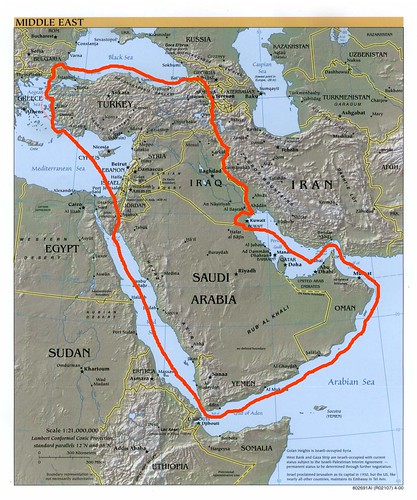
Those who have been paying attention know that the world's largest oil reserves are in Iraq. Greg Palast is (in a way) one of those people, and he has a brief history lesson on the old "red line" agreement and many of the subsequent maneouvrings to make sure most of Iraq's oil has stayed right where it is.
I can’t make this up:
In a hotel room in Brussels, the chief executives of the world’s top oil companies unrolled a huge map of the Middle East, drew a fat, red line around Iraq and signed their names to it.
The map, the red line, the secret signatures. It explains this war. It explains this week’s rocketing of the price of oil to $134 a barrel.
It happened on July 31, 1928, but the bill came due now.
Barack Obama knows this. Or, just as important, those crafting his policies seem to know this. Same for Hillary Clinton’s team. There could be no more vital difference between the Republican and Democratic candidacies. And you won’t learn a thing about it on the news from the Fox-holes.
Let me explain.
In 1928, oil company chieftains (from Anglo-Persian Oil, now British Petroleum, from Standard Oil, now Exxon, and their Continental counterparts) were faced with a crisis: falling prices due to rising supplies of oil; the same crisis faced by their successors during the Clinton years, when oil traded at $22 a barrel.
The solution then, as now: stop the flow of oil, squeeze the market, raise the price. The method: put a red line around Iraq and declare that virtually all the oil under its sands would remain there, untapped. Their plan: choke supply, raise prices rise, boost profits. That was the program for 1928. For 2003. For 2008.
Again and again, year after year, the world price of oil has been boosted artificially by keeping a tight limit on Iraq’s oil output. Methods varied. The 1928 “Redline” agreement held, in various forms, for over three decades. It was replaced in 1959 by quotas imposed by President Eisenhower. Then Saudi Arabia and OPEC kept Iraq, capable of producing over 6 million barrels a day, capped at half that, given an export quota equal to Iran’s lower output.
In 1991, output was again limited, this time by a new red line: B-52 bombings by Bush Senior’s air force. Then came the Oil Embargo followed by the “Food for Oil” program. Not much food for them, not much oil for us.
In 2002, after Bush Junior took power, the top ten oil companies took in a nice $31 billion in profits. But then, a miracle fell from the sky. Or, more precisely, the 101st Airborne landed. Bush declared, “Bring’m on!” and, as the dogs of war chewed up the world’s second largest source of oil, crude doubled in two years to an astonishing $40 a barrel and those same oil companies saw their profits triple to $87 billion.
In response, Senators Obama and Clinton propose something wrongly called a “windfall” profits tax on oil. But oil industry profits didn’t blow in on a breeze. It is war, not wind, that fills their coffers. The beastly leap in prices is nothing but war profiteering, hiking prices to take cruel advantage of oil fields shut by bullets and blood.
I wish to hell the Democrats would call their plan what it is: A war profiteering tax. War is profitable business – if you’re an oil man. But somehow, the public pays the price, at the pump and at the funerals, and the oil companies reap the benefits.
Indeed, the recent engorgement in oil prices and profits goes right back to Bush-McCain “surge.” The Iraq government attack on a Basra militia was really nothing more than Baghdad’s leaping into a gang war over control of Iraq’s Southern oil fields and oil-loading docks. Moqtada al-Sadr’s gangsters and the government-sponsored greedsters of SCIRI (the Supreme Council For Islamic Revolution In Iraq) are battling over an estimated $5 billion a year in oil shipment kickbacks, theft and protection fees.
The Wall Street Journal reported that the surge-backed civil warring has cut Iraq’s exports by up to a million barrels a day. And that translates to slashing OPEC excess crude capacity by nearly half.
Result: ka-BOOM in oil prices and ka-ZOOM in oil profits. For 2007, Exxon recorded the highest annual profit, $40.6 billion, of any enterprise since the building of the pyramids. And that was BEFORE the war surge and price surge to over $100 a barrel.
It’s been a good war for Exxon and friends. Since George Bush began to beat the war-drum for an invasion of Iraq, the value of Exxon’s reserves has risen – are you ready for this? – by $2 trillion.
Nevertheless, oilman George W. Bush opposes it as does Bush’s man McCain. Senator McCain admonishes us that the po’ widdle oil companies need more than 80% of their windfall so they can explore for more oil. When pigs fly, Senator. Last year, Exxon spent $36 billion of its $40 billion income on dividends and special payouts to stockholders in tax-free buy-backs. Even the Journal called Exxon’s capital investment spending “stingy.”
At today’s prices Obama’s windfall tax, teeny as it is, would bring in nearly a billion dollars a day for the US Treasury. Clinton’s plan is similar. Yet the press’ entire discussion of gas prices is shifted to whether the government should knock some sales tax pennies off the oil companies’ pillaging at the pump.
More important than even the Democrats’ declaring that oil company profits are undeserved, is their implicit understanding that the profits are the spoils of war.
And that’s another reason to tax the oil industry’s ill-gotten gain. Vietnam showed us that foreign wars don’t end when the invader can no longer fight, but when the invasion is no longer profitable.
Posted
by Big Gav
in
clinton,
obama,
politics,
us
Grist has a "green take on Super Tuesday", looking at the contrast between the Democrat and Republican front runners.
Coming out of Super Tuesday's primaries and caucuses in 22 states, the Republicans are looking ever more likely to nominate their most eco-conscious candidate, John McCain, who was the big GOP winner of the day. But green issues don't seem to have played much if any role in the Republican voting, and McCain didn't reference anything environmental in his speech to supporters at the end of the night. In contrast, Hillary Clinton and Barack Obama -- who are still running oh so close -- both made impassioned calls for environmental action in their speeches on Tuesday.
"I see an America where we stand up to the oil companies and the oil-producing countries, where we launch a clean energy revolution and finally confront the climate crisis," said Clinton, who also praised "businesses who are training people for green-collar jobs" and "the auto companies and the auto workers who want higher gas-mileage cars so we can compete with the rest of the world." Said Obama, "[W]e will harness the ingenuity of farmers and scientists and entrepreneurs to free this nation from the tyranny of oil once and for all and we will invest in solar and wind and biodiesel, clean energy, green energy that can fuel economic development for generations to come." And the race goes on ..
Crikey's Guy Rundle has also been following the primaries and was mighty impressed with
Obama's latest speech.
So far, Obama's taken nine states, some, like Georgia, he could have reasonably banked on, but in some he's absolutely stormed in, like the 73% result in Kansas, and the 67% in Minnesota. But he's also gained a surprisingly strong showing in New York, taking almost 40% from Clinton -- this all matters because of the arcane way in which the delegates are being awarded on the Democratic side.
In fact MSNBC is now saying that delegates could be a 50/50 split, although with 6% of the votes counted in California, Clinton is leading about 2 to 1. But whatever result she gets, it's a win for Obama – and a guarantee that the next months are going to be an absolutely grueling campaign for every last delegate – including the 22 or so to be selected by the Democrats Abroad primary over the next few days. Clinton spoke about half an hour ago, and she sounded wooden and depleted – as she would, having actually taken fewer states than Obama. Obama's speaking now – the networks cut off the end of McCain's speech to get the start of Obama's, which is about as symbolic as it gets – and he sounds like he just cranked it up a notch.
It's a new speech -- not his stump, thank Christ -- and it's expert, effortlessly moving from the general, to the empowering ("This is not about what I'm doing, it is what you are doing – because you are tired of the failure, tired of the lies ..." etc) and then onto the specifics, the mother foreclosed on, the soldier going on another tour in a war that never should have been waged. God it's a good speech, like Bach perfectly played, every part fitting together, every note struck at exactly the right strength.
It feels like you're watching the moment in the race when the second runner hits the front and magically draws out the energy of the leader as they're passed. You can count off every technique outlined by Saul Alinsky, the Chicago activist who was Obama's inspiration – from the particular to the general, the pregnant pause, turning it round from speaker to audience, the parable that leads to the invocation, taking the story through to the call to action – "we are the people we have been waiting for to change the world. The time is unlike any other. Let's go to work!"
The mention of Alinsky reminded me of this MSNBC article from last year on Hillary's "
hidden thesis" (the only time I've ever heard of him) - maybe Obama and Clinton aren't all that far apart in their inspirations. That said, both are hard to make out, as their sniping session a while back (about Hillary being an ex-WalMart board member and Obama being backed by a Chicago "slumlord" - and one soon to go on trial at that) demonstrated. Certainly neither seem to have any friends on the far left, who you would think would still admire Alinsky.
The senior thesis of Hillary D. Rodham, Wellesley College class of 1969, has been speculated about, spun, analyzed, debated, criticized and defended. But rarely has it been read, because for the eight years of Bill Clinton’s presidency it was locked away.
As forbidden fruit, the writings of a 21-year-old college senior, examining the tactics of radical community organizer Saul D. Alinsky, have gained mythic status among her critics — a “Rosetta Stone,” in the words of one, that would allow readers to decode the thinking of the former first lady and 2008 presidential candidate. ...
Rodham’s thesis describes trying to pin him down on his personal philosophy: “Alinsky, cringing at the use of labels, ruefully admitted that he might be called an existentialist,” she wrote. Rodham tried to ask him about his moral relativism — particular ends, he said, often do justify the means — but Alinsky would only concede that “idealism can parallel self-interest.”
In her paper, she accepted Alinsky's view that the problem of the poor isn't so much a lack of money as a lack of power, as well as his view of federal anti-poverty programs as ineffective. (To Alinsky, the War on Poverty was a “prize piece of political pornography,” even though some of its funds flowed through his organizations.) “A cycle of dependency has been created,” she wrote, “which ensnares its victims into resignation and apathy.”
In formal academic language, Rodham offered a “perspective” or muted critique on Alinsky's methods, sometimes leaving unclear whether she was quoting his critics or stating her own opinion. She cited scholars who claimed that Alinsky's small gains actually delayed attainment of bigger goals for the poor and minorities.
In criticizing the “few material gains” that Alinsky engineered — such as pressing Kodak Co. to hire blacks in Rochester, or delaying the University of Chicago's expansion into the Woodlawn neighborhood — Rodham placed part of the blame on demography, the diminishing role of neighborhoods in American life. Another part she laid charitably to an Alinsky character trait: “One of the primary problems of the Alinsky model is that the removal of Alinsky dramatically alters its composition," she wrote. "Alinsky is a born organizer who is not easily duplicated, but, in addition to his skill, he is a man of exceptional charm."
In the end, she judged that Alinsky's “power/conflict model is rendered inapplicable by existing social conflicts” — overriding national issues such as racial tension and segregation. Alinsky had no success in forming an effective national movement, she said, referring dismissively to “the anachronistic nature of small autonomous conflict.”
Putting Alinsky's Rochester symphony threat into academic language, Rodham found that the conflict approach to power is limited. “Alinsky's conclusion that the ‘ventilation’ of hostilities is healthy in certain situations is valid, but across-the-board ‘social catharsis’ cannot be prescribed,” she wrote.
She noted, however, that he was trying to broaden his reach: In 1969, Alinsky was developing an institute in Chicago at his Industrial Arts Foundation, aimed at training organizers to galvanize a surprising target: the middle class. That was the job he offered to Hillary Rodham.
Though some student activists of the 1960s may have idolized Alinsky, he didn't particularly idolize them. At the time Hillary Rodham brought him to Wellesley in January 1969 to speak at a private dinner for a dozen students, he was expressing dissatisfaction with New Left protesters such as the Students for a Democratic Society. One of his criticisms, surprisingly, was their tactical mistake of rejecting middle-class values.
Rodham closed her thesis by emphasizing that she reserved a place for Alinsky in the pantheon of social action — seated next to Martin Luther King, the poet-humanist Walt Whitman, and Eugene Debs, the labor leader now best remembered as the five-time Socialist Party candidate for president.
“In spite of his being featured in the Sunday New York Times," she wrote of Alinsky, "and living a comfortable, expenses-paid life, he considers himself a revolutionary. In a very important way he is. If the ideals Alinsky espouses were actualized, the result would be social revolution. Ironically, this is not a disjunctive projection if considered in the tradition of Western democratic theory. In the first chapter it was pointed out that Alinsky is regarded by many as the proponent of a dangerous socio/political philosophy. As such, he has been feared — just as Eugene Debs or Walt Whitman or Martin Luther King has been feared, because each embraced the most radical of political faiths — democracy.”
Sidebar: ALINSKY's RULES FOR RADICALS - "Personalize it"
Saul Alinsky's rules of power tactics, excerpted from his 1971 book "Rules for Radicals: A Practical Primer for Realistic Radicals"
1. Power is not only what you have but what the enemy thinks you have.
2. Never go outside the experience of your people.
3. Whenever possible go outside the experience of the enemy.
4. Make the enemy live up to their own book of rules.
5. Ridicule is man's most potent weapon.
6. A good tactic is one that your people enjoy.
7. A tactic that drags on too long becomes a drag.
8. Keep the pressure on.
9. The threat is usually more terrifying than the thing itself.
10. Maintain a constant pressure upon the opposition.
11. If you push a negative hard and deep enough it will break through into its counterside.
12. The price of a successful attack is a constructive alternative.
13. Pick the target, freeze it, personalize it, and polarize it.
Back to Guy Rundle at Crikey, who also has some comments about
global warming policy and tornados.
"If you are Mitt Romney you can't say this is a good night."
"Well, if you're Mitt Romney you've entrenched your vote among conservatives ..."
"Nooooo - if you're Mitt Romney you can say you've got good hair – that's all you can say."
- MSNBC exchange last night.
It tore across the heart of the country, ripping up everything in its path – no, it wasn't the Mike Huckabee express, it was a brace of tornados that the rest of the country barely noticed until all the votes had been counted. When the Super Tuesday storm died down, the death toll of the real storm was 50.
I'm not the type to point to every weird weather episode as evidence of climate change – but an increasing number of Americans are, and that includes the insurance companies. Millions of homes across the west's tornado alley and on the Gulf coast are uninsurable, effectively destroying their value. If anything was likely to remind Americans of the last eight years of torpor and failure, it's this perfect storm, the economy meeting the environment, your sub-prime mortgage home you can't afford the payments on suddenly being unsellable because no one wants to buy a future pile of matchwood.
The increasing perception that the environment is getting up and walking around the joint in great big boots has undoubtedly been great for McCain, who's been the only Republican to really campaign on the issue - although of course he's talked about it a lot more in states with open primaries rather than in the hardcore GOP-only zones. Huckabee has also been leaning on the Biblical notion of stewardship of God's earth to carve a furrow between the evangelicals and a policy they regarded as communism not so long ago.
Only Mitt Romney is giving out that guffawing Chamber of Commerce rhetoric ("Hey – it's global warming! Why should we pay for it all?"), constructing the environment as an add-on, a position as 80s nostalgic as big floppy hair and an interesting Peter Carey novel. That isn't the only reason why Mitt tripped – he pretty much screwed up on everything, and Huckabee's relentless southern barnstorming wore the foundations away.
McCain has so far picked up 613 delegates, with Romney on 270 and Huckabee on 190. McCain seems to have been pretty sure it would fall out that way, which is why he spent so much time campaigning in Romney's home state Massachusetts, hoping to land the killer blow. Mitt won that 41 to 30%, but all the pundits have begun the deathwatch. There's not a chance he'd get the VP slot – there'd be a McCain-Noam Chomsky ticket before that happened. Indeed, McCain's in a hell of a dilemma VP-wise, since any choice that might blunt Obamappeal – Condoleeza Rice has been spoken of (though she has such a Bush taint that may be hype) – would simply drive the evangelicals further away. But a McCain-Huckabee ticket would put a man who believes angels guide bullets to their targets, one icy-path-shattered hip away from the nuclear button.
Really I was hoping Romney would get the nomination, because a Clinton/Obama v Romney stoush would be like a grudge match between a real person and a piece of whitebait on a string. If McCain can knock Romney out early, he can start attacking the Democrats and the race will come right in. Unless Huckabee scarfs up Romney's delegates in toto, and really lays a number on him from the Right.
For the Democrats, Obama's performance was very much in the tornado mode, as a glance at the results show. With the exception of her home state, Clinton's victories were all in the 50-60% range. Obama's numbers by contrast were huge, hitting high sixties and seventies in states as diverse as Georgia, Minnesota and Kansas.
The results clearly demonstrate that white Democrats will get behind him – though whether the swinging voters he needs in the mid-west will follow remains to be seen – and Camp Obama is also claiming that they have a lot more scope for fundraising over the next months, saying that Hillary Clinton has tapped out the $2000 maximum on her supporters, while Obama's crowd have been giving in hundred and fifties here and there. Indeed news has just come in that Clinton has put $5 mill of her own cash in (as a "loan") to her campaign, and staff are working for no salary (Bill, it should be noted, has earnt $40 million from speeches over the past few years. Working without pay is like running a garage sale for the Ceaucescus).
The Democrat race is going to go on and on – Hillary wasn't being cute when she tipped her hat to American Samoa in her speech last night. A plurality could easily come down to primaries in Puerto Rico or the currently underway Democrats Abroad primary – although if it gets that close the Convention will be a very ugly fight about credentials, voting irregularities etc etc. That's routine convention behaviour, and not enough to cause a serious rift in the party – unless Clinton, or realistically the Clintons, try to get the Florida and Michigan delegates seated.
Both states were stripped of their delegates for moving their primaries to earlier than Super Tuesday, and all candidates agreed not to campaign in those states. Then on the eve of a South Carolina primary she knew she was going to lose, Hillary started making noises about "ohhhhh it's terrible that all these people are going to be unrepresented" and then bent the rules by flying to Flordia for a "victory" party on the night of the dead primary.
If the Clintons made a real effort to seat these delegates, it will sour the entire run. If they manage to seat them, it would plunge the party into crisis. Are the Clintons that crazed that they would put the party through that. Why that'd be as crazy as ... as ... swapping your second term effectiveness for an executive chair BJ, or sending a 6000-page health care bill to Congress, scorning all tactical advice.
Mark Morford at the San Francisco Chronicle also turns out a few witty phrases from time to time, and he is also pondering the Clinton / Obama matchup - an Exxon's record profits - in "
Dead soldiers, peak oil and mind-boggling profits; praise Jesus, the machine's still working".
Surprisingly moving Barack Obama music videos? The potential end of the writer's strike? Cute young deer being saved by helicopters? No no no no no. Here are your most deeply inspiring news stories of the month:
A flurry of pink slips fluttered over the job sector as corporate payrolls were sliced like sour pie. Foreclosures are skyrocketing and new home sales across the nation are plummeting faster than Britney Spears' serotonin levels. A nasty recession is either creeping or flooding in, depending on your perspective and how recently you purchased your home and/or tried to dump your Google stock.
Meanwhile, the largest corporation in the world, the one which has consistently raked in the largest and most appalling profits of any organization on Earth, a company so powerful and deeply influential to the machinations of our own nation, our government, the globe, so ingrained and unstoppable that no president, no administration, no nuclear warhead to its CEO's home planet stands a chance of slowing it down or altering its behavior in any significant way because there is simply far, far too much money involved in its nefarious endeavors, has recently posted the largest profit of any company in American history.
Yes, the Exxon Mobil corporation sucked in a staggering $11.7 billion in a single quarter (more than $40 billion for the year, a new record for an American company) thanks largely to record-breaking prices for a barrel of oil, which are of course only record-breaking because, well, the Bush administration has essentially engineered the economy and launched a bogus war and desiccated the American idea exactly so they would be.
Oh yes, two more trifling stories, buried beneath the nauseating Exxon headlines and the tales of looming economic struggle: More U.S. soldiers are dead in Iraq as a result of Bush's failed war, U.S. military spending in 2009 will reach its highest levels since WWII ($515 billion), insurgents have taken to strapping suicide bombs to mentally retarded women and nearly 100 more civilians are dead in another bombing in Baghdad because the U.S. troop surge is working so well. Oh wait.
Do you feel the righteousness? The inspiration? Can you sense the deep connection between these stories? Because the truth is, they merely add up to the heartwarming conclusion that, without a doubt, American capitalism is still firing on all cylinders. Praise!
Yes, the system is working just exactly as those in control of the nation right now wish it to be working, with the most dominant, ruthless corporations in the world (Exxon joined by Shell, Chevron, BP, ConocoPhilips et al) still making the most money in the most destabilizing and environmentally devastating manner possible, while poor uneducated kids die like chattel in unwinnable wars trying to secure a tiny bit more of the source of their profit.
And somewhere in between, the nation's overall health and well-being are sacrificed like dazed lambs to an ignorant god, with our government offering up only the most meager, desultory efforts to keep it functional so as to not induce all-out fire-and-pitchfork revolt.
Is that too simplistic? Too reductive? Not even close. Hell, you can distill it down even further. For if you understand, as most sentient creatures on the planet now do, that this "war" is merely a particularly bloody chunk of a particularly brutal, fraudulent national energy policy spearheaded by Dick Cheney and beloved by Saudi Arabia and Halliburton and most of Texas, then it is no stretch at all to say that we are sending American kids to their deaths exactly so Exxon can continue to make $3 billion in a single month (or: $100 million per day, $4 million per hour, or more than $1,000 every. Single. Second).
Or how about this for dark math: $40 billion for the year, 4,000 dead U.S. soldiers ... that's a cool $10 million in pure profit for every American soldier BushCo has thrown to the wolves of petroleum, just for 2007 alone. Even if you factor in the 20,000 wounded, paralyzed and brain damaged U.S. soldiers — not to mention the record number of military suicides — on a body-by-body basis, you've still got yourself one hell of a sweet profit margin. See Dick Cheney's vile, crooked little grin? Now you know where it comes from.
This, you might argue, is perhaps the bleakest way to look at American capitalism, as an instrument of war and death and gluttony that serves only the most cretinous corporate masters at the expense of, well, everyone else. This is the capitalism of the hard right, a particularly ruthless type that happily sacrifices quite literally everything — the environment, health, human life, God, national identity, the stability of future generations — for the sake of immediate and unchecked profit.
It is the kind of system, furthermore, that brings with it a huge, nauseating sense of shame for how we have approached the world, pouring a vague disgust over the nation like a cancerous sludge. This is perhaps BushCo's cruelest gift of all: tragically convincing us that this strain of capitalism, a furious weapon of greed and disgrace, inviting all manner of corruption and destruction as it brings out the absolute worst in the human animal, is the only flavor there really is.
But then again, no. Maybe there's something else, a flipside we've forgotten amid the insane oil profits and dead bodies and global mistrust. It's the awkward truism that American capitalism is potentially capable, despite its dark core of profit, despite its frequently poisoned heart, of tremendous creative opportunity and ingenuity. Like porn, like God, like wisdom and plutonium and very, very dark rum, it's all in how you use it.
Here, then, is perhaps the most dominant question surrounding the upcoming big transition, as the nation prepares over the next year to finally rid itself of the cancer of Bush: Are we still capable of reshaping the capitalist demon, injecting it, on a national scale, with something like conscience and compassion and responsibility, sans the need to sell your mother, rape Alaska, or bomb ancient cities and kill pathetic foreign dictators in a pitiable attempt to vindicate your dad? Is such a turnaround even possible anymore?
Because this nasty truth remains: Bush or no, Exxon and its nefarious, insanely powerful ilk are ramming full speed ahead, undertaking more incredibly brutal, land-raping techniques as you read these very words to get at the Earth's remaining supply of oil, sucking up tar sand and coal and anything else possible to maintain profit and power. They are, and will continue to be, utterly relentless and, at least for a number of years to come, quite unstoppable.
There is no eliminating the dark side of capitalism, the gluttony and the greed and the violent underbelly. There is only minimizing, shifting the emphasis, changing the pitch and angle of approach, trying to take what is, at its very heart, a flawed and self-destructive system, and making it into something proud and interesting and vibrant, something actually worth defending.
Can it be done? Is it still possible? No matter how many poetic Barack Obama speeches, no matter how many pragmatic Hillary Clinton promises, it's a question that seems far bigger than both of them. And the truth is, it's really the only question that matters.


 Posts
Posts