Record Oil Prices Can't Make Biofuels Profitable  

Posted by Big Gav

The Australian reports that Australian Biodiesel Group has joined Australian Renewable Fuels in mothballing a number of biodiesel plants, with high feedstock prices outweighing high oil prices. Axiom Energy seems to think it can succeed where others have failed though, pushing ahead with a new plant in Geelong.

AUSTRALIAN Biodiesel Group has sold a plant and cut staff because of unprofitable production. It is the second Australian producer of the fuel to reduce output in a week, amid a surge in feedstock prices. It would sell other assets and would resume production only when doing so would improve its finances, the Sydney company told the Australian Securities Exchange yesterday. The Narangba plant in Queensland would be kept on standby, it said.

Australian biodiesel capacity, which more than quadrupled last year amid optimism over demand for clean-burning fuel, outstripped production fivefold after tax changes reduced sales. Last week, Australian Renewable Fuels, another producer, halted production at its two plants because of losses. "It's not surprising with the way feedstock prices have increased," said Graeme Bethune, chief executive of Adelaide consultancy Energy Quest. ...

The slump followed a 71 per cent drop in the price of Australian Renewable Fuels on November 5 after it announced the closure of its plants. Most other Australian-listed biodiesel companies, including Natural Fuel, Babcock & Brown Environmental Investments and Sterling Biofuels International, are at or near record lows. Mission Biofuels, an Australian company building a biodiesel plant in Malaysia, is the only stock trading above its offer price.

Prices of tallow, a feedstock for biodiesel, have risen in the past six months to more than $900 a tonne from less than $600, Perth-based Australian Renewable said on November 2. "Under current market conditions and government policy settings, the cost of producing biodiesel exceeds the price it can be sold for," Australian Biodiesel (ABG) said yesterday. "ABG believes there is a good case for the current unsustainable situation to be rectified by governments adopting policies that are common overseas."

Ronald Bailey at Reason is blaming soaring oil prices on under-investment in oil production capacity, but doesn't think social meltdown is imminent.
Crude oil prices hover between $90 and $100 per barrel and U.S. gasoline prices are again north of $3 per gallon. Since 2002, the price of a barrel of oil has risen more than four-fold. Are we running out of oil?

A new report by the German think tank Energy Watch Group (EWG) says so. The EWG report argues that the world reached the peak of oil production last year and supplies will fall from about 81 million per day now to just 39 million by 2030. "The world is at the beginning of a structural change of its economic system. This change will be triggered by declining fossil fuel supplies and will influence almost all aspects of our daily life," declared EWG founder Joerg Schindler. This fast onset of oil supply shortfalls, warns the EWG report, could trigger the "meltdown of society."

At the heart of the EWG analysis is its drastic downward revision of estimated world oil reserves.

...Higher prices do generally mean that supplies are becoming relatively scarcer. So what is causing today's scarcity? Most people have forgotten that by the mid-1990s, the price of oil dropped to around $10 per barrel. Why? Because the world was awash in oil relative to demand. The oil crisis of the 1970s provoked so much field development that there was a 25 percent excess capacity. Low prices also meant that there was very little incentive to invest in projects to increase supply. For example, when oil prices collapsed in the 1980s, the number of exploratory drilling rigs in the United States fell from 4500 to under 1000.

At the beginning of the 21st century, economic growth in India and China surged after they finally managed to shrug off the shackles of socialist planning. Strong world economic growth soaked up the excess production capacity, which has now fallen to around 2.5 million barrels per day. Generally a cushion of 5 million barrels per day is necessary to keep prices low. Most of the excess capacity is in Saudi Arabia. The world currently consumes about 86 million barrels per day.

...Instead of the "meldown of society," a likely and painful scenario is that greedy and incompetent government oil producers will continue to under-invest, causing a shortfall in supplies that will drive up prices and provoke a global economic slowdown. Expensive oil also encourages consumers and businesses to invest in energy efficiency that will combine with the slowdown to cut demand. Reduced demand will drive down oil prices as steeply as they rose. Some day peak oil production will be reached, but most oil reserve estimates suggest that there are good reasons to doubt that that day is now at hand.

Ralph Nader, on the other hand, thinks that oil prices have manipulated by speculators and the oil industry.
Question of the day: who and what is determining the price of oil and your gasoline and home heating bills? Don't ask Uncle Sam, because George W. Bush and Dick Cheney are running a regime marinated in oil that does not issue reports which explain the real determinants of petroleum pricing beyond the conventional supply-demand curves.

First, let us create a historical framework to provide some background. In the good 'ole oil days, before the producer-countries' cartel in the Third World gained pricing power, there were seven giant oil companies called the 'seven sisters' led by Standard Oil (now Exxon) and Shell. As chronicled in Robert Engler's classic book, The Brotherhood of Oil, they were able to affect pricing through extra-market means. Economists called them a tight oligopoly.

...Today, a third party has moved to the table-the New York Mercantile Exchange, a similar operates in London and a new one in Dubai. There, boisterous traders buy and sell futures contracts on the delivery of oil. But as Ben Mezrich, the author of the new book Rigged said recently, the dollar amounts of these futures contracts are far far larger than the actual oil deliveries they represent as they turn over and over at the Mercantile Exchange.

So now the critical resource of oil is driven by speculation at ever higher abstract electronic levels of futures trading. Increasingly, the distance becomes greater and greater between this abstract trading (fueled by rumors of storms in the Gulf of Mexico, or some possible political turmoil in a region of the world, or some other frightful excuse for bidding up) and the physical supply and demand for oil and its refined products.

These oil gamblers in New York and London try to justify their frenetic daily bidding by saying that these futures markets provide liquidity, and a clear price for oil. Alright, but who benefits when, how and where?

Certainly, the strain between physical supply and demand in recent years does not explain such extreme volatility. With OPEC countries down to supplying only 40 percent of the world production, Chinese demand for oil growing fast, and the expansion of production by Saudi Arabia and others to meet this demand, crude oil supplies are not tight enough to explain such pricing behavior.

Bart at Energy Bulletin notes that both are simply viewing the world through their ideological lenses. I have a fair amount of sympathy for both interpretations personally - and they aren't necessarily mutually exclusive. Its probably important to remember that geology is just one factor determining when oil production peaks - and the other 2 (economics and politics) are often more important.
It's interesting to compare Ralph Nader and Ronald Bailey's analyses. Both find an someone to blame, appropriate to their political positions. Ronald Bailey focuses on "greedy and incompetent government oil producers." Nader blames speculators, oil companies and "oil-indentured politicians."

The Age has a report noting that most Australians would be happy with - higher bills for clean energy.
NEARLY nine out of 10 Australians are prepared to pay more for energy if the extra revenue is spent developing clean energy sources to combat climate change, a global poll has found.

The BBC World Service poll found that among developed countries, Australia had the highest proportion of people — four out of five — who believed the cost of "harmful" energy sources such as coal and oil had to go up to encourage individuals and industry to use less. More than three out of five — 61 per cent — favoured raising taxes on coal and oil no matter what the additional revenue was spent on; this figure leapt to 87 per cent if the money was to be spent on making energy more environmentally friendly.

I was somewhat staggered to see Dr Karl has admitted he made a mistake in his recent comments about "clean coal". Carbonsink had pointed out the fairly large error in Dr Karl's maths at the time, to which I'd cynically retorted "he's a politician now - of course he is lying - his lips are moving". But it turns out it was an honest mistake and he's apologising and conceding clean coal may have a short term transition role as we move to clean energy sources.
Dr Kruszelnicki, a NSW senate candidate for the Climate Change Coalition, told The Australian: "I was wrong. We're very happy to admit our mistake on that."

The error comes from incorrect data found in the first edition of Australian of the year Tim Flannery's best-selling climate change book The Weather Makers, which has subsequently been corrected. "We're stuck with the fact that we have still got to make electricity in the short term from carbon of some sort," he told the paper. "Something is better than nothing, so sequestering carbon dioxide is better than just letting it go out. I see it as a stop-gap, short-term thing rather than a long-term solution because the more you store it away the more the chance that it will escape," he said.

I haven't done a joke for a while, but I liked this story from "OnceFueled" at TOD today.
GOD AND ST. FRANCIS DISCUSSING LAWNS

GOD: Francis, you know all about gardens and nature. What in the world is going on down there? What happened to the dandelions, violets, thistle and stuff I started eons ago? I had a perfect, no-maintenance garden plan. Those plants grow in any type of soil, withstand drought and multiply with abandon. The nectar from the long lasting blossoms attracts butterflies, honey bees and flocks of songbirds. I expected to see a vast garden of colors by now. But all I see are these green rectangles.

ST. FRANCIS: It's the tribes that settled there, Lord. The Suburbanites. They started calling your flowers "weeds" and went to great lengths to kill them and replace them with grass.

GOD: Grass? But it's so boring. It's not colorful. It doesn't attract butterflies, birds and bees, only grubs and sod worms. It's temperamental with temperatures. Do these Suburbanites really want all that grass growing there?

ST. FRANCIS: Apparently so, Lord. They go to great pains to grow it and keep it green. They begin each spring by fertilizing grass and poisoning any other plant that crops up in the lawn.

GOD: The spring rains and warm weather probably make grass grow really fast. That must make the Suburbanites happy.

ST. FRANCIS: Apparently not, Lord. As soon as it grows a little, they cut it-sometimes twice a week.

GOD: They cut it? Do they then bale it like hay?

ST. FRANCIS: Not exactly, Lord. Most of them rake it up and put it in bags.

GOD: They bag it? Why? Is it a cash crop? Do they sell it?

ST. FRANCIS: No Sir. Just the opposite. They pay to throw it away.

GOD: Now let me get this straight. They fertilize grass so it will grow. And when it does grow, they cut it off and pay to throw it away?

ST. FRANCIS: Yes, Sir.

GOD: These Suburbanites must be relieved in the summer when we cut back on the rain and turn up the heat. That surely slows the growth and saves them a lot of work.

ST. FRANCIS: You aren't going to believe this Lord. When the grass stops growing so fast, they drag out hoses and pay more money to water it so they can continue to mow it and pay to get rid of it.

GOD: What nonsense. At least they kept some of the trees. That was a sheer stroke of genius, if I do say so myself. The trees grow leaves in the spring to provide beauty and shade in the summer. In the autumn they fall to the ground and form a natural blanket to keep moisture in the soil and protect the trees and bushes. Plus, as they rot, the leaves form compost to enhance the soil. It's a natural circle of life.

ST. FRANCIS: You better sit down, Lord. The Suburbanites have drawn a new circle. As soon as the leaves fall, they rake them into great piles and pay to have them hauled away.

GOD: No. What do they do to protect the shrub and tree roots in the winter and to keep the soil moist and loose?

ST. FRANCIS: After throwing away the leaves, they go out and buy something which they call mulch. They haul it home and spread it around in place of the leaves.

GOD: And where do they get this mulch?

ST. FRANCIS: They cut down trees and grind them up to make the mulch.

GOD: Enough. I don't want to think about this anymore. St. Catherine, you're in charge of the arts. What movie have they scheduled for us tonight?"

ST. CATHERINE: "Dumb and Dumber", Lord. It's a really stupid movie about.....

GOD: Never mind, I think I just heard the whole story from St. Francis.


Links:

* SMH - Oil price creates a new world order
* Jeff Vail - On Odalisques and Obelisks (e.g. Bartiromo & Yergin)
* WSJ - Winter-Heating Crisis Looms
* Business Green - Firms are playing with matches over biofuel
* Clean Break - Geothermal: flourishing under the shadow of solar
* After Gutenberg - Bye-Bye, Ballard
* WSJ - Marvell to Unveil Energy-Saving Chip
* Truveo - Glacier Surfing Alaska
* Reuters - US GMO rice caused $1.2 bln in damages -- Greenpeace
* David Poulson - How to be a good source of environmental (or peak oil) news
* AP - Skepticism Greets New US Africa Command
* SMH - Deadliest year so far for US military in Iraq
* The Times - Blair 'knew Iraq had no WMD'. Robin Cook and David kelly speaking from the grave...
* Washington Post - Former Technician 'Turning In' AT&T Over NSA Program
* Cryptogon - Mark Klein on AT&T/NSA Domestic Surveillance Program: “The NSA is Getting Everything.”

Flight Patterns  

Posted by Big Gav

Via NPR

Geothermia Revisited  

Posted by Big Gav in , , ,

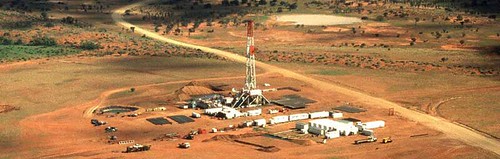
Australian geothermal energy company Geodynamics was an unusual subject of attention in the energy press last week, after cornerstone shareholder Origin Energy expanded their stake in their Cooper Basin hot rocks project, including Geodynamics' giant Lightning drilling rig, Australia's biggest onshore rig.

Origin is hoping to leverage its experience in gas exploration, production and power generation and exposure to geothermal power generation in New Zealand.

I've been following the (slow) progress of this endeavour for a number of years now, as the field has the potential to supply a large amount of clean energy over a considerable period of time.

Geodynamics was floated on the stock exchange back in 2002 and has been drilling in the Cooper Basin ever since. Origin believes the company had the best potential of the several Australian geothermal proposals and that "geothermal energy will play an increasing role in the security the world's future for clean energy".

The company has been working towards tapping heat from granites buried up to 5km underground between Innamincka and Moomba to generate electricity. Geodynamics aims to bring in a pilot one megawatt generator at the site within 12 months. Further drilling should enable a decision in 2009 to invest in a 50 megawatt demonstration plant. If successful, that would be followed by a 500-megawatt plant operating by 2016.

The project has been delayed by heat and pressure problems, which have caused drilling difficulties and led to the construction of the specialised drill rig - and to the departure of founding CEO Bertus de Graaf, who is now with uranium company Uranoz and looking to develop the Limestone Coast geothermal energy project elsewhere in South Australia and prospects in the India state of Maharashtra and in Kyrgyzstan.

The Kyrgyzstan development is reported to have very hot granites at relatively shallow depths - estimated to be between 2km and 3km compared to the 4km to 5km depth of the Geodynamics project.

Geothermal energy is unusual compared to other large renewable power sources, in that it provides "baseload" power (thus placating those suffering from the "baseload fallacy") unlike other more intermittent sources like solar, wind and ocean power.

Tim Flannery dubbed this region of South Australia "geothermia" last year, pondering a future where a large proportion of the nation's power supply comes from the region, with an industrial and mineral processing hub developing to exploit the large quantities of energy available.

Imagine an Australia that decides to build on this natural wealth, creating a centre for minerals processing and natural gas conversion by using emissions-free power. Imagine linking the north-south railway with Queensland and Western Australia in order to bring bauxite and other minerals to the processors, and then to market them through the Port of Darwin. Imagine the exports of gas and of processed minerals from the mammoth Olympic Dam mine, which is nearby. And finally, imagine Australia with a fully linked and freight rail and electricity grid, all powered from zero-emissions sources. If you can do this, then you can imagine a nation transformed from climate-change pariah to leader in the fight for the survival of our planet.

All of this would require a new city in the desert - let's call it Geothermia. What might it look like? I imagine a solar collector towering over a low-rise city, providing shade and conserving soil moisture. Perhaps the infrastructure would be underground. Geothermia would be a city not of thousands but of hundreds of thousands - a place with its own critical mass. And most importantly it would be a fully sustainable city - Australia's very first.


Flannery appeared on "Democracy Now" recently to talk about global warming, geothermal energy and the geothermia vision.
AMY GOODMAN: Talk about geothermia and the hot rocks.

TIM FLANNERY: Well, look, it is so important that we get this new industrial revolution happening and move from the dirty fossil fuels to clean sources of energy. One of the most promising is geothermal energy. You know, it’s an old source, really. We’ve had some geothermal plants around the world for a long time. But recently there’s been astonishing discoveries of massive reserves of heat energy in the earth's crust. One of the biggest is in Australia. And I’ve proposed to our government that we try to exploit this clean and sustainable energy resource to run a lot of our heavy industrial needs, such as mineral processing. We could have a new city in central Australia that I’ve sort of called Geothermia, you know, based around the use of this resource, and use our national rail system to bring in minerals to be cleanly processed and then shipped out.

AMY GOODMAN: Now, explain how this was discovered, where it is in the earth.

TIM FLANNERY: Look, it’s in the most dismal spot in Australia. It’s right in the dead center of our continent, near Lake Eyre, which is a huge salt pan, and it’s four kilometers down in the earth. And it was discovered by an oil and gas company, who had discovered a ring of oil-bearing rocks and then a ring of gas-bearing rocks and, in the middle of this, really hot rocks.

They spent hundreds of millions of dollars drilling. And being an oil and gas company, they thought, “We like the oil, we like the gas, but these hot rocks, we can just post that information publicly.” And, of course, someone else came up and said, well, the amount of energy in the hot rocks is actually probably a hundred times greater than the energy in the oil and gas they discovered, so this is the real gem. And so, they got a free ride. They got a couple hundred million dollars worth of free drilling, and now they're going out trying to exploit this resource.

And we’ll know by Christmas, I think, whether this can be successfully done. The second drill bit is now deep in the earth. It’s getting close to those hot rocks. And if we can get circulation happening of the hot fluids, as projected, then we will have unlocked an enormous energy resource at about the price of coal. And that will change everything for Australia.

AMY GOODMAN: And how long would it last?

TIM FLANNERY: If you run the whole Australian economy on it, it will last at least a century. And that’s the one deposit, you know. This is -- there’s ten companies looking for more of these hot rocks in Australia now. And in China there’s great prospects, as well. There’s prospects in Europe and, doubtless, in parts of the US. So as we shift away from coal and take a medium to long-term view, we can’t just imagine the choices between clean coal technologies and nuclear power. There are other very formidable sources of power that can deliver large volumes of what’s called baseload electricity, you know, the stuff you need twenty-four hours a day, at low cost.

AMY GOODMAN: Let's talk about your proposals around a green electrical grid, green transportation.

TIM FLANNERY: Yeah, look, we know that in order to beat this problem we have to reduce our emissions on the order of 80% in the next forty years. Now, forty years might sound like it’s a long way off, but it isn’t really, you know. I suppose just to drive home to people what that means, it means that in forty years from now we can’t be driving cars that are fueled with fossil fuels, with oil. We can’t be generating our electricity by burning coal and natural gas. We have to have shifted decisively from those polluting sources of power to clean sources of power. So that’s why the race is on now for new affordable takes to harness energy of the sun, which is massive, to harness wind energy, wave energy, geothermal energy, all of these sources that will drive this new clean and prosperous economy of ours, if we can reach out, make the investments and push forward to avoid dangerous climate change.


The idea of shifting energy intensive industries to areas where there is abundant renewable energy (which is a good way to hedge against rising fossil fuel prices) is one which has started being put into practice already, with aluminium (sometimes called "congealed electricity") producers looking to set up smelters close to hydro power stations in Canada, Iceland, Greenland, and the Congo.

If HFR geothermal turns out to be practical on a large scale, South Australia may be a big beneficiary of this trend, as it also has high potential for generating power from solar and ocean (wave) energy - not to mention the world's largest uranium mine and some residual (albeit declining) oil and gas production. Another region which may have large scale generation potential is the Hunter Valley region, conveniently located next to a lot of existing coal fired power stations.

Other companies looking to development geothermal energy in Australia include:
  • Petratherm - looking to develop another HFR resource in northern South Australia, initially to power the Beverley uranium mine. Managing Director Terry Kallis expects the cost of power "to consumers would be somewhere between $50 to $60 a megawatt hour or five to six cents per kilowatt hour". The company is also looking to develop projects in China.
  • Green Rock Energy - operating in the area around the Olympic Dam mine and in Hungary
  • Scope Energy (now part of Uranoz) - looking to develop a 100MW plant near Millicent in the south-east of South Australia. Principal Roger Massey-Greene expects the cost of power to be "very competitive with combined-cycle gas power plants"
  • Torrens Energy
  • Pacific Hydro
  • Greenearth Energy
  • Osiris
  • Eden Energy
  • Geopower


The industry is already fighting against "clean coal" backers for government funding and has formed the Australian Geothermal Energy Association, representing at least 16 companies operating in the sector. The organisation will have its inaugural meeting on November 21.

More data about geothermal resources in Australia is being gathered by Geoscience Australia's Geothermal energy project and the Research Institute for Sustainable Energy (RISE).

Background

Geothermal energy has been used for centuries for heating, cooking, and medicinal bathing. The first geothermal power generation plant was constructed in 1904 in Larderello, Italy, followed by Wairakei, New Zealand in the 1950's then the Geysers in California in the 1960’s.

There is currently an estimated 12,000 MW of direct use and over 8,000 MW of power generation using geothermal resources around the world. This generation capacity represents about 0.4% of the world total. The US is the largest producer, followed by the Philippines, Mexico, Indonesia, Italy, Japan and New Zealand.

If heat recovered by ground heat pumps is included, the non-electric generating capacity of geothermal energy is estimated at more than 100 GW (gigawatts of thermal power) and is used commercially in over 70 countries.


Existing geothermal power generation is sometimes called "wet" geothermal power - using natural hot water sources close to the surface to generate power using energy conversion technologies like dry steam, flash steam and binary cycle systems.

Hot Dry Rock / Hot Fractured Rock (HFR) power is still at the experimental stage, with the Geodynamics project being the most advanced in terms of commercial development. Besides the various projects underway in Australia, Swiss company Geopower Basel has tried drilling under the city of Basel - however this has been halted due to concerns about the drilling causing earthquakes - and other experiments are being performed in Germany and the french village of Soultz-sous-ForĂȘts.

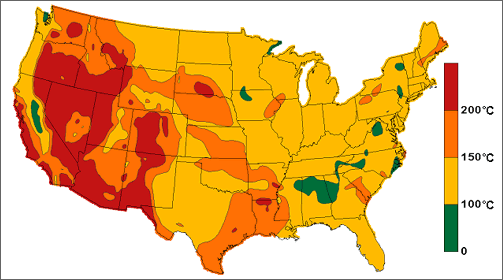
An MIT led study (funded by the US Department of Energy) last year said that if 40 percent of the heat under the United States could be tapped, it would meet demand 56,000 times over. The report estimated that an investment of $800 million to $1 billion could produce more than 100 gigawatts of electricity by 2050, equaling the combined output of all 104 nuclear power plants in the US.

The report noted that geothermal energy is important for several key reasons:

* fossil fuels (coal, oil and natural gas) are increasingly expensive and consumed in ever-increasing amounts
* oil and gas imports from foreign sources raise concerns over long-term energy security
* burning fossil fuels dumps carbon dioxide and other pollutants into the atmosphere

Herman Kahn was also very enthusiastic about the potential of geothermal energy, rating it as by far the largest available power source we have, dwarfing any demand for energy we are likely to have even with a massively increased population.

Technology Review had an interview with the MIT report author Jefferson Tester last year which noted that the amount of energy available is "thousands of times more than we now consume each year".
The figure for the whole world is on the order of 100 million exojoules or quads [a quad is one quadrillion BTUs]. This is the part that would be useable. We now use worldwide just over 400 exojoules per year. So you do the math, and you know you've got a very big source of energy.

How much of that massive resource base could we usefully extract? Imagine that only a fraction of a percent comes out. It's still big. A tenth of a percent is 100,000 quads. You have access to a tremendous amount of stored energy. And assessment studies have shown that this is thousands of times in excess of the amount of energy we consume per-year in the country. The trick is to get it out of the ground economically and efficiently and to do it in an environmentally sustainable manner.

A recent report from the Geothermal Energy Association (pdf) showed that the amount of geothermal power being generated is already increasing significantly.
"The number of countries producing geothermal power and total worldwide geothermal capacity under development appear to be increasing significantly in the first decade of the 21st century," according to the report. "The number of countries producing power from geothermal resources could increase 120 per cent, from 21 in 2000 to as many as 46 in 2010. Total geothermal capacity online could increase over 55 per cent, from 8,661 megawatts in 2000 to 13,500 megawatts or more."

New Zealand

New Zealand’s geothermal generating capacity (as of 2000) of over 400 MW (far exceeding that of Australia currently). The coutry has significant expansion plans for new geothermal power generation. New permits have been approved for a 60 MW power station in the Wairakei-Tauhara geothermal field and a 70 MW plant at the Kawerau field, with more permits expected to be issued in the future as part of the country's move to be the world’s first carbon neutral nation. Rod Oram reports the country could easily increase geothermal generation by a factor of 4.

Iceland

Byron King at The Rude Awakening recently had a look at the prime mover towards the use of "hot and steamy" geothermal energy - Iceland. Byron notes that the country is now energy self sufficient and is a good example of locations with large renewable energy supplies attracting energy intensive industries (one recent case in point is companies like Microsoft and Cisco considering using the country to host "green server farms").
When it comes to harnessing geothermal power, the go-to place on the planet right now is the Republic of Iceland. Yes, Iceland. It is a large island at high latitude, composed mostly of dense basalt lava flows. Iceland straddles the Mid-Atlantic Ridge, which provides that country with an almost direct link to the primordial heat energy within the mantle of our planet. And that is one all-but-immeasurable store of energy. Thus, Iceland is the world’s leading nation in terms of exploiting its local geothermal power resources. In Iceland, the insiders refer to the process of extracting geothermal energy as “heat-mining,” and they are getting rich from the effort.

Recently, the president of Iceland, Olafur Grimsson, visited the U.S. to speak at a number of events and testify before the U.S. Senate Committee on Energy and Natural Resources. In a speech delivered at Harvard on Sept. 26, President Grimsson emphasized the importance of geothermal energy to the economy and society of Iceland. He stated that Iceland has undergone a “radical transformation” from dependence on coal and oil in the past 30 years. As recently as the 1970s, Iceland was among the poorest countries within what was then known as the European Common Market (now called the European Union). That is, by most measures of gross domestic product and other economic output, Iceland was an economic laggard.

But then Iceland made a conscious, strategic commitment to develop its domestic geothermal energy resources. From large industrial projects down to the level of family housing, Iceland focused its public and private energy investment on making a geothermal energy vision into an energy reality. Now, according to what President Grimsson told his Harvard audience, Iceland is one of the most affluent nations in the world. Fully 100% of Iceland’s electricity now comes from renewable sources, geothermal and hydroelectric, and almost all buildings in Iceland are heated with geothermal energy. On the whole, about 72% of Iceland’s total energy usage is tied to geothermal sources, which eliminates essentially all carbon emissions and dramatically reduces reliance on imported fossil fuels of any type.

According to President Grimsson, Iceland has “turned this [geothermal power production] into an extremely profitable business.” For example, electricity is so inexpensive in Iceland that there is a booming business on the island that imports bauxite from the Caribbean area for the purposes of refining aluminum, a highly energy-intensive process.

In comments after his prepared speech at Harvard, President Grimsson expressed his “astonishment” at the utter paucity of geothermal power generation in the U.S., merely 0.3% of all electricity generated across 50 states. And much of that power comes from one location in California, called the Geysers. President Grimsson noted that the U.S. sits atop “the second largest geothermal resources in the world, following only Indonesia.”

President Grimsson concluded that by harnessing the “fireball on which we sit,” mankind could revolutionize energy production across the globe.


Iceland is not only making extensive use of its own geothermal resources but is looking to export technology and expertise to other promising regions, including Indonesia, the Philippines and the US - particularly a new company called Reykjavik Energy Invest.

Indonesia

With its hundreds of active and extinct volcanoes, Indonesia has the potential to produce an estimated 27,000 MW of electricity from geothermal sources. Reuters recently reported that Chevron is looking to expand its geothermal generation capacity in the country as part of the country's efforts to tap alternative energy sources to meet rising power demand and to cut consumption of crude oil as its own reserves dwindle.

Simon Sembiring, the Indonesia director general of geothermal and mineral resources, said earlier this year many foreign firms were interested in investing in geothermal energy projects in Indonesia, with the Icelandic invasion now underway - Reykjavik Energy Invest have already signed a preliminary deal to develop a geothermal power plant with Indonesian oil company Pertamina.

The Philippines

Another country astride the 'ring of fire" is The Philippines, where Chevron also run a number of geothermal power plants (including Tiwi, which is currently impacted by water shortages). The country currently generates around 8% of its electricity from geothermal energy - and another 15% from hydro power - making it the world's second largest producer of geothermal power.

The Icelanders are also looking to help expand the local industry here, with officials from Reykjavik Energy Invest visiting recently to discuss partnering in the development of other geothermal areas and bidding for a stake in power company PNOC-EDC (along with 23 other groups).

Papua New Guinea

Another country in the Asia-Pacific region looking to exploit geothermal energy is PNG, where gold miner Lihir Gold already has a geothermal plant powering mine operations. Bismarck Energy managing director Karl Yalo recently appealed to the PNG government to encourage geothermal power as high and rising fossil fuel prices hit the local economy hard.
“Several developing countries have well-entrenched geothermal plants complimenting traditional energy sources, thereby increasing energy output and enhancing economic growth. In PNG, we have seen the Lihir Gold Mine increase its base load capacity through geothermal energy, thereby reducing substantially use of fossil fuel and consequently converting the savings to sound profit,” Mr Yalo said.

Mr Yalo said numerous naturally occurring hot steams throughout New Britain and New Ireland showed the abundance of these opportunities and that serious consideration had to be given to examining the commercial development of geothermal as an alternative energy source particularly given the present high crude oil prices.

He appealed to the National Government to support the project as it will contribute meaningfully to the national economy through fiscal and other benefits. “With world crude oil price now trading at a record US$90 per barrel, there is no price relief in sight. “I believe fossil fuel prices will not come down to the late 90’s prices. The end result is that countries like PNG whose economies depend entirely on fossil fuel, will continue to face economic hardship, particularly people in the rural communities where bulk of them reside,” Mr Yalo said.

United States

While the US today makes only limited use of geothermal energy, it has a number of areas containing large energy resources, particularly Alaska and western states like California and Nevada. The Intermountain West Geothermal Consortium estimates geothermal resources of around 13,000 MW in the western states.

Producing geothermal power from oil and gas wells in the Gulf of Mexico is also being considered.


The largest geothermal plant in the US (and the world) at present is in Northern California, generating enough power for 800,000 homes, with the plant currently undergoing further expansion.

Iceland's Glitnir Bank plans to invest $1 billion in U.S. geothermal energy projects over the next five years in order to exploit some of the $40 billion market that they predict will develop over the next 25 years.

Another company from Iceland, Iceland America, plans to develop geothermal plants in the Salton Sea area in California.

While geothermal power generation is relatively limited in the US so far, passive use of geothermal energy in the form of ground heat pumps appears to be quite widespread, with estimates ranging between 500,000 and 1 million units already installed - Oklahoma is apparently leading the way in this regard.

Mexico

Mexico is currently producing around 950 MW - about 3% of the country's annual electricity consumption. By 2010 it is expected that an addition 220 MWe will be available - the total capacity of known resources is estimated at around 8,000 MW.

Germany

Hochtief and Exorka are looking at opportunities in the Molasse Basin of Bavaria.

The Scramble to insure against more oil price rises  

Posted by Big Gav

The FT has a look at the "Scramble to insure against more oil price rises".

Energy consumers and speculators are scrambling to take out options contracts to insure themselves against oil prices rising above $100 a barrel – a further sign of growing expectations of a spike in the crude market.

Some have even taken out contracts to protect themselves against prices rising to $250 a barrel in the next two years. The buying frenzy has been “extraordinarily” strong in the past week as oil prices rose to a record high of $96.24 a barrel, according to traders and bankers. “Options calls of strikes well over $100 a barrel are being bought by the thousands,” said Nauman Barakat of Macquarie Futures in New York.

The strong flows in call options – contracts that give the right to buy at a predetermined price and date – are boosting short-term oil prices as the banks that sell them have to hedge some of their positions by buying crude oil in the spot market.

There has already been a sharp increase in the number of outstanding options contracts, or “open interest”, at the New York Mercantile Exchange. This represents only a fraction of the overall market, which is concentrated on over-the-counter deals.

Links:

* The Oil Drum - When Will Russia (and the World) Decline?
* The Oil Drum - Peak oil coverage on CNBC
* The Energy Blog - Total Chief Warns of Peak Oil
* RealClimate - Is the ocean carbon sink sinking?
* The Oil Drum - The Kipper Gas Field: Our CO2 Future
* Clean Break - Is the fuel-cell car dead?
* The Energy Blog - Gore Nightmare Wins as Europe Pays to Ship U.S. Coal
* Reuters - Tibetans wake up to nosebleeds in super-dry autumn
* TreeHugger - Red Cross To Georgia: 'Be Ready For Drought Emergency With 10 Cases Of Bottled Water Per Person'
* Douglas Adams - Don't Panic

Cooking In Cloncurry  

Posted by Big Gav in , , ,

The SMH has a report on a solar thermal power project in Queensland - "Cloncurry so hot it's first on the solar block" no doubt helped along by Andrew McNamara.

IT'S HOT in Cloncurry. Bloody hot. Hot enough to power the homes for all the outback town's 4828 residents with heat from the sun. That is what the Queensland Government is hoping to do with a $7 million solar thermal power station that would make the former copper mining town the first in Australia to rely completely on solar power.

The Queensland Premier, Anna Bligh, yesterday announced the north-west Queensland town had been chosen as the site for a "groundbreaking" 10-megawatt plant that will use 8000 mirrors to reflect sunlight onto graphite blocks. Water will be pumped through the blocks to generate steam that will operate a turbine electricity generator. ...

"This is an example of the diversity of clean energy that is available in Australia because of the renewable resources at our disposal," said the energy council's chief executive, Dominique La Fontaine.

An Australian company, Lloyd Energy Storage, designed the unique graphic-block storage system. A forest of mirrors, each three metres by two metres, will reflect the sun's rays up into 50 10-tonne blocks perched atop 15-metre towers. Enough heat will be stored in the blocks to service peak daytime needs and overnight demand. Less water than falls in an average year on the power station's roof will be used in the turbine.

The project follows a decision last year by the Federal Government to give $75 million to a $420 million project to build a large-scale solar concentrator in Mildura in Victoria. That project is expected to start next year and reach full capacity by 2013. Using high-performance solar cells developed to power satellites, it could power as many as 45,000 homes.

The IHT has an update on the bioplastic industry - "Bioplastics have a small but growing market".
For Dennis McGrew, chief executive of NatureWorks, the high price of crude oil and natural gas is not unwelcome news. NatureWorks, formerly Cargill Dow, produces a plastic made from plant stalk, not fossil fuel. McGrew, a former plastics executive at Dow Chemical, says that as prices for fossil fuels soar and as the environment becomes an ever larger concern, ecofriendly plastics are becoming increasingly competitive, though they still remain a niche market.

That bioplastics are trending upward is clear. In the past month, a number of large chemical concerns have increased their commitment to market segment, including Braskem, the largest Brazilian petrochemical group, and Dow Chemical. In September, Plantic Technologies of Australia announced that DuPont would market its starch-based resins and sheet plastics in North America, a new market for a company previously limited to selling in Europe and Australi

Biopact reports that scientists have found a way to convert biodiesel byproduct glycerin into ethanol.
Recently, a way to connect the ethanol and biodiesel industries was revealed when it was determined that biodiesel could be a value-added product for ethanol plants through corn oil extraction technology (previous post). But now the link is reversed: researchers at Rice University in Houston have developed a way to convert glycerin (glycerol), a byproduct of biodiesel production, into ethanol. Both sectors are now linked and could create synergies that make both more efficient.

The glycerin-to-ethanol pathway is seen as promising, which is why the scientists behind it formed Glycos Biotechnologies to commercialise it. Once considered a valuable co-product, crude glycerol is rapidly becoming a 'waste product' with a disposal cost attributed to it - a result of the biodiesel boom. ...

The implications of this research are so promising that the process may be commercialized before cellulosic ethanol. Gonzalez partnered with Paul Campbell, who researches, develops and markets blends of microbes for industrial, agricultural and environmental markets, to form Glycos Biotechnologies Inc. The company, which was funded by Houston-based venture capital fund DFJ Mercury, expects to complete its pilot plant in early 2008.

TreeHugger has a post on "Using Sweet-Toothed Bacteria to Produce Hydrogen".
Aside from crop-based biofuels, few sectors of renewable energy have attracted as much attention as microbial fuel cells. With companies like LS9 and Amyris leading the way, the idea of engineering bacteria to produce new sources of energy has become an increasingly marketable one as gas prices continue to soar.

This high level of interest has also prompted a groundswell of new research in universities and government-funded science institutions aimed at finding ways to make these nascent technologies more practical and efficient. Scientists from Washington University and the Agricultural Research Service (ARS) recently formed a partnership to study how electrochemically active, biomass-eating bacteria could be used in microbial fuel cells.

Mike Cotta, who leads the ARS Fermentation Biotechnology Research Unit, and Lars Angenent, an assistant professor at WU, will use the Microbial Culture Collection - an ARS-funded database with accessions from about 87,000 freeze-dried bacteria from around the world - to specifically isolate anaerobic bacteria that could help produce hydrogen. Electrochemically active bacteria are able to transfer electrons from fuel cell sugars - which, after traveling through a circuit, can be combined with protons in a cathode chamber to form hydrogen. This can then be burned or converted directly into electricity.

Two taxa that are showing early promise include Bacteroides and Shewanella.

TreeHugger also has a demoralising report on the state of the oceans - "Increasingly Acidified Waters Could Prompt Mass Shellfish Dissolution".
If present acidification trends in the world's oceans continue unabated, mussels, oysters and other shellfish could become extinct as early as 2100. Carol Turley, a researcher at the Plymouth Marine Laboratory, is warning that these mass casualties could have severe repercussions for humans and the health of ocean ecosystems. "A lot of shellfish are an important food source for fish as well as humans. The impacts of shellfish disappearing could be massive," she explained in a recent address.

Increasing levels of dissolved carbon dioxide hinder the ability of shellfish to build their protective shells by significantly reducing the amount of free carbonate in the water. Shellfish typically absorb calcium carbonate from their surroundings and deposit it around their bodies to make their shells; higher levels of carbon dioxide, however, limit the amount of available carbonate - which otherwise could bind to free calcium ions - by forming more bicarbonate ions.

This effect is especially pronounced in deeper waters, where extremely low levels of carbonate ions, paired with higher hydrogen ion concentrations, have caused shellfish shells to actively dissolve. Indeed, several recent studies have noted a worrying rise in the Carbonate Compensation Depth (CCD), a level below which the rate of supply of calcium carbonate equals that of dissolution.

For very much the same reason, coral reefs are also likely to be hit hard as coral polyps struggle to build the tough skeletons they need to protect themselves and provide habitats for a wide variety of organisms. Fish are also likely to not escape unscathed as acidification harms their ability to fertilize their eggs.

Links:

* Technology Review - Betting on Biocrude
* Red Herring - Wind Power Gets Gust of $16M
* The Long Now - NY Times Magazine: “The Future is Drying Up”
* UPI - Duke Energy faces water shortage
* Richard heinberg - Big melt meets big empty: Rethinking the implications of climate change and peak oil
* TreeHugger - Farewell to "Flush and Forget"
* TreeHugger - The Latest on the Disappearing Honeybee Mystery
* ABC - Press freedom declining: audit
* The Australian - Our slide into secrecy and censorship


Kopi Luwak  

Posted by Big Gav

REA reports that tidal energy is coming to Nova Scotia - one of those truly massive unharnessed renewable energy sources.

In an effort to harness the huge tidal currents of Nova Scotia's Bay of Fundy, British company Marine Current Turbines (MCT), the developer of SeaGen, has signed an agreement with Canada's Maritime Tidal Energy Corporation (MTEC). The companies plan to submit a joint proposal to the Nova Scotia Department of Energy to deploy MCT's SeaGen technology in the Bay of Fundy, which has one of the greatest tidal resources in the world.

Martin Wright, Managing Director of MCT said, "Working with MTEC in Canada, we will be using our unrivalled knowledge and experience from our 1.2 MW SeaGen commercial tidal system as well as our previous work with our 300kW SeaFlow tidal project in the Bristol Channel, the world's first offshore tidal stream device, to tap the massive potential that exists in the Bay of Fundy."

MTEC representative Ron Scott added, "MTEC can become a frontrunner in terms of in-stream tidal power development for the Bay of Fundy, and eventually elsewhere in the Atlantic Provinces and North America. This is a golden opportunity for Nova Scotia, which the Nova Scotia Government fully recognizes, to provide the lead in marine energy generation in North America, moving away from carbon based fuel systems."

The Nova Scotia Department of Energy plans to have tidal turbines operating in the Bay of Fundy during 2009. The Bay of Fundy is located on Canada's eastern seaboard.

WorldChanging has an article on Germany leading the way on renewables - setting a 45% target for 2030.
In July, Germany's Ministry for the Environment, Nature Conservation, and Nuclear Safety released a draft progress report on the country's Renewable Energy Sources Act. The Act, adopted in 2000, establishes an advanced "feed-in tariff" in Germany, enabling any company or individual who meets the technical and legal requirements to sell renewable electricity into the power grid for a guaranteed, long-term price for each kilowatt-hour sold. "The Renewable Energy Sources Act is the most important and successful instrument to promote the expansion of renewable energies in the electricity sector," the report notes.

The report's findings indicate significant advances in Germany's renewables sector, including:

* The share of electricity from renewable energy sources nationwide has increased from 6.3 percent in 2000 to 12 percent in 2006.
* The Act resulted in the avoidance of 45 million tons of carbon dioxide (CO2) emissions in 2006, up from 37 million tons avoided in 2005.
* All renewable energy used in Germany--for electricity, heat, and transport fuel--avoided the release of more than 100 million tons of CO2 in 2006.
* More than 9 billion euros (US$12.7 billion*) was invested in new renewable energy installations in Germany in 2006.
* Approximately 240,000 people in Germany were employed in the renewable energy sector in 2006, representing a 40-percent increase over 2004. More than half of these jobs were created by the Renewable Energy Sources Act.

The report also finds that the net economic benefits of renewable electricity in Germany amount to about 6 billion euro ($8.5 billion) per year. While renewable electricity costs the nation's consumers an estimated $3.3 billion euros ($4.7 billion) annually in differential costs (the cost premium of renewable over conventional power) and the provision of energy balancing (balancing electricity generation and demand), the government estimates that its benefits are far higher. The economic benefits of renewable energy totaled more than 9 billion euro ($12.7 billion) in 2006, including fuel-import savings of 0.9 billion euro ($1.27 billion), avoided environmental and health damages worth approximately 3.4 billion euro ($4.8 billion), and a decline in wholesale electricity prices amounting to 5 billion euro ($7 billion).

By some estimates, renewables will provide about 14 percent of Germany's gross electricity consumption by the end of this year, well ahead of official targets for 2010. As a result of this success, in July the German government increased its targets for renewable energy to 27 percent of electricity by 2020 (up from 20 percent) and at least 45 percent by 2030. Germany's success with the feed-in law has also prompted several other countries around the world to adopt advanced feed-in laws.

The SMH reports that New York is set to tax carbon emissions. Mike Bloomberg seems to be one of those rare politicians who actually understands the intersection of global warming and economics - the correct way to fix the problem is carbon taxes.
New York City Mayor Michael Bloomberg proposed a national "pollution pricing" plan that would tax companies directly for the greenhouse gases they release. "If you really want to reduce carbon emissions, tax carbon at the source, which would mean at the mine head, at the oil well, whatever," Bloomberg told more than 100 other mayors at a climate summit sponsored by the US Conference of Mayors.

Bloomberg suggested a fee of $US15 ($A16.5) for every ton of greenhouse gas companies emit, with the money used to reduce payroll taxes and finance tax credits for companies that reduce their greenhouse gas pollution. Greenhouse gases such as carbon dioxide and methane trap the sun's energy, warming the Earth's surface and lower atmosphere.

Bloomberg's plan is similar to one already proposed by Democratic presidential hopeful Senator Chris Dodd. Bloomberg said the voluntary and unenforceable emissions targets favoured by President George W Bush are "like voluntary speed limits - doomed to fail." He also said another carbon-reduction approach known as cap-and-trade, which many Democratic candidates have endorsed, is a flawed solution and could create bidding wars.

The Guardian has a look at the British Environment Agency's list of 50 ways to save the planet. Some of the top 20 look dubious to me (16 and 17 in particular) and many others could all be wrapped up in to 1 concrete action - institute carbon taxes.
The full list is published on Monday in the Environment Agency's quarterly magazine Your Environment (environment-agency.gov.uk). To comment on the list, or suggest your own ideas, visit guardian.co.uk/environment, where you can also sign up to the Guardian's new Tread Lightly eco-pledge project.

The top 20: What the panel prescribes

1 Dramatically improve the energy efficiency of electrical goods
2 Religious leaders to make the environment a priority for their followers
3 Encourage the widespread use of solar power throughout the world
4 Secure a meaningful post-Kyoto treaty on reducing the emissions that contribute to global warming
5 Encourage households to generate much more of their own power
6 Introduce tax incentives to "buy green"
7 Tackle the rapid growth in aviation emissions
8 Wean ourselves off dependency on petroleum
9 Encourage individuals to buy less non-essential "stuff "
10 Dramatically improve public transport
11 Aim for a "zero waste" culture
12 Install "smart energy" meters in all homes
13 Introduce a measure of economic success that includes the environment
14 Fully harness Britain's huge potential for generating renewable energy
15 Seek alternative, less damaging sources for biofuels
16 Bury carbon dioxide from power stations underground
17 Encourage hydrogen fuel cell technology in cars
18 Implement government policies to control global population growth
19 Reach international agreement on preserving rainforests
20 Create better incentives to improve energy efficiency in the home

The SMH notes that while the drought may be pushing up basic food prices, "top-end restaurants, bars and food shops are still finding that there is an insatiable demand for their most expensive goods". Apparently my local coffee shop sells the most expensive coffee in town - but I'm not sure I want to try it, even if I did feel like spending that much on a coffee...
The most exclusive coffee in Sydney is Kopi Luwak, available at $50 a cup from Rob Forsyth's shop in Naremburn. It is made in Indonesia from coffee beans that have been eaten and excreted (whole) by a possum-like marsupial called a luwak. The 10-centimetre slabs are then dried, broken up, cleaned and roasted for a brew which is - apparently - exceptionally smooth. Mr Forsyth said: "We do get people coming in to drink it but I think it's more because of the hype than the taste."

Links:

* Energy Bulletin - DOE publishes poster: "Peak Oil - the Turning Point"
* David Strahan - Total boss on why oil production will never top 100 mb/d
* The Oil Drum - ANZ News 4 November
* REA - Banking on Green Energy
* PhysOrg - Japan: Total Mobility Project Converts Standard Auto to Solar
* PhysOrg - Fowl play as scientists make power from chicken droppings
* Green Car Congress - Khosla and BIOeCON Form New Bio-Oil Joint Venture
* Auto Blog Green - Audi A3 TDIe crosses Australia at 71.3 mpg!
* TreeHugger - Is a Negative CO2 Footprint Possible For Bioplastic ?. See also Better Living Through Green Chemistry.
* Solar Rocks - Wanna Leave Solar Net-Metering Standards up to Utilities? Here’s What You Get.
* SMH - 'Unwelcoming' US sees sharp fall in visitors
* The Guardian - Déjà vu all over again

The only thing stopping renewable energy in Australia is policy  

Posted by Big Gav in , ,

The Australian reports that the Renewables energy industry backs Labor's target of 20% by 2020 for renewable energy.

THE renewable energy industry has predicted it can meet Labor's ambitious 20 per cent target by 2020, rebutting claims by conventional power generation companies that the target may be unachievable. The prediction came as conventional power generators disputed claims by Labor's environment spokesman, Peter Garrett, that he had consulted widely with industry before announcing the ambitious target. "There has been significant consultation with both (Labor energy spokesman) Chris Evans and myself," Mr Garrett said yesterday. "The views of industry have been listened to very, very intensely." ...

Mr Garrett said Labor decided to announce a target now and not wait until Ross Garnaut finished his economic analysis of emission trading and targets next year because the renewable energy industry was ready to move. "Why wait when we have a climate crisis on our hands?" Mr Garrett said. "Why wait when we have $20billion worth of investment just waiting to emerge?"

John Howard yesterday refused to confirm or deny the report in The Australian that former environment minister Ian Campbell wrote to him two years ago seeking an expansion of the Mandatory Renewable Energy Scheme. n his letter, then senator Campbell said the reluctance to lift targets risked undermining efforts to combat climate change and might force investors offshore. "I'm not going into discussions that may or may not have occurred," the Prime Minister told ABC radio yesterday. ...

Pacific Hydro spokesman Andrew Richards said the renewable industry was ready to spend the estimated $12billion needed to deliver Labor's renewable target. He said that although wind energy alone could meet the target, it was likely to be augmented with a range of other renewable technologies, including geothermal and biomass. "The only thing stopping 10,000 megawatts of wind energy in Australia is policy," he said.

Links:

* SMH - Loyalty to coal takes wind out of clean energy advocates' sails

The Hobbit Theory of Grid Modernization  

Posted by Big Gav

Smart Grid News is a great resource, but is generally pretty dry reading. However even electrical engineers can be playful at times - proved by this offbeat look at modernising the electrical grid - "The Hobbit Theory of Grid Modernization".

Theorem #1: In the midst of greatly troubled times, Pippin says, “We will always have the shire.” To which Merry responds, “The fires of Isengard will spread, and the forests of Tuckborough and Buckland will burn. And all that was once great and good in this world will be gone. There won't be a Shire, Pippin.”

Will we always have our customers? The trends show rapid growth in customers finding their own solutions for energy independence, show most innovations are taking place on the consumer side of the meter, and show electric prices will increase 50% over the next decade.

The very nature of the US culture regarding technology use is changing. It appears the industry is not matching this consumer interest in technology. Are we the rotary-dial phone in an iPhone world?

Theorem #2: "Do we really have to go through [Mirkwod]?" groaned the hobbit. "Yes, you do!" said the wizard, "if you want to get to the other side. You must either go through or give up your quest. There are no safe paths in this part of the world."

The traditional approach to a build-out of new transmission and distribution does seem to support that there are no “safe paths in this part” of the industry. Most of these lines have large impacts, yet they are needed. However, this should not diminish our search for alternative solutions that present less impact, cost, and / or future risk in our Integrated Resource Planning (IRP).

The natural human condition is to delay uncomfortable decisions. But, decisions about long-term strategy do not go away; they must be addressed. Plus, delays in decisions usually add risks to the process, not diminish them. So, moving the industry along a path that addresses the robust trends in the industry by adding more technology solutions and shared/consumer-involved solutions is a decision that should be embraced now.

Theorem #3: "If more of us valued food and cheer and song above hoarded gold [as the hobbits do], it would be a merrier world."

The industry’s overriding focus on rates may lead us to missing the point with customers. There are places in the US where customers pay more for more reliability, more green power, and more services. The next generation of electric customers have completely different goals for electric service than we who grew up during the massive build-out of the industry; but that is another story.

Problem with the Hobbit Theory?

Last month we discussed “cathedral thinking” from the aspect of change over time. We need to be on the correct side of cathedral thinking. Large cathedrals could take 75 years to complete, but last more than 1,000 years. Cathedral thinking means that we have to establish a proper vision, then stay the difficult course to achieving the vision over a long period of time. We should not apply “shire thinking” that once the cathedral is built, we do not have to do anything for 1,000 years. In the US, we aggressively built the electric delivery infrastructure for 40 years, then decided we will always have transmission capacity (the shire) and essentially stopped (including research).

The industry is pointing in a direction it has for forty years, which is actually a good example of cathedral thinking. But, the consumer has changed direction, so the industry and consumer are no longer (aligned) on the same path. Avoiding the discussion and decision, about hard issues such as alternatives to building large generation and transmission and empowering the consumer only widens the gap between the industry and consumers.

Assuming the consumer will pay 50% higher rates in 7 – 10 years on the current (traditional) path is a bad assumption not born out by the robust industry trends. During the period rates will climb 50%, the cost of distributed energy independence will continue to come down. You can plot the intersection. At that point, 7 to 10 years from now, it will be cheaper in many parts of the country to self-generate than to buy the service from the electric company. This is why we see such emphasis by consumer electronics and services industries on the consumer side of the meter; all providing alternatives to buying from the electric company. Can this lead to some utilities becoming irrelevant?

The Bottom Line

Elrond raised his eyes and looked at him [Frodo]; "This is the hour of the Shire-folk, when they arise from their quiet fields, to shake the towers and counsels of the Great. Who of all the Wise could have foreseen it?"

Could this be true of our industry? As we continue to raise the debate, will some part of the industry or segment of the consumer-base surprise us and take on the mantle of leading the industry to a modern grid that truly empowers the 21st century economy?

Green Car Congress has a post on the Flybrid Flywheel Hybrid System - an energy storage alternative to batteries.
Flybrid Systems has demonstrated that its high-speed spinning flywheel system can survive a crash test of the severity used for Formula One frontal impact testing.

The Flybrid kinetic energy recovery system (KERS) incorporates Continuously Variable Transmission (CVT) technology sourced from the partnership of Torotrak Plc and Xtrac. Xtrac is using Torotrak’s full-toroidal traction drive technology for use in kinetic energy recovery systems within the motorsport industry. The FIA have defined the amount of energy recovery for the 2009 season as 400kJ per lap giving the driver an extra 80hp over a period of 6.67 seconds.

The mechanical KERS system uses flywheel technology developed by Flybrid Systems to recover and store a moving vehicle’s kinetic energy which is otherwise wasted when the vehicle is decelerated. The combination of gearbox-variator and flywheel form part of the driveline assembly. Energy is received from the driveline through the Torotrak CVT as the vehicle decelerates, and is subsequently released back into the driveline, again through the CVT, as the vehicle accelerates.

Compared to the alternative of electrical-battery systems, the mechanical KERS system provides a more compact, efficient, lighter and environmentally-friendly solution.

Although flywheel systems are not new, installations tended to be heavy and the gyroscopic forces of the flywheel were significant. To overcome these issues,Flybrid uses a smaller and lighter flywheel that rotates at more than 60,000 rpm. This advance in speed has been made possible by several key inventions for which the company is seeking patent protection.

ComputerWorld reports the OLPC is experimenting with a cow-powered device to generate electricity for its low-cost XO laptop.
The One Laptop Per Child Project (OLPC) is toying with a novel source of power for its low-cost XO laptops: cows.

"We plan to drive a dynamo (taken from an old Fiat) through a system of belts and pulleys using cows/cattle," wrote OLPC's Arjun Sarwal, in an e-mail dated October 21 and posted to one of the group's discussion lists. Sarwal and others are now finalizing the design of the cow-powered generator.

The goal is to develop a low-cost energy source that can be used in Indian villages. Working in a village close to Mumbai, Sarwal said the group considered using solar energy but sunlight near Mumbai was not "consistently strong." There was not enough wind or running water nearby to use these as sources of power, and the cost of running a gas-powered motor was too high. "But the village had an abundance of cattle that were being used in the fields. So we decided to design something around that," Sarwal wrote in a subsequent e-mail.

Tyler Hamilton at Clean Break has a look at a nappy to diesel facility in Canada.
My Clean Break column in The Toronto Star this week is about plans to build a facility in Quebec that will process used diapers into oil, gas and char using a pyrolysis process. Engineering giant AMEC has been contracted to build the plant, which will take in used diapers (infant and adult) from hospitals and seniors homes. It makes sense. Pyrolysis is a great technology, but the key to making it work -- and by work I mean make a business out of it -- is to assure you have a steady supply of predictable feedstock that's not too expensive to collect and transport. When I say predictable I mean that the feedstock is the same. That is, no surprises like what you get with the mish-mash of stuff that comes from municipal solid waste. If you know the materials you're dealing with, it's easier to control the pyrolysis process and maximize its efficiency. Diapers are ideal for this reason -- all you've got is plastic, fibre, poop, and pee -- and in the case of collection and transportation, there's already a system in existence that you can piggyback. In fact, the company accepting the diapers will make money, not spend it, by charging a tipping fee to the company that does the diaper pickup and disposal for institutions. It's a model that could be replicated throughout industry with a wide range of materials -- if we thought about it.

The output is synthetic gas, a diesel-like oil and char. The gas can be used for power and heat during the pyrolysis process, the char can be used in a wide range of application (or simply mixed in depleted soils, thereby sequestering the high content of carbon inside), and the oil can be used for heating or electricity production, the latter potentially sold into the grid -- yet another stream of revenue. AMEC won't name the company that's doing this diaper-to-diesel project, but I hope it proves the model successful so that others can adopt it as well.

After Gutenberg has a post on Combined Heat and Power from Rice Husks.
Biopact reports on growing interest in the conversion of agricultural waste from rice farming into useful energy. After rice is harvested from the paddy and processed, there is a large amount of biomass waste. Ajinomoto will purchase rice hulls from farmers in the surrounding area, where large quantities of the hulls go unused. This will mark the first time, at an overseas production site, that the company has made use of biomass as a fuel.

According to the IEA’s Bioenergy Task 33 on thermal biomass gasification, the leftover rice husks have a relatively high energy content (18 GJ/ton - higher heating value). Roughly 280kg of hulls remain after the rice is processed, thus, each ton of processed rice could represent around 120 kWh of energy from waste.
By the end of 2008, Japan’s Ajinomoto Co., a global food processor, will switch from oil to rice hulls for most of the fuel consumed at one of its key seasonings plants in northern Thailand. The biomass resource is abundantly present in the region, but has no market value. Farmers and rice processors often simply burn the hulls as waste, which releases carbon dioxide into the atmosphere. Ajinomoto now wants to utilize the biomass in an efficient combustion system to power a large food plant and so cut back its own emissions.

Construction of such a system requires significant capital investment since the feedstock is subjected to high temperatures in the absence of oxygen levels, and a pressurized environment must be maintained. Ajinomoto is applying for the project to be registered as a CDM (Clean Development Mechanism) by the UN. In addition to UN certification, Ajinomoto is preparing to apply to the governments of Japan and Thailand to receive credit for emissions reduction.

Proponents of such biomass gasification argue that there is a net reduction in greenhouse gases due to the amount of fossil fuel not being mined, transported and burned to generate electricity for operation of the food plant in Thailand. Since core operation of the food plant is fermentation of sugars and starches extracted from sugar cane and cassava to produce seasonings, Ajinomoto wants to build a combined heat and power system similar to a project underway in Brazil. In addition to the biomass-fueled, steam-generated electric power plant, heat from the conversion will be utilized in the fermentation process.

Technology Review has an article on a Carbon-Free, Stackable Rental Car. Sounds like some of the ideas raised by Jamais in "The Problem Of Cars".
An MIT group hopes that its foldable electric vehicles will cut pollution, ease congestion, and thrive alongside a city's transportation system.

The Smart Cities group at the MIT Media Lab is working on two low-cost electric vehicles that it hopes will revolutionize mass transit and help alleviate pollution. Next week, the group will unveil a prototype of its foldable electric scooter at the EICMA Motorcycle Show, in Milan. A prototype for the team's foldable electric car, called the City Car, is slated to follow next year.

The MIT group sees the vehicles as the linchpin in a strategy that aims to mitigate pollution with electric power, expand limited public space by folding and stacking vehicles like shopping carts, and alleviate congestion by letting people rent and return the vehicles to racks located near transportation hubs, such as train stations, airports, and bus depots.

"We're looking at urban personal mobility in a much more sustainable way than the private automobile provides," says William Mitchell, director of the Smart Cities research group.

The group's strategy will efficiently solve the "last mile" problem without losing the virtues of the private automobile, Mitchell says. The last mile is that inconvenient distance between any major transit stop and a person's final destination. While a traditional automobile provides mobility on demand and gets you to your destination, its negative externalities--congestion and pollution--seem intractable.

At the heart of these vehicles is an omnidirectional robot wheel that the team has developed. The wheel encases an electric-drive motor, as well as suspension, steering, and braking systems. With no engine or mechanical parts between the wheels and the driver's controls, the system offers great flexibility in design. The driver can, in fact, fold the car up (see below image). Six to eight folded and stacked City Cars can fit into one conventional parking space. General Motors sponsored the development of the car.


Links:

* Clean Break - EEStor should talk. Doubts rising about their ultracapacitor technology.
* Smart Grid News - First Ever WiFi Linked Smart Metering Installation
* Smart Grid News - A Smarter Grid for India
* Physorg - New technology improves the reliability of wind turbines
* Cleantech.com - Chevron, NREL team up on algae biofuel
* TreeHugger - Garbage-Burning Oven Helps Clean Up and Power Kenyan Slum
* WorldChanging - Fish For Fuel
* The Oil Drum - ANZ News - Friday 2 November 2007
* Phil Hart - A Tale of Two Economists
* Bruce Sterling - The Oil of the 21st Century Is, Uh, Oil. "Just give it up, information wants to be worthless"
* Bruce Schneier - The war on different
* Tom Dispatch - Mike Davis, Who Really Set the California Fires?. "The shape of the shape-shifting arsonist has changed over the years: more or less in historical order, according to Davis, they have been Indians, sheepherders, tramps, Wobblies, Okies, 'Axis saboteurs', and, in our own time, environmentalists, gays and terrorists. The search for arsonists is, of course, on again..."
* PES - Who killed JFK Jr ?

The Daily Katabatic  

Posted by Big Gav in , , , ,

The NZ Herald has an interesting article about a proposed Antarctic wind farm (also noting that the wind strength on the coast south of Wellington is often greater).

Wellington is a tougher proposition for a wind farm than Antarctica, says a team exploring the possibility of building turbines at Scott Base. Experts from Meridian Energy have flown to the world's windiest continent to conduct feasibility tests around Scott Base, which three years ago was hit by a storm with wind gusts that exceeded 200km/h, destroying the base's wind vane.

Iain Miller, Antarctica New Zealand's Antarctic services manager, said if the windfarm went ahead, it would help power Scott Base and also the neighbouring United States base, McMurdo Station. "Interestingly enough, because of turbulence created by the landscape, the wind at Scott Base and McMurdo isn't as brutal as parts of New Zealand where there are windfarms," he told The Press. "Meridian is planning one on the southwest coast of Wellington where the wind speed and turbulence are worse."

If approved, the Antarctic windfarm would augment the diesel generators used to power the two bases. The high cost of transporting fuel to Antarctica, including use of icebreakers to create a shipping channel for the tanker, made wind energy a more economical prospect than in New Zealand. The NSF did a feasibility study four years ago of wind power at McMurdo Station and found it could save up to 1.2 million litres of fuel each year.

Another place with plenty of wind is South Dakota, which the Seattle PI reports is about to become a "mammoth wind farm". It really is big.
Plans for the world's largest wind farm, proposed to be built in South Dakota, have become more grandiose. South Dakota is officially rated No. 4 in the nation for the potential capacity to make electricity from wind, although the ranking is more than a decade old. Many industry officials believe the Great Plains state is the windiest of all.

Clipper Windpower of Carpinteria, Calif., intends to erect enough wind turbines in several South Dakota counties to produce up to 6,000 megawatts of electricity, said Bob Gates, the firm's senior vice president of commercial operations. That would be eight times larger than the biggest wind farm in the world, a 735-megawatt FPL Energy facility with 421 turbines stretching across three Texas counties.

Clipper Chairman and Chief Executive Officer James Dehlsen told The Associated Press in 2004 the company intended to develop a $3 billion wind complex with 1,000 turbines that could produce 3,000 megawatts of juice in South Dakota. But as envisioned now, the project would be twice as large and cost $6 billion, Gates said. Taking into account that the wind doesn't always blow or is too light or strong at times to operate turbines, a 6,000-megawatt wind farm could supply enough power for an average of about 1.6 million homes, based on data from the American Wind Energy Association.

AHN reports that Singapore is to build the world's largest Solar energy plant.
The world's largest manufacturing plant for making solar energy products will be built in Singapore, it will be the first such plant in Southeast Asia. The plant is expected to start production of wafers, cells and modules used to generate solar power by 2010. It will be built by leading Norwegian solar energy firm Renewable Energy Corp (REC) in the Tuas View area with space set aside for supporting industries.

The plant will be able to produce products that can generate up to 1.5 gigawatts (Gw) of energy annually. That is enough to power several million households at any one time. The current largest plant in the world, also run by REC in Norway, has a capacity of 650 megawatts (Mw).

Renewable Energy Access has an interesting article on growing maize in the US for biofuel - "If Corn is King of Biofuels, Tropical Maize May Be Emperor". This isn't without drawbacks, but it is a lot better than corn based ethanol.
When University of Illinois crop scientist Fred Below began growing tropical maize, the form of corn grown in the tropics, he was looking for novel genes for the utilization of nitrogen fertilizer and was hoping to discover information that could be useful to American corn producers. Now, however, it appears that maize itself may prove to be the ultimate U.S. biofuels crop.

Early research results show that tropical maize, when grown in the Midwest, requires few crop inputs such as nitrogen fertilizer, chiefly because it does not produce any ears. It also is easier for farmers to integrate into their current operations than some other dedicated energy crops because it can be easily rotated with corn or soybeans, and can be planted, cultivated and harvested with the same equipment U.S. farmers already have.

Finally, tropical maize stalks are believed to require less processing than corn grain, corn stover, switchgrass, Miscanthus giganteus and the scores of other plants now being studied for biofuel production.

What it does produce, straight from the field with no processing, is 25 percent or more sugar—mostly sucrose, fructose and glucose.

"Corn is a short-day plant, so when we grow tropical maize here in the Midwest the long summer days delay flowering, which causes the plant to grow very tall and produce few or no ears," says Below. Without ears, these plants concentrate sugars in their stalks, he adds. Those sugars could have a dramatic affect on Midwestern production of ethanol and other biofuels.

According to Below, "Midwestern-grown tropical maize easily grows 14 or 15 feet tall compared to the 7-1/2 feet height that is average for conventional hybrid corn. It is all in these tall stalks," Below explains. "In our early trials, we are finding that these plants build up to a level of 25 percent or higher of sugar in their stalks.

This differs from conventional corn and other crops being grown for biofuels in that the starch found in corn grain and the cellulose in switchgrass, corn stover and other biofuel crops must be treated with enzymes to convert them into sugars that can be then fermented into alcohols such as ethanol.

Storing simple sugars also is more cost-effective for the plant, because it takes a lot of energy to make the complex starches, proteins, and oils present in corn grain. This energy savings per plant could result in more total energy per acre with topical maize, since it produces no grain.

"In terms of biofuel production, tropical maize could be considered the 'Sugarcane of the Midwest'," Below said. "The tropical maize we're growing here at the University of Illinois is very lush, very tall, and very full of sugar."

He added that his early trials also show that tropical maize requires much less nitrogen fertilizer than conventional corn, and that the stalks actually accumulate more sugar when less nitrogen is available. Nitrogen fertilizer is one of major costs of growing corn.

He explained that sugarcane used in Brazil to make ethanol is desirable for the same reason: it produces lots of sugar without a high requirement for nitrogen fertilizer, and this sugar can be fermented to alcohol without the middle steps required by high-starch and cellulosic crops. But sugarcane can't be grown in the Midwest.

The tall stalks of tropical maize are so full of sugar that producers growing it for biofuel production will be able to supply a raw material at least one step closer to being turned into fuel than are ears of corn.

"And growing tropical maize doesn't break the farmers' rotation. You can grow tropical maize for one year and then go back to conventional corn or soybeans in subsequent years," Below said. "Miscanthus, on the other hand, is thought to need a three-year growth cycle between initial planting and harvest and then your land is in Miscanthus. To return to planting corn or soybean necessitates removing the Miscanthus rhizomes."

The Australian reports that Dr Karl isn't a member of the cult of Nyos - "Clean coal a Goebbels scale lie".
SCIENCE broadcaster and New South Wales Senate candidate Karl Kruszelnicki has likened talk of clean coal to Nazi propaganda, describing it as a "complete furphy". The celebrity science commentator and Climate Change Coalition candidate today said the major political parties were lying when spruiking the benefits of clean coal technology.

Claims carbon dioxide could be removed from burning coal and stored underground or underwater were a lie, he said. Such technology would require one cubic kilometre of compressed carbon dioxide to be stored every day, something that was "physically impossible". "That is the volume of compressed carbon dioxide that we have to get rid of – not every 10 years, not every year, but every single day," he said. "It is simply a furphy, it's a porky pie to cover up the fact that there is no such thing as clean coal."

It was the kind of lie a Nazi propagandist would conceive, Mr Kruszelnicki claimed. "Goebbels, the Nazi propagandist, said if you're going to tell a lie, tell a big one, and this is a beauty," he said.

Dr Kruszelnicki also said political policies such as a $20m plan for exploration of underground caverns would be a waste of taxpayer dollars. He claimed any storage facility would eventually wear down and would release the stored carbon dioxide back into the environment.

The Age has an article on a Melbourne company putting bicycles back on the roads - "Recycled Cycles".

BILL BRETHERTON is living the maxim. No matter how many times you fall off, you have to get back on the bike. Even after four months of your life have disappeared. Not that the 27-year-old remembers much of how his world came crashing down in the middle of 2000 after he landed on his head while mountain biking on Mount Buller. What he does remember is that it prompted a radical meaning-of-life analysis that has seen this big-thinking Brunswick man start a bicycle recycling business to fund his charity work.

"It was a crazy time and because I couldn't pick up the same life straight away, I had a lot of time to think about where I wanted to go. It took about 18 months before I could ride again but I was determined not to let it beat me," Bretherton says.

This mental journey he pedalled during rehabilitation has seen him arrive, seven years later, at Human Powered Cycles, a volunteer driven co-operative that pushes pedal power as the solution for a more sustainable world. Each weekend countless people visit the workshop at the bottom of his garden, wheeling in their injured bikes. "Bill the Bike Man's" reputation is far reaching. ...

George Monbiot has a review of Cormac McCaryhy's "The Road" - "Civilisation ends with a shutdown of human concern. Are we there already?".
A powerful novel's vision of a dystopian future shines a cold light on the dreadful consequences of our universal apathy.


A few weeks ago I read what I believe is the most important environmental book ever written. It is not Silent Spring, Small Is Beautiful or even Walden. It contains no graphs, no tables, no facts, figures, warnings, predictions or even arguments. Nor does it carry a single dreary sentence, which, sadly, distinguishes it from most environmental literature. It is a novel, first published a year ago, and it will change the way you see the world.

Cormac McCarthy's book The Road considers what would happen if the world lost its biosphere, and the only living creatures were humans, hunting for food among the dead wood and soot. Some years before the action begins, the protagonist hears the last birds passing over, "their half-muted crankings miles above where they circled the earth as senselessly as insects trooping the rim of a bowl". McCarthy makes no claim that this is likely to occur, but merely speculates about the consequences.

All pre-existing social codes soon collapse and are replaced with organised butchery, then chaotic, blundering horror. What else are the survivors to do? The only remaining resource is human. It is hard to see how this could happen during humanity's time on earth, even by means of the nuclear winter McCarthy proposes. But his thought experiment exposes the one terrible fact to which our technological hubris blinds us: our dependence on biological production remains absolute. Civilisation is just a russeting on the skin of the biosphere, never immune from being rubbed against the sleeve of environmental change. Six weeks after finishing The Road, I remain haunted by it.

So when I read the UN's new report on the state of the planet over the weekend, my mind kept snagging on a handful of figures.


Links:

* Marc Gunther - Making the Dumb Grid Smarter
* The Energy Blog - Startup Plans on Establishing Grids to Sell Electricity for Recharging Electric Cars
* REA - U.S. Demand for Renewable Energy Exceeding Supply
* REA - The power of solar radiation - from a purely scientific point of view
* Technology Review - IBM says it has a greener and cheaper way to reuse silicon from making chips
* Plenty - Labor of Lovins
* Technometria - 10 part series of lectures by Amory Lovins on IT Conversations
* Business Green - Climbing gas prices make case for energy efficiency
* The Energy Blog - U.N. Rapporteur Calls for Moratorium on Building Biofuel Plants Using Food Feedstocks
* Google - UK carbon footprint project
* After Gutenberg - Mordor? No, Athabasca
* Grist - Experts agree: We should all lie. A lot. About important stuff.
* Salon - Google's Brain
* Crooked Timber - Loafing with LaRouche
* Cryptogon - Travelers: Homeland Security is Googling You
* Cryptogon - AT&T Invents Programming Language for Mass Surveillance


Statistics

Locations of visitors to this page

blogspot visitor
Stat Counter

Total Pageviews

Ads

Books

Followers

Blog Archive

Labels

australia (619) global warming (423) solar power (397) peak oil (355) renewable energy (302) electric vehicles (250) wind power (194) ocean energy (165) csp (159) solar thermal power (145) geothermal energy (144) energy storage (142) smart grids (140) oil (139) solar pv (138) tidal power (137) coal seam gas (131) nuclear power (129) china (120) lng (117) iraq (113) geothermal power (112) green buildings (110) natural gas (110) agriculture (91) oil price (80) biofuel (78) wave power (73) smart meters (72) coal (70) uk (69) electricity grid (67) energy efficiency (64) google (58) internet (50) surveillance (50) bicycle (49) big brother (49) shale gas (49) food prices (48) tesla (46) thin film solar (42) biomimicry (40) canada (40) scotland (38) ocean power (37) politics (37) shale oil (37) new zealand (35) air transport (34) algae (34) water (34) arctic ice (33) concentrating solar power (33) saudi arabia (33) queensland (32) california (31) credit crunch (31) bioplastic (30) offshore wind power (30) population (30) cogeneration (28) geoengineering (28) batteries (26) drought (26) resource wars (26) woodside (26) censorship (25) cleantech (25) bruce sterling (24) ctl (23) limits to growth (23) carbon tax (22) economics (22) exxon (22) lithium (22) buckminster fuller (21) distributed manufacturing (21) iraq oil law (21) coal to liquids (20) indonesia (20) origin energy (20) brightsource (19) rail transport (19) ultracapacitor (19) santos (18) ausra (17) collapse (17) electric bikes (17) michael klare (17) atlantis (16) cellulosic ethanol (16) iceland (16) lithium ion batteries (16) mapping (16) ucg (16) bees (15) concentrating solar thermal power (15) ethanol (15) geodynamics (15) psychology (15) al gore (14) brazil (14) bucky fuller (14) carbon emissions (14) fertiliser (14) matthew simmons (14) ambient energy (13) biodiesel (13) investment (13) kenya (13) public transport (13) big oil (12) biochar (12) chile (12) cities (12) desertec (12) internet of things (12) otec (12) texas (12) victoria (12) antarctica (11) cradle to cradle (11) energy policy (11) hybrid car (11) terra preta (11) tinfoil (11) toyota (11) amory lovins (10) fabber (10) gazprom (10) goldman sachs (10) gtl (10) severn estuary (10) volt (10) afghanistan (9) alaska (9) biomass (9) carbon trading (9) distributed generation (9) esolar (9) four day week (9) fuel cells (9) jeremy leggett (9) methane hydrates (9) pge (9) sweden (9) arrow energy (8) bolivia (8) eroei (8) fish (8) floating offshore wind power (8) guerilla gardening (8) linc energy (8) methane (8) nanosolar (8) natural gas pipelines (8) pentland firth (8) saul griffith (8) stirling engine (8) us elections (8) western australia (8) airborne wind turbines (7) bloom energy (7) boeing (7) chp (7) climategate (7) copenhagen (7) scenario planning (7) vinod khosla (7) apocaphilia (6) ceramic fuel cells (6) cigs (6) futurism (6) jatropha (6) nigeria (6) ocean acidification (6) relocalisation (6) somalia (6) t boone pickens (6) local currencies (5) space based solar power (5) varanus island (5) garbage (4) global energy grid (4) kevin kelly (4) low temperature geothermal power (4) oled (4) tim flannery (4) v2g (4) club of rome (3) norman borlaug (2) peak oil portfolio (1)