Posted
by Big Gav
in
bicycle
Outside Magazine has an article on commuting by bike in the US - Rage Against Your Machine.
THE U.S. CENSUS BUREAU DEFINES AN "EXTREME COMMUTER" AS SOMEONE WHO SPENDS MORE THAN THREE HOURS GETTING TO AND FROM WORK.
This is usually understood to be by car. It's not clear, then, how the Census would categorize Joe Simonetti, a 57-year-old psychotherapist who lives with his wife in Pound Ridge, New York. His commute takes him from the northern reaches of exurban Westchester County to his office just south of Central Park.
It's about three and a half hours each way.
By bike.
When I heard about Simonetti's commute—some 50-odd road miles as Google Maps flies—I was vaguely stupefied. It may or may not be the longest bike commute in America, but it's certainly the most improbable. In my mind's eye, there was the dense clamor of New York City, then a netherland of train yards and traffic-clogged overpasses, then an outer belt of big-box retail, and then you were suddenly in the land of golf courses and five-acre zoning—where middle managers crowd the bar car on Metro-North and hedge-fund analysts cruise in 7 Series BMWs down I-95.
The idea that this landscape could be traversed on a bike struck me as fantastic. This is America, where 65 percent of trips under one mile are made by car. But at 7 A.M. on a mid-November Thursday—among the last of the year on which Simonetti was going to ride—I packed my bike into the back of a hired minivan and headed for Pound Ridge, noting with subtle alarm the ticking off of miles as we pushed north.
Simonetti obviously isn't the typical bike commuter. For one thing, he does it only twice a week, weather permitting. For another, he doesn't ride home the same day; he has a crash pad in the city where he can shower and sleep. But in following this supercommuter, I wanted to open a window into what it means to be a cyclist in a country where the bicycle struggles for the barest acceptance as a means of transportation.
Over the years and the miles, Simonetti has experienced just about everything a cyclist can on the roads today: honked horns, cramped bike lanes, close calls with cars, and even a few crashes—the last one landing him in the hospital. I was curious to ride with him for the sheer novelty of it, and also to get a handle on what seemed to be an increasingly prevalent culture war between cyclists and drivers, one that was claiming actual lives. At least for one beautiful morning, I wanted to move beyond the alarming headlines and toxic chat rooms and into the real world, to get a sense of how, why—and if—things had gotten so bad.
My interest isn't because I'm a cyclist, though I am, in the loose recreational sense. Rather, the issue was forced upon me by the publication of my 2008 book Traffic, which looked at the oft-peculiar psychology of drivers. Cyclists were among the book's most devoted readers, although I'm still not sure if it's because they found my dissection of drivers' foibles educational or cathartic. After all, the little things that drivers think are excusable—forgetting a turn signal, weaving a bit as they fumble for their Big Gulps—can range from frustrating to life-threatening for a cyclist.
Simonetti's house, a cozy ranch that he jokes is the smallest in Pound Ridge, sits on a twisting country lane. The walkability-measuring Web site Walkscore.org gives his address a rating of zero, meaning, basically, that you can't get around without a car. Tall and trim, with a professorial salt-and-pepper beard, Simonetti is waiting with his LeMond Buenos Aires, a 50th-birthday gift that, he jokes, makes him look "like a real cyclist." Clad in a helmet, gloves, and a blue cycling jacket, he fills our bikes' bottles with a mixture of juice and water, checks that his back pouch has spare tubes (I've forgotten mine), and clicks his shoes into his pedals.
Posted
by Big Gav
in
australia,
coretrack,
drilling,
geothermal energy,
geothermal power
The Climate Spectator has an article on a company looking to make geothermal drilling a lot cheaper - Deeper, faster, cheaper.
The transformation of Australian industry into a low-carbon economy is often said to depend on the development of smart and high technology, but some of the country’s most prospective clean energy resources could be unlocked by some good old-fashioned mining know-how.
A Kalgoorlie-based drilling company, Coretrack, believes new drilling technology that it is has unveiled in the past two months could shave millions of dollars off the costs of drilling for geothermal resources, and enable aspiring developers to prove up resources at a fraction of the cost they currently face.
If proven, it will be a critical breakthrough for the Australian geothermal industry, which has been stranded at the starting gate because of the huge up-front costs of drilling programs, and the reluctance of investors to commit large sums to high-risk new technology.
A total of seven geothermal firms have received promises of $50 million funding grants from the federal government under its Geothermal Drilling Program. But these monies remain largely untouched, because none of the five recipients in round two of the program – allocated in late 2009 – have been able to provide matching funding.
Drilling for geothermal wells can cost $15 to $20 million, and Australian developers have been frustrated by the lack of rigs in the country and the “premium” rates demanded by rig owners to ship to Australia. Only Geodynamics owns its own rigs – at a cost of more than $40 million – and this is now being used by joint venture partner Origin Energy to pursue shallower geothermal resources in the Cooper Basin.
Coretrack has spent four years as a listed R&D company – an adventurous place to be in Australia – but is now looking to cross over into commercialisation. It pocketed its first revenues last month, with a $711,000 contract with Woodside for a 20-day program to build a shallow and wide hole using the GT3000 rig.
The GT3000 is the brainchild of Coretrack director Warren Strange, who in between coming to grief in Dakar rallies on his motorbike, built up a large drilling business before selling out to Brandrill for an estimated $26 million. He kept one subsidiary, Globedrill, and an idea to build the fastest, most compact and manoeuvrable, most affordable deep drilling rig in the world, and one designed specifically for the geothermal industry.
Coretrack says the GT 3000 has been achieving hard rock penetration rates of more than 30 metres an hour, many times faster than the existing platform-based drill rigs. It has used just a three-man crew and consumed only 14.6 litres of diesel per hour, compared to as much as 600 litres per hour used in competing oil and gas rigs.
The Salamander 1 well drilled by Panax Geothermal in South Australia in 2010 reached a depth of 4025 metres after 42 days and at a cost of $15 million. That equates to an average drill rate of 95 metres a day at a cost of $3,750 per metre. It says the GT3000 could have done the same job in half the time and half the cost.
Posted
by Big Gav
in
canada,
ontario,
solar power,
solar pv
Technology Review has a look at the boom in solar power in the unlikely location of Ontario, Canada - Ontario Struggles with Solar Boom.
Where's the largest operational solar photovoltaic facility in the world? Not in California, Spain, Italy, or any other sunny location. Strangely enough, it's in Ontario, a Canadian province known more for its long, snowy winters than its cloudless skies.
The sprawling 97-megawatt facility, located just outside the city of Sarnia and built by thin-film manufacturer First Solar, has been operating since October by Enbridge, a natural gas pipeline company based in Alberta. It's an unusual sight in a region better known for its chemical refineries, but it's also indicative of a solar boom that has made Ontario one of the fastest-growing markets in North America.
The growth comes at a cost. Ontario's capital, Toronto, gets 20 per cent less sunlight per year than Los Angeles, meaning that right from the start projects are one-fifth less economical. So in 2006 the province launched a program that pays 42 cents per kilowatt-hour as part of 20-year power-purchase agreements. First Solar was among a number of developers to jump at the opportunity, seizing more than 300 megawatts worth of projects.
In the fall of 2009 Ontario replaced the program with a much more comprehensive feed-in tariff program, as part of a strategy to lure green manufacturing and investment while helping the province meet its goal of phasing out all coal-fired generation by 2014. The government maintains that the program is on track to create 50,000 green-collar jobs.
The program, modeled after similar programs in Europe but unusual in North America, pays 44.3 cents per kilowatt-hour for multi-megawatt solar projects and up to 80.2 cents for rooftop systems below 10 kilowatts in size. (By comparison, Ontario residents pay about 10 cents per kilowatt-hour during peak times when solar panels are most productive, and when peak demand has typically been met by a mix of coal and natural gas.)
With those prices, it is little surprise that Ontario has been deluged with applications. In less than 18 months, more than 30,000 projects have filed for program approval, and so far, contracts totalling more than 1,400 megawatts have been offered, on top of 300 megawatts to be built under the older program. Not bad for a province that five years ago had less than a megawatt of grid-connected solar.
Posted
by Big Gav
in
japan,
nuclear power
Crikey has a column from Giles Parkinson looking at the demise of some of the myths being spread about nuclear power and the harsh reality now facing energy minister Martin Ferguson - he's going to have to get serious about renewable energy - Nuclear myths in meltdown, in Japan and here.
Amid all the quotes about Japan’s unfolding nuclear crisis that have galvanised the world’s attention over the past few days, this one stood out: “The earthquake was terrifying, but this is worse,” said one Japanese resident, told to evacuate his home near the crippled plant a Fukushima. “We want to go home, but we are scared.”
Nuclear proponents can bang on all they like about the science and the textbook safety of nuclear energy, and how well it compares with other technologies; and of the dangers of exploding oil refineries, collapsing coal mines, or bursting dams. As awful as these events might be, there is nothing quite so menacing as the danger that is not seen and is not understood. The nuclear industry stands unique in this regard.
It has been quite surreal to observe “experts” 10,000 kilometres away from the scene insisting there is no public danger from the dramatic events unfolding at the Fukushima Daiichi nuclear plants, while the nuclear authorities on the spot ordered the immediate evacuation of more than 200,000 residents, began the distribution of iodine tablets — given to minimise the threat of thyroid cancer — and recommended those that remained within a 20-kilometre radius of the plant close their windows and cover their heads in wet towels.
The nuclear industry has recognised, since the incidents of Three Mile Island in 1979 and Chernobyl in 1986, that its prosperity depends on the indulgence of public opinion — unless, of course, you live in a country such as China where that doesn’t matter so much. The passage of time, the emergence of a younger generation, the development of new technology, and the clamour for low emission energy sources to help curb greenhouse emissions held the promise of a new beginning. You would have thought that the industry — and its most ardent proponents — would have understood that the one essential ingredient to this surprising renaissance would be public trust.
Maybe not. In its obstinance, the nuclear industry can deliver as powerful an argument against itself as the most vociferous green opponent. The Japanese public have always been ambivalent about the industry, given their history with atomic reactions. Their faith has not been improved by revelations that executives from the Tokyo Electric Company falsified safety documents (from the very reactors that are now compromised), and its belated admission in 2007 that another nuclear plant had not been designed to withstand earthquakes of the magnitude that hit the region at the time.
Even the academics can’t make head nor tail of the events. One Japanese university expert replied to a query yesterday: “It’s all quite confusing. The Tokyo Electric Power Company has been holding a press conference almost every three hours since yesterday, but every time it seems to be an announcement that contradicts the last announcement they made.”
The one sure casualty of Fukushima is the fantasy that nuclear energy can somehow be stripped down to a cheap and easy model, that shorn of “unnecessary” regulation and safety measures, it could be as cheap as coal. Given the extraordinary circumstances that has seen the top blown off two reactor buildings and sea-water used to flood and effectively kill the overheating cores, this is delusional at best. This event will surely add to those extra layers of safety and costs.
As each layer of protection at the Fukushima nuclear plant was peeled back by the force of nature, bad planning, human error, or just plain bad luck, so too was the fantasy that the general public would agree to the installation of nuclear facilities — in Australia or any other developed nation, for that matter — without the maximum possible safety measures. That much was learnt from Three Mile Island, which at this stage has more in common with Fukushima than Chernobyl.
The other key ingredient to a prosperous nuclear energy industry is the indulgence of the financial markets. Not a single buyer could be found for shares in Tokyo Electric Co for much of Monday, and when some could be found it translated into a slump of 24%. Some industry experts suggest the cost of remediation at the Fukushima Daiichi plants could be horrendous, and may send the company broke. Only one light water reactor has ever been decommissioned — a small 60MWe facility at Shipping Port in the US — but it was not compromised by what appears to be at least a partial melt-down in two of its reactors. The company is in unknown territory in its efforts to control the immediate events at the reactor, and will continue to be when it seeks to clean it up.
Whatever the impact on the global nuclear industry — and judging by the comments of several Western leaders over the past few days it seems stalled at best — it now seems clear that no nuclear energy industry will emerge in Australia, or at least not for another decade or two. That much was made clear by Prime Minister Julia Gillard last night, noting that the country had no need for it. Even without the safety concerns and the costs, there is no energy utility in the country that possesses the balance sheet to contemplate the scale of investment, let alone the risk that is attached to it. Incidentally, the Coalition policy on nuclear is not to have one (a policy) unless Labor does — a unique offering of bipartisanship
The US has been trying to rekindle its industry for 30 years, but no company has been able to obtain private finance without massive support from the US government through loan guarantees. It should be noted that the French nuclear network, often cited as the benchmark for the industry, was built entirely by finance at first provided, and then written off, by the French government. The low cost of French electricity to local consumers is not quite what it seems, and will be tested when the country needs to replace its fleet in coming decades.
Australia’s short-term abatement requirements in the electricity industry will likely be delivered by the gas industry — as controversial and as costly as that might turn out to be. Thereafter, the future abatement prospects are likely to be delivered by renewable technologies — at least that is the assessment of the International Energy Agency, which predicted last year that large-scale solar could deliver as much as 40% of its energy needs by 2050.
That remains to be seen. But if renewables — with the help of smart grids, high-voltage networks, and a reduction in costs at scale — can deliver on such promises anywhere in the world, then it must be in Australia. Countless economists and experts point to Australia’s natural advantage, both in resources and technology — and Gillard reinforced those attributes on the ABC’s Q&Aprogram on Monday night — but we don’t appear to be in any rush to find out.
One of nuclear’s biggest proponents in Australia, the energy minister Martin Ferguson, has been happy to allow the development of renewable technology to be stalled, all the while pretending to be doing otherwise. Perhaps now he, and the government he serves, will recognise the importance of investing — with the same vigour and mechanisms he would have envisaged for a nuclear energy industry — in a credible long-term alternative to coal and gas.
Posted
by Big Gav
in
bicycle
The SMH has an article on the unfortunate decline in children walking or riding to school - Letting kids ride to school doesn't make you a bad parent.
Early this month, and quite suddenly, our roads got busy. The reason was simple: school went back and overnight once-quiet streets were invaded by vast, urgent fleets of cars delivering children to class in the morning and picking them up again in the afternoon.
This twice-daily school-gate rush hour is now the norm but it wasn't always. Forty years ago 80 per cent of Australian children walked or rode a bike to school, and felt comfortable doing it.
But in little more than a generation we've seen a precipitous decline so that today it is thought that less than 20 per cent of children get to school under their own steam. All this despite the fact that most kids still live within two kilometres of school: they are not travelling further, just covering the same distance in the back of a car. Sadly, it has become absolutely normal for children to be driven short distances to school, many every day.
Putting aside the congestion and pollution issues, the impact of an increasingly sedentary lifestyle on these children – our children – is profound. Visit any schoolyard and it's not hard to see firsthand that obesity is no longer the exception. Type 2 diabetes in children, once almost unheard of, is also on the rise.
Spot the connection? Our children aren't moving as much, aren't burning up as many kilojoules, and it's making some of them sick. Health experts say children need at least one hour of physical activity each day for good health and many just aren't getting it.
And it turns out that it's not just their young bodies that are affected by the way they are being allowed to live their lives. Research completed by the Australian Council for Education Research found that children who travelled to school by car had a remarkably narrow view of their community. When researchers asked car-borne kids to draw pictures of the way they saw their world they drew abstract, isolated images of neighbourhoods where the car and the road were the central theme. Traffic lights, road signs, office buildings, shopping centres and fast food outlets dominated.
Researchers contrasted this alarmingly stunted vision with that of children who rode or walked to school. Their drawings were dominated by green spaces and people doing things; trees, grass, people playing sport, riding bikes, walking dogs.
It is hard to image a more contrasting world view.
And from this springs the obvious question of why, why are we allowing many of our children to become increasingly (alarmingly) inactive? It's a complex question with as many potential answers as there are flabby kids and the irony is that at least part of the remedy might be very simple; we need to encourage kids to walk, ride or scoot to school.
Posted
by Big Gav
in
renewable energy
Technology Review has a look at a number of clean energy startups looking to make renewable energy cheap enough to compete with fossil fuels - Praying for an Energy Miracle.
The company's breakthrough is strictly off-limits to outsiders. Work on the technology goes on in an unseen part of the sprawling one-story building, beyond the machine shop, the various testing and fabrication instruments, the large open office space stuffed with cubicles. What a visitor gets to see instead is a thin wafer of silicon that would be familiar to anyone in the solar-power industry. And that's exactly the point. The company's advance is all about reducing the expense of manufacturing conventional solar cells.
In its conference room is a large chart showing the declining cost of electricity produced by solar panels over the last three decades. The slightly bumpy downward-sloping line is approaching a wide horizontal swath labeled "grid parity"—the stage at which electricity made using solar power will be as cheap as power generated from fossil fuels. It is the promised land for renewable power, and the company, 1366 Technologies, believes its improvements in manufacturing techniques can help make it possible for solar power to finally get there.
It's an ambitious target: even though silicon-based photovoltaic cells, which convert sunlight directly to electricity, have been coming down in price for years, they are still too expensive to compete with fossil fuels. As a result, solar power accounts for far less than 1 percent of U.S. electricity production. And 1366 founder Emanuel Sachs, who is the company's chief technology officer and an MIT professor of mechanical engineering, says that even though solar might be "within striking distance" of natural gas, existing solar technology won't be able to compete with coal. "To displace coal will take another level of cost reduction," says Sachs. That's where 1366's breakthrough comes in. The company is developing a way to make thin sheets of silicon without slicing them from solid chunks of the element, a costly chore. "The only way for photovoltaics to compete with coal is with technologies like ours," he says.
Once photovoltaics can compete with coal on price, "the world very much changes," says Frank van Mierlo, the company's CEO. "Solar will become a real part of our energy supply. We can then generate a significant part of our energy from the sun."
In a number of ways, 1366 (the name refers to the average number of watts of solar energy that hit each square meter of Earth over a year) reflects the ambition of a whole generation of energy startups. These companies often refer to "game-changing" technologies that will redefine the economics of non-fossil-fuel energy sources. Many were founded over the last decade, during a boom in venture capital funding for "clean tech"—not only in solar but also in wind, biofuels, and batteries. Many have benefited from increases in federal support for energy research since President Obama took office. Though the companies are working on different technologies, they share a business strategy: to make clean energy sources cheap enough, without any government subsidies, to compete with fossil fuels. At that point, capitalism will kick into high gear, and investors will rush to build a new energy infrastructure and displace fossil fuels—or so the argument goes.
The problem, however, is that we are probably not just a few breakthroughs away from deploying cheaper, cleaner energy sources on a massive scale. Though few question the value of developing new energy technologies, scaling them up will be so difficult and expensive that many policy experts say such advances alone, without the help of continuing government subsidies and other incentives, will make little impact on our energy mix. Regardless of technological advances, these experts are skeptical that renewables are close to achieving grid parity, or that batteries are close to allowing an electric vehicle to compete with gas-powered cars on price and range.
In the case of renewables, it depends on how you define grid parity and whether you account for the costs of the storage and backup power systems that become necessary with intermittent power sources like solar and wind. If you define grid parity as "delivering electricity whenever you want, in whatever volumes you want," says David Victor, the director of the Laboratory on International Law and Regulation at the University of California, San Diego, then today's new renewables aren't even close. And if new energy technologies are going to scale up enough to make a dent in carbon dioxide emissions, he adds, "that's the definition that matters."
Field of Mirrors
Few people have more faith in the power of technology to change the world than Bill Gross. And few entrepreneurs are as familiar with the difficulty of turning clever ideas into commercial technology. In the dot-com era, he and his company Idealab, an incubator that creates and runs new businesses, started up several of the era's hottest firms, only to struggle when the bubble burst.
Gross latched onto the clean-tech craze, founding a company called eSolar in 2007 to work on solar thermal technology (see Q&A, March/April 2010). These days, Web, social-computing, and energy projects are intermingled in Idealab's tightly packed offices in downtown Pasadena, California. In keeping with its dot-com-era heritage, the offices occupy a large loftlike space full of various companies or hope-to-be companies, some of them consisting of no more than a few desks dominated by large computer screens. Somewhere in all the brushed metal, exposed ventilation systems, track lighting, and designer desk chairs is Bill Gross's office, a small glassed-in cubicle.
Like almost every other founder of a renewable-energy startup, Gross gets right to the numbers. Pulling up a screen that compares the costs of energy from various sources, he points out how a technology being developed by eSolar could make solar thermal power less expensive and help it become competitive with fossil fuels. Solar thermal plants produce electricity by using a huge field of mirrors to focus sunlight on a tall central tower, where water is heated to produce steam that generates electricity. Large power plants using the technology can produce electricity more cheaply than ones using silicon solar panels, although the thermal approach is still more expensive than power derived from coal or even wind. Several such plants are operating around the world, and more are being built (see "Chasing the Sun," July/August 2009). In 2006, when the giant California utility PG&E put out a bid for a 300-megawatt solar thermal plant (now being built by a company called BrightSource), Gross got excited and began working with his employees to improve the economics.
Not surprisingly, Gross's solution is based on software. Large solar thermal plants cost more than a billion dollars to build, and one reason for the high cost is that tens of thousands of specially fabricated mirrors have to be precisely arranged so that they focus the sunlight correctly. But what if you used plain mirrors on a simple metal rack and then used software to calibrate them, adjusting each one to optimize its position relative to the sun and the central tower? It would take huge amounts of computing power to manipulate all the mirrors in a utility-scale power plant, but computing power is cheap—far cheaper than paying engineers and technicians to laboriously position the mirrors by hand. The potential savings are impressive, according to Gross; he says that eSolar can install a field of mirrors for half what it costs in other solar thermal facilities. As a result, he expects to produce electricity for approximately 11 cents per kilowatt-hour, enticingly close to the price of power from a fossil-fuel plant.
Posted
by Big Gav
in
japan,
nuclear power
The ongoing problems at Japan's nuclear power plants have sent share prices of uranium miners on the ASX spiralling, as part of a more generalised sharemarket fall - Uranium stocks plunge for second day.
Australian uranium stocks plunged for a second straight day amid heightened fears of a nuclear meltdown in Japan following last week’s earthquake and tsunami.
Another explosion this morning at the Fukushima reactor, 220km from the nation’s capital, prompted Japanese Prime Minister Naoto Kan to warn that substantial amounts of radiation were leaking in the area, triggering waves of panic selling across global financial markets.
‘‘There’s just so much uncertainty. Nobody bar a few nuclear experts actually know what’s happening, which is the scary thing,’’ IG Markets market strategist Ben Potter said. ‘‘Some reports are saying winds could blow low level radiation into Tokyo in 10 hours, while others dismiss the fact.
Advertisement: Story continues below
‘‘Either way, the world’s worst nightmare could be unfolding.’’
CMC Markets sales trader Ben Taylor said speculation that a nuclear cloud was floating towards Tokyo city had terrorised the markets.
‘‘Further rumours of another flash crash coming has seen value thrown out the window as panic selling sets in across world equity markets,’’ Mr Taylor said.
Investors sold out of Australian uranium stocks in droves as the trading session ground on amid a greatly weakened outlook for the sector.
Shares in Rio Tinto-majority owned Energy Resources of Australia (ERA), the world’s fourth largest uranium producer, plunged to a more than six-year low after dropping 12 per cent on Monday. ERA was down $1.18, or 14.3 per cent, at $7.07, its lowest since January 2005.
Africa-focused uranium miner Paladin Energy also continued to slide after slumping more than 16 per cent on Monday.Paladin was down 69 cents, or 17.5 per cent, at $3.26, its lowest since mid-March last year.
Posted
by Big Gav
in
earthquakes,
japan,
meltdown,
nuclear power,
tsunami
The Guardian has a report on developments in Japan's damaged nuclear infrastructure - Japan nuclear fears as systems fail at second reactor. More at the Washington Post.
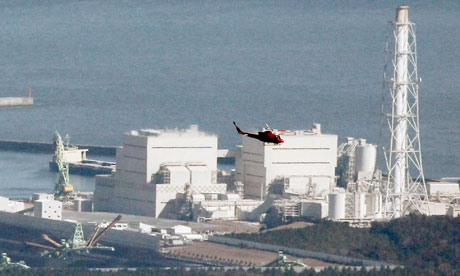
Fears of another explosion at a Japanese nuclear plant are growing after officials said the cooling system in a second reactor had failed.
Thousands of people were evacuated on Saturday following an explosion and leak from the Fukushima Daiichi plant, 240 km (150 miles) north of Tokyo.
It was believed the first explosion had been contained and disaster avoided.
But on Sunday the plant operator, Tokyo Electric Power (TEPCO) said radiation levels around the Fukushima Daiichi plant had risen above the safety limit and said the cooling system in the number three reactor had failed.
It was preparing to vent steam to relieve pressure in the reactor and the government had warned of a rise in radiation during the procedure.
Fears of a nuclear fallout were first raised when a massive explosion rocked the Fukushima Daiichi atomic power plant following damage to the number one reactor in Friday's earthquake.
A pall of grey-white smoke rose over the plant, operated by Tokyo Electric Power, and it was reported that four workers had been injured.
Government officials revealed plans to distribute iodine tablets – a treatment for radiation poisoning – to locals while a 20km exclusion zone was set up round the plant.
Residents outside the zone were urged to stay inside, close doors and windows and turn off air conditioning. Scientists had detected eight times the normal radiation levels outside the facility and 1,000 times normal levels inside the affected unit's control room.
Japan's prime minister, Naoto Kan, declared a state of emergency at the crippled unit and at its sister plant, the Fukushima Daini, as engineers tried frantically to determine whether the reactor had gone into meltdown.
Posted
by Big Gav
in
earthquakes,
japan,
nuclear power,
tsunami
'1,000 dead' in Japan quake; nuke plants overheat. More at The Guardian, CNN and MSNBC.
More than 1,000 people were feared dead and authorities scrambled to prevent meltdown at two nuclear plants after a monster tsunami devastated a swathe of northeast Japan.
Reactor cooling systems failed after Friday's record 8.9-magnitude earthquake hit, unleashing a terrifying 10-metre (33-foot) high wave that tore through coastal towns and cities and destroying all in its path.
Radiation 1,000 times above normal was detected in the control room of one nuclear plant, although authorities said levels outside the facility's gates were only eight times above normal, spelling "no immediate health hazard".
Tens of thousands of people were evacuated from around the the plants as Tokyo Electric Power, which runs the facilities, said it had released some radioactive vapour at both locations to relieve building reactor pressure.
"We are not in a situation in which residents face health damage," Chief Cabinet Secretary Yukio Edano told reporters, according to Jiji news agency.
The two nuclear plants affected are the Fukushima No. 1 and No. 2 plants, both located about 250 kilometres (160 miles) northeast of Tokyo.
The atomic emergency came as the country struggled to assess the full extent of the devastation wrought by the massive tsunami, which was unleashed by the strongest quake ever recorded in Japan off the eastern coast.
The towering wall of water pulverised the northeastern city of Sendai, where police reportedly said 200-300 bodies had been found on the coast.

There has been speculation that a meltdown may occur at one reactor, with this Bloomberg report being a good example -
Explosion Destroys Walls of Japanese Nuclear Reactor Building, NHK Reports.
An explosion occurred at the Fukushima Dai-Ichi power station north of Tokyo, destroying the walls of the No. 1 reactor building, NHK Television said. The report came after the government said a reactor may be melting.
Smoke was rising around the nuclear reactor after an aftershock from yesterday’s quake struck, Ryohei Shiomi, a spokesman at the country’s nuclear safety agency said by phone.
The spokesman said several people were injured during an aftershock that struck around 3:30 p.m. Japan time, adding he had no further information. Tokyo Electric Power Co., which operates the plant, said it had no information, when contacted by Bloomberg News.
Japan’s Nuclear and Industrial Safety Agency said earlier that a nuclear reactor in the Fukushima Dai-Ichi power station, about 220 kilometers (140 miles) north of Tokyo, may be starting to melt down after Japan’s biggest earthquake on record hit the area yesterday.
Fuel rods at the No. 1 reactor at the plant run by Tokyo Electric Power Co. may be melting after radioactive Cesium material left by atomic fission was detected near the site, Nuclear and Industrial Safety Agency, spokesman Yuji Kakizaki said by phone today.
“If the fuel rods are melting and this continues, a reactor meltdown is possible,” Kakizaki said. A meltdown refers to a heat buildup in the core of such an intensity it melts the floor of the reactor containment housing.
Tokyo Electric, Asia’s biggest power company, started releasing radioactive gas and steam into the atmosphere to reduce pressure in the containment housing after yesterday’s magnitude 8.9 earthquake, Akitsuka Kobayashi, a company spokesman, said by phone earlier today
Posted
by Big Gav
National Geographic has an article on the possible impact of a large scale solar eruption of the order of 1859's "Carrington Event" - What If the Biggest Solar Storm on Record Happened Today?.
On February 14 the sun erupted with the largest solar flare seen in four years—big enough to interfere with radio communications and GPS signals for airplanes on long-distance flights.
As solar storms go, the Valentine's Day flare was actually modest. But the burst of activity is only the start of the upcoming solar maximum, due to peak in the next couple of years.
"The sun has an activity cycle, much like hurricane season," Tom Bogdan, director of the Space Weather Prediction Center in Boulder, Colorado, said earlier this month at a meeting of the American Association for the Advancement of Science in Washington, D.C.
"It's been hibernating for four or five years, not doing much of anything." Now the sun is waking up, and even though the upcoming solar maximum may see a record low in the overall amount of activity, the individual events could be very powerful.
In fact, the biggest solar storm on record happened in 1859, during a solar maximum about the same size as the one we're entering, according to NASA.
That storm has been dubbed the Carrington Event, after British astronomer Richard Carrington, who witnessed the megaflare and was the first to realize the link between activity on the sun and geomagnetic disturbances on Earth.
During the Carrington Event, northern lights were reported as far south as Cuba and Honolulu, while southern lights were seen as far north as Santiago, Chile. (See pictures of auroras generated by the Valentine's Day solar flare.)
The flares were so powerful that "people in the northeastern U.S. could read newspaper print just from the light of the aurora," Daniel Baker, of the University of Colorado's Laboratory for Atmospheric and Space Physics, said at a geophysics meeting last December.
In addition, the geomagnetic disturbances were strong enough that U.S. telegraph operators reported sparks leaping from their equipment—some bad enough to set fires, said Ed Cliver, a space physicist at the U.S. Air Force Research Laboratory in Bedford, Massachusetts.
In 1859, such reports were mostly curiosities. But if something similar happened today, the world's high-tech infrastructure could grind to a halt.
"What's at stake," the Space Weather Prediction Center's Bogdan said, "are the advanced technologies that underlie virtually every aspect of our lives."
Posted
by Big Gav
in
drought,
ogallala aquifer
The UK Daily Telegraph has an article on fears the Ogallala Aquifer in the US midwest is drying up - US farmers fear the return of the Dust Bowl.
There is not much to be happy about these days in Happy, Texas. Main Street is shuttered but for the Happy National Bank, slowly but inexorably disappearing into a High Plains wind that turns all to dust. The old Picture House, the cinema, has closed. Tumbleweed rolls into the still corners behind the grain elevators, soaring prairie cathedrals that spoke of prosperity before they were abandoned for lack of business.
Happy's problem is that it has run out of water for its farms. Its population, dropping 10 per cent a year, is down to 595. The name, which brings a smile for miles around and plays in faded paint on the fronts of every shuttered business – Happy Grain Inc, Happy Game Room – has become irony tinged with bitterness. It goes back to the cowboy days of the 19th century. A cattle drive north through the Texas Panhandle to the rail heads beyond had been running out of water, steers dying on the hoof, when its cowboys stumbled on a watering hole. They named the spot Happy Draw, for the water. Now Happy is the harbinger of a potential Dust Bowl unseen in America since the Great Depression.
'It was a booming town when I grew up,' Judy Shipman, who manages the bank, says. 'We had three restaurants, a grocery, a plumber, an electrician, a building contractor, a doctor. We had so much fun, growing up.' Like all the townsfolk, she knows why the fun has gone. 'It's the decline in the water level,' she says. 'In the 1950s a lot of wells were drilled, and the water went down. Now you can't farm the land.'
Those wells were drilled into a geological phenomenon called the Ogallala Aquifer. It is an underground lake of pristine water formed between two and six million years ago, in the Pliocene age, when the tectonic shifts that pushed the Rocky Mountains skywards were still active. The water was trapped below the new surface crust that would become the semi-arid soil of the Plains, dry and dusty. It stretches all the way down the eastern slope of the Rockies from the badlands of South Dakota to the Texas Panhandle. It does not replenish.
Happy is the canary in the coalmine because the Ogallala is deepest in the north, as much as 300ft in the more fertile country of Nebraska and Kansas. In the south, through the panhandle and over the border to New Mexico, it is 50-100ft. And around Happy, 75 miles south of Amarillo, it is now 0-50ft. The farms have been handed over to the government's Conservation Reserve Programme (CRP) to lie fallow in exchange for grants: farmers' welfare, although they hate to think of it like that. ...
But it was only in the 1940s, after the Dust Bowl (the result of a severe drought and excessive farming in the early 1930s), that the US Geological Survey worked out that the watering holes were clues to the Ogallala, now believed to be the world's largest body of fresh water. They were about to repeat the dreams of man from the days of Ancient Egypt and Judea to turn the desert green, only without the Nile or Jordan. With new technology the wells could reach the deepest water, and from the early 1950s the boom was on. Some of the descendants of Dust Bowl survivors became millionaire landowners.
'Since then,' says David Brauer of the US Agriculture Department agency, the Ogallala Research Service, 'we have drained enough water to half-fill Lake Erie of the Great Lakes.' Billions upon billions of gallons – or, as they prefer to measure it, acre-feet of water, each one equivalent to a football field flooded a foot deep – have been pumped. 'The problem,' he goes on, 'is that in a brief half-century we have drawn the Ogallala level down from an average of 240ft to about 80.'
Brauer's agency was set up in direct response to the Dust Bowl, with the brief of finding ways to make sure that the devastation never happens again. If it does, the impact on the world's food supply will be far greater. The irrigated Plains grow 20 per cent of American grain and corn (maize), and America's 'industrial' agriculture dominates international markets. A collapse of those markets would lead to starvation in Africa and anywhere else where a meal depends on cheap American exports. 'The Ogallala supply is going to run out and the Plains will become uneconomical to farm,' Brauer says. 'That is beyond reasonable argument. Our goal now is to engineer a soft landing. That's all we can do.'
Posted
by Big Gav
in
michael klare,
peak oil
Michael Klare has a new article at TomDispatch looking at the unrest in the middle east and the implications for oil consumers - Oilquake in the Middle East.
After the Anglo-Persian Oil Company (APOC) discovered oil in Iran (then known as Persia) in 1908, the British government sought to exercise imperial control over the Persian state. A chief architect of this drive was First Lord of the Admiralty Winston Churchill. Having ordered the conversion of British warships from coal to oil before World War I and determined to put a significant source of oil under London’s control, Churchill orchestrated the nationalization of APOC in 1914. On the eve of World War II, then-Prime Minister Churchill oversaw the removal of Persia’s pro-German ruler, Shah Reza Pahlavi, and the ascendancy of his 21-year-old son, Mohammed Reza Pahlavi.
Though prone to extolling his (mythical) ties to past Persian empires, Mohammed Reza Pahlavi was a willing tool of the British. His subjects, however, proved ever less willing to tolerate subservience to imperial overlords in London. In 1951, democratically elected Prime Minister Mohammed Mossadeq won parliamentary support for the nationalization of APOC, by then renamed the Anglo-Iranian Oil Company (AIOC). The move was wildly popular in Iran but caused panic in London. In 1953, to save this great prize, British leaders infamously conspired with President Dwight Eisenhower‘s administration in Washington and the CIA to engineer a coup d’état that deposed Mossadeq and brought Shah Pahlavi back from exile in Rome, a story recently told with great panache by Stephen Kinzer in All the Shah’s Men.
Until he was overthrown in 1979, the Shah exercised ruthless and dictatorial control over Iranian society, thanks in part to lavish U.S. military and police assistance. First he crushed the secular left, the allies of Mossadeq, and then the religious opposition, headed from exile by the Ayatollah Ruhollah Khomeini. Given their brutal exposure to police and prison gear supplied by the United States, the shah’s opponents came to loathe his monarchy and Washington in equal measure. In 1979, of course, the Iranian people took to the streets, the Shah was overthrown, and Ayatollah Khomeini came to power.
Much can be learned from these events that led to the current impasse in U.S.-Iranian relations. The key point to grasp, however, is that Iranian oil production never recovered from the revolution of 1979-1980.
Between 1973 and 1979, Iran had achieved an output of nearly six million barrels of oil per day, one of the highest in the world. After the revolution, AIOC (rechristened British Petroleum, or later simply BP) was nationalized for a second time, and Iranian managers again took over the company’s operations. To punish Iran’s new leaders, Washington imposed tough trade sanctions, hindering the state oil company’s efforts to obtain foreign technology and assistance. Iranian output plunged to two million barrels per day and, even three decades later, has made it back to only slightly more than four million barrels per day, even though the country possesses the world’s second largest oil reserves after Saudi Arabia.
Dreams of the Invader
Iraq followed an eerily similar trajectory. Under Saddam Hussein, the state-owned Iraq Petroleum Company (IPC) produced up to 2.8 million barrels per day until 1991, when the First Gulf War with the United States and ensuing sanctions dropped output to half a million barrels daily. Though by 2001 production had again risen to almost 2.5 million barrels per day, it never reached earlier heights. As the Pentagon geared up for an invasion of Iraq in late 2002, however, Bush administration insiders and well-connected Iraqi expatriates spoke dreamily of a coming golden age in which foreign oil companies would be invited back into the country, the national oil company would be privatized, and production would reach never before seen levels.
Who can forget the effort the Bush administration and its officials in Baghdad put into making their dream come true? After all, the first American soldiers to reach the Iraqi capital secured the Oil Ministry building, even as they allowed Iraqi looters free rein in the rest of the city. L. Paul Bremer III, the proconsul later chosen by President Bush to oversee the establishment of a new Iraq, brought in a team of American oil executives to supervise the privatization of the country’s oil industry, while the U.S. Department of Energy confidently predicted in May 2003 that Iraqi production would rise to 3.4 million barrels per day in 2005, 4.1 million barrels by 2010, and 5.6 million by 2020.
None of this, of course, came to pass. For many ordinary Iraqis, the U.S. decision to immediately head for the Oil Ministry building was an instantaneous turning point that transformed possible support for the overthrow of a tyrant into anger and hostility. Bremer’s drive to privatize the state oil company similarly produced a fierce nationalist backlash among Iraqi oil engineers, who essentially scuttled the plan. Soon enough, a full-scale Sunni insurgency broke out. Oil output quickly fell, averaging only 2.0 million barrels daily between 2003 and 2009. By 2010, it had finally inched back up to the 2.5 million barrel mark -- a far cry from those dreamed of 4.1 million barrels.
One conclusion isn’t hard to draw: Efforts by outsiders to control the political order in the Middle East for the sake of higher oil output will inevitably generate countervailing pressures that result in diminished production. The United States and other powers watching the uprisings, rebellions, and protests blazing through the Middle East should be wary indeed: whatever their political or religious desires, local populations always turn out to harbor a fierce, passionate hostility to foreign domination and, in a crunch, will choose independence and the possibility of freedom over increased oil output.
The experiences of Iran and Iraq may not in the usual sense be comparable to those of Algeria, Bahrain, Egypt, Iraq, Jordan, Libya, Oman, Morocco, Saudi Arabia, Sudan, Tunisia, and Yemen. However, all of them (and other countries likely to get swept up into the tumult) exhibit some elements of the same authoritarian political mold and all are connected to the old oil order. Algeria, Egypt, Iraq, Libya, Oman, and Sudan are oil producers; Egypt and Jordan guard vital oil pipelines and, in Egypt’s case, a crucial canal for the transport of oil; Bahrain and Yemen as well as Oman occupy strategic points along major oil sealanes. All have received substantial U.S. military aid and/or housed important U.S. military bases. And, in all of these countries, the chant is the same: “The people want the regime to fall.”
Two of these regimes have already fallen, three are tottering, and others are at risk. The impact on global oil prices has been swift and merciless: on February 24th, the delivery price for North Brent crude, an industry benchmark, nearly reached $115 per barrel, the highest it’s been since the global economic meltdown of October 2008. West Texas Intermediate, another benchmark crude, briefly and ominously crossed the $100 threshold.
Why the Saudis are Key
So far, the most important Middle Eastern producer of all, Saudi Arabia, has not exhibited obvious signs of vulnerability, or prices would have soared even higher. However, the royal house of neighboring Bahrain is already in deep trouble; tens of thousands of protesters -- more than 20% of its half million people -- have repeatedly taken to the streets, despite the threat of live fire, in a movement for the abolition of the autocratic government of King Hamad ibn Isa al-Khalifa, and its replacement with genuine democratic rule.
These developments are especially worrisome to the Saudi leadership as the drive for change in Bahrain is being directed by that country’s long-abused Shiite population against an entrenched Sunni ruling elite. Saudi Arabia also contains a large, though not -- as in Bahrain -- a majority Shiite population that has also suffered discrimination from Sunni rulers. There is anxiety in Riyadh that the explosion in Bahrain could spill into the adjacent oil-rich Eastern Province of Saudi Arabia -- the one area of the kingdom where Shiites do form the majority -- producing a major challenge to the regime. Partly to forestall any youth rebellion, 87-year-old King Abdullah has just promised $10 billion in grants, part of a $36 billion package of changes, to help young Saudi citizens get married and obtain homes and apartments.
Even if rebellion doesn’t reach Saudi Arabia, the old Middle Eastern oil order cannot be reconstructed. The result is sure to be a long-term decline in the future availability of exportable petroleum.
Three-quarters of the 1.7 million barrels of oil Libya produces daily were quickly taken off the market as turmoil spread in that country. Much of it may remain off-line and out of the market for the indefinite future. Egypt and Tunisia can be expected to restore production, modest in both countries, to pre-rebellion levels soon, but are unlikely to embrace the sorts of major joint ventures with foreign firms that might boost production while diluting local control. Iraq, whose largest oil refinery was badly damaged by insurgents only last week, and Iran exhibit no signs of being able to boost production significantly in the years ahead.
The critical player is Saudi Arabia, which just increased production to compensate for Libyan losses on the global market. But don’t expect this pattern to hold forever. Assuming the royal family survives the current round of upheavals, it will undoubtedly have to divert more of its daily oil output to satisfy rising domestic consumption levels and fuel local petrochemical industries that could provide a fast-growing, restive population with better-paying jobs.
From 2005 to 2009, Saudis used about 2.3 million barrels daily, leaving about 8.3 million barrels for export. Only if Saudi Arabia continues to provide at least this much oil to international markets could the world even meet its anticipated low-end oil needs. This is not likely to occur. The Saudi royals have expressed reluctance to raise output much above 10 million barrels per day, fearing damage to their remaining fields and so a decline in future income for their many progeny. At the same time, rising domestic demand is expected to consume an ever-increasing share of Saudi Arabia’s net output. In April 2010, the chief executive officer of state-owned Saudi Aramco, Khalid al-Falih, predicted that domestic consumption could reach a staggering 8.3 million barrels per day by 2028, leaving only a few million barrels for export and ensuring that, if the world can’t switch to other energy sources, there will be petroleum starvation.
In other words, if one traces a reasonable trajectory from current developments in the Middle East, the handwriting is already on the wall. Since no other area is capable of replacing the Middle East as the world’s premier oil exporter, the oil economy will shrivel -- and with it, the global economy as a whole.
Consider the recent rise in the price of oil just a faint and early tremor heralding the oilquake to come. Oil won’t disappear from international markets, but in the coming decades it will never reach the volumes needed to satisfy projected world demand, which means that, sooner rather than later, scarcity will become the dominant market condition. Only the rapid development of alternative sources of energy and a dramatic reduction in oil consumption might spare the world the most severe economic repercussions.
Posted
by Big Gav
in
nuclear power
Joe Romm has a post at Grist about some poll results about subsidies for nuclear power - Wall Street Journal poll: Most popular spending cut is subsidies for new nuclear plants.
It is no big surprise that Americans don’t want cuts in Social Security, Medicare, or K-12 education. But the new WSJ/NBC poll does have some surprises:
The survey found that the most popular potential spending cuts were subsidies to build new nuclear plants, with 57 percent support….
Of course, nuclear is absurdly over-subsidized (see “Nuclear Pork—Enough is Enough“). In fact, a new report by the Union of Concerned Scientists, Nuclear Power: Still Not Viable without Subsidies (the source of the chart below), finds:
Government subsidies to the nuclear power industry over the past fifty years have been so large in proportion to the value of the energy produced that in some cases it would have cost taxpayers less to simply buy kilowatts on the open market and give them away ….
New nuclear power plants look to be even more uneconomical:
* Nuclear Bombshell: $26 billion cost—$10,800 per kilowatt!—killed Ontario nuclear bid
* Exelon’s Rowe: Low gas prices and no carbon price push back nuclear renaissance a “decade, maybe two”
* The staggering cost of new nuclear power
* GOP wants 100 new nukes by 2030 while 'Areva has acknowledged that the cost of a new reactor today would be as much as $8 billion'
Posted
by Big Gav
in
agriculture,
biofuels,
ethanol,
food prices
Prompted by a post at Early Warning, SP at TOD ANZ has a look at the impact of US ethanol policy on global food prices - Grain$ of truth.
Early Warning had a post recently decrying the proposed emergency policy of the Spanish Govt. to increase the biofuel content in their petrol. One follow up post then used US data for ethanol production to extrapolate the impact of US production to global food prices. Thus linking the unrest in North Africa and around the gulf states with the increased cost of food due to biofuels (as indicated by corn ethanol). But root causes of the increased cost of food are more complex than that.
Stuarts prime beef seems to be with the corn to ethanol conversion: many authors have argued that the conversion efficiency is poor - but it is probably the final act of a greater tragedy. Outside of the Americas, is corn a primary human staple? Even within the US its prime function seems to be as energy source for feed lot produced beef and a major ingredient in the US staple of fast foods (including supermarket ready meals).
While I agree that biofuels may be problematic, lumping all cereal crops together and then assuming that because 40% of US CORN production is going to ethanol that that is the cause of the rise in food prices seems to overly and dramatically simplify the issue.
Various international agencies have pointed out that the rise in GLOBAL food prices is a complex issue, with different causes in different regions. ...
From this we should remember that generally “commodities such as corn or wheat are a small part of the final retail price of most food products”. Not also the effect attributed to the currency situation in the US – the effect of the deflating dollar. ...
So, its complicated, but it’s not all down to biofuels.
Other sources about the more recent price rises also note that speculation has been a significant factor in the increases.
- Speculation behind global commodity price rise (different version at Speculation behind global commodity price rise)
- Food Price Spiral: Causes and Consequences
- High food prices: Cause and Result
Finally, I just want to point out that many of the countries in the Arab World experiencing turmoil (partially) as a result of these increased prices have one other thing in common. They all have currencies that are either:
1. directly pegged (or nearly so) to the US dollar,
2. are neighbors or close trading partners with countries with fixed dollar exchanges, or
3. have currencies that are not traded.
The following have (had?) a direct peg; Eritrea, Lebanon, Qatar, UAE, Suadi Arabia, Jordan, Bahrain. Egypt had periodic revaluations along with Oman, Kuwait and Tunisia had rigid currency controls. That a large number of countries in the region have a pegged or fixed exchange rate to the $US and the major commodity of the region is traded in $US means that other commodities will be more expensive to import in these countries.
So, if you need to buy grain valued in falling US dollars and your currency is pegged to (or otherwise controlled by) that currency, or your own currency is also falling OR you can’t easily convert your currency to buy US dollars AND speculators are playing the market… What then for local food prices?
On the other hand, if your currency was not affected in this way, and appreciated against the $US, then food from the US would have become cheaper.
Which could explain the US sourced apples and oranges in the supermarkets of the provincial Indonesian city in which I currently reside!
However the cost of rice has increased, not becuase of corn feed cows or biofuels, but for the simple reason that the heavy rain (and flooding) in Indonesia has cut production.
Posted
by Big Gav
in
book review,
electric vehicles,
hugh mackay,
transport,
what makes us tick
 I read Hugh Mackay's book "What Makes Us Tick?: The Ten Desires That Drive Us over the Christmas break and found it to be a reasonably entertaining piece of pop psychology.
Mackay identifies 10 driving "desires" that guide our lives (some good, some often bad):
- the desire to be taken seriously (which he identifies as the "primary" desire)
- the desire for 'my place'
- the desire for something to believe in
- the desire to connect
- the desire to be useful
- the desire to belong
- the desire for more
- the desire for control
- the desire for something to happen
- the desire for love
The section on "the desire for 'my place'" includes an interesting take on the role of the car in western society today:
The western world is characterised by speed, restlessness and motion (look at any major airport at almost any hour of day or night), so its hardly surprising that for many people in modern urban settings, 'my place' is neither a building nor a piece of the Earth's surface, but that somewhat ubiquitous mobile enclosure we call the car.
My very own space ? I'll tell you where that is - behind the wheel of my car. It's the only place I ever have to myself and it's the only place where I seem to get any real peace.
I've lost count of the number of times I've heard people say the car is the most comfortable place they ever inhabit; the place where they feel totally in control (helped immeasurably by the symbolism of the steering wheel in their hands and an accelerator pedal under their foot); the place that feels more like a personal space than anywhere else they spend their time...
Cars are for escaping into, for meditation, for thinking, for praying, for courting, for sex, for conversation, for eating and drinking, for sleep, for letting off steam and for generating unrivaled - and positively dangerous - feelings of power. Oh, and for driving too: cars are our most flexible and efficient means of transport, though at enormous cost to life and limb - to say nothing of the cost to the quality of the air we breathe and the health of the planet.
The role the car now performs seems (in my mind at least) to guarantee the success of electric vehicles in a post oil wold - for all the benefits of public transport, transit oriented development and walkable neighbourhoods, none of them offer a personalised space that people can take with them when they are on the move.
Posted
by Big Gav
in
limits to growth,
ugo bardi
Ugo Bardi from The Oil Drum has set up his own blog, dubbed "Cassandra's Legacy". One of his first posts looks at "The Limits To Growth", which has has written a (soon to be published) book about - The time machine of the 1960s . Also at CL - What punctured the North-African balloon? Crude oil and social unrest and How to drive your elephant: dealing with complex problems .
How about that? You are young and you are all interested in the future. And, a time machine that takes you to the future, wow! that would be something!
Of course, no matter how good a researcher is professor Deriu, I think he hasn't arrived yet to developing a time machine; one that takes you to the future and back. But maybe it could be built. I don't know if there are physical reasons preventing it to exist; but I know that - if it were ever built - it could only take you to "a" future, not to "the" future. The future, after all, is in our hands; it depends on what we do. So, if a time machine takes you to the year 2110, then you come back and you do something based on what you learned in your trip; then the future must change. So, when you go to 2110 again, what you see is completely different. That is, after all, the theme of the movies of the series "Back to the Future," but not just of that movie. Plenty of science fiction has been written on this theme: you go to the future, see how it is, then you come back and you do something to change it. The future can never be exactly predicted, it is not fixed.
Now, as I said, a time machine doesn't exist today; maybe it will never exist. But something like the story I have been asking you to imagine did take place back in the late 1960s - many of you weren't even born at that time. It happened at the Massachussets Institute of Technology, the MIT, in Boston, where someone named Jay Forrester was working.
I think you'll like to hear a little about Jay Forrester. He was born - if I remember correctly - in 1918. He has traveled quite a stretch in time! And, last time I wrote to him, he answered to me via email - though he is in his 90s, his mind is still sharp. We are all time travelers, after all, and if you are lucky you travel in comfort - not forever though, but that's another problem. Anyway, Jay Forrester has been a pioneer of computer science: he led a team who developed a new computer memory that became the standard for computers in the 1950s and 1960s. At that time there was no such thing as a "personal computer." There were those big computers; you know, big cabinets occupying several rooms and with technicians in white coat running around. And these big computers were much less powerful than your laptop, today. Things change as you travel in time.
Anyway, Forrester was interested in many things; one was the future. Of course, he didn't have a real time machine. But he had this idea that he could use the computers he had built as something that could "see" the future, although not really predicting it - that, as I said, is not possible. His idea was to study the future. It is something different. In science, when you study something, you do it as a function of the parameters of the system. Say, when you study a chemical reaction, you do such things as changing things like concentrations, type of reagents, that kind of changes. And then you see what happens. So, when you study the future, you change some of the parameters and you see what happens. You play the game "what would happen if..." And that is what Forrester had developed: a model of the world that could be run in the memory of a computer and generate different futures depending on the parameters in input. Each one is what you call a "scenario." In a way, it is a time machine, although it is a virtual one. But it is still a possible future, a destination you could find yourselves traveling to .
So, imagine you were a PhD student working in Forrester's lab in the 1960s. I guess the atmosphere must have been very exciting. They had these new computers, very powerful for the time, and they were using them to study the future. It would have been great to be there and to work on these models.
The story, at this point, has to do with someone named Aurelio Peccei - you probably never heard of him as well. He was Italian and he was at the head of a group of people who referred to themselves as the "Club of Rome." They had started with the idea that they wanted to do something to help the poor in the world. But they soon discovered that it was not an easy task - of course we all know it is not. One basic question was, "do we have enough resources on this planet to help the poor?" In other words, what are the limits to the resources on earth? Obviously, that was a difficult question to answer. So, what happened was that Peccei met Forrester in Italy, at a meeting on the shores of Lake Como. That was in the late 1960s. Peccei was impressed by Forrester and probably Forrester was impressed by Peccei. They met again in Switzerland, later on, and in the end they decided that the model that Forrester was developing was just what was needed to solve the question that the Club of Rome was asking.
So, one of Forrester's students took up the task of making a big model of the whole world for the Club of Rome. His name was Dennis Meadows. At that time he wasn't a student any more, he was 28 years old, but he was young anyway. And so the research called "The Limits to Growth" was started. Dennis Meadows collected a group of young people and they started modelling the whole world for a future that spanned more than 100 years, up to the end of the 21st century. I am sure that they were absolutely thrilled by the challenge. I am sure that all of you would be thrilled. It was an incredible chance: use the computer as if it were a time machine and explore the future of the world! In the past few years, I have had the chance of meeting some of the people who worked on that project in person. Now, of course, they are in their 60s or 70s; but they maintain a lot of enthusiasm for these studies. The had the chance to see how their scenarios have fared over almost 40 years of comparison with the real world. As I said, we are all time travelers.
So, what did they find with their virtual time machine? The results are described in a book titledcalled "The Limits of Growth" which was published almost 40 years ago. Today, if you heard about that study, you probably heard that it was all wrong. That it was a flawed study based on wrong data and that it had predicted that the world should have ended - maybe - in the 1990s and that, of course, didn't happen. Or, if you never heard about it, you may wonder why - if it was so new and important.
Here, you have to be careful. You probably know the old say about computers: "garbage in, garbage out". It is true and it is a good warning. As I said before, if you are using the computer as a time machine, you must be aware of the limitations of a time machine. If you expect the computer to be able to predict the future, you'll be sorely disappointed. The future depends on what we do and if we decide to do one thing rather than another, then the future will change. That's the basic idea of what people call "scenario planning". You don't try to predict what the future will be. You try to figure out what it may be and act in consequence.
That, believe me, is a lot. You read newspapers and the feeling is that nothing of what happens could be imagined just the previous day - let alone predicted years before. You get the impression that we live in a world where politicians surge every day to meet some challenge that was utterly unexpected, and they gain much press coverage in the process. But it is not like this. Computers give you a tremendously powerful tool to manage the future. Not tomorrow's future, of course. If I could predict what will happen tomorrow, and I could predict it exactly, well, I would be somewhere else, of course. But in the past 10 years or so I have been working with this kind of models and I am impressed at the insight that they can give to you. In the past few years, nothing of what happened has really surprised me - it is almost scary. Of course, I can't predict the exact year when something will happen, or details of what is going to happen, but I can have a general idea of what is in store for us.
As I said, it is a little scary to have tools that can give you some idea of the future. That is because the future is not always bright - of course. And that brings us back to "The Limits to Growth," the study made in 1972. The study was not "wrong" as some people said later on - the problem was that the future it saw for humankind was not bright at all. And people didn't like that. So, rather than thinking "how can I make the future brighter?" they decided that the study was wrong. It happens all the time - it is a tough life for those who chose this job: exploring the future.
Anyway, the authors of "The Limits to Growth" did a good job in exploring many possibilities for the world's future. But most of their scenarios had a "robust" feature, something that didn't change much as a function in changes of the parameters in input or of the model itself. That was collapse of the world economy. And if the economy collapses, a lot of things must collapse with it, including the human population. There was a scenario in the study that was called "base case", or "standard run" - the one which had as parameters data which were the best available and that assumed that the world - meaning the way people behave - wouldn't change too much over time. Well, this scenario produced the start of the collapse of the economy for around 2010 -2020.
Now, I think you start understanding where I am heading to. In practice, I am arriving to the same concepts that I could have shown to you from my power point presentation on crude oil. You see, collapse is the result of a number of things happening right now; in front of your eyes. Less and less crude oil; and that forces people to pay more for it. And, eventually, we'll arrive to a point where we can't afford it any more. And that is not just a problem with crude oil - it happens with all mineral resources. If minerals are what keeps the world's economy running, then you'll see it collapse. And there is another resource which is gradually running out; it is the capability of the atmosphere to absorb the products of combustion of oil and of fossil fuels. As you know, the consequence is we are gradually heating the whole planet - that's no good for the economy, either. And for us all; too.
So, this is what we are seeing around us. Things are starting to collapse - maybe not exactly collapsing - but surely there are all those ominous creaks that you hear when a structure is near collapse. The economy, the prices, all those things that happen. I could give you more data; but I think the general picture should be clear to you. We have been growing at the expense of the natural capital of our planet and now we are being asked to repay it, with the interests. All that was known from a long time ago, with that 1972 study "The Limits to Growth".

Posted
by Big Gav
in
bicycle
The SMH reports that Sydney cyclists are shaming bad drivers by putting video footage on YouTube - Cyclists put mettle to the pedal to capture collisions.
CYCLISTS have found a new weapon in their battle to stay safe on the roads - the video camera. They are mounting the tiny cameras to their helmets or handlebars to film accidents or near misses.
Police say they are willing to use the footage as evidence.
On average there are three injuries a day for pedal cyclists in NSW, the RTA says, citing the most recent figures, from 2009.
Advertisement: Story continues below
A couple of years ago Nathan Besh hit a pedestrian who stepped in front of his bicycle.
He said the pedestrian was at fault but did not admit responsibility. ''In a lot of situations like that there are no witnesses and no evidence, it is your word against theirs,'' Mr Besh said.
As a result he started an online company which sells mounts for attaching cameras to bicycles. He has mounted a forward-facing camera to his bike for his Chatswood-to-city commute.
Police could take action after reviewing video footage, a NSW police media spokesman said. ''Such footage could be used by police to make further inquiries, but whether they used that footage to take things further would be reviewed on a case-by-case basis,'' he said.

Posted
by Big Gav
in
electricity grid,
europe,
geothermal energy,
geothermal power,
iceland,
super grid
Bloomberg has an article on exporting geothermal and hydro power from Iceland to Europe via a new undersea transmission cable - Iceland Channels Volcanoes to Win Europe's Energy-Supply Race.
Europeans left stranded at airports last year as an Icelandic volcano spewed ash across the continent may soon benefit from the power that seethes beneath the remote north Atlantic island.
Iceland is doing a feasibility study into building a 1,170- kilometer (727-mile) power cable to Scotland to send some of its untapped potential of 18 terawatt-hours of geothermal and hydropower -- that’s enough for 5 million European homes. The project has the backing of the government, Industry Minister Katrin Juliusdottir said in an interview.
“Icelanders live with earthquakes and volcanic activity but the benefits are that now we can monetize these powers,” said Valdimar Armann, an economist at Reykjavik-based asset manager GAMMA, who estimates annual clean-energy exports could reach about a tenth of the island’s $12 billion economy.
The island is trying to emerge from Europe’s biggest banking meltdown this century to restyle itself as one of the European Union’s main sources of renewable energy. The power cable, which would be the longest of its kind ever built, would come as the EU strives to reach its target of 20 percent clean energy by 2020. In about 20 years, Iceland’s energy revenue per capita may rival that of Norway, where oil income has made its $540 billion sovereign wealth fund the world’s second-biggest, Armann said.
The U.K. day-ahead spot price values 18 terawatt hours at 828 million pounds ($1.33 billion), according to data available on Bloomberg. Landsvirkjun, a state-owned utility that produces 75 percent of Iceland’s electricity, is driving the feasibility study for the $2.1 billion power-cable project, which would send as much as 5 terawatt-hours a year
Posted
by Big Gav
Cryptogon points to an NYT article on American efforts to use the world's largest prison population as a source of cheap labour - Budget Problems? Just Use Prison Labor.
The New York Times outdoes itself with this one. “Financial experts agree.” Oh sure.
See, Land Of The Free: Never In The Civilized World Have So Many Been Locked Up For So Little, for a bit of context.
Via: New York Times:
Before he went to jail, Danny Ivey had barely seen a backyard garden.
But here he was, two years left on his sentence for grand theft, bent over in a field, snapping wide, green collard leaves from their stems. For the rest of the week, Mr. Ivey and his fellow inmates would be eating the greens he picked, and the State of Florida would be saving most of the $2.29 a day it allots for their meals.
Prison labor — making license plates, picking up litter — is nothing new, and nearly all states have such programs. But these days, officials are expanding the practice to combat cuts in federal financing and dwindling tax revenue, using prisoners to paint vehicles, clean courthouses, sweep campsites and perform many other services done before the recession by private contractors or government employees.
In New Jersey, inmates on roadkill patrol clean deer carcasses from highways. Georgia inmates tend municipal graveyards. In Ohio, they paint their own cells. In California, prison officials hope to expand existing programs, including one in which wet-suit-clad inmates repair leaky public water tanks. There are no figures on how many prisoners have been enrolled in new or expanded programs nationwide, but experts in criminal justice have taken note of the increase.
“There’s special urgency in prisons these days,” said Martin F. Horn, a professor at John Jay College of Criminal Justice and a former commissioner of the New York City Department of Correction. “As state budgets get constricted, the public is looking for ways to offset the cost of imprisonment.”
Although inmate labor is helping budgets in many corners of state government, the savings are the largest in corrections departments themselves, which have cut billions of dollars in recent years and are under constant pressure to reduce the roughly $29,000 a year that it costs to incarcerate the average inmate in the United States.
Senator John Ensign, Republican of Nevada, introduced a bill last month to require all low-security prisoners to work 50 hours a week. Creating a national prison labor force has been a goal since he went to Congress in 1995, but it makes even more sense in this economy, he said.
“Think about how much it costs to incarcerate someone,” Mr. Ensign said. “Do we want them just sitting in prison, lifting weights, becoming violent and thinking about the next crime? Or do we want them having a little purpose in life and learning a skill?”
Financial experts agree.
Posted
by Big Gav
Reuters reports the Spanish government is reacting against rising oil prices - Spain brings in measures to lower oil costs.
Spain, aiming to reduce its dependence on oil as crude prices surge, will raise biofuel blending and lower both speed limits and rail fares, Deputy Prime Minister Alfredo Perez Rubalcaba said on Friday.
The minimum proportion of biofuels to be mixed with mineral fuels, known as minimum blend, is to be raised to 7.0 percent from 5.8 percent, he said.
The news sent shares in biofuel maker Abengoa up nearly 5 percent.
The fuel-saving measures, which include cutting the speed limit on motorways to 110 kilometres per hour from 120 Km/h and lowering short and medium distance rail fares by up to 5 percent, will come into effect on March 7.
"A 10 euros increase in oil prices as has been seen in recent days increases our country's energy costs by 6 billion euros per year, or 500 million per month," Rubalcaba said at a weekly news conference after a cabinet meeting.
Spain has little or no oil reserves, making it heavily dependent on imported oil.


 Posts
Posts