The China Syndrome  

Posted by Big Gav

China is getting a lot of attention lately, which reminds me a little of 1995, when the red peril supposedly posed by China was the subject of much discussion in magazines like the Economist.

This time round the muttering seems a lot more serious, with the recent teeth baring over Taiwan now being overshadowed by tensions flaring between China and Japan over oil and gas in the east china sea.

Japan was accused of a "serious provocation" by China Thursday for its plans to drill for oil in a disputed area of the East China Sea. The tension escalated when Japan's Ministry of the Economy, Trade and Industry said Wednesday companies will be permitted to analyze energy deposits in an area east of Shanghai that spans a maritime economic zone partially claimed by both countries.

"This move by Japan is a serious provocation of China's rights and international border norms," Qin Gang, spokesman of China's foreign ministry said. "China has already made a protest to Japan, and reserves the right to take further reaction."

Anti-japan rallies seem to have become the latest fashion in China over the last month, with thousands of people joining protest marches on the weekend.

Its not just Japan that is starting to butt heads with China - the US also seems to adopting a policy of containment that mirrors that used against the Soviet Union. Michael Klare notes in "Imperial Reach":
Most significant, overall, is the revised calculation of America's geopolitical interests. During the cold war, when "containment" was the overarching strategic principle, the United States surrounded the Soviet bloc with major bases. With the end of the cold war, however, this template no longer made sense, and many of these bases lost their strategic rationale. Meanwhile, other concerns--terrorism, the pursuit of foreign oil and the rise of China--have come to preoccupy American strategists. It is these concerns that are largely driving the realignment of US bases and forces.

There is a remarkable degree of convergence among these concerns, both in practical and geographic terms. Oil and terrorism are linked because many of the most potent terrorist groups, including Al Qaeda, arose in part as a reaction to the West's oil-inspired embrace of entrenched Arab governments, and because the terrorists often attack oil facilities in order to weaken the regimes they abhor. Similarly, oil and China are linked because both Washington and Beijing seek influence in the major oil-producing regions. And the major terrorist groups, the most promising sites of new oil and the focal points of Sino-American energy competition are all located in the same general neighborhoods: Central Asia and the Caspian region, the greater Gulf area and the far reaches of the Sahara. And the United States is establishing new basing facilities precisely in these areas.

There is also a very detailed discussion of the economic, energy and military issues related to China here - "Crisis on the China Rim: An Economic, Crude Oil and Military Analysis" (pdf). I recently received this link via email, and it appears I wasn't the only one. The key issue in here is that east asia has very few energy resources of its own, and is extremely dependent on energy from the caspian sea and middle east regions.

Another view of the US - China competition for oil is shown in the "Crude Dashboard" (pdf) from Atlantic Monthly.

From an Australian point of view, this is an increasingly difficult issue to deal with. While we generally adopt a completely subservient pose towards the US, and in many ways act like a colony, China and Japan are our 2 biggest trading partners, with Chinese trade growing rapidly.

Unlike almost every other country in the world, we have a trade deficit with the US (helped along by the "Free" trade Agreement our leaders were weak enough to sign) but large trade surpluses with China and Japan - so tensions to our north and any isolation of China will not be working in our favour economically.

The government has been trying to keep a foot in each camp, with the recent behind-the-scenes arm twisting of BHP to cave in and accept a meagre 74% price increase for iron ore supplies to China the latest move to try and keep in China's good books, after recently trying to stay neutral during the sabre rattling over Taiwan. This has met with some success, as a "free trade agreement with China may be negotiated (hopefully a better one than was signed with the US). Opposition leader Kim Beazley has changed his usual pro-american stance and declared that China and India are the key to our future security (sensibly echoing Jacques Chirac's call for a multipolar world).

Of course, trying to stay friends with everyone can be risky as well - as one Chinese thinktankologist noted, we may end up like the bat in Aesop's fable.

Of course, the rising tension over energy in the east may end up derailing Australian export efforts anyway - The Stinkin Desert Post notes:
Do these people use their heads for anything besides putting their hats on? From an article this weekend in the Japan Times:

"WASHINGTON (Kyodo) Finance Minister Sadakazu Tanigaki and U.S. Treasury Secretary John Snow agreed Friday that stubbornly high oil prices pose a risk for the global economy, Japanese officials said."

Now there's a blinding insight. I hope they are well paid for articulating such a subtle idea.

"Tanigaki said a spike in crude oil prices is a risk for the Japanese economy. In reply, Snow said high oil prices are also a risk for the global economy, including the U.S., the officials said."

And what if it's not a spike? What's going to happen when the price goes up and doesn't come back down? Instead of mouthing platitudes, the "leaders" should be grappling with the really big problems thundering down the pike. I can't speak for other countries, but one of the issues in the US is that our power structure (government+corporations+media+theocrats) has been captured by a collection of scoundrels not seen since the height of the Gilded Age.

As if peak oil wasn't enough, it's worth considering the possibility that China is economically, financially, socially, and environmentally a house of cards. If Snow et. al push on that house too hard, it may come tumbling down.

Of course, some people believe that as we go past the peak, pushing down the house of cards may be US policy. Paraphrasing the speculations of one peak oil maven recently (analysing the situation from a US point of view rather than advocating what should happen):
Given the importance of oil in our civilization, the imminence of Peak Oil, and the fact that most of the world's remaining oil reserves are in the Middle East, control of that region is crucial. We must, at the least, prevent others from getting control of any significant part of that area of the world if we are to remain the world's hegemon.

As push comes to shove over oil, this is likely to mean ongoing and even escalating warfare in that region.

Given that the downside of the Hubbert Curve is imminent, oil in the ground will be increasingly valuable with every passing year. This means that escalating violence in the Middle East - and even short (or intermediate) term chaos in the region - can be in our favor, provided that we end up in control of what's left in the long run.

An alliance of China, India, Russia and others has been forming in opposition to the U.S. - given that this alliance has increasing ties to Iran, and that Iran will soon have nuclear weapons and has very large oil reserves, it is going to be necessary to attack Iran in the near future.

The best justification for this might be an attack on a full oil tanker leaving the Persian Gulf. If we cannot provoke Iran into such an attack, we could have our own operatives carry it out in such a way that Iran can be blamed - for example with a missile hitting the port side (the side facing Iran as a tanker leaves the Gulf).

Given that we get a smaller percentage of our oil from the Middle East than China and some other challengers of the Empire do, if we can dramatically slow or stop the flow of oil from the Middle East it might achieve a number of useful objectives. Not the least of which relates to the world's precarious financial/economic situation. Specifically, if we can dramatically slow or stop the flow of oil from the Middle East in the near future, we can blame the bursting of the Credit Bubble (which is inevitable in the near future anyway) and the collapse of the world's economy (inevitable when the Credit Bubble bursts in any case) on "the enemies of freedom and democracy."

I think we will see significant escalation in the Middle East and significant conflict with China dominating the years ahead.

Technorati tags:

Who Owns East Timor's Oil and Gas ?  

Posted by Big Gav

Some pre-Anzac day TV ads are being run to suggest it might be the East Timorese...

An 85-year-old World War II veteran has defended a series of television commercials that condemn the federal government for its negotiations over Timor Sea oil and gas rights.

The ads feature World war II veterans who served in East Timor and who are critical of Australia's position in the negotiations over the $41 billion oil and gas reserves.

Former engineers sergeant John Jones today rejected criticism from the RSL that the Anzac spirit should not be used to criticise the government over the Timor Sea issue.

"Anzac day is for all Australians and particularly those who fought in any of the wars that Australia was involved in," he told reporters in Melbourne.

"Any of those Australians has the right to say what he wants to say on Anzac Day if it involves him and his experiences."

Mr Jones defended his fellow soldiers who have appeared in the ads saying the federal government's attitude was not in the "Anzac spirit" and Prime Minister John Howard was not welcome at their Anzac Day parade.

"Only for the Timorese we would not be here today," Mr Jones said.

Former Australian Army major Chip Henriss-Anderssen who served with Interfet forces in 1999-2000 said the ads reminded Australians of the Anzac spirit and the "Australian notion of a fair go".

"It is a clear cut, very simple issue," he said.

"They're poor, we are rich. We have a lot of resources, they haven't.

"We need to give them their oil and we need to look after this country."

Technorati tags:

California Dreaming  

Posted by Big Gav

Martin Hastings has a new piece of analysis out on the contenders to supply California with LNG. It would seem both the Woodside and BHP bids are unlikely to succeed (and the possibility of Exxon shipping gas from PNG doesn't even seem to be a starter).

If I was going to bet on it I'd say ChevronTexaco will win (probably in a joint venture) with the gas coming from the Gorgon field.

One ugly prospect this raises is the possiblity of an american military base reappearing on the north west coast (probably at the old cold war base at Exmouth), given the propensity for US forces to appear in numbers wherever energy is to be found.

Technorati tags:

Boing Boing On Peak Oil  

Posted by Big Gav

James Kunstler's "Long Emergency" article made it on to Boing Boing (unnoticed by me) a few days ago.

It provoked a lot more comment than normal on BB, with some people focussing on Viridian solutions, some talking about the nuclear option and some nut saying we need to consider abiotic oil (there's one in every crowd).

I've been reading a lot about Peak Oil, which refers to the year at which oil production hits the peak of a bell curve, and after which oil production goes down, tapering to zero.

There's some argument about the year of the peak, but pretty much everyone agrees -- including the US government -- that the peak is fewer than a couple of decades away. A lot of experts says we've already hit the peak. James Howard Kunstler's piece in Rolling Stone, called "The Long Emergency," argues that the US hit its peak decades ago.

One reader recommended an essay called "The Slow Crash" which looks interesting, and probably more accurate than the rapid collapse foreseen by some.
I'm not ruling out a global supercatastrophe. A runaway greenhouse effect might turn Earth into another Venus and cook us all. Acidification of the oceans might kill the plankton, and with them everything that needs a lot of oxygen. An instant ice age could happen several ways, and this scenario needs more attention because some humans would survive. But what I'm focusing on here is the scenario that includes only events we're reasonably sure about: the end of cheap energy, the decline of industrial agriculture, currency collapse, economic "depression," wars, famines, disease epidemics, infrastructure failures, and extreme unpredictable weather.

If that's all we get, the crash will be slower and more complex than the kind of people who predict crashes like to predict. It won't be like falling off a cliff, more like rolling down a rocky hill. There won't be any clear before, during, or after. Most people living during the decline and fall of Rome didn't even know it. We're told to draw a line at the sack of Rome by the Visigoths, but to Romans at the time it was just one event -- the Visigoths came, they milled around, they left, and life went on. After the 1929 stock market crash, respectable voices said it was a temporary adjustment, that the economy was still strong. Only years later, when we knew they were wrong, could we draw a line at 1929.

Technorati tags:

Are These Guys Serious ?  

Posted by Big Gav

Unfortunately probably yes - more consent manufacturing for the upcoming Iran invasion from the Swift Boat Nuts For "Truth" team (see Mobjectivist for some background).

Technorati tags:

Global Warning  

Posted by Big Gav

James Kunstler is getting a lot of press lately - here's a new interview (nothing particularly new here). I don't agree with all of his opinions, but he does get people talking.

Q:Paula Routly: You've long criticized the housing and transportation policies that drove people from the cities to suburbia after World War II. Now it turns out "Levittown" is not only ugly and soul-killing, but unsustainable. Explain your vision of the "Long Emergency."

A:James Howard Kunstler: We poured our national wealth into the construction of a living arrangement that has no future -- and the future is now here. The infrastructure of suburbia can be described as the greatest misallocation of resources in the history of the world. It was deficient and problematic as a human habitat even apart from the question of its sustainability. The way we live in America represents a tragic set of collective and individual choices we made at a particular point in history, the mid-to-late 20th century, when circumstances seemed to suggest there were no limits to our quest for comfort, convenience and leisure. These things turned out to be a poor basis for a value system and for an economy.

Q:So life without oil equals the apocalypse?

A:Your word, not mine. I rather resent being labeled "apocalyptic." It demonstrates how poorly even journalists understand what we face, which is an epochal discontinuity in the conditions of daily life, not the end of the world. In fact, we don't even face a life without oil, at least not imminently. We face a life without cheap oil, which is a big difference. Specifically, we are heading into a period of social, political and economic turbulence, which will probably include a lot of hardship. That's not the end of the world. That's something that the human race has been through many times before. For instance, the Europeans of 1913 would never have conceived the degree of destruction and vicissitude visited upon their societies by two 20th-century world wars. We're equally blind and clueless about what we are facing.

Technorati tags:

The Sanctuary of Freedom  

Posted by Big Gav

Here's one from FTW on the value of the wilderness (via FTD).

Ethics often gets mentioned in connection with the wilderness, usually in the form of the truism that destroying the remainder of the natural world is morally wrong.

But I want to emphasize a different ethical dimension of the wilderness: it is the sanctuary of freedom, and that this is its greatest value. If we are to take seriously the founding images and stories of American identity, we must regard the wilderness as the soul of America: it gave the native peoples their ways; it called to the frontiersmen, the mountainmen and the explorers; and because it bespoke a dignity and self reliance that Europe had lost, it was the source of an American spiritual strength that found expression in the Declaration of Independence and in Whitman's Leaves of Grass.

In the American lexicon, freedom has come to mean the freedom of corporations to generate profit and the freedom of the public to consume. The ugly irony here is that consumption itself is antithetical to freedom, because chasing the illusory fulfillment of artificial needs prevents us from determining our own real needs. If you own a car, or a house, or any other possessions, then you are tied down by your car insurance, your mortgage, your bills, your consumer debt, and the material things themselves. If freedom is measured by the ability to do whatever you want, whenever you want and wherever you want, the freest person you are likely to see is that homeless guy riding his bicycle and rifling through garbage bins. He has his risks and his limits, but he isn't toiling for a salary, servicing debt, or storing possessions. Is he free?

As Thoreau understood, those who have lived in the wilderness are the freest people on the planet. So long as there remains some wilderness where people can go to escape the ties that bind, freedom will retain some of its former meaning.

Technorati tags:

Scrutiny Hooligans  

Posted by Big Gav


These guys have the occasional peak oil post - including a recent note from the Fatal Harvest school.

Imperial Reach  

Posted by Big Gav

Michael Klare has another article out - this one on the migration of US military bases from cold war frontiers to oil rich regions. He notes something I've said previously - all this big power jockeying is remiscent of the lead in to world war 1 (or world war 2 if you want to push the neocon - nazi comparison).

It is not clear exactly when the Defense Department will complete the reassessment of its overseas basing requirements and complete the actual redeployment of American forces. Some of the initiatives described above have already begun, while others remain on the drawing board. There is no doubt, however, that a major realignment of American power is under way that entails a seismic shift in the center of gravity of American military capabilities from the western and eastern fringes of Eurasia to its central and southern reaches, and to adjacent areas of Africa and the Middle East. This is certain to involve the United States more deeply in the tangled internal politics of these regions, and to invite resistance from local forces--and there are many of them--that object to current US policies and will resent a conspicuous American military presence in their midst. Far from leading to a reduction in terrorism, as advertised, these moves are certain to provoke more of it.

Finally, the American power shift from outer Eurasia to its troubled interior is certain to arouse concern and antipathy in Russia, China, India and other established or rising powers in the region. Already, Russian leaders have expressed dismay at the presence of American bases in Uzbekistan and Kyrgyzstan--territories that were once part of the Soviet Union. The recent political upheaval in Kyrgyzstan and the ouster of President Askar Akayev--long considered friendly to Moscow--is certain to exacerbate their concerns. At the same time, Chinese officials have begun to complain about what they view as the "encirclement" of their country. Although reluctant to take on the Americans directly, leaders of Russia and China have talked of a "strategic partnership" between their two countries and have collaborated in the establishment of a new regional security organ, the Shanghai Cooperation Organization. None of this is likely to lead soon to the outbreak of hostilities, but the foundation is being set for a great-power geopolitical contest akin to the European rivalries that preceded World Wars I and II.

Technorati tags:

Oilfields MegaProject Update  

Posted by Big Gav

Energy Bulletin has an interesting article on determining the peak oil point by looking at how many new large projects will be coming online in the coming years.

Since its first appearance more than a year ago, UK Petroleum Review Editor Chris Skrebowski's Oilfield Megaprojects Report, has come to be regarded as a new and vital milepost on the way to Peak Oil. Julian Darley asks Chris to explain the complexities of global depletion and new supply, and why he thinks that this year may well be the year of Peak Oil.

As Richard Heinberg has pointed out, there are at least four ways of predicting the peak in global oil production, the results of which seem to be converging on dates within this decade.

One fairly crude method is to add about 40 years to the date of peak of discoveries, which country by country data tells us is a reasonable guess. Oil discoveries peaked in the mid 1960s.

One can also use M. King Hubbert's method of predicting oil peak as the point when we've used half of all the original available recoverable reserves. We're about at the halfway point now by most estimates.

The third method is like what ASPO does which is to graph regional, or country by country predictions and add these together to get an overall global peak. ASPO predict a peak for conventional oil in 2006 and all liquids in 2007.

Chris Skrebowski's laudable efforts at Petroleum Review represent a fourth, and high resolution, method which seems to confirm the troubling news.

For all the focus on a particular date, it's worth noting that we have probably already passed a more significant peak. If we had the accounting mechanisms to subtract the amount of oil consumed in the extraction and processing of oil, we may find we passed the net energy oil peak as far back as 1979/80. The bad news is that besides the symbolic punch, the now famous gross oil peak will accelerate this declining net energy trend.

Technorati tags:

Natural Gas Release - Gorgon Awakening  

Posted by Big Gav

Bloomberg notes that exploration in Australia is focussing on natural gas, as oil finds and reserves dwindle, and Energy Bulletin reports that Shell is now moving ahead with the Gorgon gas project in north west WA.
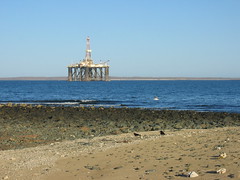
The $11 billion Gorgon gas project, off the West Australia coast, moved a step closer yesterday with project partner Shell saying it had finalised the sale of 2.5 million tonnes of Gorgon LNG (liquefied natural gas) a year to the US west coast.

Last week the Gorgon project was restructured after ExxonMobil agreed to add its massive Jansz gas discovery - Australia's biggest single known reservoir - into the development.

Going ahead with this project will continue the minerals and energy boom going on in WA. Looking at it from an investment point of view, and given that local oil and gas companies don't have much of a stake in the Gorgon project, the best way to make some money on it for Australian investors is via the oil and gas services sector - specifically WorleyParsons (WOR.AX), Monadelphous (MND.AX) and PCH (PCG.AX).

There has been a lot of opposition to this project going ahead over the years (although I suspect the main impediment has been the difficulties encountered in signing up a long term customer). Martin Hastings calls the project "Ugly by name, ugly by nature" - this is a good background piece and raises a whole lot of interesting questions.
There are many boundaries being tested with the Gorgon Gas project. This project has commercial, technical, geoscientific, economic, legal, political, geographic and timing elements involved, some of which appear to ‘jump the gun’ on co-operative international agendas that are currently being worked on. There are 2 separate projects on the go here that have been rolled into one development. This has blurred the lines about what is being proposed and turned a scientific discussion that has previously been publicly rejected on more than one occasion into an economic one with a much better chance of success.

The project involves far more than just the development of an isolated, deepwater, sour gas reservoir on an ‘A’ class nature reserve.The second project proposed at Gorgon involves the subterranean storage/disposal of approximately 5 million tonnes a year of CO2 into an underground aquifer. This element of the overall development constitutes a world first and is highly controversial given the history of geologic waste disposal in Australia and the proposed storage location. Currently, there are no laws, rules, indemnities or precedents in place that relate to what is being proposed in this project. Should the project receive final approval then the State government will have to introduce a regulatory framework that is applicable in law. By doing so they will in/advertently also create the necessary legal framework for the subterranean disposal/storage of other more noxious substances, ones that have been rejected in the past, at least in the public eye. This bifurcation is further explored in the article on carbon sequestration in this issue.

When looked at objectively almost every aspect of the proposed CO2 sequestration urges caution and further research to prove up the basic concept, yet here we are with in principle State government approval for the proposed location, subject only to final approvals and production of an environmental impact assessment. The EPA has already advised against the project taking place on Barrow Island but their advice has been ignored by the State government.

The whole issue of carbon sequestration is unusual and I'm not sure what to make of it. The implication that it won't just be CO2 that gets dumped in there is a bit unsettling, but there have been a lot of proposals to dump nuclear waste here that have all been derailed eventually.

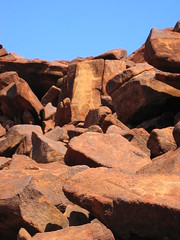
I am a bit dubious about the issue of general environmental destruction on Barrow Island as a result of constructing a new LNG plant. Having heard the same concerns voiced about the Burrup penninsula, I was expecting to find a toxic wasteland there when I visited 18 months ago - but in reality the plant didn't seem all that large in the context of the local environment, and didn't seem to have made that much of an impact on the surrounding area - the air seemed clean enough, the water had plenty of wildlife in it and the aboriginal rock art in the surrounding area seemed in the same condition as elsewhere.
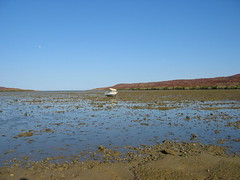
The large flare from the plant was the most obvious problem, but even that had an upside for those stupid enough to get stranded by the tide when trying to make a run through a strait and later having to make their way home in the darkness.

Compared to the iron ore port at Dampier and the salt processing works near Karratha it all seemed pretty clean - I'm happy to be corrected with any evidence to the contrary but complaints about environmental impact seemed pretty overblown.

Update: Removed a section about "flaring off" from the Gorgon project that I'd misread in Martin's article - apologies for any confusion caused.

Technorati tags:

The Uranium Report  

Posted by Big Gav

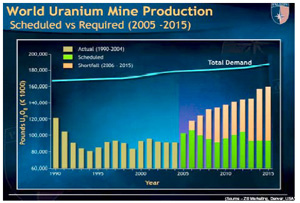
321 Energy has a survey of the uranium mining industry. There are a few contradictions in the data, but overall its an excellent summary of who is digging up what, where.

In the 1940s, the US government began buying large amounts of uranium in the effort to produce the world’s first atomic bomb. After World War II, the Atomic Energy Commission began examining peaceful uses. The first privately funded nuclear energy plant came online in Illinois in 1959. By the 1970s, about 250 nuclear reactors were planned across the United States – but then an accident in Pennsylvania changed all that. Three Mile Island hit, and starting in the 1980s utilities started cancelling plants. The investing public, the lay public, everyone kind of turned on nuclear power at that time. The uranium market collapsed on all those cancelled plants.

A second blow came when the Soviet Union fell apart, and enriched uranium removed from Russian bombs was blended down to reactor-grade fuel and dumped on the market. The third jolt occurred when the Clinton-administration privatised a government-owned uranium-enrichment program, and 70 million pounds of “yellowcake” was unloaded on the market. Exploration also tapered off. Wyoming once had eight uranium operations, producing 12 million pounds per year. Now it has none.

Technorati tags:

Oil: Is the Top In ?  

Posted by Big Gav

Rigzone is speculating that traditional signs of a top are visible in the oil market.

Calling a top in any market is always a gamble (having tried it in the tech stock market in 1998 and the real estate market here in 2000 I'm reluctant to point to a top in any market until a crash has actually begun) and in this case, its hard to imagine any future weakness in oil prices persisting for long (unless peak oil really is a long way off).

The shouts of oil prices remaining high "permanently" are getting louder. Last week Goldman Sachs called for crude oil prices to rise to $105 per barrel. This week, the World Bank described a similar scenario. Venezuela's oil minister also talked about oil prices remaining high. And now the International Money Fund is warning of the risk of a "permanent," oil shock.

A rather prominent fellow approached us yesterday, and with a gleam in his eye that we haven't seen in some time, pronounced that the current market is a "secular" bull market in oil, and that it is a "once in a lifetime" opportunity. The fellow then asked us which discount futures broker would be the best one for the futures trading account that he was about to open.

Few things, especially, in the commodity markets are permanent, other than prices will fluctuate. From a contrarian standpoint, when everyone agrees on something, it usually means that the opposite is about to happen. But the presses are now burning with hot oil stories.

Technorati tags:

The Real Reason (Honesty From The Rodent)  

Posted by Big Gav

Peak Oil Optimist ?  

Posted by Big Gav

Rob over at "Peak Oil Optimist" had a rather demented freak-out this week about the millenialist tendencies in some peak oil circles (and gives a very good example of how not to deal with sensible comments - if you don't like reasoned debate than just ban comments altogether and save people the time of composing a reasonable reply).

I think he's kind of missing the point - a lot of the dire warnings about the peak are intended (I assume) to motivate discussion and action in the same way that "The Day After Tomorrow" was meant to wake some people up about global warming.

And even the most extreme peak oil sites like dieoff.org don't seem gleeful about the imminent demise of humanity that they predict, contrary to Rob's accusations - they just think its inevitable because a large mass of the western world's population clearly doesn't listen to warnings about unsustainable behaviour.

If you want to be optimistic about it thats great - but the optimism should be based on positive actions that are happening to deal with the problem, rather than repeating the "market will solve all problems" religious mantra that seems to be increasingly emanating from the US these days (every single party state needs some simple slogans for the proles to chant I guess).

The original rant was inspired by an interesting article at Anthropik called "The Opposite Of Malthus" which is worth reading. Rob's rant also inspired a reply, "On Optimism", which I guess expresses the primitivist view on peak oil.

Many call me a pessimist, because I see the collapse of civilization in the next 15 years--whether by Peak Oil, global warming, or simply its increasing fragility--as inevitable, as well as the concommitant death of 99% or more of the current human population. But then, in the future I foresee, after breaking its 10,000-year-old fever in the greatest strife any animal has ever had the misfortune to behold, those who choose to survive by changing their lifestyle will get to live the balance of their days in the peace, freedom and simple joy which has been unknown to our civilized kind for 10 millennia. It's not a perfect utopia, except in comparison to civilized life. Civilization is all about living today by indebting the future; eventually, that must be paid. In the future I foresee, we pay it all at once and be done with it.


Rob also has a (much less fraught) post on methane hydrates which views them in a positive light. One article he links to is a good one from "Mechanical Engineering Magazine" that discusses the economic viability of extracting natural gas from methane hydrates. He doesn't comment on the global warming implications unfortunately, something I've morbidly moaned about previously.


Technorati tags:

Oil, Geopolitics, and the Coming War with Iran  

Posted by Big Gav

Tom Dispatch has a new article from Michael Klare on the forthcoming invasion of Iran. For some reason he thinks oil might be behind this...

As the United States gears up for an attack on Iran, one thing is certain: the Bush administration will never mention oil as a reason for going to war. As in the case of Iraq, weapons of mass destruction (WMD) will be cited as the principal justification for an American assault. "We will not tolerate the construction of a nuclear weapon [by Iran]," is the way President Bush put it in a much-quoted 2003 statement. But just as the failure to discover illicit weapons in Iraq undermined the administration's use of WMD as the paramount reason for its invasion, so its claim that an attack on Iran would be justified because of its alleged nuclear potential should invite widespread skepticism. More important, any serious assessment of Iran's strategic importance to the United States should focus on its role in the global energy equation.

Technorati tags:

Australia: We're Running Out Of Oil, says Treasurer  

Posted by Big Gav

Peter Costello has taken some time off from cooking the books and plotting the Rodent's demise to address the Northern Territory Cattlemen's Association on oil depletion.

Treasurer Peter Costello has delivered a blunt warning that Australia is running out of oil as existing fields near the end of their productive lives.

In a speech to the Northern Territory Cattlemen's Association, Mr Costello said it was little known that Australian exports of fuel had been falling for years despite soaring prices.

"The reason why Australia's crude oil exports have fallen over recent years - while world demand and prices have increased to record levels and LNG exports are booming - is that some of our oilfields are approaching the end of their productive lives," he said.

Total production had fallen from about 650,000 barrels a day to less that 430,000 barrels a day since mid-2002. Some fields - for example the Bonaparte field off Western Australia - are now producing only about a quarter of 2002 levels.

Technorati tags:

Analysing Oil Reserves  

Posted by Big Gav

After Goldman Sachs did their best to pump up the oil price with talk of a US$105 "super spike" last week, prices have drifted downwards.

Nevertheless, in the absence of a crushing recession or the magical appearance of some good alternative, oil prices should keep rising - and if you're interested in working out if any money can be made in the meantime, analysing the reserves of individual energy companies can be quite enlightening.

ChevronTexaco's recent takeover of Unocal valued Unocal's oil reserves at US$9.37 (A$12.20) per barrel. (Which seems pretty cheap with oil at US$50+ per barrel - but I haven't seen the estimated extraction costs and likely time taken to extract that oil, so who knows).

If that's the benchmark price, then what are Australian oil companies worth ?

Local broker E. L. and C. Baillieu cast their greedy eyes over the local market last week and ranked producers by market price per barrel of oil reserves.

Looking at it from this viewpoint, Papua New Guinea based Oil Search (OSH.AX) came out as by far the cheapest, at a meagre A$2 (US$1.54) per barrel. This is partly due to their low earnings (so they don't seem so cheap on a PE basis) and partly due to country risk (PNG isn't the most stable place on the planet, but still - its not the middle east or west africa either).

Oil Search are looking to build a pipeline to Australia, with the east coast looking for new supplies of gas. Exxon Mobil is their major partner and supplies most of the expertise, so OSH could be a good long term play, with the possibility of an Exxon takeover at some point also adding interest.

Of the others, Santos (STO.AX) is next cheapest at A$9 per barrel (not including their recent find at Jeruk), with the rest all around the benchmark price set for Unocal.

There is some speculation floating around that Shell may make another takeover attempt on Woodside (WPL.AX) to try and shore up their rapidly depleting reserves, but its hard to imagine the government would change their mind and not block any takeover attempt again.

Technorati tags:

Noam Chomsky Interview  

Posted by Big Gav

Noam Chomsky noted in a recent interview that the US has aimed to control the middle east since the end of world war 2 - referring once again to an oft quoted State Department memo from the late 1940's.

Q:In your opinion, what are the plans of America for Iraq and the future of Middle East? How will the situation effect the Middle East if America is exposed to the same, which was in Vietnam, also in Iraq? May the Middle East get more confused or may a calmness take place?

A:The US presumably seeks to establish a powerful position right at the heart of the world's major reserves of energy, thereby strengthening its control over this "stupendous source of strategic power, and one of the greatest material prizes in world history," as the State Department described the Gulf region at the end of World War II. Formal democracy in Iraq and elsewhere would be acceptable, even preferable, if only for public relations purposes. But if history is any guide, it will be the kind of democracy that the US has tolerated within its own regional domains for a century.

I'm not entirely sure who the author of the original memo was, but I suspect it was George Kennan, who also wrote that U.S. control over Japanese oil imports would help to provide "veto power" over Japan's military and industrial policies.
After the war, U.S. corporations gained the leading role in Middle East oil production, while dominating the Western hemisphere, which remained the major producer until 1968. The United States did not then need Middle East oil for itself. Rather, the goal was to dominate the world system, ensuring that others would not strike an independent course. Despite the general contempt for the Japanese and disparagement of their prospects, some foresaw problems even here. George Kennan proposed in 1949 that U.S. control over Japanese oil imports would help to provide "veto power" over Japan's military and industrial policies. This advice was followed. Japan was helped to industrialize, but the U.S. maintained control over its energy supplies and oil-refining facilities. As late as 1973, "only 10 per cent of Japan's oil supply was developed by Japanese companies," Shigeko Fukai observes. By now, Japan's diversification of energy sources and conservation measures have reduced the power of the "veto" considerably, but it is still a factor not without weight.

It is, furthermore, misleading simply to assert that the U.S. has sought to keep oil cheap, though that has generally been the case. Oil prices declined (relative to other commodities) from the 1940s until the sharp rise of the early 1970s brought them back into line. This was a major boon to the Western industrial powers, though extremely harmful to the long-term interests of the Arab world; and reduction in the real cost of oil was also of critical importance for the Reaganite veneer of prosperity. But cheap oil is a policy instrument, not an end in itself. There is good reason to believe that in the early 1970s, the U.S. was by no means averse to the increase in the price of oil, harmful to its industrial rivals, but beneficial to U.S. energy corporations and exporters. Control over energy is a lever for global dominance; the actual price and production levels gain significance within this context, and the economic effects of fluctuations are not a straightforward matter.

Technorati tags:

Norman Borlaug: Forgotten Benefactor of Humanity  

Posted by Big Gav

While I refer fairly frequently to the "Fatal Harvest" school of thought on industrial agriculture, the original "Green revolution" is worthy of some attention - this article is about Norman Borlaug, the agronomist whose discoveries sparked the Green Revolution.

Borlaug's leading research achievement was to hasten the perfection of dwarf spring wheat. Though it is conventionally assumed that farmers want a tall, impressive-looking harvest, in fact shrinking wheat and other crops has often proved beneficial. Bred for short stalks, plants expend less energy on growing inedible column sections and more on growing valuable grain. Stout, short-stalked wheat also neatly supports its kernels, whereas tall-stalked wheat may bend over at maturity, complicating reaping. Nature has favored genes for tall stalks, because in nature plants must compete for access to sunlight. In high-yield agriculture equally short-stalked plants will receive equal sunlight. As Borlaug labored to perfect his wheat, researchers were seeking dwarf strains of rice at the International Rice Research Institute, in the Philippines, another of the Ford and Rockefeller Foundations' creations, and at China's Hunan Rice Research Institute.

Once the Rockefeller's Mexican program was producing high-yield dwarf wheat for Mexico, Borlaug began to argue that India and other nations should switch to cereal crops. The proposition was controversial then and remains so today, some environmental commentators asserting that farmers in the developing world should grow indigenous crops (lentils in India, cassava in Africa) rather than the grains favored in the West. Borlaug's argument was simply that since no one had yet perfected high-yield strains of indigenous plants (high-yield cassava has only recently been available), CIMMYT wheat would produce the most food calories for the developing world. Borlaug particularly favored wheat because it grows in nearly all environments and requires relatively little pesticide, having an innate resistance to insects.

CIMMYT's selectively bred wheat, no longer a wholly natural plant, would not prosper without fertilizer and irrigation, however. High-yield crops sprout with great enthusiasm, but the better plants grow, the more moisture they demand and the faster they deplete soil nutrients. Like most agronomists, Borlaug has always advocated using organic fertilizers -- usually manure -- to restore soil nutrients. But the way to attain large quantities of manure is to have large herds of livestock, busily consuming the grain that would otherwise feed people. Inorganic fertilizers based on petroleum and other minerals can renew soil on a global scale -- at least as long as the petroleum holds out.

Technorati tags:

Statistics

Locations of visitors to this page

blogspot visitor
Stat Counter

Total Pageviews

Ads

Books

Followers

Blog Archive

Labels

australia (619) global warming (423) solar power (397) peak oil (355) renewable energy (302) electric vehicles (250) wind power (194) ocean energy (165) csp (159) solar thermal power (145) geothermal energy (144) energy storage (142) smart grids (140) oil (139) solar pv (138) tidal power (137) coal seam gas (131) nuclear power (129) china (120) lng (117) iraq (113) geothermal power (112) green buildings (110) natural gas (110) agriculture (91) oil price (80) biofuel (78) wave power (73) smart meters (72) coal (70) uk (69) electricity grid (67) energy efficiency (64) google (58) internet (50) surveillance (50) bicycle (49) big brother (49) shale gas (49) food prices (48) tesla (46) thin film solar (42) biomimicry (40) canada (40) scotland (38) ocean power (37) politics (37) shale oil (37) new zealand (35) air transport (34) algae (34) water (34) arctic ice (33) concentrating solar power (33) saudi arabia (33) queensland (32) california (31) credit crunch (31) bioplastic (30) offshore wind power (30) population (30) cogeneration (28) geoengineering (28) batteries (26) drought (26) resource wars (26) woodside (26) censorship (25) cleantech (25) bruce sterling (24) ctl (23) limits to growth (23) carbon tax (22) economics (22) exxon (22) lithium (22) buckminster fuller (21) distributed manufacturing (21) iraq oil law (21) coal to liquids (20) indonesia (20) origin energy (20) brightsource (19) rail transport (19) ultracapacitor (19) santos (18) ausra (17) collapse (17) electric bikes (17) michael klare (17) atlantis (16) cellulosic ethanol (16) iceland (16) lithium ion batteries (16) mapping (16) ucg (16) bees (15) concentrating solar thermal power (15) ethanol (15) geodynamics (15) psychology (15) al gore (14) brazil (14) bucky fuller (14) carbon emissions (14) fertiliser (14) matthew simmons (14) ambient energy (13) biodiesel (13) investment (13) kenya (13) public transport (13) big oil (12) biochar (12) chile (12) cities (12) desertec (12) internet of things (12) otec (12) texas (12) victoria (12) antarctica (11) cradle to cradle (11) energy policy (11) hybrid car (11) terra preta (11) tinfoil (11) toyota (11) amory lovins (10) fabber (10) gazprom (10) goldman sachs (10) gtl (10) severn estuary (10) volt (10) afghanistan (9) alaska (9) biomass (9) carbon trading (9) distributed generation (9) esolar (9) four day week (9) fuel cells (9) jeremy leggett (9) methane hydrates (9) pge (9) sweden (9) arrow energy (8) bolivia (8) eroei (8) fish (8) floating offshore wind power (8) guerilla gardening (8) linc energy (8) methane (8) nanosolar (8) natural gas pipelines (8) pentland firth (8) saul griffith (8) stirling engine (8) us elections (8) western australia (8) airborne wind turbines (7) bloom energy (7) boeing (7) chp (7) climategate (7) copenhagen (7) scenario planning (7) vinod khosla (7) apocaphilia (6) ceramic fuel cells (6) cigs (6) futurism (6) jatropha (6) nigeria (6) ocean acidification (6) relocalisation (6) somalia (6) t boone pickens (6) local currencies (5) space based solar power (5) varanus island (5) garbage (4) global energy grid (4) kevin kelly (4) low temperature geothermal power (4) oled (4) tim flannery (4) v2g (4) club of rome (3) norman borlaug (2) peak oil portfolio (1)