V2G In Sweden  

Posted by Big Gav

TreeHugger has a post on Swedish plans to increase the use of wind power and build a V2G network.

Sweden isn't a hot wind power market in Europe, not compared to Germany (20,000 MW of capacity), Spain (11,000 MW) or even Great Britain (nearly 2,000 MW). In fact, the Swedes currently have a paltry 572 MW of wind capacity, generating about 1.2TWh of power last year - less than one percent of electricity produced in this Nordic nation.

But Sweden has audacious goals (4.9 TWh of generation by 2010), and is starting to formulate a big vision to go with its big plans, based on the idea of wind power helping to drive (bad pun alert) a new generation of plug-in hybrid vehicles creating plausible climate neutral driving.

The way the Swedish Windpower Developers Association (SVIS) sees it, the Swedish vehicle industry (Volvo and Saab) and Swedish windpower are a great fit.

There are a few reasons why these gung-ho Swedish wind proponents may have a chance. It is true that Sweden will probably need to vastly up its renewable generation and reduce CO2 emissions further in coming years, especially after the EU sets binding CO2 reduction targets for the post-2012 period, which it should do early next year.

Wind is one of Sweden's best bets. Hydro power is pretty developed, remaining rivers are already protected - and biomass resources, which benefited from a green certificate subsidy system, are also fairly well-exploited.

Combining turbines with hybrids in a distributed generation system may not be such a stretch for the Swedes. Wind generation is a bit fickle, and many grid systems including Sweden's are not built to handle lots of incoming electricity from the spots where the wind blows best. But in a vehicle-to-grid (V2G) system, many small wind installations feeding in power are balanced by electric or hybrid-electric cars plugged in and theoretically offering up their excess capacity during times of peak need, taking it back late at night or when demand is lower.

Two more points in the Swedes' favor: the first European lithium-ion battery developer just opened its doors in Sweden, and Volvo at least is heavily investing in hybrid-electric technology. Volvo Cars is now showing its C30 ReCharge hybrid-electric plug-in concept car, and perhaps as important, Volvo Trucks is at work on a next generation of all kinds of hybrid vehicles.

Also not to be overlooked: Volvo and Saab with their nice heavy (safe) cars, unfortunately have some of the highest fleet-average CO2 emissions in Europe, which they will need to rectify.

There are definite roadblocks - in spite of itself Sweden hasn't been able to yet streamline approvals for wind power projects, whether they are for 12 turbines or 1,200. The approval process for Lillgrund, the new offshore wind farm in the picture, took a decade! And many Swedes, grown up on a combination of clean hydro and nuclear, see wind power as great in theory but in practice, a NIMBY nuisance. There are also clearly technology hurdles - battery cost and sophistication are just two.

But SVIS is conviced that V2G is a great concept to sell to the environmentally-conscious as well as everyone else, and will put forth its vision to the government in a few days, hoping for a new national policy on wind power and a plan for how to form a Swedish V2G network.

Renewable Energy Access has an article on "'Greening the Grid' in California" - an important step towards shifting to a clean energy system.
While "location-constrained" renewable resources can help California meet its Renewable Portfolio Standard, their development is often hampered by a lack of adequate transmission capacity. It can be difficult to find financing for transmission projects to reach generation that has not been built yet—hence the chicken or egg dilemma. Which should come first, generation or the transmission capacity needed to get the power to the grid?

Under the process approved last week, the appropriate Participating Transmission Owner (PTO) would build the "trunk lines" out to the renewable-rich areas, initially recovering its costs through the FERC-approved Transmission Revenue Requirement (TRR). As individual generation projects are built and connected to the grid, each generator would pay its pro-rata share of the annual TRR payments.

This financing arrangement would continue until the entire capacity of the project is subscribed at which time the remaining revenue requirement for the end-state transmission facility is completely supported by the project developers.

Currently, new power plant owners are responsible for the upfront cost of building transmission trunk lines to the grid and the costs can be prohibitive for smaller renewable power developers.

"This plan removes a major obstacle blocking the development of renewable resources," said ISO President and CEO Yakout Mansour. "This new hybrid financing method is a creative way to help alternative energy suppliers connect to the grid. It is all a part of leveling the playing field for green power generators and guaranteeing their non-discriminatory grid access. They still pay their fair share, but the costs are spread and appropriately based on when the green power comes on line."

Grist reports that French President Sarkozy has launched a number of green initiatives.
French President Nicolas Sarkozy today described a smattering of green initiatives for the country, prescribing some and promising to study others. Capping a two-day conference on ways France could green itself, Sarkozy outlined the policy ideas in a speech, with climate campaigner Al Gore looking on. Afterward, Gore offered the praise he was likely invited for, saying of the proposals, "This is the beginning of an historic process." Sarkozy said France would invest in greening its buildings, suspend the commercial planting of genetically modified crops, discourage use of inefficient cars, and will also halt construction of new roads and airports. Sarkozy promised a tax on freight-carrying trucks and mentioned plans for cross-country freight trains to replace them. He also floated an idea from former president Jacques Chirac that's sure to be popular with the United States. "We have to study the possibility of taxing products from countries that do not respect the Kyoto protocols," he said. Sarkozy touted the policies as "an ecological New Deal." Coincidentally, that's also what his critics in the U.S. said.

Richard Steubi at Cleantech Blog has a post on "Carboholics Anonymous".
This weekend, there was an extraordinary editorial in The Washington Post. The essence of the message was "Save me from myself: I can't stop emitting carbon. Unless the government changes the rules to induce me to stop, I will kill the planet."

The author of this plea was David Crane, the CEO of NRG Energy (NYSE: NRG), the 10th largest power generation company in the U.S. In effect, he is saying that his company is willing to undertake major changes to reduce emissions -- but only if competitors do so too, because NRG would be disadvantaged in the marketplace to take proactive action on its own.

I am very sympathetic with Mr. Crane's argument. It's a fine thing if people want to engage in emission reductions voluntarily. As for me, I admit that I'm not enthusiastic to unilaterally make changes that I otherwise don't prefer in order to reduce my carbon footprint. My rationale is that my miniscule contribution to solving the climate problem is individually meaningless, and I don't want to be just one of very few parties incurring costs or inconvenience without having any macro-scale impact anyway. Put another way, I'll do what it takes without complaining if everyone else is in the same boat, but I'm not going to be put out if most people aren't. I don't mind sacrificing, but if I'm going to sacrifice, it's only just that the sacrifice must be shared.

This is where public sector leadership comes in, which in turn is based not only on courageous voting by citizens, but also by visionary companies that demand a new world order. I'll gladly pay the price if everyone else does, and I'm eager to change the rules of the game so that we all bear our share of the burdens -- and it looks like NRG is of the same opinion. With more corporate leaders committed to taking the same stand, maybe we'll finally get somewhere with sound climate policy in Washington.

Tom Englehardt points out the obvious in his introduction to Jack Miles' article "Endgame for Iraqi Oil?: The Sovereignty Showdown in Iraq". Could they really be suggesting the Iraq war is over oil ? What a ridiculous idea - I'm sure the saints within the State Department (who are very disappointed at the way the Iraqi government selfishly refuses to share its oil revenues) and the Bush administration wouldn't dream of such a barbaric act of piracy.
Here's the strange thing about the Iraq oil "debate" in our media world. Call me crazy, but if you were going to invade Iraq and oil wasn't right at the forefront of your brain, you would be truly derelict, even if you hadn't run a major energy services corporation or hadn't had a double-hulled oil tanker named after you.

From the article itself:
The oil game in Iraq may be almost up. On September 29th, like a landlord serving notice, the government of Iraq announced that the next annual renewal of the United Nations Security Council mandate for a multinational force in Iraq -- the only legal basis for a continuation of the American occupation -- will be the last. That was, it seems, the first shoe to fall. The second may be an announcement terminating the little-noticed, but crucial companion Security Council mandate governing the disposition of Iraq's oil revenues.

By December 31, 2008, according to Foreign Minister Hoshyar Zebari, the government of Iraq intends to have replaced the existing mandate for a multinational security force with a conventional bilateral security agreement with the United States, an agreement of the sort that Washington has with Kuwait, Saudi Arabia, and several other countries in the Middle East. The Security Council has always paired the annual renewal of its mandate for the multinational force with the renewal of a second mandate for the management of Iraqi oil revenues. This happens through the "Development Fund for Iraq," a kind of escrow account set up by the occupying powers after the overthrow of the Saddam Hussein regime and recognized in 2003 by U.N. Security Council Resolution 1483. The oil game will be up if and when Iraq announces that this mandate, too, will be terminated at a date certain in favor of resource-development agreements that -- like the envisioned security agreement -- match those of other states in the region.

The game will be up because, as Antonia Juhasz pointed out last March in a New York Times op-ed, "Whose Oil Is It, Anyway?"
"Iraq's neighbors Iran, Kuwait and Saudi Arabia.... have outlawed foreign control over oil development. They all hire international oil companies as contractors to provide specific services as needed, for a limited duration, and without giving the foreign company any direct interest in the oil produced."

By contrast, the oil legislation now pending in the Iraqi parliament awards foreign oil companies coveted, long-term, 20-35 year contracts of just the sort that neighboring oil-producers have rejected for decades. It also places the Iraqi oil industry under the control of an appointed body that would include representatives of international oil companies as full voting members.

The news that the duly elected government of Iraq is exercising its limited sovereignty to set a date for termination of the American occupation radically undercuts all discussion in Congress or by American presidential candidates of how soon the U.S. occupation of Iraq may "safely" end. Yet if, by the same route, Iraq were to resume full and independent control over the world's third-largest proven oil reserves -- 200 to 300 million barrels of light crude worth as much as $30 trillion at today's prices -- a politically incorrect question might break rudely out of the Internet universe and into the mainstream media world, into, that is, the open: Has the Iraq war been an oil war from the outset?


Links:

* The Oil Drum - Australia: The Place To Be (Part 1)
* The Oil Drum - Review of What a Way to Go: Life at the End of Empire
* Kuwait Times - Why Kuwait wants to shift to heavy oil
* The Oil And The Glory - Sign of the Times For Big Oil
* WSJ Energy Roundup - The SPR Mystery
* Energy Bulletin - Iran worries and oil prices
* Cleantech Blog - Is Australia approaching 'K' day?
* Cleantech Blog - Australia the untapped market - new report on Australian Cleantech investment activity
* Haaretz - Cities find bright way to cut energy use
* TreeHugger - Honda FCX-concept Series Name to be Announced
* TreeHugger - Myths That Waste Energy In The Kitchen: The Baking & Roasting Episode. Preheating the oven is "an old wives tale".
* Tom Paine - Biofuel Backfire
* WSJ Energy Roundup - British Scientists: Massive Investment In Alternative-energy Research Required
* New York Times - Cement Industry Is at Center of Climate Change Debate
* The Guardian - Lime is a much greener option than cement
* Grist - Wild Thing, I Think I'll Miss You: Photos of species threatened by climate change
* AP - Much of U.S. Could See a Water Shortage
* Rolling Stone - The Prophet of Climate Change: James Lovelock
* UC Davis - Bee Specialist Eric Mussen Fingers Prime Suspects in ‘BSI: The Case of the Disappearing Bees’
* Washington Post - FEMA Meets the Press, Which Happens to Be . . . FEMA. If you can't handle real press conferences, fake them. Its a little like being President.
* Past Peak - Many-Fold Increase In US Airstrikes This Year In Iraq
* The Economist - Where Have I Heard That Tune Before ?


Greener Than A Leprechaun  

Posted by Big Gav

Bruce Sterling has a report on Dell's launch of a global competition to focus on environmentally-responsible technology, or as he put it in his inimitable way "Dell is going greener than a leprechaun".

Dell today issued a global challenge to members of the “ReGeneration” – people of all ages who share a goal of protecting the Earth – to help its engineers design the world’s most environmentally responsible computing technology.

Dell's call for ideas was issued here during the CONNECTING’07 World Design Congress. The challenge is called the ReGeneration: International Green Computing Technology Design Competition; Dell is looking for ideas that demonstrate fresh approaches and responsible solutions for green computing technology. "Dell is committed to partnering with the ReGeneration," said Ken Musgrave, director of Dell's Experience Design Group. “We want the best ideas from design students, computer enthusiasts and others to help technology protect our environment.”

The competition, which is endorsed by the Industrial Designers Society of America, is designed to invigorate the academic and industry dialogue regarding designs for environmentally responsible computing. The professionally juried competition is open to all, with a focus on students of universities and colleges that offer design programs.

Meanwhile, ex-Sun Microsystems founder and now KPCB venture capitalist Bill Joy is saying it is "Better to be in green tech than the Internet".
The legendary Internet technologist Bill Joy has found a better place than the Internet to put his venture capital dollars: green technology.

On Monday Joy gave a talk on why he is exploring a wide range of green technologies as a partner at venture capital firm Kleiner, Perkins, Caufield & Byers. He spoke at the Lux Research conference on nanotechnology where he also predicted major changes in transportation industry and solar energy.

Joy, credited with inventing several Internet technologies as a co-founder of Sun Microsystems, joined the high-profile Silicon Valley venture capital firm in 2005. Apart from some semiconductor companies, he is staying away from Internet investments which he said are "wacky right now." By contrast, the urgent problem of global warming means that energy and green tech investments represent a great opportunity for innovation, he said.

"Eugene Kleiner, the co-founder of Kleiner Perkins, said there is a time when panic is the appropriate response. And I think we should go into a panic--not only (because) the scale of the problem but also the economic opportunity that becoming more efficient in our use of energy gives to us," Joy said during his talk.

In an interview after his presentation, Joy said that energy and green tech makes for appealing venture investments because there is a large technology component and the markets are huge. He is confident that there will be good financial returns in green tech, which is seeing an explosion of investment. In the past few years, some clean tech companies in electricity-grid demand management and solar electricity have successfully gone public, while other fields, such as biofuels, have had mixed results.

During his talk, Joy forecast how the transportation and electricity businesses could change over the next five to 10 years. Although biofuels--fuels like ethanol made from plants--are garnering the bulk of investment dollars, Joy thinks that "electric vehicles will beat biofuels." That means that the transportation and electricity grid will be increasingly interlinked.

The key stumbling block to plug-in hybrid cars are electric vehicles is batteries. But Joy is again optimistic there. "There's a range of new chemistries coming so that you can imagine, say five to ten years from now, instead of 100 watt-hours per liter we're at today, that a break-out company will have a 500 or thousand watt-hours--a five to 10 times (increase in) the energy density," he said. "It'd be perfectly practical to have a car that you plug into your garage and you never have to go to a gas station," he said.

For longer trips, people could have tanks for liquid fuels. Joy also imagines that cars will be equipped with 40- to 50 percent-efficient solar panels to charge their batteries. "Maybe outdoor parking lot spots will be more valuable," he said. He said it's more likely that these electric cars will take hold in Europe before the United States because Americans drive longer distances, have heavier cars and drive more trucks as passenger cars.

Business Week has a depressing article on "Little Green Lies" - looking at the difficulty of greening businesses. I think the key aspect in this example is that Auden Schendler is trying to cost justify carbon free power sources in an environment where coal is still the cheapest source of power - basically an impossible task, which is why he has made so little headway. Until carbon taxes arrive (or some other charge to compensate for the damage caused by carbon emissions) this mission will be very difficult, though hopefully at some point solar and wind power will become cheaper than coal regardless of policy responses to global warming.
Auden Schendler learned about corporate environmentalism directly from the prophet of the movement. In the late 1990s, Schendler was working as a junior researcher at the Rocky Mountain Institute, a think tank in Aspen led by Amory Lovins, legendary author of the idea that by "going green," companies can increase profits while saving the planet. As Lovins often told Schendler and others at the institute, boosting energy efficiency and reducing harmful emissions constitute not just a free lunch but "a lunch you're paid to eat."

nspired by this marvelous promise, Schendler took a job in 1999 at Aspen Skiing Co., becoming one of the first of a new breed: the in-house "corporate sustainability" advocate. Eight years later, it takes him six hours crisscrossing the Aspen region by car and foot to show a visitor some of the ways he has helped the posh, 800-employee resort blunt its contribution to global warming. Schendler, 37, a tanned and muscular mountain climber, clambers atop a storage shed to point out sleek solar panels on an employee-housing rooftop. He hikes down a stony slope for a view of the resort's miniature power plant, fueled by the rushing waters of a mountain creek. The company features its environmental credentials in its marketing and has decorated its headquarters with green trophies and plaques. Last year Time honored Schendler as a "Climate Crusader" in an article accompanied by a half-page photo of the jut-jawed executive standing amid snow-covered evergreens.

But at the end of this arid late-summer afternoon, Schendler is feeling anything but triumphant. He pulls a company sedan to the side of a dirt road and turns off the motor. "Who are we kidding?" he says, finally. Despite all his exertions, the resort's greenhouse-gas emissions continue to creep up year after year. More vacationers mean larger lodgings burning more power. Warmer winters require tons of additional artificial snow, another energy drain. "I've succeeded in doing a lot of sexy projects yet utterly failed in what I set out to do," Schendler says. "How do you really green your company? It's almost f------ impossible." ...

Science Daily has a look at some European research into the smart grid / electranet - "Could The Electricity Grid Become A Type Of Internet?".
In the future everyone who is connected to the electricity grid will be able to upload and download packages of electricity to and from this network. At least, that is one of the transformations the electricity grid could undergo.

Dutch researcher Jos Meeuwsen (Technical University Eindhoven) developed three scenarios for the Dutch electricity supply in the year 2050. The starting point is that in this year, 50% of the consumption will originate from sustainable sources. Due to the security of supply and the connection with the European market, electricity networks will always be necessary says Meeuwsen. Further, due to an increasing demand for electricity it is important to include all possible energy options (including coal and nuclear energy) in the scenario development.

The exact form of future networks will largely depend on the primary energy mix chosen. In all cases engineers face new and considerable challenges in the areas of network and system integration and the development and implementation of new technology. Moreover, in all scenarios the total network capacity must increase. Small-scale networks will adapt characteristics from the current large-scale networks, such as the possibility of 'two-way traffic' and the responsibility to maintain a stable system.

Demand follows supply

In particular, the number of ways in which the total electricity supply system can be held in balance in the future will need to be expanded as more electricity is generated from sustainable sources.

This might even mean a paradigm shift from the current 'permanently matching supply to demand' to 'continuously matching demand to supply'. Meeuwsen foresees a step-by-step integration of energy technology, ICT and power electronics that might result in an electricity system that exhibits many similarities with the Internet. Everyone connected to the system could then, within certain limits, upload and download packages of 'electrical energy' whenever they want. An important condition is, however, the technical feasibility of the centralised and/or decentralised storage of large amounts of electricity.

Three scenarios

Meeuwsen's three different scenarios for the future of the electricity grid mainly differ in the size of the electricity generation facilities. The scenario 'super networks' consists of large-scale production locations, transportation via high voltages, a considerable import of sustainable energy (in the form of biomass) and energy from offshore wind farms. The 'hybrid networks' scenario also includes large plants with high voltages that originate from offshore wind parks and large biomass stations.

Additionally, small-scale generation takes place in and around cities and villages (wind, biomass and solar energy). Finally, in the 'local' scenario the number of local generators (in the form of micro-cogeneration units, solar energy panels, small-scale biomass plants at neighbourhood level and land-based wind turbines) is the greatest, yet large industrial processes and small consumers still make partly use of electricity from large-scale production resources.

Michael Klare has a new article out in The Nation - "Beyond the age of petroleum".
This past May, in an unheralded and almost unnoticed move, the Energy Department signaled a fundamental, near epochal shift in US and indeed world history: we are nearing the end of the Petroleum Age and have entered the Age of Insufficiency. The department stopped talking about "oil" in its projections of future petroleum availability and began speaking of "liquids." The global output of "liquids," the department indicated, would rise from 84 million barrels of oil equivalent (mboe) per day in 2005 to a projected 117.7 mboe in 2030--barely enough to satisfy anticipated world demand of 117.6 mboe. Aside from suggesting the degree to which oil companies have ceased being mere suppliers of petroleum and are now purveyors of a wide variety of liquid products--including synthetic fuels derived from natural gas, corn, coal and other substances--this change hints at something more fundamental: we have entered a new era of intensified energy competition and growing reliance on the use of force to protect overseas sources of petroleum.

To appreciate the nature of the change, it is useful to probe a bit deeper into the Energy Department's curious terminology. "Liquids," the department explains in its International Energy Outlook for 2007, encompasses "conventional" petroleum as well as "unconventional" liquids--notably tar sands (bitumen), oil shale, biofuels, coal-to-liquids and gas-to-liquids. Once a relatively insignificant component of the energy business, these fuels have come to assume much greater importance as the output of conventional petroleum has faltered. Indeed, the Energy Department projects that unconventional liquids production will jump from a mere 2.4 mboe per day in 2005 to 10.5 in 2030, a fourfold increase. But the real story is not the impressive growth in unconventional fuels but the stagnation in conventional oil output. Looked at from this perspective, it is hard to escape the conclusion that the switch from "oil" to "liquids" in the department's terminology is a not so subtle attempt to disguise the fact that worldwide oil production is at or near its peak capacity and that we can soon expect a downturn in the global availability of conventional petroleum.

Petroleum is, of course, a finite substance, and geologists have long warned of its ultimate disappearance. The extraction of oil, like that of other nonrenewable resources, will follow a parabolic curve over time. Production rises quickly at first and then gradually slows until approximately half the original supply has been exhausted; at that point, a peak in sustainable output is attained and production begins an irreversible decline until it becomes too expensive to lift what little remains. Most oil geologists believe we have already reached the midway point in the depletion of the world's original petroleum inheritance and so are nearing a peak in global output; the only real debate is over how close we have come to that point, with some experts claiming we are at the peak now and others saying it is still a few years or maybe a decade away.

Until very recently, Energy Department analysts were firmly in the camp of those wild-eyed optimists who claimed that peak oil was so far in the future that we didn't really need to give it much thought. Putting aside the science of the matter, the promulgation of such a rose-colored view obviated any need to advocate improvements in automobile fuel efficiency or to accelerate progress on the development of alternative fuels. Given White House priorities, it is hardly surprising that this view prevailed in Washington.

In just the past six months, however, the signs of an imminent peak in conventional oil production have become impossible even for conservative industry analysts to ignore. These have come from the take-no-prisoners world of oil pricing and deal-making, on the one hand, and the analysis of international energy experts, on the other.

Most dramatic, perhaps, has been the spectacular rise in oil prices. The price of light, sweet crude crossed the longstanding psychological barrier of $80 per barrel on the New York Mercantile Exchange for the first time in September, and has since risen to as high as $90. Many reasons have been cited for the rise in crude prices, including unrest in Nigeria's oil-producing Delta region, pipeline sabotage in Mexico, increased hurricane activity in the Gulf of Mexico and fears of Turkish attacks on Kurdish guerrilla sanctuaries in Iraq. But the underlying reality is that most oil-producing countries are pumping at maximum capacity and finding it increasingly difficult to boost production in the face of rising international demand.

Even a decision by the Organization of the Petroleum Exporting Countries (OPEC) to boost production by 500,000 barrels per day failed to halt the upward momentum in prices. Concerned that an excessive rise in oil costs would trigger a worldwide recession and lower demand for their products, the OPEC countries agreed to increase their combined output at a meeting in Vienna on September 11. "We think that the market is a little bit high," explained Kuwait's acting oil minister, Mohammad al-Olaim. But the move did little to slow the rise in prices. Clearly, OPEC would have to undertake a much larger production increase to alter the market environment, and it is not at all clear that its members possess the capacity to do that--now or in the future.

A warning sign of another sort was provided by Kazakhstan's August decision to suspend development of the giant Kashagan oil region in its sector of the Caspian Sea, first initiated by a consortium of Western firms in the late '90s. Kashagan was said to be the most promising oil project since the discovery of oil in Alaska's Prudhoe Bay in the late '60s. But the enterprise has encountered enormous technical problems and has yet to produce a barrel of oil. Frustrated by a failure to see any economic benefits from the project, the Kazakh government has cited environmental risks and cost overruns to justify suspending operations and demanding a greater say in the project.

Like the dramatic rise in oil prices, the Kashagan episode is an indication of the oil industry's growing difficulties in its efforts to boost production in the face of rising demand. "All the oil companies are struggling to grow production," Peter Hitchens of Teather & Greenwood brokerage told the Wall Street Journal in July. "It's becoming more and more difficult to bring projects in on time and on budget."

That this industry debilitation is not a temporary problem but symptomatic of a long-term trend was confirmed in two important studies published this past summer by conservative industry organizations.

The first of these was released July 9 by the International Energy Agency (IEA), an affiliate of the Organization for Economic Cooperation and Development, the club of major industrial powers. Titled Medium-Term Oil Market Report, it is a blunt assessment of the global supply-and-demand equation over the 2007-12 period. The news is not good.

Predicting that world economic activity will grow by an average of 4.5 percent per year during this period--much of it driven by unbridled growth in China, India and the Middle East--the report concludes that global oil demand will rise by 2.2 percent per year, pushing world oil consumption from approximately 86 million barrels per day in 2007 to 96 million in 2012. With luck and massive new investment, the oil industry will be able to increase output sufficiently to satisfy the higher level of demand anticipated for 2012--barely. Beyond that, however, there appears little likelihood that the industry will be able to sustain any increase in demand. "Oil look[s] extremely tight in five years' time," the agency declared.

Underlying the report's general conclusion are a number of specific concerns. Most notably, it points to a worrisome decline in the yield of older fields in non-OPEC countries and a corresponding need for increased output from the OPEC countries, most of which are located in conflict-prone areas of the Middle East and Africa. The numbers involved are staggering. At first blush, it would seem that the need for an extra 10 million barrels per day between now and 2012 would translate into an added 2 million barrels per day in each of the next five years--a conceivably attainable goal. But that doesn't take into account the decline of older fields. According to the report, the world actually needs an extra 5 million: 3 million to make up for the decline in older fields plus the 2 million in added requirements. This is a daunting and possibly insurmountable challenge, especially when one considers that almost all of the additional petroleum will have to come from Iran, Iraq, Kuwait, Saudi Arabia, Algeria, Angola, Libya, Nigeria, Sudan, Kazakhstan and Venezuela--countries that do not inspire the sort of investor confidence that will be needed to pour hundreds of billions of dollars into new drilling rigs, pipelines and other essential infrastructure. ...

This conclusion leads to two obvious strategic impulses: first, the government will seek to ease the qualms of major energy investors by promising to protect their overseas investments through the deployment of American military forces; and second, the industry will seek to hedge its bets by shifting an ever-increasing share of its investment funds into the development of nonpetroleum liquids.

The New 'Washington Consensus'

The need for a vigorous US military role in protecting energy assets abroad has been a major theme in American foreign policy since 1945, when President Roosevelt met with King Abdul Aziz of Saudi Arabia and promised to protect the kingdom in return for privileged access to Saudi oil.

In the most famous expression of this linkage, President Carter affirmed in January 1980 that the unimpeded flow of Persian Gulf oil is among this country's vital interests and that to protect this interest, the United States will employ "any means necessary, including military force." This principle was later cited by President Reagan as the rationale for "reflagging" Kuwaiti oil tankers with the American ensign during the Iran-Iraq War of 1980-88 and protecting them with US warships--a stance that led to sporadic clashes with Iran. The same principle was subsequently invoked by George H.W. Bush as a justification for the Gulf War of 1991.

In considering these past events, it is important to recognize that the use of military force to protect the flow of imported petroleum has generally enjoyed broad bipartisan support in Washington. Initially, this bipartisan outlook was largely focused on the Persian Gulf area, but since 1990, it has been extended to other areas as well. President Clinton eagerly pursued close military ties with the Caspian Sea oil states of Azerbaijan and Kazakhstan after the breakup of the USSR in 1991, while George W. Bush has avidly sought an increased US military presence in Africa's oil-producing regions, going so far as to favor the establishment of a US Africa Command (Africom) in February.

One might imagine that the current debacle in Iraq would shake this consensus, but there is no evidence that this is so. In fact, the opposite appears to be the case: possibly fearful that the chaos in Iraq will spread to other countries in the Gulf region, senior figures in both parties are calling for a reinvigorated US military role in the protection of foreign energy deliveries.

Perhaps the most explicit expression of this elite consensus is an independent task force report, National Security Consequences of U.S. Oil Dependency, backed by many prominent Democrats and Republicans. It was released by the bipartisan Council on Foreign Relations (CFR), co-chaired by John Deutch, deputy secretary of defense in the Clinton Administration, and James Schlesinger, defense secretary in the Nixon and Ford administrations, in October 2006. The report warns of mounting perils to the safe flow of foreign oil. Concluding that the United States alone has the capacity to protect the global oil trade against the threat of violent obstruction, it argues the need for a strong US military presence in key producing areas and in the sea lanes that carry foreign oil to American shores.

An awareness of this new "Washington consensus" on the need to protect overseas oil supplies with American troops helps explain many recent developments in Washington. Most significant, it illuminates the strategic stance adopted by President Bush in justifying his determination to retain a potent US force in Iraq--and why the Democrats have found it so difficult to contest that stance.

Consider Bush's September 13 prime-time speech on Iraq. "If we were to be driven out of Iraq," he prophesied, "extremists of all strains would be emboldened.... Iran would benefit from the chaos and would be encouraged in its efforts to gain nuclear weapons and dominate the region. Extremists could control a key part of the global energy supply." And then came the kicker: "Whatever political party you belong to, whatever your position on Iraq, we should be able to agree that America has a vital interest in preventing chaos and providing hope in the Middle East." In other words, Iraq is no longer about democracy or WMDs or terrorism but about maintaining regional stability to ensure the safe flow of petroleum and keep the American economy on an even keel; it was almost as if he was speaking to the bipartisan crowd that backed the CFR report cited above.

It is very clear that the Democrats, or at least mainstream Democrats, are finding it exceedingly difficult to contest this argument head-on. In March, for example, Senator Hillary Clinton told the New York Times that Iraq is "right in the heart of the oil region" and so "it is directly in opposition to our interests" for it to become a failed state or a pawn of Iran. This means, she continued, that it will be necessary to keep some US troops in Iraq indefinitely, to provide logistical and training support to the Iraqi military. Senator Barack Obama has also spoken of the need to maintain a robust US military presence in Iraq and the surrounding area. Thus, while calling for the withdrawal of most US combat brigades from Iraq proper, he has championed an "over-the-horizon force that could prevent chaos in the wider region."

Given this perspective, it is very hard for mainstream Democrats to challenge Bush when he says that an "enduring" US military presence is needed in Iraq or to change the Administration's current policy, barring a major military setback or some other unforeseen event. By the same token, it will be hard for the Democrats to avert a US attack on Iran if this can be portrayed as a necessary move to prevent Tehran from threatening the long-term safety of Persian Gulf oil supplies.

Nor can we anticipate a dramatic change in US policy in the Gulf region from the next administration, whether Democratic or Republican. If anything, we should expect an increase in the use of military force to protect the overseas flow of oil, as the threat level rises along with the need for new investment to avert even further reductions in global supplies. ...

And so we have a portrait of the global energy situation after the peak of conventional petroleum, with troops being rushed from one oil-producing hot spot to another and a growing share of our transportation fuel being supplied by nonpetroleum liquids of one sort or another. Exactly what form this future energy equation will take cannot be foreseen with precision, but it is obvious that the arduous process will shape American policy debates, domestic and foreign, for a long time.

As this brief assessment suggests, the passing of peak oil will have profound and lasting consequences for this country, with no easy solutions. In facing this future, we must, above all, disavow any simple answers, such as energy "independence" based on the pillage of America's remaining wilderness areas or the false promise of corn-based ethanol (which can supply only a tiny fraction of our transportation requirements). It is clear, moreover, that many of the fuel alternatives proposed by the Bush Administration pose significant dangers of their own and so should be examined carefully before vast public sums are committed to their development. The safest and most morally defensible course is to repudiate any "consensus" calling for the use of force to protect overseas petroleum supplies and to strive to conserve what remains of the world's oil by using less of it.


Links:

* TreeHugger - Turtle Airships: Not Slow, But Hardshelled
* CNet - Start-up says it can make solar panels out of dirty silicon
* Cleantech.com - Fuel cells go to waste
* Technology Review - Hybrids versus Electric Cars
* Business Week - The Global Race to Fuel the Car of the Future
* TreeHugger - Benjamin Kahn: A TIME Magazine Hero
* Andrew Leonard - Sub-Saharan dilemma: Food vs. fuel or radioactive waste?. Why not solar instead ?
* TreeHugger - Rising Food & Oil Prices: A Recipe For Riots Says FAO
* Mobjectivist - Blogorithm. WHT isn't a member of the Michael Lynch fan club.
* Tom Whipple - The peak oil crisis: A message from Houston
* Jeff Vail - 2015 Oil Futures
* New York Times - A Ban on Ron Paul Supporters
* Past Peak - Dems Suck, Too. "What's the difference between Democrats and Republicans? Democrats tell different lies to get elected. A pox on both their houses." To be fair, Ron Paul and Dennis Kucinich should be exempted from this criticism.
* The Agonist - The "Hitler Comparison"
* AFP - Iraq Revokes All Contractor Immunity. Let the Blackwater trials commence.
* Cryptogon - Putin Comments on Bush: “Running Around Like a Madman with a Razor Blade”

Dumber Than Dirt ?  

Posted by Big Gav

I'm still bogged down in a longish post, with the link hopper backing up rapidly - so no news tonight, other than the latest ANZ news at The Oil Drum and this little rant from Mark Morford - American kids, dumber than dirt (or as Jeff Wells called them today, the "tazed and confused").

I'm not sure the relative uselessness of modern day kids is all that new - it doesn't sound that different to most people I knew growing up in the 1970's - and these kids aren't necessarily mal-adapted to the modern ultra-specialised world they live in - so long as the resources they (and the rest of us) depend on keep flowing of course.

I have this ongoing discussion with a longtime reader who also just so happens to be a longtime Oakland high school teacher, a wonderful guy who's seen generations of teens come and generations go and who has a delightful poetic sensibility and quirky outlook on his life and his family and his beloved teaching career.

And he often writes to me in response to something I might've written about the youth of today, anything where I comment on the various nefarious factors shaping their minds and their perspectives and whether or not, say, EMFs and junk food and cell phones are melting their brains and what can be done and just how bad it might all be.

His response: It is not bad at all. It's absolutely horrifying.

My friend often summarizes for me what he sees, firsthand, every day and every month, year in and year out, in his classroom. He speaks not merely of the sad decline in overall intellectual acumen among students over the years, not merely of the astonishing spread of lazy slackerhood, or the fact that cell phones and iPods and excess TV exposure are, absolutely and without reservation, short-circuiting the minds of the upcoming generations. Of this, he says, there is zero doubt.

Nor does he speak merely of the notion that kids these days are overprotected and wussified and don't spend enough time outdoors and don't get any real exercise and therefore can't, say, identify basic plants, or handle a tool, or build, well, anything at all. Again, these things are a given. Widely reported, tragically ignored, nothing new.

No, my friend takes it all a full step — or rather, leap — further. It is not merely a sad slide. It is not just a general dumbing down. It is far uglier than that.

We are, as far as urban public education is concerned, essentially at rock bottom. We are now at a point where we are essentially churning out ignorant teens who are becoming ignorant adults and society as a whole will pay dearly, very soon, and if you think the hordes of easily terrified, mindless fundamentalist evangelical Christian lemmings have been bad for the soul of this country, just wait.

It's gotten so bad that, as my friend nears retirement, he says he is very seriously considering moving out of the country so as to escape what he sees will be the surefire collapse of functioning American society in the next handful of years due to the absolutely irrefutable destruction, the shocking — and nearly hopeless — dumb-ification of the American brain. It is just that bad.

Now, you may think he's merely a curmudgeon, a tired old teacher who stopped caring long ago. Not true. Teaching is his life. He says he loves his students, loves education and learning and watching young minds awaken. Problem is, he is seeing much less of it. It's a bit like the melting of the polar ice caps. Sure, there's been alarmist data about it for years, but until you see it for yourself, the deep visceral dread doesn't really hit home.

He cites studies, reports, hard data, from the appalling effects of television on child brain development (i.e.; any TV exposure before 6 years old and your kid's basic cognitive wiring and spatial perceptions are pretty much scrambled for life), to the fact that, because of all the insidious mandatory testing teachers are now forced to incorporate into the curriculum, of the 182 school days in a year, there are 110 when such testing is going on somewhere at Oakland High. As one of his colleagues put it, "It's like weighing a calf twice a day, but never feeding it."

But most of all, he simply observes his students, year to year, noting all the obvious evidence of teens' decreasing abilities when confronted with even the most basic intellectual tasks, from understanding simple history to working through moderately complex ideas to even (in a couple recent examples that particularly distressed him) being able to define the words "agriculture," or even "democracy." Not a single student could do it.

It gets worse. My friend cites the fact that, of the 6,000 high school students he estimates he's taught over the span of his career, only a small fraction now make it to his grade with a functioning understanding of written English. They do not know how to form a sentence. They cannot write an intelligible paragraph. Recently, after giving an assignment that required drawing lines, he realized that not a single student actually knew how to use a ruler.

It is, in short, nothing less than a tidal wave of dumb, with once-passionate, increasingly exasperated teachers like my friend nearly powerless to stop it. The worst part: It's not the kids' fault. They're merely the victims of a horribly failed educational system.

Then our discussion often turns to the meat of it, the bigger picture, the ugly and unavoidable truism about the lack of need among the government and the power elite in this nation to create a truly effective educational system, one that actually generates intelligent, thoughtful, articulate citizens.

Hell, why should they? After all, the dumber the populace, the easier it is to rule and control and launch unwinnable wars and pass laws telling them that sex is bad and TV is good and God knows all, so just pipe down and eat your Taco Bell Double-Supremo Burrito and be glad we don't arrest you for posting dirty pictures on your cute little blog.

This is about when I try to offer counterevidence, a bit of optimism. For one thing, I've argued generational relativity in this space before, suggesting maybe kids are no scarier or dumber or more dangerous than they've ever been, and that maybe some of the problem is merely the same old awkward generation gap, with every current generation absolutely convinced the subsequent one is terrifically stupid and malicious and will be the end of society as a whole. Just the way it always seems.

I also point out how, despite all the evidence of total public-education meltdown, I keep being surprised, keep hearing from/about teens and youth movements and actions that impress the hell out of me. Damn kids made the Internet what it is today, fer chrissakes. Revolutionized media. Broke all the rules. Still are.

Hell, some of the best designers, writers, artists, poets, chefs, and so on that I meet are in their early to mid-20s. And the nation's top universities are still managing, despite a factory-churning mentality, to crank out young minds of astonishing ability and acumen. How did these kids do it? How did they escape the horrible public school system? How did they avoid the great dumbing down of America? Did they never see a TV show until they hit puberty? Were they all born and raised elsewhere, in India and Asia and Russia? Did they all go to Waldorf or Montessori and eat whole-grain breads and play with firecrackers and take long walks in wild nature? Are these kids flukes? Exceptions? Just lucky?

My friend would say, well, yes, that's precisely what most of them are. Lucky, wealthy, foreign-born, private-schooled ... and increasingly rare. Most affluent parents in America — and many more who aren't — now put their kids in private schools from day one, and the smart ones give their kids no TV and minimal junk food and no video games. (Of course, this in no way guarantees a smart, attuned kid, but compared to the odds of success in the public school system, it sure seems to help). This covers about, what, 3 percent of the populace?

As for the rest, well, the dystopian evidence seems overwhelming indeed, to the point where it might be no stretch at all to say the biggest threat facing America is perhaps not global warming, not perpetual warmongering, not garbage food or low-level radiation or way too much Lindsay Lohan, but a populace far too ignorant to know how to properly manage any of it, much less change it all for the better.

What, too fatalistic? Don't worry. Soon enough, no one will know what the word even means.

Congealed Electricity  

Posted by Big Gav in , , , ,

The Australian has an article on BHP considering a $3.4bn Congo aluminium smelter. It is interesting to see companies that depend heavily on cheap energy starting to move towards large renewable power sources (similar to the move of petrochemical companies to the middle east).

MINING giant BHP Billiton is considering spending $US3 billion ($3.365 billion) on building an aluminium smelter in the once war-torn Democratic Republic of Congo to take advantage of cheap and green hydro-electric power in the country. Under a memorandum of understanding with the DRC Government, BHP will spend $US20 million on a feasibility study for the smelter and an associated expansion of the Inga hydro power station on the Congo River.

BHP could source alumina for the refinery from its $3 billion alumina and bauxite project in Guinea, and the move will stoke speculation that BHP is stalking its Canadian-based partner in the Guinea project, Global Alumina, which is valued at more than $US500 million.

The Congo project is the latest sign that miners are having to go into riskier geographies to find key assets - the key asset in this case being hydro power.

Aluminium is often referred to as "congealed electricity" because of the large amount of power needed to smelt alumina. Aluminium producers are scouring the world for sources of so-called stranded power that can guarantee low costs, and the inevitability of a price on carbon means green power is high on the list. Rio Tinto's $43 billion takeover of Canadian aluminium giant Alcan is largely driven by Alcan's large sources of hydro-electric power in Canada.

While aluminium producers including Rio increasingly see the Middle East as an attractive site for smelters, given the region's surplus natural gas reserves, BHP is believed to be wary of the area, given the potential for the gas to be exported as liquefied natural gas.

WorldChanging notes that New Zealand Aims to be World’s First Carbon Neutral Nation
New Zealand has declared its aim to be carbon neutral in electrical energy by 2025, in stationary manufacturing energy in 2030 and in transport energy by 2040.

The New Zealand government has a history of leadership in sustainable energy planning already signaled its intention to be a leader in carbon neutrality when it announced its Emissions Trading Scheme in September. The October launch of the New Zealand Energy Strategy to 2050, titled Powering our Future: Towards a sustainable low emissions energy system, has provided further detail of the steps.

The strategy includes plans for substantial reductions in emissions, along with carbon offsetting projects such as increasing national forest area by 250,000 hectares by 2020. By 2025, the goal is to obtain 90 percent of all electricity from renewable sources. Is this achievable? We think so: Provision of renewable electricity is cheaper in New Zealand compared to other countries due to abundant renewable energy resources. Around 70 percent of New Zealand energy production is already from renewable sources, and a number of large scale wind farm proposals have recently been approved.

Crikey notes that the Greens are actually economic rationalists compared to the pork-barrelling Rodent - Greens show up Howard on energy subsidies
It's a bizarre election campaign when the economic flat-earthers in the Greens make more sense than the Government. But their attack on the Liberals' proposal to subsidise low income earners for higher energy bills as a consequence of emissions trading is exactly right.

As the Prime Minister noted on Sunday night, addressing climate change will actually entail costs for consumers. That's exactly the point, really, because only costs, not good intentions, will cause consumers to make decisions with lower carbon impacts. You can't stop a runaway greenhouse effect with a few fluoro light bulbs and the occasional bike ride to work.

But Howard promptly undermined this by announcing a climate change fund, sourced from proceeds from emissions trading, to subsidise low income earners' power bills, which an emissions trading scheme will – or should, if it actually works - increase. Of course, we are talking here about a proper emissions trading scheme, not Morris Iemma's version that exempts the biggest carbon producers because they're mates of the government.

Quite how you encourage people to reduce their carbon emissions when you're subsidising their power usage isn't clear. It's like subsidising a smoker's cigarette costs because of all the taxes you've imposed on tobacco.

Greens senator Christine Milne has pointed this out, arguing that funding energy efficiency measures in low income households will provide a more permanent and effective guarantee against higher power bills. Even better, she calls the Liberals' proposal "a bandaid cheque", which is the best entry so far in the "Mixed Metaphor of the Campaign" competition.

Perhaps the Government has had its preferred inventor of greenhouse fictions, ABARE, produce some evidence that carbon emissions from low income earners have less of a greenhouse impact than those from everyone else. But on that basis, the Government wouldn't justify its refusal to sign on to the Kyoto Protocol because it leaves out China and India. Clearly carbon emissions from foreign low income earners have to be addressed, even if ours don't.

Public Opinion has a post on Climate change: rhetoric+reality
Jim Douglas, writing in the Canberra Times on climate change, says that:
You get the feeling, under these circumstances, of being in a luxury car accelerating towards a sheer drop, as its demented driver ignores your shouts of alarm and regales you with enthusiastic details of what a wonderful vehicle it is, and how well he has maintained it.

That's what the Liberal's "Go for Growth "campaign slogan signifies. It means more of the same kind of growth with the economy machine being run with energy produced by dirty coal power.

Some reality is dawning. The Liberals are backtracking on nuclear power as the key solution, due to the unpopularity of nuclear power plants in the electorate. Clean coal is the key. But that's ten years down the track, if not more. In the meantime?

What is lacking is an acknowledgment that any plan for deep cuts in greenhouse emissions entails a major roll-out of renewable energy technologies and the introduction of ambitious renewable energy targets to reduce emissions and to secure Australia’s share in the boom in renewable energy occurring globally. The danger is that Australia is becoming a renewable technology importer and it's losing the chance to move to a clean energy economy.


Links:

* Pop!Tech - The Pop!Tech Blog
* The Economist - Roll out the $100 barrel?
* AP - US Electricity prices see biggest jump in 25 years
* Jerome a Paris - Energy: the fundamental unseriousness of Gordon Brown
* The Oil Drum - The Bullroarer - Wednesday 24 October 2007. Lots of links.
* BBC - Oceans are 'soaking up less CO2'
* The Energy Blog - Unexpected Growth in Atmospheric CO2
* Wired - Carbon Dioxide in Atmosphere Increasing
* Climate Savers - Climate Savers Computing initiative
* SMH - Yahoo aims to be carbon neutral. Through offsets, not their own generation capability.
* Thomas Friedman - Save the Planet: Vote Smart
* Joshua Holland - Ron Paul Schools Democrats; Stands Up Against Terror Hysteria
* Chicago Tribune - Blackwater and me: A love story it ain't. US troops seem to think Blackwater is a lot more dangerous than Al Qaida. To them.
* Crikey - Howard and Cheney in 'iron curtain' Hicks deal?
* Past Peak - Fair's Fair. Miami residents will soon welcome their new Ecuadorian overlords.
* Past Peak - Today's Bush Joke
* Cryptogon - Scientists Want to Steer Hurricanes with Industrial Slag and Directed Energy Systems
* Boing Boing - Tale of the tree that ate cows. Feed me Seymour !

Solar Power to Reach Parity with Fossil Fuels in Sunny Countries in Five Years, Most Countries by 2020  

Posted by Big Gav in , , ,

The Energy Blog reports that Solar Power Will Reach Parity with Fossil Fuels in Sunny Countries in Five Years, Most Countries by 2020, pointing to an article from Reuters. Its a shame this sunny country hasn't been investing in solar instead of letting our best technology head offshore to the US and China.

Solar power could be the world's number one electricity source by the end of the century . . . production of solar panels will double both next year and in 2009, according to U.S. investment bank Jefferies Group Inc, driven by government support especially in Germany and Japan. . . . costs are dropping by around 5 percent a year and "grid parity", without subsidies, is already a reality in parts of California. Very sunny countries could reach that breakeven in five years or so, and even cloudy Britain by 2020. . . . General Electric Co's Chief Engineer Jim Lyons told the Jefferies conference in London; "The solar industry will eventually be bigger than wind." . . . But all the growth is from a tiny base. The sun supplies just 0.3 percent of electricity even in market leader Germany, says Jefferies. "It doesn't even register statistically outside Germany," said Jefferies analyst Michael McNamara.

This article totally agrees with the consensus of what I have been reading over the past year, actually a little more pessimistic than the claims of some companies. The technology is so close to being there now, the only thing holding it back is the scaling up of production facilities of the right technology to the gigawatt scale - in a single location. Some form of thin-film PV solar will be the dominant technology, if not more than one. Even though a lot of the technology is being developed by U.S. and German companies, don't be suprised if a Japanese company with manufacturing in China is the first one to take the big leap.

I've got one of those nearly endless posts in the works which I hope to publish here tomorrow, so just a short post tonight.

I've also got a big roundup of ANZ energy news up at The Oil Drum.

Tiny Solar Cells  

Posted by Big Gav in , , , ,

Technology Review has an article on advances in solar cells made from nanowires.

Researchers at Harvard University have made solar cells that are a small fraction of the width of a human hair. The cells, each made from a single nanowire just 300 nanometers wide, could be useful for powering tiny sensors or robots for environmental monitoring or military applications. What's more, the basic design of the solar cells could be useful in large-scale power production, potentially lowering the cost of generating electricity from the sun.

Each of the new solar cells is a nanowire with a core of crystalline silicon and several concentric layers of silicon with different electronic properties. These layers perform the same functions that the semiconductor layers in conventional solar cells do, absorbing light and capturing electrons to create electricity. To make the cells, Charles Lieber, a professor of chemistry at Harvard University, modified methods he'd previously used to make nanowires that could serve as sensors or transistors. He then demonstrated that his solar cells can power two of his earlier nanowire devices, a pH sensor and a set of transistors.

"This paper provides the very first example of using a single silicon nanowire for harvesting solar energy," says Zhong Lin Wang, professor of materials science and engineering at Georgia Tech. He calls Lieber's work "breakthrough research in the field of nanotechnology."

At first, the nanowire solar cells will most likely be useful in niche applications where their small size is key, such as extremely small sensors, or robots whose sensors and electronics might benefit from an integrated power source. "There has been a lot of talk recently about making independent nanomachines and nanosystems," says Phaedon Avouris, a fellow at IBM Research. "The issue has always been, how are you going to power them? If you want to have an independent nanosystem that's self-contained, that's not plugged into a central power supply, then you need something like this."

The ultimate goal would be to build electronic components that can self-assemble into devices that might not be possible to make otherwise. (Lieber has shown that it's possible to make such components from nanowires, which can then be assembled into regular arrays in solution.) "We'd like to incorporate memory, a nanoprocessor, maybe a sensor, and a power source to drive that," Lieber says. "If you try to put together all of these pieces with conventional technology, it gets pretty cumbersome."

In addition to powering tiny machines, solar cells made from microscopic wires might eventually be bundled together into large arrays to replace conventional rooftop solar panels. Lieber's research is still at an early stage, but his new nanowires suggest that a theoretical solar cell proposed by researchers at the California Institute of Technology could be viable. Harry Atwater, a professor of applied physics and materials science at Caltech, and Nathan Lewis, a professor of chemistry there, have suggested that solar cells made of microscopic wires would be much cheaper than conventional solar cells, since they could be made from less expensive materials--including, Lewis says, rust.

Transmaterial has a post on Light-Emitting Roof Tiles.
The roof has historically focused on one primary function: keeping out the elements. New technologies, as present in Light-Emitting Roof Tiles, allow the integration of additional functions within roof surfaces. Manufactured by Lambert Kamps, the transparent roof tiles are integrated light-emitting diodes (LEDs) and designed to display text, pictures, and other graphical content in multiple colors. Information may also be animated, such as with an illuminated news trailer. Light-Emitting Roof Tiles also come with their own self-supporting solar-photovoltaic power system.


AFP reports that a German University has won the solar decathlon competition - "Germans win international competition to design solar house".
A German university team was named on Friday the winner of the 2007 Solar Decathlon, a competition to design, build and run the most attractive and energy-efficient solar-powered home. "I want to congratulate this year's Solar Decathlon champion, Technische Universitaet Darmstadt, and the 19 other teams for their innovative designs and application of solar technologies," US Energy Secretary Samuel Bodman said at the awards ceremony in Washington, where the decathlon began last week.

Teams from universities in Canada, Germany, Puerto Rico, Spain and the United States took part in the competition, which, like the sports version of the decathlon, consists of 10 categories. "It was a close race with the University of Maryland, which also built a beautiful house, with very good architecture and a good system," Barbara Gehrung, the German team's spokeswoman, told AFP.

Teams in the competition erected their energy-efficient homes, powered exclusively by the sun, on the National Mall in Washington, in the shadow of the White House. The homes were open to the public for the duration of the competition. They were judged on whether they maintained a comfortable temperature, had adequate lighting, sufficient power for household appliances and home electronics, and hot water -- all produced using solar energy. The houses also had to power an electric vehicle.

"We'll keep from this experience the fact that solar energy works," Gehrung said. "We have proved that we can live better in the future without fossil fuels. We can, if we work together internationally, achieve something."

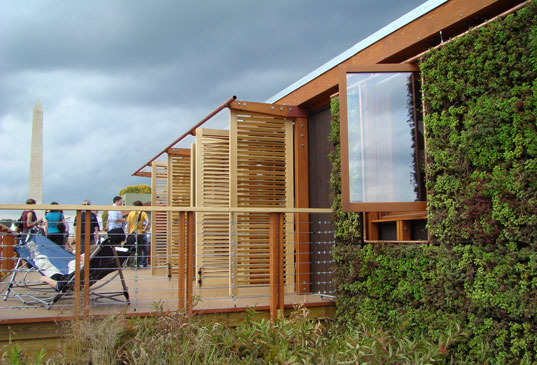
Inhabitat has a post on the runner up entry from Maryland - "LEAFHOUSE: Maryland’s Solar Decathlon Zero Energy Home".

The second place winner of this year’s Solar Decathlon is the University of Maryland’s Leaf House, which is, as the name would imply, green, naturally inspired, and modular to boot. When designing the zero energy home, the student team drew inspiration from the simple, yet vastly complex leaf. The abode boasts every sustainable system from the obvious high-tech solar panels to a liquid desiccant waterfall to control humidity, grey water recycling, green wall, and even a plug to charge an electric car.

In concept, the Leaf House hoped to meet goals like creating an open and flexible space, connecting to the landscape, material responsibility and durability, and energy efficiency. The team addressed the need for transformability in today’s housing using a series of movable, translucent panels that transform a small house into a large space. The modular approach lends itself to both easily housing the green systems as well as constant flexibility of space.

The photovoltaic system which spans the entire sloped roof provides 100% of the electrical energy to the home and solar hot water tubes, and is all monitored by the adaptive control energy monitor system. The most innovative feature of the Maryland house may be the indoor waterfall—a liquid desiccant wall system that’s used to control humidity. As far as the team knows, such a system has never been used for a home. A grey water system also helps the recycling, filtering, and storage of water.


The weekend SMH had a pair of article on the interaction between grain production, drought and biofuel and the resulting impact on food prices - "Energy boost may come a cropper" and "Rising grain prices put a dent in fuel revolution".
Biofuels are not necessarily an easy fix to the energy crisis.

This year tens of thousands of Mexicans took to the streets to protest that the cost of tortillas, their national staple, had doubled. The reason? Local farmers were shipping their corn to the US to be made into ethanol. Generous government subsidies for the green fuel were ensuring higher prices for the crops.

The tortilla demonstrations were a stark illustration of the global battle brewing between food and energy producers for crops. Made from crops such as corn, sugar or grain rather than crude oil, biofuels have been embraced for their potential to cut greenhouse emissions and protect energy security, while delivering cheaper petrol in an era of soaring oil prices.

But there is mounting concern that the biofuel industry's burgeoning demand for food crops will create profound shifts in world agricultural markets. The food v fuel debate, as it is known, is gaining momentum in Australia, as governments move to regulate the ethanol content in petrol at a time when the prolonged drought has already pushed crop prices to record highs.

David Lamb from the CSIRO estimates Australia could produce three-quarters of its fuel needs domestically from food crops, "but we'd have to stop eating and tear up our exports". He predicts a future where land and water resources are increasingly contested between food, energy, fibre and conservation needs.

The Organisation for Economic Co-operation and Development has warned that any diversion of land from food or feed production to energy production will inflate food prices as supplies are cut. "The rapid growth of the biofuels industry is likely to keep these prices high and rising throughout at least the next decade," it said in a report - titled Biofuels: Is the Cure Worse Than The Disease? - released last month.

These warnings were echoed by Charles Coventry from Graincorp at a recent ethanol conference in Brisbane. "Linking agricultural land to the price of energy is a radical change in the way grain markets work," he said. "We'll see an increase in food prices, which will bring the issue of food security back to the table."

The OECD report suggested, somewhat ironically, that the growth of the biofuels industry also could be to the detriment of the environment. "There will be powerful incentives to replace natural ecosystems such as forests, wetlands and pasture land with dedicated bio-energy crops." This is a particular risk in Australia, where the availability of suitable land is limited.

As the drought continues to suck the life out of local crops, many Australian grain buyers oppose regulating the ethanol content in fuel, or any form of government subsidy for the industry, arguing that this will simply force crop prices up even further. Coventry says the drought has slashed production of wheat, sorghum and barley by more than half on the eastern seaboard. Meanwhile, the global price of wheat has risen 60 per cent in the past year, and it peaked at a record $492 a tonne on the Australian Stock Exchange last month.

"Mandated ethanol production is going to magnify price pressures," the executive director of the Australian Lot Feeders' Association, Helen Murray, told the ethanol conference in Brisbane. "It would effectively be adding to the drought."


Think Progress has a classic video clip of Iraqi National Security Adviser delivering a ‘Big fat no’ to US bases in Iraq.
The Iraqi government has “put the U.S. on notice” that they do not want permanent U.S. bases in Iraq, CNN reports today. The message was “delivered directly to Vice President Dick Cheney at the White House” by Iraqi National Security Adviser Mowaffak Al-Rubaie, who told CNN that Iraqis say, “No, big fat no, N-O for the bases in Iraq”:
The people of Iraq, the parliament, the council of representatives and the government of Iraq, they all say no, big fat no, N-O for the bases in Iraq. No military bases for Iraq because we believe that is in direct encroachment to our soveriegnty, and we don’t need it.

As one commenter noted:
WTF! How dare these ingrates say we can’t have full run of their country. They won’t sign over their oil, they won’t let us keep Darth’s Mercenary Scumbags stay and kill at will, now they won’t let us use their country for a terrestrial aircraft carrier.

Links:

* Forrester - Creating The Green IT Action Plan
* Technology Review - A New Nanogenerator: Researchers are experimenting with a novel nanowire material to power tiny biosensors and portable devices
* NewsWise - Researchers Develop Wireless Bridge Sensors Without Batteries.
* Sustainable Is Good - Target Mirel Bioplastic Gift Card Pictures
* Core 77 - Connecting '07: Paul Saffo, Dunne + Raby, Janine Benyus
* Biomimicry News - Mimicking Mussel Proteins, Scientists Develop Super-Adhesive from Dopamine
* Globe And Mail - Canadian Investors slowly warming to clean tech
* Renewable Energy Access - Solar Hot Water Set To Go Mainstream with California's AB 1470
* Clean Break - Solar thermal as art
* Clean Break - Electrovaya shares rocket as battery JV revealed in India
* Technology Review - Measuring the Polar Meltdown
* AP - Rising seas threaten 21 mega-cities
* Energy Bulletin - Drought and water wars
* The Oil Drum ANZ - Drumbeat Down Under - Sunday 21 October 2007
* The Guardian - Steep decline in oil production brings risk of war and unrest, says new study
* Jerome A Paris - Countdown to $100 oil (49) - peak oil and libertarians
* CNN - Houston's Cancer Canal
* AlterNet - Bioneers: Groundbreaking Ways to Repair the Earth. "It's all connected. Because the world will always be changing, the ultimate goal is not stability but some sense of dynamic equilibrium. Businesses and governments use something called scenario planning, where they try to envision different scenarios for how the future might unfold so that they can anticipate how to respond. We're going to have a session at the conference with one of the leading lights in that field, Peter Schwartz of Global Business Network. The premise of Peter's book, Inevitable Surprises, is that if you're paying attention, things should not come entirely as surprises."
* Grist - Chris Dodd on the Record
* Glenn Greenwald - Majority Leader Harry Reid -- in violation of all Senate customs and rules -- intends to ignore the "hold" placed on the FISA bill by Chris Dodd. Spineless clearly isn't the right word for Reid.
* Talking Points Memo - Chris Dodd Will Filibuster Telecom Immunity Bill If Reid Brings It To Vote

The Oil Drum - Australia And New Zealand  

Posted by Big Gav in

TOD ANZ has launched, edited by Phil Hart from ASPO Australia and yours truly.

I'll be doing a fairly regular (hopefully daily) antipodean equivalent of Leanan's Drumbeat posts, focusing on energy news from Australia, New Zealand and the nearby region.

For those who are aware of it, my regular home at Peak Energy will still remain active, and will continue to see a lot of material that veers far away from the core topics that I'll concentrate on here (ie. I won't be cross-posting between the 2 sites except on those rare occasions that I write material of my own as opposed to summarising the day's news).

If you've got an article that you'd like to post (or relevant links that you think are appropriate for the daily Drumbeat) please get in touch...

The Amazon Is Burning (Again)  

Posted by Big Gav

The Guardian reports the forests of the Amazon are on fire once again (via Energy Bulletin).

Veteran Amazon pilots such as Fernando Galvao Bezerra are hard men to shock. During 20 years in aviation Mr Bezerra, 45, has ferried prostitutes and wildcat miners to remote, lawless goldmines. He has taxied wealthy loggers between ranches, lost countless colleagues to malaria and once survived when his plane plummeted out of the sky.

But as his 10-seater Cessna banked over a vast expanse of burning rainforest in the state of Mato Grosso, the pilot, who now works for the environmental group Greenpeace, was virtually speechless. "Holy shit," he blurted over the plane's PA system, as the plane swung sharply to the right towards an image of destruction which owed more to a scene from Apocalypse Now than the Amazon rainforest. "Just look at the size of what this guy is burning."

Article continues
It is burning season in Brazil, and across the Amazon region, where illegal loggers, cattle ranchers and a growing number of soy producers continue their advance into their world's largest tropical forest, similar scenes are taking place. In August government satellites registered 16,592 fires across Brazil, the overwhelming majority in the Amazon.

For environmentalists the fires are one of the first indications that deforestation is once again on the rise. Over the last two years fears for the future of the Amazon have been tempered by news of a reduction in deforestation. In August the Brazilian government heralded a 30% drop in rainforest destruction - the result, it said, of a government deforestation plan launched in March 2004. The plan outlined the creation of conservation units and 19 anti-deforestation units in deforestation hotspots such as Novo Progresso and Apui.

Great achievement

Marina Silva, Brazil's environment minister, claimed the drop was a clear indication that the Action Plan for Amazon Deforestation Prevention and Control was working. "It is a great achievement for Brazilian society," she said. Many, however, believe the good news is about to run out.

Already there are signs that rainforest destruction is gathering speed. Deforestation in the states of Mato Grosso and Para is reportedly rising, with chainsaws and forest fires levelling thousands of hectares of pristine forest. Figures released last week by Brazil's space agency, INPE, show that between May and July of this year there was a 200% rise in deforestation in Mato Grosso.

Further north, in the Amazon state of Para, local ranchers and environmental activists claim a similar process is under way. Flying over the south-western corner of Para the tell-tale signs that logging continues at a staggering rate are everywhere: in the illegal dirt tracks that trail through the forest and the trucks that are dotted along them; in the charred trees that litter the landscape; and most strikingly in the newly deforested areas, which have turned the landscape into a messy patchwork of dark green and dull brown.

"It [the level of deforestation] is definitely going to rise," said Agamenon da Silva Menezes, the president of the Rural Workers Union in the Amazon town of Novo Progresso and one of the region's most powerful farmers. "Lula [president of Brazil) says what he says because it is beneficial for him. But this year they have chopped down much more. What I am supposed to say to the guys [to stop them?]" added Mr Menezes.

Mr Menezes compared the illegal actions of the loggers to the American invasion of Iraq. If George Bush could attack a country out of financial interest, why could the loggers not do the same to the rainforest, he wondered.


On the other side of the Atlantic, the forests of the Congo are being chopped down rather than burnt down - a peace dividend for local loggers.
In a strange twist, this general dilapidation--the result of Congo's traumatic history--has inadvertently preserved Congo's massive tropical forests. First, Mobutu Sese Seko's thirty-two-year kleptocracy destroyed what infrastructure the Belgians had built. Then years of civil war and invasion by Uganda and Rwanda took an estimated 4 million lives, through violence and the attendant ravages of disease. All this chaos warded off the great timber interests. As a result the Congo Basin's massive forests--most of which lie within the DRC--are the world's healthiest and most intact.

An estimated 40 million people depend on these woodlands, surviving on traditional livelihoods. At a global level, Congo's forests act as the planet's second lung, counterpart to the rapidly dwindling Amazon. They are a huge "carbon sink," trapping carbon that could otherwise become carbon dioxide, the main cause of global warming. The Congo Basin holds roughly 8 percent of the world's forest-based carbon. These jungles also affect rainfall across the North Atlantic. In other words, these distant forests are crucial to the future of climate stability, a bulwark against runaway climate change.

But the isolation of the DRC's woodlands is ending. Since 2003 a massive United Nations mission has helped create relative stability, though several vicious and overlapping wars continue to gnaw at the country's eastern regions. Now most of the DRC is safe for logging. Over the past four years timber firms have set upon the forest in search of high-priced hardwoods. They control about one-quarter of Congo's forests, an area the size of California.

Blessed by the World Bank as catalysts of development, the companies operate largely unsupervised because the DRC lacks a functioning system of forest control. The government has written a new forestry code that requires companies to invest in local development and follow a supposedly sustainable, twenty-five-year cycle of rotational logging. But many companies ignore these stipulations; some have used intimidation and bribery; others log in blatantly illegal ways with no regard for the long-term damage they are causing.

And now the massive mahogany, afromosia, teak and wenge trees of Congo are making their way downriver, past the lower falls and over the sea to re-emerge as parquet flooring and lawn furniture in the homes of French, Italian and Chinese yuppies.

If these woodlands are deforested, the carbon they trap will be released into the atmosphere. Environmentalists say that if deforestation continues unabated, by 2050 the DRC could release as much carbon dioxide as Britain has in the past sixty years. On the ground, this would likely mean desertification, mass migration, hunger, banditry and war.

But an effort is afoot to halt Congo's plunder. "This is a make or break period," says Filip Verbelen, a forest campaigner with Greenpeace. "Logging is not helping the DRC's economy, and it is destroying the environment. The damage has to be contained now before it is too late."


PhysOrg has an article on an Irish wave energy company that is testing a device called the "Wavebob" and wants Ireland to be the "Saudi Arabia of wave energy".
A prototype wave energy converter has begun harnessing electricity from Atlantic waves off the west coast of Ireland, the Wavebob company said on Tuesday A "Wavebob" floating buoy device that automatically adjusts to the size of the waves to maximise the amount of power it produces is undergoing trials off Spiddal, County Galway.

"This is a giant leap forward for renewable energy production in Ireland," said Wavebob chief executive Andrew Parish. "As an island in the middle of the energetic Atlantic Ocean, Ireland can be to wave-energy what Saudi Arabia is to oil. The more we exploit this unlimited natural resource, the better it will be, not just for the global environment, but also for the Irish consumer's pocket," he said.

The quarter-scale prototype device involved in the trials is not connected to the national grid. At full scale, each Wavebob device will be capable of producing in excess of a megawatt -- enough electricity for 1,000 homes. Part of the strategy of Ireland's Energy Minister, Eamon Ryan, a member of the Green Party, is to have 500 megawatts of ocean energy installed by 2020.

TreeHugger has a post on the bleedin obvious - "Feedback Loop: Global Warming Could Threaten U.S. Oil Output".
Well, duh. A new report from scientists in the Energy Department suggests that global warming may produce stronger hurricanes that could disrupt U.S. oil production in the Gulf of Mexico and damage ports and pipelines along the coast that move fuel supplies.

"Increases in storm intensity could threaten further (energy supply) disruptions of the sorts experienced in 2005," the report said. In addition to seasonal damage from stronger storms, rising sea levels due to global warming permanently threatens many oil refineries, liquefied natural gas terminals and coal import and export facilities located along the U.S. coasts.

So the faster we burn the oil, the faster the global warming, and the more quickly we run out of oil as we drown out our processing facilities. Why not burn less and solve both problems?

Cleantech.com reports that Germany company Hochtief is to build a geothermal plant in southern Germany.
The company is forming a venture with Renerco and SachsenFonds to build and operate a 5 megawatt plant. Essen, Germany-based construction contractor Hochtief said today it's forming a venture to build and operate a 5 megawatt geothermal plant. Hochtief is putting 35 million euros into the venture, which it will control with a 40 percent stake. Called Süddeutsche Geothermie-Projekte, the venture will include Renerco, a renewable energy services company, and financial services provider SachsenFonds. The two companies will each hold 30 percent.

The plant, to be built in Bavaria, is just the first of many for Hochtief, which said it is "positioning itself in good time for the growing geothermal energy market." The company said it plans, with its partners, to build and operate further power plants, each with an output of four to five megawatts in the South German Molasse basin, where the venture already has the necessary permits.

Hochtief said it will initially focus on the geothermal market in Germany, eventually expanding internationally.

The Crikey editorial today was in praise of the Chaser team's pursuit of the Rodent and of their habit to speak their minds.
Everyone got stuck into the Chaser over their Eulogy Song -- watch it here -- talkback seethed, shock jocks fumed, the ABC switchboard took as many as six calls.

What was the worst of it? That Chaser's Andrew Hanson sang that Diana might have died spattered in ''Arab s-men''? That Stan Zemanek was a malignant, bull-necked xenophobe? That Don Bradman was a grumpy old tight-wad? Nope. The worst of it was, it so quickly emerged, that the worst offence was to give offence. Welcome to the age of politeness triumphant, the era of the anodyne. ''Pick on someone who's alive'' the PM told the Chaser crew this morning through gritted teeth and presumably ruling himself out of contention. Spot on we reckon. They should.

For further proof of how over-moderated public life has become, cast an eye over federal politics (and both campaigns have had nothing better to do for the last 36 hours than take pots at The Chaser). The base rule of modern politics is say what you like as long as it has been pre-polled, homogenised and sanitised for broad audience appeal. Whatever you do, don't so much as give a subliminal impression that might startle the horses or offend some demographic segment or other.

Which is all very well, expect that as well as enforcing the dominance of the bland it also argues against conviction and belief. At risk of giving offence, fuck that.

Links:

* Bloomberg - Crude Oil Breaches $90 a Barrel on Dollar Drop Against Euro
* The Australian - Delays slash Woodside forecast
* The Australian - Petsec upbeat despite production hiccup
* The Australian - Keeping natural gas fires burning. If natural gas is the "transition fuel to the low carbon economy" then it better be a quick transition.
* Dave Roberts - Coal is the enemy of the human race: Human race figures it out edition: Bad news abounds for Big Coal
* American Chronicle - Iraq and Iran, Oil, Politics and Religion
* Globe And Mail - Putin pans 'pointless' Iraq war in TV address
* The Australian - Climate brews clean power billions
* The Nation - The Making of a Climate Movement
* Boston Globe - Red, white, blue, and green
* Thisisby.us - Dennis Kucinich, the Unknown Front Runner
* USA Daily - Ron Paul has mandate for equal time during Fox News debate
* John Le Carre - Congo Journey
* Redmond O'Hanlon - Congo Journey

Statistics

Locations of visitors to this page

blogspot visitor
Stat Counter

Total Pageviews

Ads

Books

Followers

Blog Archive

Labels

australia (619) global warming (423) solar power (397) peak oil (355) renewable energy (302) electric vehicles (250) wind power (194) ocean energy (165) csp (159) solar thermal power (145) geothermal energy (144) energy storage (142) smart grids (140) oil (139) solar pv (138) tidal power (137) coal seam gas (131) nuclear power (129) china (120) lng (117) iraq (113) geothermal power (112) green buildings (110) natural gas (110) agriculture (91) oil price (80) biofuel (78) wave power (73) smart meters (72) coal (70) uk (69) electricity grid (67) energy efficiency (64) google (58) internet (50) surveillance (50) bicycle (49) big brother (49) shale gas (49) food prices (48) tesla (46) thin film solar (42) biomimicry (40) canada (40) scotland (38) ocean power (37) politics (37) shale oil (37) new zealand (35) air transport (34) algae (34) water (34) arctic ice (33) concentrating solar power (33) saudi arabia (33) queensland (32) california (31) credit crunch (31) bioplastic (30) offshore wind power (30) population (30) cogeneration (28) geoengineering (28) batteries (26) drought (26) resource wars (26) woodside (26) censorship (25) cleantech (25) bruce sterling (24) ctl (23) limits to growth (23) carbon tax (22) economics (22) exxon (22) lithium (22) buckminster fuller (21) distributed manufacturing (21) iraq oil law (21) coal to liquids (20) indonesia (20) origin energy (20) brightsource (19) rail transport (19) ultracapacitor (19) santos (18) ausra (17) collapse (17) electric bikes (17) michael klare (17) atlantis (16) cellulosic ethanol (16) iceland (16) lithium ion batteries (16) mapping (16) ucg (16) bees (15) concentrating solar thermal power (15) ethanol (15) geodynamics (15) psychology (15) al gore (14) brazil (14) bucky fuller (14) carbon emissions (14) fertiliser (14) matthew simmons (14) ambient energy (13) biodiesel (13) investment (13) kenya (13) public transport (13) big oil (12) biochar (12) chile (12) cities (12) desertec (12) internet of things (12) otec (12) texas (12) victoria (12) antarctica (11) cradle to cradle (11) energy policy (11) hybrid car (11) terra preta (11) tinfoil (11) toyota (11) amory lovins (10) fabber (10) gazprom (10) goldman sachs (10) gtl (10) severn estuary (10) volt (10) afghanistan (9) alaska (9) biomass (9) carbon trading (9) distributed generation (9) esolar (9) four day week (9) fuel cells (9) jeremy leggett (9) methane hydrates (9) pge (9) sweden (9) arrow energy (8) bolivia (8) eroei (8) fish (8) floating offshore wind power (8) guerilla gardening (8) linc energy (8) methane (8) nanosolar (8) natural gas pipelines (8) pentland firth (8) saul griffith (8) stirling engine (8) us elections (8) western australia (8) airborne wind turbines (7) bloom energy (7) boeing (7) chp (7) climategate (7) copenhagen (7) scenario planning (7) vinod khosla (7) apocaphilia (6) ceramic fuel cells (6) cigs (6) futurism (6) jatropha (6) nigeria (6) ocean acidification (6) relocalisation (6) somalia (6) t boone pickens (6) local currencies (5) space based solar power (5) varanus island (5) garbage (4) global energy grid (4) kevin kelly (4) low temperature geothermal power (4) oled (4) tim flannery (4) v2g (4) club of rome (3) norman borlaug (2) peak oil portfolio (1)