Bill McKibben on The Colbert Report
Posted by Big Gav in global warming
Grist points to this interview with Bill McKibben on the Colbert Report.
| The Colbert Report | Mon - Thurs 11:30pm / 10:30c | |||
| Bill McKibben | ||||
| ||||
0
comments »

Posted by Big Gav in global warming
Grist points to this interview with Bill McKibben on the Colbert Report.
| The Colbert Report | Mon - Thurs 11:30pm / 10:30c | |||
| Bill McKibben | ||||
| ||||
Posted by Big Gav in hybrid car, ultracapacitor
Technology Review has an article on the potential for ultracapacitors to augment conventional batteries in hybrid vehicle designs - Ultracaps Could Boost Hybrid Efficiency.
Energy storage devices called ultracapacitors could lower the cost of the battery packs in plug-in hybrid vehicles by hundreds or even thousands of dollars by cutting the size of the packs in half, according to estimates by researchers at Argonne National Laboratory in Argonne, IL. Ultracapacitors could also dramatically improve the efficiency of another class of hybrid vehicle that uses small electric motors, called microhybrids, according to a recent study from the University of California, Davis.
The use of ultracapacitors in hybrids isn't a new idea. But the falling cost of making these devices and improvements to the electronics needed to regulate their power output and coordinate their interaction with batteries could soon make them more practical, says Theodore Bohn, a researcher at Argonne's Advanced Powertrain Research Facility.
Although batteries have improved significantly in recent years, the cost of making them is the main the reason why hybrids cost thousands of dollars more than conventional vehicles. This is especially true of plug-in hybrids, which rely on large battery packs to supply all or most of the power during short trips. Battery packs are expensive in part because they degrade over time and, to compensate for this, automakers oversize them to ensure that they can provide enough power even after 10 years of use in a vehicle.
Ultracapacitors offer a way to extend the life of a hybrid vehicle's power source, reducing the need to oversize its battery packs. Unlike batteries, ultracapacitors don't rely on chemical reactions to store energy, and they don't degrade significantly over the life of a car, even when they are charged and discharged in very intense bursts that can damage batteries. The drawback is that they store much less energy than batteries--typically, an order of magnitude less. If, however, ultracapacitors were paired with batteries, they could protect batteries from intense bursts of power, Bohn says, such as those needed for acceleration, thereby extending the life of the batteries. Ultracapacitors could also ensure that the car can accelerate just as well at the end of its life as at the beginning.
Reducing the size of a vehicle's battery pack by 25 percent could save about $2,500, Bohn estimates. The ultracapacitors and electronics needed to coordinate them with the batteries could cost between $500 and $1,000, resulting in hundreds of dollars of net savings.
Ultracapacitors would also make it possible to redesign batteries to hold more energy. There is typically a tradeoff between how fast batteries can be charged and discharged and how much total energy they can store. That's true in part because designing a battery to discharge quickly requires using very thin electrodes stacked in many layers. Each layer must be separated by supporting materials that take up space in the battery but don't store any energy. The more layers used, the more supporting materials are needed and the less energy can be stored in the battery. Paired with ultracapacitors, batteries wouldn't need to deliver bursts of power and so could be made with just a few layers of very thick electrodes, reducing the amount of supporting material needed. That could make it possible to store twice as much energy in the same space, Bohn says.
Posted by Big Gav in opec, peak oil
The Times has an opinion piece from ex Economist editor Bill Emmott on peak oil (albeit a fairly skeptical one, arguing that the oil age will end soon, but because of the greed of OPEC and Russia rather than because of depletion) - Opec’s greed will herald the end of the oil age.
This point in the analysis is where the planetary gloomsters start citing a concept called “peak oil” (or, to the real oil nerds, “Hubbert’s peak”). This is the idea that the planet’s oil reserves are nearing (or, in some eyes, are past) a time at which the output from oilfields starts to decline. Don’t pay them any attention. The world is not running out of oil. What it is short of has been investment in oilfields and production. And the reason for that can be found in a different four-letter word: Opec.
The oil producers’ cartel has deliberately cut production by nearly five million barrels a day, which is more than the drop in global demand, to keep prices high. Opec members account for only about 35 per cent of world supply, but Russia, a non-member, accounts for a further 11.5 per cent and is co-operating with their efforts. Moreover, the Gulf states that dominate Opec have the largest oil reserves and lowest production costs, so can most easily and painlessly turn their taps on and off.
In the early years of this decade the kingpins of Opec, Saudi Arabia, used to say that their ideal price range for crude oil was $20-25 a barrel. Now, they say that it is $70-75. Crucially, the nationalists in Opec and the extortionists in Russia have blocked the big Western oil companies from investing as much in developing their oil reserves as they would have liked, driving them into higher-cost fields elsewhere. Investment there, even before the financial crisis, has been slow as the sudden rush to explore and expand drove up the costs of engineers and equipment. Since the financial crisis, it has slumped.
That will change over the next decade or so, if prices stay high. Brazil has discovered a huge new offshore oilfield and Angola has shown just how quickly development can occur. In seven years it has trebled its oil output, joined Opec and is now challenging Nigeria for its status as sub-Saharan Africa’s biggest oil producer — and hence as the leading oil-rich basket case. That is why the US Secretary of State, Hillary Clinton, swallowed her human rights scruples and paid homage to the Angolans on her tour of Africa, lest they become overly friendly with China instead.
Yet by the time non-Opec oil supply has been boosted, something even more important will have occurred, if Opec continues to overplay its hand and support painfully high prices. In the 1970s, the rather quotable Saudi Oil Minister, Sheikh Zaki Yamani, had a nice saying: “The Stone Age did not end because the world ran out of stones. Nor will the oil age end because we have run out of oil.”
It will end when oil consumers run out of patience with greedy oil producers, and develop substitutes instead. The Arabs should surely see a warning sign in the fact that the first new product of which Fritz Henderson, boss of the fresh-out-of- bankruptcy (and quasi-nationalised) General Motors, emerged to boast was the Chevrolet Volt, a petrol- electric hybrid, which is claimed to do 230 miles per gallon.
They may just dismiss that as good politics, given the urge of governments all around the world to paint their fiscal stimulus packages a deep shade of green by handing out subsidies to anyone claiming to be developing cleaner technologies. Yet they should remember this. When the 1970s oil shocks gave Japan a second whammy after a sharp revaluation of the yen had given it a first, its Government and industry set about transforming themselves from cheap clunker-producers into the world’s leading makers of semiconductors, consumer electronics and fuel-efficient cars — all within ten years.
This time around, there are scientists and engineers all over the globe dying to bring about just that sort of transformation — but nowhere more so than in China, the world’s second-biggest oil consumer, whose policymakers fully expect their currency to have to be revalued, hitting cheap energy-guzzling producers, and where the need to clean up the environment is urgent.
There are also scores of governments keen to show their green credentials at the Copenhagen climate change conference in December this year by promising limits on the carbon dioxide emissions of which coal and oil are the biggest source — and keen to find tax revenues to plug their huge fiscal holes, for which fuel tax will come in very handy indeed.
The usual forecasts, based on extrapolation of past trends, do not see electric cars or non-fossil fuel power plants having a really big impact for another 20-30 years. Imagine, though, the effect on innovation of oil at $100-200 a barrel, of hundreds of thousands of Chinese (and Japanese, European and America) engineers trying to do for solar power and for car batteries what has been done in the past decade for mobile phones and computers.
Then, the usual forecasts will turn out to be wrong — as usual. The oil age, which began in earnest a century ago in America, will be at an end.
Posted by Big Gav in chile, ocean energy, pulse tidal, tidal power
Bob Morris has a post on a new development in tidal power technology - Pulse Tidal. Next-gen tidal power.
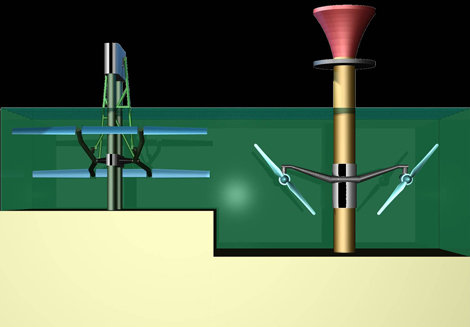
A flat, foil type device can be used to generate power in much shallower water.Traditional designs use a rotating blade to extract energy from the moving water. The diameter of this blade is limited by the water-depth and this reduces the amount of power that can be generated in shallow water.
Pulse Tidal’s technology overcomes this limitation by using a wide, flat machine where the blade length is not limited by water depth.
At a typical site where depth is limiting a Pulse generator will extract more than 4 times as much energy as a single traditional turbine.
Being able to site in shallow water means the power generation can be much closer to shore and in calmer waters. The company says this technology can deliver low-cost, utterly reliable renewable energy, and may be able to do it for less cost than offshore wind.
Ocean Power Magazine has more. They are a great resource for everything on ocean power R&D and deployment.
Chile is actively considering several tidal energy installations as a way of filling a major gap in its future energy needs and reducing dependence on coal-fired power generation.
A feasibility study on the potential for exploiting the renewable energy resource in Chile found the country had a "unique" wealth of natural sites that, if harnessed only up to 10 percent of available tidal power, could exceed the installed capacity of Chile's central grid.
The study was conducted for the Inter-American Development Bank by Garrard Hassan energy consultancy, based in Bristol, England.
According to the report, published by Chile's National Energy Commission and reported in Energy & Oil, Latin America, Chilean tidal power sites could include the ports of San Antonio, Puerto Montt and San Vicente, the Corcovado Gulf and the Magellan Straits.
Economic prosperity has raised projections for electricity consumption in Chile, which currently averages 56 billion kilowatt hours against 802 billion kilowatt hours for all of Latin America.
Electricity generation from tidal waves is a proven technology, more predictable than solar or wind power, and already used on a commercial scale by France since 1966.
The French tidal barrage at Rance, operated by Electricite de France, produces 240 megawatts at peak time.
Uses of tidal power in mills date back to Roman times.
Tidal power generation units of varying capacity are in different stages of completion or operation in the United States, Canada, China, Russia, South Korea, Australia and New Zealand and India.
Britain is planning a tidal power barrage on the River Severn between England and Wales, but the project is currently mired in controversy. Environmentalists see its huge scale as detrimental to the local ecology. ...
Much of Chilean electricity is generated in coal-fired plants, raising fears that Chile's greenhouse gas emissions could rise with the growth in demand for electricity.
Estimates cited by the Santiago Times said that without changes to its energy matrix, Chile's coal-burning would jump to a majority stake in the country's electricity production by 2030.
Posted by Big Gav in australia, china, exxon, gorgon, lng, natural gas
The SMH reports that following the Gorgon consortium's deal with India recently, they have followed up with an even larger Chinese gas supply agreement - Piping hot: $50b gas deal with China.
THE largest single trade deal in the nation's history - a $50 billion contract to sell liquefied natural gas to China - was sealed in Beijing last night, signalling the resources boom is far from over.
The contract, hailed by the Federal Government as an indicator Australia's relationship with Beijing remains sound, will supply China with gas for 20 years.
The gas will come from the Gorgon project off Western Australia. The joint venture between ExxonMobil, Shell and Chevron is expected to start production in five years and contains deposits worth $300 billion.
ExxonMobil signed the deal with the state company PetroChina in Beijing. It is twice the value of the deal the Gorgon partner signed last week with India.
The Resources Minister, Martin Ferguson, flew to China to witness the signing, saying it showed Australia had a future as ''a global energy superpower''. ''This agreement is testimony to the strength of Australia's continuing trade and investment relationship with China,'' he said. ''As China continues to develop as a modern global industrial and commercial powerhouse, Australia is committed to walking with it on its remarkable journey.''
The $50 billion Gorgon gas deal with China will personally affect every person in Australia. The tremors will be just as great in the eastern states as they are in Western Australia.
In the publicity that goes with the deal, much is made of the construction activity and the on-going revenue that Gorgon will generate. Those benefits are huge but they are dwarfed by the fact that the deal cements in the amazing link between the Australian dollar and the Chinese economy.
And if someone can wake up the Canberra politicians, it is also a signal that renewables alone will not solve our carbon problems. What we need is the combination of gas and renewables and in Queensland we have the combination of low carbon-emitting coal gas reserves of North West Shelf proportions, connected to an eastern states pipeline network (New energy can't wait, July 15).
Gorgon underlines the significant research that has been undertaken by HSBC which shows the Australian dollar has become the mirror image of Chinese economic activity.
Measuring Chinese economic activity is always difficult, but HSBC has isolated Chinese electricity production as the most reliable measure of the Chinese economy. Our dollar and Chinese electricity share the same graph, at least over the past three years.
It is impossible to understate the importance of this development. The Chinese now know that they can invest in Australia and not face a serious currency risk. We are going to see them buy property in the eastern states and they will support our debt markets on a much larger scale.
There is enormous concern in China about the US currency and the fact that there could be huge losses ahead for China if the American dollar falls. The HSBC research shows that China does not face that risk in Australia. Global investors who want to invest in China can do so via Australia with far less risk. Accordingly our share market is set to follow China (Ten steps to a new world order, July 29).
The Santos deal with French owned GDF Suez is a reminder to Australians that we have very little understanding of the value the world is putting on gas in politically secure areas. GDF Suez is the biggest gas distributor in Europe and it is very conscious that two thirds of global gas comes from Russia and the Middle East and neither are reliable long term suppliers. That’s why it is looking at what’s available in Australia.
GDF Suez is paying $US200 million up front for 60 per cent of the Petrel Tern and Frigate gas field in the Bonaparte basin – fields that the sharemarket accorded very little value. But most countries in the world – with the notable exception of Australia – see gas as an important ingredient in cutting carbon emissions while maintaining living standards.
The three Santos fields looked to be too small for conventional LNG but Suez’s floating LNG technology made development feasible.
When Santos banks the $US200 million cheque from GDF Suez it will have more than $A3.8 billion in the bank. Borrowings are about $2 billion, so the Santos net cash position is around $A1.8 billion. That will go close to funding the equity required for the group's two massive projects – Queensland coal-seam gas and PNG gas.
Posted by Big Gav in bioplastic
I don't think carbon dioxide to plastic counts as bioplastic, but its still an interesting alternative to oil based plastic production. Greentech media has a report on the latest round of venture funding to the sector - Carbon-Dioxide-to-Plastic Guys Get $14M
Can carbon dioxide be a feedstock for plastics and polymers? Novomer has raised $14 million in a second round to try and prove it.
The Cornell spin-out has devised a catalytic process that it believes could potentially solve a few big waste problems. The company effectively transforms captured carbon dioxide and carbon monoxide into binders and other chemicals for the plastics industry.
Thus, in one swoop, you get reduction of atmospheric carbon, carbon credits in jurisdictions that recognize them, reduced demand for oil, and a method for giving captured carbon an economic value beyond carbon credits.
Industrial chemicals also often sell for far higher prices than oil or gas. Thus, companies like algae makers like Biolight Harvesting are focusing more on chemicals than fuel.
The sticking point, as seen with other bioplastic and green chemical companies, is the price. Making binders from pollution isn't cheap. Novomer's binders, which contain 40 percent carbon dioxide, cost between $50 and $200 per pound in 2008, compared with an average cost of between $50 and $125 per pound for traditional electronics-industry binders.
Other notable bioplastic companies include Cereplast, which sells starch-based bioplastic materials, and Plastech, an Irish company that has a microbe that can turn plastic into a biodegradable form of plastic. In green chemistry, keep an eye on Genomatica, which has a list of synthetic industrial solvents.
Posted by Big Gav in australia, chevron, exxon, gas, gorgon, lng, natural gas
The Age reports that the Exxon has signed up its first customer for LNG from the Gorogn field off WA, with India's Petronet LNG signing a 20-year agreement to take gas from the project (First Australia-India long-term LNG deal reached).
Under the agreement, Exxon will supply about 1.5 million tonnes per annum from its 25% share of LNG from the project over 20 years (the project as a whole will produce 15 million tonnes a year) - the gas will be delivered to Petronet's new LNG terminal under construction at Kochi in southern India.
WA Environment Minister Donna Faragher has given final environmental approval for the proposed development on Barrow Island, removing one of the remaining obstacles to construction (Green light for Gorgon in time for lucrative deal), and the local press is already reporting on some of the activity required to support the construction of the project (Hercules to airlift Gorgon materials).
Federal Environment minister Peter Garrett also needs to approve the project, though given his recent stance on large scale energy developments he seems unlikely to oppose it (Chevron set to go ahead with big gas project). The Australian reports the project partners are aiming to tick off on developing Gorgon in mid-September. If approved, Gorgon will be the largest Australian resources project and, as federal Resources Minister Martin Ferguson has pointed out, will provide a greater investment than the Rudd government's $42bn stimulus package.
Annual sales from Gorgon would be worth around $12.5bn at current prices and would boost the nation's mineral and energy revenues by 10 per cent, based on government export forecasts for this year (as I've noted previously if all of Australia's proposed gas developments proceed - especially if we include coal seam gas - we'll have to be wary of the "dutch disease").
The Gorgon plant will have three 5 million tonnes a year LNG trains and will produce LNG using the 40 trillion cubic feet of gas in the two Greater Gorgon fields.
The fields, Gorgon and Io/Janz, contain Australia's biggest gas reserves and are expected to support the project, which will start production in 2014 and ramp up to full output 18 months later, for more than 40 years.
The strangest and most unsettling aspect of the project is that the federal government and WA state government will bear the costs for any problems related to sequestration of carbon dioxide from the project in future years, which seems like a spectacularly risky bet for taxpayers over the long run - (Gorgon deal on carbon).
In other Australian gas news, Gas Today has a report on the various projects under consideration further north in the Browse Basin (Browsing gas fields).
And the UK Daily Telegraph has a report on Shell's bid the purchase the rest of coal seam gas producer Arrow Energy (Royal Dutch Shell tables £1.5bn bid for Australia's Arrow Energy).
Gas Today also has a look at the wisdom of exporting LNG in such large quantities over the long term and what this means for local gas consumers (Are we exporting our energy future?).

Posted by Big Gav in apocaphilia, doomers, peak oil, religion
Toby Hemenway has an article on the genesis of peak oil doomerism, including a history of apocalyptic thinking through the ages- The Origins of Peak Oil Doomerism
People in the Peak Oil movement chafe at the label of doomer, but many of us do have an apocalyptic bent. Although plenty of Peak Oil commentary is sober analysis, a survey of the major websites and books quickly brings up apocalyptic titles like dieoff.org, oilcrash.com, The Death of the Oil Economy, The End of Suburbia, and The Last Hours of Ancient Sunlight. Peak Oil writings are sprinkled with predictions that billions will die, civil order will collapse, and even that civilization will end. Scientists, too, aren’t immune. During geologist Ken Deffeyes’s Peak Oil presentations, he displays the words “war,” “famine,” “pestilence,” and “death”—the four horsemen of the apocalypse. The Right, the saying goes, has the Left Behind books, and the Left has Peak Oil. Both predict that the end is near.
After I published an article suggesting that Peak Oil may lead “merely” to widespread unemployment and hardship rather than collapse, hundreds wrote to tell me I was a naïve optimist and a cornucopian. A significant part of the Peak Oil community holds the rock-solid sentiment that the only future is one of chaos. While the end of the oil era possesses “death and taxes” certitude, plausible post-peak scenarios span a wide scope. So why is the most touted one the most extreme? Predictions of any stripe, a review will quickly show, are almost always wrong. The future rarely goes in the direction we expect. The certainty of coming doom held by so many made me wonder why we are drawn to societal collapse and our own extinction.
The point of this article is not to argue for or against a Peak Oil collapse—a futile debate that won’t end until we enter that future—or to discuss whether our civilization deserves to continue. Rather, it’s an exploration into why, given an impending crisis or major challenge, many people in our culture spiral so quickly and automatically toward an “end of the world” vision rather than imagining any of the countless other options.
My earliest hypothesis was that a person’s chosen energy future was based more on personality than on data: Given the same information, people I knew to be optimists generally envisioned a positive future, while pessimists descended into doomerism. But in this simplistic reasoning, I was leaving out a growing mass of critiques of civilization itself by authors such as Joseph Tainter, Derrick Jensen, and Daniel Quinn, and others esteemed by many Peak Oil adherents. While these writers argue that civilization is evil, unsustainable, and must collapse, they also posit that human beings deserve something better that can only arise after this culture dies. This death-and-rebirth thinking didn’t fit my “optimist versus pessimist” hypothesis. And seeing how vehemently and urgently people argue for doom-and-gloom—I’ve literally had my lapels grabbed—made me suspect that neither individual psyche nor the cold logic of pure reason was at work here.
I now believe that Peak Oil catastrophism is largely a manifestation of our primary cultural myth: that all things end with suffering, death, and then resurrection. Belief in apocalypse is programmed into western civilization. Given our heritage, “the end is nigh” is the nearly unavoidable personal and collective response to times of uncertainty and rapid change.
Apocalypticism is at the core of the Judeo-Christian social mythology, and it influences our beliefs far more deeply than we are conscious of. I can hear the objections: “I’m not religious—I’ve never even been to church.” But that’s like saying, “I never studied Greece, so ancient Greek culture hasn’t influenced me in any way.” Cultural beliefs are in the air we breathe. We are programmed by our knowledge of mortality and of the natural world, as well as by millennia of myth-telling, to believe that all things, from organisms to businesses to civilizations, progress from birth to a shuddering death and, often, a renewal in new form. As much as the Religious Right’s boast that America is a Christian nation makes liberals uncomfortable, there is some truth to it. From the Declaration of Independence’s “endowed by their Creator with certain unalienable rights” and the dollar’s “In God We Trust,” to once-pagan, Christian co-opted Easter egg hunts, Judeo-Christian beliefs saturate our culture. And the idea of apocalypse, that some time soon the End Times will be upon us and all will be transformed, is one of the most fundamental tenets of that system. A look at the history and particulars of apocalypticism will show the truth of that statement, and reveals that Peak Oil catastrophism conforms to our apocalyptic myth in such detail that it is difficult to deny its role.
The archetypal apocalypse story in the West is, of course, that of Jesus of Nazareth. Both his life’s story and his messianic prophecies of Judgment Day reflect oppression, death, and transformation, following the common arc of the apocalypse myth. This trajectory is echoed in the Peak Oil projection of increasing global despoliation and chaos, collapse, and the belief that “after Peak Oil, everything will change.” But this myth has also emerged hundreds of other times in our history. Jesus would have remained one of thousands of minor apocalyptic prophets, all predicting a similar end, if not for the brilliant public relations of Saul of Tarsus and other early Christians. And one of their tactics was to piggy-back onto already existing apocalypse stories.
Apocalypse myths predate Jesus by centuries. Ancient Greece, Persia, and Egypt are their primary birthplaces for the West. In Greek mythology, Zeus destroyed the world several times via flood, fire, and war. In one typical example, Zeus, seeing that humanity had become corrupt, ended the world by flood, sparing only two people to found a new race. And there it is: the basic pattern of apocalypse that’s been followed ever since. Humanity becomes wicked and is destroyed except for an elect, who go on to birth a new world.
Always a Social Context
Most people think of apocalyptic groups as religious sects. Religion and apocalypse are still tightly wedded, especially in the US, where a Gallup Poll reports 75% of the people believe in life after death. But as religion has been replaced with other organizing principles such as science and economics, so too have the reasons for apocalypse. Religious people express their doomsday belief through acts of their deities, but the common feature of apocalyptic belief is not religion. It is a social background of upheaval and anxiety. When times get uncertain, people in Judeo-Christian culture gravitate to the idea that there will be an end to the wickedness and misery through disaster and collapse.
An example is one of the first Western apocalypse stories with a known historical setting, Daniel’s prophetic dream of the world’s end in the biblical Book of Daniel. Here, political and social strife paints the background. This story was written about 165 BCE, during the height of a Jewish revolt. Jews had enjoyed several centuries of peaceful rule under first the Persians and then Ptolemy, but Palestine then fell under a Syrian-Greek tyrant. He trampled on civil and spiritual liberties, and forbade Jewish religious ceremony. The result was the Jewish Maccabean uprising. During this, Daniel dreamed of four beasts, each representing a successive ruler of Palestine, in which the final beast would “devour the earth . . . and break it in pieces.” This rapacious empire would then be overthrown, and only Israel would be saved. Nearly every subsequent example of apocalyptic belief occurs in a similar social context of upheaval, oppression, and alienation.
The hallucinatory Book of Revelation is the best-known apocalyptic text, but early Christians and Jews had many other books for solace in difficult times. The first-century books of Ezra and Baruch, excluded from the Bible, tell of a time of terrible hardship and injustice, symbolized by the wrath of a devouring eagle. The eagle was the well-known emblem of the Roman Empire, which held Christians and many Jews under brutal repression at the time these books were written. This empire, it was prophesied, would soon be destroyed by a mighty warrior, and all those who collaborated in the empire’s rule would die.
A later set of end-times texts, known as the Sibylline books, first appeared in the fourth century after the death of Emperor Constantine, when rule of the failing Roman Empire was contested by his two surviving sons, Constans and Constantius II. Constans, who favored the Nicene version of Christianity that is common today, was murdered by his brother. The Sibylline books mirror the fearful response of Catholics to this killing and reversal for their beliefs, and tell of a time of tyrants who oppress the poor and enrich the guilty. The books say a new leader will appear and destroy the heathens and their temples. A similar set of Sibylline books appeared when Syrian Christians suffered under Moslem rule in the seventh century. In all these cases, people hoped for the end of social disorder through catastrophe.
Countless other apocalyptic movements arose in similar contexts of confusion and oppression. In 13th century Germany, Frederick II was enmeshed in bitter conflict with the Pope, claiming that the Church was irredeemably corrupt. During this clash, Joachin of Fiore arose as a prophet to preach of approaching last days when the Church would be destroyed, choosing 1260 as the date of its collapse. Later, in the reign of the singularly ineffective Frederick III, when the gap between rich and poor grew enormous, and lawless nobles extorted the populace, the Bohemian Wirsburg brothers attracted thousands who believed the final days would come in 1467. Apocalyptic cults arise, it seems, in a context of oppression, uncertainly, and corruption. And in most cases, the subsequent destruction of the wicked was to be followed by floods, storms, and plagues that would decimate mankind, reminiscent of claims that global warming and ecosystem collapse will come on the heels of Peak Oil, as if one calamity isn’t enough. ...
Posted by Big Gav in big brother, surveillance
The SMH has an article on yet another crackpot scheme to force all motorists to carry tracking tags in order to make traffic flow more efficient, this one in Australia - Vehicles forced to carry a tracking device. Carbon taxes are a much better way to achieve most of the same goal (that said, I imagine most people in Sydney already have a tag in their car - however the important point is that use of it is optional).
AN INNOVATIVE way to unclog our roads or a Big Brother plan to keep watch over motorists?
That is the debate sparked by a paper recommending vehicles be forced to carry a tracking device so they could be charged extra for driving on main roads and during peak hour.
The proposal to introduce so-called telematic technology was one of the policy ideas to combat congestion, recommended by La Trobe University academics, Harry Clarke and David Prentice, in a paper commissioned by the Treasury review into taxation.
The devices - similar to those used in truck fleets - would feed information to a database that would then levy charges, which would vary according to vehicle type, the road being used and the time of day.
Dr Prentice said that by charging more for busier roads and during peak hours, motorists would change their travel habits and ease congestion, which is projected to cost $20.4 billion by 2020 unless action is taken.
''By having these user charges, we'll get a better idea about what roads are being used a lot, how much people value them, what kind of day do people value them, that sort of thing,'' he said.
Dr Prentice said the data gathered by the devices could be used to help in planning roads, which the paper finds is often motivated by politics and engineering factors rather than driver demand.
The Henry review is due to report at the end of the year.
But the National Party leader, Warren Truss, said: "The idea of every vehicle in Australia carrying a government-monitored tracking device to track when and where they are travelling causes very deep concern. Kevin Rudd as Big Brother is a frightening thought.''
The paper signals a possible 10-cent rise in petrol excise, which is now 38 cents a litre. Dr Prentice said it would be an alternative to the use charge.
Posted by Big Gav in oil price, peak oil
The FT has a review of Christopher Steiner's book "$20 Per Gallon: How the inevitable rise in the price of gasoline will change our lives for the better" - The brighter side of expensive oil.
It is often pointed out that if Martin Luther King’s most famous speech had declared: “I have a nightmare”, he would not have persuaded anyone.
He might not have sold very many books, either. There is only so much gloom the average reader can take, and today’s publishing climate is not receptive to Old Testament prophecies of imminent destruction.
During the boom years, there was a spate of books warning that we were all doomed. One of the most popular spine-chillers was the threat of peak oil: the prospect that the world’s oil production is about to go into irreversible decline, bringing about the downfall of civilisation as we know it.
At their most apocalyptic, the underlying message of these books was, in the words of The Simpsons newscaster Kent Brockman: “It’s time for our viewers to crack each other’s heads open and feast on the goo inside.”
Christopher Steiner’s $20 Per Gallon, as its cheery subtitle suggests, is very different. It is the latest, and the best, example of a new type of book that seeks to put a feel-good spin on the imminent exhaustion of one of our most vital natural resources.
Hot on the heels of Jeff Rubin’s Why Your World is About to Get a Whole Lot Smaller, which also examined the prospect of peak oil without panic or despair, Steiner focuses on the brighter side of a world in which a shortage of supply has sent petrol prices soaring.
He builds on Rubin’s argument, and quotes him a couple of times, but accentuates the positive even more, and deepens the analysis into a more granular level of detail, coming up with a wealth of intriguing observations and ideas.
Expensive petrol, he suggests, will bring all sorts of benefits, from lower road deaths and less obesity to tastier, locally grown food. It could also mean the downfall of Wal-Mart and the “carnival of excess” that is Las Vegas: deaths that Mr Steiner does not seem inclined to mourn.
There will be costs, too, he admits: the bulk of the US aviation and motor industries is likely to join Wal-Mart in the history books. But overall his intent, as elegantly outlined in the epilogue, is that civilisation can survive – thanks in large part to nuclear power – and indeed flourish after the end of the Oil Age.
The book’s smartest trick is in its structure, which follows the lead of Six Degrees, Mark Lynas’s book on climate change, in casting each chapter as a step up on a numerical scale.
Starting at $4 per US gallon – the level reached last year, although we are now back to about $2.60 – the book counts petrol prices upwards in $2 increments, hypothesising about the social and economic changes that are likely at each level up to $20 per gallon. At $6 per gallon the SUVs will go the way of the dinosaurs, along with the industrial poetry of names such as Chevy Tahoe and Cadillac Escalade. At $8, it is cheap air travel that disappears, and so on.
The focus is unashamedly US-centric, as the title’s use of dollars and gallons makes clear. One of Mr Steiner’s most arresting insights is that cheap oil has built America the way it is, and expensive oil will make it much more like Europe.
Readers in Britain, where petrol already costs about $6.25 per US gallon, and was 30 per cent higher a year ago, will raise a wry smile at the prospect of the huge social changes resulting from its climb to the unprecedented heights of $8.
Posted by Big Gav in solar power, solar pv
REW has an article on Duke Energy's experiment in expanding distributed power generation using rooftop solar PV - Utilities Hatch Ambitious Plans to Own and Operate Large-scale PV Projects
In years past, solar photovoltaic (PV) installations were largely done in a piecemeal fashion, planned and implemented one rooftop or ground-mounted system at a time. But as solar technology has improved and as state governments demand more renewable generation through portfolio standards, large-scale projects are becoming more common. A growing number of utilities, rather than depend on independent power producers to build these projects, have launched multi-million dollar initiatives to own and operate their own solar assets.
Charlotte, N.C.,-based Duke Energy, one of the largest power companies in the United States and serving about 4 million customers, is one of them. In May, the utility received approval from the North Carolina Utilities Commission to proceed with a $50 million plan to install 10 megawatts worth of solar PV systems in the state, enough electricity to power 1,300 homes. The initial plan was double the size, but the North Carolina Utilities Commission Public Staff, which acts as a consumer advocate, asked for a reduction out of concern that the proposal was too aggressive and expensive.
Under the current plan, the solar systems, which will be owned and operated by the utility, will be installed starting later this year on the roofs and grounds of homes, schools, office buildings, warehouses, shopping malls and industrial plants. Between 100 and 400 separate arrays will be installed — the details are still being worked out — and they will range from about 2.5 kilowatts on residential rooftops to more than 1 megawatt (MW) on open land or on the rooftops of large commercial buildings. The power will be fed into the electrical grid and participants will be paid for use of their roofs or land, based on the size of the installation and amount of electricity generated at the site.
The main driver behind the project is North Carolina’s renewable portfolio standard, which requires the utility to satisfy 12.5 percent of its customers’ power needs with renewables or energy efficiency by 2021. The law requires that a growing portion of that renewable goal be met with solar energy, starting at 0.02 percent of the electricity sold by 2010 and rising to 0.2 percent by 2018.
But there are other reasons behind Duke’s decision to own and operate the facilities, according to Owen Smith, the utility’s managing director of renewable energy strategy. “We believe distributed generation will grow in prevalence as customers make these investments on their own,” Smith said. “We felt this was something we needed to get ahead of to understand the impact distributed generation would have on the grid.”
No single rooftop array on its own could disrupt Duke’s distribution network, but a large number concentrated in one area could lead to imbalances on a circuit, Smith said. By analyzing the data from the 10 MW project, the power company hopes to understand the limits of its electricity network and avoid potential problems. But distributed generation is also an opportunity for Duke, Smith said. With solar arrays strategically placed closer to the demand, the grid should become more robust, and the plan offers the power company a new way to interact with its customers, Smith said.
Posted by Big Gav in internet
Technology Review has an article on efforts to reduce power costs for online businesses by dynamically shifting operations based on power prices - Energy-Aware Internet Routing.
An Internet-routing algorithm that tracks electricity price fluctuations could save data-hungry companies such as Google, Microsoft, and Amazon millions of dollars each year in electricity costs. A study from researchers at MIT, Carnegie Mellon University, and the networking company Akamai suggests that such Internet businesses could reduce their energy use by as much as 40 percent by rerouting data to locations where electricity prices are lowest on a particular day.
Modern datacenters gobble up huge amounts of electricity and usage is increasing at a rapid pace. Energy consumption has accelerated as applications move from desktop computers to the Internet and as information gets transferred from ordinary computers to distributed "cloud" computing services. For the world's biggest information-technology firms, this means spending upwards of $30 million on electricity every year, by modest estimates.
Asfandyar Qureshi, a PhD student at MIT, first outlined the idea of a smart routing algorithm that would track electricity prices to reduce costs in a paper presented in October 2008. This year, Qureshi and colleagues approached researchers at Akamai to obtain the real-world routing data needed to test the idea. Akamai's distributed servers cache information on behalf of many large Web sites across the US and abroad, and process some 275 billion requests per day; while the company does not require many large datacenters itself, its traffic data provides a way to model the demand placed on large Internet companies.
The researchers first analyzed 39 months of electricity price data collected for 29 major US cities. Energy prices fluctuate for a variety of reasons, including seasonal changes in supply, fuel price hikes, and changes in consumer demand, and the researchers saw a surprising amount of volatility, even among geographically close locations.
"The thing that surprised me most was that there was no one place that was always cheapest," says Bruce Maggs, vice president of research at Akamai, who contributed to the project while working as a professor at Carnegie Mellon and is currently a professor at Duke University. "There are large fluctuations on a short timescale."
The team then devised a routing scheme designed to take advantage of daily and hourly fluctuations in electricity costs across the country. The resulting algorithm weighs up the physical distance needed to route information--because it's more expensive to move data further--against the likely cost savings from reduced energy use. Data collected from nine Akamai servers, covering 24 days of activity, provided a way to test the routing scheme using real-world data. The team found that, in the best scenario--one in which energy use is proportional to computing--a company could slash its energy consumption by 40 percent. "The results were pretty surprising," Maggs says.
The ability to throttle back energy consumption could have another benefit for massive Internet companies, the researchers say. If an energy company were struggling to meet demand, it could negotiate for computation to be moved elsewhere; the researchers say that the market mechanisms needed to make this possible are already in place.
Posted by Big Gav in four day week
The SMH has an article promoting the idea of shorter working weeks - Work four hours, then rest.
Whoever has not two thirds of his day for him self is a slave,’’ declared Friedrich Nietzsche, part of a long tradition of thinkers who thought our lives should contain work, leisure, and sleep in equal balance.
Ancient Greek philosophers, such as Aristotle, considered leisure to be constitutive of the good life, in fact, its primary purpose. Having to work was an unfortunate but sometimes necessary diversion from the important activities and experiences that make for a flourishing human existence.
From this perspective, modern Western society has got its work-life priorities topsy-turvy.
Technology now enables us to produce goods and services necessary for a materially comfortable existence with comparatively little manpower and labour time. We live in an age offering unprecedented opportunity for us all to lead the kind of flourishing, leisurely existence of which the ancients could only dream. Yet many work harder and longer than ever before.
Australians work among the longest average weekly hours of any country in the developed world. Despite our laidback facade, as a culture we have somehow managed to create a work ethic that turns thousands of years of pre-modern wisdom on its head.
Working hard has come to be seen as a moral virtue; and prioritising leisure is regarded variously as lazy, selfish, frivolous or irresponsible – unless, of course, the leisure is ‘‘well-earned’’. It seems timely to ask: what for? Is our obsession with work at the price of leisure justified? Is it preventing us from leading happier and more meaningful lives?
Studies show that as Western societies have become richer on the back of technological advances and longer working hours, their citizens, in general, have become no happier and no more satisfied with their lives. Some studies even suggest that happiness and satisfaction have declined.
Work itself is not necessarily a bad thing. On the contrary, paid work brings income, self-esteem and social ties. However, for most people, working beyond a certain threshold (generally estimated to be between four to six hours a day), brings comparatively small real additional benefits; yet has substantial opportunity costs, including loss of leisure.
Why, then, are so many of us tempted to work ever longer and harder? One reason is that we tend to attach status to high incomes. There is a tendency to envy people who earn more than we do, but not those who have more leisure than we do. The result is that we frequently trade off our leisure time for increased income. However, the benefits of extra income don’t translate efficiently into increased feelings of well-being.
One reason is our deeply psychologically ingrained habit of comparison. How good we feel about our own life depends not simply on its intrinsic quality, but how it compares to the lives of others who we identify with, or are surrounded by. A person who shares your qualifications but earns double your income will leave you feeling like you’re underachieving.
Reverse the situation and you feel pretty good about yourself. Unsavoury though it may be, it makes us feel good when we are doing better than others in our reference group, and bad to be doing less – even when ‘‘less’’ is objectively pretty good. This creates a strong psychological incentive to work harder, and longer, in order to get more income than your compatriots, in order to feel good about your life and achievements.
When everyone else is doing the same, this then becomes self-defeating: everyone has to work harder and harder just to maintain their position relative to others, and those who get left behind feel considerably worse. The result is that everyone is a lot more exhausted, and most are no happier....
Posted by Big Gav in australia, carbon trading, global warming
The Australian reports that efforts to separate the renewable energy target from the emissions trading scheme continue to be promoted - Ministers could split energy bill.
RENEWABLE energy plans, including subsidies for domestic solar panels, could be in place much earlier than expected because the Rudd government is considering altering its climate change plans in the Senate.
Even as the government's Carbon Pollution Reduction Scheme was blocked in the Senate yesterday by the Coalition, the Greens and independent senators, ministers were considering breaking the legislative links between the emissions scheme and the bill covering renewable energy targets.
Until now, the government has insisted that the CPRS bill and the RET bill, which is designed to set renewable energy targets for Australia's electricity generation of 20 per cent by 2020, had to be linked and to be voted for together.
The Coalition, Greens and independent senators have urged the government to break the link between the bills so they could vote for the renewable energy targets, which they support. The government has been accused of delaying subsidy schemes and new energy projects for purely political gain.
The government has said the bills have to be linked because common compensation claims make them inseparable.
Yesterday, however, government sources suggested the defeat of the CPRS bill meant the government could consider its strategic options of breaking the link between the bills, or decoupling them.
The proposed legislation on renewable energy has been delayed but is expected to be introduced to parliament next week. If the government agrees to decouple the energy bill from emissions trading, the bill can be debated, amended and passed this session, otherwise it will be voted down and only reintroduced with the CPRS bill in November.
A compromise on renewable energy plans would allow the government to maintain the pressure on the Coalition to support the ETS in the Senate and pass it before the UN climate change conference in Copenhagen in December.
Posted by Big Gav in bob metcalfe, ember, smart grids, smart meters, zigbee
Forbes has an interview with internet pioneer Bob Metcalfe on his venture into the smart grid software world - his comments about the smart grid leading to greater power consumption (but of cheaper, cleaner energy) are interesting - Metcalfe's Power Law.
Forbes: Bob, you have been involved with incredibly disruptive technologies over the years, starting with networking and jumping ahead to Ember, the smart grid and embedded intelligent sensors. What are the parallels between the creation of the smart grid, and what happened in the early days of the Internet?
Robert Metcalfe: The Internet began as a project to connect many computers across the United States. But it didn't really get going until personal computers and local area networks were invented. In those cases, most of the traffic never left the building.
Well, there's a direct parallel with the smart-grid evolution.
Most people look at these big towers in the woods carrying high-voltage electricity, and they think that's "the grid," and somehow we've got to make it smart. But the parallel is that that's the WAN, the wide area network. We need to do the local area network. Meaning, we need to bring the smart grid into the building. And then we need to connect all of the things in the building, whose energy needs to be managed [to the wide area grid].
That's where Ember comes in. Ember is an embedded networking company. We're building the kinds of microcontrollers that you find in thermostats, and HVAC, or heating ventilation air conditioning systems, lighting systems [and putting them in networks]. So there's a parallel with the development of the LAN.
Really, in my view, it was the LAN that got the Internet going because it generated a lot of traffic that could then leak out [to the wider Internet]. ...
What's the best example of the old stuff that we should get rid of?
We have lots of [power] transmission facilities that are fragile. And expensive. They're sort of like what existed in the telecom network prior to the Internet. We need more transmission facilities. But what you don't want to do is go out and build a bunch more of what we already have. That would be even be more fragile and even rickety. You know, the blackout phenomenon.
So the stimulus money could have the effect of delaying the modern grid, of having us invest too much money in the old grid. Then we would have to wait to amortize it over 20 or 30 years. So that could be a negative. Not that I've seen that happen. But that could happen. The stimulus money hasn't been spent yet, you know. Everyone's very excited about this money showing up. But it hasn't shown up yet.
In a world of smart meters, will the control of my house reside with me? Or will it reside with the utility company? For instance, will I be the one who says, "I'd like my house to be warmer or colder now." Or will the utility company use the data about usage to say, "You know what? There's too much of a power draw right now. We're not going to give you as much power." Is there a debate about who controls it?
There is a debate. But I believe it is much ado about nothing. It's fear-mongering. In our house, we have your random old thermostats. They're complicated. And they can control the temperature. But my wife subverts them. There's a button that says "hold." And "hold" means ignore a lot the programming and just keep the temperature right where it is. She runs around the house hitting "hold."
That's not a good thing. You're supposed to be in the smart-metering business.
I'm just making the point that the way things work, in practice, means that if the consumer really wants his house to be at 32 degrees F in August. I cannot see anyone designing a system that will let the utility override that choice. I just can't imagine that happening. So, I think it's much ado about nothing.
Does the smart grid mean that we have to be smarter consumers, then?
The smart grid will make what's going on in your house obvious to you. A lot of what goes on in your house is broken. Fans break, and you don't know it for years because you don't check your fans generally. So the smart grid will make you aware. Then, being aware, then you will want it to work better. And to save you money.
So the smart grid will make me a better consumer?
Yeah. And then you can choose to be stupid if you want, I suppose. I cannot imagine that there will be fear about the utilities taking over my house and controlling the temperature against my will.
OK. We'll let that one go. Make one prediction for me. How will the world of the energy grid be different two years from now than it is today?
Two years is kind of a dangerous prediction. I'd like to go longer than that.
OK. You can have a couple more years.
The big surprise for people will be that as we make progress on the smart grid, we're not going to use less energy than we do today. We're going to use much, much more.
We're going to use more energy?
Yeah.
Does that defeat the whole purpose?
Well, only if it's expensive and dirty energy--that would defeat the whole purpose. But if it's cheap and clean, then, which is where I think we're going, then we're going to use more of it, not less of it.
What will we be doing with more of it?
Well, I go back to the Internet for my lessons. In the early days of the Internet, we were worried about cramming the so-called information explosion into the limited facilities of what was then the AT&T company. So we were all about conserving, and compressing, and being efficient about our information. Now 20 or 30 or 40 years has gone by. Do we use less bandwidth now than we did before we build the Internet? No. We made bandwidth cheap and clean. And we now use a million times more.
So if the goal is to make energy cheap and clean, and energy is a factor of production (because it plays a role in everything we do in our whole economy) then as it gets cheaper and cleaner, we are going use more of it.
The implication for the smart grid [is it] has to have more capacity--not less capacity--than we have now. No one should say, "Well, good. We can tear down a bunch of towers now because we're going to use less energy." That would be a mistake. We're going to use more energy. Cheap and clean energy.
We hope.
Well, we won't do it unless it's cheap and clean. Both cheap and clean. Not just cheap.
Cheap and clean. And unsubsidized?
One would hope it was unsubsidized. Is someone proposing to subsidize it?
That's been the problem with clean energy so far, hasn't it?
Oh, all these subsidies. That's because the technologies don't work yet. Well, no. But that's our challenge: to get these [clean] technologies to work. To get solar to actually be cheaper than coal. So there's 100 companies right now starting up whose purpose is to make solar energy cheaper than coal. And this will be achieved in five years--if it hasn't been achieved already.
There's a bit of a debate about what do people mean when they say "cheaper than coal." Do you mean cheaper than coal-generated power back at the plant? Or cheaper than coal-generated power when it arrives at your house?
Some people argue that solar energy has already reached what's called "grid parity" [namely, the price of solar energy matches the cost of energy provided by the grid]. If we haven't reached it yet, we're going reach it really soon. And all these new technologies will make unsubsidized solar cheaper than coal.
Then we won't have to make this trade-off. We won't have to insist that people wear sweaters in houses. We'll just use cheap and clean energy to keep people healthy and happy.
Posted by Big Gav in green buildings
Green building of the week from Inhabitat is this tower planned for Istanbul - Istanbul Unveils $1 Billion Green Super Development.
In what is set to be the greenest development in Turkey, Istanbul recently unveiled the VARYAP Meridian Project, a mixed-use super-development that will house the city’s new financial and business district. Set in the Atasehir District at the crossroads of major highways, subway lines and near the airport, the new project will be a model for future green development. New York and Istanbul-based RMJM are designing the project to LEED standards and have carefully analyzed the site to take advantage of the surrounding topography, climate and context.
The project will consist of a 60-storey tower, 1,500 residential units, a five-star hotel, offices, and conference facilities with landscaped public areas and parking facilities. The residential complexes will contain a variety of options ranging from luxury 5-bedroom penthouse apartments to small studio apartments. In total, the development is meant to serve 20,000 people and is expected to cost $1 billion. Set on a 107,000 square meter parcel, the project will be built out to 372,000 square meters. Considering all of this, the project is on an incredibly fast paced schedule with completion set for 2011.
The large development will feature many sustainable elements including rainwater collection sites and facilities to optimize water usage and reduce energy consumption, wind turbine technology, cooling water pools that enhance the external landscape, and a co-generation plant that will produce electricity for the development. The designers at RMJM have also carefully analyzed the location, orientation, and landscaping of the project to optimize panoramic views and minimize solar heat gain to the buildings. Istanbul’s culture and heritage are also included in the design, which incorporates a spectral tiled facade that ranges from terra cotta to blue to white.

Driven by a progressive environmental strategy that will exploit sustainable energy design, Spanish-based firm Moho Arquitectura’s design for a mixed-use tower in San Jose will become a new benchmark for eco-friendly design in Costa Rica. In addition to its eco-conscious features, the unique “peeling” quality of the tower is sure to turn some heads!
Located in front of Sabana Park, a major recreation hub of San Jose, the proposed development offers sustainable living options for inhabitants of the city by balancing energy consumption between its mixed-use program that includes commercial and retail spaces, as well as the inclusion of a hotel and casino.
Constructed mostly from concrete, the tower will be clad in a wooden brise-soleil facade, specifically designed to allow natural light and ventilation to enter the complex, reducing the need for artificial light and air conditioning systems. Rising twenty-five stories above the city, the tower splits as it rises upwards into the sky, creating room for outdoor open spaces or sky gardens filled with plantlife.
Expected to be complete in 2012, the development will provide the necessary amenities for the city of San Jose in addition to protecting its inhabitants from the hot Costa Rican climate.

Posted by Big Gav in amory lovins
The WSJ has an article on a recnet renovation of Amory Lovins low / clean energy home - The Homely Costs of Energy Conservation.
Banana Farm 2.0, as Mr. Lovins calls his updated digs, was renovated largely with equipment donated by individuals and companies eager to be associated with the project. Mr. Lovins says he doesn't know what the two-year renovation would have cost had he had to pay the full tab. But just a few of the major items would put the retail cost of the project well beyond $150,000.
On a recent afternoon, Mr. Lovins climbed up onto his home's flat roof, an easy task because the back of the house is built into the side of a hill to take advantage of the earth's insulating power.
Laid across the roof are devices designed to capture solar energy: photovoltaic panels that convert sunlight into electricity, thermal panels that use the sun's warmth to heat water, and clear plastic tubes that funnel sunlight down into the house, where it illuminates the central hallway.
A bank of new photovoltaic panels nearly doubles the amount of solar electricity the house produces, to 9.7 kilowatts, enough for the house's needs. The panels, which were donated to Mr. Lovins, retail for about $30,000, not including installation, though tax breaks cut that price significantly.
"We are making no economic claims for Banana Farm 2.0," he says. "We deliberately brought in a bunch of cutting-edge, even bleeding-edge, stuff." Instead, he thinks that with the right government policies to spur market demand, even the most advanced green modifications could make economic sense. His role, as he sees it, is to push the limits of technology.
"Demand is the sum of a lot of negligible individual actions," he says. "When there are a lot of individuals, it isn't negligible. It adds up."
Banana Farm 2.0 isn't combustion-free. A wood-burning stove still sits near Mr. Lovins' office -- a backup heat source he hopes to abandon if the house works as planned this winter. But the new solar panels have allowed him to get rid of two devices that burned gas: a stove and a water heater.
Some of his proudest advances stem from mundane changes. He installed an electric stove made by a Swiss company that is 60% more efficient than other models he found. The savings stem partly from pots designed specifically for the stove. The pots eliminate warping that typically occurs with copper cookware, wasting heat.
He also has shaved energy use by insisting on an unconventional plumbing design. Typically, residential pipes that carry water would be ½-inch wide and turn at right angles. But that builds up friction, requiring electric pumps to work harder to propel the water. So Mr. Lovins had ¾-inch-wide pipes installed that run diagonally across ceilings and walls to minimize friction.
"If it looks pretty," he says, "it probably doesn't save energy."
For now, Banana Farm 2.0 is a showcase of what is technologically possible. Adopting some of the house's innovations on a wide scale would require huge investment and sweeping changes to governmental policy.
Still, Mr. Lovins knows that some of the most effective ways to reduce fossil-fuel use don't require groundbreaking science. As he headed out to dinner in his hybrid car on a recent evening, the Banana Farm's owner did something decidedly low-tech: He turned off the lights.
Posted by Big Gav in agriculture
Wired has an article on efforts to irrigate crops using salt water - Irrigation system can grow crops with salt water.
A British company has created an irrigation system that can grow crops using salt water.
The dRHS irrigation system consists of a network of sub-surface pipes, which can be filled with almost any water, whether pure, brackish, salted or polluted. The system can even take most industrial waste-water and use it without the need for a purification process.
The pipes are made from a plastic that retains virtually all contaminants while letting clean water through to the plants' roots.
It was designed by Mark Tonkin of Design Technology and Irrigation, which is based in Brighton. He says that once the pipes have been laid, the system will require little maintenance and therefore no significant costs. This is partly because it's fed by gravity from an elevated supply tank, and partly because water diffuses through the porous pipe walls, so there are no holes to get blocked up.
The farmer will occasionally have to flush the pipes to clean out salt crystals and dirt, but Tonkin says this is a simple process.
Since the water is delivered directly to the plant roots, there is much less wastage through evaporation and run-off than with traditional irrigation systems. According to the inventor, it is also impossible to over-water plants, as the system will only release more water as plants draw up clean water from the soil.
The dRHS system, which has been in development for ten years, was initially trialled in the UK using tomato plants, and has since been tried out in the US. The next trials will take place in Chile, Libya, Tanzania, Mauritius and Spain. Tonkin says 20,000 metres of pipe are on their way to the Middle East, where it will be tested with water that's more saline than sea water.

Posted by Big Gav in australia, carbon trading, global warming
The SMH reports that Australia's emission trading scheme legislation has been rejected by the Senate - Senate kills emissions trading scheme bills.
The Senate has defeated legislation to establish an emissions trading scheme, forcing the Government to negotiate with the Opposition or persist with its bill with the threat of an early election.
Just after 11am, the Opposition, Greens, and the independents, Nick Xenophon and Steve Fielding, voted to defeat the package of 11 bills that sought to establish a scheme from 2011 onwards.
The Greens say the Government's 2020 emissions reduction targets - between an unconditional 5 per cent and a highly-conditional 25 per cent - are too timid.
The Coalition and independent senator Nick Xenophon want the Government to consider an alternative scheme, based on a model they commissioned from Frontier Economics.
Family First's Steve Fielding is yet to be convinced human activity is causing global warming.
In the end the Senate voted 42 to 30 to reject the bills.
The Government must now wait three months before reintroducing the same legislation.
If the bills are rejected a second time, Labor will have a trigger to dissolve both houses of Parliament and call an early election.
Both major parties need to put politics aside and cut the Renewable Energy Target (RET) bill free from the defeated CPRS for immediate passage or risk catastrophic damage to and job losses in Australia’s emerging clean energy industry.
The Rudd Government was elected nearly two years ago promising a 45,000 GWH or 20 per cent renewable energy target (RET) by 2020. Nearly two years later that promise remains unfulfilled.
Clean Energy Council Chief Executive Matthew Warren said this delay is now costing the clean energy industry more than $2 million a week. The price of Renewable Energy Certificates (RECs) saw a sharp fall following the Senate’s deferral of the RET bill in June and have stayed low, wiping millions off the value of existing renewable energy projects.
“Orders for solar PV have evaporated and staff are now being laid off or are idle in clean energy companies across an industry which is supposed to be gearing up to deliver 20 per cent of Australia’s
electricity in 11 years time,” Mr Warren said.
“This is an emerging industry that cannot bear these costs any longer. It is incomprehensible that the frontline response to the decarbonisation of Australia’s energy market is being allowed to atrophy in this
fashion.”
The RET will unleash around $28 billion of new investment and along with energy efficiency strategies will create more than 28,000 new clean jobs in Australia.
A recent survey by Newspoll commissioned by the CEC found 89 per cent of Australians want more renewable energy and increased government efforts to stimulate investment.
“The RET bill needs to pass, and quickly,” Mr Warren said. “The time for political games is over. The bill needs to be amended immediately to de-couple it from the CPRS. This is a simple amendment.”
“The clean energy industry asks both major parties to put political point scoring aside and support the swift and streamlined passage of an expanded renewable energy target in Australia.'
Posted by Big Gav in concentrating solar power, energy storage, solar power, solar thermal power
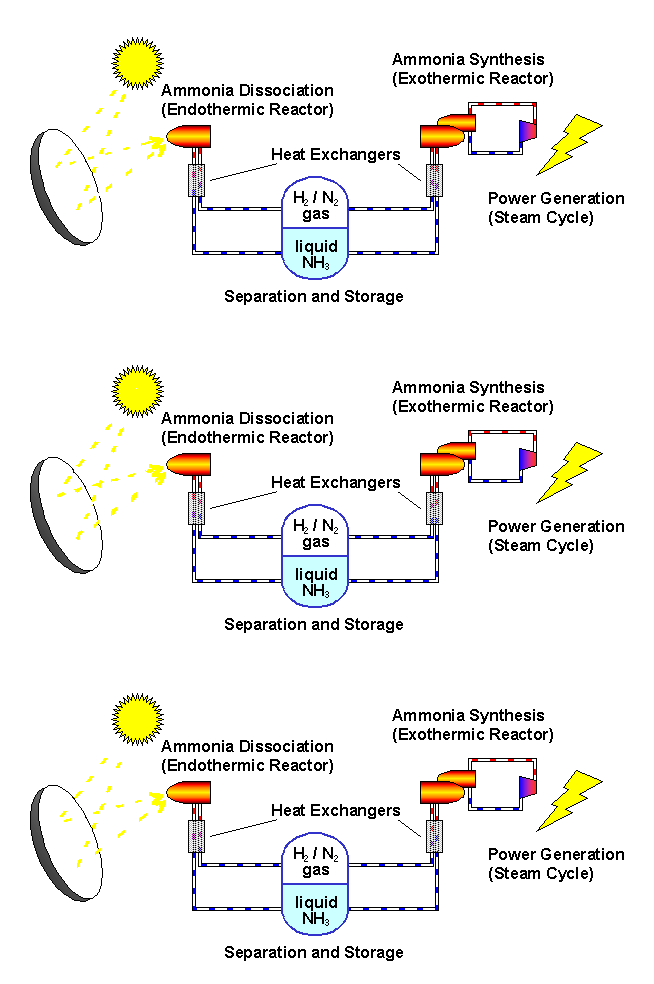
The ABC has a report on progress towards building a solar thermal power plant in South Australia (covered previously here in We're Off To See The Wizard - Storing Energy Using Ammonia) - Work starts on Whyalla solar project.
The foundations are being laid for a $15 million solar plant at Whyalla. A demonstration plant of four big dishes will combine solar power with ammonia energy storage technology.
Whyalla's deputy mayor Eddie Hughes says it is great to see something tangible after nearly 13 years of planning. "The first pad is to form a working base for the construction of the dishes," he said.
Mr Hughes says the 500-square-metre dishes will be the largest in the world. "They're going to be quite spectacular, I think they will attract a lot of attention," he said. "These are the largest solar dishes in the world, capable of generating temperatures in excess of 2,000 degrees."
He denies the plant will create another industrial eyesore for Whyalla. "Oh, I think they're going to be exceptionally beautiful to look at," he said.
Mr Hughes says, if the demonstration plant can successfully provide base load power, a 600-dish plant will be considered, at a likely cost of $350 million. It would be able to provide power to 19,000 homes.

 Posts
Posts