Posted
by Big Gav
in
beyond zero emissions,
zero carbon britain
WorldChanging has a post on a British plan - see here (pdf) - to convert completely to renewable energy by 2030 - A New, Bold Plan for a Carbon-Neutral UK by 2030.
Carbon neutrality by 2030 is the new standard for climate policies, and again the UK is leading North America in the climate debate with a bold national-level proposal about how to get there. The Centre for Alternative Technology just launched zerocarbonbritain2030 (ZCB2030), a collaborative project showing one possible scenario for making the entire UK carbon-neutral by 2030.
ZCB2030 is a well-researched, well-written, and well-designed report on a set of possible pathways to a zero carbon Britain by 2030 (The goal, though bold, is not unique: Alex Steffen called for a very similar position for Seattle, a target which the Seattle City Council has included in their legislative priorities this year; and a variety of other nations and cities are approaching the same target, from Copenhagen to New Zealand). In 384 pages, CAT presents a comprehensive look at the kind of systemic changes needed to achieve dramatic emissions reduction in just 20 years in such areas as farming, energy generation, building codes, transportation planning, and economic frameworks. This report truly addresses the scope, scale and speed of the climate crisis and the solutions needed to create a bright green future.

Posted
by Big Gav
in
geothermal energy,
geothermal power,
nevada
Inhabitat has a post on investment in geothermal power in Nevada - DOE Loans to Make Nevada the “Saudi Arabia of Geothermal Energy”.
Of all the ‘mainstream’ forms of renewable energy, it seems that geothermal power is always left in the shadows compared to solar and wind power. However, that looks set to change with news that the US Department of Energy will fund geothermal projects in northwestern Nevada and southeast Oregon. With funds from the American Reinvestment and Recovery Act, the DOE has stated a “conditional commitment” to provide a partial guarantee for a rumoured $98.5 million loan to the Nevada Geothermal Power Company (NGP).
The Silver State-based company has developed the Faulkner 1, a 49.5 MW geothermal power project at NGP’s Blue Mountain site in northwestern Nevada. Currently, the project is planning two new injection wells to enhance the distribution of injected fluids and further augment the plant’s power output. As such, the DOE is acting as loan guarantor for up to 80 percent of the $98.5 million loan to NGP for the scheme.
As part of the Obama administration’s Recovery Act, alternative energy has seen a real increase in investment with projects such as the Cape Wind Farm being finalized. Recent tragedies such as the Gulf of Mexico oil spill have only solidified support for alternative energy.
Geothermal projects haven’t dominated headlines like solar and wind projects have, but US Senator Harry Reid hopes to see that change. Speaking about the DOE’s support, Senator Reid said, “I am glad to see economic recovery funding being used to put Nevadans to work on a project that will help us achieve energy independence” He went on to say, “Northern Nevada is the Saudi Arabia of geothermal energy.”

Posted
by Big Gav
in
smart meters,
texas
GreenTech Media reports that Texas is looking to rollout a large number of smart meters, riasing the total number of devices in the US to 5 million - Landis + Gyr to Install a Million More Meters in Texas.
Landis + Gyr will install over 1 million gas and electricity smart meters for CPS Energy in San Antonio, Texas bringing the total number of meters for which Landis is under contract for that state to over five million.
CPS serves approximately 707,000 electricity customers and 322,000 natural gas customers in the region. The utility wants to gets its smart meter network fully operational by 2015. Like smart meter deployments elsewhere, CPS' network will grow in size and complexity as time goes on. It will start with automated meter reading and graduate to energy management.
Landis is also part of the Oncor smart meter project in the state, which has drawn complaints from residents alleging that the smart meters have caused their electricity bills to spike. Both Oncor and Landis have denied that the meters have caused bills to rise -- the largest number of calls are coming from households that use space heaters. Nonetheless, the Texas PUC is looking into the issue. A similar conflict in northern California has been brewing over the PG&E/Silver Spring smart grid deployment there.
Posted
by Big Gav
in
australia,
beyond zero emissions,
renewable energy
The ABC has an article on a Melbourne University report on switching Australia to 100% renewable energy (echoing another plan by Beyond Zero Emissions) and relying heavily on solar thermal power, wind power, electric vehicles and an expanded electricity grid - 100pc green energy possible by 2020: report.
There is an accompanying interview at The World Today.
A Melbourne University report says all of Australia's energy could come from renewable sources by 2020 as opposed to the Federal Government's target of 20 per cent.
The Zero Carbon Australia Stationary Energy Plan was launched in Canberra this morning by Coalition Senator Judith Troeth, independent Senator Nick Xenophon and Greens Senator Christine Milne.
Currently, wind and solar power provide less than 1 per cent of Australia's total energy needs. ...
Beyond Zero Emissions executive director Matthew Wright says the 10-year road map focuses on technologies that are already commercially available such as wind and large-scale solar thermal. "The inherent design of a solar thermal plant is that it stores its heat away for night time," he said. "We've modelled that from our 12 solar regions across the country and our 23 wind sites that we get 100 per cent of our power needs, 365 days a year, 24-7."
The report says the goal would also depend on a $92 billion upgrade to create one national electricity grid that would link the renewable projects to the city and urban areas.
University of Melbourne Energy Institute professor Mike Sandiford says cost should not impede the switch to renewable energy. "To do it in 10 years is in many ways akin to a infrastructure roll out of a wartime-like operation in many senses," he said. "But the important point of the plan is that costs are not a real impediment. The total costs of our business as usual comes down to about a cup of coffee per person per day." ...
Professor Sandiford says the plan is also based on a shift towards public transport and electric cars, which he says would offset any projected increases in electricity use.

Posted
by Big Gav
in
electric vehicles,
fedex
FedEx chief Frederick Smith has spoken in front of a US Senate committee recommending that transport be electrified - FedEx CEO Smith Testifies on Plan to End Oil Dependence.
Frederick W. Smith, Chairman, President and CEO of FedEx Corporation, co-Chairman of the Energy Security Leadership Council, and a member of the Electrification Coalition, testified today at a hearing of the Senate Energy and Natural Resources Committee. Smith spoke about the dangers posed by our nation's dependence on petroleum, and the plan to end that threat through the electrification of the ground transportation system. Following are excerpts from the testimony as prepared:
"Electricity represents a diverse, domestic, stable, fundamentally scalable energy supply whose fuel inputs are almost completely free of oil."
"We cannot let electric vehicles turn into another niche product. We cannot allow their use to be limited to environmentalists and technological enthusiasts. To make our nation's investment worthwhile"and, more importantly, to truly combat our oil dependence"we must put ourselves on the pathway toward millions, then tens of millions, and then hundreds of millions of electric cars and trucks.
"That is where this crucial legislation comes in."
"If this plan is successful, it would spur the production of electric vehicles, components, and infrastructure across the country. Much of the money that flows through deployment communities will end up in the towns and cities where the vehicles and charging infrastructure and their components are manufactured. When a factory reopens in a depressed area to build or support these vehicles"as we've already seen in places like Elkhart, Indiana and Livonia, Michigan"that is a real and tangible benefit for hardworking Americans."
"This effort is about building a new transportation system from the ground up in a fiscally responsible, competitive fashion. That's good for the entire nation."
"The public is demanding action. Electrification is truly bipartisan not just here in Washington but across the country. Americans often agree on challenges more than solutions, but that is not the case here. This proposal is popular, and it is popular for a reason."
Posted
by Big Gav
in
distributed generation
Dave Roberts has a post at Grist on a Scientific American article he wrote on distributed power generation - Local power: tapping distributed energy in 21st-century cities.
Residents of Hammarby Sjöstad, a district on the south side of Stockholm, Sweden, don't let their waste go to waste. Every building in the district boasts an array of pneumatic tubes, like larger versions of the ones that whooshed checks from cars to bank tellers back in the day. One tube carries combustible waste to a plant where it is burned to make heat and electricity. Another zips food waste and other biomatter away to be composted and made into fertilizer. Yet another takes recyclables to a sorting facility.
Meanwhile, wastewater is taken to a treatment plant, from whence it emerges as biosolids for more compost, biogas for heat and transportation fuel, and pure water to cool a power plant, which also runs on biofuels grown with the biosolids. Looking at a chart of all this is enough to induce dizziness. "In terms of what you can do at the local level for energy efficiency and renewable energy, it's incredible. It's just amazing," says Joan Fitzgerald, author of Emerald Cities (Oxford University Press, 2010).
After they are done, district authorities hope Hammarby Sjöstad will produce about half its power independently, a task made easier by the fact that residents, thanks to a broad range of efficiency and conservation measures, will consume half the energy of the average Swede (who already consumes only about 75 percent as much as the average American). These intrepid Swedish urbanites are pushing the envelope on a phenomenon catching on in cities across the developed world: "distributed energy."
That's the beginning of my new piece for Scientific American, "Local Power: Tapping Distributed Energy in 21st-Century Cities." Click on over to read the rest. I want to add a few quick things here.
First, the piece is focused mostly on technology, since I assumed that's what most Scientific American readers are curious about, but the primary barriers to distributed energy are not technological but institutional. Changing the way electric utilities (and their regulators) operate, changing financial institutions and mechanisms, creating more cohesive regional governing authorities, planning across sectors to reduce emissions, and growing carbon markets -- all these have to do with changes in law and practice.
Second, yeah, yeah, solar panels are expensive. But cogeneration isn't. Passive solar space and water heating are cheap. Geothermal heat pumps are economical. Burning methane from wastewater treatment and landfill facilities is cost-effective. In many areas biomass is renewable and relatively inexpensive for combined heat and power. District heating is lowering costs all over northern Europe. And of course efficiency is cost negative.
Efficiency -- the other half of distributed energy -- pays for the rest. That doesn't just mean more efficient appliances and cars, but more efficient metropolitan systems. Sensors and microchips are getting cheaper so fast that pretty soon it will be possible to wire everything. Information about where energy is being generated and consumed, where traffic is congested, which parking spaces are occupied, where fresh and wastewater are flowing and how much, will be available at every node in the network. With that kind of information and the computing algorithms to make sense of it available to every building, vehicle, and consumer device, it will be possible to institute variable pricing for everything from energy to congestion to parking to water. Efficiency will be infused into the system rather than tacked on.
Third, the social effects of distributed energy are among its most intriguing aspects, but also most difficult to predict. Recall what happened when computing and information technology became widely available. Now imagine the hackers of the future with their hands on local energy management. The very notion probably makes Dick Cheney lose sleep at night (if he sleeps at all), but our kids and grandkids will take their ability to shape their environment for granted. As with the internet, the furious pace of distributed innovation will produce benefits that dwarf the security risks.
More prosaically, local distributed energy just requires more civic involvement. Efficient living spaces are by nature smaller, so there's more time spent in communal spaces. There's trash sorting and thermostat programming and community planning and all the rest. Several sources I spoke to for the story waxed poetic about the cities and districts pursuing distributed energy, how the effort became a source of civic pride and engagement. As Bill McKibben puts it in a beautifully wrought essay, Hammarby Sjöstad is "a place that makes sense."

Posted
by Big Gav
in
bp,
gulf of mexico,
horizon,
pollution
Billmon has a post at Daily Kos looking at some of the stranger theories floating around about the compensation fund BP has set up to deal with the oil spill aftermath - Dear Teabaggers.
Your stupidity, fanaticism and all around mean spiritedness continue to astound, with your bizarre and – dare I say it – unpatriotic defense of British Petroleum only the latest example.
While I realize facts and logic are completely lost on you, can you at least TRY to get it through your tiny, floresiensis-like skulls that:
1.) The Constitution in your head notwithstanding, the REAL one doesn't forbid the president and/or his Attorney General from negotiating settlements of this kind. The Justice Department does it in environmental enforcement actions all the time, although usually without the 24/7 hysteria.
2.) The money is going to be held in an ESCROW account. Are you familiar with the term? Have you ever closed on a house? It means the money cannot be spent or disbursed without the approval of the trustee, who in turn will need to get approval from the courts. Again, this is a completely standard way of handling settlements in environmental cases.
3.) The money is NOT going to ACORN, your favorite all-purpose boogeyman. ACORN doesn't exist any more. Deal with it.
4.) BP agreed to the deal BECAUSE IT IS IN ITS OWN CORPORATE INTEREST. Lately investors have been shunning BP until they have some kind of idea of the company's potential legal liability. This has caused yields on BP bonds to soar and made it hard for the company to roll over short-term debt, threatening the company (and the entire financial system) with insolvency. While the settlement is not final, it does give investors some reason to hope the company will remain viable -- which in turn makes it more likely that it WILL remain viable.
5.) BP, its shareholders, and the wildlife in the Gulf of Mexico aren't the only ones at risk here. Do you by chance remember what happened to a company called Lehman Brothers when it couldn't roll over its short-term debt a couple of years ago? Do want to see a repeat of that fun-filled episode?
6.) If anything, Obama is doing BP a favor by coming to terms so quickly. The fact that BP was so eager to accept those terms is a clear sign it understands just how MORE humongeous its liabilities could be if this ends up in court. If you want to blame Obama for subverting the course of justice, go right ahead (although I'm not sure he had any realistic choice) but it's ridiculous to blame him for that with one breath and then accuse him of "shaking down" BP in the next. There was no shakedown – or, if there was, the muscle behind it was provided by Wall Street, not Chicago (unless you mean the futures pits).
Even for you, this is mendacity on a pathological scale, amounting practically to a psychotic break from reality. Your movement has become the social equivalent of BP’s blown out well: completely out of control and spewing toxic crap in every direction. Joe Barton, at least, had the excuse of being a well paid prostitute on permanent retainer to the oil industry. What’s yours? Only fools give it away for free.
Sincerely,
Billmon
Posted
by Big Gav
in
big brother,
internet
The SMH reports that crazed American Senator Joe Liebermann (always on the lookout for new ways to control people) is trying to legislate for a formal mechanism for the US to crash the internet - Internet 'kill switch' proposed.
US President Barack Obama would be granted powers to seize control of and even shut down the internet under a new bill that describes the global internet as a US "national asset".
Local lobby groups and academics have rounded on the plan, saying that, rather than combat terrorists, it would actually do them "the biggest favour ever" by terrorising the rest of the world, which is now heavily reliant on cyberspace.
The proposed legislation, introduced into the US Senate by independent senator Joe Lieberman, who is chairman of the US Homeland Security committee, seeks to grant the President broad emergency powers over the internet in times of national emergency.
Titled "Protecting Cyberspace as a National Asset Act", the bill stipulates any internet firms and providers must "immediately comply with any emergency measure or action developed" by a new section of the US Department of Homeland Security, dubbed the "National Centre for Cybersecurity and Communications".
Lobby group TechAmerica told ZDNet it worried that the bill would give the US "absolute power" over the internet and create "unintended consequences".
One of Australia's top communications experts, University of Sydney associate professor Bjorn Landfeldt, railed against the idea, saying shutting down the internet would "inflict an enormous damage on the entire world".
He said it would be like giving a single country "the right to poison the atmosphere, or poison the ocean".
"All our financial systems, all our security systems ... we're so reliant on the internet that if you shut it down there's a question of whether society will continue to operate normally anywhere in the Western world," Landfeldt said in a phone interview.
"By doing this they would do the terrorists the biggest favour ever because they would terrorise the rest of the world".
Landfeldt said the US would be the only country in the world with the ability to shut down the internet. He said such a move would be extremely difficult for the US to justify to other nations.
Posted
by Big Gav
in
carbon sequestration,
poo,
sperm whales
Giles Parkinson has an article in The Business Spectator on an unusual way of sequestering carbon safely in the oceans - A carbon sink with fins.
Australian scientists have found another very good reason to protect the sperm whale, but please finish your breakfast or lunch before reading on.
Research led by Trish Lavery at the School of Biological Sciences at Adelaide’s Flinders University, suggests the poo of the sperm whale is particularly in rich in iron, and because it comes in liquid form and is excreted near the surface, it doesn’t sink rapidly to the ocean floor.
Instead, it inspires the growth of phytoplankton which in turn absorbs carbon dioxide from the atmosphere. It means that even after taking into account the considerable amount of carbon dioxide emitted when these giants of the sea respire, sperm whales are a highly effective, and highly mobile, carbon sink.
And more so than other whales, because as a deep diving feeder, the nutrients it defecates are additional to the total count – other sea animals tend to feed at the surface and simply recycle said nutrients.
Each sperm whale is estimated to absorb at least 35 tonnes of CO2 from the atmosphere each year. From the estimated population of 12,000 Southern Ocean sperm whales that remain after decades of hunting, that amounts to around 400,000 tonnes of CO2 per year.
According to the research, this carbon saved from the current numbers of Southern Ocean sperm whales amounts to just 0.05 per cent of the carbon emitted globally each year by fossil fuel burning, but the numbers of Southern Ocean sperm whales were once ten-fold the current population, and the paper estimates that two million tonnes of CO2 have been left in the atmosphere each year as a result of decimating the sperm whale population.
“This is a previously overlooked impact of industrial whaling,” the report says. Southern Ocean sperm whales, it notes, account for just 3 per cent of the world’s population of sperm whales, which means that the global sperm whale population may be a significant contributor to carbon drawdown. Whales had once been considered to be a net carbon emitter because of their respiration.
The latest paper suggests that other mammals and organisms that consume prey at depth and defecate nutrient rich waste near the surface could be performing a similar function – these include, pygmy whales, baleen whales and fin whales, and possibly also seals and sea-lions, though more research needs to be conducted to ascertain the liquidity and the buoyancy of their poo. A previous Australian-led study suggested that baleen whale faeces once accounted for more than 12 per cent of the iron in the Southern Ocean.
And the point of all this? Well, as nations meet and continue negotiations on how to remove the other 99.95 per cent of fossil fuel emissions under the UN-sponsored climate change talks, such biological solutions will become crucial, and become the basis for new market mechanisms and ascribe a value to hitherto unrecognised assets that will turn the business models of many industries on their head. And companies and their investors need to be aware of this.
It will happen in forestry, for that is what the REDD mechanism that is nearing agreement is designed to do – make the trees that stand in the world’s remaining rainforests more valuable alive than dead. It will likely occur in land use and farming, because these will form a fundamental part of the abatement proposals of the likes of Australia and some other industrialised nations.

Posted
by Big Gav
in
gasland,
shale gas
American readers might want to tune into HBO tonight to watch the documentary "Gasland", which looks at the environmental impact of hydraulic fracturing (used to extract shale gas) - Gasland. The scene where the narrator sets fire to a stream of tapwater in a contaminated area does stick in your mind for a while...
Posted
by Big Gav
in
bay of fundy,
ocean energy,
openhydro,
tidal power
GreenTech Media reports that a damaged rotor has forced tidal power company OpenHydro to "pull up from the Bay of Fundy" - A Big Setback for Tidal Power.
The prospect of nearly unlimited, renewable energy from the tides suffered a blow this month when OpenHydro announced it would pull its experimental underwater turbine from the Bay of Fundy.
The test in this most extreme tidal environment was seen as a critical opportunity for the industry to prove that harnessing the tides had finally become feasible.
OpenHydro lowered its 400-tonne, six-story turbine onto the seabed last November, choosing the swift flowing Minas Passage near Parrsboro, Nova Scotia.
Last week, the Irish company said it would yank the turbine out by October after an underwater video discovered two broken blades. The blades are made of a combination of plastic and glass.
The setback underscores how difficult it is to operate in the corrosive, storm-plagued marine environment. The $10 million, 1 MW project had hoped to show a first-of-its-kind tidal plant could be built to supply as much as 25 percent of Nova Scotia electricity.
The Bay of Fundy was selected because it arguably has the highest tides in the world, competing for the honor with the Ungava Bay in Quebec and the Severn estuary in the United Kingdom. Tides can rise 55 feet or more, generating a potential of 1,013 MW of power, 152 MW of which can be harnessed with little environmental impact.

Posted
by Big Gav
in
australia,
bp,
halliburton,
horizon,
montara,
pollution
Phil Hart has a post at The Oil Drum on the Montara oil spill off Australia last year - The Australian Oil Spill.
The Age in Melbourne today has an article about a possible moratorium on oil and gas drilling in Australian waters, as a result of the BP spill in the Gulf of Mexico and the Montara oil spill in the Timor Sea off Australia last year. A review into the Montara accident has just been completed but has not been released, for 'legal reasons'. Apparently prosecutions may be in order. It's a pity as the review may highlight some common factors with the Gulf of Mexico spill, particularly in relation to the failure of the BOPs to seal the well. ...
Given how much outrage the BP spill has caused in the United States, it's remarkable that after the first few days, the Montara oil spill was largely ignored by everyone in Australia and was probably never heard of in most parts of the world. This despite being our nation's largest oil spill and causing an oil slick 180 km (110 mi) wide (not bad for what was really a gas well and considering that much of the oil burnt at the wellhead). With so little public outrage, there has been very little pressure on the operators PTTEP to release details of the incident to the public. The official review has now been completed but even that may not be available for quite sometime:
The Age: Why the oil minister doesn't feel too well right now
We have not heard much about the Montara incident. No one was killed and maybe 30,000 barrels of oil spilled into the sea over a few months … that's less than BP's Deepwater Horizon was thought to be gushing into the Gulf of Mexico per day. And Australian-listed companies were not involved in Montara. The key companies involved were PTTEP of Thailand, and Atlas and Halliburton, both of the US.
But as luck would have it, an extended investigation of the Timor Sea incident has just been completed. The report was handed to Martin Ferguson last Friday … and the first thing the minister did was hold on to the document for ''a legal review''. Now you might think that is an easy way out for a government that will be damned if it responds to the Greens and doubly damned by a raging multinational resources sector. But the report has been delayed for public release on advice of the Solicitor-General. In other words, there is the real possibility of prosecutions following the Montara incident.
That's a pity because there is likely to be a lot of information in this inquiry relevant to the Deepwater Horizon blowout. But already it adds weight to the idea that there have been a large number of accidents and 'near misses' and that a serious blowout and failure of the BOP was not as 'unforseeable' as some in the industry have claimed. If prosecutions are a 'real possibility', then clearly somebody or some companies have not been doing their jobs very well. Some of the companies involved in the Deepwater Horizon blowout will surely be a little worried at the moment?
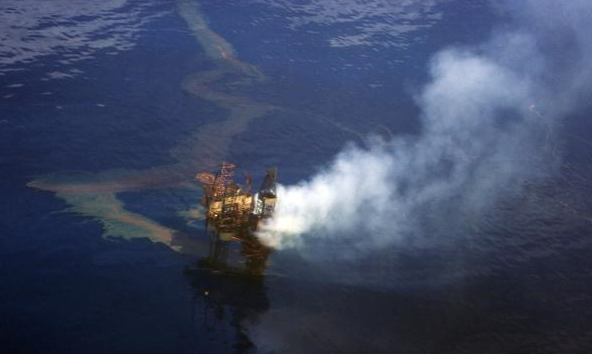
Dan Cass has an article suggesting Halliburton could be one company that could be worried -
Halliburton Dumps US Congress and Oil Spill Plaintiffs In Legal Deepwater.
President Obama’s administration and BP’s critics in Congress will be keen to read the Montara oil spill report that Mr David Borthwick, AO PSM gives to Australia’s Minister for Resources, Martin Ferguson today.
Mr Ferguson has been a staunch defender of the operator of the Montara facility and a proud booster of the oil industry generally. It is surprising then, that Australia is not one of the 17 countries who have offered to help clean up the oil spill in the Gulf of Mexico, according to the US State Department (Although BP has used some Australian resources in the clean up.)
Minister Ferguson is under pressure to release the Montara report quickly, because of the the disaster in the Gulf of Mexico. The Minister’s office has said that he needs ‘a few days’ to read the report, after which it will be put in the public domain.
As Crikey reported Halliburton built the concrete wellhead on both BP Mississippi Canyon 252 well (MC252) in the Gulf of Mexico and the Montara Wellhead Platform at the West Atlas site in the Timor Sea.
Halliburton ranks number 2 among oilfield services companies globally and was ranked as 310 in a Fortune 500 listing, with revenues around US$18 billion. The company is best known for allegations of nepotism, corruption, human rights abuse and overcharging the US military, through its subsidiary Kellogg Brown & Root (KBR), which it sold in 2007. KBR was the business division responsible for military logistics support.
Halliburton’s Tim Probert (President, Global Business Lines and Chief Health, Safety and Environmental Officer) has told the US House Committee on Energy hearings that there was no connection between Montara and Deepwater, but his wording is a matter of some concern.
When Probert was asked if Hallliburton was involved in cementing the Montara wellhead and whether this is relevant to the MC252 failure he replied with an interesting qualification, “We were involved in the well cementing. But what we do know from the public testimony is that a 5-month period elapsed between the time the cementing was completed and that the well control issue took place. [emphasis added]”
Probert continues but the gist is that he refers only to the ‘public testimony’ that his company gave to the Montara inquiry. My understanding is that he was appearing before the House on the basis of his ‘sufficient knowledge’ of technical issues, not merely his ability to inform the House about information already on the public record in another country.
This is curious, because if Probert was confident that there was no connection between Montara and Deepwater, surely he would state this simply and unconditionally. By restricting his assurance to only the public evidence, it raises the question of what other evidence exists.
Posted
by Big Gav
Alex at WorldChanging has a post on the value of focusing on solutions rather than problems - Seeing Past the BP Spill.
We've gotten a few inquiries lately about why we aren't devoting a lot more discussion to the BP Spill. After all, isn't this the "worst environmental disaster in American history?" Shouldn't a site whose purpose is to explore solutions to planetary problems be all over the planet's most visible current problem?
In a word, no. The decision not to cover the BP Spill has been fairly straightforward for us: we don't do problems, unless we're covering them in order to explain how a solution could work, or unless a new analysis of a problem is so telling that it changes the way we understand how it could be solved. The BP Spill is huge, but not particularly unique.
The BP Spill will almost certainly go down as the decade's most visible industrial accident. The BP corporate leaders involved ought probably to go to jail. The wetlands and beaches of the Gulf of Mexico will suffer horrible environmental degradation. Local people will suffer the loss of their ways of life and of places they love, as well as health effects. The impact on the marine life of the Gulf is as yet unknowable.
Yet, while the BP Spill is the biggest single oil spill we here in America have experienced, in terms of overall impact, it's just a drop in our pollution bucket. Thousands of major spills happen around the world each year. Even in terms of oil spilled in North America, this disaster is small compared to business as usual: more than 90% of all the oil spilled in North America comes from oil leaked from cars (or poured down drains) finding its way to the sea, according to a landmark 2002 report; in the Puget Sound region alone, more oil is leaked from cars and home use every two years than was spilled by the Exxon Valdez.
And oil spills are far from the worst environmental disasters we've unleashed and are in the process of unleashing through the routine operation of our economy as currently designed. Climate change will over the next century almost certainly prove far more destructive to the natural systems and human communities of the Gulf than any oil spill ever could, and that's a problem the Deepwater rig would have worsened if it had worked perfectly, as part of its successful operation. And, as we've mentioned here before, climate change is only the largest problem in a set of interconnected problems that stem from transgressing our planetary boundaries, problems that include massive extinctions, marine deadzones, desertification, and ocean acidification. The entire living fabric of our planet is being shredded, and human communities irreparably harmed, by the systems that deliver our prosperity.
The key word here is systems. Unless we understand the problems we face as systemic problems, we don't really understand them at all and can't do much about them. Unless we understand that we need to redesign and rebuild the systems that support modern life on a massive scale, very quickly, we're essentially missing the point, and guaranteeing that the destruction of the planet's biosphere will continue.
Few in the American political landscape are willing to use the oil spill to point to the real nature of our challenges. What the BP Spill tells us is not that we need tougher environmental laws, or a ban of offshore oil exploration, or even a national clean-energy strategy. What the BP Spill tells us, if we're really paying attention, is that the American economy needs systemic change, now. Even with tougher laws, bans on drilling and massive subsidies for wind and solar, the systems we depend upon for our way of life will be violently and cataclysmically destructive: the BP Spill is just a small manifestation of a massively larger problem. We need to be embracing an entirely different set of solutions right now. Political leaders in the US and worldwide need to move beyond short-term thinking and think big, think connected, and think ahead.
In failing to see that the BP Spill is a symptom, we also make it easy to blame the wrong people for the failures of the systems we now use. I've read dozens of pieces parroting the opinion that the BP Spill is all of our faults; that because we all use oil, we've all been responsible for making this happen. That's just stupid. Leaving aside entirely the fact that this particular spill itself appears to be the result of unethical and possibly criminal leadership within BP, the simple fact is that we continue to use so much oil largely because Big Oil, the car companies, the road-building lobby and sprawl developers have engaged in one of the largest sustained political efforts in history to keep us using as much oil as possible by blocking climate legislation and gas taxes, fighting smart growth laws and new public transportation investments, stalling higher mileage standards in new cars, channeling trillions of dollars into new roads and auto infrastructure, gutting water- and air-quality laws, even (arguably) getting a former oil man (George W.) elected, which resulted in a war for oil and general atmosphere of climate denialism. We burn oil in such astonishing quantities because those who profit from selling and using oil have all but run the American political system for the last ten years, and exerted decades of dominant influence before that.
Posted
by Big Gav
in
australia,
coal seam gas,
queensland
The ABC reports that opposition to coal seam gas extraction in Queensland is growing - Farmers fuming over natural gas rush.
Farmers and environmentalists are joining forces on Queensland's Darling Downs to try to stop the rush for natural gas.
The Darling Downs is one of Australia's most productive farming regions, but it is being overrun with drilling rigs as some of the world's biggest energy companies try to bank a new resource bonanza - millions of tonnes of methane from coal.
The farmers are now worried that thousands of gas wells are going to damage their ability to grow food.
"I think the coal seam gas companies are where we were 100 years ago; come in and rape and pillage, grab what you can and leave," said Dalby farmer Ian Hayllor.
"And we're not going to let them do that. They're going to have to be sustainable. If they want to work in our environment, they've got to be sustainable.
"They can come in, take the gas, but they're not going to destroy the environment they're working in. If they can leave it the way they found it, we'll accept them onto our properties."
The anger of farmers is mounting as the gas companies begin a push into some of the more productive cropping areas of the Darling Downs.
Posted
by Big Gav
in
electric vehicles,
obama
The ABC has a report on Obama's recent (apparently underwhelming, based on most commentary) speech on foreign oil dependence and clean energy - Obama's War on Oil.
After being forced to lobby for every single vote to pass basic healthcare regulation, the US president is now tied down by the Deepwater Horizon oil spill disaster. Both events represent deep challenges facing American society - its out of control health care costs and its desperate addiction, shared by us all, to fossil fuels.
The struggle to solve both problems has illustrated the weakness of the American state in terms of its ability to respond to and resolve such crises on both a political and institutional level. Just a year and a half into Obama's first term the United States remains divided and weak, with deep partisanship making unified responses nearly impossible, and structural weaknesses in terms of state capacity challenging the delivery side of what compromises can be salvaged from the political maelstrom.
In this first Oval Office address yesterday, President Obama sought to revive a flagging political agenda with a very real sense of crisis. His speech was redolent with the language of war, the image of 'a menacing cloud of black crude' evoking the black clouds that rose from the World Trade Centre on 11 September 2001.
He not only laid out his 'battle plan' in response of his administration in terms of holding BP to account, but also reaffirmed his belief that action is necessary to reduce and ultimately break fossil fuel addiction. If George W Bush seized on the 11 September attacks to declare a 'war on terror', Obama has declared nothing less than a war on oil.
On the Gulf Coast this means the deployment of 17,000 National Guard troops to help the physical cleanup, the involvement of tens of thousands of personnel, thousands of ships and the deployment of five million feet of water booms.
For all of this, BP will be expected to foot the bill. This is the 'war on oil' on an immediate and local level, with both the slick itself and BP as the villains.
It is the future and global War on Oil however that provides the bigger picture for Obama's speech. With global efforts to break fossil fuel addiction faltering since Copenhagen, Obama casts the Deepwater Horizon as emblematic of a greater struggle not only environmental and economic in proportions but also geopolitical.
Having failed to carry anti-carbon pollution legislation on environmental grounds at Copenhagen, Obama is appealing to American nationalism.
This is because dependence on 'foreign oil' is the geopolitical demon that unites both Republicans and Democrats, even where they cannot agree on climate change or pollution. Obama reminded his audience that 'each day, we send nearly a billion dollars of our wealth to foreign countries for their oil'.
It is a fact that galls every American for a range of reasons ranging from the noble to the xenophobic.
In this global picture the enemy is not dissimilar to that evoked by the war on terror - the transition is almost seamless, because the origins of both terrorists and so much 'foreign oil' is Saudi Arabia and the Middle East it represents.
America's struggle for energy independence, Obama tells us, is not only like the mission to the moon, but like World War II. There too, a looming threat was known but ignored, at vital cost:
"For decades, we have known the days of cheap and easily accessible oil were numbered. For decades, we have talked and talked about the need to end America’s century-long addiction to fossil fuels. And for decades, we have failed to act with the sense of urgency that this challenge requires. Time and again, the path forward has been blocked – not only by oil industry lobbyists, but also by a lack of political courage and candor."
But there is also another threat in the piece. This is China, which, Obama warns his audience, has been 'investing in clean energy jobs and industries that should be here in America'.
Obama thus casts the war on oil as a struggle to maintain not only America's independence from the Middle East in which it is so disastrously mired, but as a battle in America's much feared decline as a superpower. ...
The coming months will tell whether the War on Oil will do just that, or whether the United States will remain paralysed by its political division as well as its fossil fuel addiction.
The Washington Post has an editorial saying Obama didn't go far enough -
Obama's TV speech undersells how energy policy must change.
FROM THE Oval Office on Tuesday, President Obama argued that the catastrophic oil spill in the Gulf of Mexico underscores the need for America to transition from fossil fuels. But even as he attempted to rally Americans by invoking heroic American achievement in World War II and in space, the president didn't talk much about what could make such a transition happen.
The answer is that oil, gas and coal have to become more expensive to spur research into cleaner energy and encourage efficiency and switching. This could be achieved with a gradually rising tax on fossil fuels or a "cap-and-trade" system that makes utilities and others pay to pollute. The government could rebate most of the proceeds directly to Americans and invest the rest in energy research and transition assistance. When a price is placed on burning dirty fuels, market forces will drive the sort of transition Mr. Obama proposes.
The president knows this. In other speeches before and after the gulf spill, he has argued for it. Yet on Tuesday he only hinted at this and seemed to suggest he'd be open to energy legislation that doesn't raise the price of carbon.
For that, Republicans bear considerable blame. To be consistent with both science and their philosophy, they should favor a market-based approach. Most on the national stage instead prefer irresponsibly to pillory the idea as a "job-killing national energy tax"; they propose command-and-control energy programs that they think might be more popular. Democrats with ties to coal or manufacturing interests meanwhile dilute the policy, demand payoffs to support it or shortsightedly oppose it. Legislators in both parties champion more federal spending for their favored technologies.
But the harsh political climate is all the more reason why presidential leadership is essential. Passing comprehensive climate legislation isn't likely to be easier in the next Congress. As the president begins to push on crafting a compromise energy proposal next week, he'll have to be more forthright on what true change will require.
The Wall Street Journal has an article noting Obama should be putting some additional energy intp pushing electric vehicles -
Time to Plug In Electric Cars.
It's fair to say that President Barack Obama's speech to the nation on the oil spill this week didn't exactly get rave reviews. It was variously described as flat and vague—and that was by his friends.
And maybe there was just nothing he could say at this moment of helplessness in the face of the gushing oil that could have made it otherwise.
Perhaps, though, the president should have uttered two words: electric cars.
One of Mr. Obama's goals, in the speech and beyond, is to turn the BP crisis into a clarion call for moving more quickly to a post-oil energy future. Indeed, the White House believes that, once the trauma of the spill subsides, the chances of passing broad energy legislation—suspended in a partisan coma before the spill—actually will have improved, because the crisis will have a galvanizing effect on America's yearning for a different energy future.
If that's the case, there may well be broader support for building that future around electric cars than any other approach. In short, perhaps electric vehicles are something both parties can agree to ride into a new and brighter energy future.
Already, similar bills are pending in both houses of Congress to push electric cars, and they have bipartisan support from real, live Democrats and Republicans. A blue-ribbon group of corporate leaders has formed to push the bills; they also are backed by retired military leaders who see electric cars as a way to ease the national-security concerns of dependence on Mideast oil.
So maybe this is the rallying point the president was seeking in his Oval Office address. "When the president got to the end, it seemed to me he should have said, 'Let's have a mini-Manhattan Project. Let's electrify half our cars and trucks in 20 years.' " said Sen. Lamar Alexander of Tennessee, third-ranking Republican in the Senate and a kind of missionary for electric cars. "That's a very ambitious goal, but it's a goal that cries out for presidential leadership."
That doesn't mean electric cars are an easy answer; if they were, we'd all be driving them, and oil wouldn't be lapping up on the Louisiana coast. The technology to produce batteries long-lasting enough to satisfy American drivers, and the infrastructure to recharge them, aren't there yet.
But the point is that smart people with a real stake in the outcome of the quest think the answers are close enough to make this the centerpiece of a new energy equation. "You have a chance in the next two years to make a real difference," said Fred Smith, chief executive of FedEx Corp., the shipping giant. His company already is operating some all-electric vehicles.
"I'm a free-market person," Mr. Smith says. "I'd prefer that all of this take place with nothing but the free market. But the reality is that, to push things down the cost-price curve, the government is sometimes important."
Posted
by Big Gav
in
bp,
gulf of mexico,
horizon,
pollution
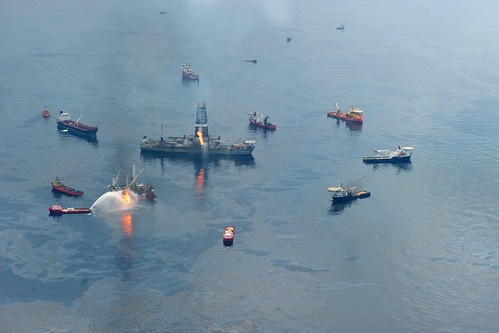
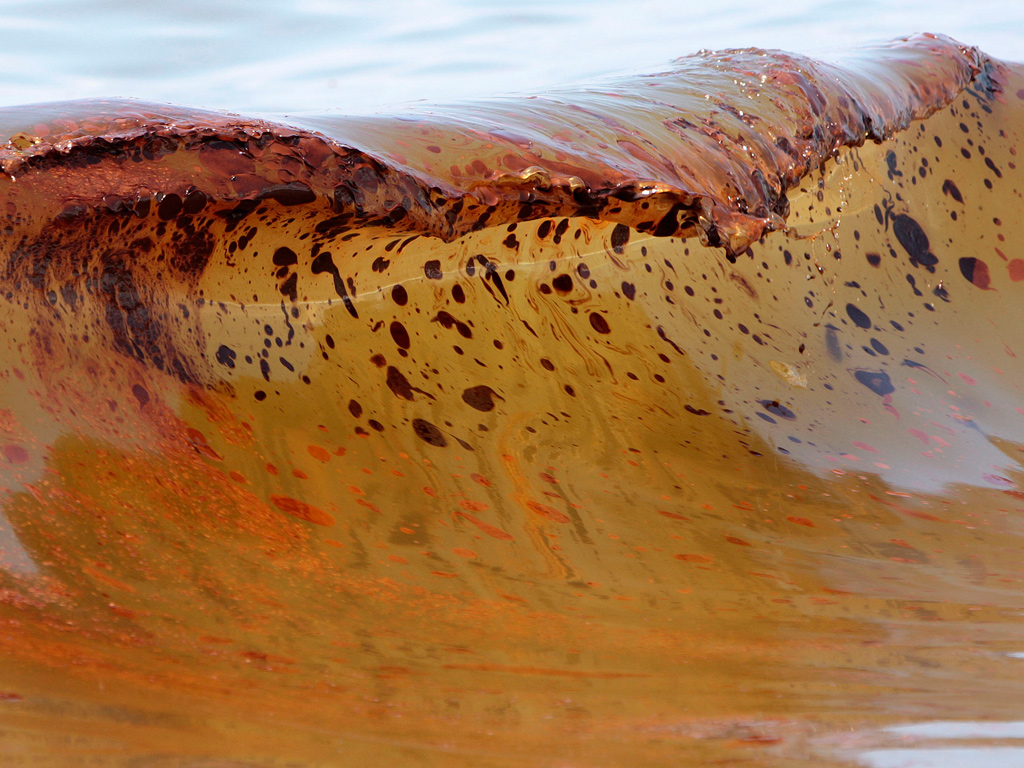
TED has an interesting set of oil slick images - Aerial photos of the oil slick.
Posted
by Big Gav
in
bp,
horizon,
pollution
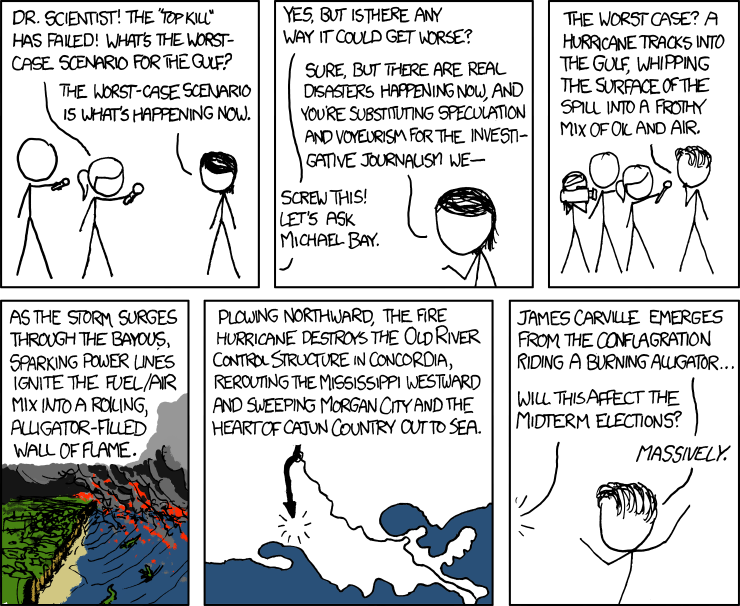
The BP oil spill has really got the fringes on fire lately with some wild theories about just how bad the oil spill could "really" be.
Posted
by Big Gav
in
air conditioning,
energy efficiency
Technology Review has an article on energy efficient air conditioning - An Energy-Saving Air Conditioner.
Keeping air cool in homes and offices this summer will be expensive--about 5 percent of the energy used in the United States each year goes to running air conditioners. But researchers at the U.S. National Renewable Energy Laboratory (NREL) in Golden, CO, have come up with a new air-conditioner design that they say will dramatically increase efficiency and eliminate gases that contribute to global warming.
"The technology we have today is nearly a hundred years old," says Eric Kozubal, a senior engineer at NREL. Kozubal and colleagues have come up with an air conditioner that combines evaporative cooling with a water-absorbing material to provide cool, dry air while using up to 90 percent less energy. The desiccant-enhanced evaporative, or DEVap, air conditioner is meant to addresses the old complaint, "It's not the heat; it's the humidity," more efficiently. ...
The industry is working on a variety of methods to improve the efficiency of air conditioning, Jacobi says, from the use of heat exchangers to improvements in the compression systems of traditional machines. "It's an area of great importance to the nation, because about a third of our nation's energy use is in buildings."
The U.S. uses about 100 quadrillion British Thermal Units each year, according to the U.S. Energy Information Administration. Up to 40 percent of that is used in buildings, with about 5 percent going to air conditioning. Kozubal says his system could cut that in half in less-humid areas and by up to 90 percent where humidity is high. "When you talk about a technology that can save 2 to 3 percent of the nation's entire energy supply, that's quite a lot," he says.
The desiccant used in the system is relatively harmless (calcium chloride is used in road salt), though its corrosiveness requires that metal be eliminated from the hardware. What's particularly attractive is that it replaces the chlorofluorocarbons that are used as the refrigerant in traditional air conditioners. Those CFCs can easily leak, and every kilogram of them provides the same greenhouse gas effect as about 2,000 kilograms of carbon dioxide.
Kozubal says it might take about five years to develop the system to a point where NREL can hand it off to industry for commercialization. The system is designed to replace existing systems without many changes, so it could be phased in as people upgrade their old air conditioners.
The desiccant can be reused simply by heating it up to boil off the water it's absorbed. In an industrial setting, that might be done using waste heat from another industrial process. In the home, natural gas or solar energy would work. In fact, Kozubal says, the setup could make solar thermal energy systems, which absorb sunlight to heat a home and its water, more cost effective. During hot summer days, solar energy that might otherwise go to waste could therefore actually help keep a building cool.


 Posts
Posts