Showing posts with label south korea. Show all posts

Oil, Gas and the Senkaku / Diaoyu Islands Dispute  

Posted by Big Gav in , , , ,

Martin Wolf at the FT is warning that "Beijing, in its dispute with Japan, risks repeating the errors of an earlier era that led to war" as the sabre rattling over the disputed Senkaku / Diaoyu islands continues - China must not copy the Kaiser’s errors.
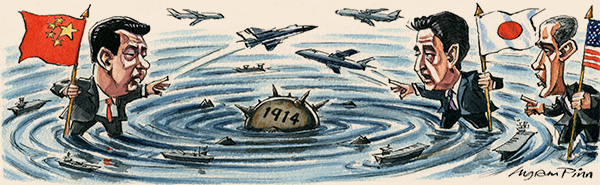
The latest development in the tension over the islands (and the seabed surrounding them) is an announcement by South Korea extending its air defence zone to cover the islands, overlapping the zones proclaimed by Japan and China - South Korea extends its air defence zone to overlap with China's.

The BBC says the dispute is over a range of factors, including oil and gas - Q&A: China-Japan islands row.

They matter because they are close to important shipping lanes, offer rich fishing grounds and lie near potential oil and gas reserves. They are also in a strategically significant position, amid rising competition between the US and China for military primacy in the Asia-Pacific region.
The Economist is also pondering the dispute - Who really owns the Senkaku islands?.
If possession is nine-tenths of the law, the answer is simple: Japan. It claims to have “discovered” the islands, a terra nullius belonging to no one, in 1884. In early 1895 it annexed them, shortly after Japan had defeated a weakened China in a brief war and seized Taiwan, which lies just to their south, as war spoils. One Tatsushiro Koga was licensed to develop the islands. He set up a bonito-processing station whose 200 employees also killed the once-abundant short-tailed albatross for its feathers. The Koga family’s last employees left during the second world war. Upon Japan’s defeat in 1945 control fell to the Americans, who used the islands for bombing practice. In 1972, at the end of the American occupation, the Japanese government resumed responsibility for the Senkakus.

By then, however, oil and gas reserves had been identified under the seabed surrounding the islands. China, which calls them the Diaoyu islands, asserted its claim, as did Taiwan, which is closest to the islands (and which is also claimed by China). China’s claim is vague, and is based on things such as a Chinese portolano from 1403 recording the islands. It all speaks to an earlier world in which China lay at the heart of an ordered East Asian system of tributary states—an order shattered by Japan’s militarist rise from the late 19th century. What this history tells you is not—contrary to modern Chinese claims—that China controlled the Diaoyus, for it never did.

The Diplomat has an article by Michael Turton (much repeated in the conservative press) arguing that Chinese claims to the Senkakus began shortly after oil was discovered in the area - Constructing China's Claims to the Senkaku.

An astonishing thing occurred in 1971: after decades of complete ignorance, the two Chinese governments in Taipei and Beijing both suddenly discovered that they owned the Senkaku Islands. That's right. Prior to 1971, neither government believed that it owned the Senkaku (Diaoyutai, in Chinese). Maps and texts from both governments during the period between 1895, when Japan seized the islands, and 1971, when the claim was first mentioned, have three things in common: (1) they always assign their sovereignty to Japan; (2) they refer to them using the Japanese names; and (3) they never refer to the disputed status of the islands. Simply put, there was no "dispute" over the Senkaku until after scientists raised the possibility of oil in the area in the late 1960s.

National Geographic is also pointing to oil as a factor - Why Are China and Japan Sparring Over Eight Tiny, Uninhabited Islands?.

It's all a bit bewildering—until you consider the rich natural gas deposits of the East China Sea. "Energy is clearly what's driving a lot of Chinese behavior," says Sheila Smith, a senior fellow at the Council on Foreign Relations in Washington, D.C. "They will give you a long, historical explanation of their sovereignty claim. But the idea that there are vast resources under the East China Sea just off their coast is a tremendous motivation for the intensity of their territorial dispute."

Just how much oil and natural gas is at stake, in either the South China or the East China Sea, is unclear. The territorial disputes have prevented any reliable survey. One Chinese estimate puts the oil stores in the South China waters at 213 billion barrels, an amount that would exceed the proved reserves of every country except Venezuela (296.5 billion barrels at the end of 2011) and Saudi Arabia (265.4 billion barrels). That's about ten times higher than a U.S. Geological Survey estimate from the mid-1990s—but even that lower figure puts the South China Sea's oil potential at four or five times that of the Gulf of Mexico. Similarly, China estimates that one of the world's largest natural gas deposits, containing some 250 trillion cubic feet, lies all but untapped in the East China Sea. U.S. energy analysts reckon the "proven and probable" reserves there at only 1 to 2 trillion cubic feet—much less than the Gulf of Mexico, but still considerable.

Bloomberg also has an article looking at the possible reserves of oil in play - Disputed Islands With 45 Years of Oil Split China, Japan.

China is the world’s largest energy consumer and is running out of oil because its aging onshore fields cannot keep pace with near double-digit economic growth. By the end of this decade, the country will need to import more than 60 percent of its crude compared with about 50 percent now and one third of its natural gas, according to estimates from China Petroleum & Chemical Industry Federation. ...

The sea east of China may hold as much as 160 billion barrels of oil and the South China Sea 213 billion, according to Chinese studies cited by the U.S. Energy Information Administration. The EIA says those figures are too high and has its own estimate for the East China Sea of as much as 100 million barrels.

While drilling will be needed to confirm the size of the resource and what is recoverable, China’s estimates are larger than the confirmed reserves in Saudi Arabia of 265 billion barrels and would be enough to meet the country’s needs for a century based on 2011 consumption data provided by BP Plc. Gaining control over the largely untapped areas in the South China and East China Seas would help China avoid Japan’s postwar energy model, where its security is largely staked on oil tanker supplies originating 7,700 kilometers (4,800 miles) from Tokyo in the Middle East. ...

The country is being forced to buy more from the Middle East, importing a record 35.5 million tons of crude from Saudi Arabia, its biggest supplier, in the first eight months of this year, according to data compiled by Bloomberg. The amount was 10 percent higher than the same period last year and the bill came to $29 billion.

If you poke around enough you can find claims of a CIA report saying whatever it is you would like to hear - a Japanese blogger is pointing to a CIA report back from the genesis of the dispute (hosted at Cryptome) - The CIA’s 1971 Secret Report On The Senkaku Islands Dispute.

First of all, you can find the entire CIA report on the Senkaku Islands here, should you be interested. The report was written in 1971 and then “approved for release” on May 2, 2007, which hopefully means nobody in dark suits will be knocking on my door anytime soon. Interestingly enough, that dates the release of this article to before the recent flare-ups between Japan and China, so it’s not entirely new. It does, however, bring up an interesting perspective and thus allows us to see what part of the report has come true (or not true), as well as have an idea of what may be to come. ...

In 1969, the Japanese government sponsored a survey of the underwater geology around the Senkaku Islands. At this point, there really was no thought from really anyone that the Senkaku Islands belonged to anyone but the Japanese. After the survey, they released newspaper accounts that they had confirmed an earlier UN survey saying there was possibly a lot of oil to be had.

South Korea Plans 200-Megawatt Tidal-Power Plant by 2016  

Posted by Big Gav in , ,

Bloomberg reports that South Korea is looking to build a new tidal power plant in Jindo - South Korea Plans 200-Megawatt Tidal-Power Plant by 2016.

South Korea plans to build a tidal- energy plant on the southern tip of the peninsula by 2016, saving an estimated 330,000 metric tons of greenhouse gas emissions a year.

South Jeolla province signed an initial agreement with Korea Electric Power Corp. (KEP), Korea Midland Power Co. and five other companies to build the 200-megawatt plant in Jindo, the provincial government said in an e-mailed statement without giving cost estimates.

Korean plans for more nuclear power plants delayed or scrapped  

Posted by Big Gav in , ,

The Korea Herald reports that a swathe of nuclear power plants have been cancelled or delayed in South Korea as part of the anti-nuclear backlash following the Fukushima disaster (and the Inchon tidal power project has been delayed for 3 years as well) - Plans for more power plants delayed or scrapped.

The construction of 10 nuclear power plants and one tidal power plant scheduled to be completed between 2013 and 2027 has been either put off or canceled, plant operators said, fanning concerns about power shortages.

The 11 plants, if completed, altogether could have produced about 12.7 million kilowatts of electricity, which accounts for about 6.4 percent of the nation’s power supply.

“We have postponed or canceled some plant construction deals because the government has become more careful about giving out approval after the Fukushima nuclear disaster,” said an official of the Korea Hydro and Nuclear Power Co.

Nuclear plant Sinuljin-1 and Sinuljin-2, originally set to be completed in June 2016 and June 2017 respectively, had their completion date postponed by at least 10 months, after failing to obtain the government approval on time.

The completion date of Sinuljin-3, Sinuljin-4, Sinkori-5 and Sinkori-6 were postponed by one year for failing to obtain the state approval, and Sinkori-7 and Sinkori-8 construction projects were canceled as the company faced difficulties in securing land for the construction site.

The KHNP decided to put off Incheon tidal power plant by about three years to June, 2020, the officials said.

South Korea to build 2.5 GW offshore wind farm  

Posted by Big Gav in ,

Ecoseed has a report on a large offshore wind farm planned for South Korea - South Korea to build $9 billion offshore wind farm by 2019.

South Korea's Korea Electric Power Corporation will build a $9 billion, 2.5-gigawatt offshore wind farm off the southwest coast of the Korean peninsula by 2019, the Ministry of Knowledge Economy said in a statement.

According to the ministry, the 51-percent government-owned Kepco will be buying wind turbines from eight local suppliers including Doosan Heavy Industries and Construction, Daewoo Shipbuilding and Marine Engineering, and Hyundai Heavy Industries.
The wind farm project will be built in three phases, beginning with a $355-million demonstration project by 2014 which will consist of turbines having the capacity of between 3 and 7 megawatts.

The second phase 400-MW demonstration project will have an investment of $1.42 billion by 2016. To complete the third phase is a $7.26-billion investment to build a 2-GW wind farm by 2019.

South Korea opens world's largest tidal power plant  

Posted by Big Gav in , ,

UPI has an article on the opening of the Shinwa tidal power plant in Korea - South Korea touts tidal power plant.

South Korea has inaugurated what it says is the world's largest tidal power plant.

"This is not only a symbol of low-carbon, green growth, but also represents a landmark on the path the world should take," South Korean President Lee Myung-bak said at the opening ceremony for the Shihwa station on the west coast near Seoul, the country's news agency Yonhap reports.

The 254,000-kilowatt facility, expected to be fully completed in December, began partial operation earlier this month, powered by six of its 10 generators. France's 240,000-kilowatt Rance Tidal Power Station is currently the world's largest.

A 7.9-mile dam has existed at the site since 1994 when the government attempted to create a freshwater lake. When Shihwa Lake became polluted, the tidal power plant was proposed as a way of cleaning the water.

The plant can provide enough electricity for 500,000 people, the government says. ...

One of the world's top energy importers, South Korea ranks fifth for oil and second for liquefied natural gas. Seoul has accelerated investment in foreign energy reserves as it seeks to increase the country's self-reliance rate of oil and gas to 20 percent from its current level of 15 percent, up from 4.2 percent in 2007. ...

The government's Green Energy Industry Development Strategies released in September 2008 proposed a total of six tidal power plants along South Korea's western coast.

During Shihwa's inauguration Monday, Lee called for the development of new energy sources, stressing that the world cannot rely on fossil fuels forever because resources are limited, but also because it worsens climate change.

Australia in 84 billion dollar LNG deal with South Korea  

Posted by Big Gav in , , , , , , ,

The Australian reports that Korean utility Kogas is soon to sign up to purchase around $84 billion of natural gas from offshore Australian developments - Shell’s Prelude floating LNG project and the Inpex / Total owned Ichthys field - Australia in 84 billion dollar LNG deal with South Korea.

AUSTRALIA is set to supply millions of tonnes of liquefied natural gas to South Korea over the next 20 years under an historic deal worth billions of dollars.

South Korea's government last night approved two deals worth $US84 billion sought by the country's state-run Korea Gas Corporation to import more than five million metric tonnes per year of LNG, the bulk of which will come from Australia.

The deals, the biggest in South Korea's history, are with Royal Dutch Shell Plc and Total SA.
The state-run utility will buy 3.64 million metric tons of LNG a year from Shell's Prelude gas project in Australia for 26 years starting 2014, the Ministry of Knowledge Economy said in a statement. It will also buy 2 million tons of the fuel a year from Total's Ichthys field gas projects in Australia and other fields in Nigeria, Norway and Egypt for 18 years starting 2014.

The shipments are valued at $US84 billion and are equivalent to 17 percent of Korea's gas consumption in 2010, according to the statement.

S.Korea to invest $1 billion in tidal power plants  

Posted by Big Gav in ,

Reuters has a report on South Korean plans to build 520 MW of tidal power generation over the next 4 years - S.Korea to invest $1 billion in tidal power plants.

Korea Western Power Corp (WP) will invest a total of 1.22 trillion won ($1.07 billion) to build 20 tidal power plants likely from next year through 2014, the government and officials at the utility said on Thursday. The power plants, to be located in about 200 km southwest of Seoul, will have a total capacity of 520 megawatts (MW), the world's largest, they said. ...

Asia's fourth-largest economy, heavily dependent on oil and gas imports, set a voluntary 2020 emissions reduction target last year to a 30 percent reduction from its forecast under a business as usual scenario. Renewable energy accounted for 2.4 percent of South Korea's total energy consumption in 2008. The country aims to increase that to 11 percent by 2030.

South Korea Sets 2030 Target for Fully Integrated Smart Grid  

Posted by Big Gav in ,

SmartMeters.com has an article about South Korean efforts to make the smart grid pervasive, partially as a result of their near complete dependence on imported energy (a few tidal power projects excepted) - South Korea Sets 2030 for Fully Integrated Smart Grid.

South Korea has established an official plan to have a fully integrated smart grid by 2030. A two-page report by the Ministry of Knowledge Economy details its plan for smart grid deployment through 2030, including target dates a range of milestones such as advanced metering infrastructure, PHEV quick-charging stations, and microgrid communications.

David J. Leeds, a smart-grid analyst with GTM Research says the presentation is “on par or better than anything I’ve seen from a progressive utility in the U.S. They clearly intend to be one of the first nations to have a fully integrated smart grid in place.”

South Korea is laying the groundwork to become a leading exporter of energy-related services. Samsung for example, has committed to becoming the world’s largest solar provider by 2015 by agreeing to build $1.6 billion worth of factories and other facilities in Ontario, Canada. Along with LG, Samsung has instituted initiatives to reduce power consumption in their household appliances.

Even though South Korea is aggressively pursuing solar as an export business, its internal goals for renewable energy are much less ambitious, with a target of 11 percent in 2030. At the same time, one-third of households are expected to be energy self-sufficient.

The MKE’s presentation calls for a 100 percent AMI penetration by 2020, along with an expansion to nearly 2.5 million PHEVs in 2030 with the capacity for vehicle-to-grid transmission. The price tag for the smart grid commitment includes an estimated $6.2 billion to be spent on technology development and $18 billion will go into building infrastructure.

South Korean media has reported that The SK Group, which includes SK Energy, SK Telecom and SK Networks, will be expected to be a major player in developing the grid. SK Telecom, for example, has partnered with Samsung for a pilot project on the island of Jeju to test multiple technologies.

Unlike western countries that have multiple utilities, South Korea is unique in that the entire population is serviced by just one energy utility, KEPCO. The country is also a broadband Mecca and is the center for online gaming development, social networking and other broadband service.

Leeds notes that while South Korean is promoting their lead position in smart energy, though country also “imports essentially all of its energy, so there is a necessity there that may drive Korea to develop next-generation smart grid technologies ahead of the pack.”

GS Engineering to build new tidal power plant in South korea  

Posted by Big Gav in , ,

AFP reports on the latest tidal power project in South Korea (the global hotspot for such initiatives) - GS Engineering to build major tidal power plant.

South Korean firm GS Engineering and Construction said Wednesday it has won a 3.4-billion-dollar contract to build one of the world's largest tidal power stations. Under the deal signed with the state-run Korea Hydro and Nuclear Power Co, GS Engineering will build the power station on the west coast near Gangwha Island, 50 kilometres (30 miles) west of Seoul.

Construction will start in late 2011 with a view to completion in 2017. The power station will have a capacity of 1.3 million kilowatts per hour or 2.41 billion kilowatts per year. ...

South Korea is also in the process of building three other tidal power plants on the west coast.

South Korea completes Uldolmok tidal plant  

Posted by Big Gav in , , ,

International Water power magazine reports that the first phase of a South Korean tidal power plant has been completed - South Korea completes Uldolmok tidal plant.

South Korea has completed construction of the first tidal power plant, at Uldolmok, and the installed capacity is to be incrementally increased over the next four years.

Starting with 1MW of capacity the plant will be increased in size to 90MW by 2013. Construction of the Uldolmok plant began in 2005.

While the plant, located in the Jindo region, is a milestone for the country it is much smaller than the tidal scheme at Sihwa, which is currently being built. The Sihwa plant will have an installed capacity of 254MW. ...

In late 2006, Voith Hydro (then Voith Siemens Hydro) also became active in tidal developments in South Korea with plans for a joint venture agreed with Korea Hydro & Nuclear Power Co, Posco, Renetex and the provicial government of Jeonnan. The JV was signed two years ago and has been looking at construction of a 600MW plant in Wando province.

Separately, Korean Midland Power Co and UK firm Lunar Energy are examining construction of a 300MW tidal scheme at Wando Hoenggan Water Way. The technology would be supplied by Rotech Engineering and Hyundai.

South Korea's Gwanggyo Green Power Center  

Posted by Big Gav in ,

Green building of the week from Inhabitat is this cluster of termite-mound like structures proposed for South Korea - MVRDV Designs Gwanggyo Green Power Center.

Rotterdam-based architects MVRDV recently won the Gwanggyo City Centre Competition with their design of this incredible new city just south of Seoul, South Korea. Envisioned as a verdant acropolis of organic ‘hill’ structures, the proposed complex is a fully self-sufficient city for up to 77,000 inhabitants. Similar nodes, common in South Korea, concentrate residences, work and play all in one interactive center, reducing dependency on auto or train travel and building a strong sense of community.

MVRDV’s masterplan provides space for housing, offices, shops, and educational facilities. Designed as a cluster of structures rising up in concentric rings, each floor in the city is lined with lush box hedges that improve ventilation while reducing energy and water usage. An internal irrigation system stores extra water from the buildings and uses it to sustain these green facades. MVRDV states: “This diverse program has different needs for phasing, positioning and size. To facilitate this all elements are designed as rings. By pushing these rings outwards, every part of the program receives a terrace for outdoor life.”

The concept is currently being reviewed for development and feasibility at Gyeonggi provincial authority’s Urban Innovation Corporation. Development is to be completed in 2011 and construction will start shortly after.

Tidal Power In Korea  

Posted by Big Gav in , ,

Korean network KBS has a report on tidal power in Korea - News In Zoom: Tidal Power Generation.

Securing energy is a matter of global concern, due to high-flying oil prices, and tidal power generation has emerged as an alternative energy source. The on-going construction of the Sihwa-ho tidal power plant will be completed in November 2009, and the planned Garorimman tidal power plant is now enjoying the limelight for its feasibility. The west coast is now expected to become the world’s largest tidal power plant belt. ...

The West Sea, also called the “Yellow Sea,” refers to a mass of water lying west of the Korean peninsula. Covering the area of 4,000km2, the West Sea is about 1,000km north and south and 700km east and west. Its average depth is 44m, and the sea bed is relatively flat. The gap between the rise and fall of the tide is about 9 m off Incheon, and 6 m off Asan Bay. The bid difference isn’t conducive to the development of a port or harbor, but is advantageous to power generation.

The frontrunner in the nation’s tidal power generation is the Sihwa-ho tidal power plant. The Sihwa-ho lake was converted from a fresh water lake to a sea lake in 2004 as part of efforts to improve the quality of the lake water. Construction of a tidal power plant began and is expected to be dedicated by November 2009. The construction will likely cost 254,000 KW (ten 25,400 KW power generators). If completed, the lake will beat the La Rance plant to become the world’s largest tidal power plant. Its annual power production is 550 million KW, which will save 39 billion won in annual energy imports and reduce the annual CO2 generation by 152,000 tons.

Garorim Bay is located between Seosan and Taean, South Chungcheong Province. The jar-shaped bay is known for big differences between the rise and fall of the tide. Just a two kilometer-long embankment will make it possible to install tidal power generating facilities. Construction of a tidal power plant was approved back in 1980, when the Korean economy was hit by the second oil crisis. But as oil prices stabilized, the project lost ground. Recently, due to high oil pirces, the shelved project began attracting attention. KOREA WESTERNPOWER, together with POSCO, DAEWOO Engineering and Construction, and Lotte Engineering and Construction are participating in the effort. The project is to construct a tidal power plant, which can also serve as a four-lane bridge, with an estimated cost of 1,002.2 billion won, and develop a huge tourist complex in the vicinity. It will have a general capacity of 520,000 KW.

Technology Review has a look at Marine Current Turbine's Seagen tidal power project in Northern Ireland - Tidal Power Comes to Market.
The world's first commercial tidal-power system has been connected to the National Grid in Northern Ireland. Built by the British tidal-energy company Marine Current Technologies (MCT), the 1.2-megawatt system consists of two submerged turbines that are harvesting energy from Strangford Lough's tidal currents. The company expects that once the system, called SeaGen, is fully operational, it will be able to provide electricity to approximately one thousand homes. The system is currently being tested and has briefly generated 150 kilowatts of power into the grid. ...

The technology works like a wind turbine, but instead of wind, the turbines are driven by the flow of tidal currents. It offers a significant advantage over wind because currents are predictable, says James Taylor, the general manager of environmental planning and monitoring at Nova Scotia Power, a company that also has plans for a one-megawatt tidal-power project. "Wind is intermittent and, because of that, is much more difficult and expensive to integrate in a power system," he says.

Generating power from currents in the form of "watermills" was first demonstrated by MCT in 1994 with a 15-kilowatt system in Loch Linnhe, off the west coast of Scotland. In 2003, MCT installed a 300-kilowatt system off the coast of Lynmouth, England. At the same time, a Norway-based energy company, Hammerfest Strom, installed a like-sized system in the Kvalsund strait. In the spring of 2007, Verdant Power submerged six 35-kilowatt turbines in New York City's East River. SeaGen, however, is much larger than any of these systems and is not an experimental device, says Fraenkel.

SeaGen uses two rotors that are 16 meters in diameter and can each produce 600 kilowatts of power. Fraenkel says that using two rotors is a "cost-effective solution" because the depth of the seas limits the size of the rotors. "We have to grow sideways," he says.

The researchers also have complete control over the rotors. "They are pitched like the propeller on an old aircraft, so by changing the angle--which dictates how much force is produced--of the blades, it allows us to optimize the rotor," says Fraenkel. The researchers can start and stop the rotor, and make it go faster or slower. And to prevent any damage to the ecosystem, it is important that the researchers keep the rotors at about 14 revolutions per minute, a speed that is too slow for marine life to run into the blades or to alter tides.

Unfortunately the plant had a setback a few days after going live, with a computer error resulting in a damaged turbine blade. Full operation is expected to restart in the northern autumn.
A plan to produce electricity from a tidal turbine installed near the mouth of Strangford Lough has been delayed. Seagen, the world's first commercial scale tidal turbine, began supplying a small amount of electricity to the National Grid last Thursday. But a programming fault led to damage to one of the blades the next day.

Seagen is calling it a "minor hiccup" - but the date for supplying full power has now slipped into early autumn at best.

Lunar Energy To Build World's Largest Tidal Power Scheme In South Korea  

Posted by Big Gav in , ,

British company Lunar Energy has agreed to become part of a joint venture in South Korea to build a 300 MW tidal power scheme. From The Daily Telegraph:

A British firm has agreed to build a giant tidal power scheme - the world's largest - in South Korea, using underwater turbines that experts say could make the proposed £15 billion Severn Barrage obsolete.

The £500 million scheme proposed off the South Korean coast will use power from fast-moving tidal streams, caused by rising and falling tides, to turn a field of 300 60ft-high tidal turbines on the sea floor. The turbines are dropped into deep water, so they are not a danger to ships, and the ecological impacts are less than tidal barrages which take away mudflats important to birds and impede the passage of migratory fish such as salmon, shad and eels.

The joint venture between Lunar Energy, a British tidal power company, and Korean Midland Power Company, in the Wando Hoenggan waterway is expected to power 200,000 homes by 2015.

Tests on a 1 megawatt pilot turbine by the Korean authorities will start early next year to assess the environmental impacts before permission is given for the full scheme. The turbines designed by Lunar Energy will be built by Hyundai Heavy Industries and Rotech Engineering, the other partners in the scheme. Lunar Energy is already working with the energy company E.ON on a proposal for an eight turbine tidal power scheme off the Welsh coast.

The design of turbine chosen by the company is based on existing technology used in the oil industry. It has a 2,500 ton frame into which a "cassette" containing a pump, generator, motor and electronics are dropped. The turbines will be deep in the water to avoid any danger to ships

William Law, chairman of Lunar Energy, said that there was the potential around the British coast for tidal stream turbines to generate up to 20 per cent of Britain's energy needs. This compares with the proposed £15 billion Severn estuary barrage – which it is estimated could produce five per cent of Britain's electricity after a 15-year construction period.

Mr Law added: "The ideal place is the Pentland Firth in Scotland where there is a huge resource of at least 10,000 megawatts – equivalent three large coal-fired power stations or enough to power a million homes – in deep water. "There is also a lot of potential in the Irish Channel, the George Channel, off the Isle of Wight and off the Channel Islands."


More at The Scotsman:
The fabrication and installation of the tidal turbines will be carried out by Hyundai Heavy Industries, while Rotech Engineering, an Aberdeen-based research and development company with considerable expertise in the offshore oil and gas industries, will provide the specialist components.

William Law, the chairman of Lunar Energy said: "I am delighted to announce this joint venture, which will combine the subsea engineering skills of Rotech with the known fabrication expertise of Hyundai. It is also a testament to the forward-thinking management of Korean Midland Power that they have seen the potential in this UK technology both for their company and Korea itself. "Lunar's lead ing role gives a British company massive potential to exploit the roll-out of tidal energy worldwide."

A company spokesman added: "It is intended that full resource research and feasibility be completed by July of this year with the installation of a 1MW pilot plant by March 2009. "Each one megawatt unit has a turbine diameter of 11.5m and a fully ballasted weight in excess of 2500 tons. Rotech tidal turbines can be easily grouped to suit tidal streams in locations worldwide. Lunar Energy is at the forefront in developing an economical and viable submerged tidal turbine with the aim of producing reliable renewable energy in an unobtrusive manner. This latest contract emphasises the increasing recognition by the worldwide power generation industry that tidal stream currents represent a significant renewable energy resource that is predictable, invisible and economic."

Statistics

Locations of visitors to this page

blogspot visitor
Stat Counter

Total Pageviews

Ads

Books

Followers

Blog Archive

Labels

australia (619) global warming (423) solar power (397) peak oil (355) renewable energy (302) electric vehicles (250) wind power (194) ocean energy (165) csp (159) solar thermal power (145) geothermal energy (144) energy storage (142) smart grids (140) oil (139) solar pv (138) tidal power (137) coal seam gas (131) nuclear power (129) china (120) lng (117) iraq (113) geothermal power (112) green buildings (110) natural gas (110) agriculture (91) oil price (80) biofuel (78) wave power (73) smart meters (72) coal (70) uk (69) electricity grid (67) energy efficiency (64) google (58) internet (50) surveillance (50) bicycle (49) big brother (49) shale gas (49) food prices (48) tesla (46) thin film solar (42) biomimicry (40) canada (40) scotland (38) ocean power (37) politics (37) shale oil (37) new zealand (35) air transport (34) algae (34) water (34) arctic ice (33) concentrating solar power (33) saudi arabia (33) queensland (32) california (31) credit crunch (31) bioplastic (30) offshore wind power (30) population (30) cogeneration (28) geoengineering (28) batteries (26) drought (26) resource wars (26) woodside (26) censorship (25) cleantech (25) bruce sterling (24) ctl (23) limits to growth (23) carbon tax (22) economics (22) exxon (22) lithium (22) buckminster fuller (21) distributed manufacturing (21) iraq oil law (21) coal to liquids (20) indonesia (20) origin energy (20) brightsource (19) rail transport (19) ultracapacitor (19) santos (18) ausra (17) collapse (17) electric bikes (17) michael klare (17) atlantis (16) cellulosic ethanol (16) iceland (16) lithium ion batteries (16) mapping (16) ucg (16) bees (15) concentrating solar thermal power (15) ethanol (15) geodynamics (15) psychology (15) al gore (14) brazil (14) bucky fuller (14) carbon emissions (14) fertiliser (14) matthew simmons (14) ambient energy (13) biodiesel (13) investment (13) kenya (13) public transport (13) big oil (12) biochar (12) chile (12) cities (12) desertec (12) internet of things (12) otec (12) texas (12) victoria (12) antarctica (11) cradle to cradle (11) energy policy (11) hybrid car (11) terra preta (11) tinfoil (11) toyota (11) amory lovins (10) fabber (10) gazprom (10) goldman sachs (10) gtl (10) severn estuary (10) volt (10) afghanistan (9) alaska (9) biomass (9) carbon trading (9) distributed generation (9) esolar (9) four day week (9) fuel cells (9) jeremy leggett (9) methane hydrates (9) pge (9) sweden (9) arrow energy (8) bolivia (8) eroei (8) fish (8) floating offshore wind power (8) guerilla gardening (8) linc energy (8) methane (8) nanosolar (8) natural gas pipelines (8) pentland firth (8) saul griffith (8) stirling engine (8) us elections (8) western australia (8) airborne wind turbines (7) bloom energy (7) boeing (7) chp (7) climategate (7) copenhagen (7) scenario planning (7) vinod khosla (7) apocaphilia (6) ceramic fuel cells (6) cigs (6) futurism (6) jatropha (6) nigeria (6) ocean acidification (6) relocalisation (6) somalia (6) t boone pickens (6) local currencies (5) space based solar power (5) varanus island (5) garbage (4) global energy grid (4) kevin kelly (4) low temperature geothermal power (4) oled (4) tim flannery (4) v2g (4) club of rome (3) norman borlaug (2) peak oil portfolio (1)